Archives for the month of: October, 2021

A few days ago, I was driving across the Brooklyn Bridge heading towards Brooklyn and saw that the Manhattan-bound side of the bridge was closed by a demonstration. I couldn’t make out what the signs said, so I turned on the local all-news radio station, 1010 WINS, to learn what was happening. It turns out it was a protest against the city’s vaccine mandate for teachers. About 90% or more of the city’s school staff are vaccinated. This was a demonstration by the holdouts.

One of them was interviewed. She said it was unfair that she is locked out of museums, Broadway plays, and soon, her workplace, because she refused to be vaccinated with a new and untested drug.

As it happened, we were returning from a visit to the Metropolitan Museum of Art, where we saw a fascinating show about the Medicis. In order to enter the musum, we had to show proof that we were fully vaccinated.

I didn’t feel sorry for Ms. Anti-Vaxxer, but I realized that many doors are closed to her, and the number of closed doors will grow.

So the anti-vaxxers may talk about their “freedom,” but the reality is that their refusal to get vaccinated is limiting their freedom.

To go to a new doctor, I had to show the vaccine card that documents that I have had all my shots (Moderna). Some shops wouldnt let me in without it. Some restaurants won’t let you in without it. The number of employers requiring that their employees get vaccinated is constantly growing. Broadway plays require them, as do other performance spaces.

The world is closing its doors to the anti—vaxxers.

They say they are waiting for more evidence, as if they regularly read The Lancet and the New England Journal of Medicine. I doubt they do.

In every state, the hospitals are overflowing with the unvaccinated. The unvaccinated are 10 times more likely to get sick, to be hospitalized, and to die from COVID, compared to those who got two jabs.

I don’t understand their reasoning. I don’t understand why they demand the ”right” not to protect themselves and their children from a deadly virus. I don’t understand why they willingly accept many other vaccines but not this one. Why dont they take this pandemic seriously? Why are they not convinced by 700,000 deaths?

They are losing their freedom by refusing the vaccine. I feel sorry for them but also angry at them for perpetuating the pandemic.

Billy Townsend of Florida writes here about an emerging development: the end of high-stakes testing. As a candidate, Biden promised to end it, but didn’t. Now Florida’s Governor Ron DeSantis says its day is done. Even his state commissioner loves testing but turned on a dime to support the Governor. The vaunted “Florida model” of test-punish-choice is dead, writes Townsend.

No state has been more devoted to standardized testing than Florida, so the fact that its leaders are adopting anti-testing rhetoric suggests that the wind is shifting.

Townsend begins:

Last month, Ron DeSantis turned heretic. Without any warning, the 2024 GOP presidential hopeful publicly trashed the Republican education policy scripture Jeb Bush wrote 25 years ago.

He joined U.S. president Joe Biden in publicly rejecting the cornerstone of America’s dying “education reform” movement: the big money, high-stakes, end-of-year, badly designed, standardized test.

Bipartisan/institutional American power has used these tests to label and punish American children, teachers, parents, schools, and communities for a generation, with no measurable or perceivable life benefit.

In Florida, we call this test the Florida Standards Assessment (FSA).

Ironically, in killing the FSA, DeSantis and his pro-test Education Commissioner Richard Corcoran used the language teacher unions and Opt-Out activists and public school advocates have used for years and years. – “I want more learning and less test prep,” DeSantis said.

“From April to May, we basically shut down schools for testing,” said Corcoran, who also called the Florida test he championed for years “archaic.” For Corcoran particularly, this is the equivalent of a Wall Street investment banker publicly repudiating capital as “archaic.”

In theory, the massive testing period near the end of the year will be replaced by three “progress monitoring” windows during the school year. Everyone in the state will use an as-yet unbuilt state-owned, state-run assessment platform.

But the policy detail is actually much less important than the political rhetoric this time.

With Joe Biden rejecting the current use of high stakes testing during his campaign; and DeSantis rejecting “test prep” and the experience of testing in Florida, the autopilot awfulness of American test-based “reform education” has lost all organized political support. It has enormous unelected money to sustain the inertia for a while. But, I believe, it is doomed.

“Absolutely central”

To understand what an earthquake this announcement was for the Florida Model of education, which has set the toxic American “education reform” template for a generation, you shouldn’t look to me.

Listen to a smart champion of “reform” and the Florida Model instead.

Travis Pillow long worked as a top editor — and by far the smartest voice — for ReDefined, the Florida-based “choice” PR/media shop. ReDefined is funded by Step Up for Students, the massive “charity” that doles out Florida’s various vouchers. Now he writes for an “education reform” site called the “Center on Reinventing Public Education.” Here’s what Travis tweeted after the DeSantis announcement. It’s completely accurate:

“The biggest piece I think non-Floridians (and some Floridians) are missing in this news is how absolutely central A-F school grades are to so many facets of our state’s education policy and how critical it will be to make sure test data can still be relied upon for them.”

As Travis understands, wiping out the FSA wipes out the functional totality of the elementary school grade formula. And it wipes out huge chunks of the middle, high school, and overall district grades. It requires Florida to completely rebuild the grade system, almost from scratch. This includes the basic legal definition of words like “growth” and “achievement” in a way that the “data” from an as-yet unbuilt state progress monitoring platform can feed.

The FSA is also the basis of Florida’s cruel and educationally unsound 3rd grade retention policies, for which there is no supportive research, and which exists only to pump student scores on another big national test, the 4th grade NAEP.

Indeed, Florida’s school grades have been entirely political tools and destructive fraudssince the day they were introduced after Jeb’s election in 1998. They have been used to advance the privatization agenda by driving public school children into un-FSA-tested, ungraded voucher schools.

Please keep reading. Open the link.

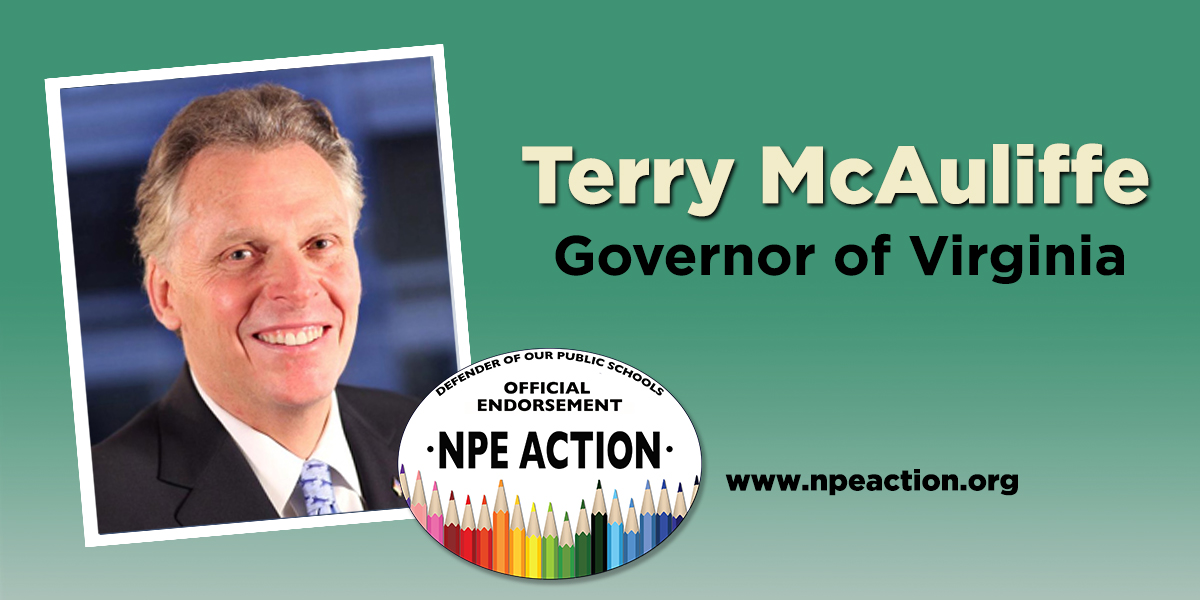
If you live in Virginia and care about your public schools, please vote for Terry McAuliffe for Governor!

The Network for Public Education Action has endorsed Terry McAuliffe for a second term as the Governor of Virginia.  

McAuliffe previously held the office from 2014-2018. In 2017, NPE Action named then Governor McAuliffe a Champion of Public Education for vetoing a group of bills that would have advanced privatization in Virginia. The bills he vetoed not only would have expanded charter schools and virtual schools, one would have established Education Savings Accounts (ESA), the worst of the  voucher programs. 


McAuliffe’s 2021 opponent, Republican Glen Youngkin, has proposed spending $100 million to increase the number of charter schools in the state.

McAuliffe’s opposition to school choice measures has remained unchanged.  His plan to improve public education in the state is to increase funding to $2 billion per year. He intends to use that funding to raise teacher pay above the national average for the first time in Virginia’s history and to expand access to pre-K for 3-4 year olds. In stark contrast to his opponent, who is creating unrest in the state by inflaming parents to rail against the supposed teaching of Critical Race Theory (CRT) in schools, McAuliffe has a plan to create an Equity Commission that will be charged with identifying the racial and socioeconomic gaps students face in the state.

We strongly encourage our supporters in Virginia to vote for Terry McAuliffe in the general election on Tuesday, November 2nd.  Please take a moment to share our endorsement in this critical election. https://npeaction.org/terry-mcauliffe-for-virginia-governor/

Mayor Bill De Blasio announced that the city would eliminate the entry test for the city’s “gifted and talented” programs, administered to four-year-olds. The children who make the cut are disproportionately white and Asian. He wants all children to have accelerated programs.

However, the Mayor has only a few months left in office, and his decision may be reversed by the new mayor, who will likely be Eric Adams, the Democratic candidate, a former police officer who has shown little interest in education, and who was funded by charter billionaires..

Instead of having a specific gifted program sorting a small number of children, all kindergarten students attending the city’s 800 elementary schools next September will receive “accelerated” instruction, city officials said Friday. Starting in third grade, all students will be screened to determine if they should continue to receive accelerated instruction in specific subjects.

“The era of judging 4-year-olds based on a single test is over,” Mayor Bill de Blasio said in a statement. “Every New York City child deserves to reach their full potential, and this new, equitable model gives them that chance.”

At least, that’s the mayor’s plan. It is an open question whether the changes will ultimately get implemented.

De Blasio has about three months left in his term and Democratic candidate Eric Adams is widely expected to replace him. Adams has offered a much different vision for the coveted gifted programs, proposing instead to keep the admissions test and add more gifted classrooms in communities across the city…

Currently, about 2,500 kindergartners a year score seats in 80 schools to the highly selective program, with many families — with and without means — spending time and money to prep their preschoolers for the exam. Many advocates and parents have blasted the test, which is administered one-on-one to children when they’re about 4, for resulting in a system that largely excludes Black and Latino students. They fill only 14% of gifted seats, but make up nearly 60% of kindergartners citywide.

Be sure to open the linked article by a teacher who has administered the test to four-year-olds.

The American Prospect publishes two of our nation’s most thoughtful commentators: Harold Meyerson and Robert Kuttner. They represent liberalism at its best; they are on the side of working people, and they aim for a fair and just society. Nothing “neo” about them. You might want to sign up for their “On Tap” bulletins.

Here is Harold Meyerson, with news about the union that is reviving the strike as a way to gain better wages and hours.

Meyerson on TAP


The Little Union That’s Reviving the Strike


The roll call of unions that have actually changed the trajectory of American labor is relatively short: the United Auto Workers, the Mine Workers, and other CIO unions in the 1930s and ’40s, as factory workers organized; AFSCME and the American Federation of Teachers in the 1960s and ’70s, as unions took hold in the public sector.

Today, a much smaller union, punching way above its weight, is vying to join that list. After 40 years in a desert of union decline, workers’ ultimate weapon to win what’s rightly theirs—the strike—looks to be coming back, a long-overdue development that I discuss and analyze in some detail in my article on the Prospect website today. In that piece, I note that 2021 is beginning to look like 1919 and 1946, the years in which America experienced its greatest number of strikes. To be sure, today, with the private-sector rate of unionization reduced to less than 7 percent, most of the striking is individual rather than collective: employees refusing to return to their old poor-paying no-benefit jobs, creating a worker shortage that has compelled such anti-union behemoths as Amazon and Walmart to raise their employees’ wages. In tandem with this new form of individualized collective bargaining (ours is a time that requires oxymorons), unions themselves are beginning to strike, a phenomenon not seen ever since Ronald Reagan busted the air traffic controllers union when it went on strike in 1981.

And the union leading the charge today is the BCTGM, the Bakery, Confectionery, Tobacco Workers and Grain Millers Union, founded in the same year as the American Federation of Labor: 1886.

You’re forgiven if you haven’t heard of the BCTGM, but they’re the folks who put breakfast on your table, bread in your sandwich, and candy in your kids’ time-to-see-the-dentist mouths. This year, though, they’re also the folks who are restoring a needed level of strategic militance to American labor. In July, protesting the crazy hours they were compelled to work (in some cases, up to 84 hours a week), their members struck a Frito-Lay plant in Topeka. The following month, members struck five Nabisco factories across the nation, also to protest the plethora of hours and the dearth of benefits. They’ve done a bang-up job of pressuring those corporations to grant their workers’ demands, by both striking and publicizing the absurd schedules and conditions their members were compelled to endure.

Now, this week, BCTGM members have struck every Kellogg factory in the United States, after negotiations over schedules and benefits had produced no results. Kellogg workers have documented how they’ve been compelled to work straight through the weekend, and how some have had to work 12-to-16-hour days to keep turning out those Frosted Flakes.

Though I’ve been writing about unions for the past 40 or so years, this is the first time I’ve written anything about the BCTGM. I can tell you that since this spring, the union has had a new president, Anthony Shelton, but I can do no more than infer that this may have something to do with the union now having to produce more picket signs.

But I do know that this outburst of militance has a lot to do with the same factors that produced the strike waves of 1919 and 1946. Those were the years following the two world wars, of course, when the words “front line” still meant exposure to deadly fire. Today, as the pandemic (we hope) recedes, it refers to workers who had to show up every workday and risk contracting a potentially fatal virus. In all three cases, those workers were hailed as heroes, and in all three cases, most of the jobs to which they either returned or continued to hold offered pay and working conditions that were anything but heroic.

So—strikes then and strikes now. And this time around, with the bakers leading the way.


~ HAROLD MEYERSON

A friend in Boston recently described New Hampshire as “the Florida of the North.” Clearly, she wasn’t referring to climate but to retrograde politicians.

New Hampshire is one of those states, like Florida, that has decided to minimize the significance of COVID. Actions have consequences.

CONCORD — A House member is claiming she was infected with COVID19 at a sub-committee meeting last week.

Rep. Nicole Klein Knight, D-Manchester, in a posting on Twitter Friday morning, said she was infected and in turn has infected her family and she blames House Speaker Sherman Packard for allowing sick members to participate without masks.

Her Twitter posting reads, “I’m positive for covid. Most due to the fact the @NHSpeaker allowed sick members to participate unmasked and come into contact and furthermore did not notify me, I since infected my entire family. If there is any legal action I can take I would appreciate help.”

Packard has insisted committees meet in person and has not allowed members who believe their lives would be at risk to meet remotely rather than physically appear at the State House or Legislative Office Building.

Democrats have pushed for remote access since the session began in January. Remote access to committee meetings was allowed this spring, but once meetings began again this fall, Packard said members would have to attend committee meetings to participate and to vote.

A number of disabled or health compromised Democrats including House Minority Leader Renny Cushing, D-Hampton, sued the Speaker seeking to participate in House session remotely, but lost the initial ruling in US District Court. That decision was overturned by the 1st Circuit Court on appeal and sent back to US District Court to determine if the House members qualify under the Americans with Disabilities Act and the Rehabilitation Act for special accommodations.

The Speaker asked the appeals court to reconsider and another hearing was held with a three-judge panel, but no decision has been released to date….

“I feel like I don’t have a right to be protected,” Klein Knight said, “the Speaker has made it impossible to protect myself.”

“This could wipe out my whole family,” Klein Knight said, “and the least the Speaker could do is notify me.”

Jeannie Kaplan, a former member of Denver’s elected school board, has warned for years about the subversion of Denver’s school election by well-funded, out-of-state “reformers.” Their money makes it difficult for ordinary citizens to run for the school board.

In this post, Jeannie reports that Dark Money is back and is prepared to fund candidates who support charter schools and other elements of the failed “reform” agenda. She has identified the groups that act as pass-throughs for Dark Money, she has tallied the total (to date) of $360,000, but it’s usually impossible to identify the original source of the money.

Katherine Kozioziemski tells the sad story of her bad experience with a charter school that promised the moon, but turned into a grand financial scam. Her post appears on a new site sponsored by the Network for Public Education called “Public Voices for Public Schools.”

She begins:

I knew something was seriously wrong as soon as I saw the budget of the charter school my kids attended. As a member of the school site council, I was on the budget committee. Now, as I looked at the numbers, I could see for myself how dire the situation was. The school was paying five times fair market value to lease a property from a shell company created by the former CEO of the charter management company. We were on a fast track to bankruptcy.

How did a charter school created by parents and teachers morph into a series of shell corporations and a money-making scheme so complex that the Securities and Exchange Commission would ultimately step in? The story begins nearly two decades ago with budget cuts. Like districts all over California, the Livermore schools had been forced to make deep cuts, including shuttering two beloved magnet schools. The Livermore Valley Charter School, which opened in 2005, emerged from a grassroots desire to provide art, music and science—all of the things our district schools were being forced to eliminate.

To me it sounded like the promise of Disneyland: a private school education at a public school price. While classes in the public schools had 25+ kids in a class, the charter would cap its class sizes at 20. I bought into it–hook, line and sinker.

Within a few years after opening, the K-8 school was in financial freefall. That’s when the CEO proposed an ambitious plan that would not just save the school but create a high school as well as acquire two additional schools in Stockton. By the time my son started at Livermore Valley Charter in 2012, I was already hearing whispers about the company that now ran the school: Tri Valley Learning Corporation. By 2015, when my kids were in kindergarten and third grade, signs that something was seriously awry were impossible to ignore.

Open the link to read the rest of this shocking story.

Ashley Parker writes for the Washington Post. She wrote this ominous article.

A year before the 2020 election, about two dozen constitutional scholars and democracy advocates traveled to Washington to work through a range of scenarios where something goes awry on Election Day.

The country’s political system was being tested by a campaign like no other in modern history, with an incumbent president, Donald Trump, who showed little regard for the democratic traditions and constitutional norms that had guided his predecessors — and who repeatedly claimed that the only way he could lose was through rampant fraud.

So the group considered a slew of hypothetical catastrophes: “What do we do if a vigilante group takes over a major county tabulation facility and burns it to the ground? What do we do if there is a military coup?” But, as Tammy Patrick, a senior adviser to the elections program at Democracy Fund tells it, the experts were too quick in retrospect to dismiss the outrageous as unlikely to happen in a country like the United States.

“Either we were not creative enough or the norms of civility our nation has seen over centuries were not reliable enough,” said Patrick, a former elections official in Maricopa County, Ariz.

The challenges for American democracy were on stark display almost exactly two months after Election Day, on Jan. 6, when a violent mob of Trump supporters mounted a deadly insurrection on the U.S. Capitol. And the challenges have been clear in the eight months since the riot, as Trump and his allies have intensified false claims of election fraud and the former president has remained the Republican Party’s most popular leader.

Now, as Trump looks and sounds increasingly like he intends to mount a presidential campaign rerun, Democrats and democracy experts are grappling with what such a campaign — and a potential second Trump presidency — would mean for the country.

In recent weeks, Trump has maneuvered to firmly establish himself as the predominant and most powerful figure in Republican politics. He has injected his voice into federal and state campaigns, endorsing several secretary of state candidates who embraced his false fraud claims and worked to overturn the results of the 2020 election. And while still banned from Twitter, he has issued a flurry of angry tweet-like statements through his political action committee.

He has also reemerged at rallies, appearing last Saturday in Perry, Ga., with another rally planned for Oct. 9, at the Iowa State Fairgrounds in Des Moines. Speaking in Perry, the former president promised to “make America great again” and called for “an earth-shattering win in November 2022,” before looking ahead to the next presidential election.

“We’re not forgetting 2020,” Trump said. “The most corrupt election in the history of our country. Most corrupt election in the history of most countries, to be followed by an even more glorious victory in November of 2024.”

In some ways, the concerns among Democrats, constitutional scholars and democracy advocates about what the return of Trump could mean are simply one side of a coin, with Trump supporters representing the flip side.

A majority of Republicans still support Trump leading their party, according to polls. A CNN poll released in September found that 68 percent of Republicans and those who lean Republican say democracy is under attack, with about 7 in 10 of them believing that President Biden didn’t win the 2020 election. One side’s nightmare scenario — Trump running in 2024 and reclaiming the presidency — represents to the other side simply the democratic system working as it should.

The threats to democracy that Trump critics envision are largely twofold.

One real risk, they say, is that four years after the failed Jan. 6 insurrection, Trump and his supporters emerge in 2024 more sophisticated and successful in their efforts to steal an election.
“For me, the scary part is, in 2020, this was not a particularly sophisticated misinformation or disinformation campaign,” said Matt Masterson, who ran election security at the Department of Homeland Security between 2018 to 2020. Referring to some of the outlandish conspiracy theories of ballot fraud posited in the wake of the 2020 election by Trump’s allies, he added: “We’re talking about bamboo ballots and Italian satellites and dead dictators.”

In the future, Masterson said, these sorts of falsehoods are going to become more advanced and nuanced — exploiting genuine areas of confusion in the electoral system — and thus harder to combat.

Masterson pointed to the recall election in California earlier this month, in which Trump and the leading Republican candidate, who ultimately lost, both baselessly claimed fraud before the election even took place. The very existence of these false allegations of rigged and stolen elections erode trust in the democratic process and are also likely to become the norm going forward, he added, because of a growing “cottage industry of election delegitimization and pre-delegitimization.”

Newly revealed details of a memo written by John Eastman, a prominent conservative lawyer who worked with Trump in the weeks before the Jan. 6 insurrection, show that efforts to subvert the results of the 2020 election were more brazen than previously known. In the memo, first disclosed in “Peril,” the new book by Washington Post journalists Bob Woodward and Robert Costa, Eastman described the vice president as “the ultimate arbiter” of election results and argued that Vice President Mike Pence had the authority to simply toss out the electoral college votes of certain states, thereby clearing the way for a Trump victory. “Pence then gavels President Trump as re-elected,” Eastman wrote.

The second possible scenario experts envision is more insidious, they say, a sort of slow-boiling frog of American democracy. In this case, Trump — or an acolyte with similarly anti-democratic sensibilities — runs and wins legitimately in 2024, emerging newly emboldened and focused on retribution. Then, the new president, intent on strengthening his own position and punishing critics, begins remaking the political and electoral system, using legal means to consolidate power and erode democratic institutions.

“We often think that what we should be waiting for is fascists and communists marching in the streets, but nowadays, the ways democracies often die is through legal things at the ballot box — so things that can be both legal and antidemocratic at the same time,” said Daniel Ziblatt, a professor at Harvard University and the co-author of “How Democracies Die,” who is working on a successive volume. “Politicians use the letter of the law to subvert the spirit of the law.”

Perhaps the most relevant modern example, several democracy experts said, is Hungary under the rule of Prime Minister Viktor Orbán, who returned to power in 2010 after a previous stint as Hungary’s leader about a decade before.
Tucker Carlson — who regularly articulates the intellectual heart of Trumpism — traveled to Hungary in August to broadcast his prime-time Fox News show from there, at one point lauding Hungary as “a small country with a lot of lessons for the rest of us.”

Upon taking power in 2010, Orbán “has steadily chipped away at the linchpins of a liberal democratic system,” said Michael Abramowitz, the president of Freedom House, a nonpartisan, pro-democracy organization.

“He stacked the courts, he engaged in gerrymandering, he had friends and allies take over the media,” Abramowitz said, referring to Orbán. “So while he has elections, they start from a very, very stacked deck. While it’s not impossible, it’s going to be very, very difficult for him to be dislodged in the normal democratic system.”

The U.S. Constitution, with its protections of free speech and a free press, as well as its prohibition on anyone winning the presidency more than twice, offers a guiding document for preserving democracy. But Trump, during his four years in office, made clear that he wished he had the powers of a monarch or a strongman, repeatedly flouting the nation’s long-held rules and norms.
And he exposed the limits of the system.

Trump, for instance, installed a number of acting Cabinet secretaries when he could not win Senate confirmation for his picks; made clear he expected the attorney general to act as his own personal lawyer rather than represent the interests of the United States; implied that the Supreme Court justices he nominated should rule in his favor out of personal loyalty; and tried to leverage U.S. foreign policy to influence his own political fortunes — resulting in the first of his two impeachments.

A number of traditionally apolitical and nonpartisan federal agencies, too, became embroiled in politics and controversy during Trump’s tenure, including the Centers for Disease Control and Prevention, the Food and Drug Administration, and the National Oceanic and Atmospheric Administration.

Tim Snyder, a history and public affairs professor at Yale University, agreed that the modern parallels between the United States and Hungary are striking.

“What we’re looking at is actually the typical way that democracies are undone,” said Snyder, who is working on an updated graphic edition of his book, “On Tyranny.”

Asked to respond to the notion that Trump represented a threat to democracy, Trump’s spokeswoman, Liz Harrington, sought to level the same allegation against the current president. “Biden has thrown away our sovereignty at his open border, issued unconstitutional decrees to private companies, and humiliated the United States in Afghanistan,” she said, reiterating Trump’s false claim that the election was rigged to say that Biden and his party “continue to threaten our very constitutional republic.”

Indeed, Freedom House’s Freedom in the World 2021 report gave the United States a score of 83 — alongside countries such as Mongolia and Ghana — marking an 11-point decline from its score of 94 a decade ago, when it appeared alongside established democracies like France and Germany. Freedom House’s scores are on a scale of 0 to 100.

But Arizona Secretary of State Katie Hobbs (D), whose own state has been on the front lines of post-election fights spurred on by Trump’s baseless claims that the election was stolen, said that Trump’s behavior while in office — from potentially using the presidency to enrich his own family to smashing through other traditional guardrails — raises concerns that a 2024 Trump victory could lead to a newly fortified and shameless president, eager to further upend democratic norms.

“All these other things that are just not the normal ways that we operate as a country, that are parameters that elected officials are held to — he never was,” Hobbs said. “And the fact that there’s been a lack of accountability for any of that and then, in fact, potentially rewarded by being reelected is highly, highly problematic.”

Experts said that perhaps the most precipitous recent threat to American democracy, however, remains Trump’s election claims.

“Democracy depends on the belief of losers in a given election to trust the process, and to marshal support so they can win another day,” said Nate Persily, a professor at Stanford University and co-director of the Stanford-MIT Healthy Elections Project. “If we have entered a phase where the process is simply not trusted, that is a dangerous situation to be in, where people do not trust elections as being the way that we replace authority.”

A number of Republicans have used Trump’s false claim as a catalyst for overhauling election and voting laws, even in states where the 2020 election ran smoothly. At least 250 laws being proposed in at least 43 states would limit mail, early in-person and Election Day voting, changes that Democrats say could especially disenfranchise minority voters. There are also some Republican-led efforts pushing to allow state legislatures to overturn election results.

“I do hear from the community and faith leaders the concern that we’re losing the ground we gained through literal blood and tears and death during the civil rights movement and so many struggles, that we’re backtracking,” said Harris County Judge Lina Hidalgo, the top elected official in Texas’s largest county.

Michigan Secretary of State Jocelyn Benson (D) said she is ultimately “optimistic” because despite “extreme pressure in 2020,” the efforts of elected officials such as herself to protect democracy and ensure free and fair elections ultimately prevailed. Yet she, too, said that the future “effort to undermine democracy” is likely to “be back in a way that is smarter, stronger, probably more organized, perhaps even more intense and better funded than ever before,” and pointed to the new voting laws as one of the challenges.

Unlike after Watergate, however, no clear or sustained effort exists to broadly protect democratic institutions as the nation hurtles toward the uncertainty of the 2024 presidential election. Ziblatt, the co-author of “How Democracies Die” — a book Biden carried around in 2018, scrawling notes in the margins and dog-earring favorite passages — suggested that some reforms are probably necessary to protect U.S. democracy going forward.

“These are soft guardrails that have constrained politicians in the past, and what the Trump administration has made clear is that we need to harden those guardrails,” Ziblatt said.
But, he added, he worries that some are still too squeamish to come to terms with the potential threat U.S. democracy faces if Trump attempts to regain power.

“If you look at how democracies get in trouble in other places, it’s how executives once in office abuse their office, and I think people just don’t want to think that Trump could get back into the presidency,” Ziblatt said. “There’s a way in which we’re not trying to think of the worst-case scenario, which is Trump gets reelected, but I think what we’ve learned is you have to prepare for the worst-case scenario.”


Scott Clement contributed to this report.

Spencer Bokat-Lindell, a staff writer at the New York Times, echoes growing fear that democracy in America is at risk.

He writes:

Nearly nine months after rioters stormed the U.S. Capitol to stop the certification of the 2020 presidential election, a question still lingers over how to place it in history: Were the events of Jan. 6 the doomed conclusion of an unusually anti-democratic moment in American political life, or a preview of where the country is still heading?

Richard L. Hasen, a professor at the University of California, Irvine, School of Law and an expert in election law, believes the second possibility shouldn’t be ruled out. In a paper published this month, he wrote that “The United States faces a serious risk that the 2024 presidential election, and other future U.S. elections, will not be conducted fairly, and that the candidates taking office will not reflect the free choices made by eligible voters under previously announced election rules.”

It could be a bloodless coup, he warns, executed not by rioters with nooses but “lawyers in fine suits”: Between January and June, Republican-controlled legislatures passed 24 laws across 14 states to increase their control over how elections are run, stripping secretaries of state of their power and making it easier to overturn results.

How much danger is American democracy really in, and what can be done to safeguard it? Here’s what people are saying.

How democracy could collapse in 2024

In Hasen’s view, there are three mechanisms by which the 2024 election could be overturned:

  • State legislatures, purporting to exercise the authority of either the Constitution or an 1887 federal law called the Electoral Count Act, swapping in their own slate of electors for president, potentially with the blessing of a conservative Supreme Court and a Republican-controlled Congress.
  • Fraudulent or suppressive election administration or vote counting by norm- or law-breaking officials.
  • Vigilante action that prevents voting, interferes with ballot counting or interrupts the legitimate transfer of power.

These mechanisms are not outside the realm of possibility:

  • Recent reporting from Robert Costa and Bob Woodward revealed that the previous administration had a plan, hatched by the prominent conservative lawyer John Eastman, for former Vice President Mike Pence to throw out the electoral votes of key swing states on the basis that they had competing slates of electors. Next time around, “with the right pieces in place, (President Donald) Trump could succeed,” the Times columnist Jamelle Bouie writes. “All he needs is a rival slate of electoral votes from contested states, state officials and state legislatures willing to intervene on his behalf, a supportive Republican majority in either house of Congress, and a sufficiently pliant Supreme Court majority.”
  • On top of passing voting administration laws, Republicans have also recruited candidates who espouse election conspiracy theories to run for positions like secretary of state and county clerk. According to Reuters, 10 of the 15 declared Republican candidates for secretary of state in five swing states have either declared the 2020 election stolen or demanded its invalidation or investigation.
  • Skepticism of or hostility toward election administration is widespread among Republican voters as well, 78 percent of whom still say that President Biden did not win in November. That conviction, Reuters reported in June, has sparked a nationwide intimidation campaign against election officials and their families, who continue to face threats of hanging, firing squads, torture and bomb blasts with vanishingly little help from law enforcement. One in three election officials feel unsafe because of their job and nearly one in five listed threats to their lives as a job-related concern, according to an April survey from the Brennan Center.

“The stage is thus being set for chaos,” Robert Kagan argues in The Washington Post. Given a more strategically contested election, “Biden would find himself where other presidents have been — where Andrew Jackson was during the nullification crisis, or where Abraham Lincoln was after the South seceded — navigating without rules or precedents, making his own judgments about what constitutional powers he does and doesn’t have.”

Some experts worry about democratic backsliding even in the event of a legitimate Republican victory in 2024, Ashley Parker reports for The Washington Post. In such a scenario, Trump or a similarly anti-democratic figure might set about remaking the political and electoral system to consolidate power.

“We often think that what we should be waiting for is fascists and communists marching in the streets, but nowadays, the ways democracies often die is through legal things at the ballot box — so things that can be both legal and antidemocratic at the same time,” said Daniel Ziblatt, a Harvard political scientist. “Politicians use the letter of the law to subvert the spirit of the law.”

Experts told Parker that perhaps the most proximate example is Hungary under Viktor Orban, who returned to power in 2010 after being ousted in 2002 and over the past decade has transformed the country into a soft autocracy. Admirers of the country’s government include Tucker Carlson, who in August extolled it as a model for the United States, and the high-profile Conservative Political Action Committee, which will host its next gathering in Budapest.

Brian Klaas, a political scientist at University College London, believes there are many reasons — the threat of primary challenges against Republicans who defy “Stop the Steal” orthodoxy, gerrymandering, the influence of social media — that the Republican Party’s anti-democratic turn might not just continue but accelerate: “There are no countervailing forces. There’s nothing that rewards being a sober moderate who believes in democracy and tries to govern by consensus.”