Archives for the month of: December, 2019

The Mormon Women for Ethical Government issued a thoughtful and clear-eyed endorsement of impeachment.  After listening to the impeachment debate, where every Republican claimed that Trump did nothing wrong, that the issues were trivial, that the process  was illegitimate, that it was….blah, blah, blah, it is refreshing to read a commonsense explanation of why impeachment of a lawless president is necessary to protect our democracy.

Here is their statement:

We assert that our most sacred civic expression is the casting of an individual vote. Any president or leader who forces political support and fails to honor and protect the free and legitimate elections on which our republic rests has lost the moral right to govern. By attempting to compel Ukraine to announce investigations benefitting only his re-election efforts, President Trump forced every American taxpayer to become an unwitting contributor to his political campaign and a supporter of his re-election.

Regardless of the behavior of any other political actor in either party, the president of the United States is never justified in bringing our common resources and might to bear against a political rival. As an organization committed to the defense of ethical government, we feel an urgent need to speak in defense of our norms and institutions. The House of Representatives produced the required articles, following procedures previously established, and voted through a legislatively approved process. They have fulfilled their constitutional obligation.

When presented to the Senate, these articles deserve a full and fair trial with impartial jurors, conducted as required by the Constitution. Even in an era of polarized partisan politics, truth is discernible and powerful. The Senate must resist all impulse to reduce this process to gamesmanship and theater and instead must pursue truth by compelling testimony from the actors at the heart of this inquiry. The president himself must honor his sworn duty to uphold the law by providing the documents Congress has subpoenaed and instructing his staff to testify. If he is innocent, their testimonies will be exculpatory. Subversion of this process, regardless of outcome, represents a subversion of justice.

At MWEG we are committed peacemakers. However, we recognize that true peace is not an absence of conflict. Rather, it requires, as Dr. Martin Luther King Jr. taught, a courageous defense of truth and justice. Some argue that an impeachment process must be bi-partisan before it is legitimate. Some say that without Congressional Republican support, investigating the president would be too divisive. We reject this argument as one devoid of moral authority. Peace cannot be purchased so cheaply. Effective leadership does not sacrifice truth and principle on the altar of consensus. Instead, it gives voice to truth and lends courage to those who are fearful. Our nation is truly indivisible only when there is liberty and justice for all.

While we speak to all of our fellow citizens and elected officials, we call specifically upon our co-religionists Senators Mike Lee (R-Utah), Mitt Romney (R-Utah), Mike Crapo (R-Idaho), and Tom Udall (D-New Mexico) to honor their oaths of office. We remind them that this oath qualifies them for service and was taken in the name of God. The oath of office does not require our representatives to protect the economy, their political party, their seat, their ambition, or even the president. It demands that those sworn to office will uphold the Constitution and fairly adjudicate on behalf of every citizen. We expect them to honor that oath, and we will hold them to account with our votes.

# # #

Mormon Women for Ethical Government (MWEG) is a nonprofit organization dedicated to inspiring women of faith to be ambassadors of peace who transcend partisanship and courageously advocate for ethical government. MWEG is not affiliated with or endorsed by The Church of Jesus Christ of Latter-day Saints. We do, however, fully sustain the leaders and doctrines of the Church.

NEW YORK — The Bloomberg Billionaires Index tracks the world’s 500 richest people on an almost continuous basis. 
The number and power of billionaires became an issue in the 2020 campaign, because both Senators Warren and Sanders have proposed a wealth tax aimed at billionaires to pay for their expansive social programs.

Bloomberg News updates the figures that feed its list after the close of every trading day at the New York Stock Exchange.

This is a list of the 500 richest people in the world. The list does not include Michael Bloomberg because the website he owns does not report on his wealth or political activities. If he were included he would be about #19 in the world with a net worth in excess of $50 billion.

Jeff Bezos was #1 until he divorced his wife and gave her $35 billion. Now he is #2  ($111 billion), almost tied with Bill Gates, who is #1 ($112 billion). The two are so close, they may change places on any given day.

Billionaires with less than $4 billion are not listed among the top 500 in the world. The list was copied on December 19, so the rankings may have changed slightly since then.

The three members of the Walton family–Jim, Alice, and Rob–are collectively worth more than $150 billion. They should pay their 1 million Walmart employees $20 an hour, which would do more to improve the lives of children than creating thousands of privately managed charter schools.

Charles Koch and his brother David’s widow, Julia Flesher Koch are each worth over $61 billion. Julia Koch is the richest woman in the world, a title she took away from Alice Walton, who is worth “only” $53 billion.

The Waltons, Bill Gates, Bloomberg, and the Koch family are major supporters of charter schools (and in the case of the Waltons and Koch, vouchers too).

Mercedes Schneider writes here about Betsy DeVos and her not-innovative idea of a “backpack full of cash.”

Betsy used the metaphor to refer snidely to a disguised voucher. It is a common metaphor among rightwing advocates of privatization. Betsy didn’t realize she was using the title of a popular documentary, shown in hundreds of communities across the country as a warning about privatization.

(If you want to book a screening of Backpack Full of Cash, go to the website.)

The film-makers, Sarah Mondale and Vera Aronow, borrowed the term from choice advocate Jeanne Allen of the Center for Education Reform, who has dreamed for years about defunding public schools by strapping the child’s cash in a backpack and sending the child to a charter school, religious school, cyber charter or home school, the less regulated the better. Anything will do for the backpack of cash except a public school.

Betsy didn’t know the etymology of the term but loved the idea of taking money away from public schools and giving it to any entrepreneur or grifter who wanted it.

Read the post to learn the not-sad fate of the rightwing’s favorite bad idea.

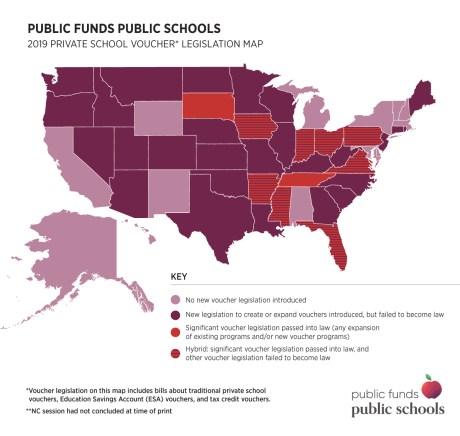
The Education Law Center created this graphic and explanatory information about the battle to keep public funds in public schools. The graphic shows the state of the voucher movement and identifies which states have advanced or repelled efforts to privatize public funding to religious and private schools via vouchers. It is heartening to see the number of states that rejected voucher legislation, especially when such legislation was defeated by a coalition of rural Republican legislators and urban Democratic legislators, as was the case in Texas and Arkansas. Thanks to all those who are joining forces to keep public funds in public schools.

pic1pic2

PRIVATE SCHOOL VOUCHERS: ANALYSIS OF 2019 STATE LEGISLATIVE SESSIONS
For a larger version and a text description of this map with a list of the states in each category, click ​here​.
In anticipation of states’ 2020 legislative sessions, this is the first in a series about the fate of private school voucher proposals during 2019 sessions.
Introduction
Despite the continued promotion of school privatization by U.S. Education Secretary Betsy DeVos, as well as support from a number of governors, legislatures, and well-funded advocacy organizations across the country, only two states enacted new private school voucher programs during their 2019 legislative sessions. Although some states expanded existing voucher programs, most passed no voucher legislation at all, and the majority of those that did made small-scale changes.
2019 Legislative Session Highlights:
  • Bipartisan majorities in Georgia, Kentucky, and West Virginia rejected voucher proposals supported by those states’ newly elected governors.
  • Although 22 states have full Republican control, only Florida and Tennessee were able to pass legislation creating new voucher programs in votes largely along party lines.
  • In Nevada, just a few years after the nation’s most expansive Education Savings Account (ESA) voucher law was passed, a new governor signed a bill repealing the program, which had never been implemented.
2019 Legislative Session Lowlights:
  • Tennessee passed a new private school voucher program, though it is limited to two counties.
  • Florida added yet another voucher program to the state’s existing voucher system.
  • Other states increased funding for their previously enacted programs, including Indiana and Iowa.
State Actions in Brief:
Arkansas
For the second consecutive legislative session, rural Republican lawmakers teamed with Democrats in a bipartisan effort to defeat legislation that would have created new school voucher programs. Proposals for a tax credit voucher and a traditional voucher were defeated. Although eligibility for the state’s existing ESA vouchers was modestly expanded, a bill passed requiring a biennial study that will provide lawmakers with important information to analyze how public funds are being spent in that program.
Arizona
Months after voters overwhelmingly rejected the 2017 expansion of the state’s ESA voucher program, legislators introduced a number of bills to again expand the program. Two of these bills passed out of relevant committees but were not taken up by the House or Senate. The remaining expansion bills did not advance, and a bill that slows the growth of tax credit vouchers passed into law.
Diverting public money to private education starves public schools of vital resources and does not lead to improved academic outcomes. For information about various types of private school voucher programs, visit the Public Funds Public Schools website. The PFPS website also highlights a wide range of research showing that private school voucher programs are an ineffective and harmful use of public funds.
Florida
Governor Ron DeSantis (R) signed Florida’s latest private school voucher plan, the “Family Empowerment Scholarship Program,” into law. This program will divert an estimated $130 million to private schools over the authorized period and will make vouchers available to middle class families earning up to $80,000 a year.
Georgia
Despite a new Republican governor who supports private school vouchers, voucher legislation failed in the State Senate. Six of the 13 Republican senators who represent rural areas of the state voted against the bill.
Indiana
Governor Eric Holcomb (R) signed legislation to increase funding for Indiana’s existing tax credit voucher program by almost 15% over the next two years. The legislation also increases the voucher amount for eligible families.
Iowa
Governor Kim Reynolds (R) signed legislation to increase the cap for Iowa’s existing tax credit voucher program by $2 million over the next two years. A bill to establish an ESA voucher was not considered by the full legislature.
Kentucky
Mobilization at the state capitol by educators standing up for public schools and several days of school sickout closures led to the defeat of legislation to create a tax credit voucher program. The Republican majority did not bring the bill up for a vote.
Louisiana
In Louisiana, a bill creating a “reading voucher” for public school students to use for private tutoring and other private uses passed the House but did not make it out of the Senate Finance Committee.
Mississippi
A bill to expand the state’s limited ESA voucher program was not voted on in the Republican-led House Education Committee. However, as the session was ending, the Lieutenant Governor included $2 million in new ESA funding in a bill to fund state construction projects.
Missouri
Bills to create a tax-credit-funded ESA voucher program were not acted upon before the legislative deadline.
Nevada
Governor Steve Sisolak (D) signed a bill formally repealing the state’s ESA voucher program first passed in 2015, and subsequently struck down by the Nevada Supreme Court. Additionally, a number of bills to create ESA vouchers for students deemed “victims of bullying” failed to advance in the legislature.
North Dakota
A bill that would have authorized a “school choice” study, including of ESA vouchers, passed in the House of Representatives but failed in the Senate.
Pennsylvania
Governor Tom Wolf (D) vetoed a major expansion of the state’s tax credit voucher program passed by the Republican-led legislature. The bill would have nearly doubled the amount that could be diverted to the program, included automatic annual expansions, and significantly raised the income limit for participating families.
South Carolina
Two bills were introduced in the legislature to establish an ESA voucher for students with disabilities. Both were referred to their chamber’s education committee, with no action taken by the legislature.
Tennessee
Governor Bill Lee (R) signed a law to establish an ESA voucher program. Concessions were made to rural Republican legislators in order to pass the bill, including limiting the program to the state’s two largest school districts and capping it at 15,000 students per year.
Texas
State leadership, including Republican legislators and the governor, did not include vouchers among their education priorities in 2019. In response to electoral losses in the suburbs and a lack of support for vouchers, legislative leaders emphasized improving the state’s public school financing system instead.
West Virginia
After a nine-day teachers’ strike in 2018, educators went on strike again, closing all but one of the state’s 55 county public school districts, to protest bills to allow charter schools and to create an ESA voucher program. The voucher bill did not pass during the regular session. Vouchers were again considered, but the program did not pass, during a special session on education legislation.
Resources
Acknowledgements
Many thanks to Jason Unger for compiling the research and drafting this series on 2019 legislative sessions.
Press Contact:
Sharon Krengel
Policy and Outreach Director
Education Law Center
973-624-1815, ext. 24

Peter Greene reveals here why he loves to read. What is reading for? It is utilitarian, to be sure. It would be impossible to make your way in the world without knowing how to read nowadays.

This post focuses on the author Rebecca Solnit, who writes about reading and its pleasures.

Greene writes:

It is easy in the ed biz to get caught up in things like the reading wars and test results and arguments about whether or not Pat can read and if not why not. And in our very utilitarian reformster-created status quo, some lapse far too quickly to the discussion of reading as a set of Very Useful Skills that will make children employable meat widgets for employers on some future day, and therefor we shall have drill and practice and exercises to build up reading muscles for that far off day.

“But let’s not kill the lifelong love of reading,” is a common reply, and one that I’m not entirely comfortable with. It’s fuzzy and reductive. I can love peanut butter and jelly, but that doesn’t really open any windows on the world; I don’t love science, but understanding it at least a little has enriched my world. The act of reading is wonderful in a sense, like looking through a pane of glass in an otherwise dull and impenetrable wall. It’s magical, yes– but what’s really uplifting and life-changing is what we can see on the other side.

The reading technocrats and pure phonics police are focused on the future, and even the lifelong love of reading camp is looking forward. Both run the risk of forgetting that reading is useful for children right now, this year, this minute, as a way of finding answers to fundamental questions– how does the world work, and what does it mean to be fully human, and how can I be in the world? Reading gives children access to answers beyond their own immediate experience which is always limited and all-too-often, as in Solnit’s case, severely limited by the control of adults who have trouble working out answers of their own. In the crush to provide reading instruction that will benefit children someday, we shouldn’t overlook the ways in which reading will benefit them right now. Both reading science and lifelong love camps stand at the window and say some version of, “Let’s look at this window. Let’s examine it and study it and polish it and enter into a deeper relationship with it,” while anxious children hop up and down on their toes and beg to look through it.

Solnit likes the wall metaphor. I’m fond of windows. You can pick your own favorite. I just want to argue that we not get carried away by either the desire to reduce reading instruction to hard science or fuzzy emotions, that we not forget that there’s an actual reason for children to read, and that the reason exists today, right now. Don’t get caught up on the trees in the larger reading forest. The children are small people, but that doesn’t mean they aren’t working on big questions. School should help.

After I read this post, I ordered Rebecca Solnit’s book as a gift for a grandson, who will love it.

Angie Sullivan is a teacher in a Title 1 elementary school in Las Vegas. She regularly writes the members of the Nevada legislature to share her outrage about the underfunding of the state’s neediest schools and the state’s waste of money on charter schools, which dominate the state’s list of the lowest performing schools.

Here is her latest:


Peter Greene in Forbes
Still Asleep At The Wheel 
What happened?  
Pile of fraud and graft.  
These charter titles got money and did what?   
This charter changed its name many many times.   It is difficult to follow its trail – 100, One Hundred, Imagine at different locations.   Is this graft? fraud?  Imagine still has a failing charter campus opened? What happened to the two additional campuses?  $300,000 disappeared with change in names and admin?   This is what lack of accountability and transparency does. 
What happened to the Montessori in Carson?   I believe it is still there – complaining about cash.  These charters worry me because they never have a testing year so zero data and zero accountability. This is what lack of accountability and transparency does.   They received funding but complain about no money and blame Vegas.  They may try to get the Silver State/Argent Building.   They do not serve the poor. 
Silver State Charter School changed its name to Argent and lost almost all its students.  Sounds like the receiver had concerns because no one attended the “distance” low performer school.  No one ever graduated.   As in zero.   Perhaps Joshua Kern knows where the $440,000 went?   No one graduated.  This is the first charter I have seen “closed” by the charter authority.  I do not think it had any students left and that is what actually closed it. 
School of the deaf went bankrupt.  Im surprised it did not go into receivership and just get more money like Quest, Silver State and others.  The Nevada Tax Payer pays millions to keep financially floundering  charters open. 
E-TECHS had a facebook and a twitter for $300,000.  This was in 2011 and they never opened?   What happened to the money? 
Gardnerville’s Sierra Crest closed in 2010.  Sounds like the local school board was not putting up with low quality.  What happened to the $172,000? 
Did Washoe Team A even exist at all?  Where did the $220,000 go?  
Nevada folks need to demand to see this money.   
If Nevada Senator Scott Hammond is hiding behind a non-profit management system – we need to know that too.    Managing 5 charters for free?  What kind of accountability and transparency is this?  
There needed to be a charter moratorium for good reason.   Rest in Power Tyrone Thompson who knew that.  Playing games like this with money when Nevada has none is crazy. 
We see you Gulenist Soner Tarim 👀 Agenda 4a.   How much money are you bringing to Nevada Strong?  Expert at getting grants and not opening?   Everyone should protest every Nevada Charter Meeting to close that Gulen Charter down.  Nevada does not need anymore scamming known bad actors. 
None of these December 2019 charter applicants should be granted anything.  These scams are too much. 
Asleep at the wheel and gone off the road and crashed into a ditch.  
This is bad. 
Angie Sullivan. 

The Network for Public Education recently released its second report on the federal Charter Schools Program, and the results are not pretty. It is titled Still Asleep at the Wheel: How the Federal Charter Schools Program Results in a Pileup of Fraud and Waste.

The report has received national coverage, in newspapers large and small.

The CSP was created in 1994 as part of the Clinton administration’s effort to spur innovation; at the time, there were only a few hundred charters. The CSP was intended to give struggling startups a financial boost. It was never intended to be a cushion for large, well-funded corporate charter chains, as it is today. The NPE review covers the years from 2006-2014 because no records were maintained by the U.S. Department of Education for the grants awarded from 1995-2005. (Unbelievable but true.) The current Department of Education kept the records for the years from 2015-2018 under wraps and released them only days before this report was published. In time, we will analyze them too, to see whether the track record of the CSP has improved. We expect to find large grants to corporate charter chains; large grants to charter advocacy groups; and large grants to states that neither sought nor needed additional charter schools (New Hampshire is a case in point; DeVos gave NH $46 million to double the number of charters in the state, and the legislative fiscal oversight committee reviewed the grant and rejected it after determining that it would endanger the state’s public schools, especially at a time when school enrollments are dropping. The state board of education in Michigan sought to reject a charter grant from CSP but the state attorney general ruled that the state must take the money whether the state board wants it or not. We will see how that turns out.)

To prepare this report, NPE staff pored over the federal data for each state. They found that 37% of the charter schools that won CSP funding either never opened or closed soon after opening. Fully 11% of the federally funded charters never opened at all. Of the schools funded between 2006 and 2014, $504 million was wasted on these failed charters. That is 28% of the total awarded. Applying that percentage to the total expenditures ($4.1 billion) during the 25-year life of this federal program, we estimate that about $1.17 billion in federal funds were wasted on charters that either never opened or opened and then closed.

Based on the findings of this report, NPE recommends that Congress terminate all new grants for this program, which we have shown to be wasteful. Numerous private foundations, such as the Walton Family Foundation, provide ample private funding for new charters and charter expansion. Federal aid is not needed, and when available, is misspent. Congress should continue to fund only the grants awarded to legitimate projects. Once those grants have been closed, we recommend that CSP be terminated, and that existing charter schools continue to receive federal aid through the customary programs such as Title 1 and IDEA. As the report concludes, “students, not charter school entrepreneurs, should benefit from federal funds.”

There has been much chatter on Twitter about who funded this report. Here is the answer: It was funded by the many small contributions of thousands of supporters of the Network for Public Education. It was written by NPE Executive Director Carol Burris, with research assistance by Darcie Cimarusti and Marla Kilfoyle. They are the hard-working, amazing staff of the Network for Public Education.

See the summary here.

See the full report here.

This set of directions was tailored for me because ProPublica has my zip code. If you sign up with your zip code, ProPublica will tell you what your member of Congress is doing.


A User’s Guide to Democracy

LESSON #2: WHY CONGRESS SEEMS SO STUCK
Hi there,

Today, we’re going to talk about the biggest job Congress has: lawmaking.

Made up of the House of Representatives and the Senate (which together are theoretically co-equal to the presidency), Congress is tasked with making laws on our behalf. I learned what Congress does back in elementary school social studies (supplemented with Saturday morning “Schoolhouse Rock”). In an ideal world, here is how the system should work:

  1. A senator or representative introduces a bill.
  2. The bill goes to a committee for hearings and approval.
  3. It is debated and voted on from the House and Senate floors.
  4. A compromise version is worked out.
  5. The resulting bill is voted on to become a law.

Ta-da!

These days, that’s not how it works most of the time.

Congress does pass a lot of bills through the legislative process. But these are mostly noncontroversial: bills to congratulate someone, rename a post office or designate a national week. There’s no debate and no deliberative, committee-driven process required.

When it comes to the legislation you do hear about — big, politically contentious things like immigration, health care and taxes — the process hasn’t been working as planned.

Why does Congress seem so stuck?

One reason for the gridlock is that, these days, bills on big, national issues are written under the supervision of party leadership: the Senate majority leader and the House speaker. They receive guidance from only a small group of other congressional power brokers, rather than the rank-and-file lawmakers who used to contribute to the process.

Most bills, in fact, move under a process that bars amendments and debate — meaning that the average member of Congress is sitting around waiting for his or her party leadership to emerge from behind closed doors and instruct them how to vote.

That legislation is then presented as a “take it or leave it” deal when it’s voted on by the full Congress, and, faced with bills on which they’ve had no real input, many members opt for “leave it.” Without enough support to pass a nearly evenly divided Congress, these bills get stuck in legislative limbo. For example, immigration is one of the biggest flashpoints in domestic politics, but over the past several years Congress has held only a couple days of debate on destined-to-fail proposals. None of the bills offered in the Senate could gain the 60 votes needed to advance because the proposals mainly appealed to one party, and there was little room to amend them to make them more palatable.

Where does your lawmaker fit into all of this?

One of the ways you can find out what Rep. Velázquez is up to is by checking out the bills she has sponsored. This is all public information, and ProPublica’s Represent app can help you navigate to the information that matters to you.

Fun fact: Representatives who sit on the Appropriations Committee, which determines government spending, tend to have fewer bills than other lawmakers. That’s because this committee tends to produce bills as a group project, with only the committee chair (currently Rep. Nina Lowey) named as a main sponsor.

To understand your representative through their bills, you want to look for three things:

1. What the bill is about: Think about the things that matter to you and your community, and ask yourself:

  • Is your representative sponsoring bills on those topics?
  • If your lawmaker seems to be ignoring your issues, why is that?

2. How far it got: Every bill that gets introduced is automatically referred to a committee. Many measures never get past this stage and were never intended to — because they are mostly meant to let lawmakers go to town halls and say, “I introduced an important bill.” But virtue signaling is not enough for those of us who want to see things get done. That’s why we’re looking only at recent bills that made it beyond the introduction stage. Of the 49 bills she has sponsored, 11 of them have made progress beyond the first step.

3. Who else is supporting the bill: When it comes to bill co-sponsors, pay attention to whether or not it has bipartisan support. Whether you want a lawmaker who’s willing to compromise with the other side, or whether you object to compromise as a sign of giving in to the other side, bipartisan support can mean that your representative has done some work to shop her bill around and help get it passed.

Here’s what Rep. Velázquez has been up to.

Dig in and take a look at the bills she has sponsored during this term. (I’ll wait.)

Bill Cosponsors [R/D/I] Latest Action
HELLPP Act (H.R.2235) 98 [28/70/0] (2019-04-10) Referred to the Subcommittee on Health.
Gun Violence Prevention Research Act of 2019 (H.R.674) 98 [1/97/0] (2019-01-25) Referred to the Subcommittee on Health.
Horse Transportation Safety Act of 2019 (H.R.1400) 97 [4/93/0] (2019-02-28) Referred to the Subcommittee on Highways and Transit.
Recognizing the duty of the Federal Government to create a Green New Deal. (H.RES.109) 97 [0/97/0] (2019-02-12) Referred to the Subcommittee on Energy and Mineral Resources.
Fairness for Federal Contractors Act of 2019 (H.R.824) 96 [6/90/0] (2019-01-28) Referred to the Committee on Appropriations, and in addition to the Committee on Oversight and Reform, for a period to be subsequently determined by the Speaker, in each case for consideration of such provisions as fall within the jurisdiction of the committee concerned.

Homework

Now that you’re familiar with the basics of using ProPublica’s Represent database, this week’s assignment is to look up the legislative work of your lawmakers in the Senate, too. What does it tell you about what they’re doing in your name?

And to learn more about the radically altered mechanics of Capitol Hill, read the ProPublica and Washington Post piece, “How Congress Stopped Working.

That’s all for this time. Thanks for rocking with me, and I’ll see you soon!

Cynthia Gordy Giwa
Proud ProPublican

P.S. Remember to tell me what you find by replying to this email or on Twitter at @CynthiaGiwa, and encourage your friends to sign up, too!

Vicki Cobb is a very successful author of children’s books and is active in promoting children’s interest in reading and in science.

She writes here about a wonderful FREE resource for children.

No catch.

Wonderful reading online at no cost.

She begins (open the link to read it all!):

In my recent post Why Education Should Always Be Nonprofit I examined some opportunities for corruption.  First, in the building of fortunes, like oil,  but also in the establishment of for-profit schools where money is siphoned off by realtors and administrators.  The product of education is not a commodity that generates enormous wealth,  like oil, but a human being who is capable of contributing to society.  So where’s the payoff for the individual for-profit investor in the school?  It’s certainly not in the production of educated individuals. Society at large benefits from that investment.

So I started a nonprofit organization to bring the work of the most talented children’s nonfiction authors to the classroom.  To that end, in 2014 we started publishing the Nonfiction Minute, a FREE daily posting of 400-word essays by top children’s nonfiction authors.  An audio file accompanies each Minute so that the more challenged readers have access to our content.  Millions of page-views later, we caught the eye of Paul Langhorst, the executive of SchoolTube.  And today, we have something new to celebrate:  We are launching The Nonfiction Minute Channel on School Tube.  Each post is the audio file of the author reading his/her Minute and is illustrated with art in a slide show.  Paul Langhorst, told me that teachers have been asking for more on quality reading and writing, so here we are. There are links on the School Tube post to the Nonfiction Minute archives so students can read the text of the Nonfiction Minutes if they are so inclined.   

Zeph Capo, president of the Texas AFT,  writes here about the state’s determination to take over the Houston Independent School District because ONE SCHOOL HAS LOW TEST SCORES.

The State has failed in other takeovers, and its only plan in Houston is to usurp the elected school board. Capo believes that the goal is to allow charter operators a free hand in the state’s biggest school district.

He writes:

“In a profoundly unbelievable decision, the state announced last month it will take over the entire Houston school district, the largest district in Texas, even though the schools have been showing remarkable progress. Either the TEA doesn’t know what’s actually happening on the ground hundreds of miles away or, more likely, it doesn’t care because it is anxious to deliver Houston’s 284 public schools to charter operators. If the state succeeds, other Texas school districts could be its next target.

”The TEA has a poor track record on state takeovers and other interventions. Take the Marlin Independent School District, about 100 miles from Austin. In late 2016, the TEA replaced the district’s board of trustees with state-appointed managers, who basically rubber-stamped the desires of the TEA. It’s been nothing but failure ever since, including a revolving door of managers, the suspension of the latest superintendent and the revocation of Marlin’s accreditation status for the 2018-19 year after failing state academic accountability standards. It could be TEA’s next takeover target.

”When the state’s takeover of North Forest ISD didn’t succeed, the district was folded into the Houston ISD, at a time when the Houston district had a higher number of “improvement-required” schools than it does now.

“The state wants to take over two other small districts now — Shepherd ISD in East Texas and Snyder ISD in West Texas — and we’re very concerned that it’s not the right solution, especially given the state’s inability to put in place an effective improvement plan.

”The state’s move is especially baffling because the state itself — not some outside group — just awarded the Houston public schools an academic accountability rating of 88: nearly an A. But to justify its long-held ideological desire to hand over the entire Houston district to charter and other private groups, the TEA is using the fact that one school was chronically underperforming as an excuse to take over the whole district.

”The takeover is a deliberate attempt to silence the voices of Houstonians, who, just two days before the takeover announcement, acknowledged problems with the local school board and voted for new members who could better address the needs of the district’s black and brown students. The seizure of the Houston ISD and school board violates democratic principles.

“From the very beginning, the Houston takeover has been about a political, not an educational, agenda. Charter schools and other forms of privatized schools often are foisted on takeover districts. However, research shows that over the past 30 years and after more than 100 takeovers in districts across the country, state takeovers have failed to deliver in places such as Detroit, Newark (N.J.), Philadelphia and New Orleans. Millions of students and thousands of communities around the country have been victimized by aggressive state and federal intrusion into their local public education.”