Archives for the month of: September, 2019


Cheryl Gibbs was not an activist. She just wanted to teach her children in a Virginia public school and ignore politics. But step by step, she realized that there was a coordinated attack on public schools. One thing led to another. She joined the union. She became a union rep. She became a BAT.

And when she retired, she became a full-fledged member of the Resistance. The Resistance fights privatization. It fights the replacement of experienced teachers by TFA and artificial intelligence. It fights for real education, real teachers, real public schools.

She begins:

When I began teaching twenty years ago, my activism was caring about children; loving them, helping them discover their most complete, healthy, and most fulfilled selves as they grew. I  read the mainstream news and voted. That was about the extent of it. 

I joined the union, like many teachers, to have the liability insurance that I knew a teacher might need when classes included at-risk and emotionally disordered students. When I was asked to be a union co-rep for my building, the promise was, “You only have to attend one meeting a month and fill-in when the “real rep” isn’t available.” I reluctantly agreed to serve.

Yet here I am. 

Voluntarily retired two years earlier than I planned; deeply embedded in BATs, participating in webinars with the Quality of Worklife Team; organizing marches and legislative actions, and planning workshops with the Virginia Educators United RedforEd Caucus; and campaigning for school board members and state legislators I think we can trust. 

Today, I am often asked by other union members and pro-school activists why more educators  don’t speak up, don’t act out, don’t defend themselves against the bullying and onslaught of attacks our profession has been under during the reform and privatization movement. 

The answers often seem obvious.

We don’t like confrontation:

It’s not our default. We prefer peace and collaboration. Our default is yes, not no. It takes a lot to push us to play offense.

We assume the best in others: 

It is impossible to believe someone could deliberately be attacking our work, our kids, our schools. We are well-intended. It’s hard to come to terms that others are not.

We are busy: 

Our jobs have been engineered to keep us so. Between 50 or more hours a

week as an educator, a second job for making ends meet, and family duties

when can we take additional actions? 

We are afraid: 

Afraid of losing our jobs, of losing our houses, of losing our kids’ health insurance, afraid of losing a career we trained long and hard for, afraid of losing our public dignity and credibility.

We don’t think we can win: 

The people who say we are at fault and our schools are failing (Yes, they are still saying that) are the intellectual elites, the thought leaders, the policymakers, the wealthy, our bosses. How can we ‘just teachers’ of kids stand up to their power, their influence, their affluence? 

So, often we find another way out. 

We just close our door and pretend there is no crisis.

We find a therapist or a friendly ear outside

We find a school with fewer high needs students

We look for a school with less toxic management

We move to coaching or counseling or administration

We leave education for another field

We  retire.

I thought all those things at various times across the last 20 years, particularly during the last 7 as my activism has escalated. I considered each of those paths and wound up retiring on my way to here. 

But none of those options really Solve the Problem, and the Problem is much bigger than just that my job is unpleasant or that my school is under funded and too often mismanaged.

The unfortunate truth is that I’m an activist today because step by step, watching my colleagues be targeted, watching schools be undermined and closed, watching systematic underfunding, and replacement of competent people with hobby teachers, watching the deliberate reduction of teachers of color in the system–  I came to realize, there is no other choice, and even worse there is nothing left to lose.

Our job protections have been dismantled. Most school employees can be fired at will with todays’ evaluation systems. Our salaries are below working class level. Our health plans and retirement plans are being gutted. Our credibility and respect in the community are already gone. And even sadder, our students are being stalked for death, stressed to the breaking point, and priced out of gaining access to professional success, and those of color are being moved systematically from school to jail. 

Individual personal solutions will not stop the destruction of our schools, or provide safety for us or our students. Pleasant and amenable collaboration will not satisfy the appetites of those who want to squeeze our schools for every penny and would distort healthy learning into a propagandized prison to get that last penny. 

Read it all.

She has joined the BATS and the Resistance, and she won’t give up.

Steve Miller writes in the Texas Monitor about the special protections provided by the law for charter schools. They claim to be public, they claim to be accountable, they claim to be transparent, but only when it suits their convenience.

Take the powerful IDEA chain, which has recently received over $200 million from Betsy DeVos’ personal slush fund called the federal “Charter Schools Program,” which currently spends $440 million of our taxpayer dollars to finance rapacious corporate charter chains.

IDEA has a private corporation that is neither accountable nor transparent.

IDEA Public Schools, for example, allows first class air travel for its employees and is looking into the lease of a private jet. But as long as it insists that the perks are being paid for with private funds, the expenditures are free from oversight, discovered only through deep dives into IDEA’s tax returns.
Charter schools and open records are “an enormous can of worms,” said Joe Larsen, a Houston public records lawyer. “It’s neither dog nor wolf — it’s kind of private and kind of public. The courts and the legislature keep grappling with it, as they want charters to have the advantage of a private entity to make more efficient choices.”
But, he said, the effort to allow charters the freedom to innovate also gives them more room to operate on the margins of transparency.
A public records dispute between a Pharr newspaper and IDEA, one of the state’s biggest charter operators, shows the divide.
In 2017, the Advance News Journal in Pharr asked for details of IPS Enterprises, a business created by IDEA. Charter officials refused to provide details and referred the request to the state attorney general’s office for a ruling. 
When that office said IDEA had to provide the records, the nonprofit sued AG Ken Paxton, citing a 2015 state Supreme Court ruling that found a nonprofit need only provide records related to businesses funded with public money.  And, IDEA said, IPS Enterprises is unrelated to the $400 million in public funding it receives.
IDEA won the lawsuit, and today no one knows much about IPS Enterprises, a for-profit entity that state records show is based at the same tax-exempt Weslaco address as IDEA. Records show IPS in 2017 received a $4.7 million contract from the U.S. Department of Education.
The newspaper never even considered suing IDEA for the records.
“We didn’t even get involved after they sued the AG,” said Advance Publishing publisher Gregg Wendorf. “They have way more money than us anyway.”


NEWS RELEASE:
For Immediate Release
| ctulocal1.org

CONTACT: Ronnie Reese 312-329-6235, RonnieReese@ctulocal1.org

Ninety-four percent of CTU members vote to authorize strike for schools Chicago’s students deserve

Chicago Teachers Union House of Delegates governing body will set strike date at Wednesday, Oct. 2, meeting.

CHICAGO, September 26, 2019—The Chicago Teachers Union this evening released totals of the Sept. 24-26 strike authorization vote. The CTU Rules and Election Committee reported that as of 9:30 p.m., the Union passed the 75 percent threshold of members voting “yes.” Ninety-four percent of teachers, clinicians, PSRPs, nurses, librarians voted to authorize a strike to win the schools Chicago’s students deserve.

The vote stands as a mandate from CTU members for Chicago Public Schools to uphold promises of equity and educational justice made by Mayor Lori Lightfoot, and that those promises must be in writing in an enforceable contract. This is the only way to hold the district to its word after decades of austerity, budget cuts, understaffing, school closings and privatization.

The CTU House of Delegates will convene for its next scheduled meeting on Wednesday, Oct. 2, to set a strike date. The earliest the Union could strike is Oct. 7. The work stoppage would be the third since 2011 and the first under Lightfoot.

“Our school communities are desperately short of nurses, social workers, psychologists, counselors and other support staff, even as our students struggle with high levels of trauma driven by poverty and neighborhood violence,” CTU President Jesse Sharkey said. “This vote represents a true mandate for change.”

“And all of our members vote, not just 30 percent of the electorate,” Sharkey said.

Facebook live stream

Bargaining Update

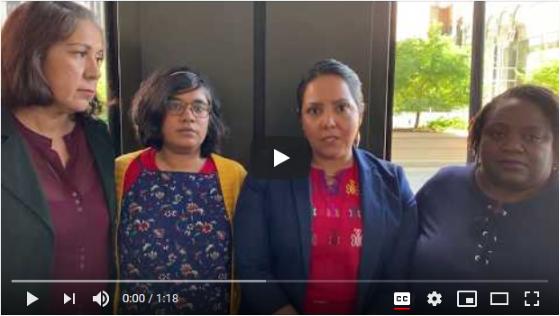
Rank-and-file members met with the district today to negotiate over early childhood and bilingual education provisions. They were sorely disappointed at the non-engagement from the other side. Watch their explanation in this video:

###

The Chicago Teachers Union represents nearly 25,000 teachers and educational support personnel working in schools funded by City of Chicago School District 299, and by extension, the nearly 400,000 students and families they serve. The CTU is an affiliate of the American Federation of Teachers and the Illinois Federation of Teachers and is the third-largest teachers local in the United States. For more information please visit the CTU website at www.ctulocal1.org.


Peter Goodman writes about education policy in New York City and New York State.

In this post, he tries to figure out whether NYC is about to double down on a “test and punish” regime or to seek collaboration.

He covers the bizarre City Council hearing about over-testing, where a top official of the NYC Department of Education announced the city’s decision to add four new off-the-shelf standardized tests to the school year to track student progress and to create a data tracking program called EDUSTATS to monitor student scores citywide, class by class.

At the hearing, chaired by Mark Treyger, a high school teacher on leave, the city described its plan:

Laura Chin, the # 2 at the Department of Education testified at the hearing and mentioned Edustats, the new Department initiative; Treyger pressed her on the program. The Department will require periodic assessments, the Executive Superintendents will review the results with Superintendents, and Chin described the process as similar to the New York Police Department (NYPD) Comstat system. Borough commanders meet with precinct commanders and review data, detailed crime statistics, and grill the precinct commanders: what have they done to respond to statistical increases in the crime data? Why isn’t it working? The precinct commanders despise the process: public shaming with the threat of job removal. While the precinct commander can move patrol cops from one area to another schools can’t prevent evictions or provide food for families or more racially integrated schools.

The Police COMSTAT Program led to many complaints that officers were “juking the stats”—gaming the system— to improve ratings, for example, by classifying felonies as misdemeanors.


Peter Greene fact-checked Betsy DeVos’s “back to school” speech at a religious school in Milwaukee and discovered that all of her facts were wrong. But facts, in DeVos’s worldview, are tiresome and unnecessary.

https://www.forbes.com/sites/petergreene/2019/09/17/betsy-devos-polly-williams-vouchers-and-selective-facts/

Perhaps most egregious was her paean of praise to Polly Williams, an African American state legislator who supported school choice until she realized she had been duped. DeVos ignores Williams’ change of heart and pretends that she was a true believer until the end. The reality in Milwaukee was that the voucher program was bankrolled by the far-right Bradley Foundation, which used Polly Williams. She eventually became disillusioned.

Peter Greene writes:

DeVos…chose to invoke Annette “Polly” Williams, the mother of school choice in Wisconsin. The Democratic politician and activist wrote the first school choice legislation in the country (adopted in 1989) and became a popular speaker on the issue, particularly to conservative audiences.

But Williams became disenchanted with the school choice movement. Her original legislation did not include religious schools, but was expanded to do so five years later. Williams took to calling the voucher program a “Catholic movement.” She expressed displeasure with some of the folks, like Lamar Alexander and Bill Bennett, who swooped in to speak. She accused leaders of exploiting black and poor families, and of leaving poor families behind with the program expansion. 75% of voucher recipients were not escaping the public system, because they had never been in it. She was critical of education measures taken by Governor Scott Walker, whose supporters have included the DeVos family.

Williams told an interviewer, “Our intent was never to destroy the public schools.” When accused of drifting away from the movement, she would reply, “I haven’t changed. The people around me have changed.”

It’s an odd choice for DeVos to invoke Williams, who seems to have viewed folks like DeVos as having hijacked the charter movement. But DeVos seems determined to launch, or at least lay a foundation for,a national voucher program, and she’s going to paint a favorable picture with whatever brush she has handy.


Valerie Strauss is not surprised yet disappointed that Betsy DeVos kicked off her “back to school tour” at a religious school in Milwaukee, flaunting her contempt for the vast majority of students who attend public schools. By doing so, she showed her agenda: privatization of public schools and transfer of public money to religious schools.

https://www.washingtonpost.com/education/2019/09/16/where-betsy-devos-started-her-back-to-school-tour-says-it-all-about-her-agenda/

It is ironic that she chose Milwaukee to demonstrate the benefits of school choice. Milwaukee has had choice for three decades: charters, vouchers, and a shrinking public school sector.

All three sectors are faring poorly. On the National Assessment of Educational Progress, Milwaukee is one of the lowest performing cities in the nation.  Students in religious schools, charters, and public schools are doing poorly.

Competition raised no boats. Milwaukee demonstrates the failure of school choice.

Betsy DeVos either doesn’t know or doesn’t care.


Cory Booker was recently interviewed by the Washington Post, and he was asked about his past support for vouchers and his friendship with Betsy DeVos. 

He insisted that he turned against vouchers in 2006, and he barely remembered any connection to DeVos. When someone asked if he had flown to Michigan in 2000 at the request of Dick and Betsy DeVos to support their voucher referendum, he at first denied it, then when shown a tape, he said he didn’t remember it.

He opposed DeVos’ nomination to be Secretary of Education in 2017.

DeVos’s allies are stunned by what they call his turnabout. They view Booker’s effort to distance himself from her and her agenda as a betrayal. 

Now that it is politically inconvenient, he has distanced himself from the issue and those who helped launch his political career,” said William E. Oberndorf, who was chairman of the American Education Reform Council when DeVos and Booker were on the board. “Cory once told me that his father used to say to him, ‘Never forget the girl who brought you to the dance.’ I can only conclude that Cory not only forgot one of the girls who brought him to the dance, he missed his . . . moment to stand up for an issue he always said he believed in.” 

Booker’s advocacy for vouchers won him the financial support of conservative Republicans who were delighted to see a black Democratic Mayor supporting their cause.

Booker’s political career took off as a parade of wealthy philanthropists, hedge fund managers and others who supported DeVos’s “school choice” viewpoint poured money into his campaigns and pet projects. 

In 2000, with their voucher referendum on the ballot, the DeVos family invited Booker to debate the legislative director of the ACLU. She kept a tape of the debate and shared it with the Post. The voucher proposal went down to a crushing defeat by 3-1.

In September 2000, Booker delivered a blistering pro-voucher speech to the Manhattan Institute, a conservative policy group. 

Booker’s 2006 race for mayor of Newark won the support of many conservative Republicans. He proposed tuition tax credits (a form of voucher) and went all-in for charters.

When he ran for the Senate in 2014 in a special election, he was helped by Jared Kushner and Ivanka Trump, who held a fundraiser for him.

As recently as May 2016, Booker appeared again before the group that DeVos chaired, the American Federation for Children. After DeVos delivered a speech defending herself against attacks from Democrats, Oberndorf warmly introduced Booker, praising his commitment to school choice.

Booker spoke proudly about the growing number of students in Newark’s charter schools, saying, “This mission of this organization is the mission of our nation. . . . I have been involved with this organization for 10 years and I have seen the sacred honor of those here.” 

As Booker finished his speech, the audience gave him a standing ovation. To DeVos and her allies, it seemed that Booker was still firmly in the fold, according to Oberndorf. 

But a year later, he opposed DeVos’ nomination.

Booker’s vote shattered his career-long alliance with DeVos and stunned her supporters. 

“Cory gained a great deal of political support thanks to his association with Betsy and other supporters,” said Mitchell, the president of the American Education Reform Council when Booker and DeVos were board members. “His abandonment of school choice and of Betsy makes it clear that his professed commitment to the issue and his friendship with her were fueled by political ambition, not principle.” 

Betsy helped to fund his political career. But it was no longer convenient to be her friend.


During the Clinton presidential campaign, Bill Clinton’s staff used this phrase: “It’s the economy, stupid.”

In current discussions about education, the phrase should be, “It’s poverty, stupid.”

Jan Resseger demonstrates how precisely Ohio’s school grades measure poverty, not school quality. 

She begins:

On Tuesday, the Cleveland Plain Dealer published a stunning analysis, by the newspaper’s data analyst Rich Exner, of the school district grades awarded by the state of Ohio on the state report cards released last week.  The new report cards are based on data from the 2018-2019 school year.  I encourage you to follow the link to look at Exner’s series of bar graphs, which, like this one, present a series of almost perfect downward staircases, with “A” grades for school districts in communities with high median income and “F” grades for the school districts in Ohio’s poorest communities.

The correlation of academic achievement with family income has been demonstrated now for half a century, but policymakers, like those in the Ohio legislature who are debating punitive school district takeovers, prefer to blame public school teachers and administrators instead of using the resources of government to assist struggling families who need better access to healthcare, quality childcare, better jobs, and food assistance.

Yet no matter how many times the pernicious effects of poverty are documented, politicians and policymakers prefer to ignore it and pretend that school choice can take the place of health care, nutrition, sound housing, good jobs, and other basic needs.

Ohio’s school district grades arrived this week. At the same time, and with less fanfare, arrived a series of reports on the level of federal spending on children, reports documenting that, as Education Week‘s Andrew Uifusa explains: “The share of the federal budget that goes toward children, including education spending, dipped to just below 2 percent of the nation’s gross domestic product in 2018—the lowest level in the decade.”….

A new report this month from the Center for Law and Social Policy (CLASP), Children and Families in Trouble, examines the persistence of child poverty and the federal government’s failure to address it: “Poverty in the United States continued a sluggish decline in 2018, falling to 11.8 percent, with children and young adults still experiencing the highest rates.  Child poverty (ages 0-18) and young adult poverty (ages 18-24) remained unacceptably high at 16.2 percent and 15 percent respectively with alarmingly large racial and ethnic disparities in poverty.  Young children, under age 5, remain the poorest of all, at 17.7 percent….”  “Racial disparities are persistent, stark, and caused by structural factors… Black and Hispanic children are more likely to be poor (29.5 and 23.7 percent respectively) compared to 8.9 percent of non-Hispanic white children, despite high levels of work among their families.”

Charters and vouchers address none of these issues.


George Conway III and Neal Catyal are lawyers. Conway is married to Kellyanne Conway; Catyal is a former Acting Solicitor General of the United States. This article appeared in the Washington Post. 

Among the most delicate choices the framers made in drafting the Constitution was how to deal with a president who puts himself above the law. To address that problem, they chose the mechanism of impeachment and removal from office. And they provided that this remedy could be used when a president commits “Treason, Bribery, or other high Crimes and Misdemeanors.”

That last phrase — “high Crimes and Misdemeanors” — was a historical term of art, derived from impeachments in the British Parliament. When the framers put it into the Constitution, they didn’t discuss it much, because no doubt they knew what it meant. It meant, as Alexander Hamilton later phrased it, “the abuse or violation of some public trust.” 

Simply put, the framers viewed the president as a fiduciary, the government of the United States as a sacred trust and the people of the United States as the beneficiaries of that trust. Through the Constitution, the framers imposed upon the president the duty and obligation to “take Care that the Laws be faithfully executed” and made him swear an oath that he would fulfill that duty of faithful execution. They believed that a president would break his oath if he engaged in self-dealing — if he used his powers to put his own interests above the nation’s. That would be the paradigmatic case for impeachment.

That’s exactly what appears to be at issue today. A whistleblower in U.S. intelligence lodged a complaint with the intelligence community’s inspector general so alarming that he labeled it of “urgent concern” and alerted the Office of the Director of National Intelligence. Though the details remain secret, apparently this much can be gleaned: The complaint is against the president. It concerns a “promise” that the president made, in at least one phone call, with a foreign leader. And it involves Ukraine and possible interference with the next presidential election. The complaint is being brazenly suppressed by the Justice Department — in defiance of a whistleblower law that says, without exception, the complaint “shall” be turned over to Congress. 

We also know this: As he admitted Thursday night on CNN, the president’s personal lawyer, Rudolph W. Giuliani, has been trying to persuade the Ukrainian government to investigate, among other things, one of Trump’s potential Democratic opponents, former vice president Joe Biden, and Biden’s son Hunter about the latter’s involvement with a Ukrainian gas company.

Trump held up the delivery of $250 million in military assistance to Ukraine, which is under constant threat from neighboring Russia. He had a phone conversation on July 25 with President Volodymyr Zelensky of Ukraine. According to the Ukrainian government, the call included a discussion of Ukraine’s need to “complete investigation of corruption cases, which inhibited the interaction between Ukraine and the USA.”

So it appears that the president might have used his official powers — in particular, perhaps the threat of withholding a quarter-billion dollars in military aid — to leverage a foreign government into helping him defeat a potential political opponent in the United States.

If Trump did that, it would be the ultimate impeachable act….

It is high time for Congress to do its duty, in the manner the framers intended….


Eric Blanc asks in Jacobin why Elizabeth Warren does not have a plan for K-12 schooling. She has expressed various positions on education but her overall policy about testing, charter schools, and accountability are murky at best. He questions how different they are from the Bush-Obama strategies.

Blanc recently wrote a comprehensive book about the wave of teachers’ strikes of 2018-19 called Red State Revolt: The Teachers’ Strike Wave and Working-Class Politics. During the strikes, he traveled the nation to talk to strike leaders and striking teachers to understand what was at stake.

He writes:

Elizabeth Warren has a commendably progressive platform on most issues. But her past approach to public education has been closer to that of free-market reformers than most people realize.

The Massachusetts senator’s track record on education has received little scrutiny. Not only was Warren until recently a proponent of market-driven education reform and so-called teacher accountability, but her current platform silences, staff appointments, and political equivocations raise questions about her commitment to reversing the billionaire-funded onslaught against public schools…

There are good reasons to doubt that a Warren presidency would reverse the policies of privatization and education reform that have decimated American’s school system since the 1990s. For someone whose campaign motto is “Warren has a plan for that,” it’s noteworthythat she has not yet issued any plan for K-12 schools — in contrast with Bernie Sanders’ ambitious Thurgood Marshall Plan for Public Education.

Much of what we do know about Warren’s past and present education proposals, as well as the composition of her staff, should be a cause for concern for teachers, students, and parents.

If Warren wants the support of public school teachers and parents, she must issue a plan that clarifies her plans on testing and privatization.

She needs to be crystal clear about whether she would eliminate the federal mandate for annual testing in grades 3-8, a leftover from George W. Bush’s No Child Left Behind, which has been an expensive dud. The testing has enriched the testing industry but had no effect on student scores.

Warren needs to take a stand on the federal Charter Schools Program, which is Betsy DeVos’ slush fund for corporate charter chain that are already amply funded by billionaires.