Archives for the month of: May, 2018

Pennsylvania loves cybercharters even though study after study shows that they get terrible results.

The Keystone State Coalition points out in its latest newsletter that state records demonstrate that none of the state’s 18 cybercharters meets state academic standards.

Do taxpayers care?

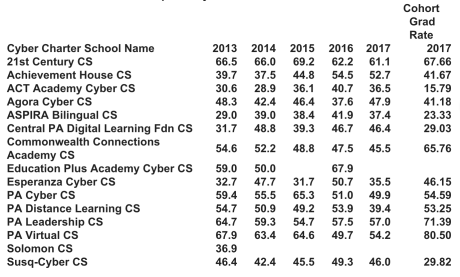
Not one of Pennsylvania’s cyber charters has achieved a passing SPP score of 70 in any of the five years that the SPP has been in effect. All 500 school districts are required to send taxpayer dollars to these cyber charters, even though none of them voted to authorize cyber charter schools and most districts have their own inhouse cyber or blended learning programs.
School Performance Profile Scores for PA Cyber Charters 2013-2017
Source: PA Department of Education website

http://www.paschoolperformance.org/

A score of 70 is considered passing.

Total cyber charter tuition paid by PA taxpayers from 500 school districts for 2013, 2014 and 2015 was over $1.2 billion; $393.5 million, $398.8 million and $436.1 million respectively.

Screen Shot 2018-05-23 at 9.09.06 PM


Bill Bloomfield is a very wealthy charter school supporter in California. He sent out a letter endorsing charter advocate Marshall Tuck for State Superintendent, accompanied by a photograph of Barack Obama, who has not endorsed anyone in the race. Tuck comes from the charter sector.

Tuck is running against Tony Thurmond, a state legislator who strongly supports public schools.

The California State NAACP was outraged by Bloomfield’s letter and told him so. It was especially shocked that he used Obama’s portrait in a mailer opposing an African American candidate. It pointed out that Bloomfield worked in John McCain’s campaign against Obama.

Bloomfield describes himself on his website as a major supporter of Michelle Rhee’s StudentsFirst, Parent Revolution (which tries to convert public schools to charter schools), and other reform organizations that attack public schools and promote charters.

It is pathetic how these charter promoters try to hitch themselves to the banner of the civil rights movement.

Read the letter here.

You knew this would happen. Security corporations are selling the latest thing to schools worried about shootings.

Lockport, New York, bought a facial recognition system that is programmed to identify the students and teachers who belong and to identify the criminals and sexual predators who are in its data system.

Next school year, Lockport schools will have in place the kind of security software used at airports, casinos and sensitive government installations.

Facial recognition and tracking software will add an unprecedented level of security at the schools. District officials have decided locked entrance doors, bullet-proof glass and sign-in registers at the front desk are not enough.

“We always have to be on our guard. We can’t let our guard down,” Lockport Superintendent Michelle T. Bradley said. “That’s the world that we’re living in. Times have changed. For the Board of Education and the Lockport City School District, this is the No. 1 priority: school security.”

Depew schools want to install the same system, as soon as a state funding request is approved.

“When it comes to safety and security, we want to have the best possible,” Depew Superintendent Jeffrey R. Rabey said. “From what I’ve seen, there’s no other like it.”

Studies have shown the technology doesn’t always work well, but the consultant to the district says a Canadian company has worked out the bugs that plagued earlier facial recognition software.

“Lockport will be the first school district in the world with this technology deployed,” said Tony Olivo, an Orchard Park security consultant who helped develop the system.

The software is used by “Scotland Yard, Interpol, the Paris police and the French Ministry of Defense,” Olivo said. “There are a lot of facial recognition systems out there. There is nothing in the world that can do what this technology does.”

Lockport will spend $1.4 million of the state’s money on the Aegis system, from SN Technologies of Ganonoque, Ont., in all 10 district buildings this summer. It’s part of a $2.75 million security system that includes 300 digital video cameras.

Lockport played a role in the system’s development. Olivo said in the summer of 2015, the software creators used Lockport High School for test videos featuring various types of guns.

Rabey said that because Depew has three buildings on one campus, rather than 10 different locations as Lockport has, Depew would need only 75 cameras, and the cost would be $188,000.

“We believe it’s innovative. We believe it’s an investment. And it’s meant to intercept unwanted people and items,” Bradley said.

But Jim Shultz, a Lockport parent, calls the upgrade a waste of money. And it won’t prevent a school shooting. He said the district would at best gain a few seconds in response time if a crazed killer rushed into a Lockport school with an AR-15.

The new system does not have X-ray.

It can’t detect metal, concealed weapons or explosives.

What it can do is alert officials if someone whose photo has been programmed into the system – a registered sex offender, wanted criminal, non-custodial parent, expelled student or disgruntled former employee – comes into range of one of the 300 high-resolution digital cameras.

“A school is now a target, unfortunately,” said Robert L. LiPuma, Lockport’s technology director. “Based on recommendations, things we saw, drills we did, pilots we did, we assessed all of that and we thought this was the best option, economically and responsibly, for the safety of our community.”

If a known bad guy is spotted, or a gun or other weapon is visible to the system’s cameras, the software could flash an alarm to any district officials connected to it, and also to police.

In the last five years, all of the major school shootings in the U.S. have been carried out by current or recent students of the school in question.

At the Sandy Hook massacre in Newtown, Conn., in 2012, the shooter was a mentally ill 20-year-old who shot his way through a locked entrance door before killing 20 children and employees. Police arrived five minutes after the killer entered.

Failed recognition

Studies have shown that commercially available facial recognition software simply doesn’t work very well.

Researchers have discovered that it works well only on white men and is much less effective on people of color, women and children.

In one of the most drastic examples, facial recognition software was tested last June on the crowd at a championship soccer game in Cardiff, Wales. The system triggered 2,470 alerts for matches with a police database – but 92 percent of the “matches” turned out to be false. The police blamed the poor quality of the photos in the database.

If the shooter is a current student, the system will not identify him. It would have been no help in Columbine or Santa Fe, Texas.

The system will have the capacity to track students’ movements in the building.

A good way to prepare for life in a surveillance state.
Nancy Bailey writes about the one proven reform that will schools safer: smaller class size

Smaller classes is REAL personalized learning, and it guarantees that no student will be anonymous.

Smaller Class Sizes and REAL Personalized Learning are Needed for Safer Schools

“High school teachers in this country face class rosters of 30-40 students per class. This means that within the course of a day teachers face approximately 200 students! With so many students it’s difficult to get to know everyone.

“Teachers who strike for better wages and working conditions always ask for a reduction in class size.

“Education reformers have rejected class size reduction. Jeb Bush spoke against it when Florida voted for lowering class size when he was governor, although he is a huge proponent of online “personalized” learning.

“Bill Gates has also been against lowering class size.

“Teachers cannot control what happens in a student’s home, but they can work with students to make school a warm environment, where students learn that they have someone they can always turn to who will help them. This is best done with smaller class sizes of 20 or less.

“Even if all classes are not reduced, students should have access to at least one period a day where teachers and students can get to know one another.”

I vividly recall the Sandy Hook massacre, the slaughter of 20 first grade children and six members of the staff at the Sandy Hook Elementary School in Newtown, Connecticut. It came as a huge shock to discover that some people believed it was an elaborate hoax, played by professional actors.

Now the parents are suing the perpetrator of the hoax theory, Alex Jones. Jones is a great admirer of Trump. Both assert that we live in a Post-truth world. Trump has appeared on Jones’ program “InfoWars,” boosting his following.

The story in the New York Times reads, in part:

More than five years after one of the most horrific mass shootings in modern history, the families of Sandy Hook victims are still enduring daily threats and online abuse from people who believe bogus theories spread by Mr. Jones, whom President Trump has praised for his “amazing” reputation.

Now, for the first time, the families are confronting Mr. Jones in court.

“When anybody’s behind a machine, whether it’s a gun or a computer or a car, a dehumanization takes place that makes it easier to commit an act of violence,” Veronique De La Rosa, the mother of Noah Pozner, another victim, said in an interview. She is suing Mr. Jones, she said, because she wants to force him to admit to his devotees that “he peddled a falsehood, that Sandy Hook is real and that Noah was a real, living, breathing little boy who deserved to live out the rest of his life.”

In three separate lawsuits — the most recent was filed on Wednesday in Superior Court in Bridgeport, Conn. — the families of eight Sandy Hook victims as well as an F.B.I. agent who responded to the shooting seek damages for defamation. The families allege in one suit, filed by Koskoff, Koskoff & Bieder in Bridgeport, that Mr. Jones and his colleagues “persistently perpetuated a monstrous, unspeakable lie: that the Sandy Hook shooting was staged, and that the families who lost loved ones that day are actors who faked their relatives’ deaths.”

More broadly, the families are seeking society’s verdict on “post truth” culture in which widely disseminated lies damage lives and destroy reputations, yet those who spread them are seldom held accountable. The suit filed on Wednesday emphasizes Mr. Jones’s reach and connection to Mr. Trump. On his show last year, Mr. Jones called himself and his listeners “the operating system of Trump.” Later he said, “I’m making it safe for everybody else to speak out just like Trump’s doing, on a much bigger scale.”

When the president called the news media the “enemy of the people” last year, Mr. Jones proudly tweeted that he used the phrase first, in 2015.

Mr. Trump has also echoed InfoWars’ false claims that Hillary Clinton benefited from the votes of millions of illegal immigrants in the election, and repeated InfoWars’ bogus charge that the news media covers up terrorist attacks.

Fantastical explanations for traumatic events punctuate history. But 21st-century conspiracy theorists gather in vast online networks where bogus claims reach millions in minutes, and where participants like Mr. Jones use social media and online marketing to turn an eccentric preoccupation into a thriving commercial enterprise.

Mr. Jones pitches the false claims, along with diet supplements and survivalist gear, on his InfoWars website, radio program and YouTube channel. His videos have been viewed more than a billion times. He most likely sells $7 million to $12 million worth of diet supplements a year, according to an analysis in New York magazine.

Sandy Hook families have been followed, videotaped and harassed by people demanding “proof” that their loved ones died. Monuments to the slain children in Newtown have been stolen and defaced. An Alex Jones devotee went to prison last year after phoning and emailing Leonard Pozner, Noah’s father, with death threats, including “LOOK BEHIND YOU IT IS DEATH.” The family relocated to a gated community with 24-hour security. Their daughters, who survived the shooting, check doors and windows before going to bed, and sleep with the lights on.

Nate Wheeler, 15, who hid in a school supply closet during the shooting that killed his 6-year-old brother, Ben, struggles to understand false online claims that both boys and their parents were “crisis actors” and that his brother never died, his father, David Wheeler, said in an interview. Mr. Wheeler has found messages on his social media accounts telling him that he will face divine judgment for lying when he dies, he said.

Wednesday’s suit follows twin defamation lawsuits filed in Texas in April by the parents of two other victims — Mr. Heslin, and Ms. De La Rosa and Mr. Pozner. Mr. Jones did not respond to requests for comment. After the Texas lawsuits were filed last month, he posted a 10-minute videotaped response suggestive of how his positions on the event shifted. “I questioned the P.R. and the talking points that surrounded the Sandy Hook massacre,” he said. “But very quickly I began to believe that the massacre happened, despite the fact that the public doubted it.”

And yet in an earlier video on his website, titled “Alex Jones Final Statement on Sandy Hook,” he says: “If children were lost in Sandy Hook, my heart goes out to each and every one of those parents, and the people that say they’re parents that I see on the news. The only problem is, I’ve watched a lot of soap operas, and I’ve seen actors before.”

It would be very satisfying to see huge judgments against the vicious Mr. Jones. He has caused grief to heartbroken families. Money can’t replace the beloved children they lost. But it might deter crackpots and creeps like Jones from harassing them and others similarly situated in the future.

By the way, Alex Jones did not invent the term “enemy of the people” to describe those they hate. For the record, Joseph Stalin or his PR team did. It was a standard phrase in the Soviet Union to describe classes of people who deserved to be eliminated, in the opinion of the state leaders.

The teachers of Los Angeles will hold a rally tomorrow to support their demand for a fair contract.

MEDIA ADVISORY **
FOR IMMEDIATE RELEASE
May 23, 2018
Media Contact: (213) 305-9654
Anna Bakalis, UTLA Communications Director

Tomorrow: More than 10,000 people expected in massive demonstration to demand a fair contract for educators, sustainable school district for all

WHO: United Teachers Los Angeles represents educators, including teachers, librarians, counselors, nurses, psychologists, psychiatric social workers, therapists, substitutes, early childhood and adult teachers.These educators, supported by parents, students and community leaders, are gathering by the thousands on Thursday in Grand Park after what is expected to be another uneventful bargaining session with LAUSD. After one year of bargaining, and with a $1.7 billion projected reserve, LAUSD refuses to make progress on key issues, including:

• A fair pay raise

• Smaller class sizes

• More nurses, counselors, psychologists, and librarians

• Less testing and more teaching

• Charter and co-location regulation

• Real support for school safety

• Community schools and support for families

WHEN: Thursday, May 24
TIME: 3:30 – 6 PM
WHERE: In front of LA City Hall Grand Park, 227 Spring St., Los Angeles, 90012

· Media truck parking available along Spring Street, as well as press check in.
WHAT: UTLA’s “All In for Respect” rally and major demonstration is the culmination of one year of escalating actions around UTLA’s contract demands. The union is hoping for an agreement by the end of this school year. If none is reached, strike authorization votes are expected to take place in the Fall.

Click here read more about UTLA’s bargaining proposals.
Speakers lineup includes:

· Rebecca Garelli, a middle school science teacher who led the walk-ins and successful strike in Arizona

· Alex Caputo-Pearl, UTLA president

· Cynthia Matthews and Adrian Tamayo, UTLA Bargaining Team members

· Marshe Doss, an 11th grader at Dorsey High School, leader in the Students Deserve coalition, activist in Black Lives Matter and Reclaim Our Schools LA.

· Eulalia Garcia and Eloisa Galindo, Parent organizers who recently fought off a co-location by a charter school.

World-renowned and Grammy award-winning Martha Gonzalez of Quetzal, Marisa Ronstadt, and Xochi Flores-Castro of Los Cambalache, will also give an inspiring performance.

Multiple student groups from around LAUSD will perform in the park as well as on stage, including:

· The Pacoima Singers, an award-winning, multi-ethnic performing arts group at the Pacoima Middle School Film, Media & Performing Arts Magnet in the San Fernando Valley.

· Garfield High School Marching Band

· The Rock Band Club of Cortines High School

· The Korean Drumming Seminar Students fromRobert F. Kennedy High School/UCLA Community School

____________________________________________

UTLA, the nation’s second-largest teachers’ union local, represents more than 35,000 teachers and health & human services professionals who work in the Los Angeles Unified School District and in charter schools.

Martin Raskin taught in the New York City public schools for many years, and he is now retired. He is obsessed with collecting memorabilia about the city’s public schools, especially his own elementary school, P.S. 202 in East New York, Brooklyn. His apartment, the New York Times writes, is a shrine to the public schools.

Maybe there is someone more crazy in love with New York City’s public schools than Martin Raskin, but who else would collect a panel of hundred-year-old brass steam heat switches from Brooklyn’s Manual Training High School that closed in 1959? Or load up his car trunk with a boiler gauge from P.S. 41 in Greenwich Village?

“I’m a little bit compulsive,” admitted Mr. Raskin, a 77-year-old retired teacher who taught at Canarsie High School in Brooklyn and the Queens School for Career Development and is aflame with ardor for all things Board of Education, which, he said, “paved the way I am today — I’m blessed.”

When last heard from (in a 2010 article in The New York Times), the salt-and-pepper-whiskered schmoozer who could talk the paint off a wall had turned his Upper East Side of Manhattan apartment into a shrine to P.S. 202 in East New York, Brooklyn, where he spent kindergarten through eighth grade, graduating in 1955, before going on to Franklin K. Lane High School.

His mock classroom showcased ink-stained attached desks, Regulator clocks, milky glass chandeliers, tall teacher’s reading chair, class photos, oval brass doorknobs, wardrobe hooks, window pole, yellow report cards, merit certificates, black and white composition notebooks, even the original enamel number plate from his homeroom, 516.

It’s all still there, along with Mr. Raskin’s prize piece, the chair splinter extracted from the rear of his principal, Charles G. Eichel, and preserved in an envelope with the (unlucky) date of the encounter, Friday, March 13, 1942. Mr. Raskin had scooped it up along with other discarded P.S. 202 material in the 1980s, a fateful discovery that set off his freely acknowledged obsession, since abetted by eBay, Etsy and other collectibles dealers.

But that, it turns out, was only the beginning. “I’m now amassing a shrine to the whole educational system,” Mr. Raskin said.

He recently paid $450 on eBay for an 1850s New England dunce chair, which stands amid a table of vintage readers, including the complete Eichel oeuvre, student magazines, multicolored high school beanies and buttons, class rings and pins, diplomas, teacher ledgers, autograph albums, lunchroom tickets, commencement programs, and oddities like the news photo of the “Black Hand Stampede,” a panic over rumors of Mafia presence that terrified students at P.S. 177 in Little Italy on June 17, 1926.

He wants to find a permanent home for his collection, but so far has had no luck. He showed it to representatives from the Museum of the City of New York and the New York Historical Society, but they were not interested.

“There’s a fire museum, a police museum, a food museum, even a sex museum,” Mr. Raskin said. “But there’s nothing to honor teachers and students.”

I am reminded that when I finished my first book in 1974, The Great School Wars: A History of the New York City Public Schools, 1805-1973, I spoke to representatives of the same museums and met the same lack of interest. I did not have the wonderful treasure trove that Martin Raskin has amassed. But nearly half a century ago, it was clear that there was no interest in creating an exhibition or museum space to honor education in the city.

Congratulations, Mr. Raskin. Your passion is admirable. I hope you find a permanent home for your collection. Maybe UFT headquarters?

Mayor Rahm Emanuel of Chicago will go down in American history as the mayor who closed 50 public schools one day.

It was a brutal act. It showed his contempt for public education. While he closed public schools, he continued to open privately managed charter schools. Perhaps he hopes one day he hopes a charter school will be named for him, as one is named for billionaire Governor Bruce Rainer and billionaire Penny Pritzker.

But what about the children? Reformers like Emanuel think that closing schools is great for students. He thinks they thrive on disruption. They don’t.

A new study concludes that the children whose schools were closed suffered academic losses. Duh.

Here is the report in The Chicago Reporter.

Mike Klonsky writes about the report and the school closing disaster here.

Mike writes:

The study concludes:

“Closing schools — even poorly performing ones — does not improve the outcome of displaced children, on average. Closing under-enrolled schools may seem like a viable solution to policymakers who seek to address fiscal deficits and declining enrollment, but our findings shows that closing schools caused large disruptions without clear benefits for students.”

CTU’s Jesse Sharkey, said the report “validates” that the closures “were marred by chaos, a desperate lack of resources, lost libraries and labs, grief, trauma, damaging disruption, and a profound disrespect for the needs of low-income black students and the educators who teach them.”

Important to note… It wasn’t just Chicago. Mass school closings were a requirement of then Secretary of Education Arne Duncan’s Race to The Top policy. Unless school districts closed schools, they were threatened with loss of millions of dollars from the D.O.E. An epidemic of closings and teacher firings, mainly in urban districts, followed in the wake of RTTT.

Who thought it would be good for the kids in the closing schools? Arne Duncan started it. He made school closings a feature of Race to the Top. He (and his sidekick Peter Cunningham, now editor of billionaire-funded Education Post) defended it as a “remedy” for low-scoring schools. Duncan’s reform program in Chicago was called Renaissance 2010, built on the idea of closing 100 schools and replacing them with charters. Of course it didn’t work. Kids need stability not disruption.

There are two ways to go wrong in scoring student essays. One is to have them graded by computers. The other is to have them graded by the low-wage slackers hired by testing corporations.

There is only one way to go right in scoring student essays. That is to have them read by teachers in the building or district where the student is enrolled.

Massachusetts is pondering turning over the grading of student essays to computers. Les Perelman, a retired professor of writing at MIT, has demonstrated how dumb the computers are when it comes to understanding what students have written. The computers like long sentences; big words; and long essays. But the computers have a serious defect: They can’t tell truth from falsehood. He told a New York Times writer, Michael Winerip, that a computer would not care if a student wrote that the War of 1812 began in 1945. Computers are not fact-checkers. That is why they can score thousands of essays in less than a minute. If you happen to think that knowledge matters, don’t have essays scored by computers.

If you think that it is better to ask Pearson or ETS or any of the other testing companies to have essays graded by humans, think again. Read Todd Farley’s book “Making the Grades: My Misadventures in the Standardized Testing Industry,” where he describes himself as a scorer who was in it for the hourly wage, surrounded by others with little or no interest in the quality of writing or the fate of students. In recent years, we have heard of ads placed on Craigslist, seeking essay readers at $11 an hour, no experience needed. Read the last paragraph of Farley’s book to know why mass-grading of student writing doesn’t work, why parents should fight it with every fibre of their being.

Who should read and assess student work? Teachers who work in the building or the district. At least then one can be certain that teachers are doing the grading, not unemployed and inexperienced college graduates who are expected to read and grade 100 essays an hour or more.

Trevor Noah of the Daily Show explains here in a short video everything you need to know about Betsy DeVos’s decision to terminate the unit investigating fraud in the for-profit college sector. This is an example of a video conveying more than thousands of words.