Archives for the month of: January, 2018


Betsy DeVos visited Excel Academy in D.C. and praised it as a model of school choice and its benefits. So did Melania Trump.

The school is closing because of poor academic performance.

http://wjla.com/news/local/dc-charter-school-must-close-despite-white-house-praise-as-exceptional

”A charter school visited just last year by Education Secretary Betsy Devos and First Lady Melania Trump – who touted it as “exceptional” – must now shut down. That was the unanimous decision late last week by D.C.’s Public Charter School Board.

“In a 6-to-0 decision, the board voted to close Excel Academy in June, at the end of this school year. It’s the District’s only all-girls public charter school, serving more than 600 students, Pre-K through eight.

“The school board cited declining test scores and below average reading and math skills.”

We don’t expect the First Lady to be knowledgeable about schools.

Turns out the Secretary of Education is clueless about education too.


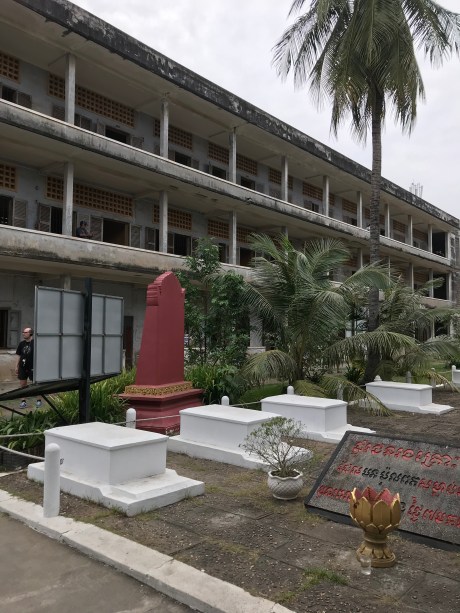
The Tool Sleng camp is in central Phnom Penh.
Between 1.7 million and 2.5 million Cambodians were murdered by Pol Pot. He wanted an agrarian society with no western knowledge or skills.
When he came to power in 1975, the people welcomed him as a liberator. Within days, the cities were completely abandoned and the killing started.
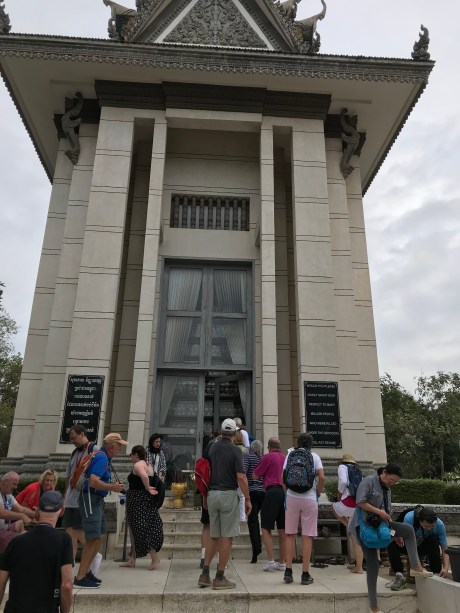
IMG_1190
This is a major prison for torture and killing in Pnomh Penh.
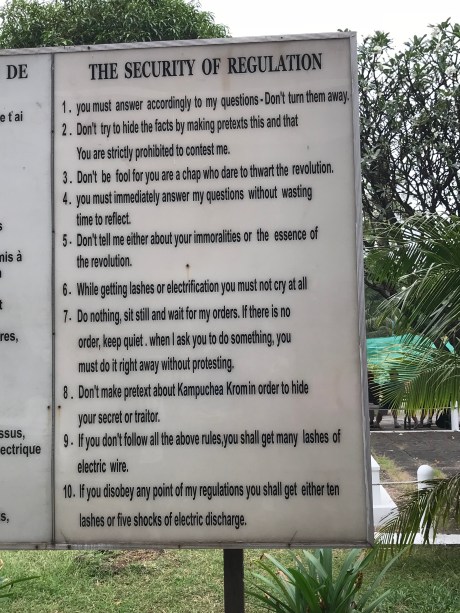
Here are the rules.

IMG_1197

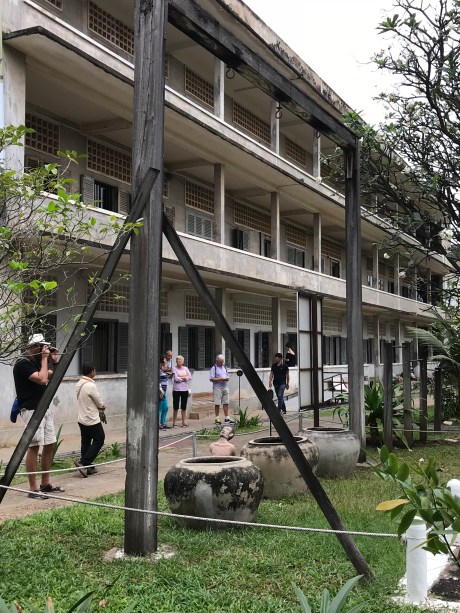
The building was originally a high school.
ThePol Pot regime turned it into a torture and death camp
IMG_1199
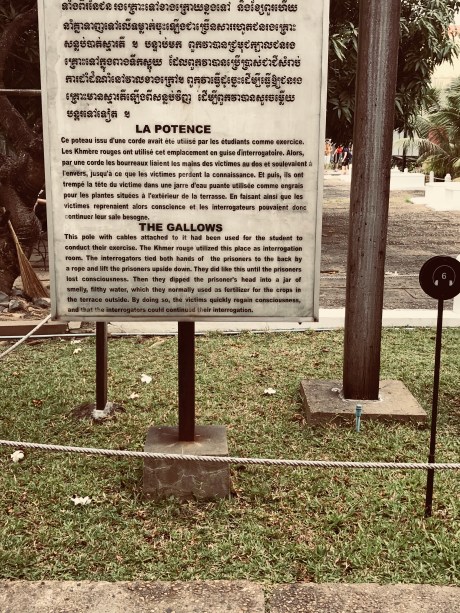
The Gallows
IMG_1206
Turned into a death camp with unspeakable torture
IMG_1232
IMG_1219
Women and children too for no reason
IMG_1227
Children
IMG_1228
When you see the individual faces, you see the horror
IMG_1226


Tom Ultican, who recently retired as a high school teacher of advanced math and physics in California, has been studying the tentacles of the privatization movement.

His latest expose reveals the nefarious, insidious organization benignly called “Education Cities.” It is a spin-off of The equally insidious organization called The. I don’t Trust, which has hidden behind a facade of faux progressivism. The Mind Trust goal is the complete privatization of the public schools of Indianapolis.

Dont be fooled! Like The Mind Trust, Educatuon Cities is a central part of a long-range plan to destroy public education. It is now operating in 25 Cities. Like other privatization groups, it begins by telling you how terrible your public schools are. It warns that there are achievement gaps in your schools, based on race and income. It claims that it will lure schools to your city that are so great that every student will have high scores. It’s propaganda, like all propaganda, is shot through with lies, exaggerations, hyperbole, and false promises.

Is your city one of their targets? Read Tom’s article and find out.

These are the hollow men. They come to steal your public schools and give them to entrepreneurs.


School Choice is the hoax of our time. It proposes a system in which schools choose students. It increase racial and economic segregation. It does not improve education. It favors the haves, not the have nots.

It is a hoax.

For more about the hoax, read Phyllis Bush on the failure of “choice” in Indiana.

http://www.journalgazette.net/opinion/columns/20180122/school-choice-reality-much-less-appealing

This is Carol Burris, the Executive Director of NPE, a national organization of which Diane is President.  NPE fights to preserve public education, a pillar of our democracy.

School Choice Week has begun. It is a well-funded campaign supported by Betsy DeVos’s American Federation for Children, the Koch Brothers, the Walton Foundation, ALEC and others in order to promote vouchers, charters, virtual schools and schemes like ESAs and tax credits.

During School Choice Week, our Governors will be bombarded with emails and phone calls extolling the virtues of School Choice.  The intent is to fund private schools with public tax dollars. Send your email in support of Public Schools. Then share this campaign on social media.

Here is the link where you can find that email.

https://actionnetwork.org/letters/tell-your-governor-the-best-choice-is-a-strong-public-school-system

It will take you less than a minute to do. Don’t let Diane down. She is counting on you to take a moment to fight the school choice scam.


Linda Lyon is the president of the Arizona School Boards Association. She is a retired officer in the U.S. Air Force. She served her country in the military and continues to serve it by her participation in defense of public schools.

Colonel Lyon made this stirring video about democracy and public education. It is short and powerful. Please watch and share with your friends via Twitter, Facebook, and other social media. Show it to your PTA, the school board, the town council, the League of Women Voters, and every other group committed to strengthening the common good.

This video was sponsored by the Network for Public Education and produced, directed, and edited by Michael Elliott, a professional cinematigher

There is a renewed effort to impose privately managed charters in Nevada, without a referendum or any indication of public demand. This is ironic because Nebraska has a long tradition of good public schools that are the anchors of their communities. We know the playbook. A rightwing Republican will Press for charters for those poor black children in Omaha, for whom he has never shown any previous concern. He knows this is the nose under the camel’s tent, the wedge he can use to please his allies in ALEC, who want to privatize everything.

I visited Omaha in 2016 and learned about Nebraska before I went.

This is what I learned: Nebraskans love their public schools.

I gave a see h to civic and education leaders, and this is what I said:

“You are too independent, too smart, too stubborn to follow everyone else over the edge of a cliff. You have saved tens of millions (maybe hundreds of millions) of dollars by losing Race to the Top. You are a model for the nation. And without having adopted any of the so-called “reforms,” Nebraska is one of the highest-performing states in the nation on NAEP. In fact, Nebraska outperformed every state that won RTTT except Massachusetts.

“Nebraska dragged its feet implementing NCLB. It put in a proposal for Race to the Top, but fortunately lost. It has no charter schools, no Common Core. It didn’t get a waiver because the state doesn’t want to evaluate teachers by test scores. The state commissioner decided not to ask anymore but to wait and see if NCLB is overhauled.

“The state is mainly rural so there is not much enthusiasm for charters except in Omaha, where there is a poor black community. Some black leaders think that charter schools will be a panacea. Some white legislators agree. But so far no action on that front.

“Despite the fact that Nebraska avoided almost every part of the reform menu, its students did very well on the 2015 NAEP. The state was in the top tier, ranked 9th or 11th in the nation. It outperformed every Race to the Top winner except Massachusetts, which has been number 1 for years.

“Nebraska is a conservative state, in the best sense of the word. It doesn’t believe in following the crowd. It doesn’t want to blow up its public schools and hope for the best. It wisely decided to wait and see. No creative disruption. No experiments on children. Just common sense.

“Also, being a state where people know one another in small cities, towns, and rural communities, Nebraska loves its public schools. Even Warren Buffett, one of the richest men in the world, sent his own children to Omaha public schools.

“But there is a new governor, and he is convinced that Nebraska needs charters, vouchers, virtual schools, the whole bag of privatization schemes.

“Hopefully the good citizens of Nebraska will persuade him that conservatives don’t destroy; conservatives conserve. Hopefully, they will inform the governor that Nebraska’s public schools are among the best in the nation.”

If it ain’t broke, don’t break it.

DONT BE HOAXED BY PRIVATIZERS AND PROFITEERS!


January 21-27 is School Choice Week, a multi-million dollar campaign funded by right-wing groups like the Koch Brothers, The American Federation for Children, ALEC and the Walton Foundation. The endgame is to replace public education with privatized systems of schooling. Read what the Center for Media and Democracy had to say here about School Choice Week.

We need YOU to help us tell the public the truth about so-called School Choice. And so we created a powerful campaign for you to use and share here.

Right Now
1. Send a letter to your Governor telling him or her that you support public education, not privatized education with vouchers, voucher-like tax credit schemes, charters and online schools. In just a few seconds you can send that letter by clicking here.

2. Go here to put a PRO-PUBLIC SCHOOL frame on your Facebook profile picture for the week. Just move your cursor down on the image and click “use frame.”

3. Watch and share this wonderful video of Arizona School Board President, Linda Lyon, unmasking what school choice has done in her state. Please share it on Facebook and go to the NPE twitter account (NetworkforPublicEd) and tweet it out. It is pinned to the top.

4. Join the Thunderclap sponsored by the #WeChoose campaign for public schools. Click here.

5.Go here to find a toolbox of resources to share all week. We will continue to post new material to share. Every day this week we ask you to go to the site and take action. Each action is designed to tell the truth about School Choice Week and its supporters.

On Friday you will receive another email from us asking you to send a letter to your legislators asking them to stop a backdoor voucher triggered by the recent tax reforms. More on that to come.

Here is the real choice we face.

Either we support public schools governed by our elected neighbors or we let state governments dole out tax dollars to parents to shop for schools.
We can’t have both.

Please do your part and get the message out this week. Thanks for all you do.

Share this link

#StoptheSchoolChoiceScam Week of Action


on social media and by email. Go back every day for new actions. Let’s let our friends and neighbors know that the right choice is public schools.

Carol Burris

The Network for Public Education is a 501 (c)(3) organization. You can make a tax deductible donation here.

  1. You can follow us on twitter and like us on Facebook.

This post was originally posted on December 21, 2016.

It is a review of my decision to oppose the Common Core standards. A few days ago, I met a high school teacher who told me she had quit her job as a teacher because her supervisor told her she could not teach poetry anymore, due to the Common Core standards. Defenders of the standards will say that the supervisor misinterpreted the standards. Unfortunately, many others are following the same guidelines: Put away poetry and classic literature; teach students to read informational text so the nation can be globally competitive. If I told you there was no evidence for this claim, would you believe me? Do you know that students can learn to read critically and thoughtfully whether they are reading literature or factual information? Every kind of text requires interpretation and understanding.


I oppose the mandated use of the Common Core standards. If teachers like them and want to use them, they should. I have no problem with that. It should be up to the teachers, not to a committee that was funded by Bill Gates, promoted by Arne Duncan, and marketed as a “state-led initiative,” which it was not.


I did not reach this view frivolously or for political reasons. I first read the standards in draft form in 2009. I read them when they were published in 2010. I was invited to the White House in 2010 to meet with the President’s top advisors–Melody Barnes, the head of the Domestic Policy Council; Rahm Emanuel, then the President’s chief of staff; and Ricardo Rodriguez, the President’s education advisor. They asked what I thought of the CCSS. I said that until standards are implemented, until they are tried and tested in classrooms with real teachers and real students, it is impossible to know how they will work. However good they might look on paper, the real test happens in real classrooms, where they must be tried and reviewed. I urged them to give grants to three-to-five states to implement the standards, listen to teachers, work out the bugs, and learn what effects they will have. Will they raise achievement? Will they narrow or lower the achievement gaps among different groups? We can’t know without running trials and revising what needs to be fixed. They flatly rejected my suggestion and said there was no time for that. I realized then that their goal was to have the standards in place in time for the next presidential election in 2012, whereas my goal was to figure out how to make sure the standards were valid and useful for students.


In 2013, after watching the fiasco of the rushed implementation of the standards in New York, I came out in opposition to them, in part because of the process, and in part because of the failure to implement them appropriately and create any mechanism for fixing them.


I also strongly oppose the arbitrary imposition of quotas for literature and informational texts. Those quotas have no basis in research or evidence. The quotas reflected the NAEP (National Assessment of Educational Progress) guidelines for assessment developers. As students get older, the tests have more questions that are informational. But the National Assessment Governing Board, which oversees NAEP, had no intention of telling teachers what they should teach or how much time to devote to literature or informational text. (I know this for a fact because I served as a member of NAGB for seven years.) One could read literature for twelve years and still be able to read informational text. The decision about how much time to spend on fiction or nonfiction belongs to teachers, not to national committees.


My bottom line is that teachers who like the Common Core standards should use them; teachers should be free to use any part of them; and teachers should be free to ignore them if they wish. Since they were  never field-tested, never validated, there is no reason to mandate them.


So here are some of the posts from the past that I hope will inform you about the CCSS and why I oppose them:


This was my first post, written in early 2013, explaining why I could not support the standards.


A post where I explained my views to the Modern Language Association.


This post in 2014 explains why the CC failed the test of standard setting.


No One Opposes Reading Non-Fiction

A post about the battle between fiction and nonfiction.


An explanation of why fiction matters, written by someone else.


Tom Loveless on the decline in teaching fiction.


Johann Neem on the danger of Common Core to the teaching of history:

Research say fiction matters.


That is a small sampling from scores of posts about Common Core.


I had long been a proponent of national standards. The flawed development and rushed implementation of the Common Core undermined my belief. As the results from the tests appeared, it became obvious that national standards do not raise achievement, do not narrow achievement gaps, and do not produce better education or equity. The Common Core taught me that national standards are not a solution to the problems of poverty, lack of appropriate funding, and neglect of education as a primary responsibility of the public. College-and-career readiness are not the purpose of education. Full development of every child’s capacities is. Preparation for citizenship is. Ethics and a sense of responsibility for oneself and to the community are. What matters most can’t be measured. Wisdom. Kindness. Character. Integrity. A love of learning. A sense of justice. Concern for others. Courage.


As time goes by, it seems clear that the biggest beneficiaries of the Common Core standards are the testing companies and the vendors of technology, not students or teachers.

Joanne Barkan has written several brilliant essays about the billionaires who use their philanthropies to undermine democracy and public education.

This is one of her best.

She writes:

“For a dozen years, big philanthropy has been funding a massive crusade to remake public education for low-income and minority children in the image of the private sector. If schools were run like businesses competing in the market—so the argument goes—the achievement gap that separates poor and minority students from middle-class and affluent students would disappear. The Bill and Melinda Gates Foundation, the Eli and Edythe Broad Foundation, and the Walton Family Foundation have taken the lead, but other mega-foundations have joined in to underwrite the self-proclaimed “education reform movement.” Some of them are the Laura and John Arnold, Anschutz, Annie E. Casey, Michael and Susan Dell, William and Flora Hewlett, and Joyce foundations.

“Each year big philanthropy channels about $1 billion to “ed reform.” This might look like a drop in the bucket compared to the $525 billion or so that taxpayers spend on K–12 education annually. But discretionary spending—spending beyond what covers ordinary running costs—is where policy is shaped and changed. The mega-foundations use their grants as leverage: they give money to grantees who agree to adopt the foundations’ pet policies. Resource-starved states and school districts feel compelled to say yes to millions of dollars even when many strings are attached or they consider the policies unwise. They are often in desperate straits.

“Most critiques of big philanthropy’s current role in public education focus on the poor quality of the reforms and their negative effects on schooling—on who controls schools, how classroom time is spent, how learning is measured, and how teachers and principals are evaluated. The harsh criticism is justified. But to examine the effect of big philanthropy’s ed-reform work on democracy and civil society requires a different focus. Have the voices of “stakeholders”—students, their parents and families, educators, and citizens who support public education—been strengthened or weakened? Has their involvement in public decision-making increased or decreased? Has their grassroots activity been encouraged or stifled? Are politicians more or less responsive to them? Is the press more or less free to inform them? According to these measures, big philanthropy’s involvement has undoubtedly undermined democracy and civil society.

“The best way to show this is to describe how mega-foundations actually operate on the ground and how the public has responded. What follows are reports on a surreptitious campaign to generate support for a foundation’s teaching reforms, a project to create bogus grassroots activity to increase the number of privately managed charter schools, the effort to exert influence by making grant money contingent on a specific person remaining in a specific public office, and the practice of paying the salaries of public officials hired to implement ed reforms.

“You Can’t Fool All of the People All of the Time

“The combination of aggressive style, controversial programs, and abundant money has led some mega-foundations into the world of “astroturfing.” This is political activity designed to appear unsolicited and rooted in a local community without actually being so. Well-financed astroturfing suffocates authentic grassroots activity by defining an issue and occupying the space for organizing. In addition, when astroturfers confront grassroots opposition, the astroturfers have an overwhelming advantage because of their resources. Sometimes, however, a backlash flares up when community members realize that paid outsiders are behind a supposedly local campaign.”

Barkan describes the Parent Trigger Law, which was financed by billionaires to enable low-income parents to take control of their schools and turn it over to a charter operator. The money was used to send organizers into low-income communities, create discord, and persuade parents to sign petitions. “The process was bound to divide communities, and it was open to abuse and outside manipulation. But most important, the law destroyed the democratic nature of public education. This year’s parents don’t have the right to close down a public school or give it away to a private company any more than this year’s users of a public park can decide to pave it over or name a private company to run it with tax dollars (see Diane Ravitch, Reign of Error, 2013). Voters—directly or through their elected officials—decide on and pay for public institutions in a democracy.”

In retrospect, Parent Trigger was a bust. Seven years and many millions of dollars later, only one or two schools were charterized. And there have been no studies of whether it made a difference. The billionaires did get a hardworking Mexican-American principal fired, and almost every member of her staff left with her in protest. What a waste.

Barkan writes that the most grievous misdeed of the billionaires is their assault on democracy. If they can’t get what they want through normal channels, they use their resources to buy what they want.

“Philanthropies risk losing their tax-exempt status if they donate directly to candidates for public office, so some foundations have tried other ways to ensure they have the people they want in key posts.

“The Los Angeles–based Broad Foundation stipulated in the contract for a $430,000 grant to New Jersey’s Board of Education that Governor Chris Christie remain in office. As the Star-Ledger reported (December 13, 2012), the Newark-based Education Law Center had forced the release of the contract through the state’s Open Public Records Act. For the center’s executive director, David Sciarra, “It is a foundation driving public educational policy that should be set by the Legislature.” The Broad Foundation’s senior communications director responded, “[W]e consider the presence of strong leaders to be important when we hand over our dollars.”

“The foundation sector will fight reform ferociously—as it has in the past. When asked to forgo some influence or contribute more in taxes, the altruistic impulse stalls.

“The keep-Chris-Christie clause was not the first time a staffing prerequisite was discovered in a grant contract with a public entity. In 2010 Washington, D.C. schools chancellor Michelle Rhee negotiated promises for $64.5 million in grants from the Broad, Walton, Robertson, and Arnold foundations. Rhee planned to use part of the money to finance a proposed five-year, 21.6 percent increase in teachers’ base salary. In exchange she demanded that the union give her more control over evaluating and firing teachers and allow bonus pay for teachers who raised student test scores.

“In March 2010 the foundations sent separate letters to Rhee stating that they reserved the right to withdraw their money if she left. They also required that the teachers ratify the proposed contract (Washington Post, April 28, 2010). Critics challenged not only the heavy-handed intrusion into an acrimonious contract negotiation but also the legality of the stipulation on Rhee: hadn’t she negotiated a grant deal that served her own employment interests? The teachers ratified the contract, but the extremely unpopular Rhee resigned in October 2010 after Mayor Adrian Fenty, who had hired her, lost the Democratic mayoral primary. By that time, much of the grant money had been spent, and the new schools chancellor kept Rhee’s policies.

“Private foundations have used another tactic to exert influence on the Los Angeles Unified School District: they paid the salaries of more than a dozen senior staffers. According to the Los Angeles Times (December 16, 2009), the privately financed “public” employees worked on such ed-reform projects as new systems to evaluate teachers and collect immense amounts of data on students. Much of the money came from the Wasserman Foundation ($4.4 million) and the Walton Family Foundation ($1.2 million); Ford and Hewlett made smaller grants. The Broad Foundation covered the $160,000 salary of Matt Hill to run the district’s Public School Choice program, which turned so-called low-performing and new schools over to private operators. Hill had worked in Black & Decker’s business development group before he went through one of the Broad Foundation’s uncertified programs to train new education administrators. A Times editorial on January 12, 2010 asked, sensibly, “At what point do financial gifts begin reshaping public decision-making to fit a private agenda?…Even the best-intentioned gifts have a way of shifting behavior. Educators and the public, not individual philanthropists, should set the agenda for schools.”

The Plutocrats want to abolish public control of public education. They have sponsored one failed “reform” after another.

They never learn.