Archives for the month of: March, 2015

One of my favorite charter school stories is the one about the Lion of Judah charter in Ohio. When it was learned that more than a million dollars had been transferred from the charter school, the lawyer for the church asked the judge to forgive his client because it wasn’t his fault: he saw the easy money and greed got the best of him, what an original defense!

Here is the latest from Bill Phillis of the Ohio Coalition for Equity and Adequacy:

“Finally, the Ohio Attorney General files a lawsuit in charterland

Extremely late, but it may be a good sign. The Ohio Attorney General is going after individuals and entities who received $2 million from a now-closed charter school-Lion of Judah. Financial fraud has been a continuing thread in some sectors of the charter industry since the beginning.

Why didn’t Ohio’s Attorney General sue White Hat Management several years ago when Scripps Howard News Service documented that the company was receiving funding for students enrolled but not attending? The Scripps report-GHOST SCHOOLS-documented a vast difference between enrollment and attendance. In one case, a White Hat charter school had a 64% absentee rate for the 2004-2005 school year. The Scripps Howard report quoted a former principal of the Life Skills Center of Cincinnati, “It’s a cash cow! We all used to sit around and joke about it.” Further he said, “I spent less than $1 million on a $3 million operation. What the *%@& are they (executives at his former company) doing with the other $2 million?”

A recent report by the State Auditor showed a great disparity between attendance and enrollment in several charter schools. In March 4 testimony before the House Education Committee, State Auditor David Yost admonished the committee to craft legislation to correct this type of abuse and enforce it via criminal penalties.

The Attorney General should be aggressively protecting taxpayers and students from blatant charter fraud. The lawsuit against those associated with the Lion of Judah charter is a good start.

William Phillis.

Ohio E & A | 100 S. 3rd Street | Columbus | OH | 43215

This is a great discussion, in which Amy Goodman of “Democracy Now” interviews Juan Gonzalez of the NY Daily News about the big money pushing charter schools. The discussion is based on this article.

“New York Hedge Funds Pour Millions of Dollars into Cuomo-Led Bid to Expand Charter Schools | Democracy Now!

In his latest column for the New York Daily News, Democracy Now! co-host Juan González reports on the tens of millions of dollars in hedge fund donations behind the push for charter schools in New York state. Gov. Andrew Cuomo is the single biggest recipient, hauling in $4.8 million. After winning approval for up to $2,600 more per pupil for charter school facilities, Cuomo is calling on the state Legislature to increase the state limit on charter schools.

AMY GOODMAN: Juan, before we move on with our first segment, you have a very interesting piece in the New York Daily News today, “Hedge fund executives give ’til it hurts to politicians, especially Cuomo, to get more charter schools.”

JUAN GONZÁLEZ: Yes. Well, I wrote about an interesting symposium that was held at the Harvard Club yesterday, an all-day symposium titled “Bonds & Blackboards: Investing in Charter Schools.” And it was a meeting, basically, of hedge fund types sponsored by the Gates Foundation and by the Walton Foundation, basically—

AMY GOODMAN: Of Wal-Mart.

JUAN GONZÁLEZ: Of the Wal-Mart family—basically enticing more investors to begin to see how they can make money off of charter schools. An all-day symposium with a small protest of parents outside. But it really has marked the enormous change that’s occurred in New York politics and, I think, around the country, as a new report showed that hedge fund executives over the last decade have poured nearly $40 million into political contributions just in New York state. The prime beneficiary over the last few years has been Governor Cuomo, who has received almost $5 million. We’re talking about Carl Icahn, you know, the famous “corporate raider”; we’re talking about Paul Singer of the vulture fund, hedge fund guy; we’re talking about Julian Robertson of Tiger Management—some of the richest people in New York City. And they’re also, most of them, also major backers of charter schools.

AMY GOODMAN: How do they make money from charter schools?

JUAN GONZÁLEZ: Well, that’s—I think a lot of it now is going to be coming in with the facilities financing that’s going to occur. aGovernor Cuomo pressed the Legislature, for instance, in New York state to begin providing what will be the equivalent of about $2,600 per child to build new facilities for charter schools, forcing Mayor de Blasio in New York City to share some of this cost. So there’s going to be a new revenue stream: In addition to direct funding from the state for pupil education, there’s now going to be a charter facilities fund that’s been set up. And, of course, the governor wants to lift the cap on charter schools to allow many more charter schools to be started in New York. And the amount of money is not just in the direct contributions; it’s also in money being given to new groups, the dark money that we’ve seen after the Citizens United case, where folks like Robertson and Dan Loeb have contributed as much as a million dollars apiece last year to a new group funding ads promoting Republicans for Senate seats in New York state, which would assure, again, support for charter schools. So it’s an enormous amount of money that’s being poured into these political campaigns specifically by hedge fund folks who are very close to charter schools. In fact, one charter network alone, the Success Academy, which I’ve reported on repeatedly, 19 members of the board of directors, or their family members, gave $600,000 to Governor Cuomo’s campaigns in the last—for his last two election campaigns. It’s an enormous amount of money, and it’s not getting much attention.”

California has embraced the Common Core standards and the SBA tests for the Common Core, but it has made an important decision: Not to use the test scores for high-stakes. California’s education leaders–namely, state Commissioner Tom Torlakson–once again demonstrate that they have more common sense than any other state that has submitted to federal dictates.


The State Board of Education unanimously voted to suspend for a year the Academic Performance Index, which is based on standardized test scores and widely used to evaluate a school’s performance in boosting academic achievement. Since the state is rolling out new tests this year, board members said they wanted at least two years of results to judge school progress.


Amid a national backlash against the overuse of test scores, board members also voted to shift from a school quality measure based solely on exam results to one that would include other factors. Possible additions include student attendance, dropout rates, suspensions, English proficiency, access to educational materials and performance in college-level classes.


“We have an opportunity to hit the reset button,” board member Patricia A. Rucker said at the Sacramento meeting…..


The representative for Los Angeles Unified School District said that in a dry run of the tests, one-third of the schools could not connect to the state server.


He also said that the district participated in statewide practice runs of the new tests last year but could not diagnose problems with them because the state did not release results….


In comments at the board meeting, Brian Rivas of the Education Trust-West, an Oakland-based advocacy organization for educational equity, cautioned that any new system must focus on closing achievement gaps among different groups of students.


Sherry Griffith of the Assn. of California School Administrators stressed that district officials and principals would continue to push hard for student improvement, using “every bit of data” from local and state tests.


“This is not about suspending accountability,” she said.


Education Trust is heavily funded by the Gates Foundation. It is hard to understand why EdTrust thinks that using test scores to rank students, teachers, and schools will “close” the achievement gaps. It hasn’t worked anywhere. Tests are a measure, not instruction. Measuring kids more often doesn’t raise their achievement.


Will California officials be surprised to learn that they cannot see the item analysis, they can see only the scores. Exactly how can they improve student performance when the tests provide no diagnostic information for any individual student?


Julian Vasquez Heilig, who recently moved from the University of Texas to California State University at Sacramento, is one of the nation’s leading authorities on Teach for America. He has studied their performance over time (see here and here), and he is not a fan. When Mathematica released its latest study of TFA, Heilig read it closely and analyzed the findings. TFA boasted that the study showed that its teachers were just as good as those who had studied education and intended to be career teachers. Some readers gleaned from this finding that “anyone can teach, no professional preparation needed,” that is, if they graduate from a highly selective college and are admitted to TFA.


Heilig digs deeper and has a different take on the study. The main finding, he says, is that Mathematica found no statistically significant differences in the groups of teachers they studied. However, he points out, the TFA teachers were overwhelmingly white, and few had any intention of staying in teaching as a career.


He notes that the test of “effectiveness” in pre-K-grade 2 is a five minute test:


Equally effective at what?…Mathematica utilized performance on the Woodcock Johnson III for the Pre-K-2 results— which takes 5 minutes to administer. Thus, the effectiveness of TFA teachers compared to Pre-K – 2nd grade teachers is based on a five minute administration to capture letter-word identification (Pre-K – 2) and applied problems for mathematics Pre-K – 2). Furthermore, one of the more egregious issues in the study is the aggregation of grades is that of the states that have Pre-K programs, more than half of states do not even require Pre-K teachers to have a bachelor’s degree. The report does not state that lack of a degree was an exclusion criteria and it is explicit that community preschools were included, so it appears than an aggregate that includes not only alternatively certified but also non-degreed teachers worked to TFA’s advantage. Should we really be impressed that TFA teachers outperformed a group that could have included non-degreed teachers? And they do it twice: with kindergarten and with grades K, 1, and 2.


What are the lessons of the study? Heilig writes:


So the [TFA] teachers were— on average— young, White, and from selective colleges. They had not studied early childhood in college and had very little teaching experience. They reported a similar amount of “pedagogy” (primarily the 60 hours from the five week Summer Institute), and more professional development (as we discussed above, they viewed it not very valuable). TFA teachers also reported less student teaching experience before they entered the classroom. They also were more likely to be working with a formal mentor (I mentioned David Greene’s point about the drain on mentors due to the constant carousel of Teach For America teachers in and out of schools here). As new teachers, they spent more time planning their own lessons, but were less likely to to help other teachers. Finally, TFA teachers were less satisfied “with many aspects of teaching” and less likely to “plan to spend the rest of the career as a classroom teacher….”


In conclusion, read at face value, here is the message Mathematica appears to promulgate with the report:


We do not need experienced (read: more expensive) teachers when non-experienced, less expensive teachers get the “same” —though not statistically significant— outcomes.
We do not need a more diverse workforce of teachers, again, because TFA teachers, who are overwhelmingly white, get the same outcomes.
Is TFA really in alignment with a vision for providing every student a high quality teacher? Or do they, Mathematica et al. just keep telling us that they are?


For myself, I have read many times that Teach for America invites young people to “make history” by serving for two years. And Wendy Kopp has frequently said that “One day,” all children in America will have an excellent teacher. I have a hard time understanding the logic of these claims. If the TFA teachers get the same results as current teachers, how is that “making history”? If most TFA recruits leave after two years, how does that lead to the conclusion that one day all children will have an excellent teacher? If TFA persuades policymakers that teachers can do a good enough job with no professional preparation, doesn’t that decimate the idea of teaching as a profession? If anyone can teach so long as they went to a selective college, how does that raise the standard for teachers? If our policymakers prefer churn, with teachers leaving every two or three years to find their real career, how is that good for students? How does TFA improve the profession? It doesn’t. It eliminates it.


For his fearlessness, for his willingness to stand up to those with money and power, for his willingness to present the evidence as he finds it without fear or favor, I place Julian Vasquez Heilig on the honor roll of this blog. He is an example to all researchers of the ethics of his profession. To be an outstanding researcher requires years of study, scholarship, discipline, dedication, and experience. Sort of like being a great teacher.


Politico.com reports a wonderful story from Arizona, where public education is underfunded and embattled as a result of years of budget cuts and yet another round of deep cuts:

“Nearly 50 Phoenix-based Teach for America members and alumni are asking TFA to return a $500,000 budget set-aside. They say public schools – which will see a net loss of about $100 million under the new budget – need the money more than TFA does. ‘There is a massive contradiction that exists when an organization that claims to work for the education of all children is part of a process that robs Peter to pay Paul,’ the group said. However, the organization’s Phoenix arm already said it intends to accept the state funds.”

More from the New Times: http://bit.ly/1Msto7t.

There was an enthusiastic and energetic audience of about 1,500 parents and educators at the Tilles Center for the Performing Arts on Long Island, Néw York, on March 9. Long Island is the epicenter of the Opt Out movement, which is supported by many of its superintendents.

This is the best, most factual account I have seen of that great evening. It was written by Jaime Franchi, the best education writer on Long Island and one of the best in the state.

It begins:

“Critics of the controversial education reform Common Core rallied at Long Island University Post Campus Monday in the first such organized protest on Long Island this year against the Obama administration initiative and the latest in what has been a consistent and relentless campaign among opponents to halt the contentious standardized testing examinations.

Titled “Standing Together to Save Public Education: A Call to Action,” the gathering drew more than 1,000 parents, teachers, school administrators and anti-Common Core activists, including New York Gov. Andrew Cuomo’s former gubernatorial primary challenger Zephyr Teachout, and was keynoted by renowned education policy analyst, historian and New York University professor Diane Ravitch.

Joining her onstage was a panel of distinguished educators including: South Side High School in Rockville Centre Principal Carol Burris, Comsewogue School District science teacher and Port Jefferson Station Teachers Association President Beth Dimino, Comsewogue Superintendent Dr. Joe Rella, New York State Allies for Public Education (NYSAPE) cofounder and Long Island Opt-Out Facebook administrator Jeanette Deutermann, and education advocacy group Lace to the Top cofounder Kevin Glynn, a teacher at Brookhaven Elementary School in South Country School District.

Each spoke about how the Common Core tests are damaging to children and echoed the need for attendees to “Refuse The Tests.” With more than 30,000 students across Long Island “opting out” and forgoing taking the exams last year—and with that number expected to increase significantly during the next scheduled round of exams this April—panelists found a welcoming and charged audience quick to respond with resounding applause and cheers. [Read About How Thousands Of Long Island Students Opted-Out Of Common Core Here]

“We are in the midst of a vast social experiment on the children of the nation and it is all tied to the standardized test,” Ravitch told the electrified crowd, many of whom held homemade posters and signs decrying the Common Core program.”

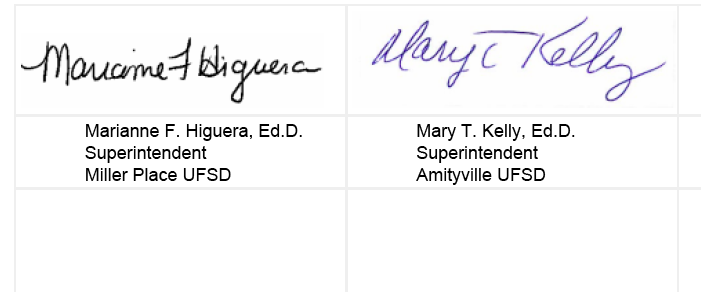
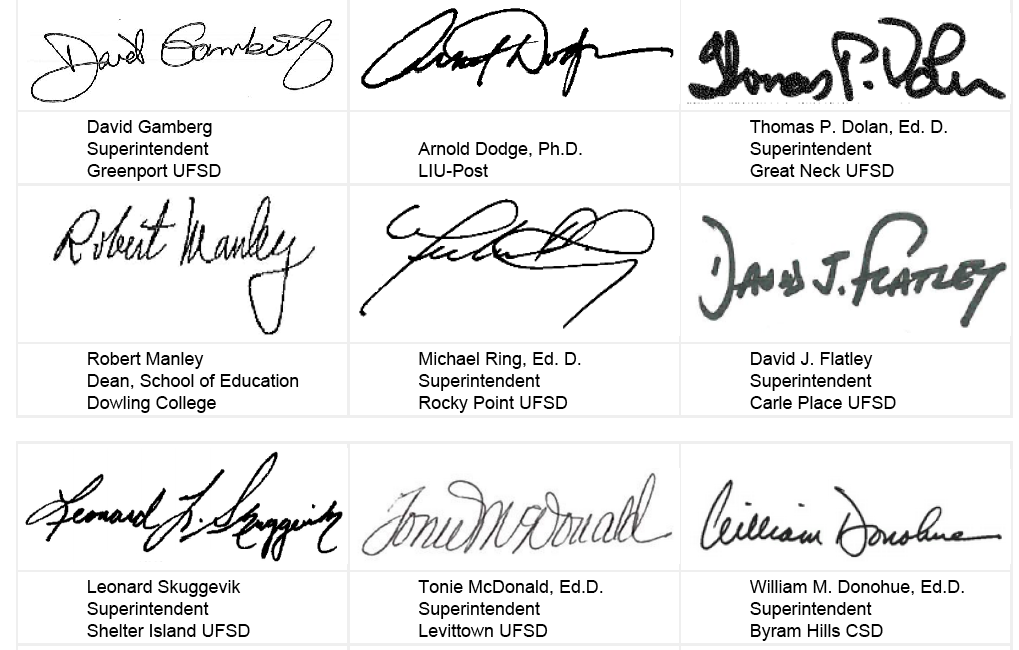
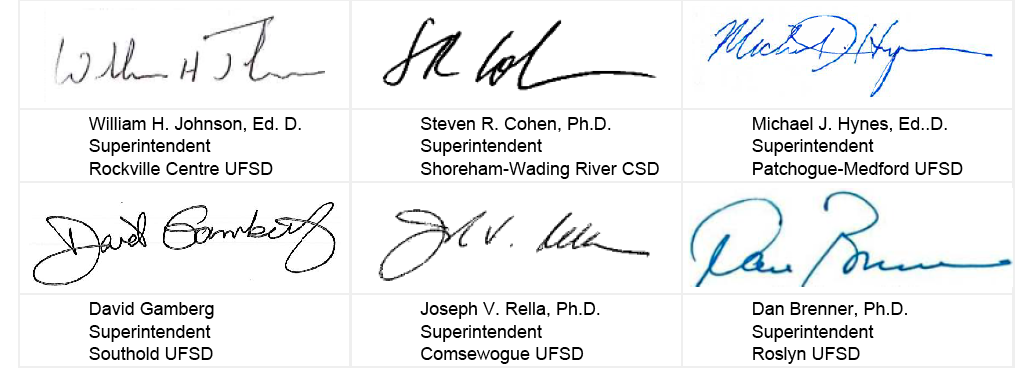
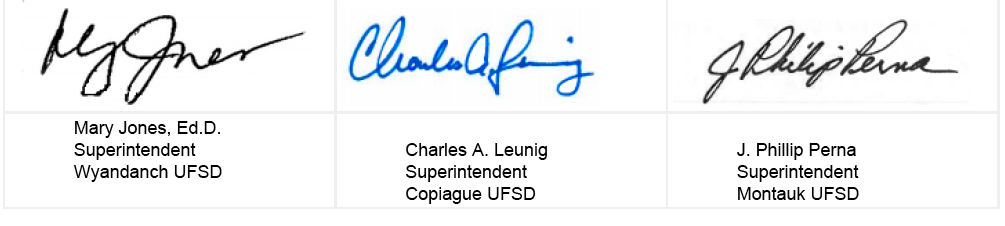
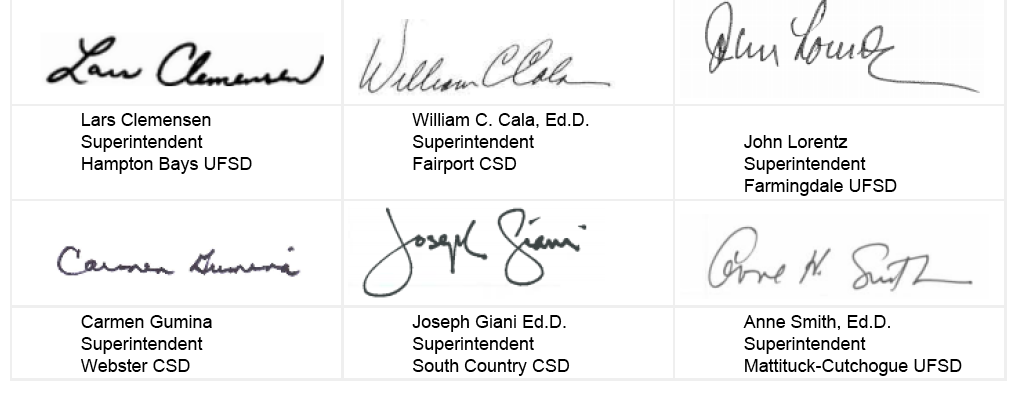
A group of school superintendents in New York banded together in late February to form The Alliance to Save Public Education.  They currently number 30 superintendents from Nassau County, Suffolk County, Westchester County, and Monroe County. They invite other superintendents from across the state to join them in signing their Declaration below. They welcome the signatures of school board presidents and leaders of parent associations as well.


Please contact your Superintendent, Board President, or PTA President to sign:


Print it, then sign the printout with a dark flair-type pen in a blank spot 


Scan & email it (or fax it) back to dgamberg@southoldufsd.com

You can download the letter to print here.


Here is the text of the letter:


March X, 2015


Dear Lawmaker:


Every day, nearly three million children and adolescents attend New York State’s public schools:  upstate and downstate, rural, urban and suburban, small, medium and large.  The variety is immense.  It may be painfully true that 109,000 students attend failing schools in New York State, but it also means that between 2.8 and 2.9 million students are attending successful schools.  Even in successful schools, we are familiar with a certain percentage of our children who fail.  We are constantly looking for ways within those systems to discover new and better methods to teach those struggling students and eliminate failure from the landscape of our public schools.  However, we must continue to support the segments of our systems that can create success.  In fact, they should be celebrated and replicated where possible.  The current effort at State reform, rather than focusing on our success and supporting what works effectively, appears to focus only on the State’s failures.  Failures can never be ignored, and do in fact need to be fixed, but not at the expense of damaging what creates our successful schools.


The Governor’s agenda is connecting the politics of State aid to education policy … AT WHAT COST?


The Governor’s agenda is removing control of our schools from our local communities … AT WHAT COST?


At what cost do we over test our students?  It must not be at the cost of our children, and our communities.


New York’s public schools include many that sustain student learning at high levels, and also some schools that fall below everyone’s expectations.  We believe the best use of our resources allows schools that work to continue to do so, and, at the same time, to support schools that need help to engage their students at the level we expect for all children.  In a state as varied as New York, a one-size-fits-all approach to school improvement is bound to damage schools that already engender students success, while dissipating the focused support that failing school require, to meet the needs of their students.


We urge the legislature to refrain from enacting the Governor’s proposals without a thoughtful debate.


Sincerely,


Screen shot 2015-03-11 at 8.43.08 PMScreen shot 2015-03-11 at 8.43.18 PMScreen shot 2015-03-11 at 8.43.28 PMScreen shot 2015-03-11 at 8.42.50 PMScreen shot 2015-03-11 at 8.42.20 PM

We are accustomed to seeing the Opt Out movement misportrayed in the mainstream media as union-led, when in fact the unions have sat on the sidelines.

John Merrow produced a fair and honest presentation of the issues in this PBS segment.

The transcript is included in the link. Merrow interviewed parents, students, critics and advocates of the Common Core standards and tests. He reports from Néw Jersey.

Brian Jones, a former teacher in the New York City public schools, is currently a doctoral student at the City University of New York. He here explains a conundrum: Many black parents think that choice and standardized tests are good for their children, despite abundant evidence to the contrary. How should he reason with those who disagree? He focuses here on the issue of standardized testing, which compels schools–especially those serving poor and minority students–to divert time and resources to testing and test preparation, thus leaving less time for the arts and other subjects that are essential ingredients of a good education. In his experience, it is best not to argue with parents who have been persuaded by the “reformer” claims, but to listen respectfully and to “deepen the conversation,” a term he learned from Chicago teacher Xian Barrett.


Jones writes:


Likewise, when we deepen the conversation about standardized testing, we usually discover that parents and educators want similar things for our children. If standardized tests are widely and loudly touted as an antiracist measure of opportunity and fairness, some parents who are desperately searching for some measure of fairness for their children might latch onto that. Those of us who are opposed to high-stakes standardized testing shouldn’t moralize with people, or disparage their viewpoints or their experience. Rather, we have to validate their experience and find a way to deepen the conversation.


In my mind, we can find a lot of common ground on resources and curriculum. Of course, I think teacher training is important. It is absolutely essential that teachers be trained to respect the languages, cultures, and viewpoints of students and their families—and engage them in the learning process. But this should never lead us away from demanding the kind of educational redistribution that this country refuses to take seriously. My experience as a student has convinced me that resources are central. On scholarship, I attended an all-boys’ private high school. As one of the few students of color (let alone black students), did I experience racism and prejudice? Absolutely. However, there are aspects of my education that I wouldn’t trade for anything—the opportunity to read whole novels and discuss them in small classes, the opportunity to participate in several sports teams, to put on plays, to engage in organized debates, and to practice giving speeches. If, for my own child, I had to choose between an amazingly well-resourced school with a fabulously rich curriculum staffed with some prejudiced teachers, on the one hand, and a resource-starved school with progressive, antiracist educators who were forced to teach out of test-prep workbooks on the other, I hate to say it, but I would choose the resources every time.


Our society is currently spending untold sums to create more tests, more data systems, more test preparation materials, ad nauseam. And then they have the audacity to tell us that these are antiracist measures! Of course, all this focus on testing is a huge market opportunity for the private companies that provide all these services and materials. What is never under serious consideration is the idea that we could take all those same millions of dollars and create for all children the kind of cozy, relaxed, child-centered teaching and learning conditions that wealthy kids already enjoy.

Denisha Jones, who holds a Ph.D. from Indiana University in curriculum and instruction, is presently a professor at Howard University. She is a regular contributor to EmPower magazine, where the following article appeared:


She writes that “reformers” claim that standardized testing will improve the achievement of children of color, although it is actually discourages many children of color. In this article, she includes a graph showing how the testing culture can contribute to the “school-to-prison” pipeline. Discouraged students are likelier to act out in school, likelier to be suspended because of “zero tolerance” policies, likelier to be pushed out of school, and likelier to end up in trouble.


These facts may be well known to educators, but they are not so well-known to civil rights organizations, 19 of which signed a statement supporting the continuation of annual testing in the new version of NCLB. Jones uses her article to explain that it is important to understand why they endorse policies that claim to advance civil rights (but don’t), to understand that they have genuinely good reasons for supporting annual testing, and to know that the way to engage in respectful dialogue, not demonizing diatribes.


She writes:


So why would 19 civil rights organizations demand more testing when there is a vast amount of research that shows how harmful high stakes standardized testing can be for low-income and minority children? I suspect that part of the reason is that the corporate reformers talk a good game. They appeal to parents who feel like they are trapped in failing public schools by co-opting the language of the civil rights movement. This is how an organization like Teach for America can be lauded by many as the savior of public education when in reality they place inexperienced, unqualified, mostly white recent college graduates in schools with students who have the most need, for a couple of years increasing the historic problem of teacher turnover. They claim to want to help low-income students but in reality they are a business that profits off of de-professionalizing the teaching profession by turning teaching into a 2 year temporary experience that anyone can do with five weeks of training. However if you are a parent and your child has consistently had teachers who are racist or do not seem to care, you might just appreciate this energetic fresh faced new comer. It is not hard to see how some parents can be deceived into thinking that the education reforms being forced onto schools are going to finally turn our public school system into an equitable and anti-racist institution.


So before you criticize these civil rights group for endorsing more testing you might want to ask yourself what would lead them to take that position. And you should ask yourself if your criticisms of them are going to expose the dangers of standardized testing or further alienate a group of people who have routinely been shut out from mainstream conversation. Criticism does not build allies or welcome people who have been marginalized to join the fight. This does not mean that we should not engage in a thoughtful discussion that challenges the dangers in believing standardized testing can put an end to racial discrimination in schools, but consider the difference in this response and the message it sends.


[Jones quotes this response, by Brian Jones, whose article follows this one on the blog]:


Likewise, when we deepen the conversation about standardized testing, we usually discover that parents and educators want similar things for our children. If standardized tests are widely and loudly touted as an anti-racist measure of opportunity and fairness, some parents who are desperately searching for some measure of fairness for their children might latch onto that. Those of us who are opposed to high-stakes standardized testing shouldn’t moralize with people, or disparage their viewpoints or their experience. Rather, we have to validate their experience and find a way to deepen the conversation.
If you are an ally to the education activists who are fighting to save public education from the grips of testing and profits, we need you to empathize with these people and not insult them by calling their thinking shallow. The reality is the corporate reformers know how to appeal to these parents concerns. They show sympathy and profess to be committed to helping these children escape the schools that continue to fail them. Maybe if we did the same they would see us as allies and join our fight. The true work of reforming public education into a system where oppression and discrimination are not tolerated and children engage in meaningful learning with teachers who use authentic assessment to guide students into tapping in to their full potential, can only be done when we stop criticizing those who have historically been on the receiving end of a unjust public education system and learn to work together to make our shared vision a reality.