Archives for the month of: March, 2015

Sheri Sobel, a mom in Chicago, writes:


“PARCC testing in Chicago!! My son is in 6th grade and was part of the 10% of CPS population scheduled to take the test; originally. As we are aware NOW, that CPS has to administer the test to 100% or lose IL funding to the tune of $1.6B, He suffers from an Anxiety Disorder and has been distraught, crying, literally freaking out about taking the test for the past 4 weeks.


“He was so distraught 3 weeks ago that I had to take him back to his dr. and therapist ASAP (he has been stable for the past 2 yrs. and seeing his dr. every 3 months and a therapist 1 or 2 times per month as needed). Now he has to go weekly.


“Yesterday was the last straw. No child has to take a standardized test and can opt out; however, this is not what my son was hearing from the teachers. I wrote a notice of refusal; sent it out to his teachers, counselors, and CPS testing director. When i picked him up from school yesterday and gave him a copy of the letter I sent out; it was like a wave of happiness and calm came over him.


“What are we doing to our kids that there is so much pressure on their performance for funding?”

Thank you, Susan Jolley, for sending this comment. I love this line from one of my favorite works of literature (yes, fiction, not informational text, which can teach us so much about the world and what matters most even when it cannot be tallied):


There is a line at the end of George Eliot’s Middlemarch that I have always loved about the value to society of the many people who never become famous but add immeasurably to other people’s lives: “for the growing good of the world is partly dependent on unhistoric acts; and that things are not so ill with you and me as they might have been, is half owing to the number who lived faithfully a hidden life, and rest in unvisited tombs.” It reminds me of the good but unheralded work done by so many teachers,

A Florida legislator has proposed letting any child transfer to any public school in the state, as long as there is space available and their parents transport them. This smacks of an ALEC-style attack on communities and local control. This is not about improving education but satisfying choice ideologues. ALEC values free-market fundamentalism over community and local control. Will it improve education? No, but who cares?

The article appeared in the Florida Sun-Sentinel. It is behind a pay wall.

It says:

School choices could expand
Under plan, parents have option to send children to schools all over state

By Scott Travis Staff writer

Parents unhappy with their child’s local school soon could have a much wider range of new choices under a proposal that drops district boundary requirements.

The state Legislature is considering a bill that would allow students to attend any public school in the state that has space, as long as families are willing to provide their own transportation.

That could mean parents could leave D-rated Deerfield Park in Broward County and head four miles north to A-rated Addison Mizner Elementary in Boca Raton, which is part of the Palm Beach County School District.

Miami-Dade parents could move their children from D-rated Barbara Hawkins Elementary in Miami Gardens to A-rated Dolphin Bay Elementary in Miramar.

Students even could attend a school several counties away, as long as their parents can get them there.

“The money would follow the child,” said bill sponsor Sen. Lizbeth Benacquisto, R-Fort Myers. “This could be for a parent who works in a different county from where they live and wants to have their child close to them. Or if a parent thinks another school district has the best learning environment for their child.”

The bill, which passed the Senate Education Committee Thursday, would apply to public schools below 95 percent capacity. That’s most traditional schools in Broward and Palm Beach counties, which have been losing students in recent years to charter schools. Parents also could choose charter schools in other counties if there is room.

About 23 states have similar policies, according to the Education Commission of the States, a Denver-based policy group. In some cases they are limited to students who are low-income or are attending failing schools.

For Broward County, this would be an expansion of an existing school-choice policy. The district allows parents to send their children to any underenrolled public school within the county. Students who are attending a school outside their boundary can get busing only if it’s one of the district’s designated magnet or choice programs, such as the Nova schools and Pompano Beach High.

Sharon Aron Baron takes advantage of that policy. She lives in Tamarac but drives 20 miles each way to Parkland to drop off and pick up her children at Park Trails Elementary and Stoneman Douglas High. While she probably wouldn’t consider a school in another county, she supports the proposal.

“The students get the money from the state, so the state’s covering their education. I don’t see anything wrong with it,” she said. “But I think the amount of people who would take advantage of it would be very slim.”

Palm Beach County School Board member Debra Robinson said she would be interested in the option as a parent and grandparent. But as a school official, she has concerns, including whether poor children would benefit without busing. “I wonder if we’re just adding more opportunity to a limited few, while pretending these are opportunities available for all,” she said.

Andrew Ladanowski, a Coral Springs parent who advocates for school choice, agrees that could create a dilemma. But he said providing transportation wouldn’t be a good option either.

“The more money we spend transporting students around town, the less money have that gets into the classroom,” he said.

stravis@tribpub.com   or
561-243-6637
Marie Corfield, teacher and education activist, tells here the worst PARCC story she ever heard. It is short and sad.

Can you top this?

Todd Farley wrote an insider’s view of the testing industry called “Making the Grades.” I highly recommend it. He said in the book that the standardized tests should not be used to determine anyone’s future. Read it!

He writes:

Opting Out?

​I spent fifteen years working in the testing industry, so of course I’ll be opting my sons out of the state tests.

Like I’d allow a completely-unregulated multi-billion dollar industry with a staggering history of errors to have any say in my children’s lives???

In fact, not only will I be opting my boys out, I’m doing it preemptively: My oldest is only in kindergarten, but I’m getting the letter ready now. My youngest is about seven years away from third grade, but if these silly tests still reign supreme then I can promise you I just won’t be opting the kids out: I’ll be leading a torch- and pitchfork-waving mob up to Pearson’s headquarters in midtown New York City, where some meddlesome education reformer who thinks he can make decisions about my boys’ lives is gonna’ get himself tarred and feathered.

And if anyone has any doubt that opting out is the only sane choice for your children, hear what really goes on behind the curtain of the standardized testing industry:

Tuesday
March 24
5:30-7pm

Earth School Auditorium
(600 E 6th St)

“Your Kids, Bad Data, and Corporate Profits:
Why a Testing Industry Insider
Is Refusing the Tests”

Todd Kaminsky, a Democratic Assemblyman from Long Island, stated his unequivocal opposition to Governor Cuomo’s tax credit proposal–a thinly veiled voucher that will benefit children who attend religious schools. However, the election is over, and now Assemblymember Kaminsky thinks that vouchers are a swell idea.

Maybe he thought that local parents are so busy fighting high-stakes testing that they wouldn’t notice that he wants to take money from their schools and send it to yeshivas, parochial schools, and madrasahs.

During the campaign, he was a vocal opponent of vouchers and received the endorsement of the teachers’ union. He said:

““It’s something that’s not going to happen,” Kaminsky said at the time. “Last year, it did not come up for a vote in the Assembly. I don’t know if it will again, but I can tell you it’s not something I favor.”

Now the election is over and the fickle Mr. Kaminsky says, “there’s a difference between campaigning and governing….”

“Nassau County’s Five Towns area, which Kaminsky represents, has a strong and growing Orthodox Jewish community. During our conversation, the assemblyman noted the tendency of Orthodox families to have many children, which puts a strain on their education budgets.”

Stephen Mucher, director of the Bard Master of Arts Teaching program in Los Angeles, warns about the precipitous decline in enrollments in teacher preparation programs.

Teachers are demoralized by scripted curricula and overemphasis on testing. They feel their voice doesn’t count in their workplace. Given the tide of teacher-bashing and mandates, they are right to feel demoralized.

“Career-minded college students are not oblivious to these developments. Since 2008, enrollment in teacher education programs in California is down 53%, and other bellwether states report a similar trend. Nationally, U.S. Department of Education statistics that include both traditional and alternative preparatory programs show that there were nearly 90,000 fewer teachers in training in 2012 than in 2008. Teach for America, which once celebrated 15 consecutive years of expansion, peaked in 2013. It is witnessing as much as a 25% drop in applications this year…..

“Our most promising educators crave work that honors their creativity and intellect. They are suspicious of easy answers. They need to hear more than the cliche that a great teacher can make a difference in a student’s life. They want to know whether this profession will make a difference in their own life.”

The teacher-bashing that has dominated the mainstream media in recent years has undermined the prestige of teaching. The insistence by the Gates Foundation, the U.S. Department of Education, and many governors that teachers should be judged by student test scores has undermined the profession. What other profession is told how to evaluate its members by state legislators and governors?

Frankly, it is tiresome to hear critics say that teachers are not our “best and brightest.” Neither are our critics. I doubt that most critics would know how to teach a classroom of 30 children of any age, but they feel emboldened to complain about those who do it every day.

As we see the pipeline for new teachers growing smaller, and many veterans taking early retirement, where will we find new teachers? Who will be held accountable for this crisis in the teaching profession?

Ever wonder who does the fun job of reading your children’s tweets, Facebook pages, and Instagrams? Stephanie Simon has done the investigative work, on behalf of politico.com, but really on behalf of parents and children across America.

In the new age of Common Core and online testing, student privacy is dead.

Simon visits companies that do the “monitoring.” She calls them “Common Core’s cyber-spies.”

She writes:

“Pearson is hardly the only company keeping a watchful eye on students.

“School districts and colleges across the nation are hiring private companies to monitor students’ online activity, down to individual keystrokes, to scan their emails for objectionable content and to scrutinize their public posts on Twitter, Facebook, Vine, Instagram and other popular sites. The surveillance services will send principals text-message alerts if a student types a suspicious phrase or surfs to a web site that raises red flags.

“A dozen states have tried to limit cyber snooping by banning either colleges or K-12 schools, or both, from requesting student user names and passwords, which could be used to pry open social media accounts protected by privacy settings. Among those taking action: California, Illinois, Michigan and Utah.

“At least five other states, among them New York and Maryland, are considering similar laws this session, according to the National Conference of State Legislatures.

“But such laws protect only accounts marked as private. Many kids post publicly to build up their online followings.

“And when they do, companies with names like Social Sentinel, Geo Listening, Varsity Monitor and UDiligence are there to read them.
The rise of online student monitoring comes at a time of rising parent protests against other forms of digital surveillance — namely, the vast quantities of data that technology companies collect on kids as they click through online textbooks, games and homework. Companies providing those online resources can collect millions of unique data points on a child in a single day. Much of that information is not protected by federal privacy law.”

Think of it: these companies “can collect millions of unique data points on a child in a single day.”

And that’s not all:

“Some of the monitoring software on the market can track and log every keystroke a student makes while using a school computer in any location, including at home…..

“Sometimes the monitoring is covert: One company advertises that its surveillance software, known as CompuGuardian, can run on “stealth mode.” At the other extreme, some high schools and colleges explicitly warn students that they are being watched and advise them not to cling to “a false sense of security about your rights to freedom of speech.”

Privacy is dead. Privacy is dead. Yes, your children are being watched. Companies you never heard of have collected vast amounts of information about them.

As the CEO of Sun Microsystems famously said in 1999, “you have zero privacy anyway. Get over it.”

Read more: http://www.politico.com/story/2015/03/cyber-snoops-track-students-116276.html#ixzz3V4nbs8Jj

Arthur Camins, director of the Center for Innovation in Engineering and Science Education at the Stevens Institute of Technology in Hoboken, N.J., warns that bipartisan agreement on the reauthorization of No Child Left Behind may be bad news.


Just as parents are expressing their disgust with annual testing, Congress is close to mandating annual testing for yet another seven years (or maybe another 12 years if past experience is any guide).


He writes:


Bipartisan agreement makes for strange bedfellows as seeming opponents engage in an uncomfortable collective embrace of federal mandates of yearly, high stakes assessment. In the absence of obvious political alternatives some civil rights groups fear that without the harsh light of disaggregated data poor performance will be ignored. Those whose ideology bends their policy choices toward privatization see inevitable failure in the face unreasonable demands as a means to undermine faith in public education. Some are in the campaign contribution thrall of testing companies that stand to gain or loose billions from publically funded testing expenditures. Still others have an abiding faith in the power of rewards and punishments to compel behavior.


The continued focus of high-stakes assessment is the education equivalent of building inspectors requiring pipe wrenches to be used by all plumbers, framers, electricians, roofers and tile-setters, while bypassing the advice and needs of contractors and workers. For education, the sure losers are deep sustainable learning and equity.


Like building a home, creating an education system is a complex endeavor. As anyone who has undertaken it knows, significant remodeling may be even more challenging. When building or remodeling a complex system, it’s best to have a large, varied set of tools. Choosing the right tool for the right purpose is an obvious but often ignored principle- not least in education assessment policy. Pipe wrenches are great for large plumbing valves, but wreak havoc on smaller nuts. They have nasty teeth that rip and apply too much torque. Selection from a full set of open-ended wrenches would be a far better choice. Needle nose pliers are just the right tool for bending wires for electrical connections, but far too imprecise for removing the accidental building-related splinter. So it is with large scale standardized testing in education. The right tool can get the job done. The wrong tool fails and often causes damage….


Let’s start with the big picture. Education has three equally important purposes: Preparation for students for life, work and citizenship.


The values principle of equity implies that the design of our education system should accommodate and address the diverse needs of all students. To be clear, equity as used here has two meanings: opportunity equity and lived equity. The former refers to what is often called a fair shot to move up the socioeconomic ladder. The latter refers to a shorter ladder, in which position on the lower rungs does not preclude access to a decent secure life, with adequate food, clothing, housing and health care– what we have come to expect of a middle class life. The United States has neither kinds of equity and needs both.


The precision principle suggests the need to develop and select a variety of tools to assess progress and success with respect to all of the purposes and components of an effective education system. To assess education’s how are we doing questions, we need subsystem precision, lest we make the education-equivalent mistake of using meter sticks when micrometers are needed….


Equitable resources are essential, but they do not ensure equitable outcomes. While constitutionally, much of education decision-making authority in U.S. is delegated to the states, the interconnectedness of the nation clearly indicates that local outcomes are a national concern. Ineffective or poorly funded education in one state impacts another. The periodic National Assessment of Educational Progress (NAEP) serves to monitor outcomes across the states. The NAEP is not given to every student at every grade in every year. Instead, it is administered at the end of grade bands and uses the well-known statistical strategy of sampling. Politicians know this technique well. They rely upon it extensively when they do polling to gauge potential policy positions because querying every citizen is impractical and not needed to get the information they need. As a tool for fair state or large city level big-picture achievement monitoring, NAEP does the trick, but different non-comparable state-designed tests do not….


ESEA reauthorization should not:


Mandate consequential state testing;
Include requirements for student assessment-based teacher evaluation.


ESEA reauthorization should:


Ensure funds to provide for and measure the attainment of equitable resources;
Provide funds to locales to increase educator expertise in the use formative assessment strategies to improve daily learning.
It is past time for all supporters of equitable education for life, work and citizenship to call out No Child Left Behind with its high-stakes testing centerpiece as a failed Faustian bargain. Choosing the right tools for the right purposes is a common sense starting point.


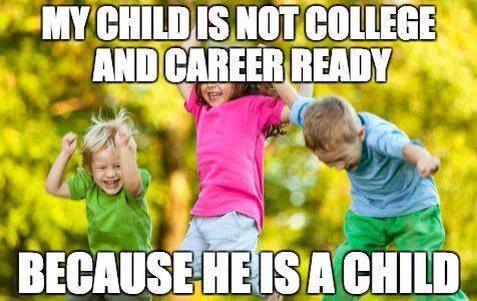
This wonderful photo is making the rounds on Twitter. The quote was taken from Monroe County ICPE (Indiana Coalition for Public Education) chairperson Cathy Fuentes-Rohwer’s speech at the Indiana State House last month. When I hear about “college and career ready standards” for elementary school and middle school children, I am reminded of the famous words of Secretary of Education Arne Duncan, who once famously said:


“We should be able to look every second grader in the eye and say, ‘You’re on track, you’re going to be able to go to a good college, or you’re not,’ ” he said. “Right now, in too many states, quite frankly, we lie to children. We lie to them and we lie to their families.”


When I look at my young grandchildren, ages 8 and not quite 2, this is the same thought that occurs to me, as I feel sure it does to most parents and grandparents:


collegeready