Public Schools First in North Carolina finds it strange that the legislature can’t find the money to raise teachers’ salaries but easily finds money to fund vouchers for the rich.

Its latest notice says:

This week House majority leader Tim Moore announced that a legislative short session priority would be to increase funding for vouchers for the coming year by around $300 million to ensure that the state could fund vouchers for all families who applied. More than half of the applications came from families with incomes too high to have been eligible last year. Our March 9 newsletterdescribed the applicant pool breakdown and pointed out that increased demand this year was likely due to the state spending $1,000,000 to market the program and droves of existing high-income private school families seeking a taxpayer-funded discount coupon for their tuition bill.

From 2018-19 through 2022-23, the percentage of new applicants who actually accepted vouchers ranged from 44% to 51%. If historical patterns hold, the current voucher budget would more than pay for Tier 1 and Tier 2 families, cover the cost for returning voucher recipients (typically 80%) and be left with $50 million extra. In other words, more voucher funding is only needed to pay for vouchers for the upper-income families.

To put Moore’s priorities in sharp relief, his announcement came one week after the State Board of Education heard from DPI staff that last year’s teacher attrition rate was higher than it had been in decades. It hit 11.5%, which represents a whopping increase of 42% over last year’s attrition numbers.

The attrition rates were driven by especially high attrition for teachers with fewer than five or more than 26 years of experience. The highest rate, 26%, was the same for first-year teachers and veteran teachers with 35+ years of experience.

When asked about teacher salaries, Moore did say he thinks there may be room in the budget for teacher raises, and that the short session would address the looming crisis in early childhood care funding.

But North Carolina has some serious catching up to do when it comes to bringing teacher salaries to a level where they will attract and retain teachers. North Carolina lags behind all surrounding states in state-funded salaries. Our beginning teachers start out lower and our veteran teachers remain at the bottom. (See our fact sheetfor links to salary schedules.)

In 2023-24, North Carolina’s state minimum beginning teacher salary was $39,000. While it is scheduled to increase to $41,000 in 2024-25, it will still lag behind the beginning salary in neighboring states. And young people looking at teaching as a possible profession will be put off by the relatively poor earnings trajectory.

Strong support for bolstering salaries also came from North Carolina’s Fiscal Research Division’s recent analysis of state-funded salaries that found only deputy clerks of court had lower starting salaries than teachers. After the 7th year, deputy clerks made more. Only state highway patrol officers had lower maximum salaries than teachers. 

Many local communities are working to make up for state neglect by offering teacher salary supplements, but this remedy simply exacerbates existing inequities. In 2023-24 teacher salary supplements ranged from $10,650 in Chapel Hill/Carrboro School District to $0 in Caswell County, Graham County, and Weldon City Schools.

Teacher salary increases barely scratch the surface of what the NCGA could do to improve conditions for public school educators, students, families, and communities. Funding for instructional assistants, school psychologists, counselors, nurses, and social workers is desperately needed. The looming child care crisiswill require fast action to prevent child care centers across the state from closing.

According to Moore, North Carolina has ample funds in reserve to pay the private school tuition vouchers for wealthy families. Perhaps those tax dollars should be redirected toward programs that serve the taxpaying public at large. 

Jonathan V. Last writes for The Bulwark, an excellent Never Trumper site. He noticed a curious phenomenon. Whenever there’s good economic news, the mainstream media worries that good economics news is bad news for Biden? What?

He writes:

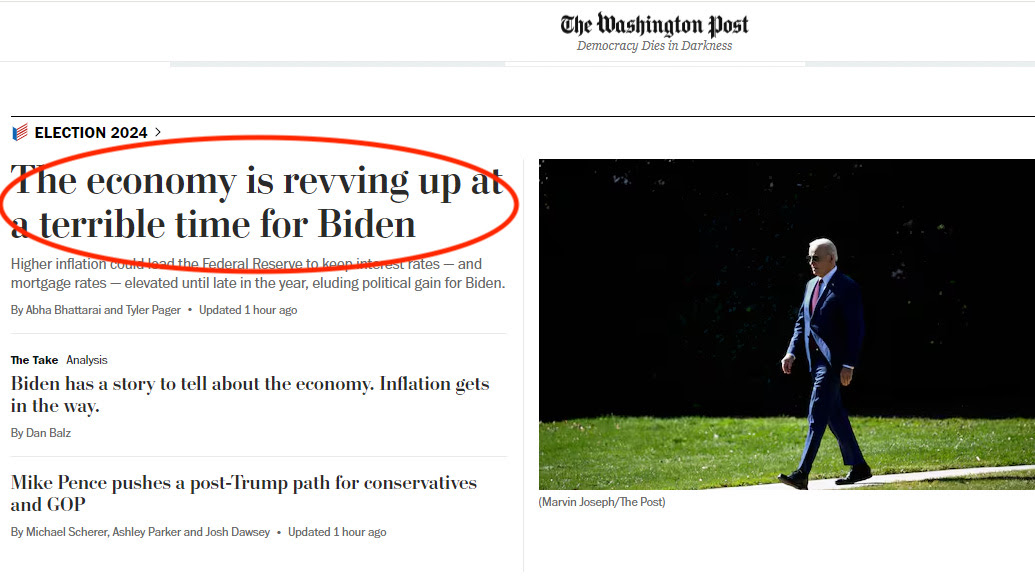
We’ve reached the ne plus ultra of Here Is Some Good News and Also Why It’s Bad for Biden headline writing. I present to you an April 13 story in the Washington Post by Abha Bhattarai and Tyler Pager. (Don’t click the link yet.)

The piece is about the current economic indicators we’re seeing in the March reports: Job growth, wage growth, consumer spending—all headed in the right direction. The economy is, the piece declares, “booming.”

Now, are you ready for the two headlines the Post gave the piece?


Before I make your head explode, this is the part where I say that you should join Bulwark+ because we don’t do happy talk, but we also don’t pull the type of nonsense where we say “Puppies were spotted at the White House, here’s why that’s bad for Biden.” 

If we want a better media, we have to build it. That’s what we’re doing here and we’d love it if you joined us.

Okay, so back to the Post.

Here’s Headline #1:

And here’s Headline #2:

Here is a real sentence written by a real person at the Washington Post: “The economy’s unfettered strength is becoming more of a political liability for the White House.”

Are you forking kidding me?

We are deep into heads-I-win, tails-you-lose territory. Would it also be a political liability for the White House if, I dunno, we were experiencing deflation and the economy was shrinking? If unemployment was rising? If wage growth was stagnant?

Pray tell, describe the economic conditions which augur political benefits for the Joseph Robinette Biden?


My two complaints:

(1) The piece is wrong on the merits: We have seen a small—but measurable—increase in Biden’s poll numbers over the last month. He is not being harmed by the economy. Or at least, his political prospects are improving, so if the economy is causing him harm, that debit is being overbalanced by something else that’s working in his favor.

(2) The Post isn’t providing analysis, it’s manufacturing a rationalization. As I’ve written before, if you came down from Mars and looked at all of the economic data and had to guess who was winning the election right now, you’d think Biden was on track for a landslide. The fact that he isn’t indicates that something interesting is going on. Instead of investigating that interesting thing, the Post is trying to pretend that everything is normal. Which is what causes them to say, Uhhh, Biden’s not doing so hot. And the economy is great. So . . . here’s why having a great economy is bad for Biden!

1. Oh, who am I kidding: The videotape wouldn’t hurt Trump at all. Sigh.

Republican leaders, including Trump and gubernatorial candidate Kari Lake, were appalled when Arizona’s Supreme Court overturned the state’s 15-week abortion and upheld an 1864 abortion ban.

Democrats wanted to introduce a bill to repeal the 1864 law. But today Republicans refused to consider their motion.

CNN reported:

The Republican-controlled Arizona House of Representatives once again failed to advance a repeal of the state’s 160-year-old abortion banWednesday, days after the state Supreme Court roiled state politics by reviving the law.

The vote is a blow to reproductive rights as well as GOP candidates in competitive races, who have been scrambling to distance themselves from the court’s decision. Republicans facing competitive races in the state, including former President Donald Trump and US Senate candidate Kari Lake, called on the GOP-controlled legislature to work with Democratic Gov. Katie Hobbs to take a more moderate path.

On Wednesday, following two attempts to discuss a bill that would repeal Arizona’s 1864 ban on abortions, lawmakers voted not to discuss the measure on the House floor.

The representatives’ votes were evenly split, with the chair making the tie-breaking decision. The bill itself was not brought up for a vote.

“The last thing we should be doing today is rushing a bill through the legislative process to repeal a law that has been enacted and affirmed by the legislature several times,” House Speaker Ben Toma said during debate.

If the 1864 law were repealed, Arizona would revert back to a 15-week abortion restriction signed into law in 2022 by then-Gov. Doug Ducey, a Republican. The state court delayed enforcement of the ban for at least 14 days to allow plaintiffs to challenge it, meaning abortions are still allowed in the state.

The ban prohibits the procedure except to save the life of the pregnant person and threatens providers with prison sentences between two and five years.

If the 1864 law goes into effect, Arizona would join 14 states that have passed near total abortion bans, some with no exceptions for victims of rape or incest…

March Wall Street Journal poll, conducted before the state Supreme Court ruling, found that 59% of registered voters in Arizona believe abortion should be legal in all cases or most cases with some restrictions. Another 27% said they believe abortion should be illegal with exceptions for rape, incest or when the pregnant person’s life is endangered. Nine percent said the procedure should be illegal in all cases.

In Florida, it is never too soon to learn about the dangers of Communism! Governor DeSantis just signed a bill to teach about Communism in schools from K-12.

Some questions:

1) Will students learn about the dangers of Communism or the dangers of dictatorship?

2)Will students learn only about Communism only in Cuba or will they also learn about it in Russia, China, Vietnam, and Cambodia, and elsewhere?

3) Will they learn about the dangers of fascism and study the Nazis and their ideology?

4) Will students learn about dictatorship, whether Communist or fascist, and the ideology and practices they have in common, e.g. censorship of books and public media, suppression of dissent, jailing of dissidents, subservience of the judicial and legal authorities to the dictator, control of what is taught in schools and universities, persecution of ideological enemies, etc.? Assignment of books such as Brave New World, 1984, and Animal Farm. Will students be allowed to study examples of censorship and suppression in our society?

Ryan Dailey writes in The Orlando Sentinel:

Flanked by veterans who served in the Bay of Pigs invasion, Gov. Ron DeSantis on Wednesday signed a measure that will lead to the history of communism being taught from kindergarten to the 12th grade in public schools.


“We’re going to tell the truth about the evils of communism,” DeSantis said at the bill signing in Hialeah Gardens.


State lawmakers overwhelmingly approved the measure (SB 1264) during the 2024 legislative session that ended last month. Under the bill, lessons on the history of communism will be added to required instruction in public schools starting in the 2026-27 school year.


The lessons would have to be “age appropriate and developmentally appropriate” and incorporate various topics related to communism, its history in the United States, including tactics used by communists.

“Atrocities committed in foreign countries under the guidance of communism,” also would be required as part of the lessons.


“All of this will be spread across the curriculum K through 12,” said Education Commissioner Manny Diaz Jr. The Department of Education will draw up academic standards for the lessons.


DeSantis signed the bill on the 63rd anniversary of the Bay of Pigs Invasion and was joined at the bill-signing event by people who fought in the invasion in an attempt to overthrow the Fidel Castro regime…

Florida students are already taught about communism in high-school social studies classes and in a seventh-grade civics and government course. A high-school U.S. government class required for graduation also includes 45 minutes of instruction on “Victims of Communism Day.”

Jay Kuo interviewed John D. Gartner, psychologist and psychotherapist, who leads a group called Duty to Warn. The group consists of mental health professionals who are concerned about Trump’s cognitive decline. Gartner told Kuo: there are increasing signs the former president is heading fast down the road toward dementia. 

I’m offering excerpts from this fascinating interview.

Kuo asks, Gartner answers:

We hear a lot about Biden’s age and gaffes, to the point where most Americans cite Biden’s age but not Trump’s as a big issue for the election, even though they are only three years apart. Based on what you and other experts have observed, why are you sounding the alarm about Trump, but not about Biden?

I call it the “double lie.” Pathologizing Biden’s normal aging is the first lie. Normalizing Trump’s dementia is the second. The sorts of small lapses we’ve seen in Biden are part and parcel of normal aging. Forgetting names and dates doesn’t make us seniors less competent. What we lack in memory we more than make up for in judgment, experience, and wisdom. Other cultures revere their elders, but America in 2024 mocks and devalues theirs. The problem isn’t old people in government—the dreaded “gerontocracy.” It’s age-ism.

Joe Biden’s calling the current president of France by the old president of France’s name is like me calling my youngest daughter by my oldest daughter’s name, which I do all the time. When I get together with my fellow senior citizens, the topic of forgetting often comes up. Sure, I forget names and even appointments sometimes. But I’m a better psychologist now than I’ve ever been. I actually pity the patients who had the young Dr. Gartner. He didn’t know anything, and, honestly, I can’t even imagine why anyone paid him. I would argue that Biden, too, has objectively performed well at his job, despite, or maybe even because, of his age. Don’t judge us senior citizens by how fast we walk, or if we stumble over a name or two. Judge us by our performance.

And hello. Forgetting the name of the president of France isn’t the same as thinking Obama is president or that Nikki Haley and Nancy Pelosi are one person. Can we introduce a sense of proportion and some common sense here?…

Here are some of Gartner’s examples of Trump’s strange language in public:

Trump shows formal signs of disordered speech we typically see only in organically impaired dementia patients:

A) “phonemic aphasia”

Trump uses non-words in place of real words, that usually include a fragment of the actual word. For example saying “mishuz” instead of missile, or “Chrishus” instead of Christmas. You can look at supercut reels assembled by Ron Filipkowski on TwitterThe Daily Show, and now by the Democratic House Judiciary Committee, as well. Both Chairman Nadler and Rep. Swalwellshowed their own supercuts of Trump’s cognitive decline at the Hur hearings, to counteract Hur’s partisan slur about Biden’s “poor memory.”

To demonstrate how pervasive these errors are, I present this long but far from exhaustive list of Trump’s phonemic aphasias:

“President U-licious S Grant” (For Ulysses S. Grant)

“space-capsicle” (for space capsule)

“combat infantroopen”(for combat infantry)

“sahhven country”(for sovereign country)

“renoversh” (For renovations)

“Anonmmiss” (for anonymous).

“transpants” (for transplants)

“lawmarkers” (for lawmakers)

“supply churn” (for supply chain)

“Rusher” (for Russia)

“raydoh” (for radio)

“Liberal-ation (for liberation”)

“benefishers” (for benificiaries)

“con-ducking” (for conducting)

“stat-tics, suh-tic-six” (for statistics)

“crimakle” (for criminal)

“armed forsiva” (for armed forces)

“internate” (for Internet)

“transjija” (for transition)

“stanktuary” (for sanctuary)

That last example took place during Trump’s State of the Union Address, just to contrast that with the SOTU we just witnessed. In recent rallies in GA, NC, and VA over the course of just a few days Trump evidenced more examples:

“We have becrumb a nation”

“All comp-ply-ments” to Joe Biden.

“I know Poten.”

“He can’t cam-pay. He can’t campaign.”

“We will expel the wald-mongers.”

But of course, this is exactly what we should expect. As he deteriorates, these deficits will make themselves apparent more and more often. Now he can’t get through a rally without an example. Cornell psychologist Harry Segal speculated Trump may be “sundowning” and hence most vulnerable to going off the rails at night-time rallies.

Some have argued that Trump’s impaired speech could be an articulation problem, rather than a brain problem. Some have argued he could be slurring from a variety of causes, from loose dentures to drug toxicity (indeed many have speculated that Trump might be abusing or even snorting Adderall or some other stimulant.)

But all those competing explanations are disproven by one fact. Trump commits these aphasic errors in his written posts, as well, proving the problem is in his brain, not his articulation. 

For example, he recently posted:

“Joe Buden DISINFORMATES AND MISINFORMATES”

B) “Semantic aphasia”

Semantic aphasia is using a real word, but in a way that doesn’t correspond to its meaning. For example, when Trump referred to the “oranges of the investigation.” Another example would be “midtown and midturn elections.” Recently, when apparently trying to say “three years later,” Trump said:

“Three years, lady, lady, lady.”

More recently Trump said at a rally:

“We’re going to protect pro-God…”

In mid-sentence he goes blank and looks at the ceiling. When he reboots, the words he uses to complete the sentence don’t make sense:

“…context and content.”

C) Complete loss of all verbal language

Like an infant sometimes, Trump just makes sounds:

“Gang boong. This is me. I hear bing.”

Until finally, he is reduced to silence. 

“Saudi Arabia and Russia will re-ve-du. Ohhh…”

Trump’s face went blank, followed by a sigh, and a silent pause while he looked at the ceiling.

D) Tangential Thinking

Trump evidences “tangential thinking” where he drifts from one unrelated thought fragment to another, and sometimes tries to “confabulate” them into a story. But the narrative is literally incoherent. When the press describes Trump’s speeches as “rambling,” they are gaslighting us with a euphemistic word that normalizes the grossly abnormal. Trump regularly degenerates into

incomprehensible strings of words.

Just recently outside a New York courtroom, Trump declared:

“We can’t have an election in the middle of a political season. We just had Super Tuesday. And we had a Tuesday after Tuesday already.”

Other examples would be:

“We are an institute in a powerful death penalty. We will put this on.”

“I could tell you about aircraft carriers, where they use electric catapults. They couldn’t go to the steam, which works better for about 1/100th the price, you know? The electric catapult, you know that story? I could tell you about the elevators on a tremendous carrier, the Gerald Ford, and they decided not to use hydraulic like the John Deere tractor, they decided to use magnets, ‘we’re gonna use magnets!’ to lift up the elevators with seven planes.”

In a recent string of rallies in GA, SC, and VA he said:

“They say I’m cognitively impaired. I’m not cognitively.”

“They don’t want illegal immigrants knocking on their front door and saying I’m going to use your kitchen. And I’m going to use your bedroom and there’s not a damn thing. And that’s the nice ones, okay?”

“They raided my house in Florida, Mar-a-Lago, they raided. With no raid, they had no reason to do so.”

Some of his utterances are incomprehensible for a different reason. They suggest Trump is so disoriented he’s occupying a different reality than everyone else. 

For example:

“They’re weaponizing law enforcement for high-level interference against Joe Biden’s top and only political appointment. A guy named me. A guy named me.”

At a recent rally, he said: 

“Biden beat Barack Hussein Obama. Ever heard of him?”

Biden never beat Obama. So we have to conclude that Trump is confused about basic reality, and living in a different reality that changes unpredictably. When a confused patient is evaluated in an emergency room, a standard psychiatric question to determine if a patient is disoriented is:

“Who is President of the United States?” 

If you get that wrong the most probable explanations are dementia, psychosis or drug toxicity, and most probably you’d be admitted for observation in any case.

From Diane: since writing this post, I saw this clip of Trump speaking about the border. Please watch it.

It’s a tweet from Republicans Against Trump.

Donald Trump on the border crisis:

“People are pouring over. It’s sort of known as Steak Mountain. Steak Hill. Snake. Snakes…a lot of snakes…rattlesnakes…”

Carol Burris writes here about a charter scandal in South Carolina. Carol is the executive director of the Network for Public Education.

She writes:

Last week, an excellent investigative report on a for-profit-run charter chain appeared in South Carolina’s Post and Courier. Entitled How a Florida principal with a controversial history became a SC charter school kingpin, it was written by Hillary Flynn and Maura Turcotte. These reporters put extraordinary care and diligent research into the piece.  I know because, over the course of a year, Flynn would call me from time to time for insight into the for-profit charter world. There is no transparency in South Carolina. You need FOIAs to determine which schools in the state are even run by for-profits. Here is a summary of what they found. 


Pinnacle, a Florida for-profit corporation, has three charter schools in South Carolina. 

Its creator and owner, Michael D’Angelo, is a former Florida charter school principal who was fired from a for-profit chain. He then moved to another charter, where he wrote himself reimbursement checks with no invoices and got fired again.


Undeterred by his previous failures, D’Angelo tried to open several charter schools in Florida. Despite being told he did “not have the competency to operate a charter school,” he found an accountant, created a for-profit charter management company, and headed to South Carolina to open Gray Collegiate Academy.


When Pinnacle’s school got into trouble with the South Carolina Public Charter School District for noncompliance, Pinnacle went shopping for a new authorizer for its charter school. A Christian college, Erskine College, stepped in. It later accused Pinnacle of fraud. Then, two Pinnacle Schools moved to another Christian College, Limestone College, for authorization. Authorizers receive substantial fees from the schools, a bonanza for cash-strapped colleges. 


The process of authorizer shopping, a common practice in states like Ohio and Michigan with large for-profit sectors, is a glaring loophole in the system. The authorizer, who stands to gain substantial fees from the schools, can provide a new lease of life to a shady charter school. A South Carolina Senate bill aims to curb this practice, but it faces fierce opposition from the charter lobby. The National Alliance of Public Charter Schools even lobbied to ensure that states with multiple authorizers are privileged when getting big CSP grants, further exacerbating the issue of authorizer shopping.


Meanwhile, Pinnacle plans to open two more schools, serving as additional cash cows for D’Angelo and his friends.


You can read the excellent investigative reporting on Pinnacle here. While you must register with the paper to see it, it is not behind a paywall. Kudos to Flynn and Turcotte. 


Peter Greene was a classroom teacher for 39 years, and he knows that teachers are overworked. There are not enough hours in the day for them to meet all their obligations. He considers in this post what to do. He certainly does not think that AI or scripted curriculum is the answer.

He writes:

When I was ploughing through the Pew Center survey of teachers, I thought of Robert Pondiscio.

Specifically, it was the part about the work itself. 84% of teachers report that there’s not enough time in the day to get their work done, and among those, 81% said that a major reason was they just have too much work (another 17% said this was a minor reason, meaning that virtually no overstretched teachers thought it wasn’t part of the problem at all). The other reasons, like non-teaching duties, didn’t even come close.

Meanwhile, in another part of the world this weekend, Pondiscio was presenting on something that has been a consistent theme in his work– Teaching is too hard for mere mortals, and we need a system that allows teachers to focus on teaching. 

Pondiscio has long argued that some aspects of teaching need to be taken off teachers’ plates so that they can put more of their energy into actual classroom instruction. I’ve always pushed back, but maybe I need to re-examine the issue a bit. 

Plugging 47 Extension Cords Into One Power Strip

Certainly every teacher learns that there’s never enough. One of my earliest viral hits was this piece about how nobody warns teachers that they will have to compromise and cut corners somewhere. It touched many, many nerves. We all have stories. My first year of teaching I worked from 7 AM to 11 PM pretty much every day. I had a gifted colleague who couldn’t bring herself to compromise on workload, so once every nine weeks grading period, she took a personal day just to sit at home and grade and enter papers. And let’s be honest–being the teacher who walks out the door as the bell rings, and who carries nothing out the door with them–that does not win you the admiration of your colleagues.

Being overworked is part of the gig, and some of us wear our ability to manage that workload as a badge of honor, like folks who are proud of surviving an initiation hazing and insist that the new recruits should suck it up and run the same gauntlet. On reflection, I must admit this may not be entirely healthy, especially considering the number of young teachers who blame themselves because they can’t simply gut their way past having overloaded circuits. 

There’s also resistance because the “let’s give teachers a break” argument is used by 1) vendors with “teacher-assisting” junk to sell and 2) folks who want to deprofessionalize teaching. That second group likes the notion of “teacher-proof” programs, curriculum in a box that can be delivered by any dope (“any dope” constitutes a large and therefor inexpensive labor pool).

We could lighten the teacher load, the argument goes, by reducing their agency and autonomy. Not in those exact words, of course. That would make it obvious why that approach isn’t popular.

Lightening the Load

So what are the ways that the burden of teaching could be reduced to a size suitable for actual mortals. 

Some of the helps are obvious. Reduce the number of non-teaching duties that get laid on teachers. Study halls. Cafeteria duty. Minute-by-minute surveillance and supervision of students. 

Some of the helps are obvious to teachers, yet difficult to implement. Most schools has a variety of policies and procedures surrounding clerical tasks that are set up to make life easier for people in the front office, not teachers in the classroom (e.g. collecting students excuses for absence, managing lunch money, etc). Then there’s the tendency to see new programs adopted at the state or district level with a cavalier, “We’ll just have teachers do that” as if there are infinite minutes in the teacher day and adding one more thing won’t be a big deal. Imagine a world in which preserving teacher time was a major sacred priority. 

Some of the helps would be hard to sell because they would cost real money. Quickest way to reduce teacher workload? Smaller classes. Or more non-teaching hours in the day for teachers to use for prep and paperwork (hard sell because so many boards believe that a teacher is only working when she’s in front of students). These are both tough because they require hiring more staff which 1) costs a bunch of money and 2) requires finding more of the qualified teachers that we already don’t have enough of.

So what are we left with?

Hiring aids to do strictly clerical stuff like scoring objective tests and putting grades into the gradebook. There are also plenty of folks trying to sell the idea of suing AI to grade the non-objective stuff like essays; this is a terrible idea for many reasons. I will admit that I was always resistant to the idea of even letting someone record grades for me, because recording grades was part of how I got a sense of how students were doing. Essentially it was a way to go over every single piece of graded work. But that would be a way to reclaim some time.

But after all that, we’ve come down the biggie, and the thing that Pondiscio has always argued is a huge lift for mere mortals–

Curriculum and instructional planning.

The Main Event

As a classroom teacher, the mere suggestion of being required to use canned curriculum made my hackles climb right up on my high dudgeon pony. For me, designing the lessons was part of any important loop. Teach the material. Take the temperature of the students and measure success. Develop the next lesson based on that feedback. That’s for daily instruction. A larger, longer, slower loop tied into larger scale feedback plus a constant check on what we’d like to include in the program. 

I like to think that I was pretty good at instructional design. But I must also admit that not everyone is, and that teachers who aren’t can create a host of issues. I will also fly my old fart flag to say that the last twenty years have produced way too many neo-teachers who were taught that if you design your instruction about the Big Standardized Test (maybe using select pieces of the state standards as a guide) you’re doing the job. I don’t want to wander down this rabbit, but I disagree, strenuously. 

So is there a place for some sort of high-quality instructional design and curriculum support for mere mortal teachers. Yes. Well, yes, but.

While I think a school should have a consistent culture and set of values, I think a building full of teachers who work in a wide variety of styles and approaches and techniques is by far the best way to go. Students will grow up to encounter a wide variety of styles and approaches in the world; why should they not find that in school (and with that variety, a better chance of finding a teacher with whom they click)?

Please open the link to finish reading.

Ray Stern of The Arizona Republic reports that the two houses of the legislature are so closely divided that Democrats would throw out the 1864 ban on abortion with the help of only a few Republicans. Even Trump crony Kari Lake is embarrassed by the 1864 ban.

Arizona Democrats, aided by a pair of Republicans in each chamber of the Legislature, appear to have the votes to pass a bill repealing the state’s 1864 abortion ban.

Almost anything is possible with a vote of 31 out of 60 in the state House, or 16 out of 30 in the state Senate.

Lawmakers say they expect to see a vote on the repeal when they return to work on Wednesday, even though the Legislature’s leaders don’t want it. The process almost started last week but stalled when Republicans didn’t get behind it.

Republicans hold one-seat majorities in the House and Senate, but Democrats can reach a majority with help from a few Republicans. Rules normally require that bills get heard by committees and move along the process according to set timelines, but a majority of members can vote to waive the rules.

The public reaction against the 1864 ban has been so intense that some Republicans might vote to overturn it. But there may be some Democrats wondering if they should take the issue off the table before November.

Nebraska voucher advocates are trying to head off a referendum because they know they will lose. Senator Lou Ann Linehan has introduced a bill intended to fund vouchers and block a referendum, thus preventing Nebraskans from voting on whether they want vouchers.

Senator Linehan is working with Betsy DeVos’s advocacy group American Federation for Children.

Of course, they don’t want to let the public decide! Vouchers will lose!

In every state referendum on school vouchers, they have always been defeated. The public wants public tax dollars to go to public schools! The public does not want to subsidize the tuition of students who attend private and religious schools. In every state that has vouchers, most are claimed by students who already attend non-public schools. Worse, as Michigan State’s Josh Cowen has demonstrated, students who leave public schools with vouchers fall far behind their public school peers.

And of course, vouchers drain funding from public schools, attended by the vast majority of children.

From: Brooke @ Stand For Schools<info@standforschools.org>
Date: Mon, Apr 15, 2024 at 5:05 PM
Subject: The Fight Continues: LB 1402

Dear Friend,

 LB 1402, Senator Linehan’s private school voucher bill, passed through general and select file debate last week. With that, LB 1402 could become the first bill in Nebraska’s legislative history to overturn a law with a referendum on the ballot for November, bypassing your right to vote. 

We urge you to please contact your Senatorand tell them NO to LB 1402 and to let Nebraskans vote on public funds to private schools in November!  

Contact Your Senator!

Instead of sending public dollars to private schools, which are under no obligation to serve all children, tell your Senator you support the public schools that 9 out of 10 Nebraska students attend, and so should they.

Contact your Senatorand tell them NO LB 1402 and that you support public education!

Contact Your Senator

Thank you for your continued support of Stand For Schools and Nebraska public education! 

 The Stand For Schools Team  

Facebook
Twitter
Instagram
TikTok
LinkedIn

Follow us on social media for legislative updates, Nebraska public education stories, and more!

Donate

Stand For Schools
211 N 14th Street
Lincoln, NE 68508
United States

Drew Harrell of The Washington Post published a sad article about the Trump devotees who have put their life savings into his DJT stock offering and have no concerns about its value or its future. They are so certain that he is a financial genius that they expect the stock to soar, once the “liberals” stop depressing its market price.

Jerry Dean McLain first bet on former president Donald Trump’s Truth Social two years ago, buying into the Trump company’s planned merger partner, Digital World Acquisition, at $90 a share. Over time, as the price changed, he kept buying, amassing hundreds of shares for $25,000 — pretty much his “whole nest egg,” he said.

That nest egg has lost about half its value in the past two weeks as Trump Media & Technology Group’s share price dropped from $66 after its public debut last month to $32 on Friday. But McLain, 71, who owns a tree-removal service outside Oklahoma City, said he’s not worried. If anything, he wants to buy more.

“I know good and well it’s in Trump’s hands, and he’s got plans,” he said. “I have no doubt it’s going to explode sometime.”

For shareholders like McLain, investing in Truth Social is less a business calculation than a statement of faith in the former president and the business traded under his initials, DJT.


Even the company’s plunging stock price — and the chance their investments could get mostly wiped out — doesn’t seem to have shaken that faith. The company has lost $3.5 billion in value since its public debut last month.

As a business, Trump Media has largely underwhelmed: The company lost $58 million last year on $4 million in revenue, less than the average Chick-fil-A franchise, even as it paid out millions in executive salaries, bonuses and stock.

And in two years, Truth Social has attracted a tiny fraction of the traffic other platforms see, according to estimates from the analytics firm Similarweb — one of the only ways to measure its performance, given that the company says it “does not currently, and may never, collect, monitor or report certain key operating metrics used by companies in similar industries.”

But for some Trump investors, the stock is a badge of honor — a way to show their devotion beyond buying Trump merchandise, visiting Trump golf courses or donating to Trump’s presidential campaign….

Trump Media has boasted that it has benefited from a flood of “retail investors” — small-time and amateur shareholders betting their personal cash. Its merger partner, Digital World Acquisition, said its shares were bought by nearly 400,000 retail investors, and Trump Media’s chief executive, Devin Nunes, told Fox News anchor Maria Bartiromo on Sunday that the company had added over 200,000 new ones in the past couple of weeks.

“There’s not another company out there that has retail investors like this,” said Nunes, who this year will receive a $1 million salary, a $600,000 retention bonus and a stock package currently worth $3.7 million…

One investor said “the recent drops in share price have been the result of “stock manipulation” from an “organized effort” to make the company look bad. There’s no proof of such a campaign, but Schlanger is convinced. “It’s got to be political,” he said, from all the “liberals that are trying to knock it down…”

After the billionaire media mogul Barry Diller called Trump Media a “scam” stock bought by “dopes,” one account, @Handbag72, claimed to have bought more shares, arguing Diller didn’t “get it” or was “at risk of [losing] $$$$.” The next day, the account shared a 2021 blog post from the investing forum Seeking Alpha saying Truth Social could be worth $1 trillion in the next 10 years.

Soon after it was launched March 26 on NASDAQ, the stock reached $79. By last Monday, it had fallen to $26.61, after news broke that DJT intends to issue millions of additional shares, which would dilute the value of the original shares.

Bibles, sneakers, perfume, wine, steaks, now stocks. Trump will keep selling, and his cult will keep buying.