Archives for category: Virtual Charter Schools

The National Education Policy Center released its sixth annual report on full-time virtual and blended learning schools. The report was written by Gary Miron, Christopher Shank, and Caryn Davidson of Western Michigan University.

As in the past, these schools get worse results than traditional public schools. Nevertheless, their enrollments continue to grow.

“Compared to prior years, there has been a shift in source of growth, with more school dis- tricts opening their own virtual schools. However, these district-run schools have typically been small, with limited enrollment. Thus, while large virtual schools operated by for-profit education management organizations (EMOs) have lost considerable market share, they still dominate this sector.”

“This report provides a census of full-time virtual and blended schools. It also includes stu- dent demographics, state-specific school performance ratings, and—where possible—an analysis of school performance measures.

“• In 2016-17, 429 full-time virtual schools enrolled 295,518 students, and 296 blended schools enrolled 116,716. Enrollments in virtual schools increased by 17,000 students between 2015-16 and 2016-17 and enrollments in blended learn- ing schools increased by 80,000 during this same time period.

“• Thirty-four states had full-time virtual schools and 29 states had blended schools. Four states had blended but no full-time virtual schools (Connecticut, Hawaii, New Jersey and Rhode Island). Nine states had virtual schools but no full-time blended learning schools. The number of states with virtual schools in 2016-17 is the same as in 2015-16, although there was an increase of eight states with full- time blended learning schools over the past two years.

“• Virtual schools operated by for-profit EMOs were three times as large as other virtual schools. They enrolled an average of 1,288 students. In contrast, those op- erated by nonprofit EMOs enrolled an average of 407 students, and independent virtual schools (not affiliated with an EMO) enrolled an average of 411 students.

“• Although private (profit and nonprofit) EMOs operated only 35.9% of full-time virtual schools, those schools enrolled 61.8% of all virtual school students.

“• Just under half of all virtual schools in the inventory were charter schools, but to- gether they accounted for 75.7% of enrollment. While districts have been increas- ingly creating their own virtual schools, those tended to enroll far fewer students.

“• In the blended sector, nonprofit EMOs operated 30.4% and for-profit EMOs op- erated 22.6%. Nearly half (47%) of blended schools were independent. Blend- ed schools operated by nonprofits were most numerous and substantially larger than others in the sector. Rocketship Education remained the largest nonprofit operator, with 16 schools that enrolled just over 7,700 students—almost 7% of all students in blended schools.

“• Blended schools enrolled an average of 394 students, but blended schools man- aged by for-profit EMOs had a far larger average enrollment of 1,288. There were more charter blended schools (68.9%) than district blended schools (31.1%), and they had substantially larger average enrollments (456) than district blended schools (257).”

There is much more, covering student demographics, student-teacher ratios, and student performance.

Two years ago, the New York Times published a front-page story about the scandal of Ohio’s Electronic Classroom of Tomorrow (ECOT), which boasted “the largest graduation class in the nation” but also had the lowest graduation rate in the nation and referred to it as a “dropout factory.”

The article said ECOT was enriching its owner, not its students.

But while some students may not have found success at the school, the Electronic Classroom has richly rewarded private companies affiliated with its founder, William Lager, a software executive.

When students enroll in the Electronic Classroom or in other online charters, a proportion of the state money allotted for each pupil is redirected from traditional school districts to the cyberschools. At the Electronic Classroom, which Mr. Lager founded in 2000, the money has been used to help enrich for-profit companies that he leads. Those companies provide school services, including instructional materials and public relations.

For example, in the 2014 fiscal year, the last year for which federal tax filings were available, the school paid the companies associated with Mr. Lager nearly $23 million, or about one-fifth of the nearly $115 million in government funds it took in.

Dave Yost, the auditor for the state of Ohio, is running for State Attorney General. Recently, he has made much of his audits of the failed ECOT, which collected about $1 billion from taxpayers over its 18-year history but recently shut down when state audits revealed its inflated enrollments, and the state demanded repayment of $80 million.

The Democratic party of Ohio is calling out Yost for ignoring the ECOT scandals until this past year. Yost posted a “timeline” to show that he had been on top of the ECOT problem, but Democrats pointed out more than 20 omissions from Yost’s timeline.

Highlights from more than 20 omissions we identified:

*Yost’s timeline draws reporters’ attention to his 2015 and 2016 charter attendance audits. What it doesn’t say is Yost exempted ECOT and other e-schools from both efforts.
*Yost’s timeline does not include the three awards for bookkeeping the auditor gave the school.
*Yost’s timeline does not include the nearly $30,000 in campaign contributions he took from ECOT.

Innovation Ohio tweeted:

@innovationohio

As Dave Yost tries to mop up his disastrous handling of the ECOT scandal with his 7 years too late audit findings, see what he had to say just a couple years ago when he gave ECOT an ACCOUNTING AWARD for having “best practices in place” and having “no problems with the audit”

Betsy DeVos wants more ECOTs, more K12 Inc. online virtual charters. Study after study has shown that they are ineffective educationally but highly profitable. DeVos was an investor in K12 Inc., and probably divested when she became Secretary but whether or not she is an investor, she supports the online charter sector.

The National Education Policy Center released its sixth annual report on “virtual education,” including both online schools and blended learning. The overall funding: neither is as effective as traditional schools with human-to-human interaction.


BOULDER, CO (May 1, 2018) – NEPC’s Sixth Annual Report on Virtual Education, Full-Time Virtual and Blended Schools: Enrollment, Student Characteristics, and Performance, provides a detailed overview and inventory of full-time virtual schools and of blended learning schools, including student demographics, state-specific school performance ratings, and—where possible—an analysis of school performance measures.

School performance measures for both virtual and blended schools indicate that they are not as successful as traditional public schools. Nevertheless, enrollment growth has continued.

Full-time virtual schools deliver all curriculum and instruction via the Internet and electronic communication, usually asynchronously with students at home and teachers at a remote location. Blended, or hybrid, schools combine virtual instruction with traditional face-to-face instruction in classrooms.

The report, beyond adding to the overwhelming evidence of poor outcomes for online schools, documents an interesting trend in the sector. Compared to prior years, there has been a shift in the type of schools with the most growth. We are now seeing more school districts opening their own virtual schools. These district-run schools have typically been small, with relatively small levels of enrollment. But the trend is nonetheless evident. While large virtual schools operated by for-profit education management organizations (EMOs) still dominate this sector, they have lost considerable market share. 

Find Full-Time Virtual and Blended Schools: Enrollment, Student Characteristics, and Performance, by Gary Miron, Christopher Shank, and Caryn Davidson, on the web at:

http://nepc.colorado.edu/publication/virtual-schools-annual-2018


Jan Resseger describes the outrageous ECOT scandal in detail. A vigilant press broke the story and alerted the public to a theft of hundreds of millions of dollars diverted from public schools to an online for-profit virtual charter. Now, because of a whistleblower complaint about fraud was ignored by public officials for six months, ECOT is back in the news. It is also in court as the state continues to recover some of the lost money.

The State is dominated by Republicans who happily accepted political contributions from ECOT’s founder,William Lager, and overlooked accountability. The state should “claw back” the money illegally diverted from public schools by going after Lager’s assets.

Resseger writes:

“Although this week’s new Associated Press report about the ECOT whistleblower doesn’t say anything really new about ECOT’s failure accurately to count its students, and even though nobody has imagined that ECOT mis-reported student attendance by accident, the new story is accomplishing something important. Suddenly politicians in the race for governor, state auditor, and state attorney general are accusing incumbents of failure to pay attention and to respond immediately last summer to a whistleblower’s account of what was surely criminal fraud on ECOT’s part. And the incumbents are all scurrying around saying that they paid more attention than anybody knew. Suddenly the ECOT scandal—which died down for a couple of months after the school was shut down in January—is a major topic in the political campaigns for statewide offices in the May 8, primary election.

“In Ohio, where the Governor is a Republican and the state House of Representatives is dominated by a 66:33 Republican majority and the state Senate by a 33:9 Republican majority, we don’t have any checks and balances. It is essential that the over-fifteen-year ECOT ripoff will remain in the news and that candidates running for office demand that voters hold Ohio’s politicians accountable.

“ECOT is now closed, a school in bankruptcy with its affairs being managed by a receiver, but ECOT’s owners are still trying to resurrect the school through the appeal of its case against the state, a case heard finally in February by the Ohio Supreme Court. We await the Court’s decision. Once again, during oral arguments, the press played its essential role. The Dispatch‘s Jim Siegel described the final interchange between ECOT’s attorney and Ohio’s Chief Justice Maureen O’Connor: “As ECOT attorney Marion Little finished his arguments for why, under the law, the online school should get full funding for students even if they only log in once a month and do no work, Chief Justice Maureen O’Connor interjected. ‘How is that not absurd?’ she asked.”

“We shall see how the Ohio Supreme Court eventually decides the case. Ohio’s supreme court is elected, and like the legislature, it is majority-Republican. But the persistent coverage by the press has kept pressure on the Court just as it has on the staff at the Ohio Department of Education and on ECOT’s sponsor, The Educational Service Center of Lake Erie West. After all, unless the Supreme Court saves it, ECOT is now closed. It is no longer receiving Ohio tax dollars, even though it still owes the state millions of dollars that had not yet been clawed back prior to the date of its closure.”


The nation’s largest virtual charter chain, K12 Inc., has consistently gotten low marks for its academic results. Founded by junk bond king Michael Milken, it is listed on the New York Stock Exchange. It is a for-profit business, but according to this financial report, its future profitability is in doubt.

“Summary

“Two days ago, we revealed multiple K12 school closures and a first ever union contract that we estimate will lead K12 to lose money in fiscal 2019 and beyond.

“Yesterday, we learned of another school closing; we estimate this non-managed school will reduce revenue by another $7 Million and operating income $5 Million.

“We were told the school was closing due to its inability to meet academic standards, marking yet another failed chapter in the virtual charter school story.

“More Bad News For K12’s Fiscal 2019

“On Monday, we released a report that disclosed five K12 (NYSE:LRN) schools that are closing or at risk of closing after this school year and a first ever union contract for the California Virtual Academies. We estimate that the lost revenue and increased expenses will cause pre-tax earnings to decline $20 Million and lead K12 to lose money in fiscal 2019 and beyond.

“Yesterday, we were told of yet another school closing. A parent of the Texas Virtual Academy (TVA) 3-8 Campus told us that, according to a letter from the school, it will be closing after the school year due to an inability to meet academic standards.

“We called K12, who partners with the school’s operator, and the enrollment specialist confirmed that the school is closing.”

In 2014, the NCAA announced that it would no longer accept credits accrued by student athletes at 24 K12 Inc. virtual charters.


Stephen Dyer says there is now little or no question that crimes were committed by ECOT (the late, unlamented Electronic Classroom of Tomorrow).

Someone knowingly inflated enrollment to collect millions from the state.

Who done it?

“Because it now appears that we have a smoking gun indicating that officials at the Electronic Classroom of Tomorrow formed the necessary mens rea to be charged with crimes.

“According to an Associated Press story today (which ran all over the place, but I’ll link to my former employer’s version), people at ECOT — at one point the largest single school in the nation — were ordered to deliberately inflate enrollment so the school could keep getting paid $100 million plus to “educate” children, even if those children weren’t actually at ECOT.

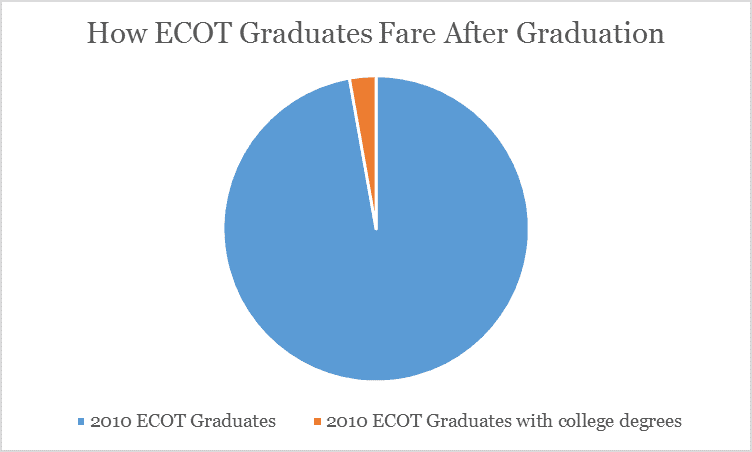
“ECOT infamously did a remarkably poor job of educating those who were, by the way. How poor? Only 109 of 3,794 ECOT graduates from 2010 earned a college degree within 6 years of graduating.”

B


A whistleblower informed state education officials that ECOT (the Electronic Classroom of Tomorrow) had used software that inflated its enroll,wants and its state reimbursements. He filed his complaint in early August but state officials ignored it until December.  

ECOT’s lobbyist disagreed.

“COLUMBUS, Ohio — Education regulators are reviewing a whistleblower’s claim that Ohio’s then-largest online charter school intentionally inflated attendance figures tied to its state funding using software it purchased after previous allegations of attendance inflation, The Associated Press has learned.

“A former technology employee of the now-shuttered Electronic Classroom of Tomorrow said he told the Ohio Department of Education last year that school officials ordered staff to manipulate student data with software obtained following the state’s demand that it return $60 million in overpayments for the 2015-2016 school year. He also took his claims to Republican Ohio Auditor Dave Yost, whose office said they were incorporated into a financial audit being prepared for release.

“The employee spoke to the AP on condition of anonymity for fear of professional repercussions for speaking out. His concerns were first raised in an Aug. 3 email to the state a month before it released its 2017 attendance review of ECOT.

“The state challenged ECOT over how it claimed student time using the new software, called ActivTrak, after finding that it duplicated learning hours, according to Education Department spokeswoman Brittany Halpin.”

ProgressOhio reported:

Columbus – Yesterday, the Associated Press reported that the Ohio Department of Education is reviewing allegations that the Electronic Classroom of Tomorrow (ECOT) deliberately inflated attendance records in order to get more money from the state. Though a whistleblower initially contacted the Department in August 2017, officials did not interview him until December.

“Manipulating attendance records is the cherry on top of ECOT’s cake of fraud that it keeps trying to serve Ohio taxpayers,” said ProgressOhio’s Monica Moran. “While taxpayers are happy to see that these claims are being looked at, it seems that once again the state is slow-walking the investigation. Ohio regulators cannot put their heads in the sand like they did for years while ECOT was still operating.”

From the report:

“A former technology employee of the now-shuttered Electronic Classroom of Tomorrow said he told the Ohio Department of Education last year that school officials ordered staff to manipulate student data with software obtained following the state’s demand that it return $60 million in overpayments for the 2015-2016 school year…

The whistleblower told the AP that the first run on the new software returned results showing students with just more than half the hours needed to justify ECOT’s full reported enrollment — and, with that, its full state payment. He shared his assessment with the Education Department’s top lawyer, Diane Lease, in an Aug. 3 email.”

Another perspective, taken from a personal email to me from a parent in Ohio, including the whistleblower’s letter:

http://www.wlns.com/ap-top-news/whistleblower-school-used-software-to-get-more-state-money/1135319359

In an Aug. 3, 2017, email, a whistle-blower who calls himself ECOT Voice sent explosive information to ODE Legal Counsel Diane Lease. He said ECOT implemented a new system to intentionally inflate its attendance and warned ODE to get back-up documentation of the attendance padding. Instead, ODE took ECOT’s word for the higher enrollment.

ECOT Voice urged the state to “demand clear documentation of the role of the ActivTrak software, how the data aggregation process distinguishes academic work from other use of the student computers, how much idle-time is allowed between verified student interactions, and how that data is used in relation to the other verified academic sources (the iQity Learning Management System, the Blackboard Collaborate online sessions, and other imported sources).

I have met with, and spoken to, ECOT Voice multiple times and verified his employment with ECOT. He said ECOT purchased new software from ActivTrak that allows the school count as classroom time anytime a window is opened on a student’s laptop. The whistleblower estimated that the new software allows ECOT to improperly collect an additional $10-20 million per school year.

It appears as if the “clear documentation” he urged Lease to obtain is readily available. I telephoned ActivTrack and spoke with both the salesman who handles the ECOT account and the CEO. They said ECOT purchased 20,000 copies of ActivTrak and provides ODE with two sets of reports: One that shows ALL time on the computer, another provides very detailed breakdowns of student activity.

We know that ECOT Voice’s warning was ignored because a Nov. 19, 2017, report in the Columbus Dispatch, states that ODE relied on ECOT’s attendance figures, clearly showing that the agency did not take ECOT Voice’s suggestion to “demand clear documentation of the role of the ActivTrak software….’’

From the Dispatch:

When the Ohio Department of Education audited ECOT’s attendance for a second school year last summer, the embattled online charter’s verified attendance went up more than 80 percent, and the amount it was forced to repay was $19.2 million, down from $60 million the previous year.

But documents show that the state used different methods during the second audit completed over the summer, as the two sides bickered over how to handle it. Instead of figuring out the attendance itself, as it had done in the previous year, the department asked the Electronic Classroom of Tomorrow on July 31 to compile computer records showing how many hours a year students performed classwork.

The process did not go smoothly. By mid-August, according to correspondence between the charter school and the department, the department was complaining to ECOT that “the manner in which the data was provided did not allow the department to validate the summary data” with ECOT’s underlying daily attendance records.

On Aug. 30, ECOT submitted yet more data that the state used “as the basis for the final determination.” In the end, the department signed off on the much-higher attendance number, but with the following caveat: “This final determination was based on the records provided by ECOT to the department,” Aaron Rausch, the department’s director of budget and school funding, wrote ECOT on Sept. 28.

Exactly what all this means about the independence of the latest audit is unclear. Neither Rausch nor department spokeswoman Brittany Halpin would answer questions about the most recent review, which ECOT will begin challenging before an arbitrator next month.

Here is the full email that warned of attendance padding:


From: ECOT Voice <ecotvoice@gmail.com>
Date: Thu, Aug 3, 2017 at 4:24 PM
Subject: ECOT Related Inquiry
To: Diane.Lease@education.ohio.gov

Ms. Lease,


I am a former ECOT employee who was referred to you by Tess Elshoff.  She declined to accept my approaching her due to pending litigation with ECOT.


As ODE is in the midst of evaluating the accuracy of reported engagement data from ECOT, I believe it to be an opportune time to express my concerns over the funding claims based upon that data. I am not an endorser of the change in how ODE is evaluating the services rendered and the resulting funding model change; nevertheless, I am also not supportive of claiming funds based upon suspect data.


While employed by ECOT (until July of this year) I had occasion to be present when strategies for calculating the per-pupil “educational opportunity” were considered, including various models tested by ECOT prior to submission.  The primary concern I would raise relates to how statistics were gathered that may not have sufficiently distinguished between non-academic and academic usage of systems, as well as the methods used to assess whether students were active or idle while logged on may have been overly generous in allocating classroom time during inactivity.


As I understand, the typical audit of selected students is unlikely to delve into the original source data used to determine the duration of student work sessions and the assumptions that may have been encoded in the processing of the raw data.  I would strongly advise that the audit process demand clear documentation of the role of the ActivTrak software, how the data aggregation process distinguishes academic work from other use of the student computers, how much idle-time is allowed between verified student interactions, and how that data is used in relation to the other verified academic sources (the iQity Learning Management System, the Blackboard Collaborate online sessions, and other imported sources).


While recent news reports indicate that a modest percentage of the audited students may have raised concern and identified need for further research, I am concerned that the scope of questionable data might be much larger.  Internal opinion at the time of my departure was that actual verifiable academic engagement is not likely to be much greater than 50% of the enrolled FTEs (a bit better than the 41% of last year) but that submitted data will represent a much higher funding rate than that — even on the order of 80% or higher.  A level many find difficult to believe.


Please consider this as a communication from a concerned citizen of the State of Ohio and forward its content as you deem appropriate for the purposes of completing an trustworthy audit of the public interest in charter school funding.


Regards,


E
 

Uh-oh. This wasn’t in the business plan. Teachers at the K12 Inc. virtual charter school in California created a union. They threatened to “logout” if management didn’t recognize them and agree to their demands. Management caved at CAVA.

While CTA welccomed the additions, some members were unhappy to embrace teachers in a for-profit virtual charter that has been subject to fines and investigations for its behavior and consistently gets poor results.

“Inspired by walkouts in West Virginia and Oklahoma, teachers in California’s largest online charter school were prepared to strike if their new union could not reach an agreement with their school’s management.

“But California Virtual Academies, which includes nine schools and contracts with K12 Inc., the biggest for-profit charter school operator in the country, and the fledgling union of California Virtual Educators Unitedhave settled on their first contract, union representatives announced Wednesday. Among the teacher demands the school has agreed to: some limits on the number of students they oversee, more flexibility in interacting with students and parents, and a whopping 17.8 percent increase in pay…

”As a unionized staff, CAVA teachers belong to a small club within the charter sector. Only 11 percent of charter schools are unionized nationally, down slightly from 12 percent in 2010, according to the National Alliance for Public Charter Schools. Charter schools make up about 7 percent of the nation’s public schools. About 70 percent of all teachers nationwide participate in unions or employee associations, according to the U.S. Department of Education.”

The contract must be ratified by the nearly 500 teachers who belong to the new local.

”K12 Inc.’s financial arrangements with the schools it helps run in California were the subject of an investigation by the East Bay Times. The paper found that the schools had little independence from K12 Inc. and that the Herndon, Va.-based management company charged fees for its service that were at times far in excess of what the schools could afford. Teachers employed by K12 Inc. were pressured to inflate student enrollment and attendance numbers, which help determine state funding. The paper also reported that half of the schools’ students were proficient in reading and only a third were proficient math. Many students that enrolled in K12 Inc. did not graduate.

“K12 Inc. reached an $8.5 million settlement with the California Attorney General in 2016 over allegations that the company misled parents about how well students were doing in the California schools it manages. The company did not:admit to any wrongdoing.

“K12 Inc. and online or cyber charters in general have been under increasing scrutiny both in California and beyond. That’s been driven in part by the ascent of Betsy DeVos to U.S. Education Secretary. DeVos is a supporter of online schools—touting them as a means to bring school choice to rural areas—and an early investor in K12 Inc.”


Maureen Downey reports that Georgia’s first virtual charter high school will close. It enrolls some 2,000 at-risk students.

What shallow thinkers (the nicest term that comes to mind) concluded that students who were struggling needed to sit in front of computers, rather than getting the time and attention of a trained professional? Were they trying to cut costs? Surely, the deciders did not have the well-being of the students in mind.

Nick Trombetta, founder of the nation’s first cybercharter, will be sentenced on July 10.

He admitted stealing $8 million in public funds intended for his school.

The long-delayed sentencing hearing of former Pennsylvania Cyber Charter School CEO Nick Trombetta on charges of tax fraud and conspiracy is set for July, according to information filed Wednesday in U.S. District Court.

The July 10 sentencing will come nearly five years after Trombetta, 62, was indicted by a grand jury on 11 counts of tax fraud and conspiracy in August 2013. He pleaded guilty to conspiring to defraud the IRS in August 2016.

He faces up to five years in federal prison.

Trombetta siphoned $8 million from the Midland-based public school and used the money to stockpile retirement money and buy personal luxury goods for himself, his girlfriend and his family — including multiple homes and a twin-engine airplane.

The conspiracy involved Trombetta and several others – including his accountant, Neal Prence – moving the money to other companies created or controlled by Trombetta and filing false tax returns.

He had this great idea. Give a computer and distance instruction to students who enrolled. Collect full state tuition. He collected $10,000 per student and had 10,000 students. He was rolling in dough. $100 million. It is easy to let that kind of money go to your head or your bank account.

There are virtual charter schools operating across the country that are raking in lots of money that they don’t need or deserve. What should they do with it?

If every charter operator who used his school’s credit card as his personal piggy bank were put into jail, the jails would be overcrowded. If they happened to be privatized prisons, the charter industry would turn against privatization and demand decent public prisons.