Archives for category: Trump

Jeff Bryant reports on a frightening phenomenon: the notorious and violent Proud Boys are targeting public schools.

He begins:

When violent insurrectionists stormed the U.S. Capitol on January 6 to attempt to overturn the result of the 2020 presidential election, some of the rioters were members of the Proud Boys, a far-right group prone to street brawling and pro-Western, anti-Muslim, and misogynistic rhetoric.

The insurrectionists were thwarted, but now extremist groups—including the Proud Boys—are aiming their threats and violence at a new target: public schools.

In Orange County, North Carolina, the Proud Boys and other white nationalist groups have begun showing up at high school football games and school board meetings, “protesting the district’s COVID-19 and LGBTQ+ policies.” Their intimidating language, apparel, and physical gestures prompted officials to hire extra security and pass a resolution opposing “incidents of hostile and racist behavior,” according to a report in the News and Observer.

The resolution charged that the rightwing agitators had “shouted racist and homophobic slurs at students” and included “emails from teachers and students who describe how unsafe they feel being around the Proud Boys.”

A local radio station quoted Orange County board chairwoman Hillary MacKenzie describing a recent meeting of the board where “there were two men in Proud Boys shirts and hats . . . one wore a stocking over his face . . . the other one told our board during public comment that someone should tie rocks around our necks, and we should throw ourselves in a river.”

Similar occurrences from around the country seem to indicate that the Proud Boys’ targeting of public schools is a coordinated, nationwide effort, suggesting a direct line from the group’s involvement in the January 6 insurrection to its current participation in the wave of protests at public schools and school board meetings.

Trump is a sore loser. Will we ever see the last of him?

It seems he’ll be with us forever, his legacy revealed by the stories that his former aides tell about what they saw during his four madcap years.

The latest is contained in a story in The New York Times. It seems that the famous xenophobe Stephen Miller cooked up a campaign season plan to close the border by stationing 250,000 troops there. Trump loved the idea. It would show that he’s a tough guy and would achieve his goal of ending immigration on our southern border.

But Defense Secretary Mark Esper shot down the idea. He thought it was “outrageous.” A quarter million troops was “more than half the active U.S. Army, and a sixth of all American forces — to the southern border in what would have been the largest use of the military inside the United States since the Civil War.”

The idea was batted around but Secretary Esper was adamantly opposed. Trump and his minions also considered a proposal to send troops into Mexico to hunt down members of drug cartels, but backed when they became persuaded that it would be considered an act of war to send our military across the border of another country, uninvited.

After a brief but contentious confrontation with Mr. Miller in the Oval Office, Mr. Esper ended consideration of the idea at the Pentagon.

Mr. Trump’s obsession with the southern border was already well known by that time. He had demanded a wall with flesh-piercing spikes, repeatedly mused about a moat filled with alligators, and asked about shooting migrants in the leg as they crossed the border. His aides considered a heat-ray that would make migrants’ skin feel hot.

Around the same time that officials considered the huge deployment to the American side of the border with Mexico, Mr. Trump also pressed his top aides to send forces into Mexico itself to hunt drug cartels, much like American commandos have tracked and killed terrorists in Afghanistan or Pakistan, the officials said.

Mr. Trump hesitated only after aides suggested that to most of the world, military raids inside Mexico could look like the United States was committing an act of war against one of its closest allies, which is also its biggest trading partner, the officials said…

But taken together, the ideas under discussion that spring underscore the Trump administration’s view of the armed forces as a tool of the presidency that could be wielded on behalf of Mr. Trump’s domestic political agenda in an election year…

Wiser heads than Trump or Miller recognized how unhinged these proposals were:

If Mr. Trump had gone through with the troop deployment, it would have represented a force two and a half times the size of the 100,000 American troops in Afghanistan at the height of the 20-year war in that country. It would have also dwarfed the American presence in Iraq during the war there: The maximum number of troops in Iraq at any time was about 170,000.

It is unclear how the Defense Department could have managed such a deployment. The U.S. Army has about 481,000 active-duty soldiers, but many are already deployed around the world, as are thousands of Marines, airmen and other troops. Sending 250,000 troops to the border — much of which crosses difficult, undeveloped lands — would also have required an enormous logistical effort to house and feed the troops.

In the original version of this post, i said that Nixon told the press when he resigbed, ”You wont have Nixon to kick around anymore.” Tom Ultican caught my error. Nixon said this when he lost the California governor’s race in 1962.

In the race for governor of Virginia, Republicans have focused their campaign on hot-button issues like banning “critical race theory” from the schools, opposing mask mandates, and taking a stand against tiny numbers of transgender students. Republicans have also argued that parents should be able to determine what teachers are allowed to teach and to ban books that they don’t like. And of course, they support school choice. In short, the Republican candidate has decided to base his campaign on “culture war” issues, offering no proposals to improve the schools.

In contrast, the Democratic candidate Terry McAuliffe has promised to raise teachers’ salaries, expand pre-K, and protect students from the virus. He has also taken a stand against parents dictating what should be taught, instead leaving those decisions to teachers. In these times, he has shown that principle and courage are possible when running for high political office, which is why he was endorsed by the Network for Public Education Action. We will learn on November 2 whether principle and courage can beat rank opportunism.

Lisa Lerer wrote in the New York Times about how unusual it is to have a statewide race centered on education. .

WINCHESTER, Va. — …From fights over evolution to desegregation to prayer, education battles have been a staple of the country’s divisive cultural issues for decades. But not quite like this.

After months of closed classrooms and lost learning time, Republicans in Virginia are making the schools the focus of their final push to capture the governor’s office, hoping to rally conservatives around both their frustrations over mask mandates and mandatory vaccinations and their fears of what their children are being taught.

Vocal groups of parents, some led by Republican activists, are organizing against school curriculums, opposing public-health measures and calling for recalls of school board members. And Mr. Youngkin, a former private equity executive, has capitalized, seizing on conservatives’ concerns about instruction on race and the rights of transgender children to argue that Democrats want to come between parents and their children’s education.

Mr. Youngkin’s attacks have forced Terry McAuliffe, the Democratic former governor trying to win back his old job, onto the defensive, and have thrust the ordinarily local issues surrounding schools into the middle of a rancorous nationwide shouting match.

The Virginia race offers an early electoral test of that conservative energy.

A victory by Mr. Youngkin would mark the first statewide win for Republicans in a dozen years and likely trigger a political panic within the Democratic Party about its prospects in next year’s midterm elections. Some Republican officials and strategists liken the surge of activism to the Tea Party, the anti-government movement that helped them win control of the House in 2010 and unleashed a revival of outrage politics that would define their party for the next decade.

“There’s just so much focus on the schools, and it’s visceral,” said John Whitbeck, a former chairman of the Republican Party of Virginia from Loudoun County, where acrimonious school board meetings have led to arrests, death threats and constant airtime on conservative media. “It’s not like, ‘Oh, I’m against the debt ceiling.’ This is like, ‘You’re destroying our children’s education.’ And, look, angry people vote.”

Polling in recent weeks has shown a tight race, with Democrats less enthusiastic than Republicans about voting. Mr. McAuliffe, who was barred from seeking re-election in 2017 by Virginia law, is faring worse in the fast-growing, voter-rich Northern Virginia suburbs than Gov. Ralph Northam, a Democrat, did when he won four years ago, according to some surveys.

Mr. Youngkin’s focus on schools may not resonate as strongly with the broader electorate.

Measures such as mask and vaccine mandates are cutting differently in the governor’s race in more liberal New Jersey and are overwhelmingly popular among Virginia’s independents and Democrats. Critical race theory — an advanced academic concept generally not introduced until college — is not part of classroom teaching in Virginia and many voters say they do not know enough about it to have an opinion.

And turning schools into a cultural war zone by railing against equity initiatives, books with sexual content and public health measures avoids tackling issues like budget cuts and the other thornier problems facing American education.

But in an off-year election, when both sides anticipate a sharp falloff in voting, victory may hinge on which candidate can best motivate their base. Mr. Youngkin and his strategists believe that in the fights roiling schools they have discovered the rare issue that can galvanize their voters, even in places that are shifting the state to the left.

Frustration with education is an issue that unites Republicans, energizing moderates eager to ensure their children remain in school as well as conservatives who see a liberal plot to indoctrinate their children with the belief that white people are inherently racist.

“The former governor is saying, ‘Hey I’ll decide how to teach your kids, not you’ — that’s really the issue driving this,” said John Fredericks, who led Donald Trump’s Virginia campaign last year. “Glenn Youngkin is the candidate that’s been able to straddle both sides of the party. And so far he’s given us just enough where we can enthusiastically vote for the guy.”

Republicans have centered much of their closing argument around a statement by Mr. McAuliffe in last month’s debate.

The comment came after Mr. Youngkin attacked Mr. McAuliffe over his 2017 veto of a bill permitting parents to opt out of allowing their children to study material deemed sexually explicit. The dispute was prompted by a mother who objected to her son, a high school senior, reading literary classics including Toni Morrison’s “Beloved.”

Mr. McAuliffe shot back that he did not believe “parents should be telling schools what they should teach.” In the weeks since, he’s stood by those remarks, saying that the state Board of Education and local school boards should determine what is taught in the classroom.

But Mr. Youngkin and Republicans, stripping the quotation from its context, have turned the footage into the core of their argument that Mr. McAuliffe would side with government over parents.

Video of the remark was featured in a flurry of digital ads and a statewide television commercial accusing Mr. McAuliffe of going “on the attack against parents.” Mr. Youngkin’s team began scheduling “Parents Matter” rallies in exurban counties, as they actively courted parent activist groups.

And Mr. Youngkin has also voiced support for Byron Tanner Cross, a physical education teacher in Loudoun County. Mr. Cross was suspended after announcing at a school board meeting that he would not address transgender students by their preferred pronouns because of his Christian faith.

At a campaign rally last week in Winchester, a small town in the Shenandoah Valley in one of the fast-growing exurb counties around Washington, Mr. Youngkin made little mention of Mr. Trump, vaccines or the coronavirus. Instead, he repeatedly invoked issues around schools as top priorities.

He drew some of the loudest applause from the overwhelmingly white audience when he promised to ban critical race theory on his first day in office and vowed that schools would never be closed again.

“This is what big government means for Terry McAuliffe. He not only wants to stand between you and your children. He wants to make government a tool to silence us,” Mr. Youngkin told the crowd of nearly 200 people at a farm stand. “This is no longer a campaign. This is a movement. It’s a movement led by parents.”

Mr. McAuliffe has dismissed the outrage surrounding critical race theory as “racist” and “a dog whistle.” He supports mask and vaccine mandates for students, teachers and school staff. (Mr. Youngkin says he encourages Virginians to get vaccinated against the coronavirus but does not support mandates.)

But there are signs that Democrats sense danger.

Mr. McAuliffe’s campaign has returned to highlighting his education proposals to undercut any argument that Mr. Youngkin could be stronger on the issue, promising to invest $2 billion in education, raise teacher pay, expand pre-K programs and invest in broadband access for students. On Friday, Mr. McAuliffe released an ad saying that Mr. Youngkin would cut billions of dollars in education funding and bring “Donald Trump and Betsy DeVos’s education policies to Virginia.”

The parent organizations in Virginia say they are nonpartisan and more focused on school board elections than national politics. But many are led by Republican activists, raise funds from Republican Party donors and are helped by conservative think tanks such as the Heritage Foundation, which has held briefings to discuss model legislation to block critical race theory. Last month, the Republican National Committee ran ads attacking “fascist mask mandates” and highlighting video clips of angry parents yelling at school board members.
Paul Waldman is on the staff of the Washington Post. In this excerpt of his column, he says that Trump zealots will refuse to believe what the police officers said about the events of January 6. Nor will Trump devotees in the Congress be moved. The police officers saved their lives on that day, but they won’t heed what they testified. The Republican members of Congress were there as rioters plundered the U.S. Capitol and threatened the lives of Speaker Nancy Pelosi and Vice President Mike Pence. Only a thin blue line separated the mob and the esteemed members of Congress, who were only a few feet apart as they scurried to their hiding places. Yet still they say things like, “It was a normal tourist crowd,” or “it was a peaceful protest.” And they have response when Trump expresses his admiration and love for the mob that beat up police officers, shattered windows, and broke down doors in their absurd effort to reverse the election results.

Waldman writes:

There are people who believe that the moon landing never happened, that the astronauts in the footage all the world saw were actually bouncing around on a soundstage hidden away somewhere. But they aren’t making our laws, they aren’t invited on TV to discuss their perspective, and they don’t have the ability to influence millions.


Yet there are people who deny the truth of what happened in Washington on Jan. 6, despite all the video, all the contemporaneous reports, all the guilty pleas, and all the testimony. And they have a lot more power.


Tuesday’s first hearing of the select House committee investigating the insurrection, with vivid testimony from four police officers who stood against a mob of President Donald Trump’s supporters overrunning the Capitol in an attempt to overturn a presidential election, should put at least some questions about that day to rest.

Still recovering from their physical and mental injuries, the officers seemed particularly incensed that the truth of what happened that day is denied by so many on the right, from Trump himself on down.
“To me, it’s insulting, just demoralizing because of everything that we did to prevent everyone in the Capitol from getting hurt,” said Capitol Police Sgt. Aquilino Gonell about the effort to minimize what happened that day, including by Trump. (“It was a loving crowd,” the former president told Post reporters Carol Leonnig and Philip Rucker, “There was a lot of love. I’ve heard that from everybody.”)

Gonnell also addressed the various conspiracy theories propagated by some very high-profile figures on the right, claiming that the insurrection might have been a false-flag operation. “It was not antifa,” he said. “It was not Black Lives Matter. It was not the FBI. It was his supporters that he sent them over to the Capitol that day.”
“The indifference shown to my colleagues is disgraceful,” said D.C. police officer Michael Fanone, slamming his fist on the table. “Nothing, truly nothing, has prepared me to address those elected members of our government who continue to deny the events of that day.”

That denial takes various forms. Some, like Trump, assert that the riot was no big deal (“By and large it was peaceful protest,” said Republican Sen. Ron Johnson of Wisconsin). Others say that, while it was certainly bad, it doesn’t have anything to do with any larger political forces and should be put behind us.

But the truth is that there was nothing isolated about the event. Those rioters came to Washington at Trump’s behest. They assaulted the seat of our government in an effort to prevent the final certification of an American presidential election. And to this day, most of the GOP continues to stoke the fires of racial resentment and contempt for the democracy that made it possible.

One of the few exceptions in the Republican Party, Rep. Adam Kinzinger (Ill.) dispatched the bad-faith argument so many in his party made that any investigation of Jan. 6 should also spend time talking about protests last summer against police misconduct, during which violence broke out:

“Some have concocted a counternarrative to discredit this process on the grounds that we didn’t launch a similar investigation into the urban riots and looting last summer. Mr. Chairman, I was called on to serve during the summer riots as an Air National Guardsman. I condemn those riots and the destruction of property that resulted. But not once did I ever feel that the future of self-governance was threatened like I did on January 6. There is a difference between breaking the law and rejecting the rule of law, between a crime, even grave crimes, and a coup.”


That is the heart of what made January 6 so threatening: Not just the physical violence, but the assault on the American system.

The hearings about the January 6 storming of the U.S. Capitol opened with testimony by four police officers who were beaten and brutalized by the pro-Trump mob, trying to stop the certification of the election of President Biden.

This story appeared in USA Today.

The officers’ accounts provided a dramatic opening for the House select committee investigating the Jan. 6 Capitol attack, when Trump’s fanatical supporters tried to stop the certification of Joe Biden’s 2020 election win.

“Here are highlights from their testimony.

“Capitol Police Sgt. Aquilino Gonell

“An Army veteran, Gonell said his experience during the insurrection was more terrifying than serving in Iraq, where he had to conduct supply missions on roads laced with improvised explosive devices.

“Nothing in my experience in the Army or as a law enforcement officer prepared me for what we confronted on Jan. 6,” he told the panel, recounting hand-to-hand combat with the rioters that likened to a “medieval” battle.

“I did not recognize my fellow citizens,” Gonell said. One rioter, he said, “shouted that I —an Army veteran and a police officer — should be executed.”

“As he and his fellow officers were punched, kicked and sprayed with chemicals, “I could feel myself losing oxygen and recall thinking to myself, ‘This is how I’m going to die’,” Gonell said.

“Six months after the riot, Gonell said he is still recovering from injuries.”

DC Metro officer Michael Fanone

Fanone, who nearly died on Jan. 6, has emerged as one of the most outspoken enforcement officials in the wake of the Capitol riot, during which he was beaten unconscious and suffered a heart attack.

In the months since Jan. 6, he has lobbied Congress to create a bipartisan, independent commission to probe the riot and lashed Republicans for downplaying the attack.

At Tuesday’s hearing, he moved into the spotlight once again.

“As I was swarmed by a violent mob, they ripped off my badge, they grabbed and stripped me of my radio, they seized a munition that was secured to my body,” Fanone recalled. “They began to beat me with their fists and what felt like hard metal objects.”

At one point during the riot, Fanone was pulled from a line of police by a rioter who shouted “I got one!”

As he was beaten, he heard a rioter shout to “Get his gun! Kill him with his own weapon.”

” … I was electrocuted again and again and again with a taser. I’m sure I was screaming but I don’t think I could even hear my own voice,” he recounted.

“I have kids,” he responded in a plea for his life.

“I still hear those words in my head today,” Fanone told lawmakers.

An unconscious Fanone was later driven by another injured officer to a nearby hospital, where he was told he suffered a heart attack and multiple life-threatening injuries. He now suffers from post-traumatic stress disorder.

“I thought I had seen it all, many times over,” Fanone said. “Yet what I witnessed and experience on Jan. 6, 2021, was unlike anything I had ever seen, anything I had ever experienced or could have imagined in my country.”

U.S. Capitol Police officer Harry Dunn

U.S. Capitol Police Officer Harry Dunn recounted how pro-Trump protestors continued to swell at the side of the Capitol all morning on Jan. 6 before becoming violent after thousands had assembled.

Rioters chanted “Stop the steal!,” clinging to the false claim that Trump was still the true elected leader of the country. When Dunn said that he’d voted for Biden and inquired if his vote didn’t matter, the already hostile crowd became irate.

“One woman in a pink ‘MAGA’ shirt yelled, “You hear that, guys, this (N-word) voted for Joe Biden!” he remembered.

“No one had ever called me a (N-word) while wearing my Capitol Police uniform,” Dunn testified.

Dunn also recounted how the aftermath of the day had been a “blur” to him. At one point he broke down in despair in the Capitol rotunda and asked how the attack was even possible, he said.

In the months since the attack, Dunn has said he’s been in support groups for his mental health to deal with the trauma of the attack, declaring that “there’s absolutely nothing wrong” with seeking help. Two Capitol police officers have died by suicide in the months since the attack.

Dunn also directly addressed the rioters and insurrectionists who were at the Capitol that day, saying “democracy went on that night and still continues to this day… you all tried to disrupt democracy, and you all failed.”

DC Metro Police officer Daniel Hodges

Hodges said rioters bashed his head, kicked him in the chest, and sprayed him with a chemical irritant during the riot, among other assaults.

One attacker told him he would “die on your knees.”

During one scuffle, a rioter tried to take Hodges’ baton and another kicked him in the chest and moved his mask over his eyes, leaving him temporarily blind while under attack.

While at his post as rioters began to assemble, he saw people in the crowd in tactical gear, wearing ballistic vests, helmets and goggles, appearing “to be prepared for much more than listening to politicians speak at a park,” he recalled.

“Terrorists were breaking apart the middle fencing and bike racks and the individual pieces, presumably to use weapons,” Hodges told the committee.

In the haze, Hodges said he remembers seeing the “thin blue line flag, a symbol of support for law enforcement” being carried by the rioters who then attacked the very officers they claimed to support. Hodges was told he was “on the wrong team” by one of the attackers.

As he was being gassed and having his head smashed, Hodges recounted screaming for help until fellow officers were able to save him from the attackers.

Politico reports:

TRUMP EMBRACES ‘GREAT PEOPLE’ OF JAN. 6 — In a Sunday interview on Fox News with MARIA BARTIROMO, former President DONALD TRUMP spun up a new interpretation of Jan. 6: It was an act of “love,” a word he used repeatedly to describe the sacking of the Capitol. He portrayed ASHLI BABBITT essentially as a martyr — an “innocent, wonderful, incredible woman” — while floating a conspiracy that she was murdered by security for a “top Democrat.” In a throwback to Charlottesville, he called the rioters “great people.”

Kevin McDermott of the St. Louis Post-Dispatch excoriated retiring Senator Roy Blunt as a symbol of a cowering GQP establishment that failed to stand up to Trump. McDermott wonders why newcomer Josh Hawley has a national profile (as a Trump lackey), but the senior senator from Missouri is virtually unknown outside the state.

Unfortunately, Blunt also has personified what establishment Republicans became during the Trump era: passive enablers to a chronically mendacious, constitutionally malicious, mentally unfit president.

And now Blunt is, once again, personifying the GOP establishment, this time by exiting the extremist bunker that his party has become — a trend that intensified under Trump, as Blunt and others at the grownups’ table stared down at their plates in mute terror...

Blunt, just by virtue of his position in the Senate Republican hierarchy, could have forced a historic shift in the narrative of the Trump era had he done what he could have — shouldhave — done at any point during Trump’s tenure. Blunt could have walked up to any microphone in sight after some Trumpian outrage or other (the available choices were constant) and said what he knows is true: “This isn’t who we are. As a party, or as a country. Acceptance of this ignorant, corrosive sociopath of a president isn’t a valid trade for tax cuts and judges. It’s a selling of the soul, and I won’t do it anymore.”

Yes, he would have lost his Senate Republican leadership role and probably his seat — the same seat he is now leaving willingly anyway. Meanwhile, it would have forced a badly needed self-examination by the GOP. Most importantly, Blunt might have provided a little cover for lower-ranking Republicans of conscience to follow suit.

Instead, Blunt mostly held his tongue for four years, voting twice to acquit Trump for his clearly impeachable offenses of trying to extort election aid from Ukraine and for inciting violent insurrection in an attempt to overturn the 2020 vote.

In essence, Blunt consistently backed a president who represented the most dire threat to constitutional democracy that we’ve seen in our lifetimes. The fact that Blunt did this quietly, without the toxic enthusiasm of Hawley and his ilk, is irrelevant. What’s the point of having a grownups’ table if its occupants let the children overrun the place?

I wrote this article a few weeks ago. I submitted it to two major newspapers as an opinion piece. The editors at both newspapers said there were no cases in the judicial pipeline, and thus my proposal was impossible. But then on Monday February 22, the Supreme Court made a decision about a Trump challenge to the Pennsylvania balloting, rejecting it with a single sentence. That might have been the chance. Maybe there is another futile legal challenge that would make this plea possible. I offer it to you because I think it makes sense even if the op-ed editors don’t.

            The United States is split almost down the middle, as the last election demonstrated. Families and friends are hopelessly divided, and some people just can’t discuss politics anymore for fear of losing touch with people they care about. Some people blame Donald Trump, some blame Newt Gingrich, some trace the fissures back even farther in time. 

            Whenever it started, the issue today is how we are able to function as a nation when we can’t even agree on basic facts. The political polarization seems likely to last a long time, but at the very least we could heal some of the divisions by establishing one basic fact: Who won the last election. According to polls, most Republicans have been persuaded by former President Trump that the election was stolen from him. To this day, Trump continues to insist he won the election.

            There is only one tribunal where this issue of fact can be resolved to the satisfaction of almost all Americans, and that is the United States Supreme Court. The current composition of the Supreme Court heavily favors Republicans. Six of its nine members were appointed by Republican presidents: Chief Justice John Roberts (appointed by President George W. Bush); Justice Clarence Thomas (appointed by President George H.W. Bush); Justice Stephen Breyer (appointed by President Bill Clinton); Justice Samuel Alito (appointed by President George W. Bush); Justice Sonia Sotomayor, appointed by President Barack Obama); Justice Elena Kagan (appointed by President Barack Obama); Justice Neil Gorsuch (appointed by President Donald Trump); Justice Brett Kavanaugh (appointed by President Trump); and Amy Coney Barrett (appointed by President Trump). 

            Chief Justice John Roberts could lead the Court in deciding to consider one of the many challenges to the Presidential election of 2020. The Supreme Court declined to hear three challenges, and at least sixty cases were decided by state and federal courts. Surely, there must still be one in the pipeline that would allow the Supreme Court to review the evidence and reach a conclusion about whether the election was wrongly decided, whether there was massive voter fraud, and whether voting machines were rigged to favor the Biden-Harris ticket. One of the voting machine companies, Smartmatic, has been accused of “rigging” the vote in multiple states, but it was used only in Los Angeles County. Both Smartmatic and Dominion Voting Systems have filed massive defamation lawsuits against those who accused them of switching votes from Trump to Biden.

            A careful review by the Supreme Court could take into consideration the lengthy record of litigation in federal district courts and appeals courts where the Trump campaign was unable to produce any evidence for its claims of election fraud. Outside the courtroom, campaign officials made lurid charges of voter fraud, lost ballots, rigged machines, ballot dumps, and votes cast by dead people, but they didn’t repeat those claims in the courtroom because they had no evidence.

            If the nation is ever to heal, there must be a reckoning with the charges that are now poisoning our politics. A sizable portion of the nation does not believe that Joe Biden won the election. A significant part of the Republican Party believes that his presidency is illegitimate. Such claims damage the ability of our political system to function. These claims were the basis of the violent siege of the U.S. Capitol on January 6 that might have led to mass casualties, had it not been for the bravery of an overwhelmed Capitol Police force. Former President Trump has made clear that he will continue to insist that the election was stolen from him. He will not stop undermining his successor.

            Only an institution that has the trust of the majority of the American people, and especially an institution that has the trust of Republicans, can settle this matter to the satisfaction of the vast majority of our citizens. 

            Only the United States Supreme Court have the credibility to review the facts and set the record straight about the 2020 election. 

Jeff Bryant wrote in the LA Progressive about President Biden’s “golden opportunity” to strengthen public education by throwing out two decades of failed “reforms.”

As we now know (and Jeff did not when he wrote the article), Biden got off on the wrong foot by mandating another round of standardized testing this spring. This unwise decision was foretold when the news came out that the Biden administration had hired Ian Rosenblum as Deputy Assistant Secretary in a key part of the Department of Education, where policy and strategy are forged. Rosenblum was never a teacher. He previously worked for the pro-testing Education Trust New York, where John King was his mentor. When King was Commissioner of Education in New York, his heavy-handed advocacy for Common Core and high-stakes testing created the parent-led Opt Out movement.

The Secretary of Education Miguel Cardona has not yet been confirmed; he is not anti-testing, but might he have been more thoughtful about mandating a renewal of testing in the midst of a global pandemic? Deputy Secretary Cindy Marten has not yet been confirmed; she knows that testing is an after-effect, not a cause of sensible education policies. But neither of them was in place. Was Rosenblum left on his own to impose a national mandate? I suspect that President Biden never heard of Ian Rosenblum, yet this young man has made millions of parents and teachers angry with his insensitive, heavy-handed announcement.

Yes, President Biden has a “golden opportunity” to rebuild and strengthen public education. But not by relying on people molded by the twenty years of failed “reforms” of the Bush-Obama-Trump years.

As Bryant points out, the schools need a new vision for education, not a stale, warmed-over dose of testing, accountability, and privatization. No, we do not need another dose of No Child Left Behind, Race to the Top, and Every Student Succeeds–all of which failed. It’s time to break free of the status quo. It’s time for fresh thinking. Filling up the U.S. Department of Education with retreads from the Obama years–and their progeny–will send us backwards, not forwards. Now is a time for sensitivity, not stupidity.

The Los Angeles Times reported on the latest FBI arrest of one of the domestic terrorists who participated in the insurrection at the U.S. Capitol:

A UCLA student who posted white supremacist views online and founded an ultra-right campus organization has been charged with federal crimes for his alleged role in the Jan. 6 U.S. Capitol insurrection.

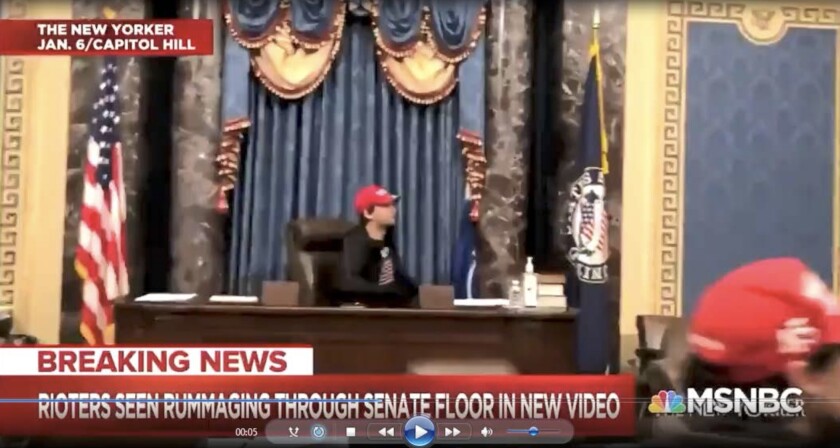
The student, Christian Secor, was captured on video sitting in the chair that Vice President Mike Pence had hastily vacated after a pro-Trump mob broke into the Capitol, according to the FBI. 

FBI agents, assisted by a SWAT team, arrested Secor, 22, at his Costa Mesa home Tuesday morning after searching the residence, said Laura Eimiller, an FBI spokeswoman. 

Federal prosecutors in Washington, D.C., have charged Secor with assaulting or resisting a police officer, violent entry and remaining on restricted grounds, civil disorder and obstructing an official proceeding. 

During an appearance in federal court in Orange County on Tuesday, a U.S. magistrate ordered that Secor be held without bail.

Secor was captured on both video and still images in a red Make America Great Again hat occupying the chair where Pence had sat while presiding over the Senate’s certification of electoral college votes, according to an affidavit by FBI Special Agent Benjamin Elliott.

A man was captured on video camera inside the Senate chambers sitting at the Presiding Officer's chair

At least 11 tipsters identified Secor as the man in the video and still images either standing on the Senate floor or on the dais sitting in Pence’s chair… 

After video of the scene surfaced on the New Yorker’s website, investigators obtained security camera video of Secor in the hallways, Rotunda area and Senate floor, the affidavit said.

Moments earlier, Secor was with a mob forcing his way past at least three police officers and through a set of double doors into the Capitol, Elliott said in the sworn statement. 

“As a result of Secor and others pushing on the double doors … the doors opened and dozens of additional rioters flooded into the building,” Elliott wrote. “The Capitol Police officers were shoved by the crowd, at times trapped between the doors and the crowd, and eventually pushed out of the way of the oncoming mob.”

Agents also found that Secor had broadcast live from the Capitol using DLive, a videostreaming service built on blockchain technology. 

In the livestream, Secor uses the moniker Scuffed Elliot Rodger, an apparent reference to the man who killed six people in Isla Vista, Calif., in 2014 and became a hero to “incels” — a fringe group of sexually frustrated men who blame women for their misery and often advocate for violence against them.