Archives for category: Texas

Gary Rubinstein, critical friend of Teach for America, reviewed the school rankings recently released by Texas and made a startling discovery. Wendy Kopp’s hometown is Dallas. Wendy Kopp is a huge supporter of charter schools, which hire most of her recruits. KIPP was started by two TFA graduates. KIPP is widely considered to be a purveyor of “high-quality seats.”

The KIPP Destiny Elementary School in Dallas was rated F by the state.

But wait, aren’t these supposed to be the schools that are beacons of excellence in a sea of despair?

Rubinstein says sadly,

So this KIPP school is rated in the bottom 250 schools out of 9,000 schools in Texas which is around the bottom 3%. There’s a reformer mantra, “Zip code is not destiny.” I guess in the case of KIPP Destiny, zip code is, in fact, destiny.


GaryRubinstein writes here about the myth of YES Prep. It is run by the husband of TFA’s CEO. Wendy Kopp wrote in her last book that the YES Prep charter chain had cracked the code and was showing that every single student was capable of excellence.


Sadly, the latest school rankings show that one of the YES Prep charter schools is among the lowest ranked in the whole state of Texas! Out of some 9,000 schools in the state, a YES Prep charter is one of the 73 lowest-rated.


As Trump would tweet, “So sad!”


The Texas legislature is starting a new session and once again Lt. Gov. Dan Patrick (former rightwing talk show host) will lead a fight for vouchers.


Once again, legislators from rural and urban districts–Republicans and Democrats–will combine to defend their community’s public schools. This year, the state launched the failed policy of giving every school a single letter grade, and now educators realize that these measures are invalid and are setting them up for privatization.


Imagine if your child came home from school with a report card and it contained only a single letter grade. As a parent, you would be furious. No child is only one dimension; no child can be reduced to an  or B or C or D or F. How much more absurd it is to attach a single letter grade to a complex institution like a school, staffed by many people, and subject to decisions made by the superintendent, the state education department, and the legislature.


Educators in North Texas see that the letter grades stigmatize their schools, damage their communities, and are intended to create demand for vouchers. There is zero validity, zero research, zero evidence for letter grades for schools.


“With the new legislative session starting Tuesday, educators from 60 North Texas districts united Monday to fight school vouchers and a new statewide grading system they say serves only to vilify public schools.
Frustration among school leaders has been mounting since provisional A-F grades were released Friday.
On Monday, area superintendents and trustees gathered in Garland to tell lawmakers that the grading system is flawed and that they are worried it is just a gimmick to get support for school vouchers or similar options.


“Lt. Gov. Dan Patrick has said school choice, which could include voucher-like tax credits or similar options, is among his top priorities for this session so families have the ability to leave failing schools.
But the area’s school leaders said such efforts would only siphon money from public schools and hurt children most in need because they don’t have the transportation and other means to take advantage of such options. Only affluent families, many of whom aren’t in public schools now, would benefit, they said.
“This is subsidies for the rich. … A equals affluent. F equals free and reduced,” Terrell ISD Superintendent Micheal French said, referring to the likelihood of poor students remaining in struggling schools that would be labeled failures.


“The provisional grades released last week were a first look at the state’s new school accountability system that takes effect in 2018. Lawmakers required the Texas Education Agency to release a sneak peek of how schools would have scored, just before they returned to Austin for the legislative session.
“That timing only reinforced educators’ fears that the new A-F system is politically motivated.
“Monday’s group represented 60 of the 80 districts in the TEA’s Region X, which includes Collin, Dallas, Ellis, Kaufman and Rockwall among its 10 counties. Combined, the districts represent 15.5 percent of Texas’ public school students.”


Pastors for Texas Children–an extraordinary group of religious leaders from across the state–is in the thick of the fight on behalf of public schools, fighting vouchers.


Gary Rubinstein writes that Texas has started the process of awarding single letter grades to schools, based mainly on standardized test scores. This is an exceptionally asinine way of evaluating schools, invented by Jeb Bush.


He reviewed the Texas scores and discovered that 25% of KIPP schools were rated F. Nearly 50% were either D or F. 


Whenever “reformers” talk about expanding high-quality charters, they use KIPP as their example. It turns out that the failure rate for KIPP is higher than for public schools.


“I thought that maybe this was one of those things where a lot of schools got an F in this domain so I looked at the 280 Houston Independent School District schools and found that only 34, or about 12.5%, got an F in ‘Student Progress.’ So the percent of ‘failing’ KIPP schools is double the number of ‘failing’ schools in the biggest district in Texas.”


Since charters are are supposed to be the remedy for “failing public schools,” what is the remedy for failing charter schools?

John Kuhn was the superintendent of the small Perrin-Whitt school district in Texas and was recently named superintendent of schools in Mineral Wells, Texas. He is also one of the best informed, most eloquent critics of corporate reform in the nation. He was a lead speaker at the 2011 Save Our Schools March on Washington, where he electrified the crowd. He has recently published two books: Fear and Learning in America and Test and Punish: How the Texas Education Model Gave America Accountability Without Equity. Kuhn says that the Texas A-F school grading system sets up schools that enroll poor kids to fail; A stands for “Affluent.”


Kuhn writes:


Texas Education Agency Releases A-F Grades for School Districts the Same Day It Dismisses Its Own A-F Grade on the National “Quality Counts” Report Card


On January 5, the Austin American-Statesman published the Texas Education Agency’s A-F grades for Texas school districts and campuses. The law establishing this system called for official A-F grades to come out in 2018, so these are “what if” grades, intended to provide to legislators a preview of what the “real” grading system will look like when grades come out officially. In a statement, TEA commissioner Mike Morath cautioned that no “inferences about official district or campus performance in the 2015– 16 school year should be drawn from these ratings.” That didn’t keep public school critics from immediately proclaiming that the A-F grades “transparently and comprehensively represent the performance of districts and campuses statewide.” No surprise there; A-F is seen by many as a tool designed specifically to give anti-public education forces ammunition to aim at the public school system.


In releasing the “work-in-progress” A-F grades to the public (as they were obligated to do), TEA officials ensured that these unofficial scores will become the de facto rating system for Texas schools for the remainder of the year, even though an actual rating system is already in place. This is despite commissioner Morath stating clearly and repeatedly that the grade report “is very much a work-in progress,” that the bases and assumptions behind the grades may change, and that the TEA didn’t take into account local community ratings of districts (statute requires that this local stakeholder input be included as 10% of schools’ final A-F grades). We now have a confusing situation in which the TEA homepage notes in a headline article that 94% of Texas school districts “Met Standard” while public school critics giddily point to another article on the same homepage announcing the release of A-F grades that often label formerly successful schools as sudden failures. In fact, several high-performing schools around the state received D’s and F’s. The Dallas Morning News listed 11 local school districts that received F’s but that were only recently considered as having “Met Standard.” “That’s amazing
when you consider that they all met the standard two weeks ago and the scores, the data, haven’t changed,” Mesquite Superintendent David Vroonland said.


School district officials have called the new A-F system “a big mistake,” “NOT an accurate reflection of quality education,” and “an unfair game,” and have noted that a similar A-F system was rescinded in Virginia after failing spectacularly, and that, since an A-F rollout in Oklahoma, student performance has declined significantly–despite the fact that A-F systems are sold to legislators as a means to improve student performance by holding districts accountable. It is difficult not to conclude that this system is for the most part arbitrary and capricious. In one respect it is very reliable, as it actually very consistently punishes those Texas schools that serve the most economically- and socially-challenged families and students. District A-F grades appear to align exceptionally closely with the percentage of economically-disadvantaged students on school district rosters, a factor that is obviously outside the ability of schools to affect.


As a means of assessing the impact of non-school factors on districts’ A-F grades, I sorted every school district in the state by the percentage of their student bodies made up of economically disadvantaged students, and then I listed their A-F grades out to the side. I took the ten districts with the lowest percentage of economically disadvantaged students that received grades in all four categories and compared them to the ten districts with the highest percentage of economically disadvantaged students. Here are the results:


The 10 Schools Serving the Lowest Proportions of Poor Kids in Texas

A – 20

B – 7

C – 9

D – 2

F – 2

Overall average – B

On the other hand:


The 10 Schools Serving the Greatest Proportions of Poor Kids in Texas:

A – 6

B – 8

C – 11

D – 6

F – 9

Overall average – D+


As you can see, there is a strong and verifiable correlation between districts’ A-F grades and the prevalence of poverty among their students. Meanwhile, there is no verifiable correlation between districts’ A-F grades and the quality of their teachers, which is supposed to be the purpose behind A-F grades even existing. They are supposed communicate to the public which schools are better, not which schools are poorer. We don’t need a measure that communicates which schools have the greatest concentrations of poor kids—we already have that measure (the economically disadvantaged numbers). The A-F system exists to differentiate good schools from bad, not poor schools from rich, and it can’t do it! Major fail.


That latter assertion—that A-F can tell us which schools are better and which schools are worse—was never really anything more than a blind assumption built on ideology and political posturing, rather than on science. This A-F system, despite what the anti-public education lobby will say, is not in the least transparent, not in the least fair, not in the least accurate, and does not serve the need of Texas parents and taxpayers to be informed about the quality of teachers and schools. In fact, if anything, it misinforms them. It amounts to fake news. These are fake grades, non-representative of what they purport to reflect. If your passing school in Texas is suddenly failing today, it’s probably because it educates the wrong kinds of kids: poor ones. The A-F system is carefully-crafted disinformation likely to adversely effect on public support for public education.


If I had time, I would do a similar bit of sorting of districts by residential home values, ratios of students served in special education, ratios of students with limited English, ratios of at-risk students, average teacher salary levels, and school finance revenue levels (because, in case you don’t know, Texas schools are funded at wildly different levels). I predict that each of those exercises would result in a strong correlation with these A-F grades (that, again, purportedly reflect teaching quality and supposedly do NOT merely reflect non-school factors outside the control of the educators being smeared by these grades). I challenge any statisticians worth their salt to examine this system in an independent review and let Texas education stakeholders know what these grades really show.


Commissioner Morath had to release these grades by law, so I don’t blame him for releasing it. However, he badly let down local teachers and administrators by over-promising transparency in the lead-up to A-F and under-delivering with its rollout. In a meeting of school leaders from the Dallas-Fort Worth area in December, Mr. Morath confidently assured school leaders that, out of a sense of fairness, since schools in Texas are funded so inequitably, he would ensure that anywhere the TEA published A-F ratings for schools, the Agency would also publish information related to each school’s relative funding level—so that users of the information would have the full picture, as it is unfair to expect schools with fewer resources to outperform schools that are funded more generously. Having promised that, however, Mr. Morath somehow failed to ensure that the information published by the Austin newspaper included the funding-levels context. As of this writing, I haven’t seen the promised relative funding levels information published anywhere by TEA. As many of us feared, the assurance that appropriate context would be included alongside the published results of the A-F accountability system appears to have been little more than a bait-and-switch. As with every school accountability system in the history of the state of Texas, this system purports to communicate to Texas parents that it represents a fair ranking of schools that are competing on an even playing field. In reality once again, by funding some schools at double and triple the level of others and keeping hush-hush about which schools are flush and which are kept on a shoestring budget, Texas is picking winners and losers and concealing the fact in school accountability system after school accountability system. This A-F system, like all the others, occludes more than it reveals.


In the end, A-F appears to exist primarily as a political tool, designed not to inform but to misinform parents and taxpayers across Texas. The A-F rating system has not been independently assessed for validity. No third party has done an in-depth analysis to establish whether A-F grades for schools tend to significantly correlate with factors outside of schools’ control, such as poverty levels of students, discrepant funding levels, and the like. Until it is established that the system accurately reflects educational quality more than it reflects social realities that schools operate within and cannot control, the system should be considered incapable of serving its stated purpose. No educational quality conclusions should be drawn absent this independent validation.


One last sidebar:


Ironically, on the same day that the TEA released grades for local campuses, it received its own A-F grade from Education Week’s “Quality Counts” report on the education systems in all 50 states and the District of Columbia. The Texas Education Agency received an overall grade of C- on the national report and wasn’t happy. TEA immediately dismissed the validity of the report, stating that it is “difficult to effectively evaluate the state’s performance from a national report where no state made the highest grade, no state made the lowest grade, and the majority of states were all lumped into the same grade category.”


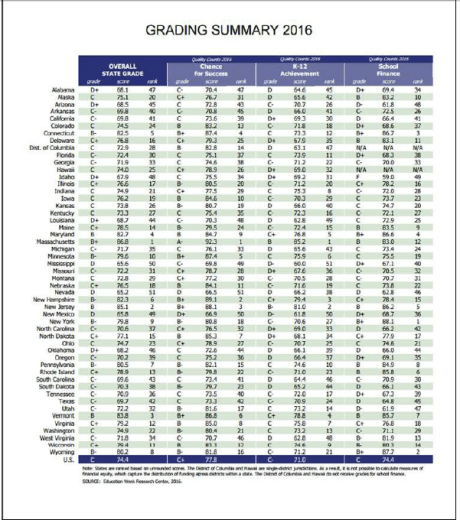
On the chart below (from www.edweek.org/media/qualitycounts2016_release.pdf), you will see that on the “Quality Counts” ranking, Texas ranked 45th in the nation in school finance. In other words, Texas schools are low-funded compared to other states. However, on the achievement of students, Texas was ranked 24th. To this educator, that means Texas teachers are picking up the slack that lawmakers are leaving. Additionally, on a third measure called “Chance of Success”—which includes circumstances faced by students including family income, parent education, parent employment, steady employment, etc.—Texas ranked 42nd. So, despite long odds and little meaningful help from policymakers, Texas teachers are doing an outstanding job overcoming obstacles placed in front of them and helping our students to learn.
screen-shot-2017-01-08-at-9-45-25-am

Despite the systemic obstacles like inadequate school funding and insufficient outside-of-school supports available to Texas children, the TEA nonetheless released this grading report labeling 30% or so of Texas schools—as demanded by the bell curve they built the system on—as “D” and “F” schools. Perhaps most incredible of all is the fact that these grades are based almost exclusively on STAAR standardized test results, an exam fraught with problems, about which the Texas Lieutenant Governor Dan Patrick once said “we don’t trust this test.”


Despite misgivings about the quality and ability of the test to reflect student learning, and despite the TEA’s own tepid reaction to its A-F grade from Education Week, and despite the prior existence of a school accountability system proclaiming 94% of Texas schools to be satisfactory performers, and despite the fact that the A-F system reflects poverty better than it reflects teaching quality, ultimately, when it comes to A-F grades, the Texas Education Agency apparently believes it is better to give than to receive.


Note:  Spreadsheets with the Texas data can be found here and here.

They are afraid. They wonder if they will be deported. They worry about their family. They don’t know if they can visit their grandparents.


Some asked their teachers about the electoral college and why Donald Trump was elected president despite receiving fewer votes nationwide. This was perhaps the easiest and most straightforward question of the day.


Teachers also reported that children asked questions about what Trump’s election meant in relation to particular family members who are recent immigrants or refugees having fled from violence in Mexico. Will my father, mother, grandparents or cousin be deported? If they move back to Mexico, could they be killed?


Children of all ages without citizenship or legal status who immigrated to this country with their parents also asked questions about whether they will be allowed to stay in this country. Will I be sent away? Will I be separated from my family? What if I don’t know anyone in Mexico because everyone is here and I’m deported?


Children also had questions about Trump’s proposed border wall and whether they will be able to visit with their family in Mexico or have their family visit them here in El Paso. Will I get to see my grandparents on Christmas? Will I see them ever again? What about my cousins and my friends? What about sick relatives?


There were also questions about the Trump electorate and wondered if the rest of America hated them because they were Mexican. Why would people elect Trump president after what he said about Mexicans and women? Do white people hate Mexicans? Does Donald Trump? Does he think we are all rapists? Do you think he hates me? Why has he said such things about us?
Think about the children in El Paso.


Rev. Charles Foster Johnson has organized strong resistance to the vouchers touted by the most powerful elected official in Texas, not the governor, but the Lieutenant Governor Dan Patrick, a former talk show host. Rev. Johnson is leader to Pastors for Texas Children, which has 2,000 members across the state. They are united in their opposition to vouchers and their support for public schools. Year after year, they have defeated vouchers in the legislature, and they are gearing up to fight them again. You can read more about his and his organization here, at “Reporting Texas.”


I am happy to place Rev. Johnson and Pastors for Texas Children on the blog’s honor roll for their stalwart defense of public schools, of the children of Texas, of religious liberty, and of the principle of separation of church and state.


Johnson, 59, is the Fort Worth-based executive director of Pastors for Texas Children, a network of about 2,000 church leaders around the state who work to support pubic schools.


Johnson and his group have emerged as chief adversaries of Lt. Gov. Dan Patrick. Patrick champions a breed of education reform forged around vouchers — which steer money from public schools to parents to pay private school tuition.


“The lieutenant governor said, a couple of weeks ago, he’ll keep bringing it up until it passes,” Foster told the pastors, who were gathered for a meeting of Texas Baptists Committed in Waco. “It’s up to us to stop him.”


In his baritone southern drawl, Johnson told the pastors that vouchers siphon funds from schools in low-income neighborhoods and violate the separation of church and state enshrined in the First Amendment. School vouchers contradict God’s law of religious liberty, he said, by providing government support for religion.


The organization’s mission is twofold: To advocate for public education with state lawmakers and to mobilize individual churches to support public schools by providing services such as student mentoring and teacher appreciation events.


Members have linked dozens of churches with public schools, met with more than 100 lawmakers since the organization’s inception in 2013, and published dozens of anti-school voucher editorials in newspapers across Texas.

The public schools of Katy, Texas, are overcrowded. The district needs a new elementary school, but it can’t afford to build one.

But the city officials know what really matters in Texas: they are spending $71 million for a new football stadium.

Please, let us not hear any rhetoric from Texas elected officials about how they love the children, how they want the state to attract new businesses by having great schools, how they are planning for the future. The legislature never fully restored the $5 billion in cuts to public schools that they extracted in 2011.

The only investment the politicians are willing to make is in charter schools–and if Lt. Governor Dan Patrick has his way–vouchers. That, of course, is not new money. Charters and vouchers take money from existing public schools and transfer it to entrepreneurs and home schoolers and those who prefer a religious education. There is no new money.

Texans are being scammed. There is no investment in children. There is no investment in public schools.

But there will be a super stadium in Katy.

In the annual fight in Texas over school vouchers, one of the strongest, most consistent defenders of public schools is an influential group known as zpastors for Texas Children. They believe in the importance of public education as a democratic right and they strongly support the separation of church and state.

At recent legislative hearings in Austin, their executive director Charles Foster Johnson testified against a voucher bill that was passed in the State Senate. This battle occurs every year. Thus far, a coalition of rural Republicans and urban Democrats has managed to defeat vouchers in the House. Pastor Johnson and his colleagues have been a powerful group in staving off privatization.

[If you want to watch Pastor Johnson’s testimony, which was “from the heart,” and diverged from his written statement, watch here:

[Start the video at the 3:50 mark– that’s 3 HOURS and 50 MINUTES– move the cursor just shy of the left side of the middle. http://tlchouse.granicus.com/MediaPlayer.php?view_id=37&clip_id=12360 ]

Testimony Before House Public Education Committee

By Charles Foster Johnson of Pastors for Texas Children

October 17, 2016

Chairman Aycock, thank you for the opportunity to testify before you and your committee today about what we have witnessed in our fine neighborhood and community public schools throughout our great State. My name is Charles Johnson, pastor of Bread Fellowship, Fort Worth. I am also executive director of Pastors for Texas Children, a statewide organization mobilizing the faith community for public education support and advocacy. We do two things: we minister to children in our local schools and we advocate for just policy for our children with our legislators. We were birthed out of the Baptist General Convention of Texas three years ago and now have over 1900 faith leaders of all denominations in churches all across Texas.

We are in our schools every day and see children from every ethnicity, every socio-economic background, and all walks of life succeeding beautifully on their path to productive citizenship in our society. We see children discovering their God-given talent and giftedness at the hands of dedicated teachers answering the call of God to pursue careers as educators. We witness daily the sheer moral power of public education as a building block of our society. This is why we are compelled to deliver the message to whoever will listen that universal public education is God’s will for all people—not a “choice” accorded to a few through a school choice voucher. I’d like to share several reasons why:

Public education is a moral duty. Education is a gift of God for all people. Just like the first human did in the Bible story so long ago, every person gets to name God’s world. Just as God brought all the creatures to the human to see what he would name them, so classroom teachers in schools all across our land teach our children to name God’s world. It’s the only way we can fulfill the first commandment of God to “be fruitful and multiply, replenish the earth and subdue it.” Education is a core component of the public interest. It is God’s common good for all God’s children—not just for those who are smart and stable and economically secure enough to pay for it with a school choice voucher.

Public education is a democratic duty. The founders of this nation determined at the outset of our Republic that in order to have a democratic society, we must educate all our children—not just a few children from families affluent enough to pay for it. Public education is a cornerstone of our American way of life. It is what has made America great. Our neighborhood and community schools are the places where our American history is taught, where our children learn basic civics, where the Pledge of Allegiance is said every day, where citizens are made. In America, citizenship is for all people—not just those few fortunate enough to be chosen by a school choice voucher.

Public education is a societal duty. It is incorrect for some of our friends to say that the money should follow the child because it is “my money.” With all due respect, it is not “my money” in a just society. We have a responsibility to participate in the well-being of all people. Do I get to have my own private security guard subsidized by the public through a “safety choice voucher?” Do I get to have my private swimming pool underwritten by the people of Texas because I don’t use the public pool? In a just and equal society, do I get a “transportation voucher” because I walk or ride a bicycle? The love of neighbor has founded our social order in these United States. We practice that love of neighbor through our taxation to support investments in that societal infrastructure.

Public education is a constitutional duty. The Constitution of the State of Texas says this in Article 7, Section 1: “A general diffusion of knowledge being essential to the preservation of the liberties and rights of the people, it shall be the duty of the Legislature of the State to establish and make suitable provision for the support and maintenance of an efficient system of public free schools.” The members of this legislative body swore a Bible oath to uphold that provision. There is zero authorization for this body to do anything with private schools.

Public education is a spiritual duty. We believe wholeheartedly in religious liberty as a gift of God from all people. Thomas Jefferson and James Madison did not make it up. It is the principle upon which our nation is founded. So, we affirm that no overt religious instruction or activity should be advanced or established with tax dollars in our public schools. All faith is voluntary. It belongs in the home and the church—not in our public institutions. This government has no authority to advance religion in our public schools. Nor, on the other hand, does this government have any authority to meddle in our private and home schools through a school choice voucher. Any money that is diverted from the public trust to a private entity will be publically accounted for, thus inserting and intruding government into the voluntary associations of religious schools. God does not need Caesar’s money to do the Lord’s work. Never has. Never will.

But, faithful teachers take the love of God with them into our classrooms each and every day, ministering long hours at low pay while serving the poorest children in our midst. They instill moral character. They teach respect across the wide diversity of our population. They show unconditional love to all kids. They do this because they are called before God. This is why the dynamics that govern our capitalistic system do not operate in an educational environment. Market forces such as competition and cost benefit analysis simply do not apply in the formation of a human being. A classroom is a holy place of learning—not a marketplace of financial gain. To make commodities of our kids and markets of our classrooms is to misunderstand—and profane—the spirituality of education.

PO Box 471155 – Fort Worth, Texas 76147
http://www.pastorsfortexaschildren.com

Lieutenant Governor Dan Patrick, former talk show host, really wants vouchers for the millions of students in Texas. Fortunately, he has been defeated year after year by a coalition of rural Tepublicans and urban Democrats.

The battle is on again this year. Patrick and his fellow ideological zealots are headed for a showdown on the issue. There is no evidence that vouchers “work,” and much evidence that they don’t. In a state like Texas, the voucher proposal is strongly opposed by a brave group called Pastors for Texas Children. (Make a donation if you can to help them.)

Supporters of vouchers insist that the schools that receive public funds should be exempt from state tests or any other accountability measures, which might limit their “freedom.”

“A bipartisan group of state representatives hammered private school choice proponents at a heated legislative hearing on Monday, signaling an enduring uphill battle in the Texas House for proposals that would use taxpayer dollars to help parents send their kids to private or parochial schools, or educate them at home.

“Rural Republicans and Democrats in the lower chamber have long blocked such programs — often referred to in sweeping terms as “private school vouchers,” although there are variations. Passing one has emerged as a top priority in the Texas Senate for Lt. Gov. Dan Patrick, who unsuccessfully pushed a private school choice program when he was a Republican state senator from Houston and chairman of the Senate Education Committee.”

Of course, the proposal for vouchers is a pathetic excuse for failing to restore the $5 billion cut to the public schools in 2011.