Archives for category: Texas

Tuesday, March 21, 2017

Senate Bill 3 Testimony

Good afternoon, Senators.

My name is Sara Stevenson, and I’ve been a librarian at O. Henry Middle School in Austin for 14 years. Previously, I taught English at St. Michael’s Catholic Academy for ten years, so I have a great respect for Catholic education.

I also write opinion pieces for The Austin American-Statesman, The Houston Chronicle, and The Texas Tribune. I have written against private school vouchers many times. Let’s be clear, ESAs are the same as vouchers.

What disturbs me most about Senate Bill 3 is its lack of accountability. With public money comes public accountability. As the bill is written, any private school or home school which accepts scholarship money does NOT have to administer state-mandated tests as do public schools and charter schools. These private schools DO NOT have to follow IDEA (The Individuals with Disabilities Education Act), and they DO NOT have to change or open their admission policies. Furthermore, the amount of the scholarship is not enough to cover tuition at most private schools, especially when transportation, textbooks, and other materials are included.

This bill is NOT a path for uplifting children in poverty but a thinly veiled tax break for parents who already or were already going to send their children to private or home schools.

Secondly, we must consider the research. According to a Brookings Institute Report by Mark Dynarski in May 2016, studies concluded that both Louisiana and Indiana students who received private school vouchers scored LOWER on READING AND MATH tests compared to similar students who remained in public schools. As Mr. Dynarski wrote:

“In education as in medicine, ‘first, do no harm’ is a powerful guiding principle. A case to use taxpayer funds to send children of low-income parents to private schools is based on an expectation that the outcome will be positive. These recent findings point in the other direction. More needs to be known about long-term outcomes from these recently implemented voucher programs to make the case that they are a good investment of public funds.”

Let’s look at some longer-term studies. In 1989, Milwaukee began its Milwaukee Parental Choice Program. That’s over 25 years ago. According to a Public Policy Report, in the years 2012 – 2014, students in Milwaukee public schools were more proficient than their private school choice counterparts in statewide reading and math tests at every grade level (3 – 10).

Even the DC Opportunity Scholarship program, according to a recent NCEE report, shows no benefits in math, after three years, between students who applied and were selected for a voucher and those who applied but were not and instead continued at public schools.

But the bottom line is that Senate Bill 3 DOES DO GREAT HARM to our already woefully underfunded public schools. The money going to the voucher students is money taken from public school coffers, which will cause greater hardship to the over 5 million Texas schoolchildren who currently attend Texas public schools. We already have so many choices in public education. Senate Bill 3 is not about choice.

Senate Bill 3 is not only unnecessary. It is ineffective and even harmful.

Mary Gonzalez is a member of the Texas House of Representatives. She is now serving her third term in the House, and she is deeply concerned that the state and the federal government want to destroy public education.

The goal of school choice, she says, is to create a separate and unequal system of schools for the state’s 6 million students.

She writes:

In 2011, the Legislature cut $5.4 billion in public education funding and implemented a testing regime that centered accountability on a dehumanizing, ineffective standardized test.

In short, schools would get a lot less money while facing impossible standards. It was as if schools were intentionally being set up to be labelled as failures. Why do you think campuses are now being labeled A through F?

Creating the perception of failing public schools in the minds of the public was necessary to fuel the “school choice” movement.

Listening to the political rhetoric at the state and national level, this strategy seems to have been effective. Instead of a collective discourse on strengthening and funding our public schools, the conversation centers on supporting charter expansion and vouchers.

The expansion of “school choice” translates into the creation of multiple systems, facilitating a structure of separate and unequal.

Charter school quality, however, is questionable. Research demonstrates that, on average, they don’t outperform traditional public schools.

The real problem with “school choice” is the creation of an unequal, tiered system that allows students to fall through the cracks. These tiers are only created when money and resources are taken away from public schools.

In the long term, this approach is unsustainable for a state serving nearly 6 million students.

The unequal distribution of resources, along with the fact that charter schools do not operate under the same rules as public schools, exacerbates the problem.

Charters claim to be “public”, but are actually run by corporations or nonprofits, rather than locally elected school boards that are accountable to parents and the community.

Charters are not subject to the same regulations as public schools. Those regulations include class size limits, student-teacher ratios, and having school nurses and counselors on site.

Also, charters can control enrollment through admission requirements like geographical location, discipline records, sibling priority, academic ability, and through dismissal and expulsion procedures that differ from those of traditional schools. This allows charters to preferentially select students who are less-expensive to educate.

When we fragment the public school system, we create more opportunity for inequity without making any real gains.

Democracy requires a strong and equitable public school system. Choice will undermine that goal.

John Kuhn is an eloquent, wise superintendent in Texas who spreads truth to power.

In this address to the Association of Texas Professional Educators, he warned that the very existence of public education was under fire by a coalition of the rich and the greedy.

He is so brilliant, so eloquent, and so on target that it is hard to excerpt his speech. I urge you to read it in full. If you know anyone in Texas, share it. Send it to Lt. Gov. Dan Patrick, the politician who wants to monetize and privatize the state’s underfunded public schools. That’s his game. That’s his shame. Be sure to tweet JOHN Kuhn’s speech to Dan Patrick @DanPatrick and @LtGovTX

Kuhn says:


“It all really comes down to vouchers. This has been the end-game the whole time. Going back through the decades from TABS to TEAMS to TAAS to TAKS to STAAR [the acronyms for successive state tests], it was never about assessing student learning. It was always about smearing teachers and manufacturing a crisis. Vouchers were always a solution in search of a problem, and the test-and-punish industrial complex arose to create that problem. In reality, testing has always shown us the same thing, always. Well-off and middle class American public school students academically outperform kids from private schools and kids from other nations, when matched socioeconomically. And poor American kids outperform poor kids in those other countries and in private schools, when matched socioeconomically. It is only when you lump all the kids together–because we have so many more poor kids testing than they systems they compare us to–that American public school results look bad. It is a trick. We don’t have an educational problem. We have a social inequality problem that politicians and privatizers dress up as an educational problem. And this statistical sleight of hand, this deliberate misdirection has one goal: to justify the need for vouchers and the dismantling of public education as a state responsibility.

“The voucher movement is about money and adult interests. It isn’t about children. It’s not even mostly about parents who want a discount on their private school tuition; it’s mostly about the interests of other adults, very wealthy adults. It’s about the interests of tycoons and political players who are funding school voucher campaigns across our state and nation not because they want to improve schools, but because they want to engineer a cheaper education so their property taxes will go down. They want to hobble teachers’ unions and reduce wages and benefits. And on top of cheapening a system that already has one of the lowest levels of per pupil spending in the nation, Texas privatizers also want to make money on theback end, they want a piece of the education pie, which billionaire school choice advocate Rupert Murdoch said was a $500 billion dollar industry just waiting to be “transformed.” He meant to say hijacked.

“They don’t really want a piece of the education pie. They want the whole thing. They want to convert a public good into a private enterprise. They want to take this public education system that was created by wiser and more selfless people long ago as a public trust, that belongs to the people—controlled by voters engaged in the Democratic process, free to attend, and open to all children—this is the vision of public education as we know it, and this is what is facing an existential threat….

Texas voters and Texas lawmakers have rejected vouchers over and over again. But the voucher lobby cynically repackages the idea under new and confusing names. Let’s call vouchers Opportunity Scholarships. The voters figured that out, time to change the name. Let’s call them Education Savings Accounts. Let’s call them School Choice. Let’s rebrand them over and over until everyone is thoroughly confused and don’t realize they’re voting for vouchers. The Dallas Morning News had a better term for vouchers in a recent headline: “Private School Vouchers are the Fool’s Gold of Better Education.”

Fool’s gold. Pyrite. A worthless material that is just shiny enough to trick the uninformed into believing that it has value. That’s exactly what vouchers are, even if you call them something else. And why would you call them something else? Why would voucher advocates feel the need to trick people by re-branding their pet policy?

Maybe it’s because vouchers are a terrible idea. Maybe they change the name because the research is in, and it’s clear: vouchers just don’t work. In fact, research shows unequivocally that vouchers don’t just fail to make student achievement better; they actually make student achievement demonstrably worse. Vouchers aren’t the civil rights movement of our time; they’re the civil wrongs movement of our time, hurting the children they pretend to help. Three different research studies published recently have found that voucher programs harm student learning—including one study sponsored by the Walton Family Foundation and the Fordham Institute, both proponents of vouchers. Students who use vouchers underperform their matched peers who stay in public schools.

You heard me right. I’m not just saying that vouchers don’t help very much. I’m saying voucher programs result in students learning less than if the voucher programs didn’t exist. Giving a student a voucher to improve his education is like giving a struggling swimmer a boulder to help him swim. The Walton Foundation study said: “Students who use vouchers to attend private schools have fared worse academically compared to their closely matched peers attending public schools.” A study of the voucher program in Louisiana found very negative results in both reading and math. Kids who started the voucher program at the 50th percentile in math dropped to the 26th percentile in a single year. Vouchers are so harmful to children that a Harvard professor called their negative effect “as large as any I’ve seen in the literature.”

Vouchers should come with a surgeon general’s warning like cigarettes. The third study was of a voucher program involving over 10,000 students in Indiana—where our vice president was governor—and it found this: “In mathematics, voucher students who transfer to private schools experienced significant losses in achievement” and show no improvement in reading. Vouchers are not only not helpful—they’re harmful. And they are not only harmful—they are more harmful than any other educational initiative Harvard researchers have ever seen. They are the educational equivalent of smoking cigarettes to treat lung disease. And the voucher lobby treats research exactly like the tobacco lobby does, by paying think tanks to generate copious amounts of pseudo-science and internet content to try and generate support for the harmful ideology behind their business venture.

In the face of this data showing indisputably that vouchers make things worse for struggling students, why then are vouchers still the big focus this session from so many Texas and Washington political insiders? It’s simple really, and sad. It’s because the voucher push isn’t about student performance at all. That isn’t what this is about. It’s about money in the pockets of adults. Vouchers are not, never were, and never will be about kids….

So I ask what is worse? A government in 1836 so blind to the needs of its citizens that it failed to create a system of public education, or a government in 2017 so deeply held hostage by cronyism and corruption that it is actively, session after session, year after year, trying to dismantle a system of public education that has already been created, a system that was built by the treasure and efforts of many selfless generations of Texas taxpayers and teachers, a system that has expanded since 1836 to cover every square inch of the state, to educate every Texas child who wants to be educated, for free, children of every race and color and creed, regardless of ability or disability, regardless of which side of the tracks they were born on, regardless of their home language or any other personal characteristic. Public schools are for the children. Vouchers are for cronies and conmen. When rich elites refuse to invest in the education of the children of the poor, they sow seeds of disenchantment that eventaually unravel the social fabric. They don’t realize what a dangerous game they play.

The public education movement was and is and will always be about the interests of poor and middle class children and families who see education as their path to a more prosperous future. The voucher movement is about funneling tax dollars to schools that have the right to exclude kids that don’t fit their mold. Voucher schools will have academic entry requirements to keep out the riff raff. Voucher schools will have behavior contracts to keep out the riff raff. Voucher schools will have parent volunteering requirements to keep out the riff raff. The voucher schools will have fees for extracurricular activities, fees for books, fees for uniforms, fees to keep out the riff raff.

But they aren’t riff raff. They’re children, and they are all welcome in our public schools.

The voucher movement rests on a foundational lie that the free market will sort good schools from bad when parents choose. But this is smoke and mirrors, because they have no intention for the marketplace of schools to be truly free. The voucher movement wants to create a system in which public schools give STAAR tests—lots of STAAR tests—but the voucher schools give none. That’s not a free market. That’s the government picking winners and losers. And the voucher movement wants public schools graded with A-F grades based on those STAAR tests, but it doesn’t want the voucher schools graded on the same A-F scale, because A-F grades for schools are based on the STAAR TESTS that voucher schools will never ever be required to give. School vouchers are not a free market, they are the government picking winners and losers and guaranteeing that the winners will be private schools that are exempt from the crushing bureaucratic regulations that our state and federal governments have heaped upon the state’s public schools for decades.

It is a cynical ploy, a corrupt, self-serving campaign. Vouchers are not about children, they are 100% about adult interests.

And school choice is not really about giving students their choice of schools. The best private schools cost over $20,000 per year in tuition. The state is talking about giving out $5000 vouchers. That won’t get poor kids into leafy green academies, it will get them into pop-up franchises that some of the voucher lobby’s largest donors are going to launch all over the state. It will get them into online for-profit schools where one teacher at a computer will “teach” 400 kids clicking through modules online, and we will all pretend this is an education, that this clicking through modules is preparing those kids to be engaged, civically-minded, well-rounded citizens.

I’m just going to say that a real education should look a lot like real life, with flesh and blood encounters with teachers and classmates, face-to-face interactions with diverse friends and neighbors, conflicts and shared lunches, recesses and sports teams, student councils and class officers and mums and bonfires, parades down main street led by the band, and news clippings in the gas station about a buzzer-beater win. Letter jackets and class rings, kissing in the stairwell, loud stereos in the parking lot and quiet tears in the counselor’s office. This is the hum and rattle of community, the pulse, the heartbeat of our neighborhoods, this is public school.

Public schools are about the children. Public schools mold the future when they educate our kids, and they always have. When our politicians brag about how great Texas is and how strong the economy is, remind them that it was public school teachers, not politicians, who built Texas, and we built it by educating 95% of the students in this state.
As the prospects for passage of voucher legislation diminish in Texas, it is time to give thanks to the tireless work of the Pastors for Texas Children. The battle is not over until the legislative session ends, but it is still time to thank those who have worked so hard on behalf of our children, their teachers, and their public schools.

This is an organization with some 2,000 members who represent faith communities across the state. They are led by Rev. Charles Foster Johnson, who understands that separation of church and state is the best protection for religious liberty and that every child in the state should have an excellent public education.

Here is an excerpt from his weekly bulletin:

A Note from Rev. Charles Foster Johnson – Executive Director of PTC

We are conducting introductory conversations with faith leaders all over the country as news of our mission spreads. We have been in productive conference calls this week with Episcopal leaders of Massachusetts and Virginia, as well as church leaders fighting privatization in Indiana. We have had face-to-face meetings with pastors in Kentucky and Mississippi, and are grateful now to have our first state partner affiliate in Pastors for Oklahoma Kids. The movement to mobilize the faith community for public education support and advocacy is going nationwide!

Of course, our main focus is right here in Texas where we still have much work to do in fighting bad policies such as the SB 3 “school choice” voucher bill, the punishing A-F assessment, and the petty SB 13 bill banning payroll deductions… and supporting good policies such as increased funding for our schools, good benefits for our teachers, and full day Pre-K instruction for our youngest children.

To this end, our PTC president Rev. Bobby Broyles is leading us in a statewide initiative to cover our Legislators in prayer. We want to assign each member a pastor as a prayer partner. If you are a pastor, we may be calling you to help with this vital ministry! [Emphasis added by me.]

Upcoming Events

REGISTER NOW! – Prayer Luncheon, Advocacy Training, and Legislative Briefing – 10 am to 2 pm on March 6, 2017 in Austin, Texas: Join Pastors for Texas Children at the historic First United Methodist Church of Austin for a meaningful prayer luncheon for our legislators and for a legislative briefing as we advance through the 85th session of the Texas Legislature. We will be praying for our senators and representatives as they face the difficult task of making policy decisions for Texas. We will learn about the issues related to fair and just education policy for all Texas children. And, we will make legislative visits to our respective policymakers in the Capitol. Click here to find out more and to register.

Texas Education Grantmakers Advocacy Consortium—We are privileged to be a part of the Texas Education Grantmakers Advocacy Consortium under the direction of our good friend, Jennifer Esterline. All of the foundations, funders, and advocates in TEGAC are urging the Legislature to fund high quality full day pre-kindergarten programs that give our children the solid educational foundation they need to succeed. TEGAC’s annual meeting is this Tuesday and Wednesday in Austin.

The Pastors for Texas Children is working with pastors in other states and encouraging them to form similar organizations to support public schools and keep their faith communities free from government mandates and controls.

I must say I love the PTC idea of assigning a pastor as a prayer partner for every member of the legislature!

Here is some good news: “State Rep. Dan Huberty, a Houston Republican and chairman of the House Public Education Committee, said Tuesday morning that school choice legislation has no path forward in the House during the current legislative session.”

The Texas Senate, under the fat thumb of former radio talk show host Lt. Gov. Dan Patrick, is gungho for vouchers. Patrick is also pushing a bathroom bill, modeled on North Carolina’s HB 2, to keep transgender girls or boys out of the bathroom of their choice. He has not suggested who will be in charge of monitoring genitalia in every public bathroom.

The Texas House of Representatives is not as eager to pass voucher legislation as the state senate. . The voucher bills so dear to Dan Patrick may not even get out of committee in the House.

This is what the Texas Tribune says:

State Rep. Dan Huberty, a Houston Republican and chairman of the House Public Education Committee, said Tuesday morning that school choice legislation has no path forward in the House during the current legislative session.

Lt. Gov. Dan Patrick has called Senate Bill 3 one of his top priorities. The bill would create two separate public programs to subsidize private school tuition and homeschooling, including one giving parents debit cards backed by taxpayer money.

“Yes, this is dead to you as an issue?” Texas Tribune CEO Evan Smith asked Huberty as a Tribune event Tuesday morning.

“I believe so, yes,” Huberty said.

School choice advocates are having a hissy fit and they want to censure Rep. Huberty.

School choice is an issue that divides Republicans; battle lines are often drawn more along rural-urban lines than party lines. Last session, the House did not take up the leading private school choice bill for a vote. In the past couple of months, Patrick has called on the House to at least take a vote on this session’s Senate Bill 3, which would create two public programs subsidizing families’ private school tuition and homeschooling expenses.

“We want a vote up or down in the Senate and in the House this session on school choice. It’s easy to kill a bill when no one gets to vote on it,” he said at January’s “National School Choice Week” rally.

On a talk radio show Monday, Patrick said the school choice bill would have the 76 votes needed to pass in the House if it made it out of committee.

Smith asked Huberty on Tuesday to weigh in on Patrick’s comments: “Do you believe you can get the 76 in the House on the floor if you let this go out of committee?”

“Your responsibility as chairman is to protect your membership,” Huberty replied.

When Smith asked what Huberty was protecting them from, Huberty said, “We’ve had a vote count over many sessions about where these numbers lie. I look at the committee and I know where the membership is on this particular issue and where we stand. Why don’t we focus on the things that we can do?”

We can thank House Speaker Joe Straus (R-San Antonio) for selecting Rep. Dan Huberty as the new chair of the House Committee on Public Education. The retiring chair, Jimmie Don Aycock (R-Killeen) was a supporter of public schools, and so is Rep. Huberty.

Huberty understands that no one ever got criticized for a bill that never made it out of committee. Rep. Huberty is protecting his fellow legislators from the wrath of the voters by strangling the voucher bills in committee.

Texans are divided about vouchers. A large association of home schoolers called Texans for Homeschool Freedom oppose vouchers, because they fear that government money will be followed by mandates about textbooks and testing, and they will lose the freedom they treasure.

Ross Ramsey, writing for the Texas Tribune, warns that the battle is far from over:

Elected officials who want vouchers have never been able to get them through the Texas Legislature. And if Huberty holds, it’s probably not going to happen in 2017, either.

One of those truisms borne of experience: Nothing is dead in the Texas Legislature while lawmakers are still in session. Resurrection is part of the game.

Vouchers could turn up as an amendment to another education bill, to legislation that rewires funding for public schools, to anything that has a similar enough subject to justify that sort of an attachment.

It would be weird, but Straus could always decide to send the vouchers bill somewhere other than Huberty’s committee for consideration. The members of the House could express an overwhelming change of heart and demand the opportunity to bring vouchers to the floor for a vote — either to pass it along to Gov. Greg Abbott, who has said he would sign such a bill, or to kill it outright to make a statement.


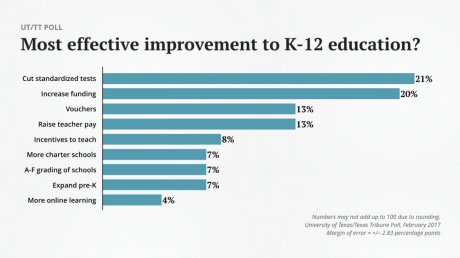
The University of Texas and the Texas Tribune conducted a statewide poll of public opinion about the direction of education reform.

Here are the results. The public makes more sense than their elected officials, who waste their energy and breath advocating for school choice. But the public wants less testing and more funding. School choice has a low priority.

c5cvpsqu0ae2uy8

By the way, I will be speaking in Austin on March 29 at the Austin Marriott North at Round Rock, sponsored by Friends of Texas Public Schools. If you want to attend, contact Jennifer Storm, at stormj@fotps.org for information.

For me, this is a makeup session for the event in 2014, when FOTPS honored me as Friend of the year, and I got stuck in New York City by a blizzard. The fake media called Snowmageddon.

I owe a debt to the public schools of Texas, which educated me. To quote Hank Williams, I’m hoping to set the woods on fire and stop the cranks in the legislature who want to defund public schools and spend public money on nonpublic schools.

Texas officials had a dilemma: a girl who was transgender became a boy. His name is Mack Beggs. He took testosterone for the past two years to aid his transition. Mack loved to wrestle. He was a good wrestler. He wanted to wrestle boys, but state officials insisted he had to wrestle girls, because his birth certificate said he was born a girl. So Mack wrestled girls and won the state championship. Mack had 52 matches against girls and won every one of them. Some people in the crowd booed and jeered and said that “she” had cheated because Mack was pumped up with testosterone.

Beyond the politics are the young people who have been forced to participate within a discussion and scene that, by any measure, is difficult to make sense of. The coach said one of his girls quit the wrestling team rather than face Beggs, who has documented and shared the results of his testosterone use on social media. James Baudhuin, the attorney suing the UIL over Beggs’s participation in the girls’ division, has a daughter who had wrestled against Beggs and, at least before the suit, was among his friends.

The ordeal grew complicated, on and off the mat. Baudhuin himself said he was so conflicted that, though he’d filed a petition to keep Beggs off the mat, he would nonetheless be cheering for Beggs to win the championship.

“The 16 girls who are in [Beggs’s] bracket have been put in a very, very unfair situation because of the grown-ups,” Baudhuin said. “To me, this is a complete abject failure of leadership and accountability from the people who regulate sports in Texas. They’re doing wrong by Mack, and not just these 15 girls but all the other girls she wrestled all year.”

Veteran sportscaster Dale Hansen in Dallas tried to think his way through this nuttiness.

Mack has been taking testosterone and it shows. There’s a reason we have rules in sports against steroids, and it was an incredibly unfair advantage for him. It was also unfair to the girls who had to wrestle him….

Transitioning is a struggle I cannot imagine. It is a journey I could not make… and it is a life that too many cannot live.

The problems that Mack Beggs is facing and dealing with now remind me again that I don’t have any problems. He needs our support, and he does not need a group of old men in Austin telling him who to wrestle because of a genetic mix-up at birth.

We have argued long enough about birth certificates. It’s an argument that needs to end. You don’t have to understand – I myself don’t understand. But Mack Beggs is not the problem so many people make him out to be. He’s a child simply looking for his place in the world, and a chance to compete in the world.

Do we really not have the simple decency to allow him at least that? Because it seems to me it’s the very least we can do.

First thing this morning I posted the story about Texas State Senator Don Huffines debating middle-schoolers about vouchers. I thought they were in grades 7-12, but they were actually grades 7-8.

Texas Kids Whup State Senator From Dallas in Debate About Vouchers

I just received a copy of the tape. Huffines berates the students for challenging him. He is rude and condescending.

This man is a disgrace to his district. He should be laughed out of his office. Or voted out, whichever happens first. The students are far better informed than he is.

This is the best part of the exchange:

“Critics of the voucher program Huffines is pushing say the amount of the vouchers will not be large enough to actually help students attend some costly schools that will be benefiting from taxpayer dollars. One student specifically asked that question, with more grace and decorum than her adult senator could muster up.

“The student asked, “Excuse me Senator, I don’t mean to offend you but you are speaking on behalf of the students, and as a student of public education I disagree with this completely. I’ve gone to a private school before…with these vouchers, what are you going to get — $5000 a year? The majority of these private schools are $5000 a semester. How are lower income families supposed to pay for the rest of the school year?” Huffines, with a very combative and condescending tone answers, “Oh, so it doesn’t pay for all their education. It doesn’t pay for all their education, does it? The $5000 won’t pay for it, right? So you’re saying since we’re not giving them enough money to pay for all their education, screw ’em they can’t go to private school! Do you want me to give them $15,000? Is that what you want? So they can all go to Hockaday or St. Mark’s? That’s the most selfish thing I’ve ever heard.”

I propose a debate between Secretary of Education Betsy DeVos and the middle school students of Richardson ISD. I would pay to see that!

A Texas State Senator debated a group of students from Richardson ISD, and as they say in Texas, the kids gave Sen. Don Huffines a whupping. The students were in grades 7-12.

He tried to persuade them they needed vouchers so they could go to private schools, and a student told him it wouldn’t work because the vouchers would never be large enough to get them into the best schools.

He got testy and snapped at her:

“Huffines countered by asking: “Do you want me to give them $15,000 so they can go to Hockaday or St. Mark’s? That’s the most selfish thing I’ve ever heard.”

Huffines got hot under the collar when the students took issue with him. He lost his cool. His spokesman said “he was ambushed.”


“But Meredyth Childress, a PTA member and mother of one of the students at the meeting, said the students were not political operatives looking to “ambush” Huffines. They were given articles to review about private school vouchers before meeting with the senator. “We’re very proud of the students,” Childress said. “Both sides were passionate. One side displayed the proper respect and decorum. One side did not.”

During one heated exchange, a woman told Huffines that it wasn’t right to send money to private schools that was meant to help public schools.

“What makes you think it’s your money?” Huffines responded, adding that businesses were taxpayers. “Sixty-two percent of all taxes are paid by businesses,” he said.

At one point, Huffines barked at the group: “What are you all afraid of?”

Richardson ISD Superintendent Jeannie Stone said she was proud of how the students responded and grateful they attended the event with her and the PTA.

Bottom line: the high school students were better prepared and more thoughtful than Sen. Huffines.

They knew their stuff. He was outsmarted and outclassed.

Is Sen. Huffines as smart as a seventh-grader from Richardson ISD? What do you think?

In case you happen to be in Texas, you might want to buy a ticket to hear Barbara P. Bush speak to the annual luncheon of Texas Planned Parenthood. The luncheon will be held in Fort Worth.

I wish I could be there!

Barbara P. is one of the two daughters of former President George W. Bush, who was adamantly opposed to abortion.

Barbara P. is a good friend of Cecile Richards, the national chair of Planned Parenthood, and daughter of the late great Texas Governor Ann Richards.

Never lose hope!

Bush’s public appearance before the group is striking, given that her father, President George W. Bush, was a staunch abortion opponent during his time as Texas governor and as president.

But it’s not entirely unexpected. Bush’s mother, former First Lady Laura Bush, has expressed support for the legality of abortion on a handful of occasions. The younger Bush, the CEO and co-founder of Global Health Corps, called Planned Parenthood an “exceptional organization” in a June New York Times interview, and attended a fundraiser for Democratic presidential candidate Hillary Clinton in Paris in October.