Republican activists have been trying to invalidate 127,000 votes cast in Harris County (Houston). Their case failed in the state courts. They are now in federal courts, arguing that votes cast at a drive-in location are invalid, even though the sites were approved by the Secretary of State of Texas.
ACLU Challenges Effort to Invalidate Nearly 127,000 Drive-Thru Votes Cast in Harris County, Texas
HOUSTON — The American Civil Liberties Union and ACLU of Texas moved to intervene tonight in a lawsuit that seeks to invalidate nearly 127,000 early votes cast via drive-thru voting in Harris County, the state’s largest county and the third largest county in the country. This is the third such attempt to discard these validly-cast ballots.
“The push to toss the ballots of nearly 127,000 Texans in Harris County is unconscionable and illegal,” said Sophia Lin Lakin, deputy director of the ACLU’s Voting Rights Project. “It appears to be an attempt to undermine a true and accurate vote count and improperly influence the outcome of the election.”
Tonight’s ACLU challenge was filed on behalf of the League of Women Voters of Texas and several individuals who voted using the drive-thru option, including:
Michelle Colvard, a 45-year-old registered voter who lives in Houston. She has both spina bifida and monoclonal gammopathy. Because of these conditions, she uses a wheelchair and is more susceptible to severe illness from COVID-19. She chose to drive-thru vote as the option that would minimize her risk of COVID-19 exposure.
Karen “Kim” Vidor, a 64-year-old registered voter living in Houston. She has been a registered voter in Harris County since she was approximately 18. She suffers from hypertension, cardiac issues, asthma, and rheumatoid arthritis, all of which heighten her risk from COVID-19. If her vote is at risk of not being counted, she fears she will be totally disenfranchised. For Vidor, a Republican, this is “not a partisan issue,” but rather an issue of having her vote counted.
Joy Davis-Harasemay, a 44-year-old registered voter who lives in Houston. She has both asthma and spondylitis, a degenerative spine disease that makes her unable to stand for long periods of time. She used drive-thru voting, and if her vote is not counted, she will be heartbroken and disenfranchised.As a Black woman, she likely will not vote again in this election for fear of breaking election rules and being accused of voting twice.
Diana Untermeyer, a 58-year-old registered voter who lives in Houston. She routinely votes for Republican candidates during general elections, including voting for Sharon Hemphill — a plaintiff in the lawsuit seeking to invalidate the drive-thru votes in Harris County — over her opponent in the 2020 general election.
“This lawsuit is another desperate and ludicrous attempt by extremists to block the will of the people and disrupt democracy,” said Andre Segura, legal director for the ACLU of Texas. “Throwing out these votes would be patently unlawful and unprecedented. Texans have shown up in record numbers to make their voices heard, and we will fight to ensure that these votes are counted.”
“The attempt to disenfranchise more than 120,000 voters who lawfully cast their ballots during early voting is disgraceful and un-American,” said Grace Chimene, president of League of Women Voters of Texas.“Drive-thru voting was established as a safe early voting option for individuals, including many disabled voters who did not want to enter a polling site during this pandemic. It was tested with great success during the Texas run-off and special election in July. This last-minute attack on voters demonstrates a desire by some to silence Texas voters and we will not stand for it.”
A hearing is slated for Monday morning in Houston in front of U.S. District Judge Andrew Hanen.
Prior to the federal court lawsuit seeking to invalidate the nearly 127,000 votes, some of the same plaintiffs filed a similar suit with the Texas Supreme Court. Earlier today, the Texas Supreme Court denied the request without an order or opinion. In late October, the Texas Supreme Court refused litigation attempting to shut down drive-thru voting in Harris County altogether.
Parents in Texas got disgusted 15 years ago when the Legislature almost passed a voucher law. They organized the Texas Parent PAC, which is a highly effective voice on behalf of public schools and more than five million students.
Their guiding principles are a model for parents, grandparents, and civic activists in other states.
I recently heard from Dinah Miller, co-founder and co-chair, who explained the PAC’s origins. She wrote:
Texas Parent PAC formed in 2005 after taxpayer-funded private school vouchers failed to pass the Texas House by only one vote. Five PTA moms called a press conference during PTA Summer Seminar in Austin and announced we were forming a political action committee to elect better talent to the Texas House who would oppose vouchers and support public schools. We recruited Diane Patrick from Arlington who had local and state school board experience to run against hostile Texas House Public Education Committee Chair Kent Grusendorf who had been in office 20 years. We beat Grusendorf in the primary along with others and then knocked off another hostile education committee member in the general election. Those races put us on the map.
From our website: Texas Parent PAC is a bipartisan political action committee for parents, grandparents, parents-to-be, and anyone who supports high quality public education. The PAC has a track record of success, helping to elect over 63 current members of the Texas Legislature, and defeat 23 incumbents who were hostile to public education.
Endorsed candidates reflect traditional mainstream American values that honor and support children and their families, quality public education, strong communities, unlimited opportunities, and maximum citizen participation in our democracy. All endorsed candidates support the Texas Parent PAC Guiding Principles.
Fifteen years later, our volunteers are still fundraising for our endorsed bipartisan candidates for the November 3, 2020 election. Our website is www.txparentpac.com
A few days ago, I spoke to a statewide group of public education advocates in Texas, brought together by my friends at Pastors for Texas Children.
For some reason, Texas is ground-zero for the charter industry right now. Betsy DeVos has given over $250 million to the IDEA charter chain (the one that wanted to lease a private jet for its executives, and she recently gave $100 million to the State Commissioner Mike Morath to expand charter schools. Morath was in business; he was never an educator. Businessmen like competition; educators know that competition belongs on the sports field and is not a way to improve schools.
I did my due diligence comparing charter schools to public schools in Texas and this is what I found: charter schools have lower test scores than public schools; charter schools have lower graduation rates than public schools; charter school graduates enter college with lower GPAs than public schools; charters have no effect on test scores and a negative effect on earnings after school. All of these articles and studies were published on my blog.
So, why, I wondered are billionaires like John Walton, Tim Dunn, the Waltons, and DeVos expanding this low-performing sector? What smart businessman would continue to pour money into a failing enterprise?
Public schools are better than charter schools by every measure, but they are underfunded. The Legislature cut the school budget by $5.4 billion in 2011 and has still not restored that funding, even though enrollment has grown.
If competition worked, Milwaukee and Detroit would be the best districts in the nation. Milwaukee has had vouchers and charters for more than 20 years. Sadly, all three sectors perform about the same, and Milwaukee is one of the lowest performing districts in the nation.
I asked the Texas audience whether it would make sense to fund two or three different police or fire departments in the same community. Would that improve their performance? Of course not! It would be a duplication and triplication and would be wasteful. I remembered that in the early 19th century, New York City had multiple fire departments. They would race to the scene of the fire, then fight each other for the right to fight the fire while the buildings burned down.
Public schools are a public service. They should be properly funded because they are creating the future. The teachers of Texas and every other state are developing their future leaders and citizens. They are heroes and should be respected and professionally compensated.
It is a fundraising event for the important work of Pastors for Texas Children, which is a great friend to the five million children who attend public schools in Texas. PTC has been a powerful force in the effort by parents and civil groups to block vouchers in Texas. They have done this by reminding people that separation of church and state is the best protection of religious liberty and that we all have a civic duty to support our community public schools and make them better for all children. PTC, in addition, has helped to organize similar organizations in other states where public schools are under assault by privatizers.
The Network for Public Education Action is pleased to endorse Candace Valenzuela for Texas House District 24. Candace is a former school board trustee who knows first hand that our public education system is under attack. She understands that corporate special interests have been undermining public education in favor of alternative models. Candace believes that public education delivers the best results on a consistent basis and true opportunity means giving every child the opportunity to learn and grow regardless of their zip code.
Candace served as a member of the Carrollton-Farmers Branch Independent School District Board of Trustees At-large in Texas for two years. She expanded STEM academies and job training in the Carrollton-Farmers Branch schools and her community is already reaping the economic benefits. Candace wants to make those opportunities a reality for all children living in TX-24. She will use her experience to stand up to Betsy DeVos’s devastating agenda that strips vital funding from our schools.
Candace will fight for universal pre-K, because she believes every child deserves a chance to get ahead. Finally, she believes that we need to pay teachers higher salaries so that we can keep more of them in our schools for longer. That also means finding a way to remove their student loan debt.
Candace is an outstanding candidate and friend of public education. We urge voters in Texas House District 24 to cast their vote for Candace in the general election on November 3, 2020.
William J. Gumbert has studied the performance of charter schools in Texas and has consistently documented that they are inferior to public schools. Their promoters have sold the Legislature a Bill of goods, meaning that their results are nowhere as impressive as their promises. In this post, he shows that charter graduates are poorly prepared for higher education.
Privately Managed, College Preparatory Charter Schools: A Common Approach and a Common Result – Graduates Underperform in College
By: William J. Gumbert
Without any notices or disclosures, the Texas Legislature has been experimenting with students in public education for 25 years. The experiment allows a separate system of taxpayer funded, privately managed charter schools (“State Charters”) to recruit students from locally governed school districts. In this regard, the State provides approximately $10,000 for each student that a State Charter recruits from local school districts. In total, the State has diverted over $25 billion of taxpayer funding from local school districts to fund its separate system of privately managed State Charters.
With State Charters receiving taxpayer funding for recruiting students to attend a low-performing school and with the flexibility to relocate underperforming schools to another community, it is not surprising that State Charters are rapidly expanding. It is also not surprising that many State Charters are targeting the enrollment of low-income, minority students. In low-income communities across the State of Texas, the “sales pitch” is the same and it goes like this:
“Because school districts offer limited high-quality educational options, privately managed charters were created to provide a tuition free, college preparatory education to close the achievement gap for low-income and minority families. As highlighted in our recruiting brochures, our schools are nationally recognized and 100% of the graduates are accepted to college every year. We are a non-profit organization with a mission to ensure that all students get in and through college. With limited seats, please contact our full-time staff of student recruiters to assist with the submission of an application”.
However, these promotions are disingenuous and “very economical with the truth” as the facts document that school district graduates, from Dallas to Houston to the Rio Grande Valley, outperform State Charter graduates upon enrolling in college.
Results in First Year of College Indicates Probability of Graduation: Many studies have indicated that students with a low-grade point average (“GPA”) in their first-year college are less likely to persist in college and graduate. According to the published article: “First Semester GPA a Better Predictor of College Success than ACT Score” by the University of Illinois at Urbana-Champaign, students with a first semester GPA below 2.33 were half as likely to graduate from college in comparison to higher performing students. For low-income students, a GPA below 2.0 (a “D” average or below) has the potential added consequence of losing their student loans or financial scholarships/grants that make college an option. The consequences of a failing GPA for low-income students are a reminder that college acceptance is one thing and succeeding in college is another. As such, prior to college enrollment it is vital for students to be academically, emotionally, and socially prepared to succeed. If not, students are being set-up to fail.
State Charters and School District Graduates – Comparison of College GPAs: Given the relationship between first year GPA’s and college graduation, the Texas Higher Education Coordinating Board (“THECB”) tracks the first year GPA’s of Texas students that enroll at a 4-year public university. The table below compares the GPA’s of State Charter and school district graduates within the Class of 2018 that enrolled in a 4-year public university in 2019. As shown, almost 30.3% of State Charter graduates had a failing GPA versus 17.5% of school district graduates. In addition, the percentage of State Charter graduates achieving a GPA or 3.0 or above lagged school district graduates by 15.4%.
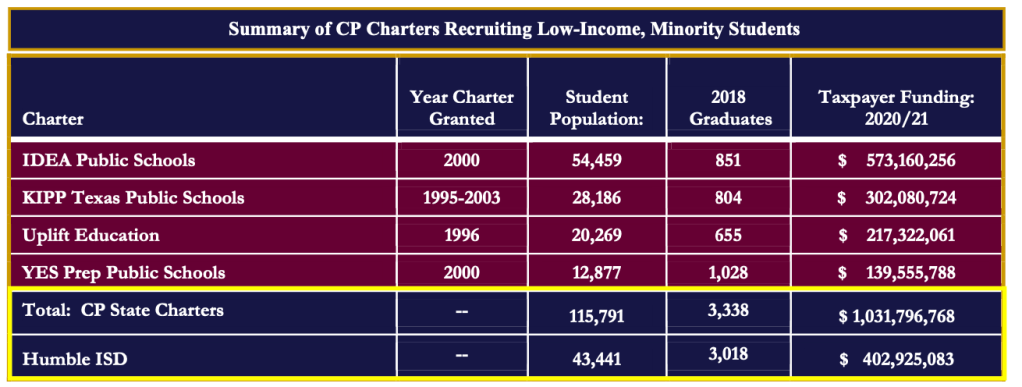
College Preparatory State Charters Targeting Low-Income, Minority Families: There are 4 primary State Charters in Texas that target the recruitment of low-income, minority students with the allure of a “college preparatory” education (referred to as the “CP Charters” herein). As shown in the table below, the enrollment at CP Charters is 115,791 students (which is approximately 33% of the enrollment in all State Charters) and over $1.0 billion of taxpayer funding will be provided in the current year. It is noteworthy that after 20 years, CP Charters produced 3,338 high school graduates in 2018. In comparison, Humble ISD with an enrollment of 43,441 produced a comparable number of high school graduates and it will receive $403 million of taxpayer funding this year.
CP Charter Graduates Underperform in College: Although touted as “tuition-free” college preparatory schools, 39.0% of CP Charter graduates had a GPA below 2.0 upon enrolling in a 4-year public university in 2019. In comparison, only 17.5% of school district graduates had a similarly low GPA. In addition, 27.0% of CP Charter graduates excelled with a GPA of 3.0 or above, which is about half of the 53.0% of school district graduates with a GPA of 3.0 or above.
While this general comparison of college GPA’s does not account for the difference in the student populations that are enrolled at CP Charters and school districts, it does indicate that CP Charters are not successfully closing the “achievement gap” for the low-income, minority students that are actively recruited.
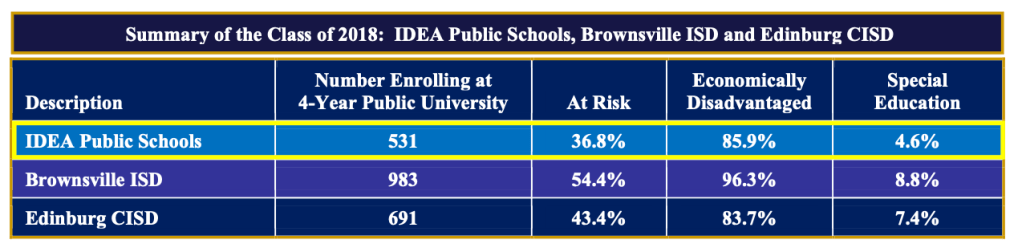
Comparison of College GPA’s – IDEA Public Schools, Brownsville ISD and Edinburg CISD: To compare the postsecondary success of CP Charter and school district graduates that serve similar student populations, a comparison of IDEA Public Schools (“IDEA”), Brownsville ISD (“BISD”) and Edinburg CISD (“ECISD”) is included below. IDEA Public Schools currently enrolls 7,972 students within BISD and ECISD and each school system had a similar percentage of economically disadvantaged graduates within the Class of 2018. For purposes of comparison, we will ignore that both BISD and ECISD had a higher number of graduates and a higher percentage of “At Risk” and “Special Education” graduates.
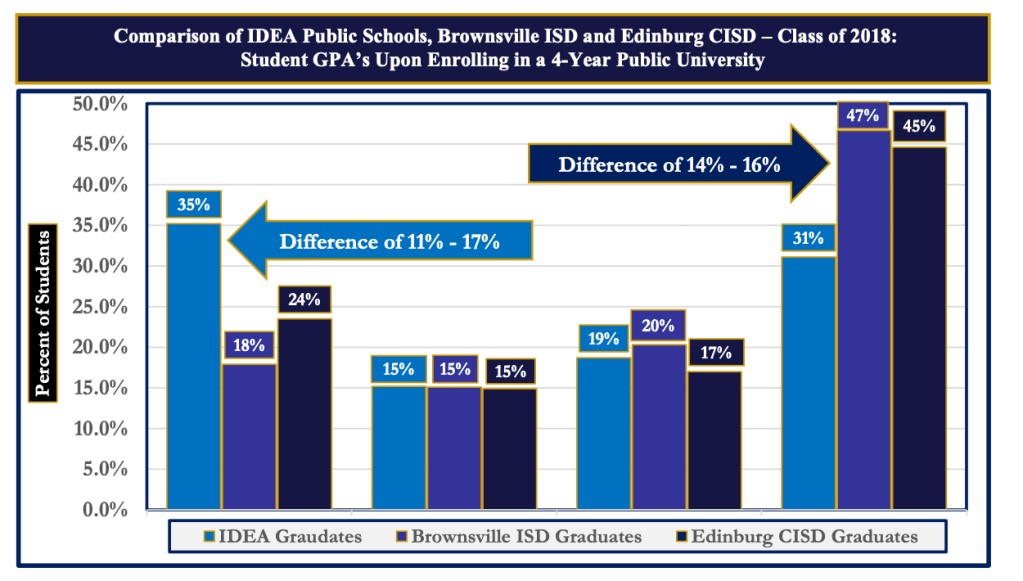
As highlighted in the graph below, the college GPA’s of BISD and ECISD graduates are similar. But despite serving a comparable student population, the GPA’s of IDEA graduates are well below BISD and ECISD graduates. For instance, 35% of IDEA graduates had a GPA below 2.0 versus only 18% of BISD graduates. In addition, the percentage of IDEA graduates that earned a GPA of 3.0 or above was 14% – 16% lower than ECISD and BISD graduates.
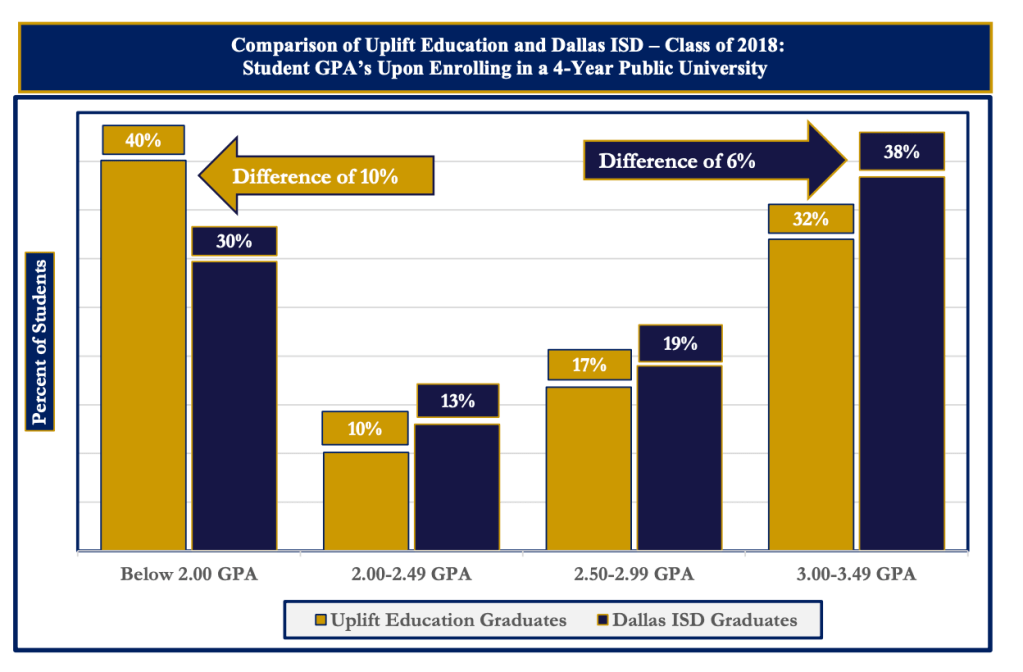
Comparison of GPA’s — KIPP Texas, YES Prep and Uplift Education: To further compare the GPA’s of CP Charter graduates to school district graduates with similar student populations, the GPA’s of KIPP Texas and YES Prep graduates are compared to Houston ISD graduates on the following page. KIPP Texas and YES Prep collectively enroll 20,957 students within Houston ISD. In addition, a comparison of the GPA’s of Uplift Education graduates and Dallas ISD graduates is included. Uplift Education currently enrolls 9,549 students within Dallas ISD.
The results of these comparisons are consistent with previous GPA comparisons, as a significantly higher percentage of KIPP Texas, YES Prep and Uplift Education graduates had a GPA below 2.0 as compared to Houston ISD/Dallas ISD graduates that enrolled in a 4- year public university. In fact, at least 40% of KIPP Texas, YES Prep and Uplift Education graduates had a GPA below 2.0 upon enrolling in a 4-year public university in 2019. Furthermore, the percentage of KIPP Texas and YES Prep graduates that earned a GPA of 3.0 or higher was equal to about half of the Houston ISD graduates that obtained a comparable GPA.
Common Attributes of CP Charters: With the strikingly similar low postsecondary performance of CP Charter graduates relative to school district graduates, there are numerous other commonalities among CP Charters that may be contributing to these results as discussed below. Funded and Directed by Special Interests: Every CP Charter has received millions of dollars from private foundations to expand in local communities. A few of the private foundations that are financially supporting CP Charters is included below. To maintain ongoing influence on public education in local communities and to oversee their financial investments, it is common for trustees of private foundations to be appointed to the governing boards of CP Charters. For example, Ms. Victoria Rico, Chairwomen of the George W. Brackenridge Foundation, has served on the Board of IDEA Public Schools and Ms. Carrie Walton Penner, a Board member of The Walton Family Foundation, serves on the Board of KIPP.
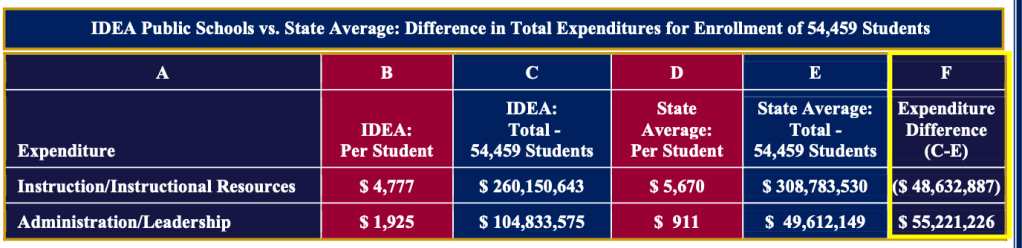
Expenditure Model: Prior studies have indicated that higher funding for student educational programs improves student outcomes. But each CP Charter deploys a conflicting “expenditure model” that devotes fewer dollars for student programs/services. In comparison to the state average of all public schools, CP Charters allocate up to $928 less per student for student “Instruction/Instructional Resources”, while allocating as much as $1,014 more per student for “Administration/Leadership” costs as summarized in the table below.
To illustrate the magnitude of the difference in the expenditures that CP Charters deploy to serve primarily low-income and minority families, the table below compares the “Instruction/Instructional Resources” and “Administration/Leadership” expenditures of IDEA Public Schools to the state average. Based upon the enrollment of 54,459 students, IDEA annually devotes $48.6 million less for student “Instruction/Instructional Resources” than the average public school in Texas and $55.2 million more for “Administration/Leadership”. To put it another way, if the 54,459 IDEA students were enrolled in a school district, an additional $48.6 million would be annually directed to support the instructional needs of students from low-income homes and $55.2 million fewer taxpayer dollars would be siphoned to pay the administrative costs of the private organizations within the State’s separate system of State Charters.
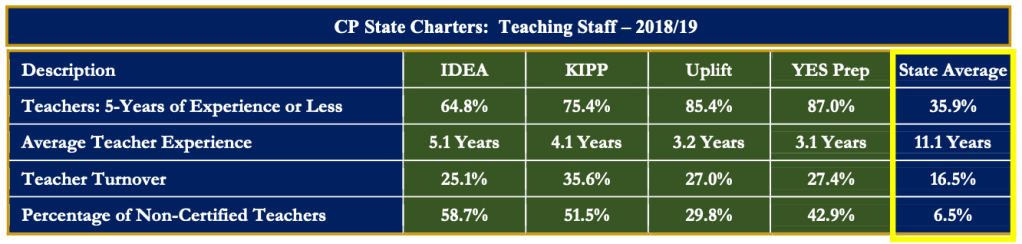
Teacher Staffing Model: There have been multiple studies concluding that teachers with more experience and lower teacher turnover improve student achievement. This includes information published by “tpier-Texas Education Reports” that is co-managed by the Texas Education Agency (“TEA”). According to “tpeir-Texas Education Reports”, teachers with 1-3 years of experience have 6% fewer students that pass the State of Texas Assessment of Academic Readiness” (“STAAR”) test than teachers with 10 years of experience. Despite these findings, CP Charters impose an unorthodox approach that does not value teacher experience, teacher certifications, or teacher persistence. As demonstrated in the table below, as much as 87% of the teaching staffs at CP Charters have fewer than 5 years of experience, and in some cases, almost 60% of teachers are “non-certified”. In addition, with an annual teacher turnover rate of over 25% – 35%, the ability of CP Charters to implement consistent instructional practices and develop long-term, nurturing relationships with students is diminished relative to school districts.
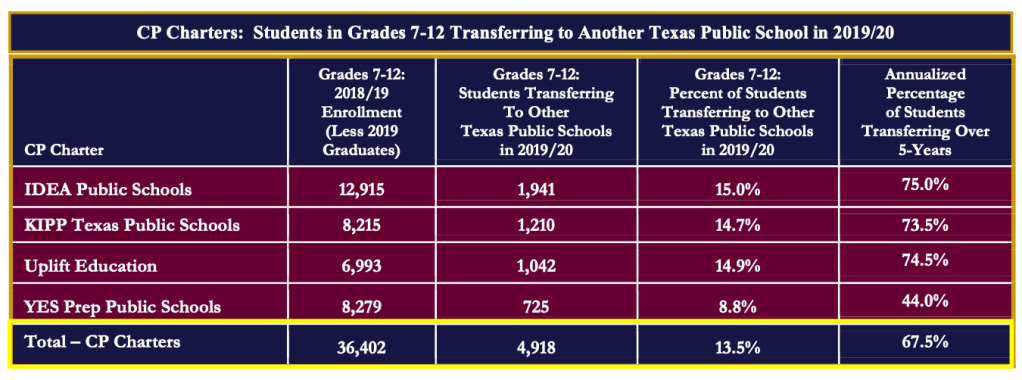
Families Transfer from CP Charters to Another Texas Public School at High Rates: CP Charters recruit new families by marketing the perception that students will be enrolled in a prestigious and nationally acclaimed, tuition-free private school. But upon acceptance and witnessing the educational experience offered by CP Charters, 13.5% of the student enrolled in CP Charters in grades 7-12 transferred to another Texas public school in 2019/20. Comparatively, the student transfer rate at Brownsville ISD and Edinburg CISD that have been bombarded with the expansion of State Charters is 6.1% and 5.8%, respectively. This revolving door means that up to 75% of the students enrolled at a CP Charter in grade 7 are not enrolled in grade 12. This high transfer rate is concerning given the growing evidence that academic outcomes can be negatively impacted as students change schools.
If a restaurant or local business were required to replace 75% of its customers every 5-years, it would likely indicate a flawed business model and the restaurant or local business would be forced to close. But the business model of CP Charters anticipates the loss of students. Which is why CP Charters devote millions of dollars each year to develop a “wait list” of new families to replace those that transfer to another Texas public school each year.
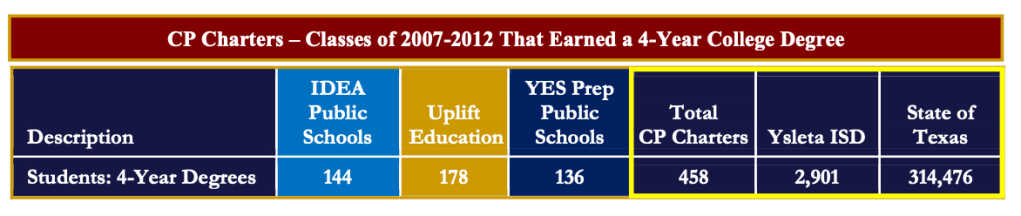
Limited CP Charter Graduates Have Earned a 4-Year College Degree: While each CP Charter has been operating in Texas for at least 20-years, the number of graduates that have earned a 4-year college degree remains very limited. According to “tpeir – Texas Education Reports”, the table below summarizes the number of graduates from the Classes of 2007-2012 at IDEA Public Schools, Uplift Education, and YES Prep Public Schools that earned a 4-year college degree by 2018 (i.e. 6 or more years after high school graduation). It is noted that KIPP Texas was excluded from the table as only 13 graduates were shown to have earned a 4-year college degree and that appeared to be potentially misleading. From the 6 graduating classes in years 2007 – 2012, a total of 458 CP Charter graduates earned a 4-year college degree. For perspective, the number of CP Charter college graduates represents 0.0014% of the total graduates within the State of Texas that earned a 4-year college degree during this time and the number of CP Charter college graduates is 6.3X lower than Ysleta ISD in El Paso.
The point is not to criticize the number of CP Charter graduates that have earned 4-year college degrees. Rather, it is to highlight that the State continues to permit CP Charters to rapidly expand and recruit additional low-income families, despite the limited evidence that CP Charters are adequately preparing students to be successful in college.
Conclusion: In our public schools, students are taught to use the “scientific method” to analyze and answer questions. In this regard, students perform extensive research, formulate a hypothesis, conduct an experiment to test the hypothesis, analyze the data, and draw an evidence-based conclusion.
However, to establish public education policies the Texas Legislature does not rely upon research to form its hypothesis that privately managed State Charters will produce better student outcomes than locally governed school districts. For the last 25 years, the State has conducted a $25 billion taxpayer funded experiment to test its hypothesis about State Charters. The data produced by the State’s experiment documents that State Charters have consistently produced lower student outcomes than school districts as measured by the State’s own academic metrics. These metrics include results of the STAAR test, district and campus academic ratings, graduation rates, financial standards, etc. The difference in the postsecondary outcomes of State Charter and school district graduates referenced herein is further evidence.
So why does the State ignore the facts of its privatization experiment and continue to support the rapid expansion of State Charters in local communities? To answer that question, I conducted my research, formed a hypothesis, analyzed the facts of the experiment, and formed an evidence-based conclusion that the State’s separate system of privately managed State Charters is not about improving student outcomes for low-income and minority students. Rather, the State’s separate system of privately managed State Charters is to please the billionaire, political donors that desire to transfer the governance and taxpayer funding of public education to private organizations.
With fewer resources and a limited political profile, the initial recruitment of low-income and minority families provided the path of least resistance to establish the State’s separate system of privately managed State Charters. With the State approving more and more State Charter expansions in suburban school districts such as, Conroe ISD, Frisco ISD, Hays CISD, New Braunfels ISD, Prosper ISD, Round Rock ISD, Sherman ISD, and Whitewright ISD to name a few, the next phase of the State’s efforts to privatize public education is well underway.
It is your students, your children, your grandchildren, your tax dollars, and your community. It is time for the State to serve students with the basic principles that our taught in our public schools: honesty, integrity, morality, equality, and the scientific method.
DISCLOSURES: This material solely reflects the opinions of the author and the author has not been compensated in any manner for the preparation of this material. The author is a voluntary advocate for public education. The material herein is based upon various sources, including but not limited to, the Texas Education Agency, Texas Academic Performance Reports, Public Education Information Management System, tpeir-Texas Education Reports, The Texas Higher Education Coordinating Board, and other publicly available information. While the author believes these sources to be reliable, the author has not independently verified the information. All readers are encouraged to complete their own review of the State’s separate system of privately managed charter schools in Texas, including the material referenced herein and make their own independent conclusions.
John Helgeson, a charter school executive, has a great deal for a public servant.
In 2007, he helped found Charter School Capital, a for-profit Oregon company that loans money to charter schools and buys school properties. In May 2015, he also started making $300,000 a year as an executive vice president at Learn4Life, a nonprofit network of more than 60 charter schools that serves roughly 45,000 students in California.
Charter School Capital lends money to Learn4Life schools and pockets the interest. While working at Learn4Life – which is funded almost entirely by California taxpayers – Helgeson maintained an ownership stake in Charter School Capital. In doing so, Helgeson discovered a way to collect not just one, but two paychecks from California’s cash-strapped public school system.
Learn4Life, which operates nine San Diego locations, serves a unique group of students. Many are at-risk and have dropped or failed out of traditional high schools. The schools are publicly funded and often located in strip-mall storefronts. Students usually come in to meet with a teacher once or twice a week and complete work packets.
Since 2014, Charter School Capital has loaned more than $6 million to two Learn4Life schools in San Diego alone. A charter school borrowing money from a for-profit lender is normal enough. To have a key employee who profits from both is not.
Just two months after Helgeson came on board at Learn4Life, the company increased its business with Charter School Capital. Charter School Capital purchased the 100,000 square-foot corporate headquarters of Learn4Life in July 2015 – making Charter School Capital the landlord of Learn4Life. Now Charter School Capital wasn’t just profiting on its loans to Learn4Life. It was also profiting on a lease. And so was Helgeson.
“It sounds like a classic conflict of interest, where someone is serving two masters,” said Jessica Levinson, former president of the Los Angeles Ethics Commission and a professor at Loyola Law School.
Carol Burris wrote about Learn4Life in her comprehensive report Charters and Consequences. Its schools have enormous dropout rates and very low graduation rates. By traditional indicators, they would be considered failing schools. Some have graduation rates as low as 0%, though 10-20% is more typical.
The Texas State Board of Education has very low standards for charter schools. How can it set standards for students and teachers when its standards for charters are so rockbottom?
The Texas State Board of Education inexplicably approved another Gulen charter chain—this one deceptively called “Royal Public Schools—though the only thing public about it is its name. Its leader is one Sonar Tarim, who tried and failed to open a charter in Alabama, and who was rejected in Nevada when he tried to open a charter chain there. All Gulen schools are connected with the reclusive Imam Fethullah Gulen, who lives in seclusion in Pennsylvania. To learn more about Gulen schools, read this piece from the Washington Post written by Sharon Higgins, independent researcher. Also, see Mark Hall’s documentary “Killing Ed,” which is available online.
Like all Gulen schools, the boards and staff will be dominated by Turkish men and most contracts are likely to be directed to Turkish-owned firms. The New York Times reported on a pervasive practice by Gulen charter schools in Texas and in Georgia of directing contracts to Turkish firms.
Pastors for Texas Children opposed charter expansion, arguing that this was not the time to divert money from the state’s underfunded public schools.
PTC believes that in a time of economic fragility, when resources are scarce, approving the use of public funds for new schools is irresponsible. Although the board took no action on five of these new charter schools, we are grateful for their veto on three of them.
Pastors for Texas Children advocated against the approval of Rocketship Charter Schools, which applied to open new schools in the Fort Worth area. The board vetoed Rocketship. We also advocated against the approval of Royal Charter Schools, but the board approved them. The south and central San Antonio community overwhelmingly opposes Royal but, unfortunately, their testimonies went unheard.
South San Antonio Parents submitted a petition against Royal but it was ignored, and there was not enough time to allow them to testify.
A witness submitted testimony based on his personal experience. All to no avail.
Testimony of Walt Sims before the
State Board of Education Austin, TX
Thursday, September 10, 2020
Concerning: COFB Item 1. Consideration of the Commissioner of Education’s Generation 25 Open-Enrollment Charter School Proposals
Stance: I am against the approval of the Royal Public School charter
Howdy. My name is Walt Sims and I would like to oppose the new Royal Public School charter and read my testimony concerning the Gulen Movement as an American who spent over a decade amongst them. From everything I know and have witnessed, I firmly believe Soner Tarim is a member of this organization.
As for me, I am a Texan. I attended TX Boy’s State, high school in Tyler, and Texas A&M University. It was at A&M that I first came into contact with the Gulen Movement through their misleading Turkish Language and Culture programs on campus. Through a series of events, I have spent the last 12 years observing the Gulen Movement at its epicenter in Turkey. Over the years, I have been close to many members of this organization, including a fiancée, and I was both an educator as well as a graduate student in a MA & PhD program at their flagship university in Istanbul (Fatih University). It was through these varying relationships that I gained access to see how this religious organization from Turkey uses the education field to pursue power; not education.
Some problems I witnessed were:
*The lobbying of individuals (in many instances, illegal) in US politics, military, journalism, diplomacy and academics;
*Their use of the Hanafi Sunni Islamic doctrine to spy on, marginalize and discriminate against non- Muslims & minorities outside of the organization (violating laws and regulations wherever they went)
*The creation of a male dominated organizational structure where select groups are prioritized and dissent isn’t tolerated, and leads to blacklisting, harassment and threats;
*The indoctrination of individuals of all ages inside the residences and after-school programs (and through cultural exchanges) with their religious propaganda;
*The targeting & infiltration of the judiciary, media and law enforcement of Turkey through the use of graduates from their educational pipeline.
And to be 100% clear: when I first went to Istanbul, I had no desire for the truth to turn out as it did, for it has been an agonizing process. My proximity in observing this organization for so long was such that recently, even the Turkish government secretly arrested & incarcerated me for several weeks denying due process or basic rights, attempting to charge me as a foreign member of this organization (which they deem a terrorist organization).
I want my many years of sacrifice to make one thing clear: I followed the truth and the facts as they were, and had no horse in this other than the truth to protect Texans from what is being deceptively hidden from them. It is because of this, I have been writing to state and federal authorities, including Governor Abbott and the SBOE, ever since early 2011 to shed light on exactly who the Gulen Movement is at their core and how they are targeting Texas.
Therefore, I would strongly encourage the SBOE to oppose any educational institution affiliated in any way with the Gulen Movement or its members, including Royal Public School.
My opposition is not against charter schools in general, but specifically about those educational institutions that operate in conjunction with and in harmony with the Gulen Movement’s members.
Thank you,
-Walt Sims
8600 N Fm 620 Rd. Austin, TX 77826 979-820-3508 waltcsims@yahoo.com
The Texas State Board of Education approved applications from five charter chains, including the Gulen chain (Royal Public Schools) operated by Soner Tarim, who was compelled to leave Alabama because of community protests. It rejected three charter chains, including Rocketship, whose “pedagogy” puts children on computers for half the day, overseen by inexperienced and low-wage teachers.
Among those approved were the Florida-based Doral chain, operated by the for-profit Academica corporate giant. Learn4Life is a California-based chain of drop-in centers with high attrition rates and low graduation rates.
Heritage Classical Academy, CLEAR Public Charter School and Rocketship Public Schools will not be able to open schools in Texas, after traditional public school usleaders and advocates argued the state could not afford to fund new charters during a destabilizing pandemic. The board’s actions are just the latest in a longstanding political debate in Texas over the growth of charter schools, funded by the state but managed privately by nonprofits.
Texas Education Commissioner Mike Morath recommended the eight charter operators at the end of an in-depth process, including mandatory public meetings in target communities and interviews with state officials. The other five —Brillante Academy, Doral Academy of Texas, Learn4Life-Austin, Prelude Preparatory Charter School and Royal Public Schools — will be allowed to open schools next academic year, unless Morath or the board takes further action within the next 90 days…
Texas is one of the largest charter authorizers in the country, with 171 charter districts in operation as of June. Texas caps the number of charter operators, but doesn’t cap the number of schools each operator can open.
Charter opponents warned that the expansion of charter chains would drain badly needed funding from the state’s underfunded public schools, but the state commissioner of education Mike Morath (a software executive, not an educator) supported all the applications and promised that the charters would introduce much-needed innovation.
Never mind that charters in Texas and elsewhere are not noted for any innovations, other than “no-excuses” discipline. Never mind that the critics are right: the funding for the charters will decrease the money available to the state’s real public schools.
Texas seems to have a special affinity for Gulen charters, which are typically managed and staffed by Turkish men who are connected to the Turkish Imam Fethullah Gulen, who lives in seclusion in Pennsylvania.
Walter Stroup is chair of the department of STEM education and teacher development and an associate professor at the University of Massachusetts Dartmouth. In 2014, as a professor at the University of Texas, he publicly testified that the state was wasting hundreds of millions of dollars on standardized testing because the only thing that was measured was skill at passing standardized tests. This was hugely embarrassing to Pearson, which had a $500 million contract with the state of Texas. Recently Professor Stroup sent a letter to the Houston Chronicle, supporting its editorial calling for a pause in standardized testing For 2020-21.
I asked if I could post his response here.
He wrote:
[Response to July 22, 2020 “Editorial: What Gov. Abbott should do about STAAR testing this year for Texas schools.”]
As researchers and longtime education advocates, we support the conclusions of the July 22, 2020 “Editorial: What Gov. Abbott should do about STAAR testing this year for Texas schools.” Before our school system can run as normal, it will need to learn to walk again. And we shouldn’t keep objects in its way that may make it stumble.
We agree that state-mandated standardized exams should be the “last thing” student and teachers need to worry about. But that’s not enough. To support our schools and teachers, the next question has to be: if not STAAR, then what?
There is indeed a substantial body of research showing that current tests are “invalid indicators of student progress and ineffective in closing the so-called educational achievement gap.” We also agree with Commissioner Morath that we need shared measures of student progress if we are all to be held accountable for the educational outcomes in our schools.
To start our thinking about what might come next, we should ask whether STAAR tests are useful to teachers – the first responders of our school system. For that matter, are the products from one of the largest non-high-stakes test vendors in Texas, Northwest Evaluation Association (NWEA), useful to teachers?
We believe the answer is a resounding, No.
Although well intended, these tests measure the wrong kind of growth. Not only does this make them the wrong kind of tool to evaluate student achievement and institutional quality, it also means the tests themselves have become an instrument in preserving inequities in students’ educational outcomes.
When it comes to test development and scoring, two kinds of growth can be assessed.
“Growth” can be evaluated relative to achievement – how much students have learned. Or “growth” can be evaluated on a scale similar to measurements of height. Just as children get taller with age, they also get generally better at certain kinds of problem-solving tasks.
It makes a world of difference which kind we use if we want to help schools recover.
The first kind of growth – in achievement – is the only kind for which schools can, and should, be held accountable. We send children to school because we know that’s where we learned to read, write and do mathematics and we want the same for our children. Tests, to be useful in improving student outcomes, must be highly sensitive to differences in what schools do – sensitive to good teaching.
Unfortunately, current test development methodologies give us tests that behave, in almost every significant sense, like measures of biological growth, not measures of achievement.
If we buy a thermometer to measure temperature, put it in a pot of hot water, and the numbers barely change, that’s a problem. If we buy a box of these thermometers that all do the same thing, then that makes it a bigger problem. Our current box of tests has been shown to have very little sensitivity to temperature change — to differences in the quality of instruction.
When it comes to the issue of what kind of growth is being assessed by current tests, the evidence is equally clear. The grade-related growth curves the test vendor NWEA shares on its web site are remarkably similar to curves pediatricians use to chart children’s height.
Age-related or grade-related mental growth metrics can’t be used to improve educational outcomes – they simply aren’t meant to help us become mentally “taller.” Compounding the problem, they have a long history of lending support to oppressive ideologies and practices. In effect, tests fully intended to help address structural inequalities in our educational system end up having the opposite effect: keeping groups of students in the same relative position year-after-year, and across subject areas.
What are the alternatives?
Here are just some of the possibilities. Pattern-based items (PBIs) provide up to eight times more achievement-specific information per question than current items and have been deployed at scale across Texas. Performance-based assessments are being used in New Hampshire. “Badges” are being used in a number of industries as part of digital credentialing programs. Portfolio-based assessment has a long history of use in a wide array of educational settings.
The last time our legislators gathered in Austin, they passed a bill, HB-3906, directing the Texas Education Agency to “establish a pilot program” in which participating school districts would “administer to students integrated formative assessment instruments for subjects or courses for a grade level subject to assessment.” Now is the time to pilot alternative assessments that will help schools and teachers do what they do best – educate our children.
Walter Stroup has his home in Austin, Texas and is chair of the department of STEM education and teacher development and an associate professor at the University of Massachusetts Dartmouth.
Anthony Petrosino is associate dean for research and outreach in Southern Methodist University’s Simmons School. Link to Editorial we were responding to:






 Diane Ravitch's blog