Archives for category: Texas

William J. Gumbert has studied the performance of charter schools in Texas and has consistently documented that they are inferior to public schools. Their promoters have sold the Legislature a Bill of goods, meaning that their results are nowhere as impressive as their promises. In this post, he shows that charter graduates are poorly prepared for higher education.

Privately Managed, College Preparatory Charter Schools:
A Common Approach and a Common Result – Graduates Underperform in College

By: William J. Gumbert

Without any notices or disclosures, the Texas Legislature has been experimenting with students in public education for 25 years. The experiment allows a separate system of taxpayer funded, privately managed charter schools (“State Charters”) to recruit students from locally governed school districts. In this regard, the State provides approximately $10,000 for each student that a State Charter recruits from local school districts. In total, the State has diverted over $25 billion of taxpayer funding from local school districts to fund its separate system of privately managed State Charters.

With State Charters receiving taxpayer funding for recruiting students to attend a low-performing school and with the flexibility to relocate underperforming schools to another community, it is not surprising that State Charters are rapidly expanding. It is also not surprising that many State Charters are targeting the enrollment of low-income, minority students. In low-income communities across the State of Texas, the “sales pitch” is the same and it goes like this:

“Because school districts offer limited high-quality educational options, privately managed charters were created to provide a tuition free, college preparatory education to close the achievement gap for low-income and minority families. As highlighted in our recruiting brochures, our schools are nationally recognized and 100% of the graduates are accepted to college every year. We are a non-profit organization with a mission to ensure that all students get in and through college. With limited seats, please contact our full-time staff of student recruiters to assist with the submission of an application”.

However, these promotions are disingenuous and “very economical with the truth” as the facts document that school district graduates, from Dallas to Houston to the Rio Grande Valley, outperform State Charter graduates upon enrolling in college.

Results in First Year of College Indicates Probability of Graduation: Many studies have indicated that students with a low-grade point average (“GPA”) in their first-year college are less likely to persist in college and graduate. According to the published article: “First Semester GPA a Better Predictor of College Success than ACT Score” by the University of Illinois at Urbana-Champaign, students with a first semester GPA below 2.33 were half as likely to graduate from college in comparison to higher performing students. For low-income students, a GPA below 2.0 (a “D” average or below) has the potential added consequence of losing their student loans or financial scholarships/grants that make college an option. The consequences of a failing GPA for low-income students are a reminder that college acceptance is one thing and succeeding in college is another. As such, prior to college enrollment it is vital for students to be academically, emotionally, and socially prepared to succeed. If not, students are being set-up to fail.

State Charters and School District Graduates – Comparison of College GPAs: Given the relationship between first year GPA’s and college graduation, the Texas Higher Education Coordinating Board (“THECB”) tracks the first year GPA’s of Texas students that enroll at a 4-year public university. The table below compares the GPA’s of State Charter and school district graduates within the Class of 2018 that enrolled in a 4-year public university in 2019. As shown, almost 30.3% of State Charter graduates had a failing GPA versus 17.5% of school district graduates. In addition, the percentage of State Charter graduates achieving a GPA or 3.0 or above lagged school district graduates by 15.4%.

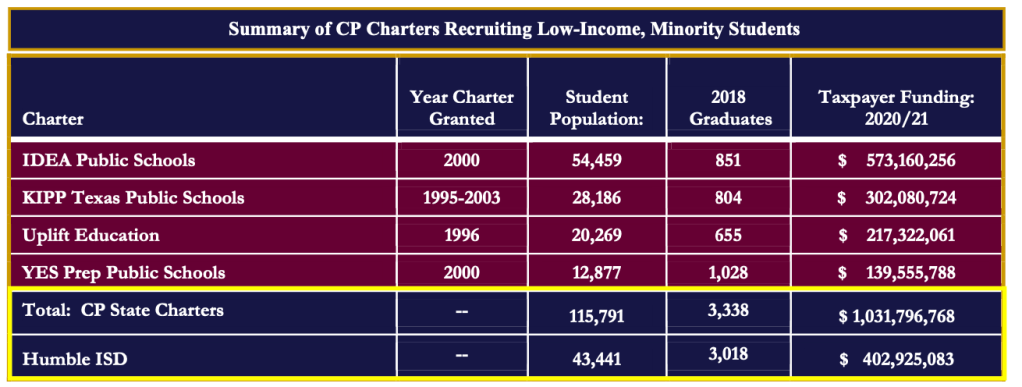
College Preparatory State Charters Targeting Low-Income, Minority Families: There are 4 primary State Charters in Texas that target the recruitment of low-income, minority students with the allure of a “college preparatory” education (referred to as the “CP Charters” herein). As shown in the table below, the enrollment at CP Charters is 115,791 students (which is approximately 33% of the enrollment in all State Charters) and over $1.0 billion of taxpayer funding will be provided in the current year. It is noteworthy that after 20 years, CP Charters produced 3,338 high school graduates in 2018. In comparison, Humble ISD with an enrollment of 43,441 produced a comparable number of high school graduates and it will receive $403 million of taxpayer funding this year.
CP Charter Graduates Underperform in College: Although touted as “tuition-free” college preparatory schools, 39.0% of CP Charter graduates had a GPA below 2.0 upon enrolling in a 4-year public university in 2019. In comparison, only 17.5% of school district graduates had a similarly low GPA. In addition, 27.0% of CP Charter graduates excelled with a GPA of 3.0 or above, which is about half of the 53.0% of school district graduates with a GPA of 3.0 or above.

While this general comparison of college GPA’s does not account for the difference in the student populations that are enrolled at CP Charters and school districts, it does indicate that CP Charters are not successfully closing the “achievement gap” for the low-income, minority students that are actively recruited.

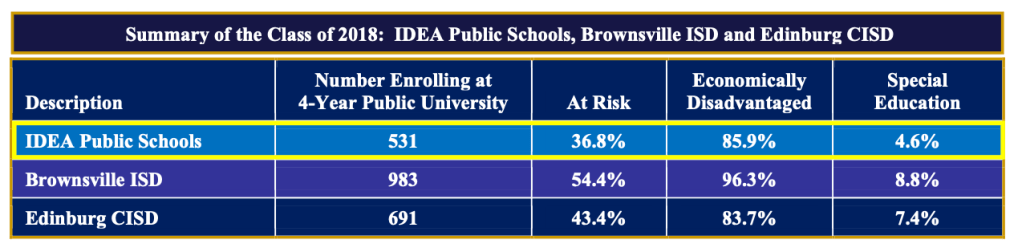
Comparison of College GPA’s – IDEA Public Schools, Brownsville ISD and Edinburg CISD: To compare the postsecondary success of CP Charter and school district graduates that serve similar student populations, a comparison of IDEA Public Schools (“IDEA”), Brownsville ISD (“BISD”) and Edinburg CISD (“ECISD”) is included below. IDEA Public Schools currently enrolls 7,972 students within BISD and ECISD and each school system had a similar percentage of economically disadvantaged graduates within the Class of 2018. For purposes of comparison, we will ignore that both BISD and ECISD had a higher number of graduates and a higher percentage of “At Risk” and “Special Education” graduates.
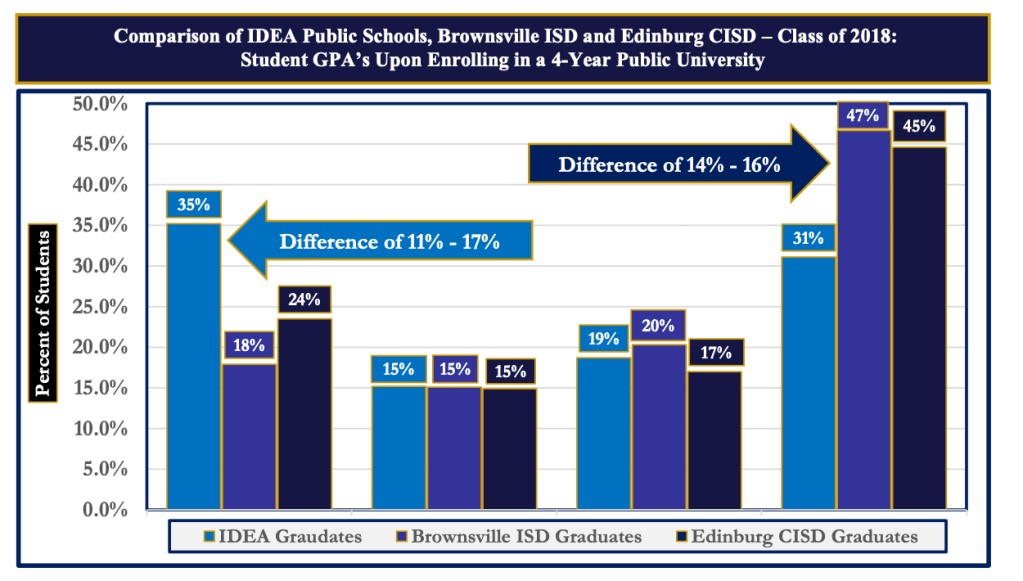
As highlighted in the graph below, the college GPA’s of BISD and ECISD graduates are similar. But despite serving a comparable student population, the GPA’s of IDEA graduates are well below BISD and ECISD graduates. For instance, 35% of IDEA graduates had a GPA below 2.0 versus only 18% of BISD graduates. In addition, the percentage of IDEA graduates that earned a GPA of 3.0 or above was 14% – 16% lower than ECISD and BISD graduates.
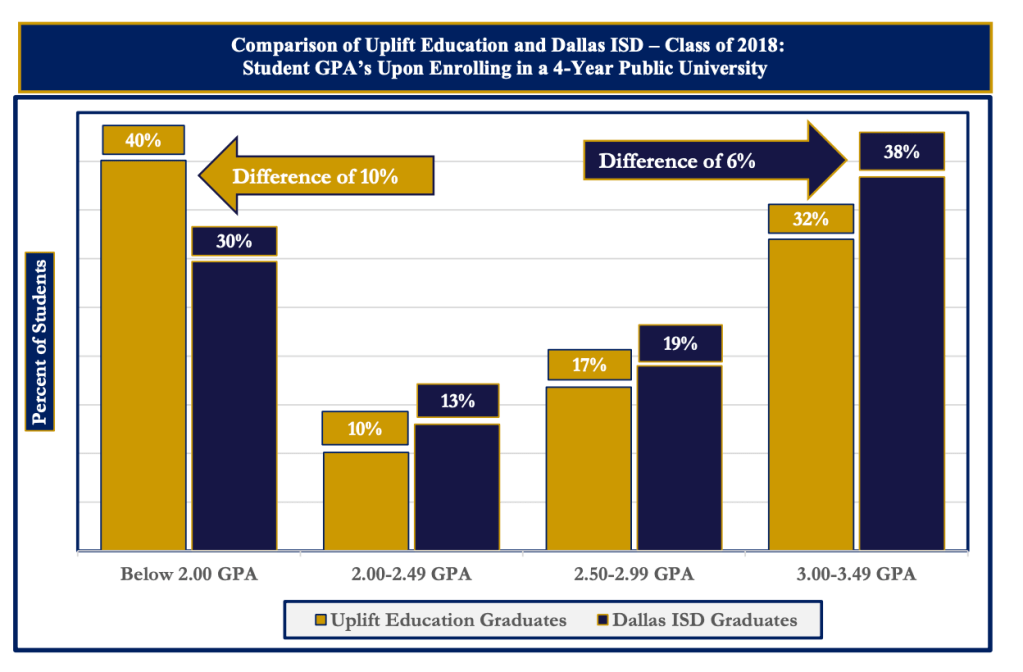
Comparison of GPA’s — KIPP Texas, YES Prep and Uplift Education: To further compare the GPA’s of CP Charter graduates to school district graduates with similar student populations, the GPA’s of KIPP Texas and YES Prep graduates are compared to Houston ISD graduates on the following page. KIPP Texas and YES Prep collectively enroll 20,957 students within Houston ISD. In addition, a comparison of the GPA’s of Uplift Education graduates and Dallas ISD graduates is included. Uplift Education currently enrolls 9,549 students within Dallas ISD.

The results of these comparisons are consistent with previous GPA comparisons, as a significantly higher percentage of KIPP Texas, YES Prep and Uplift Education graduates had a GPA below 2.0 as compared to Houston ISD/Dallas ISD graduates that enrolled in a 4- year public university. In fact, at least 40% of KIPP Texas, YES Prep and Uplift Education graduates had a GPA below 2.0 upon enrolling in a 4-year public university in 2019. Furthermore, the percentage of KIPP Texas and YES Prep graduates that earned a GPA of 3.0 or higher was equal to about half of the Houston ISD graduates that obtained a comparable GPA.

Common Attributes of CP Charters: With the strikingly similar low postsecondary performance of CP Charter graduates relative to school district graduates, there are numerous other commonalities among CP Charters that may be contributing to these results as discussed below.
Funded and Directed by Special Interests:
Every CP Charter has received millions of dollars from private foundations to expand in local communities. A few of the private foundations that are financially supporting CP Charters is included below. To maintain ongoing influence on public education in local communities and to oversee their financial investments, it is common for trustees of private foundations to be appointed to the governing boards of CP Charters. For example, Ms. Victoria Rico, Chairwomen of the George W. Brackenridge Foundation, has served on the Board of IDEA Public Schools and Ms. Carrie Walton Penner, a Board member of The Walton Family Foundation, serves on the Board of KIPP.
Expenditure Model: Prior studies have indicated that higher funding for student educational programs improves student outcomes. But each CP Charter deploys a conflicting “expenditure model” that devotes fewer dollars for student programs/services. In comparison to the state average of all public schools, CP Charters allocate up to $928 less per student for student “Instruction/Instructional Resources”, while allocating as much as $1,014 more per student for “Administration/Leadership” costs as summarized in the table below.

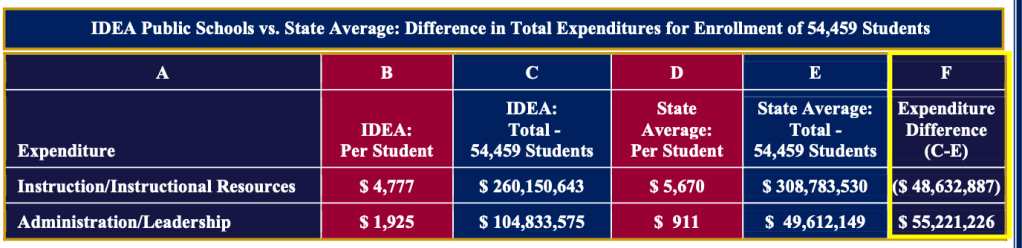
To illustrate the magnitude of the difference in the expenditures that CP Charters deploy to serve primarily low-income and minority families, the table below compares the “Instruction/Instructional Resources” and “Administration/Leadership” expenditures of IDEA Public Schools to the state average. Based upon the enrollment of 54,459 students, IDEA annually devotes $48.6 million less for student “Instruction/Instructional Resources” than the average public school in Texas and $55.2 million more for “Administration/Leadership”. To put it another way, if the 54,459 IDEA students were enrolled in a school district, an additional $48.6 million would be annually directed to support the instructional needs of students from low-income homes and $55.2 million fewer taxpayer dollars would be siphoned to pay the administrative costs of the private organizations within the State’s separate system of State Charters.
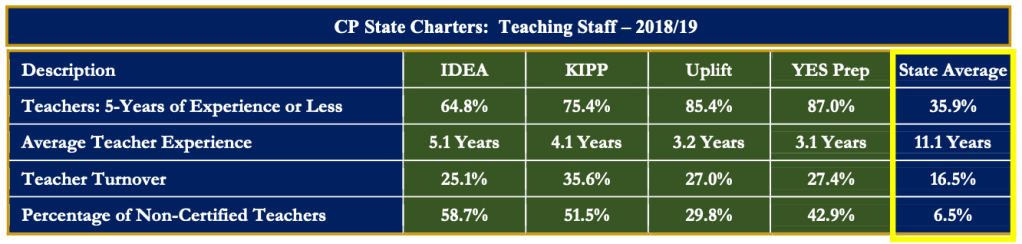
Teacher Staffing Model: There have been multiple studies concluding that teachers with more experience and lower teacher turnover improve student achievement. This includes information published by “tpier-Texas Education Reports” that is co-managed by the Texas Education Agency (“TEA”). According to “tpeir-Texas Education Reports”, teachers with 1-3 years of experience have 6% fewer students that pass the State of Texas Assessment of Academic Readiness” (“STAAR”) test than teachers with 10 years of experience. Despite these findings, CP Charters impose an unorthodox approach that does not value teacher experience, teacher certifications, or teacher persistence. As demonstrated in the table below, as much as 87% of the teaching staffs at CP Charters have fewer than 5 years of experience, and in some cases, almost 60% of teachers are “non-certified”. In addition, with an annual teacher turnover rate of over 25% – 35%, the ability of CP Charters to implement consistent instructional practices and develop long-term, nurturing relationships with students is diminished relative to school districts.
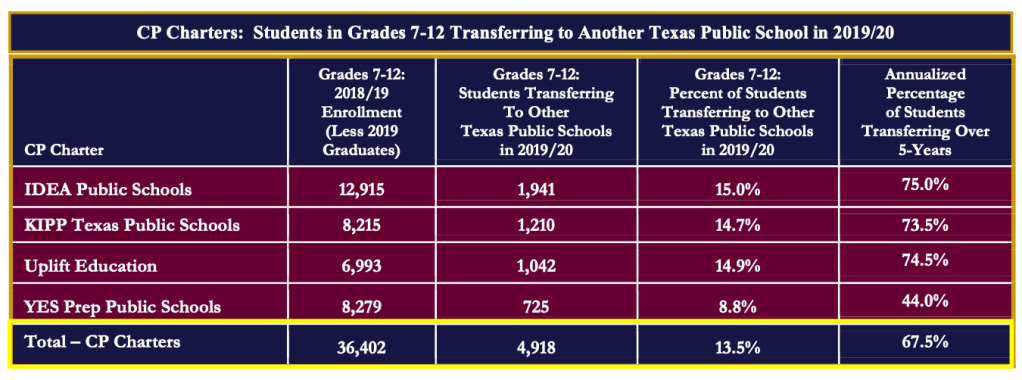
Families Transfer from CP Charters to Another Texas Public School at High Rates: CP Charters recruit new families by marketing the perception that students will be enrolled in a prestigious and nationally acclaimed, tuition-free private school. But upon acceptance and witnessing the educational experience offered by CP Charters, 13.5% of the student enrolled in CP Charters in grades 7-12 transferred to another Texas public school in 2019/20. Comparatively, the student transfer rate at Brownsville ISD and Edinburg CISD that have been bombarded with the expansion of State Charters is 6.1% and 5.8%, respectively. This revolving door means that up to 75% of the students enrolled at a CP Charter in grade 7 are not enrolled in grade 12. This high transfer rate is concerning given the growing evidence that academic outcomes can be negatively impacted as students change schools.

If a restaurant or local business were required to replace 75% of its customers every 5-years, it would likely indicate a flawed business model and the restaurant or local business would be forced to close. But the business model of CP Charters anticipates the loss of students. Which is why CP Charters devote millions of dollars each year to develop a “wait list” of new families to replace those that transfer to another Texas public school each year.
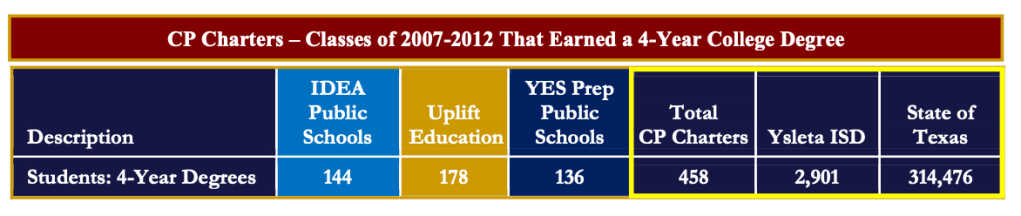
Limited CP Charter Graduates Have Earned a 4-Year College Degree: While each CP Charter has been operating in Texas for at least 20-years, the number of graduates that have earned a 4-year college degree remains very limited. According to “tpeir – Texas Education Reports”, the table below summarizes the number of graduates from the Classes of 2007-2012 at IDEA Public Schools, Uplift Education, and YES Prep Public Schools that earned a 4-year college degree by 2018 (i.e. 6 or more years after high school graduation). It is noted that KIPP Texas was excluded from the table as only 13 graduates were shown to have earned a 4-year college degree and that appeared to be potentially misleading. From the 6 graduating classes in years 2007 – 2012, a total of 458 CP Charter graduates earned a 4-year college degree. For perspective, the number of CP Charter college graduates represents 0.0014% of the total graduates within the State of Texas that earned a 4-year college degree during this time and the number of CP Charter college graduates is 6.3X lower than Ysleta ISD in El Paso.

The point is not to criticize the number of CP Charter graduates that have earned 4-year college degrees. Rather, it is to highlight that the State continues to permit CP Charters to rapidly expand and recruit additional low-income families, despite the limited evidence that CP Charters are adequately preparing students to be successful in college.
Conclusion: In our public schools, students are taught to use the “scientific method” to analyze and answer questions. In this regard, students perform extensive research, formulate a hypothesis, conduct an experiment to test the hypothesis, analyze the data, and draw an evidence-based conclusion.

However, to establish public education policies the Texas Legislature does not rely upon research to form its hypothesis that privately managed State Charters will produce better student outcomes than locally governed school districts. For the last 25 years, the State has conducted a $25 billion taxpayer funded experiment to test its hypothesis about State Charters. The data produced by the State’s experiment documents that State Charters have consistently produced lower student outcomes than school districts as measured by the State’s own academic metrics. These metrics include results of the STAAR test, district and campus academic ratings, graduation rates, financial standards, etc. The difference in the postsecondary outcomes of State Charter and school district graduates referenced herein is further evidence.

So why does the State ignore the facts of its privatization experiment and continue to support the rapid expansion of State Charters in local communities? To answer that question, I conducted my research, formed a hypothesis, analyzed the facts of the experiment, and formed an evidence-based conclusion that the State’s separate system of privately managed State Charters is not about improving student outcomes for low-income and minority students. Rather, the State’s separate system of privately managed State Charters is to please the billionaire, political donors that desire to transfer the governance and taxpayer funding of public education to private organizations.

With fewer resources and a limited political profile, the initial recruitment of low-income and minority families provided the path of least resistance to establish the State’s separate system of privately managed State Charters. With the State approving more and more State Charter expansions in suburban school districts such as, Conroe ISD, Frisco ISD, Hays CISD, New Braunfels ISD, Prosper ISD, Round Rock ISD, Sherman ISD, and Whitewright ISD to name a few, the next phase of the State’s efforts to privatize public education is well underway.

It is your students, your children, your grandchildren, your tax dollars, and your community. It is time for the State to serve students with the basic principles that our taught in our public schools: honesty, integrity, morality, equality, and the scientific method.

DISCLOSURES: This material solely reflects the opinions of the author and the author has not been compensated in any manner for the preparation of this material. The author is a voluntary advocate for public education. The material herein is based upon various sources, including but not limited to, the Texas Education Agency, Texas Academic Performance Reports, Public Education Information Management System, tpeir-Texas Education Reports, The Texas Higher Education Coordinating Board, and other publicly available information. While the author believes these sources to be reliable, the author has not independently verified the information. All readers are encouraged to complete their own review of the State’s separate system of privately managed charter schools in Texas, including the material referenced herein and make their own independent conclusions.

You have read here that the Texas State Board of Education approved five charter chains to grow in the Lone Star State and nixed three chains. One of those approved is a Gulen charter chain that was rejected in Alabama and Nevada.

Another of those that were approved is the Learn4Life chain, a California-based chain of more than 60 charter schools.

Learn more about Learn4Life here.

Will Huntsberry wrote in the Voice of San Diego about Learn4Life last year. Its a sweet deal for its leaders, not so much for its students.

John Helgeson, a charter school executive, has a great deal for a public servant.

In 2007, he helped found Charter School Capital, a for-profit Oregon company that loans money to charter schools and buys school properties. In May 2015, he also started making $300,000 a year as an executive vice president at Learn4Life, a nonprofit network of more than 60 charter schools that serves roughly 45,000 students in California.

Charter School Capital lends money to Learn4Life schools and pockets the interest. While working at Learn4Life – which is funded almost entirely by California taxpayers – Helgeson maintained an ownership stake in Charter School Capital. In doing so, Helgeson discovered a way to collect not just one, but two paychecks from California’s cash-strapped public school system.

Learn4Life, which operates nine San Diego locations, serves a unique group of students. Many are at-risk and have dropped or failed out of traditional high schools. The schools are publicly funded and often located in strip-mall storefronts. Students usually come in to meet with a teacher once or twice a week and complete work packets.

Since 2014, Charter School Capital has loaned more than $6 million to two Learn4Life schools in San Diego alone. A charter school borrowing money from a for-profit lender is normal enough. To have a key employee who profits from both is not.

Just two months after Helgeson came on board at Learn4Life, the company increased its business with Charter School Capital. Charter School Capital purchased the 100,000 square-foot corporate headquarters of Learn4Life in July 2015 – making Charter School Capital the landlord of Learn4Life. Now Charter School Capital wasn’t just profiting on its loans to Learn4Life. It was also profiting on a lease. And so was Helgeson.

“It sounds like a classic conflict of interest, where someone is serving two masters,” said Jessica Levinson, former president of the Los Angeles Ethics Commission and a professor at Loyola Law School.

Carol Burris wrote about Learn4Life in her comprehensive report Charters and Consequences. Its schools have enormous dropout rates and very low graduation rates. By traditional indicators, they would be considered failing schools. Some have graduation rates as low as 0%, though 10-20% is more typical.

The Texas State Board of Education has very low standards for charter schools. How can it set standards for students and teachers when its standards for charters are so rockbottom?

The Texas State Board of Education inexplicably approved another Gulen charter chain—this one deceptively called “Royal Public Schools—though the only thing public about it is its name. Its leader is one Sonar Tarim, who tried and failed to open a charter in Alabama, and who was rejected in Nevada when he tried to open a charter chain there. All Gulen schools are connected with the reclusive Imam Fethullah Gulen, who lives in seclusion in Pennsylvania. To learn more about Gulen schools, read this piece from the Washington Post written by Sharon Higgins, independent researcher. Also, see Mark Hall’s documentary “Killing Ed,” which is available online.

Like all Gulen schools, the boards and staff will be dominated by Turkish men and most contracts are likely to be directed to Turkish-owned firms. The New York Times reported on a pervasive practice by Gulen charter schools in Texas and in Georgia of directing contracts to Turkish firms.

Pastors for Texas Children opposed charter expansion, arguing that this was not the time to divert money from the state’s underfunded public schools.

PTC believes that in a time of economic fragility, when resources are scarce, approving the use of public funds for new schools is irresponsible. Although the board took no action on five of these new charter schools, we are grateful for their veto on three of them.

Pastors for Texas Children advocated against the approval of Rocketship Charter Schools, which applied to open new schools in the Fort Worth area. The board vetoed Rocketship. We also advocated against the approval of Royal Charter Schools, but the board approved them. The south and central San Antonio community overwhelmingly opposes Royal but, unfortunately, their testimonies went unheard.

South San Antonio Parents submitted a petition against Royal but it was ignored, and there was not enough time to allow them to testify.

A witness submitted testimony based on his personal experience. All to no avail.

Testimony of Walt Sims before the
State Board of Education Austin, TX
Thursday, September 10, 2020

Concerning: COFB Item 1. Consideration of the Commissioner of Education’s Generation 25 Open-Enrollment Charter School Proposals

Stance: I am against the approval of the Royal Public School charter

Howdy. My name is Walt Sims and I would like to oppose the new Royal Public School charter and read my testimony concerning the Gulen Movement as an American who spent over a decade amongst them. From everything I know and have witnessed, I firmly believe Soner Tarim is a member of this organization.

As for me, I am a Texan. I attended TX Boy’s State, high school in Tyler, and Texas A&M University. It was at A&M that I first came into contact with the Gulen Movement through their misleading Turkish Language and Culture programs on campus. Through a series of events, I have spent the last 12 years observing the Gulen Movement at its epicenter in Turkey. Over the years, I have been close to many members of this organization, including a fiancée, and I was both an educator as well as a graduate student in a MA & PhD program at their flagship university in Istanbul (Fatih University). It was through these varying relationships that I gained access to see how this religious organization from Turkey uses the education field to pursue power; not education.
Some problems I witnessed were:

*The lobbying of individuals (in many instances, illegal) in US politics, military, journalism, diplomacy and academics;

*Their use of the Hanafi Sunni Islamic doctrine to spy on, marginalize and discriminate against non- Muslims & minorities outside of the organization (violating laws and regulations wherever they went)

*The creation of a male dominated organizational structure where select groups are prioritized and dissent isn’t tolerated, and leads to blacklisting, harassment and threats;

*The indoctrination of individuals of all ages inside the residences and after-school programs (and through cultural exchanges) with their religious propaganda;

*The targeting & infiltration of the judiciary, media and law enforcement of Turkey through the use of graduates from their educational pipeline.

And to be 100% clear: when I first went to Istanbul, I had no desire for the truth to turn out as it did, for it has been an agonizing process. My proximity in observing this organization for so long was such that recently, even the Turkish government secretly arrested & incarcerated me for several weeks denying due process or basic rights, attempting to charge me as a foreign member of this organization (which they deem a terrorist organization).

I want my many years of sacrifice to make one thing clear: I followed the truth and the facts as they were, and had no horse in this other than the truth to protect Texans from what is being deceptively hidden from them. It is because of this, I have been writing to state and federal authorities, including Governor Abbott and the SBOE, ever since early 2011 to shed light on exactly who the Gulen Movement is at their core and how they are targeting Texas.

Therefore, I would strongly encourage the SBOE to oppose any educational institution affiliated in any way with the Gulen Movement or its members, including Royal Public School.

My opposition is not against charter schools in general, but specifically about those educational institutions that operate in conjunction with and in harmony with the Gulen Movement’s members.

Thank you,

-Walt Sims
8600 N Fm 620 Rd. 
 Austin, TX 77826 979-820-3508 waltcsims@yahoo.com

The Texas State Board of Education approved applications from five charter chains, including the Gulen chain (Royal Public Schools) operated by Soner Tarim, who was compelled to leave Alabama because of community protests. It rejected three charter chains, including Rocketship, whose “pedagogy” puts children on computers for half the day, overseen by inexperienced and low-wage teachers.

Among those approved were the Florida-based Doral chain, operated by the for-profit Academica corporate giant. Learn4Life is a California-based chain of drop-in centers with high attrition rates and low graduation rates.

Heritage Classical Academy, CLEAR Public Charter School and Rocketship Public Schools will not be able to open schools in Texas, after traditional public school usleaders and advocates argued the state could not afford to fund new charters during a destabilizing pandemic. The board’s actions are just the latest in a longstanding political debate in Texas over the growth of charter schools, funded by the state but managed privately by nonprofits.

Texas Education Commissioner Mike Morath recommended the eight charter operators at the end of an in-depth process, including mandatory public meetings in target communities and interviews with state officials. The other five —Brillante Academy, Doral Academy of Texas, Learn4Life-Austin, Prelude Preparatory Charter School and Royal Public Schools — will be allowed to open schools next academic year, unless Morath or the board takes further action within the next 90 days…

Texas is one of the largest charter authorizers in the country, with 171 charter districts in operation as of June. Texas caps the number of charter operators, but doesn’t cap the number of schools each operator can open.

Charter opponents warned that the expansion of charter chains would drain badly needed funding from the state’s underfunded public schools, but the state commissioner of education Mike Morath (a software executive, not an educator) supported all the applications and promised that the charters would introduce much-needed innovation.

Never mind that charters in Texas and elsewhere are not noted for any innovations, other than “no-excuses” discipline. Never mind that the critics are right: the funding for the charters will decrease the money available to the state’s real public schools.

Texas seems to have a special affinity for Gulen charters, which are typically managed and staffed by Turkish men who are connected to the Turkish Imam Fethullah Gulen, who lives in seclusion in Pennsylvania.

Walter Stroup is chair of the department of STEM education and teacher development and an associate professor at the University of Massachusetts Dartmouth. In 2014, as a professor at the University of Texas, he publicly testified that the state was wasting hundreds of millions of dollars on standardized testing because the only thing that was measured was skill at passing standardized tests. This was hugely embarrassing to Pearson, which had a $500 million contract with the state of Texas. Recently Professor Stroup sent a letter to the Houston Chronicle, supporting its editorial calling for a pause in standardized testing For 2020-21.

I asked if I could post his response here.

He wrote:

[Response to July 22, 2020 “Editorial: What Gov. Abbott should do about STAAR testing this year for Texas schools.”]

As researchers and longtime education advocates, we support the conclusions of the July 22, 2020 “Editorial: What Gov. Abbott should do about STAAR testing this year for Texas schools.” Before our school system can run as normal, it will need to learn to walk again. And we shouldn’t keep objects in its way that may make it stumble.

We agree that state-mandated standardized exams should be the “last thing” student and teachers need to worry about. But that’s not enough. To support our schools and teachers, the next question has to be: if not STAAR, then what?

There is indeed a substantial body of research showing that current tests are “invalid indicators of student progress and ineffective in closing the so-called educational achievement gap.” We also agree with Commissioner Morath that we need shared measures of student progress if we are all to be held accountable for the educational outcomes in our schools.

To start our thinking about what might come next, we should ask whether STAAR tests are useful to teachers – the first responders of our school system. For that matter, are the products from one of the largest non-high-stakes test vendors in Texas, Northwest Evaluation Association (NWEA), useful to teachers?

We believe the answer is a resounding, No.

Although well intended, these tests measure the wrong kind of growth. Not only does this make them the wrong kind of tool to evaluate student achievement and institutional quality, it also means the tests themselves have become an instrument in preserving inequities in students’ educational outcomes.

When it comes to test development and scoring, two kinds of growth can be assessed.

“Growth” can be evaluated relative to achievement – how much students have learned. Or “growth” can be evaluated on a scale similar to measurements of height. Just as children get taller with age, they also get generally better at certain kinds of problem-solving tasks.

It makes a world of difference which kind we use if we want to help schools recover.

The first kind of growth – in achievement – is the only kind for which schools can, and should, be held accountable. We send children to school because we know that’s where we learned to read, write and do mathematics and we want the same for our children. Tests, to be useful in improving student outcomes, must be highly sensitive to differences in what schools do – sensitive to good teaching.

Unfortunately, current test development methodologies give us tests that behave, in almost every significant sense, like measures of biological growth, not measures of achievement.

If we buy a thermometer to measure temperature, put it in a pot of hot water, and the numbers barely change, that’s a problem. If we buy a box of these thermometers that all do the same thing, then that makes it a bigger problem. Our current box of tests has been shown to have very little sensitivity to temperature change — to differences in the quality of instruction.

When it comes to the issue of what kind of growth is being assessed by current tests, the evidence is equally clear. The grade-related growth curves the test vendor NWEA shares on its web site are remarkably similar to curves pediatricians use to chart children’s height.

Age-related or grade-related mental growth metrics can’t be used to improve educational outcomes – they simply aren’t meant to help us become mentally “taller.” Compounding the problem, they have a long history of lending support to oppressive ideologies and practices. In effect, tests fully intended to help address structural inequalities in our educational system end up having the opposite effect: keeping groups of students in the same relative position year-after-year, and across subject areas.

What are the alternatives?

Here are just some of the possibilities. Pattern-based items (PBIs) provide up to eight times more achievement-specific information per question than current items and have been deployed at scale across Texas. Performance-based assessments are being used in New Hampshire. “Badges” are being used in a number of industries as part of digital credentialing programs. Portfolio-based assessment has a long history of use in a wide array of educational settings.

The last time our legislators gathered in Austin, they passed a bill, HB-3906, directing the Texas Education Agency to “establish a pilot program” in which participating school districts would “administer to students integrated formative assessment instruments for subjects or courses for a grade level subject to assessment.” Now is the time to pilot alternative assessments that will help schools and teachers do what they do best – educate our children.

Walter Stroup has his home in Austin, Texas and is chair of the department of STEM education and teacher development and an associate professor at the University of Massachusetts Dartmouth.

Anthony Petrosino is associate dean for research and outreach in Southern Methodist University’s Simmons School.
Link to Editorial we were responding to:

Related links (links are also in the text above):

What was published in the Houston Chronicle

An Op-Ed in Dallas Morning News discussing research on current tests

NWEA’s growth curve

CDC growth curves used by pediatricians

The IDEA charter chain hopes to double its enrollment in Texas. This is the free-spending chain that planned to lease a private jet for $2 million a year but backed off after bad publicity; that flies its executives and their families in first-class; that bought premium box seats for professional basketball games; that pays its executives exorbitant salaries; that has received more than $200 million in federal funding from Betsy DeVos.

If the expansion plan goes forward, the IDEA enrollment will grow from 50,000 to nearly 100,000; its annual budget will grow from half a billion to one billion. This is larger than the budget of the University of Texas at Austin. Just in the past five years, IDEA’s budget has tripled.

One state representative called for an audit, but was careful to praise the organization that is gobbling up public dollars and sucking the life out of community public schools.

STATE REPRESENTATIVE TERRY CANALES CALLS FOR COMPREHENSIVE STATE AUDIT OF IDEA PUBLIC SCHOOLS

For Immediate Release
August 18, 2020
Contact: Curtis Smith
(512) 463-0426 office

AUSTIN, TX – In a letter addressed to Commissioner Mike Morath of the Texas Education Agency (TEA) and Texas First Assistant State Auditor Lisa Collier, State Representative Terry Canales calls for a comprehensive and multi-agency audit of the IDEA Public Schools (IDEA) after recent disclosures of lavish expenditures for its executives. These disclosures included leasing of a private jet solely for the use of top IDEA officials and their families, chauffeured limousines, advertisements during the Super Bowl and World Series, travel expenses of over $14 million, and many more similar expenditures.

IDEA receives approximately half a billion dollars a year from the State of Texas to educate students. It has plans to almost double its enrollment to 97,000 students and add 27 new campuses by the end of 2021. If approved, state funding could double to approximately $1 billion annually. Additional state oversight is needed to ensure that state dollars are spent for their intended purpose and to prevent questionable use of state funds in the future.

“As public servants, the State has an obligation to ensure that taxpayer dollars are used for their intended purposes, and the recent disclosures of the expenditures at IDEA are alarming—to say the least,” said Rep. Canales. “Texas must ensure that our tax dollars are not being used for purchases like private jets and Super Bowl advertisements. I believe IDEA’s recent actions have raised clear and pressing concerns surrounding IDEA’s financial decisions. Other contracts, state agencies, and even universities that receive far fewer state dollars than IDEA receive more state oversight. So, given IDEA’s questionable expenditures, a financial audit of IDEA only makes sense,” continued Canales. “Let me be clear, I do not believe any of our neighborhood schools are at issue here. I salute the hardworking teachers and students of IDEA, and I wholeheartedly support the work that they are doing. I believe this issue is solely at the executive level of the school district.” said Rep. Canales.

A state audit conducted jointly by the Office of the State Auditor and TEA may ensure that public funds are used efficiently for their intended purpose and may improve public trust. An audit also may reveal the need for possible legislative changes to increase oversight and reduce risk to the State of Texas. For more information, contact the Office of State Representative Terry Canales.

Rep. Terry Canales, D-Edinburg, is the Chairman of the House Committee on Transportation and a member of the Sunset Advisory Commission. Rep. Canales represents House District 40 in Hidalgo County, which includes portions or all of Edinburg, Elsa, Faysville, La Blanca, Linn, Lópezville, McAllen, Pharr and Weslaco. He may be reached at his House District Office in Edinburg at (956) 383-0860 or at the Capitol at (512) 463-0426.

Is Commissioner Mike Morath in IDEA’s pocket? Stay tuned.

Anette Carlisle, public education advocate in Texas, describes how State Commissioner Mike Morath, a non-educator, bought into the anti-democratic strategy of killing local school boards and privatizing public schools. He swallowed whole the disruption program of the Center for Reinventing Public Education, one of the Gates-funded think tanks that call for the abandonment of public schools.

Despite a full decade of failure, phony “reformers” claim that education will improve if private corporations and entrepreneurs take over from elected school boards. It hasn’t worked anywhere, and it won’t work in Texas.

Carlisle writes:

Texas has chosen to abandon our local public schools, locally elected school boards, superintendents and our 5.4 million schoolchildren in favor of a “my way or the highway” single system directive by Texas Education Agency Commissioner Mike Morath. That’s why I’m standing up to say, “Whoa! Hold your horses, please, Mr. Commissioner.”

It’s an effort that’s been building for years, right under our noses. People said, “Surely not,” but here we are.

Look back to 2019 and the Center for Reinventing Public Education’s (CRPE) report centered around the System of Great Schools (SGS) concept. The System of Great Schools “starts from the premise that local school districts are ill-positioned to improve schools directly,” and local districts should “get out of the business of managing instruction in schools.”

Morath, according to the CRPE, “prioritized the SGS initiative as a signature project” and even “smoothed the path for the SGS team to work inside the agency” when other TEA staff disapproved.

It’s just one example of the state telling school district leaders to take a hike and locally elected boards to get out of the way.

Earlier this year, The Texas Tribune interviewed Commissioner Morath, and his thoughts on local control came more clearly into focus. Asked about the state’s takeover of Houston ISD, Morath said, “This is basically a grand, philosophical question that is a right for state legislatures around the country to try to answer. Why do we have schools? Do we have schools to teach children, or do we have schools to have elected school boards?”

The takeaway? Local communities don’t know what’s best for kids. The state does.

Who knew that a conservative Republican Governor and his ignorant State Commissioner would launch a state takeover of public schools?

The New York Times declared that its coverage of the pandemic would not be locked behind a paywall, so I’m assuming this article is available for free use.

It focuses on the fight to contain the virus in Harris County (Houston). One obstacle is the defunding of public health services in this country, which left us unprepared for the pandemic. Another obstacle is the actions of politicians who follow Trump’s lead and minimize the danger to the public. A third obstacle is the stubborn refusal of a large minority who insist on their “right” to do what they want without regard to the community.

This combination has crippled the nation’s response to the pandemic and will cost many thousands of lives.

Candace Valenzuela is one of the most inspiring candidates in the current election cycle. She won her primary in Texas on Tuesday.

Please watch her campaign commercial, in which she describes her difficult childhood, when she was homeless. What saved her was that she always had a “home” at school, where her teachers encouraged her. She went on to finish high school and college, to run for and win a seat on the local school board, and is now likely to become the first Afro-Latina in Congress if she wins in November.

If she makes it, she and Jamaal Bowman will be powerful and well-informed voices for public schools in Congress.

Claudia MacMillan is the director of the Cowan Center for Education at the Dallas Institute of Humanities and Culture.

I met her several years ago when I was invited to speak at the Institute. At that time, Claudia allowed me to sit in on seminars where public school teachers were discussing the Iliad, Shakespeare, and other great classics. I met with school superintendents from Dallas and the surrounding region. I also met Louise Cowan, the scholar who had inspired the work of the Institute (she called me (“an education warrior”).

I invited Claudia to share with you what the Institute is doing now. I was astonished to find this wonderful oasis of learning and knowledge in Dallas. May it grow and prosper!

Learning to Love the World

Claudia MacMillan

“You are the guardians of culture,” my teacher said in a melodious voice to a small auditorium filled with teachers at the Dallas Institute of Humanities and Culture. That was 1989. I was among those school teachers, and Dr. Louise Cowan’s words, her vision, changed the course of my life.

​I would not bother sharing this anecdote or the words that follow if my experience had been an isolated one, or if I were the only one whose life had been transformed by this educational philosophy of generosity, openness, intellectual integrity, and communal grace. But for forty years at the Dallas Institute, the hearts and minds of primary and secondary educators have been lifted up and treasured, and I believe that this message of love and hope needs to be in the world.

​In 2004, I had the privilege of assuming responsibility for the programs that changed me in what is now the Dallas Institute’s Louise and Donald Cowan Center for Education™. Since coming, I and others have spent our time and energy trying to shape and share this ennobling vision that the Drs. Cowan conceived and taught. Their aspiration was that every child in America receive a liberal education of the quality that only privileged students in the nation’s highest-tiered private schools typically receive.

​The Cowans created a work at the Dallas Institute designed to foster this sea change. And in the public schools of Fort Worth, Texas, a bold educational experiment that is modeled on their philosophy—on their love of learning, of teachers, and of human life—is currently underway.

​In three public schools in the Fort Worth Independent School District, students are enrolled in Cowan Academy® in the Humanities classes. The results have been impressive and hopeful. In the first year of classes (2018-2019), at the high school where all students are enrolled in Cowan Academy® in the Humanities classes, teachers, administrators, parents, and the students themselves saw and felt the impact of this unique experience and the quality of community that it seemed to inspire.

​Cowan Academy® in the Humanities classes were piloted in three 8th grade classes in this same year in one Fort Worth middle school. Students with all ranges of abilities were invited to join the class. The only prerequisite was that they be willing to do the work.

The Cowan Academy® in the Humanities Educational Model

I should begin with a nod to what drives public school education. So for those who consider standardized test scores important, although little test prep was introduced into these classes, in both original Fort Worth schools, scores the first year (2018-2019) were outstanding. The 8th grade averages in every category in reading and social studies were above the rest of the campus and above the district averages. Some of the strongest gains were for “English Language Learner” students. Regarding the benchmark tests given in December 2019, one middle school student reported, “Everything we read in this class is so much harder than those test passages, so the test was so much easier than it seemed before.” In the high school, where every student is enrolled in Cowan Academy® in the Humanities classes, the 9th grade English I scores ranked the school among the top in the state of Texas, and this in its first year of operation. In the category of “closing the achievement gap,” their English I scores earned them a 100%, tying for third in the state! Granted, this is the new magnet school in the district, but the district has wisely required the school to represent the district demographically, and in addition, the school has very generous entrance requirements. So although it is a magnet school, students with a wide range of abilities are enrolled.

​There are a few critical standards worked into this educational model designed to help it to succeed.

1. In order to learn to read by writing—a luxury that most public school students are not given—Cowan Academy® in the Humanities students must receive their own personal copies of the books (not the textbooks) so that they can read with pen in hand. Cowan Academy® in the Humanities classes are very low-tech, teaching students, rather, to engage with the texts and with one another in conversation daily. The Fort Worth ISD has been wonderfully generous in providing books for each Cowan Academy® student.

2. In addition, Cowan Academy® teachers who teach history and English must not have more than 75 students a year so that they can tutor and mentor their students like their peers in a private school. However, this usually works out easily for those who are teaching a Cowan Center™ humanities course. Technically, they are teaching 75 English students and 75 history students. Their total is 150 students like many of their colleagues in the district.

3. Perhaps the most important feature of a Cowan Academy® or a Cowan School® (another trademarked educational model certified by the Dallas Institute’s Cowan Center™) is that the principals who lead both educational models have the exact same certification “training” requirements as their teachers so that they can foster the community of the school in this human vision and support the vision of liberal learning overall. The educational vision that gives shape to this work is vastly different from what the bureaucracy knows or provides. And this is not a “do as I say” kind of “training.” It is a “do as I do” vision.

​Cowan Academy® in the Humanities students have largely responded with pride about their achievement. They have even sensed the importance of community that this philosophy seeks to foster. After their first year in a Cowan Academy® class, 8th graders like Eduardo stated, “Thanks to humanities, writing essays is easy, and I am not afraid to talk out loud in front of my speech class.” Madison explained, “This class gives me an advantage for my future. I have learned to see many different perspectives,” while Ke’Onna observed, “we work hard, but the class is getting us ready for high school.” According to the Cowans’ vision, non-competition and community are daily fostered in each class, making a burgeoning human community one of the most common features in a Cowan Academy® class that is observed both by students and by the grown-ups in their lives. As Fernando stated, “I feel a part of a large community in this class.” His classmate, Uriel, proudly claimed, “Humanities makes me feel like I’m part of something so important.”

Cowan Center® Humanities Curricula

Next month, the Cowan Center™ will begin its third year of Cowan Academy® in the Humanities classes in three Fort Worth ISD schools and will be serving students in grades 6-11. All three campuses have chosen to use the trademarked Cowan Center™ curricula. These daily syllabi are modeled on an integrated history/English curriculum used with great success for more than twenty-five years in a private school in Dallas. Cowan Academy® in the Humanities students in the Upper School level, grades 6-12, write and present original speeches to sharpen their powers of persuasion and their public speaking skills. They read aloud daily. They study grammar and rhetoric, write often in journals and frequently compose and revise formal essays on literature, history, and philosophy. They participate in formal small-group seminars that are guided by their own text-based questions or responses. They memorize and recite at least five lyric poems each year. Students do art projects and presentations based on ideas or images from the readings that have captured their imaginations. In addition, students at each level view, sketch, and study the form and meaning of art, architecture, and monuments from around the world. In each grade, then, Cowan Academy® in the Humanities students are tenderly taught to read, write, listen, think, and speak at a high level of sophistication about ideas and situations that have challenged and inspired humanity in every age.

​At each grade level, Cowan Academy® in the Humanities curricula are organized historically around the epoch studied in that year. Freshman Cowan Academy® in the Humanities students study world history and geography from prehistory through the early modern period launched by Machiavelli’s thought. Titles here include The Epic of Gilgamesh, the Ramayana, the Odyssey, Plato’s Apology, Boethius’ Consolation of Philosophy, One Thousand and One Nights, The West African Mwindo Epic, Dante’s (entire) Divine Comedy, and Erasmus’ The Praise of Folly. Connections and comparisons are steadily considered among themes and cultures throughout the year. Apparently startled by the continuity, one 9th grade Cowan Academy® in the Humanities student asked her teacher in the second half of the year, “Are we ever going to stop talking about The Epic of Gilgamesh?” The answer is no, and why would we want to?

​An example of the continuity of the curriculum is found in the way in which freshmen are guided to treat primary documents. Throughout the year, as they read passages from The Code of Hammurabi, the 10 Commandments, Confucius’ Analects, Laozi’s Way of the Dao, The Code of Justinian, the “Beatitudes,” the Tang Code of China, Shotoku’s Constitution, the Magna Carta, Luther’s 95 Theses, and Machiavelli’s The Prince, the class compares the new code or set of laws to preceeding ones to consider what the new codes reveal about the people who wrote them. Ninth grade student also read primary texts to trace the historical development of the three “Abrahamic” religions— Hebrew, Christian, and Muslim—to help lay the foundations for a better understanding of the complex relationship that exits among these traditions even to this day. Lyric poetry by Rumi, Petrarch, and Shakespeare complement one another and deepen in the daily reading of lyric poetry in every class. For their end-of-year speech, each freshman choses an image or idea and traces it through the major historical epochs in at least three different cultures.

​Carrying forward both the content and the modes from their freshman year, sophomore Cowan Academy® in the Humanities students build on this, picking up world history and geography in the early 17th century to study through our time. After Don Quixote, students study literary works such as Hamlet, Candide, Frankenstein, Hard Times, Bartleby the Scrivener, Notes from the Underground, Heart of Darkness, and Kafka’s Metamorphosis, making additional connections to the history and the readings from the 9th grade class. The epic creation story theme continues here from the freshman year with the study of the Popol Vuh. From John Donne to Newton, from Kant to Kobayashi’s haiku, from Blake and Mary Wollstonecraft to Frederick Douglass, from Marx to Mill, from T.S. Eliot to the Harlem Renaissance, from Hitler’s Mein Kampf to Churchill’s and Dr. Martin Luther King, Jr.’s speeches, from James Baldwin, William Faulkner, Gabriel García Márquez, lyric poetry, political documents, and philosophical works are considered from within the frames of the Scientific Revolution, the Enlightenment, the age of industrialization and the Romantics, and up into modern times. The sophomore end-of-year speech requires students to reach back into the freshman curriculum to trace the idea or image from ancient times to modern day.
​On the high school campus, the original Cowan Academy® students are now going into their junior year, a landmark being initiated with Moby-Dick for their Summer Reading. This level of expectation is not new. Students are assigned Volume I of Don Quixote for Summer Reading going into their sophomore year. But these students going in their third year of Cowan Academy® classes are beginning “The American Experience and the World™” with a broad yet deep foundation from reading, discussing, and writing about world history and geography, as well as about literature, philosophy, political philosophy, religion, and art history from around the world. The junior course is framed by Moby-Dick and Invisible Man, epics whose themes and images will allow students to recall, discuss, and write about works studied in both the freshman and sophomore Cowan Academy® classes. Among the authors studied here are Walt Whitman, Ida B. Wells, Booker T. Washington, DuBois, Fitzgerald, Steinbeck, Elie Weisel, Zora Neale Hurston, Frost, Hemingway, Pound, Eliot, Virginia Woolf, William Carlos Williams, Toni Morrison, O’Connor, Neruda, Baldwin, César Chávez, Malcolm X, Gloria Steinem, Lorca, Faulkner, Borges, Cortázar, Paz, Momaday, Barack Obama, and Jumpa Lahiri. In addition to nonfiction essays and speeches, in each of the four parts of the curriculum, political documents include rulings from important cases from the Supreme Court of the United States to help students understand how the political, cultural, social, and spiritual landscape of America has been created and sustained.

​Middle school Cowan Academy® in the Humanities classes are conducted using the same integration of modes and disciplines as their high school counterparts, with a daily dose of in-class poetry memorization celebrating joyful recitations and readings. On one of the two middle school campuses, all the 6th graders will be enrolled in Cowan Academy® in the Humanities classes beginning in August and the comprehensive Cowan Academy® classes will roll up with the students each year in this neighborhood school.

​In the 6th grade “World Myths: Mappings and Meanings™” course, students review the basics of grammar, of language and form in writing, in speaking, as well as practice active listening and reading deeply by annotating texts. Rather than history, the focus here is on learning world geography and on reading broadly from around the world novels, short stories, and folk tales. A steady diet of beautiful images of the world in power point presentations and beautiful picture books about creation myths from Virginia Hamilton’s In the Beginning and D’Aulaire’s Book of Greek Myths fill students’ hearts and minds with the wonder and complexity of the planet and the human condition. The end-of-year assignment in this grade is an original short story about a child from another culture that includes a focus in the plot on a significant geographical feature from that particular region.

​In the 7th grade “Texas Myths™” course, students study the history and epic spirit of Texas, its glories and its blunders. A book of Texas Indian myths and selections from J. Frank Dobie’s Texas Tales provide a touchstone throughout the year. These works are deepened by the study of significant historical documents and with novels such as Juneteenth, Old Yeller, Summer of the Mariposas, and The Evolution of Calpurnia Tate. Enfolding the idea of Texas in its mythic terms is the study of Virgil’s Aeneid, which these students read in class in its entirety. This ancient poem evokes a timeless landscape from which to consider Texas’ (six!) foundings, the struggles and the achievements thereof. Historical figures in Texas are compared to Aeneas and to other major figures in the poem through formal essays, speeches, and journals. The 7th grade end-of-year assignment is an original “tall tale,” Texas-style, to present to the class.

​In the 8th grade “American Myths™” course, students study American history from Jamestown to Reconstruction, with an emphasis on primary historical documents and nonfiction writers such as John Smith, Thomas Paine, Benjamin Franklin, Olaudah Equiano, Alexis de Tocqueville, Thoreau, Emerson, Douglass, Harriot Jacobs, and Abraham Lincoln. Lyric poetry and short stories bathe the year, including authors such Native American poets, Anne Bradstreet, Phillis Wheatley, Jonathan Edwards, Jupiter Hammon, Washington Irving, James Fenimore Cooper, Emily Dickinson, Poe, Hawthorne, Melville, and Walt Whitman. The final assignment for these students is to write and present a formal speech considering the difference between “freedom” and “liberty.” Students must use primary sources that go back to the original colonies and that include the voices of at least three different peoples from the diverse American “myths.”

The Cowan Vision of Liberal Learning for All​

Out of the depths of the pandemic lockdown this spring, messages of inspiration and hope issued from Cowan Academy® students, galvanizing our commitment to the work in Fort Worth and to the splendid teachers and principals who guide it. Missives such as Carlos’, a 7th grader who explained, “Humanities has not only been a class to learn history but a life lesson in itself. I think it is very safe to say that this is a great class that not only one school district needs but the whole country needs in every single school.” A 9th grade student remarked to her teacher, “As the year progressed, I started to view humanities as my little opportunity to really understand the world. I had assignments and lessons that didn’t teach me how to read or annotate for a grade, but to look deeper into the ancient worlds to understand what life meant for anyone at any point in time. I was starting to learn how to read for the experience. The experience to live someone else’s life, and to know what it meant for them to be human.” And an 8th grade Cowan Academy® student sagely observed, “Through our class I have learned that we have a great life because others went through difficult things before us.”

​There are many, many more such comments from our Cowan Academy® students, and we are grateful for every one. They are proof, to me, that the Cowans were correct in their estimation of human possibility and in their confidence that liberal learning truly does set one’s heart and mind free.

​I could go on in great detail about the Cowans’ philosophy of liberal learning. They were profound intellectuals and thinkers, and their vision is what I am privileged to consider and apply every day. But in closing, I would simply like to point out what I believe to be most essential to their vision—what they contributed to the tradition of liberal learning. Their most concrete contributions are Donald Cowan’s—a physicist—emphasis on the purpose of a liberal education—-to cultivate a “poetic imagination” first through the proper study of literature.

The other indispensable feature of their mark on the tradition is the loose yet sturdy frame of Louise Cowan’s literary genre theory in which she teaches how to read for understanding, for broadening one’s views and ideas about life. But just as important as their rigorous academic theories are their insights into the impact of what Donald Cowan calls the “spirit of liberal learning.” They believed that the effect of liberal learning is to help enable a person to achieve the true form of his or her life. They taught the unpopular reality that the deepest understanding almost always comes from the greatest struggle. They taught that true learning always begins with submission. They believed in the power of the well-educated imagination, in society and in one’s life. And they believed that wisdom was connected to mystery and beauty along with the search for meaning and truth. Most importantly, to me, what distinguishes their vision of education from cynical educational and social theories is that they believed that an education better fits a person to be in the world, particularly to be in a democracy where a liberally educated citizenry is critical.

And even though they were constantly elevating their sights to transcendent ideals—such as myth and meaning—in order to couch their understanding, I have never known people so deeply in love with people, in love with the frail and glorious human condition. It was this that motivated them, this love that guided their educational dreams and ambitions, and because of this great gift, love and hope motivate and fuel every aspect of the Cowan Center™ work. Because although the Cowans believed that there was something beyond this world, beyond this life, they also believed that until we “shuffle off this mortal coil,” to quote Hamlet, “earth’s the right place for love,” as Frost’s narrator claims. An education, they taught us, should not only prepare us to make our way through the world in work and in society. At its foundation, an education—like the one we strive daily to provide our precious Cowan Academy® students—should prepare our hearts and minds not only to see and judge clearly, an education should prepare us to live open to wonder, and ultimately, to love this world.