Teachers are receiving apples, donuts, and lovely notes to thank them for their service. But that’s not enough. Many states are reporting severe shortages of teachers and support staff. This means larger class sizes and curtailed curricula. This means denial of a good education to millions of children.
A 2022 report reviews EPI research on teacher pay and presents the evidence showing that K–12 schools are facing a staffing crisis. The pandemic made clear that our economy cannot function if schools don’t have the staff they need to operate safely and effectively.
Policymakers need to invest in K–12 education now, the report’s authors emphasize. They can start by tapping into hundreds of billions of dollars of available federal COVID relief funds. Read the report.
Key takeaways
Since the beginning of the pandemic, state and local public education employment fell by nearly 5% overall, with much larger declines in some states, according to establishment data from the Bureau of Labor Statistics. Household survey data indicate that the number of employed public K–12 teachers fell by 6.8%, school bus drivers by 14.7%, school custodians by 6.0%, and teaching assistants by 2.6%.
COVID concerns are likely a factor in nonteacher staff shortages. Education support staff tend to be older—and thus more at risk of severe COVID—than the average U.S. worker. Less than a third (31.6%) of U.S. workers overall are age 50 or older, compared with 66.2% of bus drivers, 55.4% of custodians, and 50.4% of food service workers in the K–12 public education workforce.
Low pay is a long-standing issue for support staff. From 2014 to 2019, the median weekly wage (in 2020$) for food service workers in K–12 education was $331, while school bus drivers received $493 and teaching assistants $507. In contrast, the median U.S. worker earned $790 per week.
Inadequate pay is a long-standing issue for teachers. Past EPI research shows that public K–12 school teachers are paid 19.2% less than similar workers in other occupations.
Policymakers should tap into the hundreds of billions of dollars in federal COVID relief funds available now to raise pay for education staff, enact strong COVID protections, invest in teacher development programs, and experiment with ways to support part-time and part-year staff when school is not in session. They also need to plan for sustainable long-term investments in the K–12 public education workforce.
NPR released a new poll showing that, despite the loud mouths attacking public schools, most parents like their public schools and teachers.
They like their schools despite the hundreds of millions, if not billions, invested in promoting school choice, charter schools, vouchers, and privatization.
This poll suggests that Democrats should go after people like Ron DeSantis and other politicians trying to harm a civic institution that most Americans, both Democrats and Republicans, appreciate.
Teachers in New South Wales, Australia, plan to strike on May 4 to protest working conditions, especially understaffing and low salaries.
A letter to public school parents
Every day across NSW, children are missing out because of a lack of teachers.
It’s an unacceptable situation affecting public and private schools. Children can’t put their education on hold and wait for this to be fixed.
They have a right to be taught by a fully qualified teacher today and every day.
This is why teachers and principals have made the difficult decision to go on strike on Wednesday, May 4.
The teacher shortages are a growing problem caused by uncompetitive salaries and unsustainable workloads. COVID isn’t the cause. It’s just making a bad situation worse.
In February this year, there were vacant permanent teaching positions in more than half the schools in NSW. More than 95 per cent of teachers and principals say their school has difficulty finding casual teachers.
The Department of Education’s own research shows large and growing shortages of teachers in many subject areas, forcing almost a quarter of secondary teachers to teach outside their area of expertise.
How do we fix the teacher shortages and ensure no child misses out?
If we truly want every child to get a high-quality education, we need a qualified teacher in every classroom.
Significantly, increasing teacher salaries and giving them more time to prepare lessons is an investment in our future that will pay off for our kids and our country.
While the work of teachers has become far more complex and challenging, their salaries have fallen far behind other professions. The NSW Government’s wage offer of a 2.04 per cent annual increase won’t even keep pace with rising costs, with inflation now running at 5.1 per cent.
Workloads are also excessive, with NSW teachers now working an average of 60 hours a week.
For more than 18 months, we have tried to reach agreement with the NSW Government on a reset of teacher salaries to better reflect the value of the work teachers do and make the profession more attractive to high— achieving young people.
We have also sought an increase of two hours in the preparation time teachers have each week. (The current two-hour entitlement for primary teachers has not changed since the 1980s. Preparation time for secondary teachers hasn’t changed since the 1950s.)
Unfortunately, the NSW Government is refusing to make this investment that will help retain our dedicated teachers and attract the ones we need to stop the shortages.
What will happen on Wednesday May 4?
You will need to make alternative plans for your child on this day because teachers will not be at the school.
We understand this is not ideal. But if we do not take action now, the teacher shortages will only grow and more children will miss out.
If you would like more information or to show your support for teachers, you can do so at
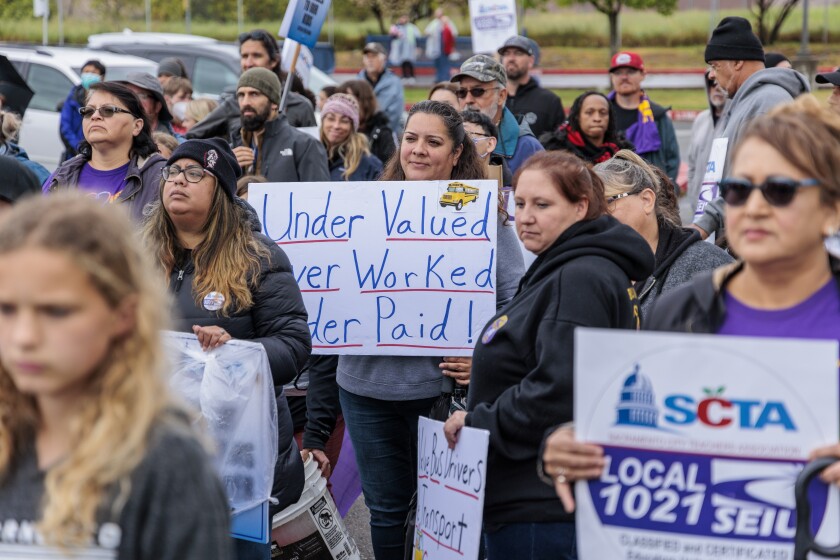
Sacramento City Unified School District teachers, school staff and supporters take part in a rally at Rosemont High School on March 28 as they have been gone on strike due to the staffing crisis in the district . All SCUSD schools shut down and will remain closed for the duration of the strike.
I have read many articles about the shortage of teachers and school staff. I have read many that were laden with statistics. This is one of the best. It appeared in the Los Angeles Times.
A few weeks ago, Sacramento teacher Kacie Go had 56 kids for second period.
That day, there were 109 students at her eighth- through 12th-grade school who were without an instructor because of staff shortages. So she crammed the students into her room and made it work, but “it’s not sustainable,” she said.
No kidding.
Go told me the story standing with hundreds of other teachers and support staff Tuesday morning in the parking lot of an empty high school, as “We’re Not Gonna Take It” blared from speakers and the mostly female workers gathered for day five of a strike that has closed down schools in the Capitol City.
Like Go, these teachers, cafeteria workers, bus drivers and instructional aides are fed up with being asked to do more with less. It’s a problem that goes beyond the Sacramento City Unified School District, with 48,000 students in 81 schools. Frustration among teachers and school workers is rampant across California — pushed to a breaking point by the pandemic and a shortage of more than 11,000 credentialed teachers and thousands of support staff as the state tries to expand pre-kindergarten and bring 10,000 mental health counselors on campuses.
From school closure protests in Oakland to Sacramento’s all-in strike, those who work in our schools are telling us they cannot do this job under the conditions we are imposing. These include mediocre pay, sometimes vicious political blowback from COVID-19 safety measures, a witch-hunt-like scrutiny around hot-button topics, a mental health crisis, the reality of too few people doing the work, and the general disrespect of a society that swears it loves teachers and values education but does little to invest in it. Worrying about school shooters, once an urgent concern of educators and parents, doesn’t even make the top three problems anymore.
It’s the same story playing out in hundreds of other districts not just in California but across the country. Minneapolis teachers just ended a 14-day strike that shared some of the same issues of pay and support, underscored by the same teacher chagrin that we talk a good game about supporting public education but don’t always come through with actions. Minneapolis Federation of Teachers Chapter President Greta Callahan summed it up, sounding like she could be standing in Sacramento.
“We shouldn’t have had to [have] gone on strike to win any of these things, any of these critical supports for our students, but we did,” she said.
Go, who has been a teacher for 20 years and earned a master’s degree along the way — bringing her to the top of the district’s salary scale at just more than $100,000 a year — estimates she’s losing about $500 a day during the walkout.
But she’s more worried about support staff such as Katie Santora, a cafeteria worker who was also on the picket line.
Santora is the lead nutrition services worker at a high school, expected to churn out 1,500 meals a day between breakfast and lunch — with a staff of nine people (though they started the year with only five). Most are part-timers because the district doesn’t want to pay them benefits, and they make about minimum wage.
Santora, with 13 years at the district, makes $18.98 an hour for what is essentially a management role. She’s in charge of ordering, planning, receiving and keeping the joint running.
On the last day before the strike, that included making popcorn chicken bowls for lunch. What does that look like? Five 30-pound cases of chicken, oven-baked, 22 bags of potatoes, boiled and mashed, corn and gravy — all assembled after her staff finished making steak breakfast burritos and scrambled egg bowls. Did I mention every student is required to take a piece of fruit, which means washing somewhere along the lines of 1,700 apples?
Santora says high schoolers are the “most misunderstood” people on the planet, teetering between child and adult. Their well-being, she says, depends on being fed so “their bellies aren’t rumbling in class” and seeing a friendly face when they walk in her cafeteria. She loves delivering both.
“When they come through the line, I like to say, ‘Thank you for having lunch with me,’” she says.
But the money isn’t enough to pay her bills. Four or five nights a week, she gets about an hour at home before she heads to her second job loading grocery bags for delivery drivers at Whole Foods. She’s working two jobs just to pay for the privilege of doing the one she likes.
Go, the teacher, feels the hardships in other ways. One of her twin daughters recently had a “pretty severe concussion,” she said, but Go felt like she couldn’t stay home with her. If she did, one of her co-workers would likely be stuck with a jampacked classroom — and all the other unofficial jobs she has to do on a daily basis, from fill-in parent to police officer to relationship advisor when her teenage students’ hormones go into overdrive. Substitutes are hard to come by, she thinks, because the pay — $224 a day — isn’t competitive compared with other jobs with less stress.
“Subs don’t have an easy life,” Go said. “Why would you want to do that when you could go to In-N-Out and worry about if it’s animal-style or not for the same amount of money?”
The unions involved in the Sacramento strike contend that there are hundreds of open positions in the district in virtually every job. Nikki Milevsky, a school psychologist and vice president of the teachers union, puts it at 250 vacancies for teachers and 400 for classified staff — in a district with 2,069 teachers and 1,656 classified staff. That classified staff and teachers walked out together shows the depth of problems in Sacramento — it’s unusual for both to strike at the same time, and it has forced schools to shut down because there was no one left but administrators to watch kids.
Chris McCarthy, a first grade teacher in the Sacramento Unified School District, joined other teachers, parents, students and supporters, in the rain at a rally in support of their strike against the school district at Rosemont High School in Sacramento.
The teachers union says that 10,000 students lack a permanent instructor, and on some days, up to 3,000 don’t even have a substitute. About 547 kids who signed up for independent study haven’t been given a teacher yet, meaning they are learning nothing.
The district says it’s down 127 certificated staff and 293 classified positions. Take the difference as you will, but the district doesn’t dispute it’s in a staffing crisis.
Sacramento teachers want a pay raise to make the district more competitive in hiring. Right now, some surrounding districts pay more but have lesser benefit packages. (Please don’t make me tell you that healthcare is a right, not a privilege.) The teachers want the district to back off of a proposal to make current and retired teachers pay hundreds more to keep a non-HMO health plan. The district says it has made an offer of a pay increase and recruitment bonus and a one-year stipend to offset the health plan issue.
From there it turns contentious. Teachers reject the district’s offer as lowball and assert there is money available to do better, just not the will to invest it in staff. The district says the teachers need to compromise because it can’t afford all of their asks.
For days, there were no negotiations. State Supt. of Public Instruction Tony Thurmond tried to bring everyone to the table, only to be rebuffed by the district. Back home again instead of in the classroom, my eighth grader, a student in Sacramento schools, ate lots of chocolate chip pancakes and watched “Turning Red” on repeat.
There is no end in sight. Though negotiations with both unions have resumed, the shutdown is another blow to parents and families already anxious and stressed out. The last time my daughter had a normal school year, she was in fifth grade. So I understand the frustration, and even anger, of parents that schools are once again closed — and the resentment of parents across the state who are sick and tired of problems with schools, many of which predate the pandemic.
But I went to the strike line three times and I can tell you this — it’s not about the money for these teachers. You can roll your eyes at the unions all you want, but these teachers and support staff want their schools to work, for their students, for themselves, and for our collective future. Because democracy depends on an educated populace and education is a right. And because they are educators, and they’re invested in our kids.
Go doesn’t want to do anything else but teach, even if it means 56 kids sometimes. Even if it means losing $500 a day and striking. Even if it means making some people mad to make schools better.
Bill Gates struggled for years to bring charter schools to Washington State, over the opposition of parent groups, teachers, and civil rights organizations. He lost three state referenda, but won the fourth—barely—by blitzing voters with a multimillion dollar campaign that the opponents could not match.
Be careful what you want. First a CREDO report found that the charters did not outperform the much-maligned public schools.
Teachers who lacked proper accreditation taught at charter schools in Seattle and Tacoma, in violation of state rules. This was discovered through an audit; State Auditor Pat McCarthy called these findings “unprecedented.”
The state audit found that Summit Sierra and Summit Atlas, schools in Seattle, and Summit Olympus, a school in Tacoma, received nearly $4 million in funding related to the positions, which may now need to be repaid…
The auditor’s office estimated that Summit schools received $3.89 million in state funding more than it should have related to the teaching positions filled by uncertificated staff.
In a formal response to the audit findings, an attorney for Summit Public Schools challenged all of them, and the state’s repayment calculations.
“It is simply not the case that a person is only qualified to teach under Washington law if he or she has a state-issued teacher certificate,” wrote attorney David Stearns.
The auditors, Stearns wrote, failed “to recognize the explicit exception to the teacher certification requirement that applies to charter schools.”
Jessica de Barros, interim executive director of the Washington State Charter School Commission, which authorizes and oversees Summit Public Schools, disagreed.
“All public charter schools are required to employ certificated teachers,” de Barros said. “The Commission supports full compliance with all of the audit recommendations,” including repayment of inappropriately-granted state dollars.
“We have since strengthened our systems to ensure these inadvertent reporting issues will not happen again,” said Kate Gottfredson, spokesperson for Summit Public Schools. “We will work with the [Office of Superintendent of Public Instruction] to develop an appropriate plan to address the findings.”
It is not clear why the spokesperson for the charter chain thought the problem was a “reporting issue,” not a breaking-the-law issue.
Jeff Bryant writes in The Progressive about the success of community schools in building trust between schools and parents. Rightwing activists and politicians have made an issue of the gulf between schools and parents and stirred up angry parents to demand “control” over what is taught.
He begins:
Leslie Hu remembers the very day, a Thursday in March 2020, when her school, Dr. Martin Luther King Academic Middle School in San Francisco, received word from the district office that Friday would be the last day the school would be physically open until further notice due to the coronavirus epidemic. Without waiting for guidance, she and a few other staff members, “immediately went into overdrive to connect with as many families as possible,” she tells me.
Working late into the evening, the staff members made “wellness calls” to deliver messages of care and reassurance. “Our message was, ‘We are not abandoning you. What do you need? We still care,’ ” recallsHu, a community schools coordinator and social worker at the school.
The next day, they enlarged the circle of callers to other school staff members. By the following Wednesday, their wellness calls had reached nearly all of the 460 families with children at the school.
Their efforts yielded critical information about how families were affected by the pandemic and what kinds of challenges they faced.
The outreach effort then expanded to more in-depth interview calls to stay connected to families handling the emergency. Within a month, they had reached out to every family.
Their efforts yielded critical information about how families were affected by the pandemic and what kinds of challenges they faced—such as, whether a breadwinner had lost a job, whether the household had access to the Internet, or whether the family was facing an eviction notice. They also conveyed critical information to help families navigate the crisis, including how to pick up Wi-Fi hotspots and devices from the district, where there were open food pantries, and which local nonprofit organizations and community agencies were providing support for dealing with financial and mental health issues.
“We knew there would be certain things our families probably needed,” Hu recalls. “But we didn’t make assumptions. We knew to ask open-ended questions.”
This outreach effort was so successful that, according to an article by the California Federation of Teachers, the San Francisco Board of Education used it as a model to create a districtwide plan to establishpermanent “coordinated care teams” for reaching out to families and checking on their well-being.
Looking back, Hu describes their response as something that came about intuitively. She and her colleagues didn’t wait for directives from higher-ups. Instead, they relied on a well-practiced behavior of “co-creating,” as she put it, with colleagues in a school where leadership responsibilities are shared rather than hierarchical.
The actions Hu and her colleagues took are not unique—stories of educators and school staff members rising to address the challenges of the coronavirus pandemic abound. But rarely do these reports delve into what took place before the response to the crisis occurred. They do not mention, for example, whether there was a particular school culture inculcated among staff members that guided how they responded, or whether there were structures and systems put into place beforehand that were set in motion once the crisis emerged.
“The work that led to our wellness calls was due to an effort that took years,” Hu says, referring to the school’s decision in 2014 to transform its culture and operations to align with an approach known widely as community schools.
As Hu explains, “All the work the model requires you to do to build systems and structure to communicate with families paid off.”
The community schools model may just be the path to genuine educational reform. Not privatization. Not “no-excuses discipline.” Not harsh pedagogy of control.
Thousands of educators are on strike in Minneapolis, two years into a pandemic that has pushed public education to a breaking point across the country. With the future of education in unprecedented limbo, the stakes are high—and not just in the Twin Cities.
Public schools were in crisis well before Covid-19. Especially in predominantly non-white, working-class school districts like Minneapolis, decades of underfunding, privatization, high-stakes testing, and low educator pay made it increasingly difficult for teachers and support staff to provide the education their students deserve.
In the Twin Cities and beyond, the past two years have reversed Red for Ed’s political momentum and exacerbated structural stressors and inequities, resulting in increased educator outflows from the profession and increased familyoutflows from public schools. By late 2021, a quarter of teachers, and almost half of Black teachers, indicated in national surveys that they were considering leaving their jobs. Over the past 18 months, Minneapolis Public Schools have lost over 640 teachers and support professionals.
Schools have lacked basic resources necessary to address students’ mental distress in the face of pandemic conditions, the police murder of George Floyd, and subsequent social unrest. In line with a growing trend of progressive unions to “bargain for the common good,” one of the Minneapolis strike’s major demands is for every school to be provided with a social worker and counselor every day, as well as increased hiring of school psychologists. “As educators, we have been saying ‘What about the kids?’ for decades,” explains Greta Callahan, president of the teachers’ chapter of the Minneapolis Federation of Teachers. “And right now we’re at a place where we can no longer allow students to pay for the mistakes made by those at the top.”
Shortages of support staff, substitutes, and teachers in Minneapolis and St. Paul have deepened the difficulties of those educators who remain. This is especially the case for educational support professionals (ESPs), half of whom are people of color. “If we’re going to talk about racial justice, we have to talk about how we treat everybody in our system,” explains Shaun Laden, president of the educational support professionals’ chapter of Minneapolis Federation of Teachers. “The district doesn’t treat our members of color and our hourly workers with the dignity and respect that they deserve.” Faced with increased work burdens and a less-than-living wage—many ESPs make as low as $24,000 a year—it is not surprising that Sahan Journal found a 22 percent vacancy rate for Minneapolis ESPs, with many choosing instead to work at McDonalds or as FedEx delivery drivers. Unions are demanding that the starting pay for 90 percent of ESPs be bumped up to $35,000.
Of course, teachers are striking for higher pay but much more is involved. Open the link and read on.
Jennifer Berkshire, expert education journalist and co-author of A Wolf at the Schoolhouse Door, writes in The Nation about the forces driving teachers out of the schools.
She interviewed many teachers who explained why they were leaving. Some cited ”the bad teacher” narrative promulgated by Arne Duncan and his insistence that teachers be evaluated, based on their students’ test scores, which is both ineffective and inaccurate. His and Obama’s “Race to the Top” was deeply demoralizing to teachers, and it accomplished nothing positive.
She begins:
Neal Patel survived teaching in the pandemic. It was the culture wars that did him in.
In the fall of 2020, Patel added two flags to the wall of his science classroom in Johnston, Iowa. Now, alongside images of energy waves and the electromagnetic spectrum were the Gay Pride rainbow flag and a proclamation that Black Lives Matter. The flags, says Patel, represented the kind of inclusive space he was committed to creating, sending a signal to all students that even in this conservative suburb of Des Moines, there was a place for them.
School administrators supported him—on one condition. “They’re just there as decoration,” Patel says. “The only time I discuss the flags is when a student asks me about them.”
Patel assumes it was a student who snapped a picture of the display. Somehow it ended up on the Facebook page of a conservative state legislator. Representative Steve Holt, who lives 100 miles from Johnston, pointed to the flags as evidence of creeping left-wing indoctrination in Iowa’s schools and encouraged his constituents to take a stand. Patel says he was shocked by the attention, then upset: “Holt thinks it’s a political issue to try to create an inclusive environment, and he’s using that to try to further divide our community.”Johnston has grown only more divided since Patel became Facebook fodder. At a school board meeting last fall, members debated whether to ban two books on race, including one by the Native American writer Sherman Alexie, after parents complained. The president of the Iowa State Senate, who represents a neighboring county, took the mic during the public comment period, calling for teachers who assigned “obscene” material to be prosecuted. Patel was in the crowd that night, to lend support to minority and LGBTQ students who’d come to speak out against banning the books. And he had an announcement of his own to make: This year would be his last as a teacher in Johnston.
The Obama administration made matters much worse for teachers when it imposed test-based evaluation as the heart of its “reforms.”
The thinking went something like this: Make teacher evaluations tougher, and teaching would get better, which would mean higher student achievement, more students graduating from college, and ultimately a country better able to outsmart China et al. “Tougher” meant holding teachers accountable for how their students fared on standardized tests…
In 2010, Colorado became one of the first states to enact a high-stakes teacher evaluation law; by 2017, nearly every state had one on the books. While the pandemic may have disrupted everything about schooling, policies like Colorado’s Senate Bill 10, with its 18-page evaluation rubric and 345-page user guide aimed at weeding out bad teachers, remain in place.
For Shannon Peterson, an English language acquisition teacher in Aurora, that meant leading her students through a writing exercise last fall as her principal observed. Peterson’s students, many of them immigrants who live in poverty, bore the pandemic heavily, she says: “The kids are stressed, all of their writing is about anxiety, and attendance is way down.”
To her delight, the students responded enthusiastically to the writing prompt she’d come up with: comparing and contrasting the Harlem Renaissance and Black Lives Matter, and how the entertainment industries in their respective eras related to both. In a year of stress and struggle for teachers and students alike, here was something to celebrate. “Excellent writing came out of this,” Peterson says.
Her principal wasn’t convinced. Peterson, he felt, hadn’t done enough actual teaching during the observation. “I just don’t feel comfortable checking off these boxes,” he told her.
The previous year, when the cash-strapped school district had offered teachers buyouts to leave, Peterson turned it down: “I felt an enormous obligation to go back for the kids and my colleagues.” After her evaluation, though, Peterson had reached a breaking point. She quit a week later, walking away from a career that spanned 23 years, 18½ of them in Aurora. “I’m not a box,” Peterson says.
Two weeks after Peterson resigned, a major study came out: The decade-long push to weed out bad teachers had come to naught. The billions of dollars spent, the wars with teachers’ unions, and the collapse in teacher morale had produced “null effects” on student test scores and educational attainment.
Please open the link and read the study. Billions of dollars wasted on ineffective and demoralizing teacher evaluations that produced tons of data but nothing else.
Jill Underly is the state superintendent of education in Wisconsin. In this article, she responds to the demands in red states for “parent rights,” which is usually premised on the belief that teachers are “indoctrinating” their students and can’t be trusted.
Superintendent Underly writes:
Dr. Jill Underly is the Wisconsin State Superintendent, and she offers thoughts to parents and teachers facing the current attacks by legislators.
Like you, I know what it means to be involved with my children’s education, and I love it.
But I look at the way politicians talk about parental involvement, and I don’t recognize it. Family engagement isn’t about yelling at school staff or suing your school board if they don’t do exactly as you demand.
It’s also not asking caregivers to homeschool or pay for private tuition if they feel unheard or unseen.
Family engagement is about having a real conversation about – and with – our children.
Like you, I build relationships with my children’s teachers, I reach out when I need to, and they know they can call if they need to.
As a parent, I love my children’s school, and I see the ways our district works to involve all families and the entire community, and how the entire community supports our school.
It’s an exchange, because what matters most to all of us is what we all have in common: our children.
Of course, this isn’t what politicians mean when they talk about protecting parental rights when it comes to children’s education. Rather, they’re talking about micromanaging curriculum and preying on our parental emotions during a traumatic time, all with the ulterior motive of placing suspicion on educators by weaponizing lessons about difficult topics, or by placing blame on schools for a pandemic they did not cause but are nonetheless supporting our children through.
As to my fellow educators, you and I all know that this isn’t the first time that politicians in this state have gone after teachers.
And as a former civics teacher, I know that teaching the history of this nation cannot – and should not – be done without tackling difficult topics.
Families know this and support these opportunities for our schools to engage our children to become critical thinkers and critical consumers of information. We want our students to grow up and be active participants in democracy, and that means they need to know how to examine their past, think critically about their present, and make informed decisions about their future.
I’m tired.
Like you, I’m tired of the pandemic. I’m getting tired of this winter. And I’m really, really tired of politicians pitting parents against teachers when our children are the ones who get hurt in the end.
Because they’re the ones who matter most in this conversation and who matter most for the future of our state. And that conversation – how to best meet the needs of our children and students – is one I’m excited to continue having as a parent and an educator, and to lead as your Wisconsin State Superintendent.
Veteran teacher Nancy Flanagan was asked by a candidate for advice about education policy. Nancy wrote a list of ten ideas that she thought would be useful guideposts. She now updates her guide for legislators.
She writes (and I summarize):
#1. You don’t know education just because you went to school…
#2. Plan to pay many non-photo op visits to lots of schools…
#3. Take the tests that kids have to take…
#4.Be picky about what you read, listen to, and believe…
#10. Honor our democratic foundations. Public education is the most democratic of our institutions, one of our best ideas as Americans. Public schools may be tattered and behind the technological curve, but systematically destroying the infrastructure of public education is profoundly selfish and immoral. Don’t be that legislator.
This is a thoughtful and thoughtful-provoking post. She updates it.

 Diane Ravitch's blog