Archives for category: Teachers and Teaching

A Tennessee court might rule on whether a student has a right to a teacher, and whether computers count as teachers. The district wants the case dismissed.

Do the rights of Tennessee students to a public education extend into the right to have a teacher, and if so, does a computer program count?

Those questions were posed to a state appeals court Tuesday during oral arguments in a case involving a Nashville student, Toni Jones, that could set a statewide framework defining school districts’ obligations to their students.

Jones was a freshman at Pearl-Cohn High School who was pulled out of an algebra class before an end-of-course test and placed into a computer-based credit recovery program, Jones’ lawyer, Gary Blackburn, said. He said the student was struggling in the algebra class but had a passing grade.

The appeal stems from a lawsuit Blackburn filed in 2015, alleging the district was padding test scores by moving Jones and others to the other program. Several teachers who spoke out about the testing practices are suing the district in a separate case, saying they were inappropriately reprimanded by the district.

He said precedent set in Tennessee court cases entitled Jones to a teacher, and that due process protections were violated when she was moved into the other class without notice to Jones or her family.

“The slippery slope so to speak is that if a teacher is not essential, then a school system can be offered entirely by computers,” he said. “Students can be placed in a gymnasium and put a computer on a desk, and say, here is your teacher. And we’re going to have a hall monitor to keep you from acting up. That is basically what happened to Toni Jones. That’s not teaching.”

Does a computer count as a teacher? Is a corporation a person? What do you think?

Last month, Andy Hargreaves of Boston College spoke at Wellesley College about the essence of the teaching profession. Andy has studied teaching and teachers around the world and has received many honors for his work, which seeks to raise the esteem of teaching as a profession. He won the Grawemeyer Award in 2015 for his work with Michael Fullan.

Andy spoke at the Annual Diane Silvers Ravitch ‘60 Lecture at Wellesley. He graciously agreed to speak on short notice after Linda Darling-Hammond fell ill.

Here is a video of the occasion.

The key to successful teaching, he has learned, is collaboration. Teachers work together, plan together, support one another in their work. Their work is focused on their students; it is seldom a solitary endeavor.

I am happy to announce that the 2018 Lecturer in this series will be the outstanding scholar Yong Zhao. I look forward to the event.

Alan Singer did not like the editorial in the New York Times declaring that certain charters with high test scores should be allowed to hire uncertified teachers.

If only they read the news stories in their own newspaper, he writes, they would have known better.

He writes:

“Do the editors of the New York Times read their own newspaper? The opening line of their pro-charter school editorial offered faint praise for charter schools. Apparently, “New York City is one of the rare places in the country where charter schools generally have made good on the promise to outperform conventional public schools.” If the statement is true that New York City charter schools “generally” outperform conventional public schools, what about the rest of the charter school industry in the United States?

“According to the National Alliance for Public Charter Schools, “In 2016-17, there are more than 6,900 charter schools, enrolling an estimated 3.1 million students.” In New York City there are only 227 charter schools that enroll a little over 100,000 students. That means 97% of charter schools in the country and 97% of the children attending charter schools are outside New York City and many do underperform. In Michigan, 70% of the charter schools score in the bottom half of the state’s school rankings. As a result of “charterization,” Michigan declined from being an average performing state on math and reading tests to one of the worst. These do not seem like a reason to endorse an expansion of charter schools in New York City or to advocate for removing regulations from the existing schools.

“I visited two excellent New York City charter secondary schools, one in Queens and one in Brooklyn. Neither is part of a “not-for-profit” charter school network or a private for-profit charter school company. Part of what makes them good schools is that they function just like regular public schools, educating diverse young people without making exaggerated claims for student performance or lobbying state officials for extra privileges and waivers.”

Peter Greene says the New York Times’ Editorial praising the removal of any standards for charter teachers was written while the fact checkers were out to lunch.

“The editorial notes that charter schools “made good on their promise to outperform conventional public schools,” which is a fact-check fail two-fer. First, it slides in the assertion that charters are public schools, even though NYC’s own Ms. Moskowitz went to court to protect her charter’s right to function as a private business, freed from state oversight. If NYC charters are public schools, then McDonald’s is a public cafeteria. Second, it accepts uncritically the notion that charters have “outperformed” anybody, without asking if such superior performance is real, or simply an illusion created by creaming and skimming students so that charters only keep those students who make them look good.

“The Times thinks the warm body rule is “a reasonable attempt to let these schools avoid the weak state teacher education system that has long been criticized for churning out graduates who are unprepared to manage the classroom.” Their support for this is a decade-old “report” by Arthur Levine, and even if that report were the gospel truth, that does not shore up the logic of saying, “I’m pretty sure the surgeons at this hospital aren’t very good, so the obvious solution is for me to grab some guy off the street to take out my spleen instead.”

“The Times also commiserates with charter hiring problems.

“New York’s high-performing charter schools have long complained that rules requiring them to hire state-certified teachers make it difficult to find high-quality applicants in high-demand specialties like math, science and special education. They tell of sorting through hundreds of candidates to fill a few positions, only to find that the strongest candidates have no interest in working in the low-income communities where charters are typically located.

“Oops. There’s a typo in that last part– let me fix it for you: “only to find the strongest candidates have no interest in working for bottom-dollar wages under amateur-hour conditions that demand their obedience and donation of tens of hours of their own time each week.” There.

“But if you want absolute proof that the Times had no access to fact-checking for this piece, here comes multiple citations of the National Council on Teacher Quality.

“If there is a less serious, less believable, less intellectually rigorous in all of the education world that the NCTQ, I do not know who it is. Kate Walsh may be a lovely human being who is nice to her mother and sings in her church choir, but her organization is– well, I few things astonish me as much as the fact that NCTQ is still taken seriously by anybody at all, ever”

Mitchell Robinson writes that reformers have an obnoxious habit. When they are caught in a lie or an awkward situation—like having their true motives revealed—they say plaintively, “But it’s all about the kids.”

As though it is okay to bash teachers, drive them out of the profession, lower standards for new teachers, because…it’s all about the kids. That is the assumption behind such fake names as “StudentsFirst” and “Kids First.” What about a Family? It is all together, not kids before mom or dad. How stupid!

He writes:

“It’s a common refrain among the reformer Illuminati whenever they experience any push-back against their anti-teacher, anti-union, anti-public education, anti-Motherhood-apple-pie-and-hot-dogs agenda. You can bet your bottom privatization dollar that as soon as these edu-tourists hear any reasonable, evidence-based rationale refuting their radical positions on teacher evaluation, tenure or the use of Value-Added Measures, they will inevitably blurt out the one magic incantation they believe will repel all attacks, confident in its power to tug at the heartstrings of any parent/voter: “But, it’s all about the kids!”

(“Let’s leave aside the notion for the moment that this well-funded clique of hedge fund managers, investment bankers and failed morning show hosts suddenly cares about kids after spending their entire adult lives making backroom deals and raiding pension funds. There is obvious power in this spell, which is designed to cut through logic and reason, and appeal directly to the most primal instincts of any parent.)

“The truth is that education and schools are not, and should not be, all about the kids. If we truly want our schools to be healthy, highly-functional institutions, then every member of the school community must be treated with honor, dignity and respect. This includes adults as well as children.

“It means that every person who works in the school–from teachers to principals, from custodians to secretaries, from bus drivers to cafeteria workers, from nurses to counselors, from students to parents–deserves to work and learn in an environment where they feel trusted and valued.”

It means that the working conditions of teachers cannot be separated from the learning conditions of students, and that when one member of the community is devalued there is a devastating ripple effect across the rest of the community.

The Teacher Union Reform Network (TURN), composed of leaders from both the AFT and the NEA, issued a report representing their vision of what good public schools should do to improve student learning and to build a respected teaching profession. The link contains both the executive summary and the full report.

The report begins with this rationale:

With major changes to public education coming from top-down prescriptions in recent decades, schools have shifted from their original purpose – advancing the common good. More than 20 years ago, the National TURN began convening classroom teachers and teacher leaders for a series of open discussions around the country. We asked participants: How must we strengthen public education in ways that reflect the collective wisdom of teachers? How can public education, once again, become “the great equalizer” and the foundation for our democracy? How could it be made to benefit all our students, not just some? And how must we change, too, so that teachers and their unions become agents of needed improvements?

Our TURN: Revitalizing Public Education and Strengthening Democracy Through the Collective Wisdom of Teachers lays out a fresh, exciting, teacher-led vision on what it will take to improve our public education system and reestablish its rightful place as the cornerstone of our democracy. Drawing from research-based practices and the experiences and ideas of classroom teachers across the country about what works, we highlight creative and innovative solutions that place students at the center of learning, support teachers as professionals, promote equity, and advance negotiated agreements that improve student learning. The report provides a clear and compelling roadmap for education policymakers, practitioners and advocates alike towards a revitalized system of public education that benefits all our students.

And here is the vision:

Our TURN: Revitalizing Public Education and Strengthening Our Democracy Through the Collective Wisdom of Teachers

As teachers and teacher unionists, we believe that teaching and learning can be transformed if we embrace a new vision of education that rests on four pillars, each of which bears equal weight:

1. If we want schools to prepare student to be career and college ready, thoughtful citizens, and reflective human beings, then schools should be safe, learner-centered and well-resourced to serve the needs of each individual student.

2. If teachers are the most important in-school determinant of student learning, then teaching must be recognized as a true profession.

3. If America needs to tap into the talents of all students, irrespective of their background, then educational excellence must be inclusive and education redesign must be accompanied by changes in other aspects of students’ lives.

4. If all education policy must ultimately be about enhancing opportunities for students to learn, then collective bargaining (and other forms of collaborative decision-making) between teachers and management should always aim to advance student learning.

The Teacher Union Reform Network (TURN), a coalition of teachers and teacher union leaders from AFT and NEA union locals, was founded 20 years ago “to promote progressive reforms in education and in teacher unions.” To all who are engaged in the debate about the future of public education – whether practitioners or policymakers — this document lays out precisely what we aspire to.
We begin with our idea of what education, schools and classrooms could and should look like, then turn to the policies needed to bring about that vision.

It is a good report. It refutes the common refrain from corporate reformers that there is no alternative to their cramped and toxic practice of high-stakes testing and school choice. It is a public school response to the Betsy DeVos’ belief in the free market of charter schools and vouchers for religious schools.

This is a worthy presentation of a well-resourced public school system, staffed by experienced teachers whose collective voices are represented in the policymaking process, and whose voices carry more weight than those of the politicians who write unreasonable and impossible mandates.
The Chancellor of the New York Board of Regents, Dr. Betty Rosa, and the state Commissioner of Education, Dr. MaryEllen Elia, released this statement:

“”We strongly disapprove of today’s actions by the SUNY Charter Schools Committee. With the adoption of the latest proposal, the Committee ignored our concerns and those of many others in education. Over the past several years, the Board of Regents and the Department have raised standards for our teachers and are working to uplift the entire profession through efforts such as TeachNY. This change lowers standards and will allow inexperienced and unqualified individuals to teach those children that are most in need – students of color, those who are economically disadvantaged, and students with disabilities – in SUNY-authorized charter schools. Lowering standards would not be acceptable for any other profession; this is an insult to the teaching profession. With this irresponsible action, the SUNY Charter Schools Committee has eroded the quality of teachers in New York State and negatively impacted student achievement.”

http://www.nysed.gov/news/2017/statement-board-regents-chancellor-betty-rosa-and-state-education-commissioner-maryellen

Charters need lower standards for teachers because they can’t retain teachers. They have high turnover of teachers. The working conditions and hours are difficult. Many teachers leave because of the harsh disciplinary regime.

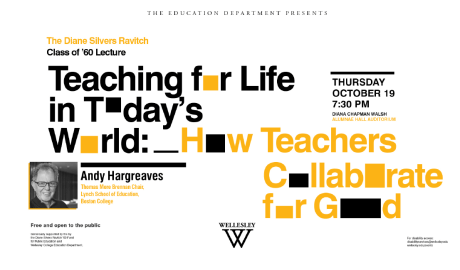
Andy Hargreaves is an internationally renowned expert on teaching and a proponent of teacher collaboration. He very kindly agreed to step in at the last moment when Linda Darling-Hammond, the originally scheduled speaker, fell ill and was unable to travel.

Andy Hargreaves is Thomas More Brennan Chair, Lynch School of Education, Boston College. He is a renowned scholar of international education, teaching, and education reform who consults with organizations and governments all over the world, Andy Hargreaves is author or editor of over 30 books. He will describe what teaching for life, not just for tests, skills, careers, or individual gain looks like in different communities internationally where teachers work together to fight for dignity, peace, and democracy, even in the most difficult circumstances. Drawing on examples from around the world, he will discuss how we can help teachers in the United States work together to teach for good in their communities.

Andy Hargreaves received the Grawemeyer Award in 2015 with his co-author Michael Fullan for their work on the transformative power of teacher collaboration.

We will miss Linda, but are so fortunate that Andy agreed to speak. It will be a great evening. It won’t be live-streamed, but the video will be posted on YouTube.

Screen Shot 2017-10-10 at 7.29.43 PM

Justin Parmenter is an English teacher in North Carolina and is nationally board certified. He recently was part of a professional conference where he was asked what advice he would give himself if he were a first year teacher. Be aware as you read that Justin teaches in a state that was once considered the leader in the South in education policy, in the number of NBCT teachers, and in teacher pay. Since 2010, when a hard-right Tea Party Group took control of the legislature and gerrymandered the state, many laws have been passed with the intent of reducing the professional status of teachers and privatizing public schools.

Justin writes about his first year teaching on an Apache reservation in Arizona.

“My first job in an American public school was teaching 6th grade Language Arts at Whiteriver Middle School. This school is located on the White Mountain Apache Reservation in the poorest county in Arizona. It was a very difficult place to be a teacher but an even harder place to be a child. Many of my students were chronically absent and exhibited serious behavior problems when they were at school. Some suffered from the effects of fetal alcohol syndrome. Some of them struggled to read at a first grade level. Parent support was spotty, as some of my students’ families maintained deep misgivings about public education–understandably so given the appalling recent history of American Indian boarding schools that used inhumane methods to forcibly assimilate Native children into European-American culture.

“I began my job in Whiteriver believing that I was going to transform every child. My fresh graduate school perspective, cutting edge pedagogy, and research-based literacy practices were going to bring all of my students up to reading on grade level in a hurry and change the way they felt about education forever. I was in for a rude awakening.

“Despite my best efforts at applying what I’d learned in grad school, my students’ reading proficiency levels remained relatively unchanged. School and district-level formative assessments yielded disastrous results. Our pass rates on Arizona’s standardized reading test hovered around 20-25%, where they remain today(the school has since been renamed Canyon Day Junior High). Every day, the outcomes I was getting reminded me that my students were failing and, by extension, I was failing them. I would sometimes wake up in the middle of the night and lie in bed wondering whether I was cut out for this work at all.”

He includes a graph showing the large attrition of teachers in their early years, which interestingly shows that most leave to teach in another state. This is not surprising given the legislature’s attacks on career teachers and its preference for TFA (the recently elected state superintendent is a TFA alum).

Initially, Justin blamed himself for his students’ poor scores. But over time, he realized the negative impact of poverty on school performance:

“While I was beating myself up about my inability to get my students to pass a test, I was unaware that our educational system’s data is more about measuring socioeconomic status than it is about measuring academic achievement. That was true in Whiteriver, Arizona two decades ago and it’s just as true in North Carolina today. Consider School Performance Grades, which routinely stigmatize entire schools as failures. The NC Department of Public Instruction’s most recent analysis of Performance and Growth of North Carolina Public Schools clearly shows that school report card grades and levels of poverty are inversely proportional to each other. As poverty goes up, school grades go down.”

Justin described the changes he made in his teaching so that students found the school work meaningful. The results did not necessarily show up in test scores, but he could see a difference in student work and engagement.

He writes:

“In an incredibly taxing profession that is chronically underpaid and under respected, our sense that our efforts are worth it is sometimes the only thing that keeps teachers going. Frequent turnover at our high poverty schools means those schools are more likely to house teachers who are just starting their careers, some of them probably believing they are going to transform every child and looking for evidence of their impact on their students. What we tell or don’t tell those teachers about that impact is critical. Our successes should not just be reflected in test scores and school letter grades which are often inextricably linked to our students’ backgrounds. As former Wake County Teacher of the Year Allison Reid puts it, we need to remember to focus on what is meaningful and not just what is measurable.”

There is a lot that Justin can teach new teachers.

There are many changes North Carolina could make if it valued teachers.

The Alliance for Quality Education, a civil rights group in New York, has threatened to sue if the State University of New York charter committee passes a regulation allowing certain charter schools to self-certify their teachers with lowered standards.

AQE maintains that the changes in the original proposal require new hearings and a new comment period.

The chair of the committee says he plans to call a vote.

The state Board of Regents, which is supposed to be the ultimate education authority in the state, has e pressed concern about this end run around the state’s high standards for teachers.

The SUNY committee will create teachers unqualified to teach in public schools. At the same time, it insults the teacher certification programs at SUNY campuses across the state.