Archives for category: Teacher Pay
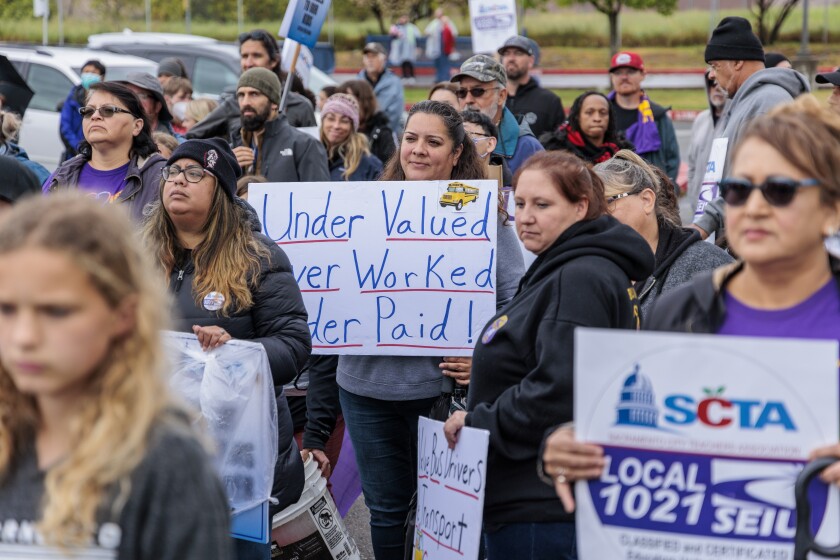
Sacramento City Unified School District teachers, school staff and supporters take part in a rally at Rosemont High School

Sacramento City Unified School District teachers, school staff and supporters take part in a rally at Rosemont High School on March 28 as they have been gone on strike due to the staffing crisis in the district . All SCUSD schools shut down and will remain closed for the duration of the strike.

I have read many articles about the shortage of teachers and school staff. I have read many that were laden with statistics. This is one of the best. It appeared in the Los Angeles Times.

BY ANITA CHABRIA COLUMNIST

A few weeks ago, Sacramento teacher Kacie Go had 56 kids for second period.

That day, there were 109 students at her eighth- through 12th-grade school who were without an instructor because of staff shortages. So she crammed the students into her room and made it work, but “it’s not sustainable,” she said.

No kidding.

Go told me the story standing with hundreds of other teachers and support staff Tuesday morning in the parking lot of an empty high school, as “We’re Not Gonna Take It” blared from speakers and the mostly female workers gathered for day five of a strike that has closed down schools in the Capitol City.

Like Go, these teachers, cafeteria workers, bus drivers and instructional aides are fed up with being asked to do more with less. It’s a problem that goes beyond the Sacramento City Unified School District, with 48,000 students in 81 schools. Frustration among teachers and school workers is rampant across California — pushed to a breaking point by the pandemic and a shortage of more than 11,000 credentialed teachers and thousands of support staff as the state tries to expand pre-kindergarten and bring 10,000 mental health counselors on campuses.

From school closure protests in Oakland to Sacramento’s all-in strike, those who work in our schools are telling us they cannot do this job under the conditions we are imposing. These include mediocre pay, sometimes vicious political blowback from COVID-19 safety measures, a witch-hunt-like scrutiny around hot-button topics, a mental health crisis, the reality of too few people doing the work, and the general disrespect of a society that swears it loves teachers and values education but does little to invest in it. Worrying about school shooters, once an urgent concern of educators and parents, doesn’t even make the top three problems anymore.

It’s the same story playing out in hundreds of other districts not just in California but across the country. Minneapolis teachers just ended a 14-day strike that shared some of the same issues of pay and support, underscored by the same teacher chagrin that we talk a good game about supporting public education but don’t always come through with actions. Minneapolis Federation of Teachers Chapter President Greta Callahan summed it up, sounding like she could be standing in Sacramento.

“We shouldn’t have had to [have] gone on strike to win any of these things, any of these critical supports for our students, but we did,” she said.

Go, who has been a teacher for 20 years and earned a master’s degree along the way — bringing her to the top of the district’s salary scale at just more than $100,000 a year — estimates she’s losing about $500 a day during the walkout.

But she’s more worried about support staff such as Katie Santora, a cafeteria worker who was also on the picket line.

Santora is the lead nutrition services worker at a high school, expected to churn out 1,500 meals a day between breakfast and lunch — with a staff of nine people (though they started the year with only five). Most are part-timers because the district doesn’t want to pay them benefits, and they make about minimum wage.

Santora, with 13 years at the district, makes $18.98 an hour for what is essentially a management role. She’s in charge of ordering, planning, receiving and keeping the joint running.

On the last day before the strike, that included making popcorn chicken bowls for lunch. What does that look like? Five 30-pound cases of chicken, oven-baked, 22 bags of potatoes, boiled and mashed, corn and gravy — all assembled after her staff finished making steak breakfast burritos and scrambled egg bowls. Did I mention every student is required to take a piece of fruit, which means washing somewhere along the lines of 1,700 apples?

Santora says high schoolers are the “most misunderstood” people on the planet, teetering between child and adult. Their well-being, she says, depends on being fed so “their bellies aren’t rumbling in class” and seeing a friendly face when they walk in her cafeteria. She loves delivering both.

“When they come through the line, I like to say, ‘Thank you for having lunch with me,’” she says.

But the money isn’t enough to pay her bills. Four or five nights a week, she gets about an hour at home before she heads to her second job loading grocery bags for delivery drivers at Whole Foods. She’s working two jobs just to pay for the privilege of doing the one she likes.

Go, the teacher, feels the hardships in other ways. One of her twin daughters recently had a “pretty severe concussion,” she said, but Go felt like she couldn’t stay home with her. If she did, one of her co-workers would likely be stuck with a jampacked classroom — and all the other unofficial jobs she has to do on a daily basis, from fill-in parent to police officer to relationship advisor when her teenage students’ hormones go into overdrive. Substitutes are hard to come by, she thinks, because the pay — $224 a day — isn’t competitive compared with other jobs with less stress.

“Subs don’t have an easy life,” Go said. “Why would you want to do that when you could go to In-N-Out and worry about if it’s animal-style or not for the same amount of money?”

The unions involved in the Sacramento strike contend that there are hundreds of open positions in the district in virtually every job. Nikki Milevsky, a school psychologist and vice president of the teachers union, puts it at 250 vacancies for teachers and 400 for classified staff — in a district with 2,069 teachers and 1,656 classified staff. That classified staff and teachers walked out together shows the depth of problems in Sacramento — it’s unusual for both to strike at the same time, and it has forced schools to shut down because there was no one left but administrators to watch kids.

Chris McCarthy, a first grade teacher in the Sacramento Unified School District, joined other teachers, parents, students and supporters, in the rain at a rally in support of their strike against the school district at Rosemont High School in Sacramento.

The teachers union says that 10,000 students lack a permanent instructor, and on some days, up to 3,000 don’t even have a substitute. About 547 kids who signed up for independent study haven’t been given a teacher yet, meaning they are learning nothing.

The district says it’s down 127 certificated staff and 293 classified positions. Take the difference as you will, but the district doesn’t dispute it’s in a staffing crisis.

Sacramento teachers want a pay raise to make the district more competitive in hiring. Right now, some surrounding districts pay more but have lesser benefit packages. (Please don’t make me tell you that healthcare is a right, not a privilege.) The teachers want the district to back off of a proposal to make current and retired teachers pay hundreds more to keep a non-HMO health plan. The district says it has made an offer of a pay increase and recruitment bonus and a one-year stipend to offset the health plan issue.

From there it turns contentious. Teachers reject the district’s offer as lowball and assert there is money available to do better, just not the will to invest it in staff. The district says the teachers need to compromise because it can’t afford all of their asks.

For days, there were no negotiations. State Supt. of Public Instruction Tony Thurmond tried to bring everyone to the table, only to be rebuffed by the district. Back home again instead of in the classroom, my eighth grader, a student in Sacramento schools, ate lots of chocolate chip pancakes and watched “Turning Red” on repeat.

There is no end in sight. Though negotiations with both unions have resumed, the shutdown is another blow to parents and families already anxious and stressed out. The last time my daughter had a normal school year, she was in fifth grade. So I understand the frustration, and even anger, of parents that schools are once again closed — and the resentment of parents across the state who are sick and tired of problems with schools, many of which predate the pandemic.

But I went to the strike line three times and I can tell you this — it’s not about the money for these teachers. You can roll your eyes at the unions all you want, but these teachers and support staff want their schools to work, for their students, for themselves, and for our collective future. Because democracy depends on an educated populace and education is a right. And because they are educators, and they’re invested in our kids.

Go doesn’t want to do anything else but teach, even if it means 56 kids sometimes. Even if it means losing $500 a day and striking. Even if it means making some people mad to make schools better.

“I freakin’ love it,” she said. “I do.”

Patrick Kelly, director of governmental affairs for the Palmetto State Teachers Association, warned in an opinion piece in the Charleston (SC) Post and Courier about the state’s teacher shortage. Teacher salaries are low, and legislators are obsessed with the idea of telling teachers what they may and may not teach. Meanwhile the state has a budget surplus, and Governor Henry McMaster will use it to lower taxes, not to raise abominably low teacher salaries or to feed the children in South Carolina who go hungry every day (about 15% of the children in the coastal counties of the state). Of course, I take issue with the headline: there’s no point trying to teach in a state that requires teachers to teach lies.

Kelly writes:

With the 2022 session of the S.C. General Assembly now more than a quarter complete, legislators have committed a significant amount of time and energy to bills that could have sweeping implications for what is taught in South Carolina classrooms as well as the very definition of what constitutes a public education.

Some of these debates address real, pressing challenges in our schools, while others are fueled by the desire of policymakers to respond to the very vocal concerns of select constituencies. However, in spite of all the time and energy dedicated to education, not enough has been accomplished to address the single problem that threatens to make all other education policy efforts moot: the state’s increasing teacher shortage.

The shortage of teachers in South Carolina has been growing steadily for years. In 2019, I wrote about how “the house is on fire” in schools due to the growing number of vacant teaching positions across the state. That year, schools had opened with 621 vacancies. This year, that number ballooned to 1,063 positions, a 71% increase. What looked like a house fire then has grown into a five-alarm inferno.

The timing of this shortage could not be worse for children. Right now, our students are facing unprecedented challenges, including increased incidents of school violence, depression and suicidal thoughts. At the same time, students are attempting to navigate the academic fallout of lost instructional time stemming from shifts to virtual learning, quarantines and student illness…

Education research universally agrees that the No. 1 in-school influence on student achievement is the quality of the teacher in the classroom. Given this fact, it is imperative to address the more than 1,000 classrooms that do not have access to any teacher at a time when students need more support than ever.

To date, though, there has been little done this legislative session to take the steps necessary to enhance educator recruitment and retention. One notable and important exception has been the advancement of a bill introduced by Sen. Stephen Goldfinch to guarantee 30 minutes of daily, unencumbered planning time for elementary and special education teachers, two groups that often go through an entire school day without a moment even to go to the restroom.

Other recently introduced bills hold promise, such as one introduced by Rep. Gilda Cobb-Hunter to address student debt for teachers and one from Senate Republican Leader Shane Massey to provide enhanced lottery scholarships to education majors.

But these bills have yet to receive committee review, a significant problem in the rapidly advancing second year of this General Assembly. As both the legislative calendar and our teacher supply dwindle, we need action now on these bills as well as other measures that could enhance education retention — steps such as reducing class sizes, providing enhanced mentoring support for new teachers and creating meaningful career pathways to keep our best teachers in the classroom.

The Legislature should also follow the lead of S.C. Education Superintendent Molly Spearman, who called on budget writers to do “as much as (they) can” to increase teacher salaries, including raising minimum starting pay to $40,000…

As our state continues to debate what is — or is not — taught in our classrooms, we should never lose sight of the indisputable fact that nothing is taught in a classroom without a teacher. A failure to put out this growing fire in our schools will deprive an ever-increasing number of students of access to the great teacher who can spark interests and abilities into their full potential.

Patrick Kelly is director of governmental affairs for the Palmetto State Teachers Association and has taught in S.C. schools since 2005.

A wave of labor activism is underway. Amazon workers in Staten Island in New York City are trying to organizing a union. Bloomberg News reports:

Deere & Co. employees, who launched a 10,000-person strike Oct. 14, cited the mandatory overtime that can stretch their shifts to 12 hours. At Kellogg Co., the union went on strike this month after decrying the toll of seven-day workweeks that had kept cereal flowing to stuck-at-home customers during the pandemic. And at Frito-Lay Inc., workers have this year challenged what they called“suicide shifts”: being made to leave late and return early, with only eight hours of turnaround time in between.

Scranton teachers announced their decision to strike on November 3.

SCRANTON, Pa.—The Scranton Federation of Teachers, which represents more than 800 teachers and paraprofessionals, announced today that it will set up picket lines and go on strike at 12:01 a.m., Nov. 3. The union has been working under a contract that expired in 2017.

“We’ve reached the end of the line and our patience with the Scranton School District. The district has refused to address our concerns about the slash-and-burn budget cuts that are significantly affecting the quality of education,” said Scranton Federation of Teachers President Rosemary Boland. “Strikes are always the last resort. We held off for many months, hoping, in vain, we could agree on conditions that are good for kids and provide decency, fairness, respect and trust for our educators.”

Boland expressed optimism that new members will be elected to the Scranton School Board on Nov. 2 and that the needs of students and educators finally will be prioritized.

SFT gave the district more than the required 48 hours’ notice before starting a strike. Picket lines will begin early Wednesday morning on Nov. 3 at most schools.

Teachers and paraprofessionals want realistic solutions to reversing the teacher turnover crisis; raising educator pay that has been frozen since 2016; returning Scranton’s esteemed and essential preschool program; and restoring libraries, bus routes and electives such as consumer[LBC1] science and music.

The austerity budget that is starving Scranton classrooms of the necessary resources, coupled with the administration’s disrespect for teachers, are issues reminiscent of what led to the walkouts in West Virginia, Oklahoma, Arizona, Colorado and Chicago in 2018 and 2019, SFT said.

“Teachers and paraprofessionals don’t want to walk out, but they will when their students’ needs are ignored and schools are starved of resources,” Boland said.

Scranton public schools are operating under a state Recovery Plan, which is akin to a state takeover.

“The Recovery Plan prioritizes financial recovery over student achievement, balancing the budget on the backs of students. Yet the plan has not been amended to factor in the $60 million in federal aid that should be used to stabilize the district and pay teachers decent, competitive wages,” she said, noting that the Recovery Plan originally factored in the use of “windfall funds,” such as federal aid when defining “recovery.”

“Since the recovery plan began in 2019, more than 100 teachers and paras have left the district, demonstrating a serious recruitment and retention problem that has harmful ramifications for students,” she said. Classes are severely overcrowded. Special education students are not being served adequately because teachers are pulled into other classrooms. Students aren’t getting individualized attention. In the COVID-19 environment, overcrowded classrooms pose a health hazard.

Boland said teachers and paraprofessionals deserve a pay raise. Teachers have not received a raise for more than four years, which has prompted many of the teacher defections to other school districts. Several paraprofessionals were furloughed, only to be brought back at a lower salary after public outrage. The district also is insistent on an inferior health scheme that would directly impact the Scranton community, as they are still dealing with the impact of COVID-19, the union said.

“It’s time for a contract that’s good for students and fair to educators,” Boland said.

School bus drivers in Greenville, Mississippi, did not report to work for two days to protest their low wages. Apparently they were unaware that the legislature had passed a law in 1985-36 years ago-absolutely prohibiting any strikes by any school employees, including bus drivers.

The local school board debated whether the drivers’ failure to work was or was not a strike. They did not realize that their own board could be fined thousands of dollars each for failing to report the names of those who struck.

One thing is clear: Mississippi loathes the very idea of unions. And another: they “appreciate” their teachers and other school staff but they don’t want to pay them a living wage.

Nancy Bailey is fearful that the stage is being set for a big-tech takeover when the pandemic is gone. Scores of tech vendors have longed to gain a permanent foothold in the schools, and their day may have come, even though there is nearly universal agreement that remote instruction is a poor substitute for in-person instruction.

Here are the warning signs:

First, there is sure to be a teacher shortage when schools reopen because so many are taking early retirement, due to health concerns.

Second, several districts have recently passed urge bond issues for technology.

Third, due to the pandemic-caused recession, there is unlikely to be sign I can’t improvements in teachers’ salaries or working conditions.

So we face this conundrum: teachers, students, and parents are frustrated and voted with online learning. They yearn to be back in class with face-to-face, human interaction. Yet after the pandemic, we can expect to have more of what we abhor.

#Red4Ed is still producing results in Arizona!

Voters approved a measure to raise the taxes of the wealthiest by 3.5% for the benefit of public schools.

Proposition 208 passed with 52% of the vote. It will produce nearly $1 billion annually for public schools. Fifty percent will be used to raise teachers’ salaries.

The “YES” vote on Prop. 208 will impose a 3.5% income tax surcharge on taxable annual income over $250,000 for single persons or $500,000 for married persons filing jointly.

Arizona Governor Doug Ducey, who is often called a Koch puppet because the Koch network donated heavily to his elections, denounced Proposition 208, which would increase taxes to raise teachers’ salaries. Secretary of Education Betsy DeVos stood by his side, presumably pleased with his attack on higher wages for the state’s teachers. He made his remarks while visiting a charter school and lauding charter schools for innovation.

Gov. Doug Ducey delivered a scathing rebuke of Proposition 208, the Invest in Education Act, while visiting a school on Thursday with U.S Education Secretary Betsy DeVos.

The proposal on November’s ballot would add a 3.5% surcharge on income tax for individuals with taxable income of $250,000 or more or couples making $500,000 or more. The revenue would go largely to raising school staff salaries.

“It would make us the equivalent of Bernie Sanders’ Vermont, or New York state or Washington, D.C.,” he said in response to a question about U.S. Sen. Bernie Sanders’ endorsement of the measure. 

Sanders, I-Vt., endorsed Proposition 208 in a news release on Thursday morning. 

“Let’s address the decades of cuts to education funding in Arizona and invest in our schools, teachers, and kids,” he wrote in a statement. 

A poll released Thursday showed that the measure is in the lead among registered voters.

Ducey is opposed to new taxes which he says will harm small businesses and be bad for the economy.

Proponents of Invest in Ed say that the average tax increase for someone who earns from $250,000-$500,000 a year would be $120.

The Joint Legislative Budget Committee, a third-party state entity that analyzes the financial impact of ballot propositions, estimates that Proposition 208 would raise $827 million for education, about $100 million less than Invest in Ed’s initial estimate.

The measure would send the money to the following areas: 

  • 50% of the money would go to hiring and raising the salaries of teachers and other certified employees, such as counselors and nurses. 
  • 25% would go to hiring and increasing the salaries of student support staff, including classroom aides and bus drivers.
  • 12% would go to career and technical education programs. 
  • 10% would go to programs dedicated to retaining and mentoring teachers. 
  • 3% would go to scholarships for the Arizona Teachers Academy, which waives college tuition for teachers-in-training who commit to work in Arizona schools after graduation.

I like the Economic Policy Institute in Washington, D.C., for many reasons. I like the research it produces. But I most admire the fact that it is not sustained by the usual billionaires. It follows the facts.

In a recent report, EPI found that teachers pay a wage penalty for choosing teaching as their profession. They are paid about 20% less than others with similar levels of education. This makes it hard to attract new teachers and hard to hold on to teachers. If billionaire-funded “reformers” had spent their time advocating for higher wages for teachers, instead of spinning their wheels about phony evaluations based on student test scores (which have failed everywhere to improve teacher quality) or on merit pay (which has consistently failed for at least a century), they might have actually helped improve the schools. Their bogus efforts have undermined teacher morale and actually reduced the supply of people entering what is one of our most important professions.

The report begins:

As we have shown in our more than a decade and a half of work on the topic, there has been a long-trending erosion of teacher wages and compensation relative to other college graduates.1 Simply put, teachers are paid less (in wages and compensation) than other college-educated workers with similar experience and other characteristics, and this financial penalty discourages college students from entering the teaching profession and makes it difficult for school districts to keep current teachers in the classroom.

This report was produced in collaboration with the Center on Wage and Employment Dynamics at the University of California, Berkeley.

Teacher compensation is not just an issue of staffing: Effective teachers are the most important school-based determinant of student educational performance. To promote children’s success in school, schools must retain credentialed teachers and ensure that teaching remains an attractive career option for college-bound students. Our previous report (Allegretto and Mishel 2019) explains in more detail why providing teachers with a decent middle-class living commensurate with other professionals with similar education is not simply a matter of fairness but necessary to enhance student and economic performance.

We provide this update to our long-standing series on the teacher wage and compensation penalty as the U.S. continues to struggle with the COVID-19 pandemic and the economic consequences. While the data in this paper are through 2019 and thus predate the pandemic, our analysis may provide useful insights as schools struggle to reopen. As a country we have yet to make the necessary investments, and pass the needed policies and procedures (e.g., universal mask requirements and testing, tracing, and isolating protocols) that would allow us to achieve some semblance of normalcy. Teachers and other school staff will continue the business of educating students in these trying times. They and their unions will play a critical role in moving forward in an effective and safe environment.

Key findings

  • The teacher wage penalty has grown substantially since the mid-1990s. The teacher wage penalty is how much less, in percentage terms, public school teachers are paid in weekly wages relative to other college-educated workers (after accounting for factors known to affect earnings such as education, experience, and state residence). The regression-adjusted teaching wage penaltywas 6.0% in 1996. In 2019, the penalty was 19.2%, reflecting a 2.8 percentage-point improvement compared with a penalty of 22.0% a year earlier.
  • The teacher wage penalty declined in the wake of recent teacher strikes but only time and more data will reveal whether teachers’ actions led to a decline and a turning point. The lessening of the teaching penalty from 22.0% in 2018 to 19.2% in 2019 may reflect pay raises enacted in the wake of widespread strikes and other actions by teachers in 2018 and 2019, particularly in some of the states where teacher pay lagged the most. Unfortunately, the data we have to date are not sufficient to allow us to identify the geographic locus of the improvements in teacher wages and benefits and any association with the recent wave of teacher protests and strikes. Only time will tell if this single data point marks a turning point in teacher pay.
  • The wage premium that women teachers experienced in the 1960s and 1970s has been replaced by a significant wage penalty. As noted in our previous research, women teachers enjoyed a 14.7% wage premium in 1960, meaning they were paid 14.7% more than comparably educated and experienced women in other occupations. In 2019, women teachers were earning 13.2% less in weekly wages than their nonteaching counterparts were—a 27.9 percentage-point swing over the last six decades.
  • The wage penalty for men in teaching is much larger than it is for women in the profession, and it too has worsened considerably. The teacher wage penalty for men was 16.6% in 1979. In 2019, male teachers earned 30.2% less than similar male college graduates who chose a different profession. This explains, to a large degree, why only one in four teachers are men.
  • While teacher wage penalties have worsened over time, some of the increase may be attributable to a tradeoff school districts make between pay and benefits. In other words, school districts may not be giving teachers raises but are instead offering stable or slightly better benefits, such that benefits make up a larger share of the overall compensation package for teachers than for other professionals. In 2019, nonwage benefits made up a greater share of total compensation for teachers (29.3%) than for other professionals (21.4%). In 2004, nonwage benefits share of compensation was 20.7% for teachers and 18.7% for other professionals.
  • The benefits advantage of teachers has not been enough to offset the growing wage penalty. The teacher total compensation penalty was 10.2% in 2019 (composed of a 19.2% wage penalty offset by a 9.0% benefits advantage). The bottom line is that the teacher total compensation penalty grew by 7.5 percentage points from 1993 to 2019.
  • The teacher wage penalty exceeds 20% in 21 states and in the District of Columbia. Teacher weekly wage penalties for each state, computed using pooled 2014–2019 data, range from 2.0% in Wyoming to 32.7% in Virginia. In 21 states and the District of Columbia teachers are paid less than 80 cents on the dollar earned by similar college-educated workers.

A Florida teacher posted this comment. It raises the question of whether it is fair to attract people to become teachers with promises that are later canceled by a nasty, brutish legislature. The legislature passed a law called “the Best and Brightest” that awarded bonuses to new teachers based on the SAT scores they recorded years earlier. It constantly thinks about how to attract new teachers but does nothing to retain the experienced teachers it has. What this teacher describes is the perfidious work of Jeb Bush and his cronies:

I was never a money person. If I was I would never have become a teacher. I honestly believed that we were paid what they could afford to pay us. Seems stupid now but I was a kid. I was a fool. Twenty years ago I signed up to be a teacher. I wanted to be a teacher. I went to college for it. I knew I would never be able to support a family. It was ok, I wasn’t interested in having one. When I first became a teacher, I was shown a “step” system of pay. I saw that every year you’d make a little more. When you finally reached 20 or 25 years in the system the pay took huge leaps higher. Some years as much as a $10,000 increase if you can believe it. I thought I’d be rewarded for loyalty.

That “step” system has long been abandoned. Now we receive increases of around 1.3% a year. I thought the worst indignity came when I actually made less money than the year prior. The state of Florida forced us to contribute 3% to our retirement. Our yearly salary increase wasn’t even that much. This latest indignity is worse. Florida passed a new law raising the minimum teacher salary. Wonderful for new hires and attracting talent. Not so wonderful for those of us that have put the years in. Now, after 20 years of dutiful service I make $5,000 dollars more than a 21 year old, fresh out of college.

I am absolutely and totally morally devastated. The system seems to now be designed to have a perpetual series of inexperienced teachers. I need help. I need for my story to be heard. What do I do? What can I do? They don’t care about me. Now I don’t care about my job. When they showed me that “step” schedule 20 years ago, I believed it to be a nonverbal agreement about how much I would make, roughly, in the future. I was a fool. If I knew then I would never have become a teacher. I feel conned, duped, and lied to and I just can’t take it anymore.

Louisiana Governor John Bel Edwards announced a budget proposal that earmarked new spending on education, but no raises for teachers, whose pay is below the average for southern states.

For Louisiana public school teachers, a group that includes some of Gov. John Bel Edwards’ earliest and most avid supporters, the governor’s first post-reelection budget proposal has good news and bad news.

The good news is a request that the Legislature spend significantly more on education. The $32 billion spending package includes an additional $65 million to support K-12 schools, $25 million for early childhood learning programs and $35 million for colleges.

The bad news is that a certain line item is conspicuously missing: money specifically dedicated to raise teacher pay.

No raises has been the status quo for a long time now, with the notable exception of last year, when Edwards backed the first increase in a decade. Until Friday, every indication, both from Edwards’ campaign-year rhetoric and from the new reality of a budget surplus, was that it wouldn’t be the last.

It could be, at least for now. Rather than propose a specific raise and signal that Edwards would once again fight for it in the Legislature, his administration is now saying that any raises this year would have to come from the overall allocations the state makes to school districts. So while some teachers may benefit, there would be nothing across the board.

The governor’s top priority is early childhood education.

Low education spending and low teacher pay help to maintain Louisiana’s place as one of the lowest-performing states in the nation on NAEP.