Archives for category: Teacher Evaluations

The night before I addressed the Kentucky School Boards Association, I had dinner with a group of teachers and parents from Tennessee. The group included Mama Bears, BATS, and TREES.

One of the BATS was Lauren Hopson from Knox County, who teaches third grade children. She is smart, strong, experienced, and wise. She is also outspoken, as I learned by watching this video, in which she let the board know what teachers really think: They are tired of being pushed around. They are tired of an evaluation system tied to test scores. They are tired of pointless training. They are tired of foisting test after test on little children. They are tired of getting training from consultants with less experience than they have. They are tired of the charade foisted upon them by the state of Tennessee. They want to teach. What an idea!

When Lauren gave her talk, she had no idea it would be posted on YouTube. In a week, it had tens of thousands of views. Now it is over 100,000.

Help this video reach every parent and teacher. We can be the change. Social media can counter the billionaires who are trying to destroy our public schools and demoralize our teachers.

Valerie Strauss reports that almost all the superintendents in the state of Maryland signed a letter protesting the rushed timetable for Arne Duncan’s favorite reforms.

She writes:

“Nearly all of the superintendents of Maryland school districts have signed a statement that criticizes federal and state education officials for forcing them to implement several major reforms, including the Common Core State Standards, on what they say is an unrealistic timetable.

“The document, approved by 22 of Maryland’s 24 superintendents from districts educating more than 800,000 students, asks for more time and resources to put the reforms in place, including the use of new Common Core tests expected in the 2014-2015 school year. The statement (which you can read here) represents the first time that such a high percentage of schools chiefs in Maryland have come together to publicly call out education officials over school reform.

“Parents, elected officials, community leaders and pundits are reacting sometimes with alarm as local school systems throughout the state deal with the challenges of implementing the many components of education reform,” says the document, obtained by The Washington Post. Carl Roberts, executive director of the Public School Superintendents Association of Maryland and a former superintendent, organized the joint statement but would not identify the two superintendents who did not sign on.

“Though affirming that they wholeheartedly support the Common Core standards as “a more rigorous path through pre-kindergarten to grade twelve for all students,” the superintendents wrote that there are serious problems with the introduction of the reforms. They specifically cited the fact that Maryland plans to continue using an outdated test — the Maryland School Assessments — while the state has shifted to a new curriculum that isn’t aligned with the old test. They also said it is inappropriate for new test-based teacher evaluations and accountability measures to roll out before the reforms have been fully put in place.”

It bears noting that Duncan’s faith in evaluating teachers by test scores has not worked anywhere it has been tried. In New York, for example, tens of millions of dollars (perhaps more) were spent to determine that 1% of teachers were “ineffective,” and that 1% might have been misidentified. The Common Core standards have not yet been validated for any purpose, except on paper. Some 500 early childhood experts have declared them to be inappropriate for the early grades.

The federal government apparently wants everyone to jump into the deep end of the pool, whether they can swim or not, and without looking to see if the pool has any water in it.

[Note to readers: I abridged this article to comply with copyright limits. Please open the link and read the article in full at the Hartford Courant, which had the good sense to publish it.]

Thanks to the punitive actions and policies of the U.S. Department of Education and the states, there is a new genre of writing by teachers, explaining why they are quitting. The most famous was written by Kris Neilsen of North Carolina, whose letter of resignation went viral, was viewed by hundreds of thousands of people, and went around the world.

This column was written by Elizabeth Natale, a middle-school teacher in Connecticut. This state has one of the best public school systems in the United States, yet its governor and state commissioner continually bash teachers and public schools, while lauding charters and showering them with extra money. The leaders are certain that public schools and teachers are failing and need tough measures to shake them up. In time, what the leaders are doing will be revealed as a mighty hoax whose goal is to increase market share for charters.

Natale writes:

“Surrounded by piles of student work to grade, lessons to plan and laundry to do, I have but one hope for the new year: that the Common Core State Standards, their related Smarter Balanced Assessment Consortium testing and the new teacher evaluation program will become extinct.

I have been a middle school English teacher for 15 years. I entered teaching after 19 years as a newspaper reporter and college public relations professional….

Although the tasks ahead of me are no different from those of the last 14 years, today is different. Today, I am considering ending my teaching career.

When I started teaching, I learned that dealing with demanding college presidents and cantankerous newspaper editors was nothing. While those jobs allowed me time to drink tea and read the newspaper, teaching deprived me of an opportunity to use the restroom. And when I did, I was often the Pied Piper, followed by children intent on speaking with me through the bathroom door.

I loved it!

Unfortunately, government attempts to improve education are stripping the joy out of teaching and doing nothing to help children….

The Smarter Balance program assumes my students are comfortable taking tests on a computer, even if they do not own one…

I am a professional. My mission is to help students progress academically, but there is much more to my job than ensuring students can answer multiple-choice questions on a computer. Unlike my engineer husband who runs tests to rate the functionality of instruments, I cannot assess students by plugging them into a computer….

My most important contributions to students are not addressed by the Common Core, Smarter Balance and teacher evaluations. I come in early, work through lunch and stay late to help children who ask for assistance but clearly crave the attention of a caring adult…

Teaching is the most difficult — but most rewarding — work I have ever done. It is, however, art, not science. A student’s learning will never be measured by any test, and I do not believe the current trend in education will lead to adults better prepared for the workforce, or to better citizens. For the sake of students, our legislators must reach this same conclusion before good teachers give up the profession — and the children — they love.”

The new Di Blasio team is off to a good start in education. The Bloomberg team is quietly exiting stage right. One of the key players, Marc Sternberg, has moved to the Walton Family Foundation to promote vouchers. Another, Shael Suransky, will be president of Bank Street College, which does not share his enthusiasm for test-based accountability.

The new chancellor, Carmen Farina, is assembling her own team, and unlike Bloomberg and Joel Klein, she is selecting veteran educators.

When she met with principals as a group for the first time, she was greeted with a standing ovation. She made clear that the days of derision were over and a new era of respect and collaboration. She also made the startling announcement that the city would require a minimum of seven years’ experience, in contrast to the Bloomberg policy of fast-tracking inexperienced newcomers to lead schools.

Her second in command, Dorita Gibson, has more than 30 years’ experience in the schol system.

The Deputy Chancellor for Teaching and Learning, Philip Weinberg, a high school principal in Brooklyn, has nearly thirty years in the system, and the Executive Director of Curriculum, Instruction, and Professional Development has 27 years in education.

This is quite a change from the early years of the Klein regime, when the inner circle consisted of fresh-faced MBA graduates, and 20-something’s with no classroom experience. As one insider told me later, “I would look around and realize that no one making decisions had ever worked in a school.”

Philip Weinberg, who takes charge of teaching and learning, was a signer of the New York principals’ letter opposing the New York State Annual Professional Performance Review, the evaluation system designed by John King that created enormous pushback.

In this article, he explains why more than 1,000 principals signed the letter and why it is wrong to remove the job of evaluating teachers from principals.

This is part of what Weinberg wrote:

“My concern about the agreement is that a large portion of a teacher’s evaluation is to be taken out of the hands of principals. I am disturbed by this, not just because I think this will lead to inaccurate ratings and will pressure teachers in unproductive ways (it will), but also because I believe it speaks to a growing distrust of or disrespect for principals. I am surprised that the teachers’ union would trade a principal’s rating for that of a student’s test score, especially given the recent teacher data report debacle. Are most principals less fair or trustworthy than reductive data? I think not. I think most principals feel exactly as Mr. Mulgrew does when they work with an ineffective teacher, and they communicate those concerns with the same intelligence, honesty and kindness Mr. Mulgrew expressed above.

“The desire to use multiple measures to rate teachers seems like a smart idea. However, New York City’s two experiments with value-added ratings in education, the teacher data reports and the school progress reports, have not produced reliable information. So far we have not discovered any measures which clearly correlate teacher performance to student learning. This new agreement will generate a teacher’s rating by using data which we know does not answer the question we are asking. Why? Are principals incapable of understanding data, incapable of interpreting it based upon what they see in their schools? I think not.

“I think we can review our schools’ data in a much more nuanced and accurate way than any measure designed to encapsulate and compare the work of thousands of teachers working with hundreds of thousands of students. No less a prominent voice in this discussion, Mayor Michael R. Bloomberg, was recently quoted as saying: “The principals’ job is to decide who’s good, who’s bad. It’s their judgment; that’s their job.” Who could disagree?”

“But we principals, too, are part of the problem. Not because we have promoted the use of bad data to rate teachers, but because we may have allowed our attention to stray from our chief job of promoting professional growth, training staff, documenting teacher performance, creating community and defining what quality teaching and learning look like in our schools. Newly necessary distractions like marketing and fund-raising and data analysis may have seemed more important than getting into classrooms and working with teachers on how to plan lessons and ask questions. But if we let our attention waiver from those things which we know should be our primary focus, if we asked “How can we help students earn more credits?” instead of “How can we help students learn more?” then some of the distrust we see driving this new agreement is our fault, even if we believe that is what the school system and the general public wanted us to do. We may have felt less incentive to concentrate on the quality of classroom instruction in our schools because we are rated on other things, but we know our jobs. If we chose to focus on tasks outside of instruction, it makes sense that the void such a choice created was filled by psychometricians.”

Imagine that: a deputy chancellor who believes that professional judgment is wiser than data!

This will be interesting.

This statement was written by Katie Zahedi and Bianca Tanis.

Katie Zahedi is principal at Linden Avenue Middle School in Red Hook, NY, and serves on the administrative panel for NYSAPE.
Bianca Tanis is a public school parent in the Hudson Valley as well as an elementary special education teacher and a co-founder of NYS Allies for Public Education.

“We ask that the New York State Education Department (NYSED) Board of Regents act to reform hiring and appointment procedures for employees and new regent members. The lack of professional and scholarly input has produced many of the problems with the failed Regents Reform Agenda. Constituencies in education have historically guarded against governmental involvement in education, yet there are unprecedented requests of the legislature for protection from the corporatized dismantling of public education by NYSED leadership.

Our comments embody attempts to advocate for a secure future for public schools and do not represent their respective school districts.
_________________________________________________________________________________

Bianca Tanis and Katie Zahedi, a teacher and a principal are asking that the New York State Education Department (NYSED) Board of Regents reform hiring and appointment procedures for employees and new regent members. A lack of professional and scholarly input has produced many mistakes and a failed Regents Reform Agenda. Constituencies in education have historically guarded against governmental involvement in education, yet there are unprecedented requests of the legislature for protection from the corporatized dismantling of public education by NYSED. Their comments constitute advocacy for a secure future for public schools and do not represent their respective school districts.

_________________________________________________________________________________

NYSED has been enforcing standards based evaluations for teachers and principals, despite the absence of consistently used standards and protocols for hiring or evaluating NYSED. The current commissioner’s performance program is not public, though it was under Commissioner Mills. As such, schools are held accountable to increased standards under a department that is violating the state labor contract. The commissioner was hired without a formal search or established criteria. There are unqualified “fellows” hired as “consultants” who are doing work not appropriately linked to approvable expenditures for consultants or accountable to any public entity because they are privately funded. There are postings for temporary employees to evaluate APPR plans, with a pre-requisite “one year of relevant professional experience”.  The Regents’ appointment process is in need of review, while the NYSED has allowed corporate know-nothings to design curriculum that is being forced on our schools.


Are these inappropriate hiring practices at NYSED upholding flawed policies that waste time, public money and hurt students?  Are we comfortable leaving implementation of education reform to unproven methodologies managed by private consultants who are unaccountable to the public? The two images depicted here include: 1) an advertisement for temporary employment seeking applicants with minimal qualifications (one year of relevant experience) to evaluate the compliance plans of New York School districts to the SED’s directives, and 2) a FOIL submitted by the Professional Employees Association (PEF) at the NYSED for what they believe may be the illegal relocation of their work, which is currently being done by others in private offices under the direction of the questionably hired fellows.

Some professionals are rendered speechless at the chagrin of what is happening in full public view. Those who are able to respond to the overbearing conditions have written to leadership, requested meetings, spoken at forums all over the state, and pleaded with elected officials to intervene in the troubling course.  Has the time yet come to turn the APPR (teacher and principal evaluation system) around?  If so, we encourage policy makers on the Board of Regents and SED executive staff to reflect and consider their performance on a state HEDI band. In case you don’t know what we mean, are they “Highly Qualified”; “Effective”; “Developing”; or “Ineffective” as leaders of the NYSED?


The Regents oversee education but the board is presently populated with few individuals possessing experience or expertise relevant to educational governance at the state level. With four seats open on the board, we encourage hiring and selection criteria for all appointments based on professional expertise and related criteria.  The best candidates will have backgrounds in education, with increased representation from stakeholder groups such as experienced K-12 practitioners, parents and advocates of students enrolled in public schools and scholars of education history, policy and practice.


The NYSED has only grudgingly listened to educators. They have resisted input from scholars who have sought to assist with analysis of reform efforts and systems of implementation now under review. NYSED leadership’s almost fetishistic obsession with data in the absence of substantive analysis of the efficacy of high-stakes tests and test scores vis-à-vis their meaning or relevance to school improvement and student learning has effectively obscured any focus on reforms that might actually work. Innovation, at the heart of American success, doesn’t appear to be tightly coupled with an ability to answer fact-based questions correctly. What if social emotional learning, creativity and relationships are more relevant to success than test rankings? Who will be accountable for RTTT if it cripples student progress?


While NYSED is preoccupied with unreflective implementation, even scant effort would yield local assistance.  For example, at the Department of Education Administration and Policy Studies at SUNY Albany, within a half an hour of the commissioner’s office, are experts who can assist them with a better understanding of the macro-factors contributing to comparatively lower scores of US students on the Program for International Students Assessment (PISA) league tables.  Lower international rankings are driving RTTT, so understanding causality is critical to the design of appropriate solutions. Perhaps the Board Secretary might order a few copies of Pisa, Power, and Policy and the Globalization of Educational Governance, written by experts at SUNY, Albany.  Editors, Meyer and Benavot, scholars at the State University of New York (Albany), may be willing to drive across town to help them understand faulty assumptions driving RTTT that has shaped the policies that are creating havoc in New York schools.


APPR and CCLS, as formulated, are crumbling.  We suggest that APPR with number grades for teachers that are tied to student test scores, be scrapped and the CCLS be left to the states and districts for review. Meanwhile, SED mandates should cease until our leadership is properly reviewed and a higher standard is applied to their hiring and evaluation.  The public will soon be asking who is going to be accountable for the billions of dollars wasted on systems that were imposed on schools against the earnest advisement of professionals in the field.


We want to acknowledge that the Regents are public-minded in their service as volunteers and thank them all for their efforts. Commitment and devotion are respected, but we call for standards guiding the Regents selection process.  While it may be difficult, we are asking for decision makers to vote for what is best for schools and children even if it means that the calls for “change” that have been enacted on schools are now applied to themselves. They will know what is best by speaking with actual school leaders, not policy entrepreneurs!


Heinz-Dieter Meyer & Aaron Benavot. Introduction. PISA and the Globalization of Education Governance: some puzzles and problems. OXFORD STUDIES IN COMPARATIVE EDUCATION

PISA, Power, and Policy. The Emergence of Global Educational Governance
Edited by HEINZ-DIETER MEYER & AARON BENAVOT (Benavot, 2013)
NEA President Dennis Van Roekel strongly supported the legal action of the Colorado Education Association against SB 191, one of the worst bills of its kind in the nation. It was written in 2010 by State Senator Michael Johnston, ex-TFA. Fully 50% of teachers’ evaluations are tied to test scores.

I was in Denver the day the law passed in the Senate. Johnston and I were supposed to have a lunch debate before about 60 or so local leaders. He was late. We waited and waited. Finally, I gave my talk. As soon as I finished, young Master Michael Johnston walked in, safe from hearing anything I might say, and proceeded to give a speech praising his bill and saying it would produce great schools, great principals, and great teachers. He was very pleased with what he had done.

Here is Van Roekel’s statement:

NEA PRESIDENT COMMENTS ON SB 191 LAWSUIT IN COLORADO

WASHINGTON—The following is a statement from NEA President Dennis Van Roekel on SB 191 lawsuit in Colorado:

“The National Education Association supports the efforts of Colorado educators in their fight to keep quality teachers in the classroom and preserve the stability of our students’ learning environment. Legislation should be used to ensure that every public school student has a quality teacher in the classroom. It should not drive out great educators without the benefit of a rigorous evaluation system. The way SB 191 has been implemented by the Denver School District has resulted in the removal of more than a hundred teachers without a hearing or cause. The lawsuit brought by Denver Classroom Teachers Association and the Colorado Education Association challenges firing those teachers without cause. The notion that a veteran quality teacher can be removed from the classroom without due process not only subverts the essence of the law but hurts our students.”

Grover (Russ) Whitehurst is worried that the public is turning against standardized testing. As George W. Bush’s director of education research, he was and is a true believer in testing. As head of the Brown Center at Brookings, once known as a bastion of liberal thought, Whitehurst wants to see the programs he tended under Bush’s NCLB survive.

Yet they are, as he puts it, “in a bit of trouble.”

He is upset to see that Néw York City elected a new mayor who does not share his love of testing, accountability, and choice. Bill de Blasio is a progressive Democrat.

He is not happy that the Texas legislature rolled back some of its testing requirements, responding to public protest.

But most of all, he is upset that Linda Darling-Hammond, who is senior advisor to one of the federally funded testing consortia, recommends testing in only a single grade in each of the three levels of schooling: elementary school, middle school, and high school.

He frets: What would that do to teacher assessment? How could growth scores be calculated?

Whitehurst’s recommendation: we should test more, not less!

I am not sure I follow the logic here.

How will more testing quell the growing rebellion against testing? There will be more angry moms and dads, more Bill de Blasio’s elected. Maybe he is on to something.

On Saturday morning, the Board of Directors of NYSUT–the New York State United Teachers–voted unanimously for a resolution of “no confidence” in State Commissioner John King.

This is tantamount to calling for his removal.

The implementation of Common Core testing in New York state was widely recognized as a fiasco. Many legislators, including the leader of the State Assembly, have called for a delay.

King’s high-handed tactics, his refusal to listen to the public, and his lack of experience as an educator have set off widespread protests among teachers, principals, and parents.

This is the press release from NYSUT:

ALBANY, N.Y. Jan. 25, 2014 – New York State United Teachers’ Board of Directors approved a resolution Saturday that declared “no confidence” in the policies of State Education Commissioner John King Jr., therefore calling for his removal by the Board of Regents.  NYSUT’s board also withdrew its support for the Common Core standards as implemented and interpreted in New York state until SED makes major course corrections to its failed implementation plan and supports a three-year moratorium on high-stakes consequences from standardized testing.

The union’s board acted unanimously Saturday morning at a meeting in Albany.

“Educators understand that introducing new standards, appropriate curriculum and meaningful assessments are ongoing aspects of a robust educational system. These are complex tasks made even more complex when attempted during a time of devastating budget cuts. SED’s implementation plan in New York state has failed. The commissioner has pursued policies that repeatedly ignore the voices of parents and educators who have identified problems and called on him to move more thoughtfully,” said NYSUT President Richard C. Iannuzzi. “Instead of listening to and trusting parents and teachers to know and do what’s right for students, the commissioner has offered meaningless rhetoric and token change. Instead of making the major course corrections that are clearly needed, including backing a three-year moratorium on high-stakes consequences for students and teachers from state testing, he has labeled everyone and every meaningful recommendation as distractions.”

The resolution states that the board declares “no confidence in the policies of the Commissioner of Education and calls for the New York State Commissioner of Education’s removal by the New York State Board of Regents.”

NYSUT Vice President Maria Neira said the union has been sounding warning bells since 2011 about the over-emphasis on standardized testing and the state’s rushed and unrealistic timeline for introducing curriculum and assessments tied to the Common Core state standards.  She said NYSUT is seeking:

  •  completion of all modules, or lessons, aligned with the Common Core and time for educators to review them to ensure they are grade-level appropriate and aligned with classroom practice;
  •  better engagement with parents, including listening to their concerns about their children’s needs;
  •  additional tools, professional development and resources for teachers to address the needs of diverse learners, including students with disabilities and English language learners;
  •  full transparency in state testing, including the release of all test questions, so teachers can use them in improving instruction;
  •  postponement of Common Core Regents exams as a graduation requirement;
  •  the funding necessary to ensure all students have an equal opportunity to achieve the Common Core standards.  The proposed Executive Budget would leave nearly 70 percent of the state’s school districts with less state aid in 2014-15 than they had in 2009-10; and
  •  a moratorium, or delay, in the high-stakes consequences for students and teachers from standardized testing to give the State Education Department – and school districts – more time to correctly implement the Common Core.

“The clock is ticking and time is running out,” Neira said. Students sit for a new battery of state assessments in just a few months. It’s time to hit the ‘pause button’ on high stakes while, at the same time, increasing support for students, parents and educators. A moratorium on high-stakes consequences would give SED and school districts time to make the necessary adjustments.”

The resolution will go to the more than 2,000 delegates to the 600,000-member union’s Representative Assembly, to be held April 4-6 in New York City.  The resolution underscores NYSUT’s longstanding, strong opposition to corporate influence and privatization in public education and calls for an end to New York’s participation in InBloom, a “cloud-based” system that would collect and store sensitive data on New York’s schoolchildren.

New York State United Teachers is a statewide union with more than 600,000 members. Members are pre-K-12 teachers; school-related professionals; higher education faculty; other professionals in education, human services and health care; and retirees.  NYSUT is affiliated with the American Federation of Teachers, the National Education Association and the AFL-CIO.

The centerpiece–and the most destructive element–of Race to the Top is the insistence that teachers must be evaluated to a significant degree by the test scores of their students, whether they go up or down.

It is destructive because it makes standardized tests the purpose of education.

The tests cease to be a measure and become the aim.

That is wrong.

It leads to a narrowed curriculum, teaching to the test, and cheating.

And the measure itself is fraught with error. The teachers with high ratings one year may get low ratings the next year. Some with low ratings may get high ratings the next year. They did exactly the same things but their ratings shifted. One gets a bonus, the other gets fired. It is wrong to make the tests so consequential.

Here, if you have not read it, is an excellent summary of the VAM research, explaining why VAM is misused, by the distinguished psychometrician Edward Haertel, presented in a lecture to ETS.

You should also follow VAMboozled, which is testing expert Audrey Amrein-Beardsley’s blog. She will publish a book this spring, showing the invalidity of VAM. She points out that more than 90% of researchers in the related field agree that VAM is misused by federal policymakers.

Children are not data points; teachers do more than tests measure. Education is more than standardized tests can measure.

Neither children nor teachers nor education itself can be reduced to a metric or an algorithm.

VAM is Junk Science.

In a rational world, NCLB and the Race to the Top would be consigned–quickly–to the ash heap of history.

Hang on, friends. That day is coming.

This post was written by Charles J. Morris, Emeritus Professor of Psychology at Denison University, who lives in Indianapolis.

Does the ISTEP Measure School Quality and Teacher Effectiveness?

Charles J. Morris1

While there appears to be general agreement that teachers can make a big difference in the lives of students, there is little evidence that performance on standardized tests provides a valid assessment of teacher effectiveness. Nonetheless, at the national, state, and local levels, we are seeing increasing use of test scores to evaluate both schools and teachers, to award merit pay, and even sanction low performing schools and corporations.

This growing trend toward using test scores to evaluate schools and teachers fails to recognize the evidence that factors beyond the control of schools account for most of the variation we see in test scores among school districts throughout a given state. Matthew Di Carlo of the Shanker Institute sums it up this way: “…roughly 60 percent of achievement outcomes is explained by student and family background characteristics…schooling factors explain roughly 20 percent, most of this (10-15 percent) being teacher effects.”2 (The remaining variation is unexplained and considered error variance.) What this basically means is that schools and teachers are being judged to a substantial degree on the basis of factors over which they have little control.

Is the above conclusion also true for the ISTEP, Indiana’s test for measuring student performance and evaluating school quality and teacher effectiveness? The purpose of this short piece is to briefly summarize some evidence which indicates that the same conclusion holds for the ISTEP: Out-of-school factors, namely the socioeconomic profile (SES) of a school district, explain most of the variation we see in test performance from one district to the next.

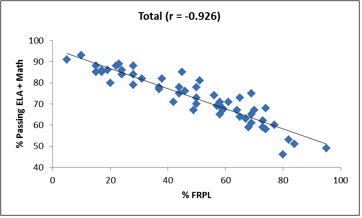
Consider, for example, the following chart which shows the percent of students who passed both the ELA (English/Language Arts) and Math portions of the 2013 ISTEP as a function of the percentage of students in the corporation (Indiana’s districts) who qualify for free- or reduced-price lunches (FRPL, a commonly used measure of SES):

istep1

These data are based on the 56 corporations that have at least 5000 students in the district. As can be seen, there is a very strong correlation between the two variables: The higher the percentage of kids who qualify for FRPL, the lower the passing percentage. Another way of putting it is, if we know the socioeconomic profile of a corporation we can make a very good prediction of where that corporation stands compared to other corporations on the ISTEP. This should not be a surprise to those familiar with the research literature. The same relationship has been found for the various standardized tests used throughout the country.

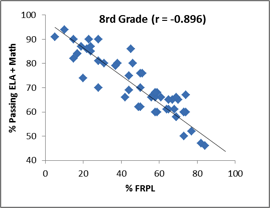
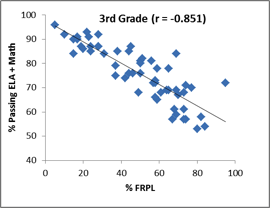
The above results are based on the performance of all students in each corporation. The following charts show the results separately for 3rd and 8th graders:

istep2istep3

Again, we see the same pattern for both grade levels, basically unchanged after 5 years of schooling in a high-scoring or low-scoring corporation. The SES influence is quite strong independently of the schools and teachers in a particular corporation. In fact, if anything, the SES impact appears to become slightly stronger as students progress from the 3rd to 8th grade.

So what are we to make of this obvious association between ISTEP scores of SES? The seemingly inescapable conclusion is that corporations and teachers deserve neither praise nor criticism for how their student compare to other corporations and teachers. Clearly, the socioeconomic profile (SES) of the corporation plays a decisive role. So I ask a simple question: Does anyone seriously believe that if Carmel and Gary (a high and low-performing corporation, respectively) exchanged teachers, the ISTEP scores would suddenly reverse themselves? I don’t think so.

The challenge thus becomes how to respond to the fact that poorer kids are not performing well in our schools. Is there less parental involvement in these communities? Are expectations lower? Do these parents need additional help in becoming more effective mentors? Are after-school tutoring programs a possible solution? What about summer programs? Or pre-school programs? Perhaps all of the above, along with addressing the well-documented and devastating effects that poverty has on the health and well-being of poor children long before they even enter school3.

But one thing seems clear: Judging school and teacher quality on the basis of test scores offers little in the way of a solution. We need to look beyond our schools and teachers if we are going to better prepare all kids for the world they will face in the days ahead.

1Charles J. Morris is an Emeritus Professor of Psychology from Denison University. He resides in Indianapolis.

2Matthew Di Carlo, Shanker Institute (see http://shankerblog.org/?p=74#more-74)

3Diane Ravitch, Reign of Error (New York: Knopf, 2013, pp. 91-98).