Colorado Gov. Jared Polis holds up a copy of Project 2025 as he speaks during the Democratic National Convention Wednesday, Aug. 21, 2024, in Chicago. (AP Photo/J. Scott Applewhite)
Polis, a Democrat, faced quick pushback on social media after he said he was “excited” by President-elect Donald Trump’s selection, and he posted againan hour later to clarify his thoughts. A spokesman for the governor then further walked back Polis’ support for Kennedy in a statement to The Denver Post.
Kennedy has pushed a number of public health conspiracies, most prominently around vaccines, and has advocated for other positions that are generally out of the mainstream, such as more availability of unpasteurized milk. He has said he wants to remove fluoride from the American water supply, and when he ran for president, he said he wanted to pause research into pharmaceuticals and infectious diseases for at least eight years.
He has falsely suggested that COVID-19 was “ethnically targeted” to “attack” certain groups and that mass shootings have been caused by prescription drugs, among other debunked conspiracy theories.
Kennedy has adopted some mainstream health positions, such as limiting ultra-processed foods and the use of pesticides in growing crops. Polis, citing specific quotes by Kennedy, focused on those latter views in his first post Thursday afternoon on the social platform X.
“‘In some categories, there are entire departments, like the nutrition department at the (Food and Drug Administration) that are — that have to go, that are not doing their job, they’re not protecting our kids,” Polis quoted Kennedy as saying, then added himself: “YES! The entire nutrition regime is dominated by big corporate ag rather than human health and they do more harm than good.”
Polis — who’d previously criticized Kennedy’s anti-vaccine stances this summer — acknowledged those positions in his posts Thursday but urged his 136,000 X followers to hold off on mocking or disagreeing with Kennedy.
He said Kennedy had “helped us defeat vaccine mandates in Colorado in 2019.” He was referring to a defeated legislative measure that would have made it harder for parents to opt out of vaccine mandates for public schools.
Polis wrote that he hoped Kennedy would make vaccines a matter of choice, not about bans or requirements.
Polis’ comments drew swift backlash. Outgoing state Rep. David Ortiz, a Littleton Democrat, called the governor’s endorsement “pathetic pandering.” Rep. Javier Mabrey, a Denver Democrat, quipped on X: “Yikes.” Shad Murib, the chair of the Colorado Democratic Party, tweeted “Welp” shortly after Polis’ comments, and he subsequently criticized Kennedy’s conspiratorial history in a Thursday evening statement from the party.
Sen. Kyle Mullica, a Thornton Democrat and emergency room nurse, was blunter.
“This is just complete bullshit,” he said in an interview, and then repeated that point for emphasis.
Mullica rejected Polis’ suggestion that state officials had sought vaccine mandates in the past. He said legislators worked to improve immunization rates through medical exemption reform and through education. Polis previously supported parents’ ability to opt out of vaccinations — drawing support from anti-vaccine advocates — despite the state’s poor rankings for pediatric immunization.
“The biggest thing is — look, science matters, man,” Mullica continued. “And with all the disinformation and misinformation that’s being put out by people like RFK Jr. and the internet, we need leaders who can stand up, follow the science, understand it and (make) sure we are making decisions based on evidence and science.”
Asked why Polis endorsed Kennedy in light of his often-conspiratorial stances, a spokesman for the governor responded by referring to a subsequent Polis social media post. The spokesman, Eric Maruyama, then issued a statement distancing the governor from the controversial figure he had just backed.
Maruyama wrote that Polis “does not endorse actions that would lead to measles outbreaks and opposes unscientific propaganda.”
“Governor Polis has not changed his view as a whole on RFK Jr. or on the Governor’s previously stated concerns regarding some of RFK Jr’s positions,” Maruyama wrote. “While opposed to RFK’s positions on a host of issues, including vaccines and banning fluoridation, (Polis) would appreciate seeing action on pesticides and efforts to lower prescription drug costs and if Trump is going to nominate someone like him then let them also take on soda, processed food, pesticides and heavy metals contamination.”
John Horgan is a widely published science writer. In this article, he expresses his sorrow that Scientific American bowed to pressure to oust its outstanding Chief Editor Laura Helmuth. Right wingers love to attack Democrats for “censorship,” but it is Republicans who forced Helmuth’s ouster and Republicans who ban books.
On election night, Sci Am editor Laura Helmuth called Trump voters “racist and sexist” and “fucking fascists” on the social media platform BlueSky, a haven for Twitter/X refugees. Yeah, she lost her cool, but Helmuth’s labels apply to Trump if not to all who voted for him.
Trump spews insults and wins the election. Helmuth loses her job. Critics of cancel culture cheered Helmuth’s cancellation. I’m guessing we’ll see more of this sickening double standard in coming months and years.
I’m writing this column, first, to express my admiration for Helmuth. She is not only a fearless, intrepid editor, who is passionate about science (she has a Ph.D. in cognitive neuroscience). She is also—and I’ve heard this from her colleagues and experienced it first-hand–a kind, considerate person. That’s a heroic feat in this mean-spirited age.
I’d also like to address the complaint that Helmuth’s approach to science was too political and partisan. Yes, under Helmuth, Scientific American has had a clear progressive outlook, ordinarily associated with the Democratic party. The magazine endorsed Joe Biden four years ago, shortly after Helmuth took over, and Kamala Harris this year.
Sci Am presented scientific analyses of and took stands on racism, reproductive rights, trans rights, climate change, gun violence and covid vaccines. Critics deplored the magazine’s “transformation into another progressive mouthpiece,” as The Wall Street Journal put it. Biologist Jerry Coyne says a science magazine should remain “neutral on issues of politics, morals, and ideology.”
What??!! As Coyne knows, science, historically, has never been “neutral.” Powerful groups on the right and left have employed science to promote their interests and propagate lethal ideologies, from eugenics to Marxism. Science journalists can either challenge abuses of science or look the other way.
I became a staff writer at Scientific American in 1986, when Jonathan Piel was editor. The magazine bashed the Reagan administration’s plan to build a space-based shield against nuclear weapons. I wrote articles linking behavioral genetics to eugenics and evolutionary psychology to social Darwinism. I got letters that began: “Dear Unscientific Unamerican.” My point: the magazine has never been “neutral,” it has always had a political edge.
Under Piel, as well as successors John Rennie, Mariette DiChristina and Helmuth, the magazine published plenty of articles with no political ramifications. But if you just stick to uncontroversial science, and you decline to take a position on topics like climate change or reproductive rights, you aren’t “neutral.” You are just looking the other way.
Meanwhile, Trump is vowing to cut federal aid to schools “pushing critical race theory, transgender insanity, and other inappropriate racial, sexual or political content.” And The Guardian reports that Trump is filing lawsuits against The New York Times and other media “that have been critical of him.”
Using your power to silence your opposition sounds pretty fascist to me. Will the next editor of Scientific American have the guts to challenge Trump and his minions? Will anyone?
NPR reported on the resignation of Laura Helmuth, the editor of Scientific American, in the wake of her comments about Trump on social media after the election. Who knew that Trump supporters were such snowflakes? Trump constantly sneers at and insults people and he got elected President. She expressed her reaction to his election and was forced out.
Before coming to Scientific American, Helmuth was previously the health and science editor for The Washington Post. She was also the President of the National Association of Science Writers.
NPR wrote:
Laura Helmuth, the chief editor of Scientific American magazine, announced her resignation on Friday after comments she made disparaging supporters of President-elect Donald Trump gained attention in conservative circles.
In a post on the social media platform Bluesky, Helmuth wrote, “I’ve decided to leave Scientific American after an exciting 4.5 years as editor in chief. She added, “I’m going to take some time to think about what comes next (and go birdwatching).”
In subsequent messages on Bluesky, which were later deleted, Helmuth referred to some of Trump’s supporters as “the meanest, dumbest, most bigoted” individuals celebrating his election night victory over Vice President Harris.
She also expressed regret to younger voters, stating that her generation is “so full of f****** fascists.”
Helmuth later apologized for her remarks, writing: “These posts, which I have deleted, do not reflect my beliefs; they were a mistaken expression of shock and confusion about the election results.”
Helmuth’s comments and resignation come in the wake of a highly contentious election season, during which media organizations and their reporters struggled with how to address Trump and his allies concerning conspiracy theories, their plans to consolidate power to the White House, and threats to their perceived enemies.
For only the second time in its nearly 180 years, Scientific American endorsed a presidential candidate, backing Kamala Harris while describing Trump as a threat to public safety who “rejects evidence, preferring instead nonsensical conspiracy fantasies.”
In an emailed statement to NPR, Kimberly Lau, president of Scientific American, confirmed Helmuth’s resignation, stating, “Laura Helmuth has decided to move on from her position as editor in chief. We thank Laura for her four years leading Scientific American, during which time the magazine won major science communication awards and established a reimagined digital newsroom. We wish her well in the future.”
Helmuth is a courageous editor. Her departure is a loss to freedom of thought and expression, as well as to science.
If you are on BlueSky, check out her posts. Especially her list of the outstanding articles published on her watch.
Trump knows that there is a strong possibility that some of his nominees for his Cabinet are so unqualified that they may not be approved by the Republican majority of the Senate. The Senate typically advises and gives its consent to high-level appointments. But Trump is trying to exercise a relatively obscure provision of the Constitution to bypass the Senate.
Since we know that Trump never read the Constitution, it’s certain that one of his creative lawyers planted the idea.
Trump’s selection of Matt Gaetz, who faces allegations of sex-trafficking minors and drug abuse, as Attorney General, produced shock and disbelief among some Republicans. So has Tulsi Gabbard, whom Trump would elevate to the highest position in the American intelligence community. So has Robert Kennedy Jr., the anti-vaccine advocate, to head the Department of Health and Human Services. Medical and scientific experts are appalled. So has Trump’s choice of Pete Hegseth, FOX talk show host, to lead the department of Defense.
But Trump could give them “recess appointments” and have no scrutiny or review by Senators. And avoid the risk that some or all might be rejected.
We know that Trump doesn’t care about norms, traditions or laws that constrain his power. If the Senate abandoned its role to please Trump, he would be empowered to trample the rule of law at every turn. That is most definitely a threat to our democracy.
Senate Majority Leader John Thune says “all options are on the table,” and has neither accepted or refuted the scheme.
President-elect Donald Trump is threatening to turn the Constitution’s appointment process for Cabinet officers on its head. If what I’m hearing through the conservative legal grapevine is correct, he might resort to a cockamamie scheme that would require House Speaker Mike Johnson (R-Louisiana) to play a critical role. Johnson can and should immediately put an end to this scheme.
The Senate’s power to approve or reject a president’s nominees for Cabinet positions is a fundamental feature of the Constitution’s system of checks and balances. As Alexander Hamilton explained in the Federalist Papers, that power “would tend greatly to prevent the appointment of unfit characters,” including those “who had no other merit than that … of possessing the necessary insignificance and pliancy to render them the obsequious instruments of [the president’s] pleasure.” Almost as if Hamilton were describing Matt Gaetz, Trump’s pick for attorney general.
To be sure, the Constitution also provides a backup provision that allows the president to make recess appointments — “to fill up all Vacancies that may happen during the Recess of the Senate.” But as Hamilton put it, this “auxiliary method of appointment” is “nothing more than a supplement” to the “general mode of appointing officers of the United States” and is to used “in cases to which the general method was inadequate.”
It appears that the Trump team is working on a scheme to allow Trump to recess-appoint his Cabinet officers. This scheme would exploit an obscure and never-before-used provision of the Constitution (part of Article II, Section 3) stating that “in Case of Disagreement” between the houses of Congress, “with Respect to the Time of Adjournment,” the president “may adjourn them to such Time as he shall think proper.”
Under this scheme, it appears that the House would adopt a concurrent resolution that provided for the adjournment of both the House and the Senate. If the Senate didn’t adopt the resolution, Trump would purport to adjourn both houses for at least 10 days (and perhaps much longer). He would then use the resulting intrasession recess to appoint Gaetz and other Cabinet nominees.
Ten years ago, Supreme Court Justice Antonin Scalia labeled the president’s recess-appointment power an “anachronism” because “modern forms of communication and transportation” make the Senate always available to consider nominations. Along with three of his colleagues, Scalia also argued that the president’s power to make recess appointments is limited to intersession recesses and does not apply to the intrasession recess that the Trump scheme would concoct. The justice, who died in 2016, would be aghast at the notion that a president could create an intrasession recess for the purpose of bypassing the Senate approval process for nominations.
Mike Johnson should not be complicit in eviscerating the Senate’s advice-and-consent role. He should promptly make clear that the House will abide by its usual schedule of recesses and will not attempt to engineer a recess of the Senate.
Edward Whelan is a distinguished senior fellow of the Ethics and Public Policy Center, where he holds the Antonin Scalia chair in constitutional studies.
I first got interested in health policy because of Ronald Reagan, but not in the way you might think.
Growing up in the San Francisco Bay Area with a mom who worked at the United Way, I was well aware of the HIV/AIDS epidemic. I knew people who were HIV positive. So when HBO released the film adaptation of And the Band Played On, I was riveted. Enraged. Filled with righteous indignation.
To be honest, it hasn’t really worn off.
Randy Shilts wrote in his prologue to And the Band Played On (which I reread amid the COVID-19 pandemic) the following:
“The bitter truth was that AIDS did not just happen to America – it was allowed to happen by an array of institutions, all of which failed to perform their appropriate tasks to safeguard the public health. This failure of the system leaves a legacy of unnecessary suffering that will haunt the Western world for decades to come…. The story of these first five years of AIDS in America is a drama of national failure, played out against a backdrop of needless death. People died while Reagan administration officials ignored pleas from government scientists and did not allocate adequate funding for AIDS research until the epidemic had already spread throughout the country… People died while public health authorities and the political leaders who guided them refused to take the tough measures necessary to curb the epidemic’s spread, opting for political expediency over the public health.”
So was also the case for the COVID-19 pandemic, which was unleashed upon the world at a time in which the United States’ public health bureaucracy was hotly politicized, chronically underfunded, and constrained by anti-science forces at the head of the Trump Administration.
And rather than learning from the mistakes of this pandemic, the most dangerous among them are being rewarded with high-level posts from which to spew anti-scientific drivel, which can come with real life-or-death consequences.
I’m not talking about R.F.K. Jr… this time. Right now, I’m talking about Jay Bhattacharya, who according to Dan Diamond of The Washington Post is likely poised to be the new head of the National Institute of Health (NIH), having been listed by RFK Jr. as a top contender for the position, which falls under the broader umbrella of HHS.
It has admittedly been an interesting experience to watch the nominations unfold, having written a doctoral dissertation on the problems that arise when agencies are headed by people who oppose the agencies’ core missions, and when Congress and others are ill-equipped or disinclined to hold those agencies accountable. You know, hypothetically.
So, who is Jay Bhattacharya? Needless to say, he has been a critic of the NIH while being celebrated by noted public health opponent, Florida Governor Ron DeSantis. His other cheerleaders include Peter Thiel, Elon Musk, and Joe Rogan – you know the voices of reason in public health.
His opposition within the public health community is not about partisanship, but rather the anti-science stances that he embraced over the course of the deadly pandemic, and which have been widely perceived among experts as having prioritized the business community over health outcomes. While I joined with experts in public health and medicine through the organization Brief-19 to disseminate evidence-based analyses of the public health and policy implications of what we were learning from day to day about the pandemic, Bhattacharya downplayed the threat of the virus, instead emphasizing less government control and more reliance on individual choices to self-protect.
Rugged individualism and self-reliance. Now where have we heard that before?
To be sure, I have had many quibbles with Ayn Rand and her followers over the years. Some of it is political. Some of it isn’t.
The reality is that rugged self-reliance just simply doesn’t work in the public health setting. Public health can and indeed must be rather paternalistic, because by definition it’s focused not on individual health, but collective health outcomes and system performance. Choosing not to get vaccinated is bad for you, but it’s really bad for your community. Choosing not to mask or socially distance during a pandemic undercuts not only your and your family’s safety, but it compromises scientifically-grounded public interventions aimed at flattening the curve. This requires that we care not just about “me me me,” but to think more broadly. That isn‘t always easy for Americans. But given that we know that the next pandemic isn’t a matter of “if” but rather “when,” it’s vital that our institutions of public health be staffed with grown-ups who believe in science and understand that effective public health interventions should be prioritized over individual convenience. And they absolutely need to be staffed with people who know better than to elevate pseudoscience and grifters – whether in hedge funds, on podcasts, or widely discredited academics relying on a degree to lend credence to anti-scientific and/or anti-democratic theories.
Indeed, a prominent supporter of Bhattacharya was his Stanford colleague Scott Atlas, who went against the scientific community in encouraging lower-risk people to become infected with COVID-19 as a means to promote herd immunity, and who urged the reopening of schools even as we knew that there would be risks of increased transmission in those settings. And Bhattacharya contributed to The Great Barrington Declaration, which urged that younger Americans return to work and build immunity against the COVID virus.
All of this was in the interest of creating a false dichotomy between helping the economy and promoting public health. But the reality is that while people of both parties want a robust business sector, containing a deadly virus is an important precursor. What is the value of having a business open if would-be patrons are sick or dying? What is the value of forcing a business open if staff immediately become exposed and sick?
Investments in public health pay off. We see this in the insurance setting, which is where most of my own research and teaching are situated. Of course, covering people costs money. But what is the result? People are able to access needed care. They are able to manage chronic and acute medical conditions. They are able to not only survive but thrive. And in light of that, they can be productive in the American economy, while health care providers are relieved of the economic burdens of uncompensated care.
These are not burdens. They are investments.
America just emerged – far from unscathed – from a major, deadly pandemic the likes of which we had not seen since the 1918 Spanish flu. And we deserve public health leaders who learned the right lessons from it. Instead, Bhattacharya’s impulse amid the COVID pandemic was to see the core problem as the stifling of dissent (which is to say, prioritizing public health expertise over the legitimization of quackery).
These are not the only reasons why Bhattacharya would be a problematic selection to head NIH. While he boasts impressive academic credentials, he has never before overseen a large bureaucratic organization, while the National Institute of Health has nearly 20,000 staff. To be sure, RFK Jr. and others within Trump’s orbit see it as an advantage to lack government experience, largely because of a deeper distrust of the government apparatus and hostility to government interventions (even those which could honestly be termed “pro-life”). But governmental and managerial competence is vital, and when this is put on the back burner in the domain of public health, there are life-or-death consequences.
Bhattacharya has ideas for how the NIH should operate, and it doesn’t look good, essentially coming down to its decentralization as well as deprioritizing the expertise of long-serving bureaucrats. This disregard for agency expertise fits well within the Trump Administration’s broader opinions on the administrative state (or what’s left of it after Loper Bright), seeking to clamp down on civil servants who are perceived as being politically disloyal. Prof. Don Moynihan has written extensively on these issues in Schedule F positions, and you should read it.
If we are lucky, as with the first Administration, the degree of incompetence will exceed the high degrees of malevolence, thus stymying the most dangerous policy proposals that have been floated. But we should not have to root for public health incompetence when our lives – not to mention our research funding on a broad array of public health and health policy subjects – depend on the strength of this agency.
Jay Bhattacharya would deeply damage our efforts to study public health problems facing the country and the world and would signal even further entrenchment of conspiratorial perspectives and political expediency where we most need to follow the science. Tom Nichols wrote a book called The Death of Expertise: The Campaign Against Established Knowledge and Why it Matters. As with my own work on bureaucratic noncompliance amid misaligned agency objectives, I fear that this will be all too relevant in the coming months and years.
When Robert F. Kennedy Jr. abandoned his independent campaign and endorsed Trump, Trump offered him any job he wanted. He wanted a role in public health.
The New York Times reported:
Robert F. Kennedy Jr., who President-elect Donald J. Trump has suggested would have a “big role” in his second administration, wasted no time laying out potential public health measures he would oversee if given the chance.
Mr. Kennedy, an environmental lawyer who has no medical or public health degrees and has promoted anti-vaccine conspiracies for years, told NBC News on Wednesday that he would not “take away anybody’s vaccines,” but that he wanted Americans to be informed with the “best information” available so they “can make individual assessments about whether that product is going to be good for them.”
“People ought to have choice,” he said, adding that he has “never been anti-vaccine.”
Mr. Kennedy has been a prominent critic of the childhood vaccination schedule and has frequently linked some vaccines to autism and other health issues. Studies have long shown no such connection.
“I think fluoride is on its way out,” he said. “I think the faster that it goes out, the better. I’m not going to compel anybody to take it out, but I’m going to advise the water districts about their legal liability.”
The treatment of public water with small amounts of fluoride has been widely hailed as one of the most important public health interventions of the past century; the American Dental Association has said that it reduces dental decay by at least 25 percent.
Mr. Kennedy also said that if he were given a position in Mr. Trump’s administration, he would focus on eliminating corruption at public health agencies like the Food and Drug Administration and the Centers for Disease Control and Prevention.
Some departments, including those focused on nutrition, “have to go,” he told NBC. “They’re not protecting our kids.”
“Once Americans are getting good science and allowed to make their own choices, they’re going to get a lot healthier,” he added.
As president, Mr. Trump would have only limited authority to make some of these changes, and some would need congressional approval. But on the campaign trail, Mr. Trump said he would let Mr. Kennedy “go wild on health.”
“I want to be in the White House, and he has assured me that I’m going to have that,” Mr. Kennedy said this week.
Now here is another Trump promise that should keep us up at night: He has said that RFK Jr. will have a large role in his administration, overseeing the appointees in the areas that interest him: public health and food.
In June 2019, Robert F. Kennedy Jr. visited Samoa with his anti-vaccine organization, Children’s Health Defense, meeting with local anti-vaxxers and government officials at a time when the country’s measles vaccine was under attack. Prominent anti-vax voices, including CHD, blamed the vaccine for two infant deaths the prior year, even after the true reason was discovered. Amid the swirling misinformation, vaccine rates plummeted from 60–70 percent to 31 percent.
A few months after RFK Jr.’s visit, measles swept through the freshly vulnerable Pacific island nation, killing 83 Samoans—mostly children. Kennedy doubled down, writing to the Samoan prime minister to questionwhether a “defective vaccine” was responsible for the outbreak. Even two years later, in 2021, Kennedy called a Samoan anti-vaxxer who had reportedly discouraged people from getting vaccinated during the 2019 crisis a “medical freedom hero.” Kennedy has also insisted for years, against all available scientific evidence, that vaccines cause autism, blaming them for a “holocaust” in the United States.
This week, Kennedy told supporters that if Republican presidential candidate Donald Trump wins, he has promised Kennedy “control of the public health agencies,” including the Department of Health and Human Services. Trump transition co-chair Howard Lutnik later denied that Kennedy would have a job with HHS—although, at the same time, he said Kennedy had convinced him to pull vaccines from the market. Trump himself, at his Madison Square Garden rally on Sunday, seemed to lend credence to the idea of Kennedy leading on health: “I’m gonna let him go wild on health. I’m gonna let him go wild on the food. I’m gonna let him go wild on medicines,” Trump said. Trump also said on a three-hour podcast episode with Joe Rogan last week that he’s told Kennedy, “Focus on health, focus—you can do whatever you want.” It’s not clear whether such a promise would have been made in exchange for Kennedy’s political endorsement, which would be illegal.
But if Kennedy were to be put in charge of HHS, he would be leading the executive department that oversees the U.S. Centers for Disease Control and Prevention, the Food and Drug Administration, and the National Institutes of Health, among others. In the meantime, Kennedy is an honorary co-chair on the Trump transition team, and claims to be “deeply involved in helping to choose the people who can run FDA, NIH, and CDC.”
In his own speech at Madison Square Garden, Kennedy took aim at Democrats, saying they were once “the party that wanted to protect public health, and women’s sports”—a bizarre pairing that highlights his recent pivot to attacking trans athletes and gender-affirming care. Kennedy, who ran as a Democratic and then independent presidential candidate before throwing his support behind Trump, is also spreading misinformation on chronic health issues such as obesity, diabetes, drug overdoses, and autism; on Tuesday, for example, he said diabetes could be “cured with good food.” In his Sunday speech, Kennedy characterized Trump as a president who would “protect our children … and women’s sports,” as well as “end the corruption at the federal agencies—at FDA, at NIH, at CDC, and at the CIA”—a constellation of bodies rarely joined together, which he implied are conducting surveillance upon and acting against the interests of the American people.
“This unbridled assault on science and scientists, it’s highly destabilizing for the country,” Baylor College of Medicine dean Peter Hotez, author of The Deadly Rise of Anti-Science, told me earlier this year, a few months after Kennedy announced his run. But it’s not just Kennedy—Trump and other Republicans in Congress are also leading the charge to undermine expertise and further erode public trust in the government, he said. “This is what authoritarianism is all about,” Hotez said, lamenting “the collateral damage that it’s going to do to our democracy” and pointing to the ways Stalin portrayed scientists as public enemies during the Great Purge.
Hotez sees the false claims about vaccines causing autism, which first started gaining momentum in the late 1990s, as phase one of the assault on science. When that was thoroughly debunked, anti-science activists began aligning themselves “around the banner of health freedom, medical freedom,” getting a major boost with the Covid-19 pandemic, Hotez said. “Now we’re seeing the next phase, which is not only targeting the science but targeting the scientists and portraying them as public enemies. That is both scary and worrisome.”
The past five years have seen a “substantial” drop of trust in public health and scientists, especially among Republicans, Robert Blendon, Harvard University professor emeritus of political analysis and health policy, told me. At the same time, the anti-vaccine movement—which previously was not tied to politics—swung wildly to the right. “Republicans have become incredibly distrustful of vaccines,” Blendon said. “The Republican Party after the [start of] Covid has become very anti–public health.” They lashed out against what they perceived to be government overreach, which made them receptive to questions about the safety and effectiveness of the Covid vaccines—and, soon, other vaccines as well, Blendon said. “This led to a tipping point with this enormous resentment among particularly Republican audiences that the government went way too far.”
Trump’s own short-lived support for vaccines during the measles outbreak in 2019 and Covid in 2020 seems to have been a blip; he has spouted anti-vax views since at least 2007. Although Operation Warp Speed produced highly effective Covid vaccines in record time, one of the Trump administration’s only accomplishments of the pandemic, “the Republicans don’t want to claim it,” Trump said in September. At least 17 times, Trump has pledged to defund schools mandating vaccines. While his campaign says this vow applies to Covid vaccines only, Trump doesn’t make any distinctions in his speeches, opening up the possibility of all childhood vaccines being banned—though it’s not clear how he would carry out this plan. (No states requireCovid vaccines for school attendance.)
At the recent Vice-Presidential debate, JD Vance engaged in sanewashing and normalizing Trump, falsely claiming that Trump tried to improve or salvage Obamacare. He lied, as LA Times’ Pulitzer-Prize winning columnist Michael Hiltzik shows. In fact, Trump and most other Republicans tried to kill Obamacare. Trump was also responsible for incompetent management of the federal response to COVID, which increased the death toll.
Every newspaper should either have its own Michael Hiltzik or repost his columns.
I love it more today than ever, because it applies so perfectly to how we must respond to the campaign claims of Donald Trump and JD Vance. Especially Trump’s assertions about his role — heroic, in his vision — in “saving” the Affordable Care Act and fighting the COVID pandemic.
I’ve written before about the firehouse of fabrication and grift emanating from the Trump campaign like a political miasma. On these topics, he has moved beyond his habit of merely concocting a false reality about, say, immigration and crime to deliberately concocting a false reality about himself.
Donald Trump could have destroyed [Obamacare]. Instead, he worked in a bipartisan way to ensure that Americans had access to affordable care.
— JD Vance, flagrantly lying about Trump’s management of the Affordable Care Act
To start by summarizing: Trump did everything in his power to destroy the Affordable Care Act, starting on the very first day of his term in 2017. On COVID, he did everything in his power to make America defenseless against the spreading pandemic.
Let’s take them in order.
Here’s what Trump said about the Affordable Care Act during his Sept. 10 debate with Kamala Harris: “I had a choice to make when I was president, do I save it and make it as good as it can be? Never going to be great. Or do I let it rot? … And I saved it. I did the right thing.”
This was the prelude to his head-scratching assertion that he has “concepts of a plan” to reform healthcare in the U.S. I examined what that might mean in a recent column, in which I explained that it would turn the U.S. healthcare system to the deadly dark ages when people with preexisting medical conditions would be either denied coverage or charged monstrous markups.
“Donald Trump has said that if we allow states to experiment a little bit on how to cover both the chronically ill, but the non-chronically ill … He actually implemented some of these regulations when he was president of the United States. And I think you can make a really good argument that it salvaged Obamacare. … Donald Trump could have destroyed the program. Instead, he worked in a bipartisan way to ensure that Americans had access to affordable care.”
Here’s what Trump actually did to the Affordable Care Act during his presidency. He had made repealing the ACA a core promise of his 2016 presidential campaign, stating on his website, “On day one of the Trump Administration, we will ask Congress to immediately deliver a full repeal of Obamacare.” (Thanks are due to the indispensable Jonathan Cohn of Huffpost for excavating the quote.)
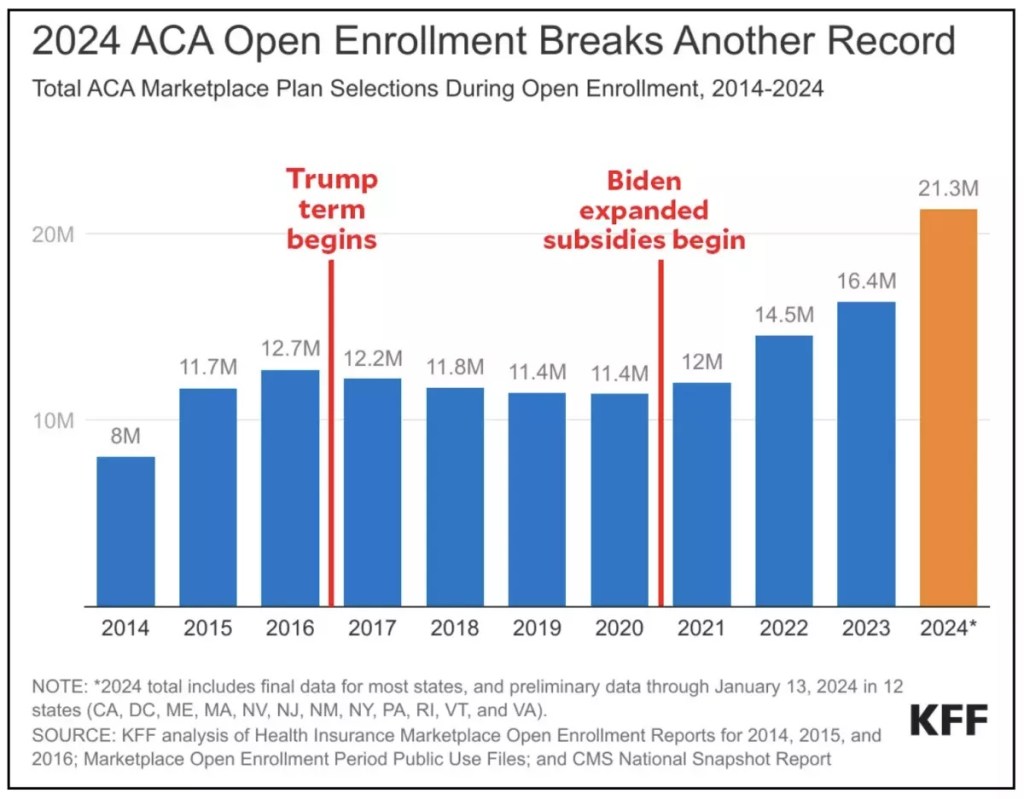
Trump drove down Obamacare enrollment every year he was in office; when Biden removed Trump’s obstacles, enrollment soared.
(KFF / Kevin Drum)
On Inauguration Day, Trump issued an executive order instructing the entire executive branch to find ways to “waive, defer, grant exemptions from, or delay the implementation of any provision or requirement” of the ACA.
During his presidency, he never abandoned the Republican dream of repealing Obamacare, even after July 28, 2017, when the late Sen. John McCain (R-Ariz.) strode to the Senate well and delivered a thumbs-down coup de grace to a GOP repeal bill.
Trump never ceased slandering the ACA as a “disaster.” He returned to the theme during last month’s debate: “Obamacare was lousy healthcare,” he said. “Always was. It’s not very good today.” As president, he threatened to make it “implode,” and used every tool he could get his fingers on to do so.
In September 2017 he slashed the advertising budget for the upcoming open enrollment period for individual insurance policies by a stunning 90%, to $10 million from the previous year’s $100 million. He also cut funds for nonprofit groups that employ “navigators,” those who help people in the individual market understand their options and sign up, by roughly 40%, to $36.8 million from $62.5 million.
Just after taking office, he abruptly canceled the customary last-minute advertising blitz to encourage enrollments in Obamacare plans before open enrollment ended on Jan. 31. The last minute surge in enrollments, which had occurred every previous year, vanished. The drop-off was particularly devastating because it was concentrated among the healthiest potential enrollees — those who often wait until the last minute to sign up and whose premiums generally subsidize older, less healthy patients.
The impact these policies had on enrollment was inescapable. In the three years before Trump took office, ACA marketplace plans experienced annual enrollment increases, to 12.7 million enrollees in 2016 from 8 million in 2014. During every year of the Trump administration, enrollment declined, falling to 11.4 million in 2020.
Every year since Joseph Biden took office, enrollment has increased, reaching a record 21.3 million this year — an 86% increase over Trump’s last year.
As for Vance’s fatuous claim that Trump “worked in a bipartisan way to ensure that Americans had access to affordable care,” you have the right to ask what Vance has been smoking.
The only bipartisanship on the ACA during the Trump years, Cohn observes, were the actions of GOP senators such as McCain and Lisa Murkowski of Alaska to cooperate with Democrats to stave off their fellow Republicans’ anti-ACA vandalism.
Now onto Trump’s fantasy vision of his role in fighting the COVID pandemic. Speaking in a low-energy, exhausted monotone at a speech Tuesday in Milwaukee and reading at times from a binder, he praised himself for instituting Operation Warp Speed, which funded COVID vaccine development in record time and got them rolled out in January 2021.
“We did a great job with the pandemic. Never got the credit we deserved,” he said. He then veered into blaming China for the pandemic, a familiar topic. He said bluntly that the pandemic was “caused by the Wuhan lab. I said that from the beginning, came from Wuhan. And the Wuhan lab, it wasn’t from bats in a cave that was 2,000 miles away. … It’s really the China virus.”
As for the rest of his COVID performance, he said this: “We did a great job with the ventilators, the masks and the gowns and everything. … When we got here the cupboards, our cupboards, I used to say our cupboards were bare. … No president put anything in for a pandemic.” Then he segued into praising himself for a big tax cut, and COVID was forgotten.
A few points about this spiel:
Trump is correct that Operation Warp Speed was a significant achievement. But he didn’t follow up by advocating for its product, the COVID vaccine. Instead, he has thrown in his lot with fanatical anti-vaccine agitators such as Robert F. Kennedy. He has repeated an anti-vax mantra, promising, “I will not give one penny to any school that has a vaccine mandate or a mask mandate.” This is a formula for exposing children to vaccine-preventable diseases such as measles and even polio.
Trump’s reference to the Wuhan Institute of Virology as the source of SARS-CoV-2, the virus that causes COVID, underscores how closely the so-called lab-leak theory of COVID’s origins is tied to right-wing partisan politics. The theory originated with Trump acolytes at the State Department, who saw the accusation as a convenient weapon in Trump’s economic war with China.
To this day, not a speck of evidence has been produced to validate this claim; scientists versed in the relevant disciplines of virology and epidemiology say the evidence overwhelmingly supports the hypothesis that the virus reached humans via the wildlife trade, and that its journey may well have started with bats thousands of miles from Wuhan, China.
Trump is lying when he says his predecessors in the White House left him without resources. The truth is that Trump himself hobbled pandemic response from the start.
In 2016, in the wake of the Ebola epidemic in Africa, President Obama had established the the Directorate for Global Health Security and Biodefense at the National Security Council “to prepare for and, if possible, prevent the next outbreak from becoming an epidemic or pandemic,” in the words of its senior director, Beth Campbell. Trump dissolved it in 2018.
Due to these steps, the U.S. was fated to sleepwalk into the pandemic. The COVID death toll in the U.S. stands at more than 1.2 million, and its reported death rate from COVID of 341.1 per 100,000 population is the highest in the developed world.
Ventilators, masks and gowns? Trump placed the procurement of this essential personal protective equipment in the hands of his son-in-law, Jared Kushner, who handled the task incompetently. Kushner turned away urgent appeals from state and local officials for those supplies.
“The notion of the federal stockpile was it’s supposed to be our stockpile, it’s not supposed to be states’ stockpiles that they then use,” Kushner said at a briefing.
Following his remarks, the website of the government’s national strategic stockpile of medicines and supplies was changed from asserting that its purpose was to “support” the emergency efforts of state, local and tribal authorities by ensuring that “the right medicines and supplies get to those who need them most.” The new language redefined the stockpile’s role as “to supplement state and local supplies … as a short-term stopgap.”
Supplies of ventilators, masks and gowns remained scarce through the first months of the pandemic. A procurement official at a Massachusetts hospital system told me of having had to cut a deal with a shadowy broker offering 250,000 Chinese-made masks at an inflated price, completing the transaction for $1 million at a darkened warehouse five hours from home.
Trump made anti-science incompetence and disregard for the welfare of Americans part of our history. The same thing, or worse, looms on the horizon in a second Trump term.
My comment: who can forget that dramatic moment in 2017 when the late Senator John McCain strode down to the well of the Senate to cast the deciding vote not to repeal Obamacare by dramatically extending his good arm and showing a thumb’s down gesture? Trump forgot.
As to COVID, why didn’t Trump take credit for the vaccines produced by Iperatuon Warp Speed? If the scientists had called it “the TRUMP vaccine, he probably would have boasted about it. Instead, he threw his support to the anti-VAXX conspiracy theorists, which surely contributed to the death toll.
For only the second time in its 179-year history, the prestigious magazine Scientific American issued a Presidential endorsement. It endorsed Kamala Harris. The only other endorsement in its history was four years ago for Joe Biden. The magazine cares deeply about science, climate change, health, and factual evidence. For these reasons, it opposes Trump.
The editors of Scientific American wrote:
In the November election, the U.S. faces two futures. In one, the new president offers the country better prospects, relying on science, solid evidence and the willingness to learn from experience. She pushes policies that boost good jobs nationwide by embracing technology and clean energy. She supports education, public health and reproductive rights. She treats the climate crisis as the emergency it is and seeks to mitigate its catastrophic storms, fires and droughts.
In the other future, the new president endangers public health and safety and rejects evidence, preferring instead nonsensical conspiracy fantasies. He ignores the climate crisis in favor of more pollution. He requires that federal officials show personal loyalty to him rather than upholding U.S. laws. He fills positions in federal science and other agencies with unqualified ideologues. He goads people into hate and division, and he inspires extremists at state and local levels to pass laws that disrupt education and make it harder to earn a living.
Only one of these futures will improve the fate of this country and the world. That is why, for only the second time in our magazine’s 179-year history, the editors of Scientific American are endorsing a candidate for president. That person is Kamala Harris.
Before making this endorsement, we evaluated Harris’s record as a U.S. senator and as vice president under Joe Biden, as well as policy proposals she’s made as a presidential candidate. Her opponent, Donald Trump, who was president from 2017 to 2021, also has a record—a disastrous one. Let’s compare.
The COVID pandemic has been the greatest test of the American health-care system in modern history. Harris was vice president of an administration that boosted widespread distribution of COVID vaccines and created a program for free mail-order COVID tests. Wastewater surveillance for viruses has improved, allowing public health officials to respond more quickly when levels are high. Bird flu now poses a new threat, highlighting the importance of the Biden-Harris administration’s Office of Pandemic Preparedness and Response Policy.
Trump touted his pandemic efforts during his first debate with Harris, but in 2020 he encouraged resistance to basic public health measures, spread misinformation about treatments and suggested injections of bleach could cure the disease. By the end of that year about 350,000 people in the U.S. had died of COVID; the current national total is well over a million. Trump and his staff had one great success: Operation Warp Speed, which developed effective COVID vaccines extremely quickly. Remarkably, however, Trump plans billion-dollar budget cuts to the Centers for Disease Control and Prevention and the National Institutes of Health, which started the COVID-vaccine research program. These steps are in line with the guidance of Project 2025, an extreme conservative blueprint for the next presidency drawn up by many former Trump staffers. He’s also talked about ending the Office of Pandemic Preparedness and Response Policy, calling it a pork project.
Trump appointed the conservative U.S. Supreme Court justices who overturned Roe v. Wade, removing the constitutional right to a basic health-care procedure. He spreads misinformation about abortion—during the September debate, he said some states support abortion into the ninth month and beyond, calling it “execution after birth.” No state allows this. He also refused to answer the question of whether he would veto a federal abortion ban, saying Congress would never approve such a ban in the first place. He made no mention of an executive order and praised the Supreme Court, three justices of which he placed, for sending abortion back to states to decide. This ruling led to a patchwork of laws and entire sections of the country where abortion is dangerously limited.
GUN SAFETY
The Biden-Harris administration closed the gun-show loophole, which had allowed people to buy guns without a license. The evidence is clear that easy access to guns in the U.S. has increased the risk of suicides, murder and firearm accidents. Harris supports a program that temporarily removes guns from people deemed dangerous by a court.
Trump promised the National Rifle Association that he would get rid of all Biden-Harris gun measures. Even after Trump was injured and a supporter was killed in an attempted assassination, the former president remained silent on gun safety. His running mate, J. D. Vance, said the increased number of school shootings was an unhappy “fact of life” and the solution was stronger school security.
ENVIRONMENT AND CLIMATE
Harris said pointedly during the September debate that climate change was real. She would continue the responsible leadership shown by Biden, who has undertaken the most substantial climate action of any president. The Biden-Harris administration restored U.S. membership in the Paris Agreement on coping with climate change. Harris’s election would continue IRA tax credits for clean energy, as well as regulations to reduce power-plant emissions and coal use. This approach puts the country on course to spend the authorized billions of dollars for renewable energy that should cut U.S. carbon emissions in half by 2030. The IRA also includes a commitment to broadening electric vehicle technology.
Trump has said climate change is a hoax, and he dodged the question “What would you do to fight climate change?” during the September debate. He pulled the U.S. out of the Paris Agreement. Under his direction the Environmental Protection Agency and other federal agencies abandoned more than 100 environmental policies and rules, many designed to ensure clean air and water, restrict the dangers of toxic chemicals and protect wildlife. He has also tried to revoke funding for satellite-based climate-research projects.
TECHNOLOGY
The Biden-Harris administration’s 2023 Executive Order on Safe, Secure and Trustworthy Development and Use of Artificial Intelligence requires that AI-based products be safe for consumers and national security. The CHIPS and Science Act invigorates the chipmaking industry and semiconductor research while growing the workforce. A new Trump administration would undo all of this work and quickly. Under the devious and divisive Project 2025 framework, technology safeguards on AI would be overturned. AI influences our criminal justice, labor and health-care systems. As is the rightful complaint now, there would be no knowing how these programs are developed, how they are tested or whether they even work.
The 2024 U.S. ballots are also about Congress and local officials—people who make decisions that affect our communities and families. Extremist state legislators in Ohio, for instance, have given politicians the right to revoke any rule from the state health department designed to limit the spread of contagious disease. Other states have passed similar measures. In education, many states now forbid lessons about racial bias. But research has shown such lessons reduce stereotypes and do not prompt schoolchildren to view one another negatively, regardless of their race. This is the kind of science MAGA politicians ignore, and such people do not deserve our votes.
At the top of the ballot, Harris does deserve our vote. She offers us a way forward lit by rationality and respect for all. Economically, the renewable-energy projects she supports will create new jobs in rural America. Her platform also increases tax deductions for new small businesses from $5,000 to $50,000, making it easier for them to turn a profit. Trump, a convicted felon who was also found liable of sexual abuse in a civil trial, offers a return to his dark fantasies and demagoguery, whether it’s denying the reality of climate change or the election results of 2020 that were confirmed by more than 60 court cases, including some that were overseen by judges whom he appointed.
One of two futures will materialize according to our choices in this election. Only one is a vote for reality and integrity. We urge you to vote for Kamala Harris.
Judd Legum of Popular Information tells the sad story of what happened to sex education in Florida. Responding to Ron DeSantis, the legislature passed a bill declaring what must be taught and what cannot be taught, in accord with the ideology of rightwing Republicans, not science. The law requires districts to have their sex Ed curriculum approved by the state. Large numbers of students are getting no sex education at all. That may be what DeSanths wants.
Legum writes:
In May 2023, Florida Governor Ron DeSantis (R) signed Florida House Bill 1069, a law that requires sex education classes in the state to conform to right-wing ideology. Specifically, the law requires all sex education classes to teach students that sex is binary, “either male or female,” even though that is inaccurate. It also mandates that students are instructed that sex is defined exclusively by “internal and external genitalia present at birth,” and these sex roles are “binary, stable, and unchangeable.” This requirement erases the existence of trans and nonbinary people. Schools also must “teach abstinence from sexual activity outside of marriage as the expected standard for all school-age students” and “the benefits of monogamous heterosexual marriage.”
To enforce these new rules and other aspects of the DeSantis administration’s political agenda, HB 1069 also requires “all materials used to teach reproductive health” to be approved in advance by the Florida Department of Education (FDE) or use textbooks pre-approved by the state. Previously, sex education curricula were approved by district school boards. Florida parents can opt-out of sex education lessons on behalf of their children.
The FDE instructed school districts to submit their materials for sex education by September 30, 2023. The school districts met the deadline, but the FDE never responded. Florida counties were placed in a no-win situation as not teaching sex education, a mandatory course, at all is a violation of state law.
Several Florida school districts — including Hillsborough, Orange and Polk Counties, three of Florida’s largest — decided not to teach sex education at all during the 2023-24 school year, the Orlando Sentinel reported. Other counties, including Broward and Seminole Counties, taught sex education classes without getting the legally required approval.
Legum reviewed a copy of the training materials for reviewers of district plans. Among other things, it requires these “experts” to watch for the following criteria:
The “experts” are directed to evaluate all materials on 11 separate criteria, some inscrutable. For example, all materials must be evaluated on the criteria of “Male and Female Reproductive Roles,” “Principles of Individual Freedom,” “Critical Race Theory,” and “Social Justice.”
Please open the link to learn more about how the Florida Department of Education trains reviewers of district plans.


 Diane Ravitch's blog