Archives for category: School Choice

Julian Vasquez Heilig writes one of the best education blogs in the blogosphere.

In this post, he has video of the scholars’ panel at the NPE17 conference in Oakland, California, where the top was “school choice and privatization.”

Julian is a member of the panel, along with Frank Adamson of Stanford, who has studied choice from an international perspective; Janelle Scott of Berkeley; Roxana Marachi of San Jose State University.

The discussion is lively, and I think you will enjoy watching it.

Arthur Camins retired recently as Director of the Center for Innovation in Engineering and Science Education at Stevens Institute of Technology. He has taught and been an administrator in New York City, Massachusetts, and Louisville, Kentucky. Unlike Betsy Dezvos and other ersatz “reformers,” he knows quite a lot about teaching and innovation.

In this post, he explains the fraud of school choice.

He writes:

“Segregation and the evil twins–racism and inequity– are the divide and conquer gifts that keep on giving­ to the rich and taking from everyone else. Over the decades, the wealthy and empowered have found ways to dress up their barely concealed essential messages: We deserve what we have. Inequality is the natural order of the world. Caring about others is for losers. Winners care about themselves. If you are unhappy with your station in life, blame yourself. Some of you would be better off if was it not for Them.

“The latest incarnation of message obfuscation is the vaguely democratic-sounding term, school choice. The push for expansion of charter schools- publicly funded, but privately controlled– and for vouchers to offset a portion of the tuition for private schools is the old wolf in new sheep’s clothing.

“Equity and universal high quality have never been the goals of school choice, the roots of which are resistance to desegregation. Its latest advocates do not suggest vouchers so that the poor can attend elite, expensive private schools. They do not demand adequate funding for all schools. They do not want to give students experience interacting with one another across class or race. They certainly do not want to end the defining characteristic of the status quo, rationing of quality by socioeconomic status.

“Their rhetoric notwithstanding, they have other goals: Undermine public sector unions to reduce their political power, as well as members’ pay and health and retirement benefits; Pander to subgroups to undermine political unity; Undercut the power of unified organizing by offering an escape hatch for the so-called “deserving poor.” Advance the advantages of privilege.

“Segregation is the simple enabling strategy. Contrary to popular mythology, post-Brown v. Board of education segregation was not so much the product of individual choices, but rather intentionally segregative transportation, zoning, housing and employment policies. Policy and preexisting bias were mutually reinforcing. Increased isolation was the inevitable result. People naturally trust folks they know and interact with regularly. Economic and racial isolation turns the distant “them” into an abstraction, easily stereotyped in the absence of countervailing evidence informed by direct contact and shared struggle. It is the empowered’s Tower of Babel tactic. Sow distrust and hatred, so that even when diverse citizens speak the same language, building for the common good becomes too challenging and threatening….

“Rather than addressing the structural causes of growing inequity, appeals to market-based education play on parents’ anxieties about their children losing out in the intense competition for well-paying jobs. Similarly, school choice rhetoric reinforces some parents’ bias that going to school with certain others will hurt their children. It encourages parents to take a belligerent, you can’t-make-me, stance…

“Coupled with the exaltation of selfishness, segregation is a time-tested way for the privileged to remain in control. School choice is the latest euphemism for leaving everyone to fend for themselves in a dystopian world of ruthless competition.

“When centrists Democrats adopt choice rhetoric, they abet conservative ideology. They enable labeling of legislative solutions to help people as being about Them, not us. If the last presidential election is any indication, Democratic politicians are reluctant to take on the rhetoric of choice and the segregation and inequity it supports. That will only change when voters demand that candidates adopt a different, explicitly pro-integration, stance.

“It is time to bring back the old labor slogan: An injury to one is an injury to all.”

This post is a real tour de force. That means that Mercedes Schneider has managed to say something truly original, which I hope you will read in full.

Betsy DeVos is constantly saying how much she wants the best for every child, how urgent it is to let parents have charter schools, voucher schools, for-profit schools, cybercharters, almost anything but public schools. Despite her protestations, she is contemptuous of public schools and has spent many millions through her American Federation for Children to advance privatization.

So zmercedes uses her post to tell you what Betsy would say if she spoke her mind, without covering up any of her thoughts.

She begins like this.

“First of all, I’d like to thank all of you for coming because I appreciate yet another opportunity to campaign in a manner that ultimately promotes my favorite minority, the one to which I belong: America’s elite among elite, those possessing the top .1% in American net worth.

“One way to understand my elitist motivations is to study the history and positions of the American Legislative Exchange Council (ALEC). Of course, I would have preferred that ALEC be kept from public awareness, which it was for almost four decades. However, the unfortunate truth is that those without the interests of corporate America in mind destroyed that beautiful ALEC secrecy in 2012.

“The ALEC end game is to supplant federal control over states with corporate control. We prefer to promote this idea as federalism, or state control. The reality is states are ripe for control, and that control might as well come from moneyed interests– the .1%– rather than the federal government.

“The beauty in promoting “state control” is that those outside of the top .1% (or, let’s be generous, outside of the top 1%) hear the term “state control” and equate it with “local control.” Though I occasionally mention local control, I do not ultimately advocate for local control. You will not hear me give a speech in which I advocate replacing state control with local control. Local control is too close to you people, and, as such, corporate interests become more difficult to serve because it is the state legislators (and therefore, statehouses) that ALEC corporations control, not usually the local politicians.

“Besides, we lose the ability to hide our ALEC intentions behind federal scapegoating if we do not center our pseudo-local arguments on state control, and the best way to fool the public is to divert attention from the corporate control we desire by actively campaigning for federal control over states as the ultimate problem.”

Keep reading.

Meet the real Betsy.

Unvarnished.

Bill Phillis was Deputy Commissioner for the State of Ohio. He is now retired. He is a master of school finance and is a principled believer in public education, free and open to all. He founded the Ohio Coalition for Equity and Adequacy to track school finance and equitable practices. He has followed the theft of public money by charter frauds in Ohio for many years.

He writes here:

Betsy DeVos: School choice is a fundamental right

“The common school system in America was established as a public good, not a private consumable. The primary purpose of the system is to create and maintain a democratic society governed by public policies that promote an equitable social order. Horace Mann, the father of the great American common school said that education is the great equalizer of the conditions of men. He promoted public education as the balance wheel of social machinery.

“The constitutional provisions for education in nearly every state mandate and enable the establishment and maintenance of the common school system.

“Enactment of No Child Left Behind (NCLB) at the beginning of the 21st century was an affront to these state constitutional provisions. Congress, in defiance of the states’ responsibility for public education, in a frenzied effort to “fix” perceived problems in the system, passed NCLB. This legislation usurped the rights of states regarding education and local decision-making prerogatives. NCLB intruded into every classroom in America. The education community, being loyal soldiers, implemented the provisions knowing full well the mandates of the legislation were not in the best interest of students. NCLB has not improved student achievement and has diminished many critical educational opportunities. It, by design, has opened the choice-gate incredibly wide.

“In 2015, Congress modified NCLB with passage of the Every Student Succeeds Act (ESSA.) But ESSA is of little help in repairing the damage caused by NCLB.

“Now comes Betsy DeVos. Education Secretary DeVos, in a major public address, recently stated there is no such thing as society. Further she said in the same address, it isn’t about school systems-it is about individual students, parents and families. In another address to the Brookings Institution, DeVos pronounced that school choice is a “fundamental right.” She seems to have no understanding of or appreciation for the purpose of the public school system.

“The school choice movement of this era is the antithesis of the common school movement of the 1800s. It challenges Ohio’s constitutional provision for a thorough and efficient system of common schools. Vouchers, tuition tax credits, education savings accounts, academic distress commissions (Youngstown Plan) and charter schools, all set aside the education provisions of the Ohio Constitution.

“School children have a constitutional right to participate in the Ohio common school system. Parents have a right to opt their children out of the common system but the state has no obligation to pay for their choice.

“DeVos may have a point that parents have a fundamental right to choose an alternative to the constitutionally-mandated common school; however, parents do not have the right to tax funds to pay for that choice.”

William L. Phillis | Ohio Coalition for Equity & Adequacy of School Funding | 614.228.6540 | ohioeanda@sbcglobal.net| http://www.ohiocoalition.org

Ohio E & A, 100 S. 3rd Street, Columbus, OH 43215

Denisha Jones, a professor of early childhood education at Trinity Washington University, gave this talk at Sarah Lawrence College this past summer. Please read her talk in her entirety.

An excerpt:

I inspire my teachers—regardless of the label they give themselves—to be advocates or activists for their profession. I don’t want them to spend the next several years in survival mode until they burn out and leave the field altogether. Advocacy and activism serve as nourishment for the soul. They can sustain you even when things look bleak and the future is uncertain.

As I move forward, determined to protect public education as a right, what drives me is the acceptance of our failure. I am ready to declare our efforts, and the efforts of those who came before me, as failures. This may seem harsh, but as we know, failure is essential for success. “Failure is instructive,” John Dewey once said, “The person who really thinks learns quite as much from his failures as from his successes.”

We know that protecting children from the experience of failure is not good for their development. Failure can be a tool for learning how to get it right. Without failure, how do we know that we have even really succeeded? This doesn’t mean that education activists haven’t won some important battles. But they’ve tended to benefit one school or one community, and haven’t reached the national or state levels. Our attempts to stop the spread of the Global Education Reform Movement (GERM) have failed.

Before we examine our failures more closely, I want to quickly review what I mean by GERM so that we are all on the same page. Pasi Sahlberg notes that the movement emerged in the 1980s and consists of five global features: standardization; focus on core subjects; the search for low-risk ways to reach learning goals; use of corporate management models; and test-based accountability policies. Although none of these elements have been adopted in Finland, where he does most of his research, they have invaded public education in the U.S. and in other countries.

Here, education activists typically refer to GERM as the privatization of public education, driven by neoliberalism, which favors free-market capitalism. Under this scenario, there are no public schools: public services are turned over to the private sector. Healthcare, prisons, even water, are now being put in the hands of corporations, whose sole desire is to make a profit. When profit is the goal, the needs of human beings are discarded, unless they can generate a measurable return on investment.

We can see how GERM has infected U.S. education policy and reforms. The Common Core drives standardization and aligns with a narrow focus on math and literacy. The use of scripted learning programs, behavior training programs, and online learning is evidence of the search for low-risk ways to reach learning goals. While charter schools claim to be nonprofit, most are managed by companies with CEOs and CFOs who apply corporate models to education.

Teach for America and other fast-track teacher preparation programs also use a corporate model, developing education leaders who get their feet wet teaching before moving on to become policymakers or head up charter schools.

Pearson’s PARCC and the Smarter Balanced Assessment Consortium are drowning public education in test-based accountability. Systems that punish and reward schools and teachers based on student achievement on standardized tests are the norm today.

While the new Every Student Succeeds Act (ESSA) includes language that protects the right of parents to opt out—a movement that has been growing in recent years—it also maintains the requirement that 95 percent of students participate. Test-based accountability is here to stay and rapidly evolving into competency-based and personalized learning, in which assessments occur all day every day as students are glued to computer screens.

We have failed to stop the expansion of choice, which threatens the existence of public schools through the proliferation of charters and vouchers. In the U.S., most school-age children are educated in traditional public schools, but we can expect to see this trend reversed under the administration of Betsy DeVos. We have failed to stop the assault on public education through school closures in communities of color.

And then there’s the inexorable push down of developmentally inappropriate standards onto young children. The Common Core, adopted by most states, imposes expectations on young children that are out of step with their development, not to mention the research. Empirical data confirm that kindergarten is the new first grade, and preschool the new kindergarten.

On top of this, we have failed to stop racist school discipline practices that suspended 42% of black boys from preschool in the 2011-2012 academic year. This failure stems from our inability to address the systemic and institutional racism that is prominent in public education but often masked by teachers with good intentions who lack an understanding of culture, bias, and systems of oppression.

We must acknowledge these failures so we can understand the limits of our collective efforts and decide how we can refocus our energies toward a future that will lead to more successful outcomes. We need to change the narrative. Attacking the push for accountability and tougher standards has proven to be a losing strategy. Our insistence that these measures harm student development and learning has branded us unwilling to be held accountable for ensuring that all students can achieve.The more we resist test-based accountability and inappropriate reforms, the more we are seen by the corporations, policymakers, and privateers as resistant to innovation.

We must make the protection of childhood a nonpartisan issue. We need to revise our message. The assault on public education is not just a conservative attack by Republicans against progressive education. Democrats are also aligned with many aspects of GERM, including choice, privatization, and test-based accountability.
Thomas Toch and Phyllis W. Jordan write here about the failure of the D.C. voucher program, which has been hailed by the Trump administration as a great success. As they explain, it is not.

Mike Pence called it “a case study in school choice success.”

Far from it.

As the authors point out, significant numbers of families have turned down vouchers or abandoned their voucher school. Many students struggle academically.

“The theory behind the initiative is to give D.C.’s low-income families more and better educational opportunities by supplying them with tax dollars to send their children to private schools. Fine. But voucher enrollment in the nation’s capital dropped for four straight years, from 1,638 in the 2013-2014 school year to 1,154 in the 2016-2017 year. More striking, greater than half the new students offered vouchers last year didn’t use them…

“Low-income parents unfamiliar with the private school landscape must navigate each school’s admissions system separately. Students are awarded vouchers after many private schools have finished their admissions processes. And voucher winners must meet the admissions standards of the schools to which they apply. In this sense, the 47 schools participating in the program are choosing students, rather than the other way around…

“While federal law lacks accountability for schools, it calls for independent assessments of student progress. Between 2012 and 2014, federal researchers tested three sample cohorts of D.C. students in the year after receiving vouchers. Those who won vouchers did worse in math in their first year than students who competed in the voucher lottery but did not receive them.

“Perhaps that’s not surprising, given that nearly half the students in the program attend private schools that sprung up to serve voucher students, sometimes in storefronts, according to a 2013 report by the federal government. About 3 percent were enrolled in independent schools such as Sidwell Friends and Georgetown Day. Most of the rest attended Catholic schools, though few went to the most competitive Catholic schools, such as St. Anselm’s Abbey School.”

Toch and Jordan support charter schools, so believe that the voucher program pales in comparison to the charter and public sectors.

Some of us don’t believe that school choice is the solution to the problems of urban districts. It may in reality be a false solution, since both charters and vouchers choose their students and operate under laxer supervision than the public schools.

Nonetheless it is good to be reminded that the Trump administration’s education agenda of choice-choice-choice is a shell game.

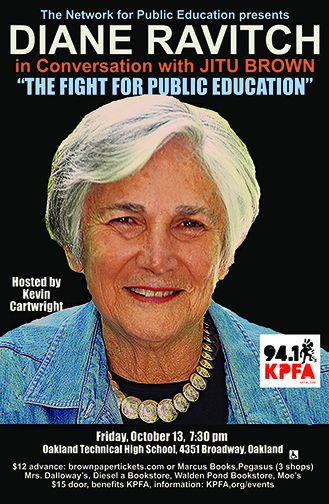
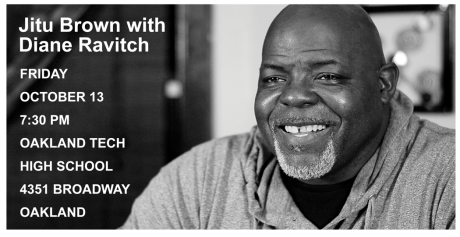
On Friday, October 13, join The Network for Public Education Action and KPFA radio for a critical conversation between Network for Public Education (NPE) President, Diane Ravitch and Network for Public Education (NPE) Action Board Member, Jitu Brown.

Diane Ravitch is the author of eleven books on education, including the best-selling Death and Life of the Great American School System, which sparked national resistance to corporate and market-based education “reform.” In addition to serving as President of NPE and NPE Action, Diane is a Research Professor at New York University and a historian of education.

Jitu Brown is a long-time community organizer born on Chicago’s south side. He is a product of Chicago’s public school system and a proud parent and husband. Jitu started volunteering for the Kenwood Oakland Community Organization (KOCO), the oldest black-led organizing community based organization in Chicago in 1991.

In his role as National Director for J4J, he leads an alliance of grassroots community, youth, and parent-led organizations in 23 cities across the country that demand community-driven alternatives to the privatization of and dismantling of public school systems. He has brought great energy and focus to the connection between the attacks on public education and the disempowerment of African American communities all across the country.

He was one of 12 parents, grandparents and community members who put their bodies on the line in a 34-day long hunger strike to save Walter H. Dyett High School in Chicago, the last open enrollment High School in the historic Bronzeville community.

Jitu and Diane will discuss U.S. Education Secretary Betsy DeVos’ continued attempt to dismantle and corporatize America’s public education system and the #WeChoose campaign, a national coalition composed of powerful education justice organizations. The #WeChoose campaign includes: Network for Public Education, BadAss Teachers Association, Alliance to Reclaim Our Schools, The Advancement Project, the Education Justice Network, Alliance for Education, Annenberg Institute for School Reform at Brown University, Dignity in Schools, Save Our Schools, Institute for Democratic Education in America and Journey for Justice Alliance, whose combined membership represents millions of Americans. Campaign members are joining forces to hold Congress and the Administration accountable in the upcoming education budget hearings.

Ravitch+Brown in Oakland-2

Picture1

In Virginia, the governor’s race will determine the future of public schools in the Commonwealth. Teachers unions are supporting Dr. Northam, who is currently Lt. Governor and also a pediatrician. Dr. Northam is a graduate of public schools in Virginia. The unions spend their members’ dues, the dues of people who work in classrooms daily. The billionaire DeVos family has spent money for Gillespie, a Republican operative and lobbyist with no experience in education or elected office.

“The Democratic Candidate Dr. Ralph Northam is a strong supporter of public schools. His opponent Ed Gillespie wants to introduce school choice with privately managed charters and public funding of religious schools.

“The outcome of Virginia’s race for governor, the country’s marquee statewide election this year, will have widespread significance for the state’s roughly 1.29 million schoolchildren, political observers and education experts say.

“The governor’s race matters a whole lot for what public education will look like in Virginia in the days ahead,” said Sally Hudson, an assistant professor of public policy, education and economics at the University of Virginia.

“The contest pits Republican Ed Gillespie, who has received more than $100,000 in donations from the family of U.S. Education Secretary Betsy DeVos, against Democrat Ralph Northam, who has accepted at least $465,000 from teachers unions.

“Gillespie and Northam both want to boost teacher pay — Virginia ranks 32nd in the nation in that category — support more workforce training and rework the state’s Standards of Learning tests, a measure for school accountability and student achievement.

“But they diverge sharply when it comes to public charter schools and using tax dollars to help parents pay tuition at private schools.

“Gillespie wants to expand the state’s charter schools beyond the eight in operation. As a state senator Northam voted against loosening restrictions that govern the establishment of charter schools, and as a candidate for governor he has advocated investing in traditional public schools.”

When Betsy DeVos says she wants to leave decisions to the states, she forgets to mention that she is trying to buy control of States that have not yet turned red.

The good news: Dr. Northam is leading in the polls. Virginia parents are alert to the threat to their public schools.

Mercedes Schneider was interviewed for the documentary “Backpack Full of Cash.” At the time, the filmmakers did not have a title, and they called it “School Reform.” At their request, Mercedes signed a release to allow them to use her words and image in the film. The form is enclosed.

The filmmakers interviewed many other people, including Jeanne Allen, the director of the Center for Education Reform, which is virulently opposed to public schools. Before Jeanne founded the CER to advocate for choice, she worked for the far-right Heritage Foundation. She was among the first of the privatizers who saw the value of using the word “Reform” instead of the Center to Destroy Public zschools.

Allen didn’t like the documentary at all, because it did not praise her efforts to privatize public funding. She also doesn’t like that the filmmakers used her words, quite literally, as the title of the film.

Strangest of all is her complaint that the privatizers are vastly outspent by the unions. She says,

“The teachers unions spend $300 million a year on political races. We don’t have that kind of money.”

Bring out the world’s smallest violin.

The privatization movement is funded by a pack of multibillionaires, any one of which could outspend the unions.

Start with the Waltons, whose net worth is near $50 Billion. Aside from their contributions to political campaigns, they currently are spending $200 Million a year to open new charter schools. Then there is Billionaire Reed Hastings, who recently dropped about $5 Million into the Los Angeles school board race. Then there are Democrats for Education zreform, which pools the money of scores of hedge fund managers. Add billionaire Daniel Loeb, billionaire John Paulson, billionaire Eli Broad, billionaire Joel Greenlight, billionaire Michael Bloomberg, bilionaire Daniel Tepper, billionaire Rex Sinquefield, billionaire Betsy DeVos, billionaire Bill Gates, billionaire Philip Anschutz, billionaire Jonathan Sackler, billionaire JOHN Arnold, and many many more, all of whom have contributed to political campaigns to expand and benefit the privatization movement.

Teachers unions collect money from the dues of their underpaid members. They have skin in the game. Why are billionaires so passionate about defunding public schools?

A reader looked over the list of contributors to the Center for Education Reform. No teachers union has this many rich people contributing to its coffers.

The Achelis and Bodman Foundations
The Anschutz Foundation
The Apgar Foundation
The Laura and John Arnold Foundation
Mr. and Mrs. Dennis Bakke
Mr. Tim Barton
Mr. Brian Bauer
The Honorable and Mrs. Frank Baxter
The BelleJAR Foundation
The Blackie Foundation
The Bonsal Family
Ms. Katherine Brittain Bradley
The Lynde and Harry Bradley Foundation
The Broad Foundation
Mr. Eric Brooks
Mr. S. Joseph Bruno and Building Hope
Mr. Kevin Chavous
Ms. Kara Cheseby
The Ravenel and Elizabeth Curry Foundation
The Daniels Fund
Mr. Angus Davis
Mr. Kenneth Davis
Mr. and Mrs. Robert Devereux
Mr. Philip H. Dietrich
The Honorable and Mrs. Pete DuPont
Mr. and Mrs. Terry Eakin III
Mr. John C. Eason
Mr. William S. Edgerly
The Doris and Donald Fisher Fund
Mr. and Mrs. John Fisher
Mrs. Maureen Foulke
Mr. Robert W. Garthwait
Mr. Randy P. Gaschler
The Bill and Melinda Gates Foundation
Mr. Philip E. Geiger
The Gleason Family Foundation
Dr. Charles J. Gorman
Mr. Jon Hage
Mr. John P. Hansel
Admiral Thomas B. Hayward
The Honorable Thomas J. Healey
The Shirley and Barnett Helzberg Foundation
The Christopher and Adrianna Henkels Charitable Fund
Mr. Donald Hense
Mr. Robert M. Howitt
Ms. Virginia James
Bob and Lynn Johnston
The Dodge Jones Foundation
Mr. William I. Jones
Mr. Melvin J. Kaplan
Mr. Robert D. Kennedy
The Kern Foundation
Mr. Norman V. Kinsey
Mr. Steven Klinsky
The Jean and E. Floyd Kvamme Foundation
Mr. Byron S. Lamm
Mr. Bob Luddy
Mrs. Maryann Mathile
Mr. Thomas McNamara
Mr. Anthony Meyer
The L & S Milken Family Foundation
Greg and Pam Miller
Mr. Michael Moe
Mr. and Mrs. Owen Moen
Mr. and Mrs. Stephen Moore
Mr. Gene E. Nicholson
Mr. and Mrs. Bill Oberndorf
Mr. Dennis Odle
Dr. Vivian Pan
Mr. and Mrs. Malcolm Peabody
The Ruth and Lovett Peters Foundation
The Pumpkin Foundation
The Honorable William J. Raggio
Mr. James S. Regan
Ms. Janice B. Riddell
Mr. Geoffrey Rosenberger, CFA
SABIS Educational Systems, Inc.
Michael and Ellen Sandler
Mr. Daniel P. Schmidt
Mr. Adam Shapiro
Mr. and Mrs. Stephen Sills
The William E. Simon Foundation
Ms. Shirley Sontheimer
The Smart Family Foundation
The Honorable H. Cooper Snyder
Mr. and Mrs. William B. Snyder
Mr. John R. Stambaugh
The John Templeton Foundation
Mr. Whitney Tilson
The Walton Family Foundation
Mr. Robert M. Weekley
The Honorable and Mrs. Ronald Weiser
Mr. Helmut Weymar
Mr. Chris Whittle
Jeff and Janine Yass
Ms. Marykay Zimbrick

And Jeanne Allen complains that her side is outspent by the teachers union!

Cry me a river!

How about a deal: Her side agrees to spend not a penny more than the teachers unions on political campaigns and advocacy?

Deal?

Since Facebook blocked Steven Singer’s post “School Choice Is a Lie,” some readers have posted it on their own Facebook pages. Facebook told Singer that his post violated “community standards.” What that community is and what those standards are was not explained.

Michael Elliott, filmmaker and public school activist, posted it at his FB page, shoot4education.

I hope you will do the same.

The algorithms can’t stop crowdsourcing.