Archives for category: Safety

The Trace, a publication devoted to stopping gun violence, assessed the Supreme Court decision striking down restrictions on gun ownership in New York. The law that was overturned has been in place for over 100 years. One thing this ruling proves: this Court doesn’t care about public safety. Despite numerous gun deaths and massacres, despite Buffalo and Uvalde, the Court relaxes restrictions on carrying guns in public. This is a Court that does not care about precedent, social stability, human life, or public safety. It will use any rationalization available to justify its extremist opinions. It is “originalist” when that suits its purposes. But not really originalist because if it were, Amy Coney Barrett and Clarence Thomas would resign at once. Neither qualify to serve on the Court or even to vote by the terms of the original Constitution.

The Trace reported:

In a landmark decision, the Supreme Court struck down New York’s restrictive firearms licensing law, a decision that could transform gun ownership in New York City and affect at least five other states with similar regulations. In a 6-3 ruling, the court’s conservative majority endorsed, for the first time, a constitutional right to carry a gun in self-defense outside the home.

New York State Rifle & Pistol Association v. Bruen is the Supreme Court’s first major Second Amendment ruling since 2010, when the Court struck down Chicago’s handgun ban. Writing for the majority, conservative Justice Clarence Thomas said Americans have a two-part right to “keep” guns in their homes and “bear” them in public.

“This definition of ‘bear’ naturally encompasses public carry,” Thomas wrote. “Most gun owners do not wear a holstered pistol at their hip in their bedroom or while sitting at the dinner table.”

The scope of the decision had been anticipated following the leak in May of a draft opinion voiding federal abortion protections. Legal experts told us at the time that the apparent sidestepping of precedent in that draft document, Dobbs v. Jackson Women’s Health Organization, could signal a similarly wide ruling in Bruen. The court did not go as far as calling into question all licensing schemes, including the 43 states that have “shall-issue” permitting laws, but it did leave the door open for potential challenges.

“Because these licensing regimes do not require applicants to show an atypical need for armed self-defense, they do not necessarily prevent ‘law-abiding, responsible citizens’ from exercising their Second Amendment right to public carry,” Thomas wrote.

“It’s going to have huge impacts because the court changed the entire standard for evaluating Second Amendment claims,” said Jake Charles, the executive director of the Duke Center for Firearms Law. “It’s much broader than I was expecting it to be.”

The decision also rewrites the methodology federal courts use when deciding Second Amendment cases. Since 2008’s District of Columbia v. Heller, which established that the Second Amendment includes the right to bear arms in the home, lower courts judging contested firearms legislation have considered whether a particular law furthers the government’s interests in things like reducing crime in addition to historical precedent.

Please open the link and read the rest.

The U.S. Supreme Court struck downNew York’s century-old concealed-carry gun law Thursday, removing restrictions on carrying guns in public and delivering a win to gun enthusiasts. The 6-3 ruling, which has been anticipated in the conservative-leaning court, makes it harder for officials to prevent civilians from carrying firearms in public without a permit by striking down New York’s rule that prospective gun-toters have “proper cause” to carry a weapon.

New York has long had separate measures in place to grant gun ownership for the home and for concealed carry in public.

The state’s top officials vowed to regroup and enact new measures to shore up New York’s gun control laws after the ruling Thursday, which kicks some decision-making back to a lower court and opens up new potential room for states to define “sensitive locations” where they will prohibit guns, like schools, courts, and, perhaps, subways, sports venues, and beyond.

Governor Kathy Hochul, Senate Majority Leader Andrea Stewart-Cousins, and Assembly Speaker Carl Heastie, all Democrats, vowed to return to Albany to pass additional legislation. “I’m prepared to call the Legislature back into session to deal with this. We’ve been in contact with the leadership. We’re just looking at dates,” Hochul said.

Lawmakers are looking at ways to strengthen existing permitting requirements, enable private businesses to ban guns, and increase the number of areas deemed “sensitive locations,” where the Court left the carve-out for restricting guns. Hochul signed Alyssa’s LawThursday, requiring schools to consider installing silent panic alarms as part of their security systems following the mass shooting in a Texas elementary school last month.

The New York City Council will hold an oversight hearing on “access to firearms” on Friday — Council Speaker Adrienne Adams and Council members on Thursday called on the state to make virtually all of New York City a sensitive location to prohibit concealed carry in the five boroughs.

Attorney General Letitia James and a number of prosecutors around the state, including in New York City, vowed to examine the ruling and look for ways to limit the dangers of guns proliferating in public.

Mayor Eric Adams said the city was reviewing its definition of “sensitive locations, and the city’s own gun license application process in light of the ruling. “Put simply, this Supreme Court ruling will put New Yorkers at further risk of gun violence,” the mayor said in a statement.

Ken Paxton is State Attorney General in Texas and as such is the state’s top law enforcement official.

On the day after the massacre of 19 children and two teachers in Uvalde, he said that “God always has a plan.” This is a variation on “thoughts and prayers.”

Paxton opposes gun control.

Karen Tumulty of the Washington Post wrote:

When thoughts and prayers seem inadequate in the wake of a tragedy, you can always blame God for what happened.

That would seem to be how Texas Attorney General Ken Paxton (R) sees it after a mass shooting at an elementary school in Uvalde, Tex., took the lives of 19 children and two of their teachers. The carnage came just 10 days after a gunman with allegedly racist motives mowed down 10 shoppers and employees — all of them Black — in a Buffalo supermarket.

In a podcast interview recorded the day after the May 24 shooting at Robb Elementary School and unearthed last week by Salon, Paxton was asked by North Texas pastor Trey Graham what he might say to the victims’ families.

“I’d have to say, look, there’s always a plan. I believe God always has a plan,” the attorney general replied. “Life is short no matter what it is.”
It was all in God’s plan. That’s a suggestion we often hear from pious, well-meaning people when other words fail in the face of an unspeakable, inexplicable tragedy. The idea is that some day we will all understand that larger purpose of our suffering. It is meant to be a balm.

But those words sound more like a shrug when an elected leader — and in this case, one who is his state’s top law enforcement officer — offers that as an explanation for a horror that was preventable and exacerbated by human error. Worse, it is a dereliction of responsibility and of the imperative to do something to prevent something like this from happening again, as it has happened over and over.

In a new ruling, the Supreme Court struck down a New York State law that limited access to guns. The New York law requires that people seeking to carry a handgun outside their homes must obtain a permit and show “proper cause.” There are similar laws in California, Hawaii, Maryland, Massachusetts, New Jersey and Rhode Island.

To those who claimed in 2016 that it didn’t matter if Trump was elected, this is what Trump’s three appointees to the Supreme Court have done: required Maine to pay for discriminatory born-again religious schools; overturned gun controls in New York; and will probably overturn Roe v Wade in the next few days. Elections have consequences. The lesser of two evils is always preferable to Pure Evil. A candidate who is good but not perfect is preferable to one who is ignorant and bigoted.

The Washington Post reports:

The Supreme Court said Thursday that Americans generally have a right to carry a handgun outside the home for self-defense and that a New York law requiring special need for such a permit is too restrictive.


The vote was 6 to 3, with Justice Clarence Thomas writing for the majority and the court’s three liberals in dissent.


“The Second and Fourteenth Amendments protect an individual’s right to carry a handgun for self-defense outside the home,” Thomas wrote, saying New York’s requirement of a specific need to carry a weapon violates that right.

“The constitutional right to bear arms in public for self-defense is not ‘a second-class right, subject to an entirely different body of rules than the other Bill of Rights guarantees.’ ” Thomas wrote, referring to a previous Supreme Court ruling. “We know of no other constitutional right that an individual may exercise only after demonstrating to government officers some special need.”


He was joined by the court’s conservatives: Chief Justice John G. Roberts Jr. and Justices Samuel A. Alito Jr., Neil M. Gorsuch, Brett M. Kavanaugh and Amy Coney Barrett.


In dissent, Justice Stephen G. Breyer pointed to the nearly 300 mass shootings since January and to data showing that gun violence has surpassed car crashes as the leading cause of death among children and teens. The majority’s decision, he said, will make it more difficult for state lawmakers to take steps to limit the dangers of gun violence.
The Second Amendment allows states to “take account of the serious problems posed by gun violence,” wrote Breyer, who was joined by Justices Sonia Sotomayor and Elena Kagan. He added: “Many States have tried to address some of the dangers of gun violence … by passing laws that limit, in various ways, who may purchase, carry, or use firearms of different kinds. The Court today severely burdens States’ efforts to do so.”

The party that claims to be “right to life” authorizes easier access to weapons of death. More people will die because this ruling. Under this court, the only protected class is the pre-born or the unborn. The born are in big trouble.

Drip by drip, we are learning the facts about what happened in the Robb Elementary School in Uvalde when a killer barged in. He could have been stopped. Lives could have been saved. But the incompetence of the police leadership caused an unconscionable delay in stopping the killer. Well-established protocols were ignored (stop the shooter asap, even if you don’t have enough men or equipment, stop the killer). As it happened, the police in Uvalde had more men than they needed and all the equipment they needed to stop the killer. But they didn’t.

The head of the state police called the response an abject failure. The pokice had shields and weapons. They did not need a key. They stood around and waited for 77 minutes.

AUSTIN, Texas — The head of the Texas State Police offered a pointed and emphatic rebuke of the police response to a shooting last month at Robb Elementary School in Uvalde, Texas, calling it “an abject failure” that ran counter to decades of training.

In his comments before a special State Senate committee in Austin, Steven McCraw, the director of the Department of Public Safety, said that just minutes after a gunman began shooting children inside a pair of connected classrooms on May 24, the police at the scene had enough firepower and protective equipment to storm the classroom.

But, he said, the on-scene commander “decided to put the lives of officers ahead of the lives of children.” Mr. McCraw, speaking forcefully, said the same commander had delayed confronting the gunman because he “waited for a key that was never needed.”

Mr. McCraw said that the doors to the classrooms could be locked only from the outside. “There’s no way to lock the door from the inside. And there’s no way for the subject to lock the door from the inside,” he said, adding that a teacher had made a request for the locks to be fixed, believing they were broken, before the shooting.

“I don’t believe, based on the information that we have right now, that that door was ever secured,” Mr. McCraw said. “The door was unsecured.”

There were so many police officers present that no one knew who was in charge. It turns out that no one was in charge.

This is an instance where the planning was wholly inadequate.

100+ men with guns were unable to stop one bad guy with a gun.

They had the guns, the shields, and overwhelming force. And for 77 minutes, they stood by.

The Texas Tribune, an independent journal, has been first to report on the news about the Uvalde massacre. In this story, there are new revelations based on video footage from inside the school.

Some of our takeaways include:

  • The records show a well-equipped group of officers entered the school almost immediately. They pulled back once the shooter began firing inside the classroom. They waited for more than an hour to reengage.
  • There is no security footage that shows police officers attempted to open the classroom doors that the shooter hid behind. Law enforcement officials are skeptical, the Tribune has confirmed, that the doors were locked or that anyone physically tried to open them.
  • At least some officers on the scene seemed to believe that Arredondo was in charge inside the school, and at times Arredondo seemed to be issuing orders. That contradicts Arredondo’s assertion that he did not believe he was running the law enforcement response…

The officers in the hallway of Robb Elementary wanted to get inside classrooms 111 and 112 — immediately. One officer’s daughter was inside. Another officer had gotten a call from his wife, a teacher, who told him she was bleeding to death.

Two closed doors and a wall stood between them and an 18-year-old with an AR-15 who had opened fire on children and teachers inside the connected classrooms. A Halligan bar — an ax-like forcible-entry tool used by firefighters to get through locked doors — was available. Ballistic shields were arriving on the scene. So was plenty of firepower, including at least two rifles. Some officers were itching to move.

One such officer, a special agent at the Texas Department of Public Safety, had arrived around 20 minutes after the shooting started. He immediately asked: Are there still kids in the classrooms?

“If there is, then they just need to go in,” the agent said.

Another officer answered, “It is unknown at this time.”

The agent shot back, “Y’all don’t know if there’s kids in there?” He added, “If there’s kids in there we need to go in there.”

“Whoever is in charge will determine that,” came the reply.

Michael Hiltzik shows that California’s strict gun laws have reduced gun deaths, although their biggest foe is the federal judiciary, especially Trump-appointed judges.

The most predictable response by the gun lobby and its political mouthpieces to calls for stricter gun laws in the wake of mass shootings is that tough laws don’t work.

You’ve probably heard all the arguments: That we already have tough laws on the books, that the problem is they aren’t enforced. Or that the legislation most often proposed wouldn’t have stopped the latest perpetrator of the latest gun-related horror, such as Uvalde gunman Salvador Ramos.

None of that is true, and California, which has some of the strictest gun laws in the nation, is the proof.

As we’ve reported before, statistics from the Centers for Disease Control and Prevention show that overall firearm deaths in California, at 8.5 per 100,000 population in 2020, easily bests the rates in states with lax controls, such as Texas (14.2 per 100,000) and Louisiana (26.3).

The disparity is especially sharp when it comes to firearm deaths of those under 18. California’s rate is about half that of the national average, less than half that of Texas, and only about one-fourth that of Louisiana. 

ADVERTISING

null

It’s true that California has not been immune from the national epidemic of mass shootings. But its laws have had a measurable, positive impact. “California has not solved the problem of mass shootings,” says Ari Freilich, state policy director at the gun safety organization Giffords. “But California children are half as likely to be shot.” 

Let’s examine the key elements of California’s laws, and how they might have interfered with the latest major gun-related outrages — the killings of 19 children and two adults at Robb Elementary School in Uvalde, Texas, on May 24, and the killings of 10 people at a supermarket in Buffalo, N.Y., on May 14.

California’s firearms regulations are among the most comprehensive in America. Assault weapons, defined partially by their manufacturer and partially by their features, have been banned since 1989. Purchasers of any firearm must do so through a registered dealer and submit to a background checkammunition sales are also regulated.

Handguns can’t be sold to anyone under 21, and with certain exceptions to transfer other firearms to anyone under 18. All purchases require a waiting period of at least 10 days, or more if certain formalities haven’t been completed, such as a firearm safety course and passage of a test. Most are barred from buying more than one gun a month.

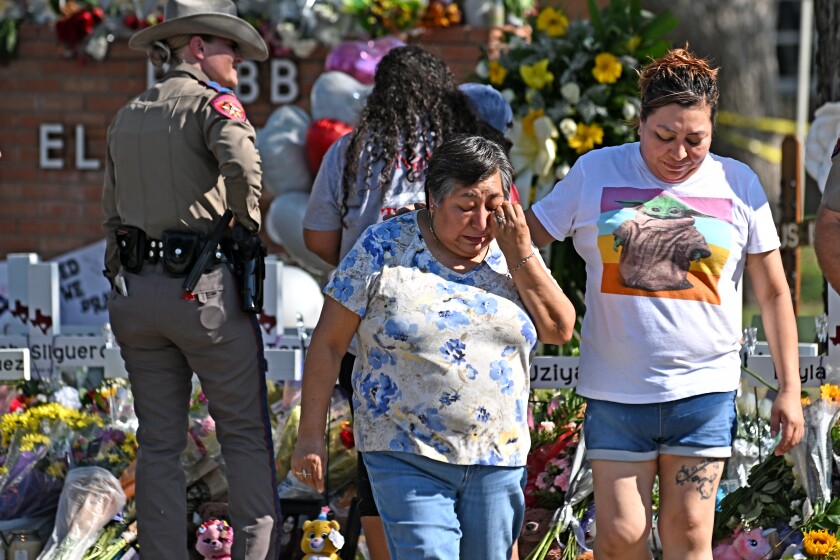
Uvalde, Texas May 26, 2022- Family members walk away after living flowers at a memorial outside Rob Elementary School in Uvalde, Texas. Nineteen students and two teachers died when a gunman opened fire in a classroom Tuesday. (Wally Skalij/Los Angeles Times)

BUSINESS

Column: Uvalde demonstrates our cowardice about guns

June 1, 2022

ADVERTISEMENT

null

Open carry of loaded firearms is generally prohibited, as is concealed carry of a loaded weapon without a license.

California also has a so-called red flag law, or “extreme risk protection orders,” which allow family members, police, employers or school personnel to alert authorities to signs of danger from a person and for a judge to order the confiscation of weapons from that person.

The California constitution has no provision protecting the right to bear arms. State law preempts all local initiatives.

One of the bizarre omissions in the bipartisan deal on gun control was the failure to raise the age to buy an assault weapon from 18 to 21. It is incomprehensible.

The Washington Post reported on studies that catalogue the sex and age of mass shooters. The killers are almost entirely male, and a large percentage are under 21. This leads the author of the study to propose raising the minimum age for buying a weapon to 21. Curiously, there is already a federal law banning the sale of handguns to anyone under 21, but no law banning the sale of long guns for that age. So the killer in Texas could legally buy two AR15s on his 18th birthday, but was not able to buy a handgun.

When Vanderbilt University psychiatrist Jonathan Metzl learned that the perpetrator of the Uvalde, Tex., school massacre was a young man barely out of adolescence, it was hard not to think about the peculiarities of the maturing male brain.


Salvador Rolando Ramos had just turned 18, eerily close in age to Nikolas Cruz, who had been 19 when he shot up a school in Parkland, Fla. And to Adam Lanza, 20, when he did the same in Newtown, Conn. To Seung-Hui Cho, 23, at Virginia Tech. And to Eric Harris, 18, and Dylan Klebold, 17, in Columbine, Colo.


Teen and young adult males have long stood out from other subgroups for their impulsive behavior. They are far more reckless and prone to violence than their counterparts in other age groups, and their leading causes of death include fights, accidents, driving too fast, or, as Metzl put it, “other impulsive kinds of acts.”

“There’s a lot of research about how their brains are not fully developed in terms of regulation,” he said. Perhaps most significantly, studies show, the prefrontal cortex, which is critical to understanding the consequences of one’s actions and controlling impulses, does not fully develop until about age 25. In that context, Metzl said, a shooting “certainly feels like another kind of performance of young masculinity.”


In coming weeks and months, investigators will dissect Ramos’s life to try to figure out what led him to that horrific moment at 11:40 a.m. Tuesday, May 24 when he opened fire on a classroom full of 9- and-10-year-olds at Robb Elementary School.

Although clear answers are unlikely, the patterns that have emerged about mass shooters in the growing databases, school reports, medical notes and interview transcripts show a disturbing confluence between angry young men, easy access to weapons and reinforcement of violence by social media.

Federal law requires people buying handguns from licensed dealers to be at least 21. But in Texas and in most other states, 18-year-olds can purchase what are known as long guns, which include assault rifles. In a prime-time address Thursday night, President Biden called for banning assault weapons but said that, if that’s not possible, lawmakers should raise the age to purchase such a weapon to 21. “The issue we face is one of conscience and common sense,” the president said.

In the wake of the 2018 Parkland shooting and other violent acts by young men, six states, including Florida, did raise the purchasing age for long guns to 21, over the objections of the National Rifle Association. The NRA calls such restrictions a “categorical burden” on the right to keep and bear arms, while Florida state attorneys argue that because “18-to-20-year-olds are uniquely likely to engage in impulsive, emotional, and risky behaviors that offer immediate or short-term rewards, drawing the line for legal purchase of firearms at 21 is a reasonable method of addressing the Legislature’s public safety concerns…”

“Age is the untold story of all this stuff,” said Metzl, who is also a sociologist. “I feel very strongly we should not have people 18 to 21 with guns.”

The United States is one of the only countries in the world where mass public shootings are a regular occurrence. Researchers Jillian Peterson from Hamline University and James Densley from Metropolitan State University, both in St. Paul, Minn., have spent their careers tracking these events, and their research shows that attacks are overwhelmingly carried out by men whose ages are strikingly clustered around two key periods in their lives.

Workplace attacks have been mostly carried out by men in middle age. School shootings, on the other hand, involve perpetrators mostly in their late teens or early 20s. Men in these same two age groups, Peterson points out, also have higher rates of suicide largely using firearms.

A Washington Post analysis of 196 mass public shootings in which four or more people were killed since 1966 shows that nearly 98 percent, or all but five, of the perpetrators were men. Forty percent of the shooters were between the ages of 18 and 29 and another third were between 30 and 45.

Based on statistics, I’d say that the best way to protect the public is to ban the sale of assault weapons and all other automatic or semi-automatic weapons. All such weapons now in private hands should be bought back and either destroyed or sent to Ukraine.

After the massacre at Marjory Stoneman Douglas High School in Parkland, Florida, the state passed a series of gun control measures. The new state leadership wants to loosen those laws. The incoming leader of the Florida House of Representatives wants to pass a state constitutional amendment guaranteeing the right to carry a gun openly, without a permit.

The Miami Herald reported:

Incoming Florida House Speaker Paul Renner told a supporter his chamber would move a “constitutional carry” policy for gun owners in Florida in the next legislative session, according to a video surreptitiously recorded at a fundraising event last month and posted online.

In the video, which was filmed at a House GOP fundraising event in Ocala on May 17, a man pulls Renner aside and asks if expanding the right for Floridians to carry guns without permits would be a legislative priority.

“I can tell you, we’ll do it in the House,” Renner tells the man. “We need to work on the Senate a little bit…”

“The issue on constitutional carry is whether government should be playing a role in saying whether you can or can’t carry outside the home when you meet the basic requirements of being able to pass a background check,” he said.

In April, Gov. Ron DeSantis promised to deliver a bill allowing permitless carry before his time as governor was through. The support of Renner, who leads one of Florida’s two legislative bodies, would mean the policy would have significant momentum next legislative session.

Current Florida law requires handgun owners to obtain a license to carry their weapons in most public places. Open carry of weapons is mostly prohibited: Florida’s licenses only allow gun owners to carry guns concealed on their person. In order to get a concealed carry permit, a handgun owner has to take a training class that includes instruction involving the live firing of a loaded gun.

In other states, “constitutional carry” has allowed gun owners to carry their weapon without a permit — and thus without going through that training. Supporters call the policy “constitutional carry” because they argue the Second Amendment’s guarantee of the right to bear arms means Americans should be able to carry without the regulatory burden of obtaining a permit.

Read more at: https://www.miamiherald.com/news/politics-government/state-politics/article262354382.html#storylink=cpy

Until recently, teachers in Ohio were allowed to carry weapons to school but they had to take the same 700 hours of instruction as peace officers in the state.

The New York Times reported that a new Ohio law allows teachers to carry weapons with no more than 24 hours of training.

Teachers and other school employees in Ohio will be able to carry firearms into school with a tiny fraction of the training that has been required since last year, after Gov. Mike DeWine signed a bill into law on Monday.

While employees have for years been allowed to carry guns on school grounds with the consent of the local school board, the Ohio Supreme Court ruled in 2021 that state law required them to first undergo the same basic peace officer training as law enforcement officials or security officers who carry firearms on campus — entailing more than 700 hours of instruction.

That ruling, Mr. DeWine said on Monday, had made it largely impractical for Ohio school districts to allow staffers to carry firearms.

Under the new law, a maximum of 24 hours of training will be enough for teachers to carry guns at school, though the local board will still need to give its approval. Twenty-eight states allow people other than security personnel to carry firearms on school grounds, with laws in nine of those states explicitly mentioning school employees, according to the National Conference of State Legislatures. Polls in recent years show that a majority of Americans, and a large majority of teachers, oppose the idea of arming teachers…

The governor emphasized that local school districts would still have the ability to prohibit firearms on school campuses. “This does not require any school to arm teachers or staff,” he said. “Every school will make its own decision.”

Last week, Justin Bibb, the mayor of Cleveland, said his city would continue to ban teachers and other non-security employees from carrying guns in schools.

Ohio’s new law, which moved suddenly and swiftly through the State Senate after the school shooting in Uvalde, Texas, passed on June 1 along roughly partisan lines, with two Republicans joining all Democrats in voting against it. The bill passed the House in November, also on a nearly party-line vote; one Republican joined the Democrats in voting against it.

In a speech on the Senate floor, State Senator Niraj Antani, a Republican, dismissed the “crocodile tears” of lawmakers who saw the bill as dangerous, arguing that armed teachers would deter school shootings and calling the bill “probably the most important thing we have done to prevent a school shooter in Ohio.”

A sizable opposition against the bill had grown against it during its journey through the Legislature. Hundreds packed into committee rooms for the bill’s hearings, with all but two or three speakers testifying against it. The opposition included gun control groups as well as teachers, school board members, police union representatives and police chiefs.

Robert Meader, who recently retired as commander of the Columbus, Ohio, Division of Police, called the training requirement in the bill “woefully inadequate,” arguing that it would “cause harmful accidents and potentially even needless deaths.”

The bill is the second major gun bill that Mr. DeWine, a Republican, has signed into law this year. The first, which went into effect on Monday, eliminates the requirement for a license to carry a concealed handgun.

Imagine this: a school shooter enters the building armed with an automatic assault weapon. Will teachers have equally powerful weapons? How terrifying will school be if teachers are carrying assault weapons? Terrifying not only for students, but for teachers and administrators.