Archives for category: Resistance

The National Grange, which represents rural communities across America, released this resolution. The Grange moves deliberately and thoughtfully before it takes a position. Its resolutions are initiated locally, then reviewed at the state and national levels before adoption.

The resolution says:


WHEREAS, our nation’s future well-being relies on a high-quality public education system that prepares all students for college, careers, citizenship and lifelong learning, and strengthens the nation’s social and economic well-being; and

WHEREAS, our nation’s school systems have been spending growing amounts of time, money and energy on high-stakes standardized testing, in which student performance on standardized tests is used to make major decisions affecting individual students, educators and schools; and

WHEREAS, the over-reliance on high-stakes standardized testing in state and federal accountability systems is undermining educational quality and equity in U.S. public schools by hampering educators’ efforts to focus on the broad range of learning experiences that promote the innovation, creativity, problem solving, collaboration, communication, critical thinking and deep subject-matter knowledge that will allow students to thrive in democracy and an increasingly global society and economy; and

WHEREAS, it is widely recognized that standardized testing is an inadequate and often unreliable measure of both student learning and educator effectiveness; and

WHEREAS, the over-emphasis on standardized testing has caused considerable collateral damage in too many schools, including narrowing the curriculum, teaching to the test, reducing love of learning, pushing students out of school, driving excellent teachers out of the profession and undermining school climate; and

WHEREAS, high-stakes standardized testing has negative effects for students from all backgrounds, and especially for low-income students, English language learners, children of color, and those with disabilities; and

WHEREAS, the culture and structure of the systems in which students learn must change in order to foster engaging school experiences that promote joy in learning, depth of thought and breadth of knowledge for students; therefore be it

RESOLVED, that the National Grange lobby the U.S. Congress and administration to overhaul the Elementary and Secondary Education Act (currently known as the “Every Child Succeeds Act”), reduce the testing mandates, promote multiple forms of evidence of student learning and school quality in accountability, and not mandate any fixed role for the use of student test scores in evaluating educators.

You will enjoy reading this interview with parent activist Kemala Karmen. She grew up in Louisiana in a family of activists, experienced racial discrimination, and now lives in New York City, where she is active in the Opt Out movement and works with film maker Michael Elliott.

How do we start a revolution and change education for the better for every student?

Start by learning from Kemala.

Join the Network for Public Education Action Fund in protest against public funding of private schools. Open the link. When you sign in, you can automatically send letters to your senators and members of Congress. You can write your own letter or send one that NPE Action has written. We make it easy for you to fight for public schools!

Please join us and speak up.

Having watched the non-debate about the GOP Tax bill in the Senate, having seen it rushed through without time for anyone to read what was in it, knowing that the bill is very harmful to education at every level, Peter Greene is depressed. Very depressed.

Maybe it’s time to throw in the towel and accept a two-tier system of schools: one for the fortunate and affluent, another for the kids who are going nowhere.

“So maybe we do need a two-tiered system of schools in this country. One tier for the wealthy, some nice private schools (complete with vouchers that give yet another kickback of tax dollars to the rich) that prepare them to be future leaders and well-off masters of the universe. And then another tier for those who had the misfortune to be poor and must be prepared to live on the bottom rungs of the ladder, because there is no hope in hell that they will ever get out. Oh, sure, a handful now and then will be found worthy, just to keep the fiction alive that we still have the prospect of upward mobility in this country (and always making sure to include a person or two of color so that it’s clear, you know, that we aren’t that racist). But mostly they will need the skills and training to survive in America’s basement, because if they’re born there, they will probably stay there, always living one health problem or bad accident away from financial ruin, never able to afford any education after high school, and condemned to a high school that is either an underfunded public school or a selective and possibly fraudulent charter school, established specifically to help them be more comfortable in their proper place (perhaps delivered through some half-assed software program that maintains their permanent personnel file for the convenience of their corporate overlords). Certainly this is what some people already envision; it’s what Betsy DeVos means when she suggests that students should be “allowed” to go to school in a place that’s the “best fit,” like a snotty rich girl in an 80s comedy looking down her nose at lower class children and saying, “Dear, wouldn’t you be happier somewhere with your own kind?””

Yeah, things look grim. And with these heartless soulless troglodytes in charges, things are grim.

But we can’t give up hope. We can’t stop fighting. We can’t abandon our ideals. We can’t let them win.

Think of all the times in history when evil was triumphant. Think of the tyrannies that had their day, but were eventually overturned. Resistance is hard but it will not be futile.

There are just a few weeks left in 2017. Then it is 2018, and we are on track for a new round of elections. Let’s begin to plan and start to fight. Let us not let evil Triumph. And above all, never lose hope because to lose hope is to lose everything. We neeed the will to fight for what we believe is right. We must start now.

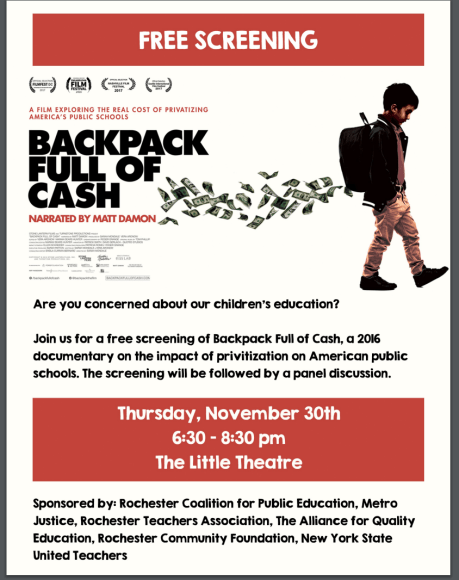
If you live anywhere near Rochester, New York, you will have the opportunity to see the amazing anti-privatization film, “Backpack Full of Cash.” Don’t miss it!

Screen Shot 2017-11-02 at 9.19.54 PM

Denisha Jones, a professor of early childhood education at Trinity Washington University, gave this talk at Sarah Lawrence College this past summer. Please read her talk in her entirety.

An excerpt:

I inspire my teachers—regardless of the label they give themselves—to be advocates or activists for their profession. I don’t want them to spend the next several years in survival mode until they burn out and leave the field altogether. Advocacy and activism serve as nourishment for the soul. They can sustain you even when things look bleak and the future is uncertain.

As I move forward, determined to protect public education as a right, what drives me is the acceptance of our failure. I am ready to declare our efforts, and the efforts of those who came before me, as failures. This may seem harsh, but as we know, failure is essential for success. “Failure is instructive,” John Dewey once said, “The person who really thinks learns quite as much from his failures as from his successes.”

We know that protecting children from the experience of failure is not good for their development. Failure can be a tool for learning how to get it right. Without failure, how do we know that we have even really succeeded? This doesn’t mean that education activists haven’t won some important battles. But they’ve tended to benefit one school or one community, and haven’t reached the national or state levels. Our attempts to stop the spread of the Global Education Reform Movement (GERM) have failed.

Before we examine our failures more closely, I want to quickly review what I mean by GERM so that we are all on the same page. Pasi Sahlberg notes that the movement emerged in the 1980s and consists of five global features: standardization; focus on core subjects; the search for low-risk ways to reach learning goals; use of corporate management models; and test-based accountability policies. Although none of these elements have been adopted in Finland, where he does most of his research, they have invaded public education in the U.S. and in other countries.

Here, education activists typically refer to GERM as the privatization of public education, driven by neoliberalism, which favors free-market capitalism. Under this scenario, there are no public schools: public services are turned over to the private sector. Healthcare, prisons, even water, are now being put in the hands of corporations, whose sole desire is to make a profit. When profit is the goal, the needs of human beings are discarded, unless they can generate a measurable return on investment.

We can see how GERM has infected U.S. education policy and reforms. The Common Core drives standardization and aligns with a narrow focus on math and literacy. The use of scripted learning programs, behavior training programs, and online learning is evidence of the search for low-risk ways to reach learning goals. While charter schools claim to be nonprofit, most are managed by companies with CEOs and CFOs who apply corporate models to education.

Teach for America and other fast-track teacher preparation programs also use a corporate model, developing education leaders who get their feet wet teaching before moving on to become policymakers or head up charter schools.

Pearson’s PARCC and the Smarter Balanced Assessment Consortium are drowning public education in test-based accountability. Systems that punish and reward schools and teachers based on student achievement on standardized tests are the norm today.

While the new Every Student Succeeds Act (ESSA) includes language that protects the right of parents to opt out—a movement that has been growing in recent years—it also maintains the requirement that 95 percent of students participate. Test-based accountability is here to stay and rapidly evolving into competency-based and personalized learning, in which assessments occur all day every day as students are glued to computer screens.

We have failed to stop the expansion of choice, which threatens the existence of public schools through the proliferation of charters and vouchers. In the U.S., most school-age children are educated in traditional public schools, but we can expect to see this trend reversed under the administration of Betsy DeVos. We have failed to stop the assault on public education through school closures in communities of color.

And then there’s the inexorable push down of developmentally inappropriate standards onto young children. The Common Core, adopted by most states, imposes expectations on young children that are out of step with their development, not to mention the research. Empirical data confirm that kindergarten is the new first grade, and preschool the new kindergarten.

On top of this, we have failed to stop racist school discipline practices that suspended 42% of black boys from preschool in the 2011-2012 academic year. This failure stems from our inability to address the systemic and institutional racism that is prominent in public education but often masked by teachers with good intentions who lack an understanding of culture, bias, and systems of oppression.

We must acknowledge these failures so we can understand the limits of our collective efforts and decide how we can refocus our energies toward a future that will lead to more successful outcomes. We need to change the narrative. Attacking the push for accountability and tougher standards has proven to be a losing strategy. Our insistence that these measures harm student development and learning has branded us unwilling to be held accountable for ensuring that all students can achieve.The more we resist test-based accountability and inappropriate reforms, the more we are seen by the corporations, policymakers, and privateers as resistant to innovation.

We must make the protection of childhood a nonpartisan issue. We need to revise our message. The assault on public education is not just a conservative attack by Republicans against progressive education. Democrats are also aligned with many aspects of GERM, including choice, privatization, and test-based accountability.
Watch this great video!!

Since Facebook blocked Steven Singer’s post “School Choice Is a Lie,” some readers have posted it on their own Facebook pages. Facebook told Singer that his post violated “community standards.” What that community is and what those standards are was not explained.

Michael Elliott, filmmaker and public school activist, posted it at his FB page, shoot4education.

I hope you will do the same.

The algorithms can’t stop crowdsourcing.

Kipp Dawson is a veteran teacher in Pittsburgh. She writes here about the new school year and the ongoing struggle to teach her students without idiotic programs foisted on her and her students. Kipp was a coal miner, and she knows the meaning of struggle.

She writes:

“Teachers and other front-line workers in our public schools are also on the front lines of some of the biggest battles in this country right now, as we are fighting alongside our children for their future. As school opens this fall, we can feel this, as we are torn between what we can already see and feel in their eyes and words of their potential and real lives and beauties and challenges, on the one hand, and what is required of us to do with and to them, on the other.

“As I begin what may become my last year in this particular relationship to these struggles, I feel a particular obligation both to do all I can with and for each of the marvelous souls and brains with whom I am blessed to spend our teaching/learning brains, and the communities they build together in our classroom, on the one hand, and simultaneously, with my amazing collesgues, to work to make our schools shrug off the ridiculousnesses politicians and their conduits who run many things put in the way.

“This is a Report from One of the Front Lines, #1 for 2017.

“Yesterday, three of my 12-year-old boy students presented personal narratives to their classmates. Two of them had been called out to do so by their peer reviewers who were stunned and impressed by their stories. These boys came from different neighborhoods with different skin hues, and each presented well-constructed, dialogue-filled, literary-devices-well-used (mainly similes and colloquialisms), narrative structure in place and well used. Each of their stories was about overcoming a personal challenge (one, learning to ride a bike; the other, overcoming a fear of rollarcoasters). Each stunned me with the skill both of the writing, and the presentation (hats off Ms. Greco, their 6th-grade teacher!). It was marvelous to see their classmates enjoy, and celebrate, their writing.

“Among their classmates was a third boy who had shared his story only (so far) with his peer reviewer, and with me. This child has the same skin hue as one of the above-mentioned presenters. (To put it right out there: to armed police, both would look like Tamir Rice or Trayvon Martin). This boy’s story was much more bare — no literary devices, sentence structure lacking a bit. He wrote of having been with his uncle when the uncle was shot, three times, in the back, as they left a store. His uncle died, he wrote, was revived, and then died again, forever. The end. Unlike the other two stories, there were no adjectives or adverbs or literary devices. But he felt he had a story to tell, and a safe place in which to tell it.

“These three boys were among their 100 or so 7th-grade peers who noisily left school for a three-day weekend when our last bell rang yesterday. These three boys were going into three different worlds. These three boys will be back in this classroom community, together, on Tuesday. They will spend a school year together in our classrooms. They (hopefully) will grow up and keep going out into different and same parts of this world. For this next few months, we have them, and we have so so much we/they/all of us can do to grow together.

“But.

“When that last bell rang, we who teach these boys, and all of their classmates, gathered our thoughts and papers, did some debriefing with colleagues or rushed out to be with families or simply collapsed at home with fatigue, beginning a weekend of downtime and the first weekend of organizing our time to meet the needs.

“Needs imposed on us by a “data-driven district” (aren’t they all, now?)

“Data.

“I am not alone in having in my home now, the stories and letters to me and daily check-ins of my approximately 85 new 7th graders, on the one hand, and the demands of a frenzied, trying-to-stay-afloat public school district which is translating that frenzy into increasingly onerous distracting, time-consuming, mis-focused (in my humble, professional/human opinion) demands on the workers, especially teachers. I will spend as much time as I can reading every word these new-to-me students wrote (or did not follow directions and left blank — equally important!) this first week of school. I will spend as much time as I can communicating with each/all of the new-to-me (with, of course, some returning via siblings) parents of these children, as these relationships are essential. I will be pulled from doing that by meeting the demands of administrations, some of which are understandable and helpful, and some of which drive me (almost) to despair.

“Test scores are our source of data. We are data driven. Therefore, our children, and their teachers, are judged, grouped, approached, by data, and test scores. Therefore these personal narratives become important mainly in how they will be rated on the rubrics which will turn into data when these children take their end-of-the-year tests. And now we are to take precious time out of our classrooms each day to put them in front of computers so the machines can judge their skills and give them individual, screen-and-keyboard-responses-only, assignments and evaluations. Every day. I am not ok with this. At all.

“If you have read this far, most likely you, also, are a school worker and/or parent. Most likely you, also, are pondering how to respond to the wonderfulnesses and alarm signals of your back-to-school days. Most likely, you are looking for ways to make things better for our children. Let’s do this together.”

More than 200 deans of education at scores of colleges and universities have organized to resist the corporate reformers’ efforts to deprofessionalize teaching and destroy public education. They call themselves Education Deans for Justice and Equity. They work in partnership with the National Education Policy Center. If you are a faculty member, please ask your dean to sign on. If you belong to an education organization, please consider adding its support.

“Dear Education Deans:

“As the start to a new academic year unfolds, so do increasing attacks on public education. Building on the “Declaration of Principles” that was released in January of this year and signed by 235 education deans, many of us feel compelled to continue to speak out collectively, publicly, and forcefully.

“Towards this end, we have prepared a new statement from education deans, “Our Children Deserve Better,” that counters the harmful rhetoric and actions currently coming from Washington with alternatives that are grounded in an ethical foundation, sound research, and a commitment to democratic values. The statement is a project of Education Deans for Justice and Equity, in partnership with the National Education Policy Center.

“Invited to sign are all current and former deans of colleges and schools of education in the United States (or comparable positions such as chairs, directors, and associate deans in institutions where there is no separate dean of education or school of education). We urge signing by August 30, because we are planning for the public release and distribution of the statement in early September.

“Please consider signing, and please consider committing to encouraging at least several other education-dean colleagues to sign so that we reach our goal of hundreds of signatories. The statement and the form for you to sign on is here:
https://goo.gl/forms/JXR2s1LZUcd6DaNh2.

“In solidarity,

“Kevin Kumashiro, on behalf of EDJE and NEPC”