Time to register for the best education conference ever!
Meet your allies and leaders of the Resistance!
I will see you in Philly March 28-29!
Time to register for the best education conference ever!
Meet your allies and leaders of the Resistance!
I will see you in Philly March 28-29!
SLAYING GOLIATH will be published one week from tomorrow!
I can’t wait for you to read it and send your comments.
Meanwhile, the latest kudo came from an unexpected source: LITHUB.
Its Astrology Book Club selected SLAYING GOLIATH as one of its annual recommendations.
 CAPRICORN
Diane Ravitch, Slaying Goliath (Knopf, January 21)
If you really need something to get done, call a Capricorn. These tough, unwavering strivers won’t stop until they reach the top of whatever mountain they’ve set their signs on—which, after reading this book, will be saving America’s public schools. So consider it a service to us all.
Now is the time to register for the best conference you have ever attended!
You will meet the bloggers you read here regularly.
You will meet leaders of the Resistance from across the country.
You will have to choose among amazing panels.
Join me in Philadelphia, March 28-29!
This is the current (and evolving) list of my speaking engagements in connection with the publication of my new book: SLAYING GOLIATH: THE PASSIONATE RESISTANCE TO PRIVATIZATION AND THE FIGHT TO SAVE AMERICA’S PUBLIC SCHOOLS.
I am trying not to wear myself out. Ten years ago, I hopped from city to city like a mountain goat.
But now I am 81 years old, and my knees are worn out. I have to pace myself.
Come out and say hello if you are in one of these cities.
SLAYING GOLIATH is a pro-public education, pro-teacher, pro-social justice, pro-common-good book. It is a book meant to give hope and encouragement to those who stand up to the billionaires and fight the status quo of choice and high-stakes testing. It contains inspiring stories of parents, students, teachers, and civil rights activists who took action against the powerful and won. At some of these events, the bookstore charges a modest fee to cover its expenses. Most are free.


The Eau Claire County Board was asked to endorse a resolution saluting “School Choice Week,” but homeowners turned out to denounce the loss of money from their public schools that was sent to voucher schools.
One after another, homeowners asked why they were supporting two school systems, why the money intended for their public schools was being diverted to religious schools, why their taxes were being used to subsidize the tuition of students who had never attended public schools.
That discussion followed a report by the state Department of Public Instruction showing Wisconsin taxpayers will spend $349.6 million on school vouchers this school year, up from $302 million the previous year. A total of 43,450 students are receiving voucher funds this year, an increase of 3,411, or 8.5 percent, from last school year..
Concerns about the impact of that funding shift on public schools surfaced at a December meeting of the Eau Claire County Board, where residents spoke against a resolution proclaiming Jan. 26 to Feb. 1 as Eau Claire County “School Choice Week.” Speakers told board supervisors that school choice is just another term for voucher schools, and that taxpayer funding for those schools hurts Wisconsin’s public schools.
After hearing from eight speakers, County Board supervisors voted 24-2 against the measure. The city of Eau Claire is home not only to a public school district but to the Regis Catholic Schools system, where 182 of the 800 students (22.8 percent) enrolled this school year receive voucher scholarships, according to DPI data.
The County Board action in Eau Claire is a sign that public school advocates are being increasingly vocal about the expansion of private school vouchers at the expense of public school districts and making taxpayers fund two different education systems.
Yes, your voice matters. Speak up against the diversion of money from public schools to privately operated charters and religious school vouchers.
Eight homeowners spoke out, and the board voted 24-2 NOT to pass a resolution supporting “school choice week.”
“School Choice Week” is “Defund Public Schools” week.
Do not celebrate the underfunding of your public schools!
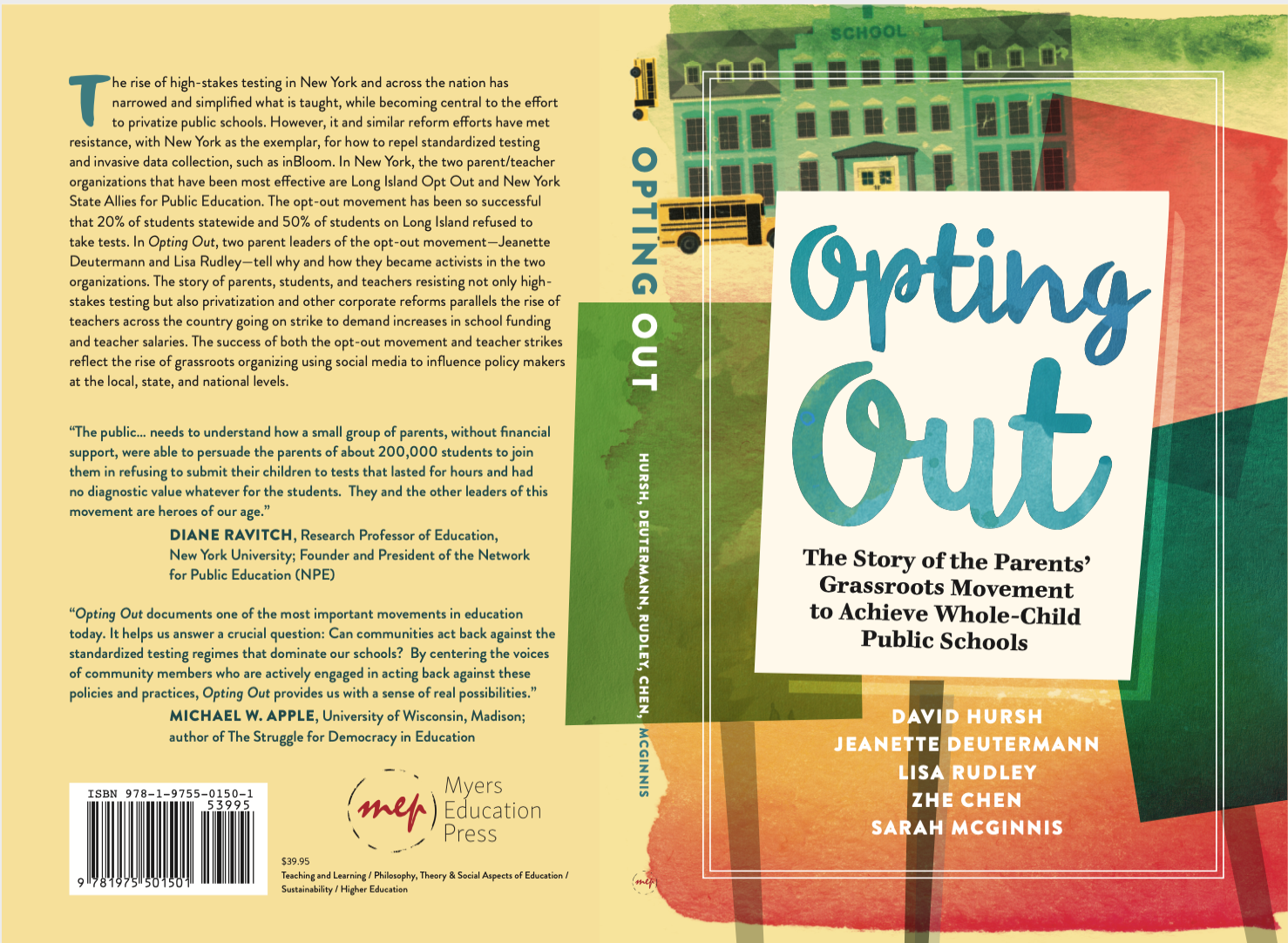
This is a book you will want to read if you are a parent, a teacher, a teacher educator.
Opting Out: The Story of the Parents’ Grassroots Movement to Achieve Whole-Child Schools is an essential addition to your bookshelf.
It was written by Professor David Hursh of the University of Rochester and parents leaders of the New York Opt Out movement Jeanette Deutermann, Lisa Rudley, and Hursh’s graduate students, Zhe Chen and Sarah McGinnis.
Together they explain the origins and development of the one of the most significant parent-led reactions against high-stakes testing and in favor of education that is devoted to the full development of children as healthy and happy human beings. The media liked to present the Opt Out movement as a “union-led” action, but that was always a false narrative. It was created and led by parent activists who volunteered their time and energy to save their children from test centric classrooms and wanted a “whole-child” education that helped their children become eager and engaged learners.
David Hursh has written and lectured about the assault on public education and the dangers of high-stakes testing.
https://www.waikato.ac.nz/wmier/news-events/prof-david-hursh-on-the-takeover-of-public-education
University of Rochester Meliora Address (2013): High-stakes testing and the decline of teaching. https://www.youtube.com/watch?v=GIQu2Hh_YkI
Keynote address: New York State as a cautionary tale (2014). New Zealand union of primary teachers and administrators. https://www.youtube.com/watch?v=hW4vZGsLiL4
The parent co-authors are leaders of the New York State Opt Out movement, primarily through their role in New York State Allies for Public Education, which has organized hundreds of thousands of parents to say no to excessive and pointless testing, whose only beneficiaries are the big testing corporations.
The parents of the Opt Out movement are a stellar example of the Resistance that is bringing an end to this current era of child abuse and test-driven miseducation.
I was happy to endorse the book and am pleased now to recommend it to you.
Thomas Ultican, retired teacher of advanced mathematics and physics in California, has written the first review of my new book SLAYING GOLIATH: THE PASSIONATE RESISTANCE TO PRIVATIZATION AND THE FIGHT TO SAVE AMERICA’S SCHOOLS.
He liked it!
He calls it “spiritually uplifting” and describes it (accurately) as a “fight to save the commons.”
Enjoy!
California Sunday Magazine published interviews with teachers about their role in striking, walking out, negotiating, bargaining.
It begins:
On February 22, 2018, some 20,000 teachers in West Virginia — many of them wearing red in solidarity — walked out of their classrooms. That April saw strikes in Arizona, Colorado, and Oklahoma, as teachers vented their collective frustration in what became known as the #RedforEd movement. In early 2019, educators picketed in Oakland and Los Angeles, in districts across Washington state and Oregon, and again in Colorado. And this fall, educators in Chicago, the nation’s third-largest school district, took to the streets.
After years of system-wide underinvestment, educators are pushing back hard. They have married concerns about pay with their ability to adequately educate students . They have made a few gains — one or two fewer students in their overcrowded classes and significant raises in some cases. But many still see a long way to go, and as another election ramps up, the public will have to decide how much these issues matter. In these pages, we hear from teachers who made the decision to walk the picket lines and others who decided to stay put.
This is a beautiful and powerful statement spoken in court by a young man on trial for “extremism” in a Russian court. It was translated by Masha Gessen and appears in The New Yorker online. it explains the power of Resistance to tyranny and the importance of individual responsibility and love.
Gessen writes:
A twenty-one-year-old university student named Yegor Zhukov stood accused of “extremism,” for posting YouTube videos in which he talked about nonviolent protest, his campaign for a seat on the Moscow City Council, and different approaches to political power. In his most recent video, recorded four months ago, he suggested that “madmen” like Vladimir Putin view power as an end in itself, while political activists view it as an instrument of common action. In many of his vlog entries, Zhukov is seated against the backdrop of the Gadsden flag—“Don’t Tread on Me”—which appears to hang in his bedroom in his parents’ apartment. The prosecutor had asked for four years of prison time for Zhukov. On Friday, a Moscow court sentenced Zhukov to three years’ probation—an unusually light punishment probably explained by the public response to Zhukov’s speech, which several Russian media outlets dared to publish. Hundreds of people gathered in front of the courthouse on the day of the sentencing. As a condition of his probation, Zhukov is banned from posting to the Internet. The judge also ordered that the flag, which was confiscated by police, be destroyed.
Instead of writing my own column, I have translated Zhukov’s final statement, delivered in court on Wednesday. I did it because it is a beautiful text that makes for instructive reading. Parts of it seem to describe American reality as accurately as the Russian one. Parts of it show what resistance can be.
Zhukov’s statement:
“This court hearing is concerned primarily with words and their meaning. We have discussed specific sentences, the subtleties of phrasing, different possible interpretations, and I hope that we have succeeded at showing to the honorable court that I am not an extremist, either from the point of view of linguistics or from the point of view of common sense. But now I would like to talk about a few things that are more basic than the meaning of words. I would like to talk about why I did the things I did, especially since the court expert offered his opinion on this. I would like to talk about my deep and true motives. The things that have motivated me to take up politics. The reasons why, among other things, I recorded videos for my blog.
“But first I want to say this. The Russian state claims to be the world’s last protector of traditional values. We are told that the state devotes a lot of resources to protecting the institution of the family, and to patriotism. We are also told that the most important traditional value is the Christian faith. Your Honor, I think this may actually be a good thing. The Christian ethic includes two values that I consider central for myself. First, responsibility. Christianity is based on the story of a person who dared to take up the burden of the world. It’s the story of a person who accepted responsibility in the greatest possible sense of that word. In essence, the central concept of the Christian religion is the concept of individual responsibility.
“The second value is love. ‘Love your neighbor as yourself’ is the most important sentence of the Christian faith. Love is trust, empathy, humanity, mutual aid, and care. A society built on such love is a strong society—probably the strongest of all possible societies.
“To understand why I’ve done what I’ve done, all you have to do is look at how the Russian state, which proudly claims to be a defender of these values, does in reality. Before we talk about responsibility, we have to consider what the ethics of a responsible person is. What are the words that a responsible individual repeats to himself throughout his life? I think these words are, ‘Remember that your path will be difficult, at times unbearably so. All your loved ones will die. All your plans will go awry. You will be betrayed and abandoned. And you cannot escape death. Life is suffering. Accept it. But once you accept it, once you accept the inevitability of suffering, you must still accept your cross and follow your dream, because otherwise things will only get worse. Be an example, be someone on whom others can depend. Do not obey despots, fight for the freedom of body and soul, and build a country in which your children can be happy.’
“Is this really what we are taught? Is this really the ethics that children absorb at school? Are these the kinds of heroes we honor? No. Our society, as currently constituted, suppresses any possibility of human development. [Fewer than] ten per cent of Russians possess ninety per cent of the country’s wealth. Some of these wealthy individuals are, of course, perfectly decent citizens, but most of this wealth is accumulated not through honest labor that benefits humanity but, plainly, through corruption.
“An impenetrable barrier divides our society in two. All the money is concentrated at the top and no one up there is going to let it go. All that’s left at the bottom—and this is no exaggeration—is despair. Knowing that they have nothing to hope for, that, no matter how hard they try, they cannot bring happiness to themselves or their families, Russian men take their aggression out on their wives, or drink themselves to death, or hang themselves. Russia has the world’s [second] highest rate of suicide among men. As a result, a third of all Russian families are single mothers with their kids. I would like to know: Is this how we are protecting the institution of the family?
“Miron Fyodorov [a rap artist who performsunder the name Oxxxymiron], who attended many of my court hearings, has observed that alcohol is cheaper than a textbook in Russian. The state is pushing Russians to make a choice between responsibility and irresponsibility, in favor of the latter.
“Now I’d like to talk about love. Love is impossible in the absence of trust. Real trust is formed of common action. Common action is a rarity in a country where few people feel responsible. And where common action does occur, the guardians of the state immediately see it as a threat. It doesn’t matter what you do—whether you are helping prison inmates, speaking up for human rights, fighting for the environment—sooner or later you’ll either be branded a ‘foreign agent’ or just locked up. The state’s message is clear: ‘Go back to your burrow and don’t take part in common action. If we see more than two people together in the street, we’ll jail you for protesting. If you work together on social issues, we’ll assign you the status of a “foreign agent.” ’ Where can trust come from in a country like this—and where can love grow? I’m speaking not of romantic love but of the love of humanity.
“The only social policy the Russian state pursues consistently is the policy of atomization. The state dehumanizes us in one another’s eyes. In the state’s own eyes, we stopped being human a long time ago. Otherwise, why would it treat its citizens the way it does? Why does it punctuate its treatment of people through daily nightstick beatings, prison torture, inaction in the face of an H.I.V. epidemic, the closure of schools and hospitals, and so on?
“Let’s look at ourselves in the mirror. We let this be done to us, and who have we become? We have become a nation that has unlearned responsibility. We have become a nation that has unlearned love. More than two hundred years ago, Alexander Radishchev [widely regarded as the first Russian political writer], as he travelled from St. Petersburg to Moscow, wrote, ‘I gazed around myself, and my soul was wounded by human suffering. I then looked inside myself, and saw that man’s troubles come from man himself.’ Where are these kinds of people today? Where are the people whose hearts ache this much for what is happening in our country? Why are hardly any people like this left?
“It turns out that the only traditional institution that the Russian state truly respects and protects is the institution of autocracy. Autocracy aims to destroy anyone who actually wants to work for the benefit of the homeland, who isn’t scared to love and take on responsibility. As a result, our long-suffering citizens have had to learn that initiative will be punished, that the boss is always right just because he is the boss, that happiness may be within reach—but not for them. And having learned this, they gradually started to disappear. According to the state statistical authority, Russians are slowly vanishing, at the rate of four hundred thousand people a year. [Deaths exceeded births by nearly two hundred thousand in the first six months of 2019.] You can’t see the people behind the statistics. But try to see them! These are the people who are drinking themselves to death from helplessness, the people freezing to death in unheated hospitals, the people murdered by others, and those who kill themselves. These are people. People like you and me.
“By this point, it’s probably clear why I did what I did. I really want to see these two qualities—responsibility and love—in my fellow-citizens. Responsibility for one’s self, for one’s neighbors, for one’s country. This wish of mine, your honor, is another reason why I could not have called for violence. Violence breeds impunity, which breeds irresponsibility. By the same token, violence does not bear love. Still, despite all obstacles, I have no doubt that my wish will come true. I am looking ahead, beyond the horizon of years, and I see a Russia full of responsible, loving people. It will be a truly happy place. I want everyone to imagine Russia like this. And I hope this image can lead you in your work, as it has led me in mine.
“In conclusion, I would like to state that if the court decides that these words are spoken by a truly dangerous criminal, the next few years of my life will be marked by deprivation and adversity. But I look at the people [who have been jailed in the latest wave of activist arrests] and I see smiles on their faces. Two people I met briefly during pretrial detention, Lyosha Minyaylo and Danya Konon, never complained. I will try to follow their example. I will endeavor to take joy in having this chance—the chance to be tested in the name of values I hold dear. In the end, Your Honor, the more frightening my future, the broader the smile with which I look at it. Thank you.”
New Jersey is a corrupt state, whose Democratic leadership controls the state and patronage. The Democratic machine worked happily with Republican Governor Chris Christie.
The Working Families Party is fighting to upend the Democratic establishment, whose titular head is boss George Norcross, who happens to be a member of Trump’s Mar-a-Lago club and the Democratic National Committee.
One WFP member, Sue Altman, was recently arrested and forcibly removed from a public hearing.
Altman previously lived in New York, where she was a founding member of NYSAPE, the group that fights high-stakes testing.
The confrontation was brief but explosive, and it laid bare the deepening fault lines within the Democratic Party in one of America’s bluest states.
New Jersey state troopers singled out Sue Altman, the leader of the left-leaning Working Families Alliance, grabbed her by the arms and forcibly removed her from a standing-room-only State Senate hearing on corporate tax breaks.
She was led past her main political rival, George E. Norcross III, a Democratic power broker who was at the hearing to testify in support of an $11 billion economic incentive program that Ms. Altman had criticized harshly and that is the subject of state investigations and subpoenas.
The imagery and its aftermath have roiled Trenton, exposing a generational and philosophical rift between progressive and mainstream Democrats that is mirrored nationwide…
Images of the clash were shared widely on social media — including by Senator Elizabeth Warren of Massachusetts, a Democratic presidential candidate — amplifying tensions between the Democratic factions that control the state government: lawmakers aligned with the progressive first-term governor, Philip D. Murphy, and those, including the powerful State Senate president, who are linked to Mr. Norcross…
Her outspokenness about corporate tax breaks and her decision to live in Camden, a city seen as the Norcross family’s inviolable power base, made her a ready target for opponents long before the contentious Senate hearing.
Ms. Altman regularly spars with the powers-that-be on Twitter and seems to revel in the role of outside agitator. Barely a week into her job as the alliance’s director, she participated in a demonstration where protesters stood near an inflatable pig handing out fake million-dollar bills stamped with Mr. Norcross’s face.
She credits her years on the basketball court with making her comfortable in the political scrum. After leading her college team at Columbia University in scoring, she played professionally in Ireland and Germany. She went on to teach and coach at Blair Academy before studying at Oxford, where she also played basketball.
“You’re going to get booed,” she said. “You still have to make your foul shots.”
She is flirting with the possibility of making a primary run against Donald Norcross. “I haven’t ruled it out,” she said, despite taking no concrete steps toward a campaign…“She doesn’t have to stay here,” said Ronsha Dickerson, 42, an African-American mother of six who works for an organization that has called for a moratorium on new charter schools in Camden. “But she’s chosen this space to really be committed to making change.”

 Diane Ravitch's blog