Archives for category: Privatization

Fred Klonsky writes that teachers at 15 charter schools voted overwhelmingly to strike.

Teachers at 15 Chicago charter schools have voted 98 percent to authorize a strike as they continue to bargain a contract with Acero Schools, the largest unionized charter network in the city, and with other charter school networks.

UNO, which later became Acero, founded the charter-school chain in 1998, and it grew quickly with the help of Democratic Party politicians like Governor Pat Quinn and Speaker Michael Madigan. The Governor and the Speaker worked out a 2009 law handing over $98 million in state grant money for UNO to build schools.

For years, the organization and its charter network were run by Juan Rangel, UNO’s clout-heavy chief executive officer.

Rangel was Rahm Emanuel’s mayoral campaign chairman.

Rangel was forced to resign his charter leadership position – with its $275,000-a-year salary – following one of many Rahm school scandals.

In addition to tens of millions of dollars in state funding, UNO received millions more from CPS.

Some politicians, like then-Governor Pat Quinn, distanced themselves from Rangel and UNO after it was reported UNO had paid millions out of the state funding to construction companies owned by brothers of Rangel’s top deputy, Miguel d’Escoto.

In a June 2014 civil settlement the U.S. Securities and Exchange Commission accused UNO of defrauding bond investors by “making materially misleading statements” about the construction contracts.

Rangel later paid a little $10,000 fine.

While operating the schools, which serve largely Hispanic students, UNO was a big spender.

But not on its teachers or classrooms or students.

It charged more than $60,000 for restaurants on Rangel’s American Express “business platinum” card in one year and spent more than $60,000 a year on travel in 2010 and 2011. Records show Rangel flew out of town 31 times in four years at the group’s expense.

Charter teacher salaries are far below those of their counterparts in regular CPS schools. By state law Chicago charter teachers are not covered by the regular CTU contract.

Denis Smith worked for many years for the Ohio Department of Education. When he retired, he was employed in the office that oversees charter schools. He has written many articles about the scams and frauds that charter operators get away with in Ohio, as well as some that they don’t get away with.

He wrote me recently to say that the five most common words in charterdom are:

The defendant will please rise.

Isn’t it interesting that the pro-charter candidates, no matter which school district or city or state they live in, do not admit they are pro-charter.

Apparently the public is catching on, and it is not a good thing to admit that you want more charters.

Suddenly, everyone—even the execrable governor’s Scott Walker and Doug Ducey of AZ—call them selves “the Education Governor” and boast about (lie about) have they have helped public schools. Don’t believe them.

Any candidate funded by the Koch brothers, The Walton Family, Eli Broad, Reed Hastings, or Michael Bloomberg is a Pro-Charter Candidate. They are coming to privatize your public school and replace it with a national corporate chain school.

Valerie Strauss summarizes the race between Marshall Tuck and Tony Thurmond.

Tuck has raised nearly $30 million from the billionaires who support charter schools; Thurmond has raised about $15 million, mostly from labor unions, teachers, and Democrats.

Tuck is supported by the Republican party. Although he claims to be a Democrat, he was booed at the state Democratic convention.

She writes:

One of the loudest and most expensive state races in the country is between two Democrats vying to win the nonpartisan position of superintendent of public instruction in California. More money is being spent on the race — for a position that has no independent policymaking power — than in most U.S. Senate campaigns.

The fight — the costliest in the state’s history for this post, with more than $43 million in campaign contributions, according to EdSource — is between state legislator Tony Thurmond and Marshall Tuck, a former charter school network president.

Thurmond, who was elected to the California State Assembly in 2014 from the East Bay, has been a teacher, social worker, city councilman and school board member. Tuck is a former banker who became the first president of the Green Dot network of charter schools in Los Angeles. After that, he founded a nonprofit that used privately donated money from the wealthy to help turn around troubled traditional public schools. Four years ago, he ran unsuccessfully for state superintendent in a race that cost some $30 million (with a lot of it coming from billionaires backing Tuck)…

The fight between Thurmond and Tuck is the latest chapter in a long-running debate about public education in a state with a scandal-ridden charter school sector and severely underfunded traditional school districts. California has more charter schools — which are publicly funded but privately operated — and more charter students than any state.

Should Tuck win, supporters of charter schools will take heart. If Thurmond triumphs, supporters of traditional public education will.

Tuck has raised far more than Thurmond, about $5 million in direct contributions, compared with $3.1 million for Thurmond, according to the Associated Press. Most of the money in the race has gone through political committees that can accept unlimited amounts of money but are not allowed to coordinate with the campaigns. In this arena, Tuck is far ahead, with two committees backing him taking in $24.1 million, according to Ed Source, with a committee supporting Thurmond’s bid taking in $11.5 million so far.

Much of Tuck’s contributions have come from billionaires who support charter schools and many who live out of state. Wealthy donors include Michael Bloomberg of New York; Eli Broad of Los Angeles; and Alice Walton of Texas, who has donated millions of dollars to his campaigns over a period of years. Netflix chief Reed Hastings and Gap founder Doris Fisher have also donated. And, not surprisingly, he is backed by the California Charter Schools Association (which celebrated the controversial 2017 confirmation of Betsy DeVos as U.S. education secretary).

We will find out in a few days whether out of state billionaires can buy the race.

Robert Skeels does a deep dive into Marshall Tuck’s record and decides that his ethnocentric values do not suit him to be the next Superintendent of Public Instruction.

Based on his experience in the charter sector, Tuck claims to be an educator, but Skeels pegs him as a banker.

Tuck’s friends in the charter industry claim that Tuck was a great success but Skeels questions their data.

Skeels writes:

Business banker Marshall Tuck is running for California State Superintendent of Public Instruction again. He’s backed by the same ideologically charged billionaires as the last time — several of whom supported reactionary measures like Proposition 8. With nearly unlimited funding, voters will be deluged with Tuck’s messaging. There’ll be plenty of unsubstantiated claims that he ran successful schools.

Marshall Tuck is running for California State Superintendent of Public Instruction again, backed by the same ideologically charged billionaires as the last time — several of whom supported reactionary measures like Proposition 8.

Those ads won’t reveal the truth about Tuck’s record. There’ll be no mention that when he ran the Green Dot Charter Corporation, one of his high schools “achieved” the dubious distinction of back-to-back years of absolutely zero students scoring proficient on the mathematics portion of the California State University (CSU) entrance examination. There won’t be discussion of how, under Tuck, one Partnership for Los Angeles Schools’ (PLAS) high school went five years without achieving even twenty percent of students scoring proficient on either the mathematics or the English portion of those same CSU exams. Five years. These awful proficiency rates were reflected in Scholastic Aptitude Tests (SAT) scores as well. Under Tuck’s “leadership” the schools he managed were among the very lowest scorers on the SAT in Los Angeles County, year after year.

Tuck’s record of terrible academic results isn’t the only issue that will be carefully obscured. His abject treatment of students of color, in a fashion much like his contemporary counterparts Tom Horne and John Huppenthal in Arizona, is something he works hard to hide. It’s time to shine a bright light on this.

Using their positions of authority, Tuck, Horne, and Huppenthal closed down popular, research proven, Ethnic Studies programs. Tuck did it at PLAS schools like Santee High School when he was their “CEO.” The other two did it while they were Superintendents of Public Schools in Arizona. Tuck went a step further than the others — he also restricted and shuttered both Heritage Language Programs and Dual Language Immersion programs. These important language programs were well regarded and research proven. The language program closures and restrictions were so egregious that a Uniform Complaint Cause of Action was filed jointly by Mexican American Legal Defense and Educational Fund and Public Counsel Law Center on behalf of the families whose civil rights Tuck violated. Additionally, Tuck closed down other critical programs including health education .

In the end, after a long battle, Horne and Huppenthal’s attacks on students of color by eliminating Ethnic Studies in Arizona were defeated in court. The judge’s opinion noted that the two were “capitalizing on race-based fears.” Both politicians would later find themselves voted out of office. Tuck, whose record on these programs mirrors that of Horne and Huppenthal, is facing a California with very different values than his. In 2016, in contradiction to Tuck’s penchant for opposing bilingualism, Californian voters passed Proposition 58 — reestablishing bilingualism as mainstream. Furthermore, school districts have been passing resolutions instituting Ethnic Studies programs. On the state level advances for Ethnic Studies like AB-2016 have proven that Californians don’t share Tuck’s aversion to programs that celebrate diversity and encourage youth to explore their history.

Dr. Bill Smith of Johnson City, Tennessee, watched the two candidates for Governor of Tennessee debate and focus on education as key to the state’s future.

The Republican, Bill Lee, swore his allegiance to the party line and endorsed charters and vouchers. He goes full Betsy DeVos.

The Democrat, Karl Dean, pledged his devotion to “public education” and his love for charter schools, which have failed in Tennessee. Dean goes partial Betsy DeVos.

Surely both men know that the Tennessee Achievement School District spent $100 million of Race to the Top money to turn low-scoring schools over to charters, and the ASD was a colossal failure. $100 million wasted.

Why do they want more of the same?

Dr. Smith writes with more wisdom than either candidate:

It’s no secret that non-profit charter schools often divert money intended for children’s instruction to other priorities. For example, many charters compensate their “CEOs” two to three times the salaries of principals who perform the same functions in regular public schools. Vision Academy in Nashville pays its two top executives (a married couple) a combined $562,000, while reportedly charging students for textbooks. (Imagine the outcry if a local public school engaged in such financial behavior.)

The Oct. 9 debate between Lee and Dean was — like the rest of their campaign — noteworthy for its civility. They both seem to be good, decent men, and they exhibit many of the leadership qualities we should all want in our governor. Moreover, when you listen to them talk about educational reforms, their arguments seem very compelling — until you carefully consider the facts.

Lee is either delusional or disingenuous to assert that he would do nothing to diminish public education but is fully in favor of vouchers and charters. The point of offering these choices is to diminish public education, and the evidence indicates that it is working.

Further, when he says we should give students educational alternatives, identify the “best practices” to emerge from these settings, and then implement these model approaches in public schools, he is describing the central promise of the charter school movement when it first emerged in the 1990s. In the beginning, the plan was that charter schools would be relieved of regulatory oversight so that they could explore creative practices and then export their best ideas to public education. Unfortunately, that never happened.

This failure raises a fundamental question that Lee, Dean and other charter advocates do not address (in my opinion, because they can’t). If charter schools are as wonderful as they claim, why won’t they tell us what makes these schools so effective? If you knew the cure to a dreadful disease, would you keep it to yourself?

The charter folks remind me of the old snake oil salesmen who appeared unexpectedly one morning, sold their mysterious elixirs, and slipped out of town at dusk. They made incredible claims about the benefits found in those opaque bottles, but they never told anyone what the ingredients were. “Trust me,” they said. “It’ll cure whatever ails you.”

Let’s be clear. Advocates of charters and vouchers can’t tell us why these educational alternatives are better because they simply aren’t. Moreover, most of the people pushing for choice don’t want to improve public education. They want to undermine it so that they can profit from educational privatization. The only reason they want relaxed regulatory oversight is so that they can funnel as much of our tax dollars as possible into their own pockets without us noticing.

I believe that Dean is sincere about his support for public education, and I will vote for him for that reason. To his credit, he opposes all forms of choice except for non-profit charters, and I hope that he will realize one day that they too have failed to live up to expectations. He is kidding himself when he denounces the undermining effects of vouchers on public education while simultaneously advocating for charters (even in a limited capacity) and not seeing that they too draw resources away from public schools.

Democrats who still think there’s a place for charter schools need to reconsider that position. If there was ever a useful role for charters in our educational system, it has long since been high-jacked and corrupted beyond redemption. Charters are simply one more weapon for market fundamentalists to employ in their effort to privatize public education.

Laura Chapman, tireless researcher, did a cursory scan of the abundance of billionaire cash flowing into charter schools, enhanced by another $400 million from the U.S. Department of Education. There are literally dozens more foundations and organizations pouring money into the charter industry, such as Reed Hastings (Netflix), Eli Broad, Michael Bloomberg, John Arnold (ex-Enron), Michael Dell (computers), the Fisher Family (Old Navy, the Gap), and many more.

Why is the U.S. Department of Education pouring hundreds of millions of dollars into this well-funded industry? Betsy DeVos recently handed out $399 million to jump-start new charter schools, even in districts and states where there is no demand. Next year, Congress has allotted $450 million for charters, whether they are wanted or not.

What is clear from Laura’s review is that charter schools are not in need of funding. They are in need of accountability, transpency, stability, supervision, regulation, and integrity.

She writes:


I just did an analysis of these USDE grants, announced by Politico, in tandem with the Walton Foundation 2020 plan for charter school grants. Of course charters have many big funders. For example the Bill and Melinda Gates Foundation has propped up the National Alliance for Public Charter Schools and the National Association of Charter School Authorizers with grants to date of $35,954,074.

The 2020 plan from the Walton Family Foundation (prepared in 2015) begins with the prideful claim that the Walton Family Foundation (Walmart wealth) has supported 1 in 4 charter schools.

The 2020 plan provides for a five year investment totaling $1 billion for charter schools and supporters.

Between the Walton Family Foundation and USDE grants, thirty states will see inflows of funds for charters and with only a few exceptions (five), these states will have funds from both sources (in addition to many other funders).

The Walton Foundation is supporting charter-friendly STATE policies in Arizona, Arkansas, Connecticut, Florida, Illinois, Michigan, Minnesota, Missouri, Ohio, Oklahoma, Pennsylvania, Rhode Island, and Wisconsin.

For 2018-2019, the Walton wealth is supporting charterizing in: Arkansas (any district); California (Los Angeles specific boundaries, two grants]; California (Oakland, two grants), Colorado (Denver, two grants), Georgia (Atlanta, two grants), Indiana (Indianapolis, two grants), Louisiana (New Orleans, two grants), Massachusetts (Boston); New Jersey (Camden), New York (New York City, two grants), Oklahoma (any district), Tennessee (Memphis, Shelby County), Texas (Houston ISD; San Antonio, two grants), Washington, DC (two grants). “Any district” means there are no constraints on location. Most of the two-for grants are for facilities support in addition to operational support.

All of the Walton and USDE grants are for charter school “startups,” expansions, “replications” (as in a franchise), or charter school facilities financing. It is not surprising that most of the USDE grants are complementing those of the Walton Foundation.

It is easy to forget that NCLB provided for various schemes to finance charter schools (in addition to federal funds). Now there are specialty companies in the business of building out the charter sector. Here are some of the services advertised by one of these.

Begin quote: “Charter School Capital provides flexible funding solutions so charter schools can gain ground and achieve success. Our charter school working capital financing enables school leaders the flexibility and stability to support everyday expenses and — importantly — fuel their growth.

We help charter schools access working capital so they can:
Expand or grow programs, Open a new charter school, Provide new technology in the classroom, Hire and/or develop staff, Address budget shortfalls and delays (deferrals, holdbacks, etc.) gracefully, Improve transportation options, Enrich educational programs, Buy new equipment,

Facilities Financing
Our facilities financing product is a long-term lease that allows schools to access funding through all stages of growth – from start-up to expansion through maturity. As a long-term partner, our team works closely with you as we explore budgetary and financial options to support your facilities needs.
Why long-term lease financing? You can finance 100% of project costs, You can retain control of your facility, You can plan on long-term affordability, You can enhance your existing building or finance new construction, Your lease can be customized to your school’s model – whether blended learning, traditional, etc., Tenant improvements can be financed in your lease, Can be used as take-out financing for an existing bond or potential bridge to bond financing.

We currently own 42 school properties in 11 states, more than $350 million in assets. Schools range in attendance from 135 to 1,200 students with educational programs that include college preparatory, art-focused, STEM schools, and others. Our goal is to aid charter leaders so they have accessible, flexible financing options to meet their schools needs today and the needs they have in the future.

Loan Details
The Charter School Capital loan product is a flexible financing solution that can help schools reach their enrollment and educational goals.Available to schools of all ages, Refinance options available throughout the school year to accommodate growth, ƒ Payment plans can be customized to suit school needs, Access to funding in as few as 30 days from date of initial request, Loan amounts based on annual state aid revenue and student count, allowing for increasing scale with growth, NO RESTRICTIONS PLACED UPON UTILIZATION OF FUNDS. (caps are mine, End Quote.) https://charterschoolcapital.org/wp-content/uploads/2018/07/csc-product-1pager_WC_Facilities_Loans_FINAL.pdf

Here is the Walton 2020 plan: https://8ce82b94a8c4fdc3ea6d-b1d233e3bc3cb10858bea65ff05e18f2.ssl.cf2.rackcdn.com/04/ab/555b3ee54d3792eebaf27a803400/k12-strategic-plan-overview-updated.pdf

During her confirmation hearings, Betsy DeVos pledged not to make political contributions while she was Secretary of Education.

But, knowing her penchant for parsing words, we may now assume that she was not covering the political donations of her family, which continue.

This latest review of political donations by Ulrich Boser and Perpetual Baffour of the Center for American Progress shows that the DeVos family gave $2 Million to far-right candidates.

My hunch is that they gave far more than $2 million, through Dark Money PACs that do not disclose the names of their donors.

The report finds:

“Even by the loose standards of U.S. campaign finance laws—and President Donald Trump’s blatant corruption—the donations by the family members of a Cabinet official have been brazen. In February 2018, Richard DeVos, Secretary DeVos’ father-in-law, gave $1 million to the Freedom Partners Action Fund—a political action fund that has long been associated with far-right causes. Over the past year, the DeVos family has also given $350,000 to the Republican Congressional Leadership Fund and another $400,000 to the Republican National Committee.

“The DeVoses have also donated to specific candidates for federal and state office. Wisconsin’s far-right firebrand, Gov. Scott Walker (R), for example, has received more than $635,000 over the past decade from the DeVos family—including $30,000 in 2018. Bill Schuette, Michigan’s Republican attorney general who is running for governor, received almost $40,000 over the past year.

“But it seems that the state of Arizona is of particular interest to the DeVos family’s political agenda. Rep. Martha McSally (R), who is in a tight race for a U.S. Senate seat, landed $54,000 in contributions from the family this cycle—more than any other U.S. Senate candidate received from the DeVoses. Arizona Gov. Doug Ducey (R) has likewise received more in campaign contributions from the DeVos family than any gubernatorial candidate across the country this election cycle, raking in $50,500 in donations.”

In Wisconsin, a vote for Scott Walker is a vote for Betsy DeVos.

In Michigan, a vote for Bill Schuette is a vote for Betsy DeVos.

In Arizona, a vote for Martha McSally is a vote for Betsy DeVos.

A vote for these candidates is a vote for charter schools and vouchers.

A vote for these candidates is a vote to privatize public schools.

Tom Ultican, retired teacher of physics and advanced mathematics in California, here describes the billionaires and bad policies behind Marshall Tuck’s campaign for State Superintendent of Public Instruction.

He sees the Tuck campaign as a new front in the “Destroy Public Education Movement,” which he has written about extensively.

Here are some of the Big Money contributors to Tuck’s campaign:

The Waltons control Walmart and have been spending heavily to privatize public schools for more than three decades.

Bill Bloomfield is a rich guy from LA who has also poured $7,000,000 into independent expenditures for Tuck.

The Rogers family is the main local force behind the privatization of Oakland’s school system.

Doris Fisher founded The Gap with her husband Don. They have spent extensively promoting charter schools and were the first significant benefactors for the KIPP franchise.

Eli Broad is the only person to found two fortune 500 companies. He announced plans to charterize half of Los Angeles’s schools and published a guide for closing public schools.

John Scully was the former CEO of Apple and consistently supports school privatization.

David Horowitz is a Republican activist who gained notoriety for his anti-affirmative action campaign.

Arthur Rock is Silicon Valley royalty who spends lavishly to support school privatization.

Peter Chernin was COO of Rupert Murdoch’s News Corp. He is also a movie producer of some note.

Reed Hastings is possibly the most dedicated destroy public education billionaire. He sat on the board of the California Charter Schools Association for many years.

Richard Riordan is the billionaire former Mayor of Los Angeles who spends millions on public school privatization.

John Arnold is the ex-Enron executive who did not go to jail. He and Reed Hastings have each invested $100 million in a new national school privatizing organization called The City Fund.

Jonathan Sackler is the heir to the billionaire inventors of Oxycontin. Besides selling addictive drugs, Jonathan invests in the privatization of America’s schools.

Les Biller is a former CEO of Wells Fargo bank. He and his wife have a foundation in Seattle, Washington where they give heavily to charter schools.

Julian Robertson Jr. is a hedge fund manager in Chicago who thinks California really needs Marshal Tuck.

Stacy Schusterman is an energy industry heir from Tulsa, Oklahoma. She has been particularly active in California school board elections.

Michael Bloomberg is the billionaire former New York mayor who spawned Joel Klein, Eva Moskowitz and Michelle Rhee. He spends heavily on California school board elections.

The big money is not in direct contributions like those listed above. It is in the money for independent expenditure committees that do not have contribution limits. For example, the Ed Voice for the Kids Pac has already reported spending over $13,000,000 in support of Tuck (Id 1243091). There are many more of these PACs spending money to elect Tuck such as Education Reform Now Advocacy for Tuck and Charter Public Schools Political Action Committee.

Ultican contrasts the two candidates:

Tony Thurmond was born in Monterey, California. His father was stationed at the Fort Ord Army base. Tony’s father abandoned his family of four children. Thurmond’s Panamanian immigrant mother became a school teacher and moved the family to San Jose.

Tragedy struck six-years-old Tony when his mother died of cancer. Tony and a brother moved to Philadelphia where they were raised by a cousin.

After graduating from high school in Philadelphia, Tony matriculated to Temple University where he was elected student body president and received a BA in psychology. He attended graduate school at Bryn Mawr earning a dual masters in Law and Social Policy and Social work.

The most disgusting statement in the San Diego Union editorial read, “In his interview with us, Assemblyman Tony Thurmond, D-Richmond, who finished second to Tuck in the June primary, seemed just as affable but not nearly as ambitious as Tuck.” In case that was too subtle; Tony is a black man.

After rising above his traumatic childhood and becoming educated, Tony married and returned to California in 1998. For the 20 years preceding his election to the California State Assembly, Thurmond served in various positions at non-profit social service agencies. Tony says it was his public school education that helped him become at 20-year social worker and serve on a school board, a city council and now the California State Assembly.

Tony has two daughters in public school.

Marshall Tuck received an MBA from Harvard University in 2000 and a BA in Political Science from University of California Los Angeles in 1995. He grew up in the San Francisco Bay area and has a wife and son.

He spent some time as a consultant at Mitt Romney’s Bain & Co. He was an investment analyst at the Upper Manhattan Empowerment Zone. He moved to Los Angeles to work at Salomon Brothers as an investment banker focused on both mergers and acquisitions. After a brief stint in sales for a Software company, in 2002, Tuck was hired by Green Dot Charter Schools as Chief Operating Officer.

In 2007, Los Angeles Mayor Anthony Villaraigosa had been rebuffed in his efforts to take control of Los Angeles Unified School District. He did convince a few donors to underwrite the takeover of a small number of schools in areas which had suffered years of poor standardized test results. They created a non-profit called Partnership for LA and Villaraigosa tapped Marshall Tuck to lead the Partnership.

Tuck had by then become the CEO of Green Dot. The year he left for the Partnership, Green Dot schools posted nine of the fifty lowest SAT scores among Los Angeles schools.

Tuck was extremely unpopular at the Partnership. The Sacramento Bee reported, “Teachers passed a vote of no confidence at nine of the schools at the end of the first year, leading to independent mediation.” An online education news paper in Los Angeles, School Matters, reported, “Many of us hoped that when right-wing business banker Marshall Tuck was ignominiously forced to step down as the ‘CEO’ of the Partnership for Los Angeles Schools (PLAS), that we might have heard the last of Tuck altogether.”

Tuck’s authoritarianism and lack of education background has led to serial failures, however, those forces trying to privatize California’s public schools find his style to their liking.

In 2014, when Tuck lost the most expensive SPI race in California’s history, his allies were there to take care of him. Even though he has no training as an educator, he was made Educator-in-Residence at the New Teacher Center (NTC). Bill Gates has granted NTC $26,305,252 since 2009.

This Contest is Very Important If You Value American Democracy

Marshall Tuck is the representative of the Destroy Public Education billionaires who are spending massive amounts of money to get him elected. It is widely understood that elected school boards are the soil from which American democratic government rejuvenates itself. Dark “DPE” forces are undermining democracy in this country by destroying the people’s 200-years-old public education system. They must be stopped.
This is Jan Resseger’s third report on her experience at the Network for Public Education annual conference in Indianapolis last weekend. In this post, she reports on what she learned by attending a panel about the NPE-Schott Foundation study of state support for public schools vs. privatization of public schools.

One of the most fascinating workshops at the conference explored the complexity of researching the groundbreaking, June 2018 report, Grading the States: A Report Card on Our Nation’s Commitment to Public Schools, and the importance of the report, the first comprehensive effort to track and compare the growth of privatization and the characteristics of state vouchers and charters. The report, a collaboration of the Network for Public Education and the Schott Foundation for Public Education, defines its purpose: “States are rated on the extent to which they have instituted policies and practices that lead toward fewer democratic opportunities and more privatization, as well as the guardrails they have (or have not) put into place to protect the rights of students, communities and taxpayers. This is not an assessment of the overall quality of the public education system in the state—rather it is an analysis of the laws that support privatized alternatives to public schools.” (emphasis in the original)

The primary assumption of a report about the privatization of education but whose title incorporates these words, “a report card on our nation’s commitment to public schools,” is that the growth of several privatized education sectors at public expense—charter schools, vouchers, tuition tax credits and education savings accounts—reflects diminishing commitment to the inclusive mission of public education. Sure enough, the report confirms that assumption, most clearly in the diversion of tax funds away from public schools: “Vouchers and charters do not decrease education costs, but instead divert tax dollars ordinarily directed to public schools thus limiting the capacity of public schools to educate the remaining students.”

Last weekend’s workshop featured three speakers: the Executive Director of the Network for Public Education (NPE), Dr. Carol Burris, who was one of the report’s researchers; Tanya Clay House, the report’s primary author and researcher—also an attorney and consultant who has previously served as a Deputy Assistant Secretary in the U.S. Department of Education, the Director of Public Policy for the Lawyers’ Committee for Civil Rights Under Law, and the Public Policy Director at People for the American Way; and Derek Black, an attorney and professor of school finance law at the University of South Carolina…

As a participant in last weekend’s workshop, I was fascinated, as Burris and Clay House described the difficulties they faced as they tried to collect the most basic data about what is now nearly 20 years of expanding school privatization. The two women told of one data set they had assumed the report would cover only to be forced to omit that issue from the report because the the records had not been kept by enough states to make it possible to draw any comprehensive or meaningful conclusion. What became clear to me as I listened is that the promoters of school privatization trusted their own ideological belief that the marketplace would provide its own accountability. They assumed that as parents voted with their feet, parents themselves would identify high quality schools and seek them out; then schools of poor quality would not be marketable. Of course we know from research in Chicago and New Orleans and elsewhere that parents choose schools for all sorts of reasons that have nothing to do with school quality—a site near home or work, the presence of a childcare or after-school program, the reputation of the football team, the advertising on the side of the bus, the incentive of the gift of a computer upon enrollment. Several years ago, Margaret Raymond, a fellow at the pro-market Hoover Institution and director of the Stanford Center for Research on Education Outcomes (CREDO), shocked listeners at the Cleveland City Club by announcing that it has become pretty clear that markets don’t work in what she calls the education sector: “This is one of the big insights for me because I actually am a kind of pro-market kind of girl, but the marketplace doesn’t seem to work in a choice environment for education… I’ve studied competitive markets for much of my career… Education is the only industry/sector where the market mechanism just doesn’t work… I think it’s not helpful to expect parents to be the agents of quality assurance throughout the state.”

The third presenter in the NPE workshop was Derek Black, a civil rights attorney and school finance professor who explored what he believes is the overall significance of the Grading the States report. I was unable to capture verbatim Derek Black’s comments at the workshop, but in a blog post when the Grading the States report was published in June, Black made the same points in eloquent detail: “The report is, in many respects, the one I have been waiting for. It fills in key facts that have been missing from the public debate and will help move it in a more positive direction. In my forthcoming article, Preferencing Educational Choice: The Constitutional Limits, I also attempt to reframe the analysis of charter schools and vouchers, arguing that there are a handful of categorical ways in which states have actually created statutory preferences for charters and vouchers in relation to traditional public schools. I explain why a statutory preference for these choice programs contradicts states’ constitutional obligations in regard to education… My research, however, analyzes the issues from a relatively high level of abstraction, highlighting problematic examples in particular states and districts and synthesizing constitutional principles from various states. This new report drills down into the facts in a way I have never seen before. It systematically examines charter and voucher laws in each state with a standardized methodology aimed at identifying the extent to which each state’s laws represent a de-commitment to public education.”

Black continues: “Each year, the National Alliance for Public Charter Schools (NAPCS) releases a report detailing charter school laws, with the frame of reference being the extent to which states have laws that promote the expansion of charters. The report normatively assumes that charter schools are good and state laws that overly restrict them are bad… Because there hasn’t been any systemic response to NAPCS’s reports, it has been able to skew the conversation. This new report brings balance.”

When the Grading the States report was released in June, this blog summarized its conclusions. Needless to say, I came home from last weekend’s conference in Indianapolis and explored the report in more depth. Here is what jumps out at me as an Ohio citizen this fall, after I’ve been watching the fallout across Ohio all year since the state’s final closure of the giant online charter school, the Electronic Classroom of Tomorrow, after it ripped off Ohio taxpayers and students for 17 years. The report examines charter schools. Forty-four states and the District of Columbia have passed laws to permit charter schools. Of those 38, including my state, earned F grades. The report explains they are “states that embrace for-profit charter management, weak accountability and other factors that make their charter schools less accountable to the public.” “Twenty-eight of these states and the District of Columbia fail to require the same teacher certification as traditional public schools… Thirty-eight of the states and the District of Columbia have no required transparency provisions regulating the spending and funding by the charter school’s educational service providers… Of the 44 states and the District of Columbia with charter school laws, students with disabilities are particularly disadvantaged in 39 states and the District of Columbia, which do not clearly establish the provision of services. Twenty-two states do not require that the charter school return its taxpayer purchased assets and/or property back to the public if the charter school shuts down or fails.” The details on the various voucher programs are equally alarming.

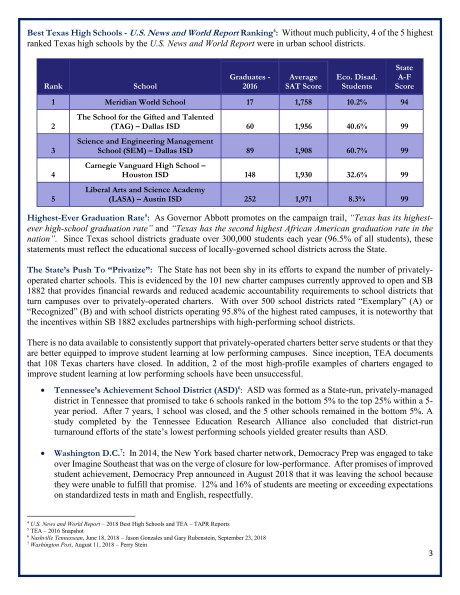
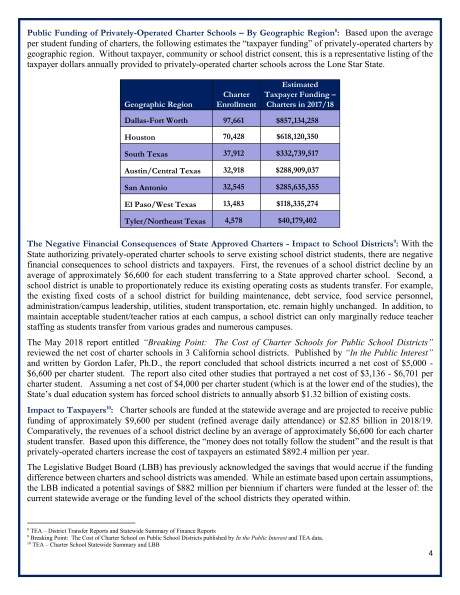
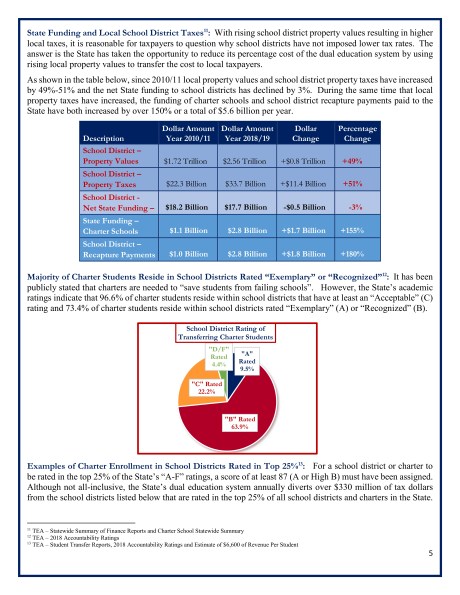
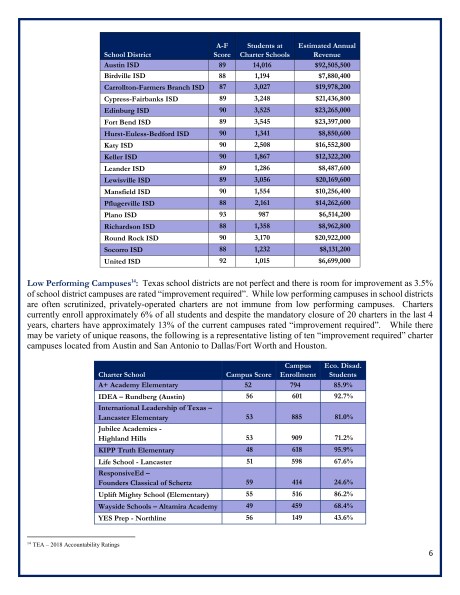
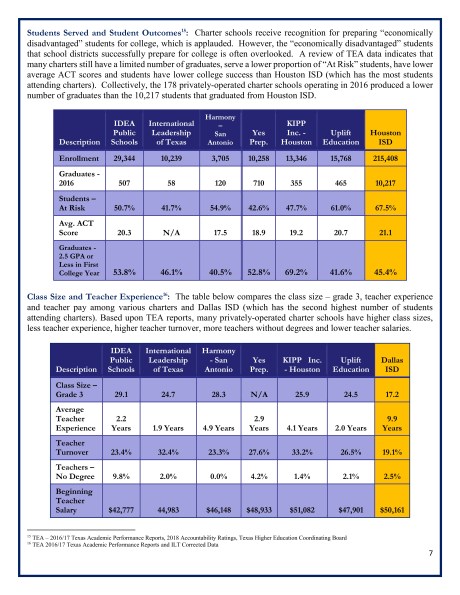
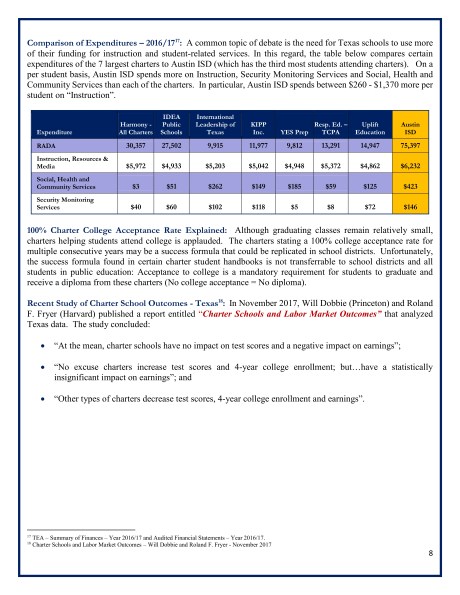
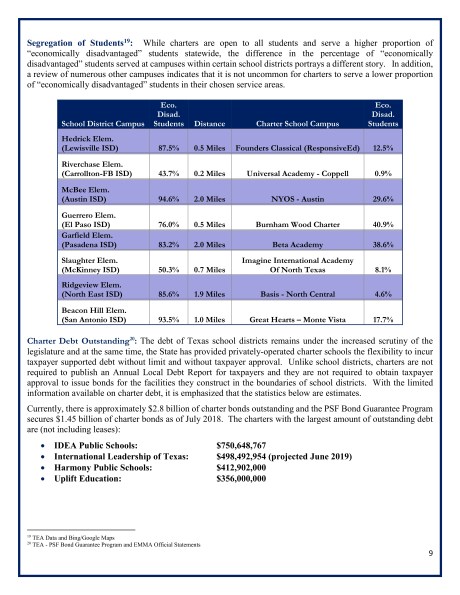
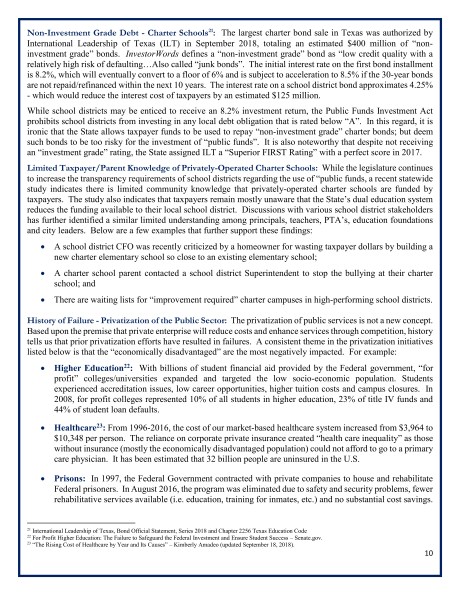
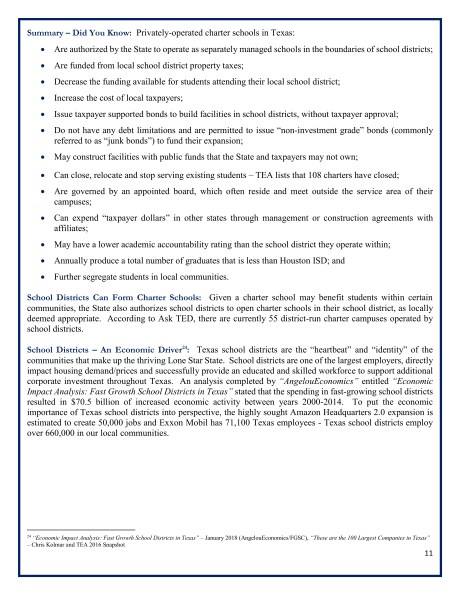
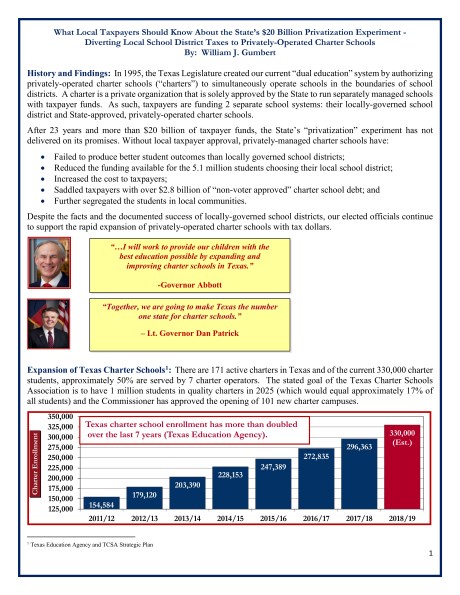
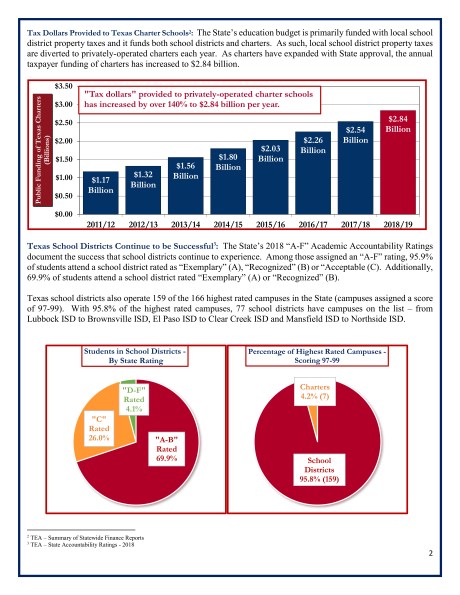
This is an important collection of data about the funding of public schools and charter schools in Texas. Do you think that taxpayers know that they are funding two separate school systems, one governed by elected, accountable school boards and the other governed by private, self-selected, unaccountable school boards? Do you think that the public knows that district public schools outperform charter schools?

What Local Taxpayers Should Know About the State's $20 Billion Privatization Experiment (October 2018)tax2tax3tax4tax5tax6tax7tax8tax9tax10tax11tax12