Archives for category: Privatization

Inspire Charter Schools does not inspire confidence in its academics, its finances, or its integrity. Inspire makes money by getting state money to underwrite home schooling, with state-subsidized field trips and lots of folderol.

Things got so bad that the Inspire chain was kicked out by the California Charter Schools Association, the powerhouse lobbyists for the charter industry. There is just so much embarrassment that the CCSA can tolerate and this is one of those rare occasions. In the past, CCSA has defended criminal charter operators, but drew the line at Inspire and called for an independent audit of its financials.

The California Charter Schools Association has expelled the Inspire home charter school network from its membership and is now calling for a third-party investigation, citing concerns about the network’s operational and governance practices.

At the same time, a group of county superintendents from across the state has asked a state agency to audit Inspire, though the scope of that audit request and the list of superintendents requesting it have not yet been finalized.

Meanwhile, a tiny California school district said it believes an Inspire school it oversees has been violating state law. The district, Winship-Robbins Elementary, said it may shut down the school if it fails to address several concerns that the district has about its finances, academics and organizational practices.

The California Charter Schools Association announced in a statement posted Tuesday on its website that the association and its Member Council have decided to revoke Inspire’s membership. They made that decision based on a review of Inspire that the association had launched in October after hearing concerns from other charter schools….

An investigation by The San Diego Union-Tribune in August found that Inspire has grown rapidly in recent years in numbers of schools and students while relying on heavy loan borrowing, consistently posting below-average academic performance and engaging in what several say are questionable organizational practices.

Inspire allots $2,600 or more of public school funds to each student annually to spend on a list of thousands of vendors who sell field trips, academic and extracurricular classes, curriculum and more, including items such as horseback riding lessons and ski passes.

Public scrutiny of Inspire grew after 11 people were criminally indicted in May in relation to another statewide charter network called A3. San Diego County prosecutors accused A3 executives of manipulating enrollment numbers and using charter schools to funnel more than $50 million into their own pockets.

Among other “unethical” practices, Inspire was poaching students from other charter schools with promises of free tickets to Disneyland!

Another critic is Terri Schiavone, the Founder and Director of Golden Valley Charter School in Ventura. Schiavone says her school is one of many that are losing students to Inspire Charter.

“They target a school and then they try to get as many of their teachers and students as possible,” Schiavone said.

Schiavone said families and teachers are enticed by incentives like using instructional funds to buy tickets to Disneyland and other theme parks. Schiavone says there is a lack of oversight and accountability.

No one is making sure teachers are checking up on students’ work, and Schiavone says parents can buy whatever they want from vendors who she says are not fingerprinted or even qualified.

“It’s very desirable for some parents to enroll in schools in which nobody’s looking over their shoulder,” said Schiavone. “They can utilize whatever curriculum they want, including religious curriculum, which is illegal if using public dollars.”

Inspire found parents to defend the glory of home-schooling with public subsidy.

A few days ago, Inspire announced that its CEO and founder was taking a leave of absence. 


Louisiana will hold elections for its state Board of Elementary and Secondary Education on October 12. This year, as in the past, out-of-State billionaires are spending heavily to keep control of the state board to promote privatization policies. During the tenure of State Superintendent John White, a former deputy to Joel Klein in New York, the state’s ranking on the National Assessment of Educational Progress (NAEP) Is near the absolute bottom in both mathematics and reading, in both 4th and 8th grades. New Orleans has gone all-Charter and its score are in the bottom third of the state’s districts while its schools are highly segregated and stratified. This much is clear: Disruption has won control of the state board but done nothing to improve education.

BESE recommendations from veteran educator Michael Deshotels –
 
Dear Friend of Public Education:
 
With just a few days left before the election of a new BESE, you can help restore sanity and independence to our State Board of Education.
 
Out of state donors are making huge contributions to elect candidates that LABI  and John White will totally control. You will surely see their ads in your mailbox and on radio and television. Do not be deceived! These are not friends of public education. They will be committed to John White,  school privatization, obsessive testing, crushing test prep., etc.  But the results of these so called reforms have been terrible using the very measures they (the reformers) think are so important; Our ranking on NAEP is the worst ever! Why would we want to continue failed policies? Just so that LABI never has to admit that they were wrong, that they know noting about education, and that our students are suffering instead of thriving because of their takeover of education?  See this latest post on my blog. http://louisianaeducator.blogspot.com
 
Here is my abbreviated voting guide listing independent minded, solid public education advocates. Please do your best to get them elected!
 
District 1: including St. Tammany and Jefferson. I recommend Lee Barrios
 
District 2: including Orleans, St. Charles, St. John, St. James and part of Assumption: I recommend Dr. Ashonta Wyatt
 
District 3: including St. Bernard, Plaquemines, Lafourche, Terrebonne, St. Mary, Iberia, St. Martin, part of Iberville and part of St. Landry: I recommend Janice Perea.
 
District 5: including Northeast LA and down to Rapides and Evangeline Parishes. I recommend Dr. Stephen Chapman
 
District 6: including EBR, Livingston, Ascension, Tangipahoa, and Washington Parishes. I recommend Gregory Spiers
 
District 7: including Southwest LA. I recommend Timmie Melancoin
 
District 8: including part of EBR, East and West Feliciana, St. Helena, Iberville, Pointe Coupee, Avoyelles, part of St. Landry part of St. Martin, and part of Assumption. I recommend Vereta Lee.


Bill Phillis, founder of the Ohio Coalition for Equity and Adequacy of School Funding, warns that privatizers run for local school boards, as they have in Atlanta and other cities. Teach for America has a special outfit called “Leadership for Educational Equity,” which trains its recruits to go into politics and helps to fund their campaigns.

Bill Phillis writes:

Anti-public school advocates run for seats on boards of education to attempt to completely privatize districts

Privatization of the public common schools takes many forms:
·        Charter schools
·        Vouchers
·        Tuition tax credits
·        Education savings accounts
·        Portfolio districts
·        State takeover that can eventually result in turning the district over to private operators
 
The most ruinous privatization tactic is for privatizers to take control of boards of education
 
Michelle Dillingham, with the Cincinnati Educational Justice Coalition, reports that some “fierce” school choice candidates are running for board of education seats in Cincinnati. The Justice Coalition has published a list of “qualities” that voters should look for when choosing a candidate. Topping the list of “qualities” is “a deep commitment to public education.” Public education is the adhesive that has held the American social order together. The education privatization craze has contributed to the fragmentation of our social order.
Phillis links to an article that explains what is happening in Cincinnati, where a TFA alum is running for the school board.
The article by Michelle DillIngham begins:

This November, voters in the Cincinnati Public School District will elect four members to the seven-member Board of Education. One contender, Ben Lindy, the founder and director of the Southwest Ohio Teach for America, has drawn significant controversy among supporters of public schools.

In his recent guest column, “Be proud of schools’ progress, but don’t settle,” (Aug. 31), Lindy’s repeated his use of the term “equity” and a “quality education for every child” are hard to swallow. The controversy surrounding Lindy comes as no surprise to those who follow the influence of Teachers for America and their agenda on public school districts.

TFA is a multi-million-dollar national organization whose main operation is to place non-education major college grads into temporary two-year teaching assignments in urban classrooms with less than two months of preparation. After their two years, the majority of TFA candidates abandon teaching and move on to other fields.

It is not hard to see why professional educators, who have invested in and achieved significant graduate and undergraduate education training, oppose this business strategy for staffing classrooms.

In the last several years, TFA has extracted over $600,000 in “finder’s fees” from our school district. Yet, a majority of TFA recruits do not stay with Cincinnati Public Schools after their two-year contract ends. TFA operates like a temp agency, paying a $5,000 “bounty” per recruit for a two-year commitment. It would make more sense to spend recruitment monies with higher education partners who can refer actual education majors.

School districts in other states have already figured out TFA is not a good return on their investment. Districts in Texas, South Carolina, California and Pennsylvania have all recently ended their contracts with TFA.

The TFA lobby has successfully diverted millions of taxpayer dollars, meant to educate the children of Ohio, to their company. Lindy was not successful in his run for state representative in 2016, but he was able to extract millions of public education tax dollars from the state legislature for TFA.

In April 2019, his joint testimony before the Primary and Secondary Education Subcommittee of the House Finance Committee helped secure another $4 million in the upcoming biennial budget for “support for ongoing development and impact of Teach for America alumni working in Ohio.” I guess he thinks TFA recruits who only spend two years in our urban classrooms now deserve another $4 million for their alumni’s “development.”

TFA is funded by billionaire elites, including the Bill Gates, Eli Broad and Walton Family Foundations. This helps explain Lindy’s confidence that he will be able to raise $250,000 to campaign for a seat whose pay is capped at $5,000 per year. It is well documented that TFA’s most influential alumni are proponents of school district takeovers, high stakes student testing, for-profit charter schools, and anti-union efforts – the most familiar to readers is likely Michelle Rhee (whom Lindy directly worked for), but there are others.

TFA, she writes, is closely tied to the Trump-DeVos privatization agenda.

Parent activist Valerie Jablow is a whistle-blower about charter school abuse in the District of Columbia.

In this post, she describes the sweet deal that KIPP has worked out to its benefit.

It is a “game of insiders,” she writes.

Ferebee-Hope is a perfect example of how the mayor on down is enabled by law and practice to ignore every member of the public regarding the future of DCPS school facilities. In the case of Ferebee-Hope, however, the consequence of that disregard to the poorest ward in the city is dire–and appears to accrue directly to the benefit of one charter (and mayoral benefactor), KIPP.

Destroying Ward 8 Education Rights

Between November 2013 and January 2014, and about 6 months after public comment ended, a clause was inserted in the Comprehensive Planning and Utilization of School Facilities Amendment Act of 2014 that allows the mayor to turn any DCPS school over for a charter at any moment. (Yes, really: see D(ii) of that link to the law.) As DC public school expert Mary Levy has noted, there was no discussion of this clause by council members at the bill’s mark-up. Indeed, until the legislation was approved by the council in April 2014, no one in the public was aware at all of this provision (nor had a chance to object to it before it was approved).

In the case of Ferebee-Hope, it thus appears the mayor is simply exercising her right to turn the facility over for charter RFO without public deliberation.

But the loss of Ferebee-Hope as a school of right has far-reaching ramifications for Ward 8 DCPS schools of right, some of which are projected to be overcapacity in that area in less than a decade. Without Ferebee-Hope, there will be no way to accommodate those students in their schools of right in that area—which means that any student population in that area (currently very high and projected to grow 16% by 2025, per an August 8 community presentation by the deputy mayor for education (DME)) will inevitably benefit whatever charter school locates in Ferebee-Hope…

Charter schools in DC often complain that they struggle for facilities–but some appear a bit more, uh, equal to that struggle than others.

Indeed, this scheme ensures that whatever the public wants, or doesn’t want, with respect to their DCPS facilities can ultimately get reduced to whatever a charter school wants or doesn’t want–depending on how well-informed that charter school is, of course. Though we may never know the insider’s game here fully, certainly DCPS deputy chancellor Melissa Kim knows well KIPP’s ambitions, having worked for the charter before directly coming to DCPS as a central office administrator–and after showing no hesitation about the possibility of future DCPS closures.

Public facilities are simply closed and handed over without public involvement to private corporations. Anything wrong with that? Yes, everything. It is a theft of public property to give it away to a private charter corporate chain.

William J. Gumbert has been writing a series of articles about charter schools in Texas, which are undermining the state’s underfunded public schools and do not perform any better than public schools.

Texas Charter Schools – Perception May Not Be Reality

IDEA Public Schools: Remove the “Rose-Colored Glasses” and Many RED FLAGS Appear

By: William J. Gumbert

IDEA Public Schools (“IDEA”) is the fastest growing privately-operated charter school in Texas and its rapid expansion in local communities is funded and controlled by “special interests” that desire to “privatize” public education. With promotions of a “100% College Acceptance Rate” and students being “Accepted to the College or University of Their Choice”, a full-time staff is employed to advocate for IDEA in local communities and to aggressively recruit “economically-disadvantaged” parents dreaming of a better life for their children.

Ann Landers said: “Rose-colored glasses are never made in bifocals. Nobody wants to read the small print in dreams”. But with the education of children and millions of taxpayer dollars at stake, the small print is vitally important. Part 4 of this 5-part series removes the “rose-colored glasses” that are inherent in the promotions of IDEA Public Schools to provide parents, taxpayers and communities an opportunity to review the potential RED FLAGS that appear when the light is solely focused on the facts of the rapidly expanding, privately-operated charter school.

Overview, Growth, Taxpayer Funding and Financial Benefits: As a privately-operated charter, IDEA has been approved by the State to separately operate in community-based school districts with taxpayer funding. Since opening with 150 students in 2000, IDEA has been consistently focused on expanding its footprint. In this regard, IDEA strategic growth plan states it will serve 100,000 students by 2022 as new campuses are opened in Austin, El Paso, Houston, Midland/Odessa, Rio Grande Valley, San Antonio, Tarrant County, Louisiana and Florida. At 100,000 students, IDEA would be the 31st largest school system in the United States.

With an appointed board in the Rio Grande Valley, the expansion of IDEA is orchestrated without the involvement of local communities and taxpayers. IDEA’s growth is solely controlled by its appointed board, the State and its private donors. With the legislature supporting the expansion of privately-operated charter schools, the State recently approved IDEA to open 21 additional campuses across Texas.

IDEA’s flexibility to expand has resulted in more and more taxpayer funding. Since its first graduating class of 25 students in 2007, IDEA’s taxpayer funding has increased from $14.9 million to approximately $440 million per year. This represents an increase in taxpayer funding of 2,853% in only 13 years.
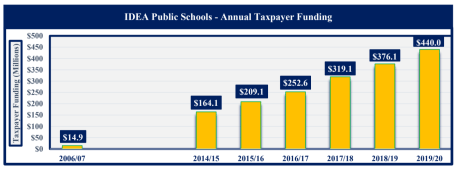
Screen Shot 2019-09-14 at 10.14.11 PM

IDEA’s growth has also proven to be lucrative for its leadership team. As disclosed on its 2017 IRS Form 990, the Chief Executive Officer and Superintendent collectively received financial benefits totaling $968,208 in year 2017/18. In addition, 8 other IDEA administrators received financial benefits totaling between $219,070 – $466,006. On average, IDEA’s Central Office administrators have a salary of $200,249, while the statewide average salary for Central Office administrators in all Texas public schools is $102,300. 2

Other benefits for IDEA’s leadership team include free travel for family members to IDEA events and the potential use of IDEA’s private airplane secured through a long-term lease. That’s right, a taxpayer-funded “charter” school targeting underserved communities uses a private plane for “charter” flights.

Special Interests are Controlling and Directing IDEA’s Expansion – Not Communities and Taxpayers: As a privately-operated public school, IDEA’s expansion is not subject to the approval of local communities. Rather, IDEA’s expansion is controlled, directed and funded by “special interests” that desire to “privatize” public education. IDEA’s growth strategy proves this: “new regional expansions are the result of community supported education reform groups soliciting and inviting IDEA to open in their region and concurrently offering substantial startup and operational funding…”.

As shown below, IDEA has received financial commitments totaling over $150 million from private donors to expand in various regions of the State. It is important to emphasize that these financial commitments are contingent upon IDEA following the criteria specified by the donor (not parents, communities or taxpayers), which includes the opening of a specified number of new IDEA campuses in each region.

Private Donor

Commitment to IDEA

Expansion Region

Permian Strategic Partners

(Scharbauer and Abell-Hanger Foundations)

$ 55,000,000

Midland/Odessa

Charter School Growth Fund

(Gates and Walton Family Foundations)

$ 23,800,000

Rio Grande Valley

KLE Foundation

$ 23,558,800

Austin

CREEED Foundation (Hunt Family Foundation)

$ 17,000,000

El Paso

Laura and John Arnold Foundation

$ 9,500,000

Houston

Sid W. Richardson Foundation

$ 5,774,000

Tarrant County

Kleinheinz Family Foundation

$ 5,774,000

Tarrant County

Ewing Halsell Foundation

$ 5,500,000

San Antonio

Walton Family Foundation

$ 5,417,800

Tarrant County

Choose to Succeed and City Education Partners

(George W. Brackenridge Foundation)

$ 4,528,351

San Antonio


IDEA Reduces the Funding of Community-Based School Districts by an Estimated $350 Million Per Year: IDEA’s expansions are typically promoted with much publicity and fanfare. But such announcements routinely fail to mention the negative financial impact to local school districts that result from IDEA’s expansion. In this regard, Newton’s Third Law – “for every action, there is an equal and opposite reaction”, applies to education funding. In most cases, there is not any additional funding provided for IDEA to operate in communities as local public education funding is finite. As IDEA enters a community, the available funding must be divided amongst IDEA and the existing community-based school districts. In other words, the funding provided to IDEA will directly reduce the funding and ability of community-based school districts to simultaneously serve students. At this time, it is estimated that IDEA’s expansion in local communities has reduced the funding of community-based school districts by $350 million per year.

IDEA Has Lower Teacher and Principal Experience and Larger Class Sizes: Most parents likely prefer for their child to attend a school that deploys lower “student to teacher” ratios and smaller class sizes. Parents are also likely to prefer teachers and principals with more experience. But IDEA’s “education model” defies these logical preferences. According to Texas Academic Performance Reports (“TAPR”) published by the Texas Education Agency (“TEA”), IDEA’s average class size in the 3rd grade is 28.9 students or 9.9 more students than the statewide average. In addition, while IDEA publicly advertises that it has “Expert Teachers”, the average experience of IDEA’s teachers is only 1.9 years and 90.9% of IDEA’s teachers have 5 years of experience or less. In comparison, the average teacher experience for all Texas public schools is significantly higher at 10.9 years. Teacher turnover has also been historically high at IDEA with 22.1% of teachers leaving each year, which is 33.1% higher than statewide average. 3

Maybe IDEA has figured out how to achieve its promoted results with larger class sizes, lower experienced staff and higher teacher turnover. But if a child was needing to see a doctor, I think most parents would prefer a doctor with 10.9 years of experience, fewer patients and longevity within the community.

COMPARISON OF IDEA PUBLIC SCHOOLS AND STATE AVERAGE – TEXAS PUBLIC SCHOOLS

Teacher and Principal Experience, Class Size and Turnover

State Average – Texas Public Schools

Description

IDEA

Public

Schools

19.0 Students

CLASS SIZE – GRADE 3

28.9 Students

18.7

NUMBER OF STUDENTS PER TEACHER

15.1

10.9 Years

AVERAGE TEACHER EXPERIENCE

1.9 Years

37.3%

TEACHERS WITH 5 YEARS OF EXPERIENCE OR LESS

90.9%

6.3 Years

AVERAGE EXPERIENCE – SCHOOL PRINCIPALS

2.7 Years

16.6%

ANNUAL TEACHER TURNOVER

22.1%


COMPARISON OF IDEA PUBLIC SCHOOLS AND STATE AVERAGE – TEXAS PUBLIC SCHOOLS

Teacher and Principal Experience, Class Size and Turnover

IDEA’s Per Student Expenditures for Instruction and Student Services are Significantly Below Statewide Average: Like a household or a business, the expenditures of a public school can provide insight into the priorities of the school. Once again, IDEA’s unique model defies the norm. In comparison to all Texas public schools, IDEA spends:

  • 17.3% less per student on instruction;
  • 91.2% less per student on career and technical training;
  • 65.5% less per student on extra-curricular activities to supplement the education of students;
  • 43.6% less per student on students with disabilities; and
  • Zero dollars to educate students with a discipline history as such students are excluded from enrolling at IDEA.

However, IDEA does spend 99.7% more per student on “School Leadership/General Administration”. It is interesting to note that in comparison to the statewide per student average, the lower dollar amount that IDEA spends of “Instruction” is essentially equal to the higher dollar that IDEA spends on “School Leadership/General Administration”.

COMPARISON OF IDEA PUBLIC SCHOOLS AND STATE AVERAGE

Per Student Expenditures

State Average – Texas Public Schools

Description

IDEA

Public

Schools

$ 5,492

INSTRUCTION

$ 4,543

62.7%

INSTRUCTION EXPENDITURE RATIO

50.9%

$ 299

EXTRA-CURRICULAR ACTIVITIES

$ 103

$ 296

CAREER AND TECHNICAL TRAINING

$ 26

$ 75

ALTERNATIVE EDUCATION

$ 0

$ 908

SCHOOL LEADERSHIP/GENERAL ADMINISTRATION

$ 1,813

$ 174

SOCIAL WORK, HEALTH AND COMMUNITY SERVICES

$ 62

$ 1,157

STUDENTS WITH DISABILITIES

$ 652


IDEA Serves a Lower Percentage of “At Risk”, “Special Education” and “Disciplinary” Students: It is true that IDEA serves primarily “economically-disadvantaged” students. But every “economically-disadvantaged” student is unique; and some students require more attention and resources. These include students that are categorized by the State as “At Risk” of dropping-out, “Special Education” due to a physical or learning disability and those with a “Disciplinary” history.

While IDEA publicly promotes that it is “Open to All Students”, IDEA’s enrollment eligibility criteria states that it may “exclude” students with a “Disciplinary” history. In 2017/18, IDEA enrolled zero “Disciplinary” students and as such, IDEA is not really open to all students. In addition, data published by TEA demonstrates that IDEA serves a significantly lower percentage of “At Risk” and “Special Education” students than the community-based school districts from which they recruit students. While there could be many reasons for this, it may be that IDEA is designed to only appeal to a certain segment of students in the communities they operate within.

Student Description

Austin ISD

Cypress-Fairbanks

ISD

El Paso ISD

Fort Worth ISD

Ector County ISD

Northside ISD – (San Antonio)

IDEA Public Schools

At Risk

51.3%

44.7%

56.3%

77.8%

57.4%

47.0%

45.9%

Special Education

10.9%

8.0%

10.7%

8.3%

8.4%

11.6%

5.2%

Disciplinary Placement

1,140

1,131

1,049

674

555

1,374

0

IDEA Has a Small Number of Graduates and an Alarming High School Student Attrition Rate: While any high school graduate is to be celebrated, the actual number of IDEA graduates remains relatively small for a charter that has been approved by the State to expand to 83,000 students. Based upon information published by TEA, in years 2015-2017 IDEA only averaged 571 graduates, which is comparable to the number of graduates at Coronado High School in El Paso ISD.

Additionally, the high attrition rates of IDEA high school students indicate that its “educational model” may not be fulfilling the needs of all students. As shown below, 24.8% of students enrolled in an IDEA high school during years 2015-2017 did not make it to graduation. In each year, an average of 202 students left IDEA to attend another Texas public high school. In other words, only 3 of every 4 high school students graduate from IDEA as 1 of every 4 students leaves to enroll at a community-based school district or other Texas public high school.

Graduating

Class

Beginning 9th Graders

No. of Students – Transferring to Another Texas Public School

Actual Graduates

Change – 9th Graders Less Actual Graduates

Percentage Change – 9th Graders Less

Actual Graduates

2015

747

224

539

-208

-27.8%

2016

670

181

500

-170

-25.4%

2017

865

200

675

-190

-22.0%

3-Year Average

761

202

571

-189

-24.8%

IDEA Public Schools and Community-Based School Districts Targeted for Expansion

2017/18 Enollment Demographics

IDEA PUBLIC SCHOOLS

Graduation Summary and High School Student Attrition – Classes of 2015-2017

IDEA’S “100% College Acceptance Rate” is a False and Misleading Promotion: IDEA’s promoted legacy is that “100% of (Students/Seniors/Graduates) are Accepted to College” and they have even promoted in formal documents that “100% of Graduates are Accepted to the College or University of Their Choice”. But based upon the facts listed below, these promotions are simply not true and are “materially misleading” to prospective parents, many of which are “economically-disadvantaged”. 5

  • First, IDEA does not disclose that its college acceptance rate is artificially manipulated by its graduation requirements, which REQUIRES students to be accepted to a 4-year college/university in order to graduate.
  • Second, IDEA fails to disclose its high student attrition rate as 1 of every 4 students enrolled in an IDEA high school transfers to another Texas public high school prior to graduation.
  • Third, IDEA does not disclose that its number of graduates is relatively small, ranging from as few as 25 students to 571 students in 2017, and are not comparable to the community-based school districts it operates within. Statewide, over 300,000 students graduate from Texas high schools each year.
  • Third and most importantly, 125 IDEA graduates applied to a 4-year Texas college/university in years 2012-2016 and were not accepted according to latest data published by “tpeir-Texas Education Reports”,
  • Fourth, the misleading nature of the statement that “students are accepted to the college or university of their choice” speaks for itself and such a statement raises the question of IDEA’s real motivations.

IDEA Graduates Have a Lower College Graduation Rate: In recent years, IDEA has attempted to broaden its appeal by promoting its unique model and curriculum is preparing students for success in college. For example, IDEA’s Student Handbook and IMPACT Magazine that is prepared for students, parents and supporters includes the following statements:

  • “IDEA has focused on raising the achievement levels and expectations of students who are underserved so they have the opportunity to attend and succeed in college”;
  • “Since inception, IDEA has promised countless families that we will get their child to and through college”; and
  • Vision: To ensure the state of Texas reaches its fullest potential, IDEA will become the region’s largest creator of college graduates.

Despite these statements, the college graduation rate of IDEA students is significantly lower than college bound students graduating from community-based school districts in the geographic areas it serves. According to “tpeir – Texas Education Reports”, only 36.9% of IDEA’s 2012 class of 122 students that enrolled in a 4-year Texas college/university had graduated by 2017. In comparison, the college graduation rate for college-bound students in community-based school districts targeted by IDEA for expansion ranged from a minimum of 50.2% to a high of 84.1%.

Description

Austin ISD

Cypress-Fairbanks

ISD

El Paso ISD

Fort Worth ISD

Ector County ISD

Northside ISD (San Antonio)

IDEA Public Schools

Enrolled

872

1,409

1,129

525

190

1,120

122

Graduated

603

1,185

567

323

145

872

45

Graduation Percentage

69.1%

84.1%

50.2%

61.5%

76.3%

77.8%

36.9%

IDEA Public Schools and Community-Based School Districts Targeted for Expansion

Class of 2012 Enrolling and Graduating From 4-Year Texas College/University by 2017

IDEA Graduates Have Lower Success During Initial Year of Attending a 4-Year Texas College/University: There may be many contributing factors for the lower college graduation rate of IDEA students and unfortunately, poverty may be one. However, information published by the Texas Higher Education Coordinating Board indicates poverty is not the only one.

Of the 467 trackable graduates within IDEA’s class of 2018 that enrolled in a 4-year Texas public college/university, 37% had a GPA below 2.0 and an additional 21% had a GPA below 2.5 in their initial year. In other words, despite IDEA’s promoted focus on preparing students to succeed in college, 58% of IDEA’s 2018 graduates had a GPA below 2.49 in their initial year of attending a 4-year Texas public college/university. 6

Closing: As IDEA Public Schools expands in your community at the direction of privately funded “special interests” and your community relinquishes control of certain schools and taxpayer funding to the privately-operated charter, you deserve to know the facts.

To me, the facts do not support IDEA’s self-proclaimed success as many RED FLAGS appear when the “rose-colored glasses” are removed from IDEA’s promotions. In addition, the facts are very similar to the circumstances of previous attempts to “privatize” public services that failed to fulfill their promises. In this regard, the factual similarities include the promotion by “special interests”, lower expenditures to deliver public services, fewer public services, deployment of less experienced staff, higher administrative costs, employment of full-time promotional staffs and misleading advertisements, targeting of prospective customers, high turnover and the denial of service to certain customers.

But these are only my thoughts and with the future of children and communities at stake, I encourage you to do a little homework and form your own conclusions. Afterall, it’s your students, your schools, your tax dollars and your community.

DISCLOSURES: This material solely reflects the opinion of the author and the author has not been compensated in any manner for the preparation of this material. The author is a voluntary advocate for public education. The material is based upon various sources, including but not limited to, the Texas Education Agency, Texas Academic Performance Reports, tpeir-Texas Education Reports, Texas Higher Education Coordinating Board and other publicly available information. While the author believes these sources to be reliable, the author has not independently verified the information. All readers are encouraged to complete their own review of IDEA Public Schools, the material referenced herein and make their own independent conclusions.

Michigan blogger “Up North Progressive” describes a clever, underhanded bait-and-switch pulled by a for-profit charter founder. 

He needed money for a new school and he showed plans of an expansive campus. Once he got the money, the reality emerged that the new school would be in an industrial office building surrounded by a parking lot, not playing fields.

For-profit Charyl Stockwell Academy likes to call itself a school district even though they don’t have boundaries, an elected school board, nor can they hold elections to approve bonds or millages. Those are methods of funding reserved for real public school districts that have real boundaries and real elected school boards. Charyl Stockwell Preparatory Academy plans to expand their business to a third building just for the middle school aged customers in 2020.

When for-profit charter schools want to expand, they have to either take out a loan or ask for donations. Sometimes, they even embezzle money from one for-profit charter school to pay for another, and then ask the non-elected board of the first for-profit charter school to call the stolen taxpayer’s school funding a loan so they can avoid paying taxes on the money they embezzled.

Last spring Chuck Stockwell, founder of Charyl Stockwell Academy, decided to show parents of children attending the middle school in 2020 designs for a brand new building at their big fundraiser event, the Beluga Ball. Parents were impressed with the plans for the new school Stockwell promised to break ground that spring, and would be completed in time for fall of 2020. The location for this project was “Brighton Interior Drive just around the corner from the present CSPA campus.” Plans shown to the parents with images and a videoconsisted of a new, breathtaking modern school with enough land to provide adequate outdoor space for students.

The catch of course was in order to begin construction this new building for the CSA franchise Chuck needed money to fund the project. Parents believing they were getting a brand new school building dug deep and donated funds to CSA.

Then Up North Progressive explains what really happened and reminds parents that they have until October 2 to enroll their child in a real public school.

That is today! Change now or the charter will vacuum up your child’s tuition money for the entire year even if you withdraw him or her.

Max Brantley is editor of the Arkansas Times, where he courageously confronts the depredations of the powerful Walton family against the public sector.

In this post, he summarizes the Waltons’ current efforts to take over the Little Rock school district, so they can eliminate public schools and replace them with charters. Any Democrat who thinks that charter schools are “progressive” should visit Arkansas, Arizona, Florida, North Carolina, or any other red state where the billionaires are doing their best to destroy public education.

He begins:

I’ve collected some items today related to the 2019 Little Rock school crisis, in which the Asa Hutchinson administration is attempting to supercharge the agenda of the Billionaire Boys Club, led by the Walton Family Foundation, to end a meaningful Little Rock public school district.

The plan is to continue to build charter schools (lightly regulated private schools operated with public money); to bust the teachers union, and to create a district of haves and have-nots. Under the Hutchinson plan, prosperous neighborhoods would have a semblance, but not complete democratic self-determination in schools. Poor neighborhoods (generally heavily black) would remain under control of a state Board of Education that has failed them miserably in five years as a supervisor.

He cites a post from this blog, describing the federal study of NAEP that concluded that charter schools do NOT outperform public schools.

He notes that even the Walton-funded University of Arkansas Department of Educational Reform acknowledges that test scores are not all that important.

He writes:

You get a district with a high poverty rate and you get lower test scores. Governor Hutchinson wants to punish Little Rock for that, while holding harmless dozens of other schools and districts with similar low scores. Here, they blame the teachers.

He cites Mercedes Schneider’s expose of Oregon-based Stand for Children, which is pouring big money into the Louisiana race for state board of education, and notes that the Waltons are financing their own efforts in Arkansas to undermine the public schools of Little Rock to make it easier to take them over and end public education.

And then he turns to Brett Williamson, a member of the state school board appointed by Governor Asa Hutchinson, who seems to specialize in insulting parents and supporters of public education. Williamson is one of the current crop of Republicans who do not believe in local control, especially for districts enrolling children of color.

Like Valerie Strauss of the Washington Post and Karen Francisco of the Fort Wayne Journal-Gazette, Max Brantley is a national treasure who is fearless in confronting the privatization behemoths owned by billionaires.


Last June, blogger Michael Kohlhaas received a huge trove of documents from the Green Dot Charter Chain in response to his request filed under the state’s Public Record Act. He has been reviewing these documents and releasing them.

In this post, he summarizes a Powerpoint presentation (and provides a link to the actual document) in which the California Charter Schools Association lays out its goals.

He headlines the post:

A SECRET POWERPOINT FROM THE CALIFORNIA CHARTER SCHOOLS ASSOCIATION REVEALS 2019 LOBBYING PRIORITIES AND STRATEGIES — IN PARTICULAR THEY CONSIDER POSITIONING THEMSELVES AS CHAMPIONS OF EQUITY AND EQUALITY BUT WORRY THAT THEIR SUPPORTERS MIGHT SEE THAT AS “MISSION CREEP” — THEY CONSIDER SUPPORTING EQUAL ACCESS TO HIGH QUALITY SCHOOLS BUT WORRY THAT SUCH A POSITION MIGHT ALIENATE THE “CHOICE WING” OF THEIR BASE — THEY LIST AMONG THE GREATEST THREATS THE BARE POSSIBILITY THAT CHARTER SCHOOLS MIGHT BE REQUIRED TO EARTHQUAKE PROOF THEIR BUILDINGS TO THE SAME STANDARD AS PUBLIC SCHOOLS — IN SHORT THIS IS A SEETHING STEW OF PRIVILEGE — AND ARROGANCE — AND CLUELESS SELF-EXPOSURE — IN OTHER WORDS MORE OF THE DAMN SAME STUFF!…

If you want to understand this powerful lobbying group, which spends millions of dollars every year to protect the charter industry and to block accountability and transparency, you have to read the post.

He adds:

As you must know by now the California Charter School Association is the premiere wingnut loony tunes mouth-frothing privatization advocacy organization in the state. And we’ve been learning an unprecedentedly awful1 lot about them since June due to a huge set of records2 released by Green Dot Charter Schools in response to a request I made of them under the California Public Records Act.

These records are so rich, so complex, so voluminous, that it’s taking me freaking forever to go through them, sort them, write about them, and I’m therefore laying them on you in increments. And the increment at hand is this powerpoint presentation, created by the CCSA in August 2018 to explain the next year’s goals and fears to their members. I have also exported this as a PDF for ease of use.3There are also JPEGs of the slides at the end of the post if that’s better.

And my goodness, what a revealing heap of steaming and pernicious arrogance we have here. Under recent wins, for instance, we learn that the CCSA “Conditioned Legislature to defeat a half dozen harmful policy and budget proposals in preparation for less reliable Executive branch.” That’s the California Charter School Association right there telling how they “conditioned” the Legislature in preparation for Gavin “Less Reliable than Jerry Brown” Newsom’s ascension to the throne.

And further down the line we learn the assumptions behind CCSA’s policymaking agenda for 2019, probably actually for always, but I don’t (yet) have the evidence. And again, what’s revealed is appalling but not surprising. For instance they pledge that “CCSA will seek compromise on legislation that minimally constrains flexibility but only in exchange for new entitlements.” This item casts the CCSA’s support of SB126, which makes it exceedingly clear that charters are subject to both the CPRA and the Brown Act, in an interesting light.

Perhaps in 2018 they thought that this new law only “minimally constrain[ed] flexibility” and that they were going to get a bunch of goodies in return. But I’m willing to bet they’re rethinking that concession now given that the fruits of a single CPRA request have subjected them to months of pain-writhing exposure, some scathing articles in the Los Angeles Times, and may ultimately end the career of theirmanchild knight in shining hair product, Nick Melvoin.

And their listing of what they see as the greatest threats against them for 2019 is very instructive as well. I’m not up on the details enough to comment on all of these but the ones I do understand are as appalling as the rest of it.

If you thought that the CCSA was discussing how to improve education for all of the state’s children, you would be wrong. Their discussion is about power and protecting the self-interest of their industry.

Jan Resseger reports here on Stephen Dyer’s astute analysis of Ohio’s state budget. Dyer is a former legislator who is now an Education Policy Fellow at Innovation Ohio.

This is Dyer’s report. Read it and weep. Ohio’s rightwing Republicans care more about campaign contributors than they care about the state’s students or the quality of education.

In looking at the plums for charters and vouchers, please bear in mind that most charter schools in Ohio are low-performing and score far below public schools, even in urban districts. And remember too that a study of Ohio’s voucher program sponsored by the rightwing Thomas B. Fordham Institute concluded that students who used vouchers actually lost ground academically. So, when you see legislators increasing funding for vouchers and reducing oversight of charters, be aware that Ohio is underwriting and rewarding failure.

Resseger writes:

In the 2020-2021 biennial Ohio budget signed into law in July, lawmakers quietly embedded the radical expansion of school privatization. Rewards for charter schools and tuition voucher expansion are written into the budget in a lots of little ways, however, which means that, during the budget debate, few noticed the overall significance of exploding state support for school privatization. A new report released last week by Innovation Ohio, however, connects the dots among several measures which together will undermine oversight of charter schools and at the same time radically expand tuition vouchers. The report includes an examination of the fiscal implications for local public school districts.

The former chair of the Ohio House Education Subcommittee of Finance and now Innovation Ohio’s education policy fellow, Steve Dyer authored the report, which ought to be essential reading for legislators and a broad range of citizens—from experts to people who have not previously tracked the issue. Dyer writes a basic primer and at the same time an analysis sophisticated enough to teach experts something new.

Dyer begins: “When Governor Mike DeWine signed HB166 into law, he approved a budget that lawmakers had packed full of little-noticed gifts to those who seek to erode support for traditional public schools through a proliferation of charter and private school options funded at taxpayer expense.”  Dyer explains that the new Ohio budget:

  • weakens Ohio’s 2015 charter school oversight law that mandated automatic closure for academic failure after two years;
  • weakens standards for Ohio’s already deplorable sector of “dropout recovery” charter schools;
  • weakens Ohio’s oversight of its many charter school authorizers; and
  • increases the transfer of state and even local taxpayer dollars to private—mostly religious—schools.

Read this summary of the state’s preferential treatment of failing charters and see if you can overcome an impulse to gag:

Although in 2015, the state cracked down on academically failing charter schools by mandating their closure after two years of failing test scores, the new budget awards these schools an extra, third year to stay in business. The new budget gives 52 schools which had been preparing to close another year of life. Dyer adds: “Interestingly, of the 52 charters that were scheduled to be closed under the old standard, 34 are run by for-profit charter school operators, including almost 20 percent of the former White Hat schools now being operated by Ron Packard—the founder of K-12 Inc.—the nation’s largest (and most notorious) online charter school operator. Another big operator set to take a hit was J.C. Huizenga’s 10 Ohio-based National Heritage Academies. Six of those were on the chopping block before the legislature offered a legislative reprieve. Huizenga is an acolyte of Betsy DeVos—the controversial U.S. Secretary of Education—and his political connections have kept his schools afloat for years, despite complaints….”

The new state budget also weakens standards at a set of charter schools described by their promoters as providing opportunity for students who have dropped out of school. While the education of school dropouts is a worthy purpose, in Ohio, the state has been providing millions of dollars of support for schools that clearly fail to accomplish that stated goal: “Some graduate less than two percent of their students in four years and less than 10 percent in eight years. The state’s already lax standards only require that dropout recovery schools graduate eight percent of their students in four years.”  Before they can graduate, students in these schools must pass a state-approved test, but the new budget permits these schools, “to adopt another, easier test, and reduces the passing score.” It is predicted that the change in standards will save some of these schools from mandatory closure.

Ohio’s legislature is either bought and paid for by privatization advocates (very likely) or it is dominated by ideologues who want to reward failure regardless of how many children are miseducated.


The charter Industry faction on the Los Angeles School Board wants to introduce a Jeb Bush-style evaluation system to rank and rate schools. It hasn’t worked anywhere else in the nation, so why not introduce it in Los Angeles.

Every other state has demonstrated that the school grading system ranks schools by the income of parents. Schools that enroll the poorest children get the lowest grades. Schools that enroll affluent children get the highest grades.

The purpose of school grades is to set schools up to be privatized.

Sara Roos, who blogs as Red Queen in L.A., writes that the school district does not need a Yelp system. She is right.

She points out that board member Jackie Goldberg wants the school system to help schools that are in need of support, not devise a system to call them “failures.”

The charter advocates are pushing the Jeb Bush Plan because it will help build the charter industry. It will do nothing for children.