Archives for category: Parents

You remember, I hope, the saga of the New Orleans Public Schools District: Abandoned by white families, underfunded by a overwhelmingly white Legislature and Dtate School Board, the public schools were segregated and held in low regard. Then came Hurricane Katrina in 2005, which severely damaged most of the schools; the students scattered. The state stepped in and created the Recovery School District, whose job was to get the schools rebuilt and reopened under new management. To get rid of the union, the entire teaching staff (mostly Black) was fired, and teachers were allowed to reapply for their jobs.

When school opened again, most of them were privately managed charter schools, many of the newly hired teachers came from Teach for America, and the district for a time enjoyed a large infusion of funds from the federal government and large foundations, all committed to the success of the charter model.

The Hechinger Report tells the story of a new school that opened this fall. For the first time in two decades, it is a district-run public school instead of a charter school.

Be skeptical of claims about dramatic improvements in student outcomes when comparing pre-Katrina to the present. The enrollment in 2004 was nearly 70,000, and is now about 40,000.

The big story in the mass media and blogs over the past two days was the way Trump answered a question in an appearance in New York City about whether he would do anything to make child care affordable; he was asked to be specific. He gave a long (two minute) reply that was meandering and incoherent. He seemed to say that the money that the U.S. will collect from tariffs will be so huge that it will wipe out the national deficit and make everything possible, including the cost of child care, assuming that tariffs would produce revenue instead of raising consumer prices. He didn’t answer the question.

Meanwhile, in another setting, JD Vance was asked about child care. He responded that parents could ask grandparents or other relatives to help out; and he suggested lowering the certification requirements for child care providers.

The New York Times must have realized, based on the keen interest in this story, that its original reporting was inadequate. At 4:42 pm EST, the Times published a story by Michael C. Bender about what happened. With this article, The New York Times squelched persistent rumors that it was not reporting on Trump’s mental acuity.

This was the headline:

Trump and Vance Took Questions on Child Care. Their Non-Answers Said a Lot.

The former president and his running mate gave nearly equally confusing answers when asked separately this week how they would make child care more affordable.

But instead of a crisp, camera-ready reply from a seasoned three-time presidential candidate, Mr. Trump unspooled two of the most puzzling minutes of his campaign.

His answer was a jolting journey through disjointed logic about how the size of his tariffs would take care of all the nation’s children, which only raised a new, more complicated question about why he remains unable to provide straightforward answers about policies he would prioritize in a second term.

“Well, I would do that,” he said when asked if he would commit to supporting legislation to make child care more affordable, and how he would seek to do so.

“And we’re sitting down — you know, I was somebody — we had Senator Marco Rubio and my daughter Ivanka was so impactful on that issue,” Mr. Trump continued, referring to the pair’s previous push for paid family leave and expanding the child tax credit. “It’s a very important issue. But I think when you talk about the kind of numbers that I’m talking about that — because the child care is, child care, it’s, couldn’t, you know, there’s something, you have to have it. In this country, you have to have it.

“But when you talk about those numbers compared to the kind of numbers that I’m talking about, by taxing foreign nations at levels that they’re not used to, but they’ll get used to it very quickly — and it’s not going to stop them from doing business with us, but they’ll have a very substantial tax when they send product into our country. Those numbers are so much bigger than any numbers that we’re talking about, including child care, that it’s going to take care.”

Mr. Trump has long portrayed himself as the nation’s economist-in-chief, a rich businessman-turned-politician now focused on increasing the wealth of everyday Americans.

He has spent two years campaigning against rising prices for Americans, from housing to food to, yes, child care. At times, he has spoken briefly about instituting “baby bonuses” for parents of newborns, and he has said that he would consider expanding the child tax credit but has not said by how much.

Mr. Trump’s rambling answer handed Vice President Kamala Harris’s campaign an opportunity to press one of its central messages: that Mr. Trump is so out-of-touch with normal problems facing most Americans that he cannot be expected to find the solutions.

“He’s always been profoundly discursive, but this one is instructive,” said Liam Donovan, a Republican strategist. “He immediately referenced the Rubio-Ivanka effort, which is actually the right answer. He just wasn’t involved or engaged in the details. So beyond that, he just pivots to a stream of consciousness about what he knows and cares about.”

Just a day earlier, on Wednesday, Senator JD Vance, the Republican vice-presidential nominee, responded to a similar question about child care with a nearly equally confusing answer at an event in Mesa, Ariz.

Mr. Vance, like Mr. Trump, acknowledged that the issue of affordable child care was “such an important question.” But his initial answer was that parents should get help from grandparents or aunts and uncles.

“Maybe Grandma and Grandpa wants to help out a little bit more,” Mr. Vance said.

But many parents cannot rely on help from relatives — and many relatives are not in a position to help with someone else’s children. Mr. Vance seemed to acknowledge that conundrum, and pivoted to calling for fewer regulations on child-care providers, falsely saying that child-care specialists were required to have “a six-year college degree.”

“Americans are much poorer because they’re paying out the wazoo for day care,” Mr. Vance said. “Empower working families. Empower people who want to do these things for a living, and that’s what you’ve got to do.”

Mr. Trump’s answer offered little additional clarity.

The former president seemed to outline a theory that his tariffs would result in such prosperity that the nation could wipe out its $6 trillion spending deficit and pay for additional benefits, like reducing child-care costs.

“As much as child care is talked about as being expensive, it’s, relatively speaking, not very expensive compared to the kind of numbers we’ll be taking in,” Mr. Trump said on Thursday.

But Mr. Trump’s answer ignored that most economists say that the burden of tariffs are largely shouldered by middle-class consumers in the form of higher costs. Left unsaid was that he spent twice as much borrowed money during his term in the White House as President Biden has, according to an analysis by the nonpartisan Committee for a Responsible Federal Budget.

Ms. Harris has called for restoring and expanding a child tax credit and proposed a new $6,000 benefit for parents of newborns. Her child tax credit proposal would increase the maximum to $3,600 per child, up from $2,000 now.

Joseph Costello, a Harris campaign spokesman, said in a statement that the tariffs Mr. Trump is proposing as part of his “‘plan’ for making child care more affordable” would raise costs on middle-class families. “The American people deserve a president who will actually cut costs for them, like Vice President Harris’s plan to bring back a $3,600 child tax credit for working families and an expanded $6,000 tax cut for families with newborn children.”

Thursday was not the first time that Mr. Trump has punted on the question of child-care costs.

In his debate with Mr. Biden this year, before the president dropped out of the race, the moderators asked Mr. Trump twice about what he would do to help with the affordability of child care.

In his first answer, Mr. Trump went off on a series of tangents related to earlier debate topics, defending his firing of retired Gen. John Kelly as his chief of staff, denying that he had called soldiers who had died in war “suckers” and “losers,” boasting about his firing “a lot of the top people at the F.B.I.,” accusing Mr. Biden of wanting “open borders” and denouncing him as “the worst president.”

Given an additional minute to address child-care costs, the topic of the question, Mr. Trump did not mention the word once.

“Just so you understand, we have polling,” Mr. Trump began. “We have other things that do — they rate him the worst because what he’s done is so bad. And they rate me, yes, I’ll show you. I will show you. And they rate me one of the best, OK?”

Parents have parental rights, and they also have parental responsibilities. One surely is to keep your guns, if you have them, locked up. Colin Gray didn’t do that. Instead, he gave his teenage son an AR-15 type weapon for Christmas in 2023. This was after the FBI had questioned father and son about online threats to shootup the boy’s school. The father insisted that he kept his hunting guns in a safe place, and the boy denied having any thought of harming anyone.

Georgia police arrested Colin Gray, the father of the 14-year-old boy who admitted bringing an assault weapon to school and murdering four people, including two students and two teachers. The father faces multiple charges that could land him in prison for life.

If police and courts make it customary and standard to hold parents accountable for their children, especially when they allow them to obtain deadly weapons, such expectations might have a deterrent effect.

The Washington Post reported:

Before Thursday’s announcement, the teen’s grandfather, Charles Polhamus, said he wanted Colin Gray charged along with his son.
“If he didn’t have a damn gun,” Polhamus said, “he wouldn’t have gone and killed anybody….”


The charges come just months after a mother and father in Michigan became the first parents of a school shooter ever convicted of involuntary manslaughter, a less severe crime than second-degree murder. Investigators found that, in November 2021, James and Jennifer Crumbley had bought their 15-year-old son a gun, didn’t lock it up and ignored blatant warning signs before he opened fire at Oxford High in Michigan, killing four students. In separate trials, each was found guilty and sentenced to 10 to 15 years in prison, the maximum allowed.

Parental rights, parental responsibility.

Trump spoke yesterday to the Economic Club of New York–an organization composed not of economists but of people who work in the financial sector (e.g. Wall Street). At the end of his speech, he took a few questions. The last one came from a woman who said that American families were worried about the high cost of childcare, costing as much as 20% of their income. She asked Trump what he would do to help families and what specific actions he would take.

His answer was rambling and incoherent. He never answered her question.

Lawrence O’Donnell played the full question and Trump’s answer last night. Watch at 18:00.

This is an unedited transcript of his response:

Well, I would do that, and we’re sitting down, and I was, somebody, we had Senator Marco Rubio, and my daughter Ivanka was so, uh, impactful on that issue. It’s a very important issue. But I think when you talk about the kind of numbers that I’m talking about, that, because, look, child care is child care is. Couldn’t, you know, there’s something, you have to have it – in this country you have to have it.

But when you talk about those numbers compared to the kind of numbers that I’m talking about by taxing foreign nations at levels that they’re not used to — but they’ll get used to it very quickly – and it’s not gonna stop them from doing business with us, but they’ll have a very substantial tax when they send product into our country. Uh, those numbers are so much bigger than any numbers that we’re talking about, including child care, that it’s going to take care.

We’re gonna have – I, I look forward to having no deficits within a fairly short period of time, coupled with, uh, the reductions that I told you about on waste and fraud and all of the other things that are going on in our country, because I have to stay with child care. I want to stay with child care, but those numbers are small relative to the kind of economic numbers that I’m talking about, including growth, but growth also headed up by what the plan is that I just, uh, that I just told you about.

We’re gonna be taking in trillions of dollars, and as much as child care, uh, is talked about as being expensive, it’s, relatively speaking, not very expensive compared to the kind of numbers we’ll be taking in. We’re going to make this into an incredible country that can afford to take care of its people, and then we’ll worry about the rest of the world. Let’s help other people, but we’re going to take care of our country first. This is about America first. It’s about Make America Great Again, we have to do it because right now we’re a failing nation, so we’ll take care of it. Thank you. Very good question. Thank you.

Even though he didn’t answer

The Atlantic contains a lovely article by contributing writer Stephanie H. Murray about a growing movement to close streets to cars so that children can play without adult direction.

She begins:

In the summer of 2009, Amy Rose and Alice Ferguson, two mothers living on Greville Road in Bristol, a midsize city in southwest England, found themselves in a strange predicament: They saw entirely too much of their kids. “We were going, like, Why are they here?” Rose told me. “Why aren’t they outside?” The friends decided to run an experiment. They applied to shut their quarter-mile road to traffic for two hours after school on a June afternoon—not for a party or an event but just to let the children who lived there play. Intentionally, they didn’t prepare games or activities, Rose told me, as it would have defeated the purpose of the inquiry: “With time, space, and permission, what happens?”

The results were breathtaking. The dozens of kids who showed up had no problem finding things to do. One little girl cycled up and down the street “3,000 times,” Rose recalled. “She was totally blissed out.” Suddenly, the modern approach to children’s play, in which parents shuttle their kids to playgrounds or other structured activities, seemed both needlessly extravagant and wholly insufficient. Kids didn’t need special equipment or lessons; they just needed to be less reliant on their time-strapped parents to get outside.

The experiment also produced some unexpected results. As children poured into the street, some ran into classmates, only just then realizing that they were neighbors. Soon it became clear to everyone present that far more children were living on Greville Road than anyone had known. That session, and the many more it prompted, also became the means by which adult residents got to know one another, which led to another revelation for Ferguson and Rose: In numerous ways, a world built for cars has made life so much harder for adults.

The dominance of cars has turned children’s play into work for parents, who are left coordinating and supervising their children’s time and ferrying kids to playgrounds and play dates. But it has also deprived adults of something more profound. Over the years, as Rose and Ferguson have expanded their experiment to other parts of the United Kingdom, neighborhoods across the country have discovered that allowing kids to play out in the open has helped residents reclaim something they didn’t know they were missing: the ability to connect with the people living closest to them.

Modern folks tend to think that streets serve largely mobile purposes—getting cars from one place to another in swift, orderly fashion. But “prior to the automobile, streets had a ton of stationary functions,” Marcel Moran, a faculty fellow at New York University’s Center for Urban Science and Progress, told me. Streets were where people sold wares and socialized. And particularly after the United States and Europe began to industrialize, streets were the primary location for the rising number of urban-dwelling children to play, according to Jon Winder, a historian and the author of Designed for Play: Children’s Playgrounds and the Politics of Urban Space, 1840–2010. This remained the case in the U.K. and the U.S. even after playgrounds became widespread in the early 20th century. Only when cars hit the streets in larger numbers did things begin to change. Society, Winder told me, began prioritizing “the movement and storage of motor vehicles over children and their playful behavior…”

Rose and Ferguson’s project on Greville Road is of course not the first or only effort to reclaim the streets for children. In the U.K., play streets emerged roughly a century ago as a sort of compromise in the process of booting kids off the street. But after peaking in the 1960s, they largely dwindled out, to be revived only in the late 2000s. New York has had a play-streets program since 1914, and Philadelphia for more than half a century—and recently, the idea has been taken up in other U.S. cities. Chicago launched a play-streets program in 2012, followed by Los Angeles in 2015; an initiative in Portland, Oregon, hosted its first events in 2023.

In the U.K., Rose, Ferguson, and their friend Ingrid Skeels expanded their experiment in 2011 by founding Playing Out, an organization that has helped residents on more than 1,000 streets in dozens of cities across the country set up their own play sessions. These typically last for two hours and occur weekly, biweekly, or monthly.

Open the link to read the rest of the article. It’s an inspiring idea that is great for children and parents alike. Plus, it introduces neighbors to each other.

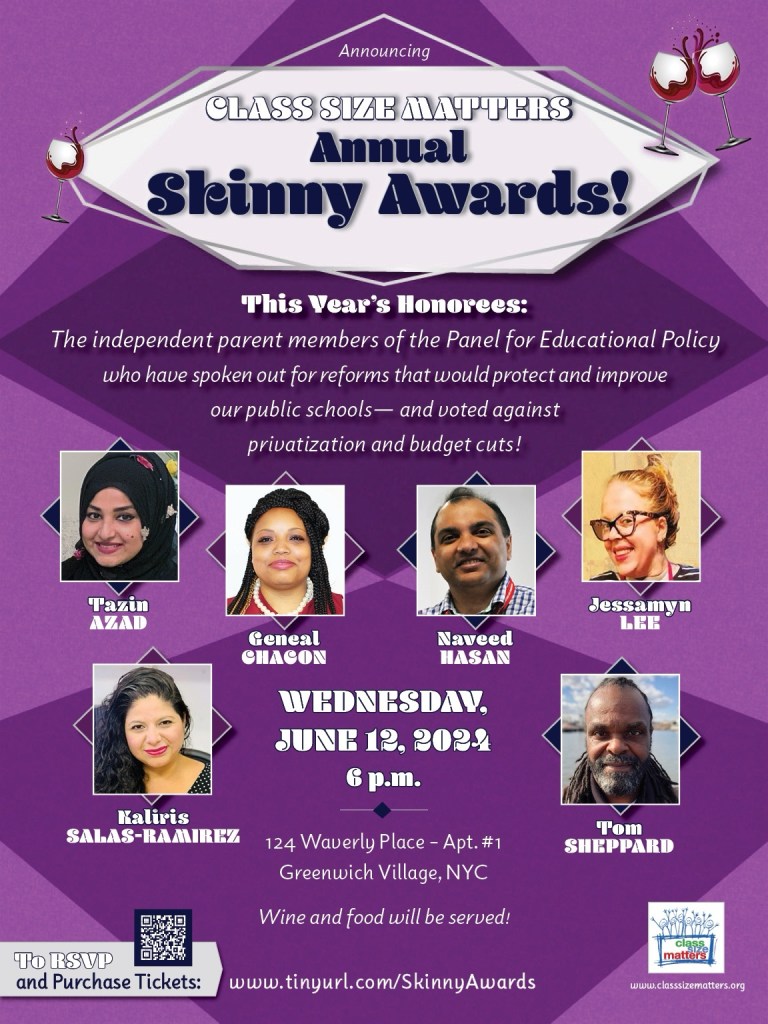
Class Size Matters is one of the most effective—if not the MOST effective—advocacy organizations for public schools in New York City. Its leader, Leonie Haimson, fights for reduced class sizes, more funding, and the privacy of student data. I am a member of the board of Class Size Matters.

On June 12, CSM will hold its annual awards dinner. The awards are called the Skinny, in contrast to the Broad Award, which was given to districts that raised test scores, closed schools, and used metrics inappropriately.

I will be there to celebrate the award winners, who are parent-members of the Board of Education who stood strong for students, teachers, and well-funded public schools.

Please join us!

Class Size Matters Skinny Award Dinner

START:Wednesday, June 12, 2024•6:00 PM

END:Wednesday, June 12, 2024•9:00 PM

LOCATION: 1st floor•124 Waverly Pl. , New York, NY 10011 US

HOST CONTACT INFO: info@classsizematters.org

Buy tickets:

https://actionnetwork.org/ticketed_events/class-size-matters-skinny-award-dinner?source=direct_link
[2024_Skinny_Awards_Announcement_final.png]
Class Size Matters Skinny Award Dinnerhttps://actionnetwork.org/ticketed_events/class-size-matters-skinny-award-dinner?source=direct_link
actionnetwork.orghttps://actionnetwork.org/ticketed_events/class-size-matters-skinny-award-dinner?source=direct_link

Leonie Haimson
Executive Director
Class Size Matters
http://www.classizematters.org
Leonie@classsizematters.org

America has had a large number of shootings over the past decades. Whenever there is a massacre of students, the public gets angry and mourns the horrific event. Politicians react along partisan lines. Democrats call for gun control; Republicans want to arm teachers and school staff.

Since the Supreme Court has decisively ruled against most gun restrictions, the Republicans have had the upper hand.

In Tennessee, the Republican-dominated legislature passed a bill yesterday to arm teachers and other school staff. This was a response to a deadly shooting at a private Christian school. Parents at that school gathered signatures against the bill, but the legislators didn’t listen.

The New York Times reported:

Tennessee lawmakers passed a bill on Tuesday to allow teachers and other school staff members to carry concealed handguns on school campuses. The measure, if it becomes law, would require those carrying guns to go through training and to have the approval of school officials, but parents and most other school employees would not be notified.

The bill is one of the most significant pieces of public safety legislation to advance in Tennessee after a shooting just over a year ago at a private Christian school in Nashville left three students and three staff members dead. The attack galvanized parents at the school and many others in Tennessee — including the state’s Republican governor — to demand action that could prevent similar violence.

But many of them believed that restricting access to guns was the solution, and critics of the legislation have argued that bringing more weapons onto school campuses would not improve safety and could even amplify the danger facing students.

Protesters opposed to the bill packed the House chamber and the corridors of the Capitol on Tuesday, carrying signs that said, “Kids Deserve More!” and “Have You Lost Your Ever-Loving Minds?”

The demonstrators echoed fears that have been raised since the legislation was proposed.

“I ask that you don’t put our children’s lives at risk by putting more and more guns in schools,” State Senator London Lamar, a Democrat from Memphis, said during a debate this month as she cradled her infant son. “It is really hard,” she added, “even as a new mom, to stand here and have to be composed on a piece of legislation that I know puts my son’s life at risk…”

The bill significantly expands the current law, which mostly limits the carrying of firearms to law enforcement officers employed at a public school or to school resource officers.

The new legislation would broaden that permission to school staff members who have an enhanced handgun carry permit and who have the approval of their principal, district director and leaders of relevant local law enforcement agencies. The measure also imposes confidentiality rules around the disclosure of who is carrying a concealed handgun.

The staff member must also complete 40 hours of school policing training, undergo a background check, submit fingerprints to state and federal authorities, and submit a psychological certification from a licensed health provider. The handgun cannot be carried in auditoriums or stadiums during school events; during disciplinary or tenure meetings; or in a clinic.

Roughly half of U.S. states allow teachers or other school employees with concealed carry permits to have firearms on campus, according to Giffords, the research group led by the former congresswoman Gabrielle Giffords, who was herself among 19 people shot during a meeting she was having with constituents in 2011. (Six people were killed.)

Two different juries in Michigan convicted the parents of a school shooter. James and Jennifer Crumbley were both found guilty of involuntary manslaughter and were sentenced to 10-15 years in prison. Their son Ethan murdered four other students and wounded several others and a teacher at Oxford High School in Oxford, Michigan.

CNN reported:

James purchased the firearm for his son on Black Friday, four days before the shooting. The next day, Jennifer took her son to the firing range for target practice. “Mom & son day testing out his new Xmas present,” she wrote afterward on social media. The parents failed to properly secure the firearm, as James Crumbley hid it in their bedroom but did not use any locking device, the prosecution argued.

In addition, the trials focused on a pivotal meeting between school employees, Ethan and his parents on the morning of the shooting. Ethan had been called into the school office after he made disturbing writings on a math worksheet, including the phrases “blood everywhere” and “my life is useless” and drawings of a gun and bullet.

The school employees recommended the parents immediately take him out of class and get him mental health treatment, but they declined to do so, saying they had work. The Crumbleys also did not mention to the school the recent gun purchase. Afterward, Ethan was sent back to class. About two hours later, he took the gun out of his backpack and opened fire at the school.

This was apparently the first time that parents have been held accountable for their child’s crimes.

Do you approve? I do.

Do you think other parents might be more responsible in the future? I wish so but I doubt it. I recall that the mother of the Sandy Hook murderer bought him an AR-15, took him to target practice to teach him how to use it. He was mentally ill. She was the first one he killed on the day of the massacre. He shot her in the face while she was still in bed. He then went to Sandy Hook Elementary School and killed 26 people, including 20 children, ages 6 and 7, and six staff members.

Nonetheless, parent accountability for the crimes of their minor children is a step forward. In a sane country, access to deadly weapons would be restricted. In most of this country, there are no limits on buying and carrying guns, thanks to the Republican Party and the Supreme Court, the NRA and the Federalist Society.

Human life is cheap in a fun-loving society.

I am almost four years late in discovering this review by two scholars for whom I have the greatest respect: David C. Berliner and Gene V. Glass.

I was happy to read this review because Slaying Goliath had a checkered fate. It was published in mid-January 2020. I went on a book tour, starting in Seattle. By mid-February, I made my last stop in West Virginia, where I met with teachers and celebrated the two-year anniversary of their strike, which shut down every school in the state.

As I traveled, news emerged of a dangerous “flu” that was rapidly spreading. It was COVID; by mid-March, the country was shutting down. No one wanted to read about the fight to save public schools or about its heroes. The news shifted, as it should have, to the panicked response to COVID, to the deaths of good people, to the overwhelmed hospitals and their overworked staff.

To make matters worse, the New York Times Book Review published a very negative review by someone who admired the “education reform” movement that I criticized. I thought of writing a letter to the editor but quickly dropped the idea. I wrote and rewrote my response to the review in my head, but not on paper.

Then, again by happenstance, I discovered that Bob Shepherd had reviewed the review of my book in The New York Times. He said everything that I wish I could have said but didn’t. His review was balm for my soul. Shepherd lacerated the tone and substance of the review, calling it an “uniformed, vituperative, shallow, amateurish ‘review.’” Which it was. His review of the review was so powerful that I will post it next.

Then, a few weeks ago, I found this review by Berliner and Glass.

The review begins:

Reviewed by Gene V Glass and David C. Berliner Arizona State University, United States

They wrote:

In a Post-Truth era, one must consider the source. 

In this case, the source is Diane Rose Silvers, the third of eight children of Walter Silverstein, a high school drop-out, and Ann Katz, a high school graduate. The Silvers were a middle-class Houston family, proprietors of a liquor store, and loyal supporters of FDR.

After graduation from San Jacinto High School, she enrolled in Wellesley College in September, 1956. Working as a “copy boy”for the Washington Post, Diane met Richard Ravitch, a lawyer working in the federal government and son of a prominent New York City family. They married on June 26,1960, in Houston, two weeks after Diane’s graduation from Wellesley. The couple settled in New York City, where Richard took employment in the family construction business. He eventually served as head of the Metropolitan Transit Authority and Lieutenant Governor in the 2000s, having been appointed by Democratic Governor David Paterson.

 Diane bore three sons, two of whom survived to adulthood. Diane and Richard ended their 26-year marriage in 1986. She had not been idle. For a period starting in 1961, Diane was employed by The New Leader, a liberal, anti-communist journal. She later earned a PhD in history of education from Columbia in 1975 under the mentorship of Lawrence Cremin.

Diane was appointed to the office of Assistant Secretary of Education, in the Department of Education by George H. W. Bush and later by Bill Clinton. In 1997, Clinton appointed her to the National Assessment Governing Board (NAGB), on which she served until 2004. 

Ravitch worked “… for many years in some of the nation’s leading conservative think tanks.

Read the full pdf here.

Pamela Lang, a journalist and graduate student in Arizona, wrote for The Hechinger Report about her futile search for a school that would enroll her son, who has special needs. Despite Arizona’s budget-busting voucher program, she and he were turned away again and again. It’s time for her to check out her local public school, where her son would get the services he needs and he could not be rejected.

Please read her account.

If you live in Arizona, school choice may be coming to your neighborhood soon. As someone who has had more school choice than I know what to do with, I can tell you what may feel like a shocking surprise: Private schools have the power to choose, not parents.

I live in Phoenix, where the nearby town of Paradise Valley is getting ready to offer the privatization movement’s brand of choice to families. The district has indicated that it will likely vote to close four public schools due to insufficient funds. If this happens, other districts will probably follow: The state’s recent universal voucher expansion has predictably accelerated the diversion of money from public to private schools.

Arizona approved use of school choice vouchers, called Empowerment Scholarship Accounts, or ESAs, in 2011 on the promise that they were strictly for children with special needs who were not being adequately served in the public school system. The amount of funds awarded to qualified students was based on a tiered system, according to type of disability.

Over the years, the state incrementally made more students eligible, until full expansion was finally achieved in 2022. For some students, the amount of voucher money they qualify for is only a few thousand dollars, nowhere near enough to cover tuition at a private school. Often, their parents can’t afford to supplement the balance. However, my son, who is autistic, qualified for enough to cover full tuition.

I took him out of public school in 4th grade. Every school I applied to seemed to have the capability to accommodate his intellectual disability needs but lacked the willingness. Eventually, I found a special education school willing to accept him. It was over an hour from our home, but I hoped for the best. Unfortunately, it ultimately was not a good fit.

I then thought Catholic schools would welcome my son, but none of them did. One Catholic school principal who did admit him quickly rescinded the offer after a teacher objected to having him in her class.

The long list of general, special-ed, Catholic and charter schools that turned my son away indicate how little choice actually exists, despite the marketing of ESA proponents.

There was a two-year period where I gave up and he was home without social opportunities. I was not able to homeschool, so a reading tutor and his iPad became his only access to education.

I then tried to enroll him in private schools for students with disabilities.

These schools were almost always located in former office suites in strip malls with no outdoor access. My son’s current school shares space with a dialysis center in a medical building, while a former school was located in a small second-floor suite in a Target plaza.

Once a private school admits your child, they can rescind admission without cause. Private schools are at leisure to act as virtual dictatorships, and special-ed schools in particular are notorious for keeping parents at a distance…

Education is a human right, and public schools, open to all, are the guardians of this right. What privatizers call choice does not really exist.

Please open the link and read the article in full.