Archives for category: New York City

Marc Epstein is a veteran New York City teacher who holds a Ph.D. in Japanese naval history. He was dean of students at Jamaica High School, now closed and replaced by multiple small schools. Epstein has written extensively for Huffington Post and other outlets. Here he shares his reflections on the past dozen years of changes under Mayor Bloomberg and the changes that face the new Mayor Bill de Blasio.

Epstein writes:

Cleaning The Stables: Why New York’s Next Mayor Faces A Herculean Task


During the first years of Bloomberg’s mayoralty I recall a conversation I had with Andrew Wolf about the direction the public schools had taken under Joel Klein’s stewardship, and voiced my deep misgivings about the future of public education in New York City.


Wolf, whose regular column in the New York Sun, provided the most trenchant reporting on the schools, replied, “Look, If Bloomberg were Frederick The Great we wouldn’t be having this conversation.”


So an enlightened mayor politically beholden to nobody owing to his great personal wealth acquired through his business expertise seemed like the perfect fit for exercising the enormous powers granted to him by the state legislature in order to turn things around in much the same way Frederick the Great reformed Prussia.


The idea of mayoral control had widespread bi-partisan support because after decades of reconfigurations of the school system that were impelled by political pressures and the exigencies of the turbulent 60s and 70s, the time seemed ripe for a radical reorganization of the schools.


But instead, a series of substantive public policy blunders, many of which lie below the surface and hence out of the public’s consciousness, will be the legacy Mayor Bloomberg bequeaths to the new mayor.


Should the new mayor do nothing, a million plus children will attend school each day, and a bureaucracy staffed by over 100,000 will show up for work. Yet there is more to just having the store filled with customers.  If the city is to thrive, an accountable, rational bureaucracy most be restored.


That’s because after 12 years of multiple reorganizations and increased expenditures that run to over $100 billion dollars, Bloomberg has nothing to show for it but a decline in academic progress, a thoroughly demoralized workforce, and a massive bureaucratic structure that no longer has its indispensible institutional memory.  


As American democracy and public participation in everyday affairs expanded, the schoolhouse emerged as one of the cornerstones of American society. 


The expansion of free compulsory education was one component, but some might argue that democratic governance of the schools was equally important.  There are 700 school boards In New York State alone with over 5,000 members serving on those boards.  Their communities elect these boards annually.


The elimination of the Board of Education in favor of total mayoral control allowed Mayor Bloomberg to cleanse all vestiges of democratic parental input into the running of the schools. Instead, a rump committee known as the Panel For Educational Policy and controlled by the mayor’s appointees, voted according to his wishes in lockstep, making the opposition of non-Bloomberg appointees an exercise in futility.


If the next mayor contents himself with some minor repairs to the tattered relationship between city hall and the badly demoralized teaching cohort and support staff, the death spiral of the New York City public school system will continue until it is completely unsalvageable.


A Modest Proposal: Restore the neighborhood high school and end Academic Apartheid


The systematic policy of closing “failed” schools is unsustainable and hurts the students it ostensibly claims the reforms were designed to help. For the past decade Bloomberg has seen to it that over a hundred schools have closed.


When, as Governor Cuomo recently said, “If the school fails it deserves to die,” what exactly did he have in mind?  Unless a schoolhouse is infected with mold or needs asbestos abatement what does closing a school entail?


The ‘School Closers’ assumption is that the school failed because the faculty has failed.  The students’ socio-economic or psychological background have no relevance for them.  Market forces will solve their problems since they are free to choose the school they attend and only the good schools will survive as the bad ones die off, at least according to the reformers.


But, usually, low performing children in the worst schools are the most disadvantaged and have personal domestic problems that often interfere with or makes learning an insurmountable task for them.


Instead of providing a combination of alternative educational paths and necessary social services the Department of Education cynically steers these kids to “failing” schools that they want to close as part of their agenda.


City Hall claims that since hundreds of new choices are available to parents shopping for schools, market forces results in the survival of fittest schools and the need to improve “failing” schools evaporates.


The reality is something quite different. The parents of these children, many of whom are single parents or new arrivals with limited English language facility, are the least likely to overcome the barriers the Department of Education has erected for them when it comes to choosing a school or being involved with their child’s education.


They are the working poor of New York, and now have to travel long distances on public transportation to attend their child’s school or address their educational needs. Not only isn’t this a consideration for those running our schools, it actually achieves the atomization of the parent body that they long for.


A recent Annenberg Foundation study documented the practice of funneling the lowest performers into the worst schools, as a perpetual motion school failure-closing machine is cynically stocked to justify school closings and openings ad infinitum.


The result is the triumph of Academic Apartheid with the strivers and middle class navigating the system to ensure acceptance in the boutique schools that either screen students or administer entrance exams. These apartheid schools have proliferated during the Bloomberg years for good reason. By providing the most articulate and economically advantaged safe havens for their children, you silence them.


Mayor Bloomberg boasts that hundreds of small schools with names like “preparatory” and “academy” were created under his stewardship, but at what cost?  They are mostly located in the defunct high schools on a hunch by Bill Gates that low achieving students wouldn’t fall through the cracks in a more intimate setting.


While Gates admitted the idea hasn’t worked, and abandoned his philanthropic support of small schools, New York has stubbornly clung to this misguided “experiment.”  That’s because killing off the neighborhood school is a central component of Bloomberg’s “creative destruction,” and the small school initiative was the perfect device for carrying out the task.


 As a parting gesture the Department of Education announced that it wanted to eliminate all geographically zoned schools.


What are the fruits of this misguided exercise in social engineering?


1. Since most classes are at capacity, the desired intimacy of the small school has never been achieved.  I attended large schools and I also attended a small private school, and can vouch for the benefits of the small school.


But my classes never had more than 15 students.  We were located in our own building instead of sharing the gym, the auditorium and the athletic fields with three other schools. If Bloomberg truly wanted small schools to succeed he would have built small schools.


2. Administrative costs have exploded since a building that was once run by one principal and one administrative staff has quadrupled to 4 principals and their individual staffs.


3. After-school student participation involving the arts and athletics has suffered too. The once great Jamaica High School was renamed Jamaica Campus, and the varsity coaches are faced with the task of putting their teams together by recruiting from the four small schools in the building, and the running of the teams must be in sync with the four schools. It’s much more difficult to get those students who have a long commute to stay after school.


4. Discipline problems have increased since it’s impossible to have a handle on the entire student body when four schools of about 500 each share one space. 


5. In the name of open enrollment and choice, hundreds of thousands of students now use mass transportation to get to school placing even more of a burden and costs on the transit system.  The result is increased tardiness and absences whenever the weather or transit glitches occur.


For a mayor who was obsessively concerned about the environment and personal health, it’s ironic that a “have your child walk to school” initiative was never part of his agenda.


“There are eight million stories in the naked city,” and it’s the mayor’s job to make the vast humanity feel that they are somehow part of a living community and civil society.  The schools are a central component in this equation. When you destroy their role in the life of the community you do it at great peril. 
The de Blasio Mandate for Education


The election of Bill de Blasio represents a major national setback for the agenda shared not only by Mayor Bloomberg, but by George W. Bush, Michelle Rhee, Arne Duncan, Jeb Bush, Scott Walker, Bobby Jindal, ALEC (the American Legislative Exchange), the Koch brothers and many others. What they had in common was that they had the gall to call themselves “reformers” as they determined to replace public education with a choice system that gave preference to privatized management over democratic governance.

Make no mistake: In New York City, the drive to privatize public education has ground to a halt with de Blasio’s election.

Bill de Blasio now has the opportunity to provide national leadership to the growing movement to rebuild and strengthen public education as a fundamental institution in our democratic society. He can make clear that the past decade of relying on testing and punishment has failed and that wise policy can restore the public schools as agencies of social progress.

De Blasio understands the failure of the Bloomberg education policies. Not only were his own children students in New York City’s public schools (one is now in high school, the other in college), but he was a member of a local school board. He knows better than most, how authoritarian the mayor was, and how indifferent he was to the concerns of parents and communities. De Blasio understands that decisions about the fate of schools should not be made arbitrarily and capriciously by one man, but only after the most earnest deliberation with those most directly affected: students, parents, educators, and the local community.

De Blasio must restore trust in public education in New York City, which Bloomberg eroded. The public school system enrolls 1.1 million students, and New Yorkers made clear in this election that they want a mayor who intends to make it work better for all children, not demean and destroy it. For a dozen years, we have had a mayor whose main message was that charter schools—the schools outside his control—were far, far superior to the schools for which he was directly responsible. He looked down on the public schools that enrolled 94% of all students, and by word and deed, sought to undermine public confidence in them.

Bloomberg did his best to destroy neighborhood schools and turn all schools into schools of choice. De Blasio must reverse that policy. He should restore neighborhood schools and the sense of community that builds strong schools and strong communities. Where Bloomberg sought to eliminate the school system and make every school into an autonomous unit, responsible for nothing more than test score data, de Blasio must rebuild the school system so that every school has competent oversight and supervision.

How does a new mayor go about rebuilding a school system that has gone through a dozen years of being the target of a wrecking ball?

First, he must restore the contiguous community school districts, each of which has a superintendent to oversee the condition and progress of the schools. In a de Blasio administration, there should be neighborhood elementary schools, neighborhood middle schools, and neighborhood high schools. There should be a district office where parents can go and get an answer if they have problems, rather than trying to penetrate the secluded, indifferent, and distant bureaucracy that Bloomberg created.

Second, the restoration of neighborhood schools would eliminate the byzantine “choice” process that Bloomberg initiated, whereby parents of children applying to middle school and high school visited schools, listed a dozen choices, and hoped for the best. Choosing a middle school should not be as difficult and complicated as applying to college. Every parent should be able to count on admission to a neighborhood school. At the same time, de Blasio should retain the specialized high schools that students want to attend, even if they must leave their neighborhood. In a city as big as New York City, there is room for both neighborhood schools and a limited number of schools that students choose, like the Bronx High School of Science, Stuyvesant High School, and Brooklyn Tech (where de Blasio’s son Dante is a student).

Third, de Blasio should assemble a team of expert educators—recruited from the ranks of the city’s most respected retired educators—who will take on a double assignment. First, they should review the quality of every principal in the system because many who were appointed by Bloomberg had minimal experience as educators. Second, his council of expert evaluators should create a regular inspection process to visit every struggling school and devise an action plan to provide the help it needs for the children it serves.

Fourth, de Blasio should follow through on his campaign promise to set higher expectations for the city’s charter sector. The policy of co-location does not work. Instead, it has created a system of separate and unequal schools housed in the same building. Charter schools that are munificently funded (and that pay their executives munificent salaries, far more than the chancellor of the entire city school system) should pay rent for using public space, as the law requires. Charter schools should be expected to enroll the same population as neighborhood schools, with the same proportions of students who are English learners and the same proportions of students with disabilities (accepting students with all kinds of disabilities, not just those with the least challenging ones, as they now do). Charters should be expected to collaborate, not compete, with the city’s public schools.

Fifth, and far from last, the new mayor should de-emphasize testing and accountability. We have learned again and again that students with the greatest needs get the lowest test scores. The mayor should eliminate Bloomberg’s flawed accountability system, whose sole purpose seems to be to set up schools for closure and privatization. Most testing should be done by teachers, who know what they have taught and can use test results to learn quickly what students need and how to give them support. It would be a breath of fresh air if the mayor announced a three-year moratorium on Common Core testing while the city is restoring integrity to a badly damaged school system.

The most immediate goal of Mayor Bill de Blasio is to select a chancellor who agrees with his vision of rebuilding the New York City public school system. This should be an experienced educator who shares the mayor’s view that the needs of children really do come first and that data are far less important than the restoration of respect for learning, respect for educators, and the realization that a new day has dawned for public education in New York City.

During the Bloomberg years, the Department of Education has had a public relations staff that declared major successes whenever a new idea is launched, without waiting to see how things worked out. It is always good to be willing to try new ideas, but it is even better to withhold judgment until they have had time to prove themselves. But that has not been the New York City way these past dozen years.

One such well-heralded school is called the New American Academy, which opened in 2010, founded by Shimon Waronker, an Orthodox Jew who had studied at the Harvard Graduate School of Education and graduated from Mayor Bloomberg’s prized Leadership Academy. The school received extensive, often fawning press coverage. The big idea was to have 60 students in the same classroom with four teachers. It would be a new model of schooling, somewhat like the “bullpens” where Mayor Bloomberg’s employees work, in open cubicles rather than individual offices. It would replace the 19th century Prussian model of one teacher in one classroom with a large roomful of youngsters and four teachers. Its founder predicted that he would have 50 such schools open by 2012.

The press was intrigued. The New York Times heralded the opening of the school with its bold new concept, though with a hint of skepticism characteristic of the reporter Sharon Otterman, who was unimpressed by the noise and disorder. Nonetheless, she made clear that this was one of the models that education officials were excited about. The New York Post wrote an admiring article. David Brooks, always fast to see a big story in the making, called it “the relationship school,” and described it in glowing terms as akin to “the networked collaborative of today.” He hedged a bit at the end of his article, saying that it was too soon to say if it would work, but he made clear his admiration for the boldness of the scheme and its leader.

Alas, too soon the praise. Rachel Monahan of the New York Daily News reports that only 2 of its 22 students who took the Common Core tests in reading and math managed to pass. The city halted its plans to expand the school to a middle school. Worse, “more than half of the first class, which started with 40 first-graders three years ago, are no longer enrolled or weren’t promoted to the fourth grade, city stats show.” Although the city withdrew its plan to expand this school, two similar prototypes have already been approved. Undaunted by the test scores and the attrition rate, teachers and parents say they are enthusiastic about the new school.


The Bloomberg years have been good for New York City in some ways; for example, smoking has been extinguished in all public and even many private places. The mayor’s dedication to public health is highly commendable.

But other things have been disastrous. The mayor has succeeded in making Manhattan a playground for international tourism and the uber-rich, but the explosion of new residential construction has added apartments that sell for millions of dollars. The New York Times, when it endorsed Bill de Blasio for mayor on October 27, noted in passing that 46% of the populace is New York City lives below the poverty line. In a city as expensive as New York City, nearly half the population is poor. That is a sad record, and it is reflected in the continuing struggles of the schools, which must educate the children of those who are homeless, hungry, and in need of intensive supports of all kinds.

At the outset of his administration, some dozen years ago, Mayor Bloomberg decided that the reform of the education system would be his greatest legacy. He said it again and again in his campaign. He was convinced that the only thing missing was management skills, of which he had plenty. He actually claimed that he could get better “results” with the same amount of money (then $12 billion). The spending has more than doubled, but the better results remain elusive. Unfortunately, the mayor decided that testing and accountability and choice would be the strategies that he would rely on to transform the system. In doing so, he mirrored George W. Bush’s No Child Left Behind. That was the zeitgeist of 2002, when Bush signed NCLB and Bloomberg took office and gained complete control of the school system.

Some observers, especially those who live thousands of miles away, are impressed with the Bloomberg record. Certainly the mayor has expanded the public relations staff devoted to selling the story of his “success.” In the years before Bloomberg, there were three people in the press office, whose job was to get information for reporters. Under Bloomberg, the PR staff ballooned, not only at the Department of Education itself, but grew to include the mayor’s own PR staff, so it is difficult to say exactly how many people were paid to “sell” the mayor’s story of success. Some thought it was a staff of at least 20, but it may have been even more.

Sadly, what was lost was any possibility of getting accurate information from the Department of Education. The PR staff existed to “sell the story” and spin results, not to candidly assess what was happening and how initiatives were working. That work was left to independent groups, which found it very difficult to raise money since the mayor used his considerable influence to affect decisions at the city’s major foundations. Anyone who questioned the administration’s claims had a difficult time finding any funding at all.

In pursuit of his elusive goal of 100% success, the mayor went through several iterations. He had three chancellors: Joel Klein, a lawyer, who lasted eight years and reorganized the schools at least three, perhaps four, times; Cathie Black, a publisher, who lasted 90 days and was a disaster, almost singlehandedly wrecking the mayor’s reputation as a reliable judge of management capability and displaying his disdain for anyone who had any experience in education; then Dennis Walcott, who had once headed the Urban League, but was better known for his long and acquiescent service to Bloomberg as an education advisor.

Over the course of this past dozen years, many schools have closed, many schools have opened. Many new schools also closed after they too posted low scores. The mayor never rethought his strategy of closing schools and opening schools, of using test scores and letter grades as measures of school quality. The graduation rate went up, but the remediation rate at local colleges remained staggeringly high.

What the city needs most today is an administration committed to telling the unvarnished truth about what is happening to the students, the teachers, and the school. If it is possible in our society today, the new administration must be prepared to be honest about successes and failures, and devote the resources necessary to have a high-quality internal department of evaluation and research. Much more is needed, but a good place to start is with a firm commitment to tell the truth without spin or hype.

Here is an analysis of the Bloomberg record, written by an insider at the Department of Education.

Click on the images to enlarge them.

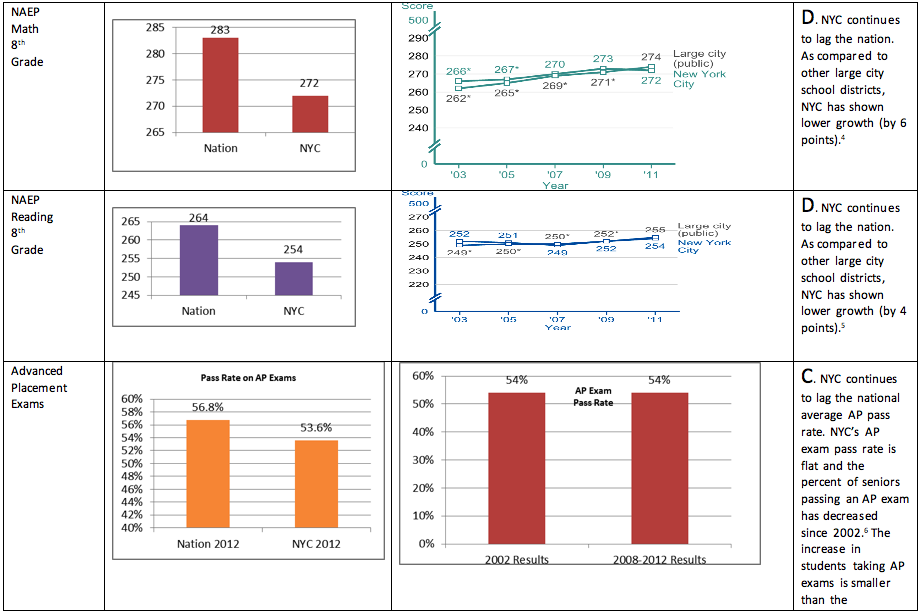
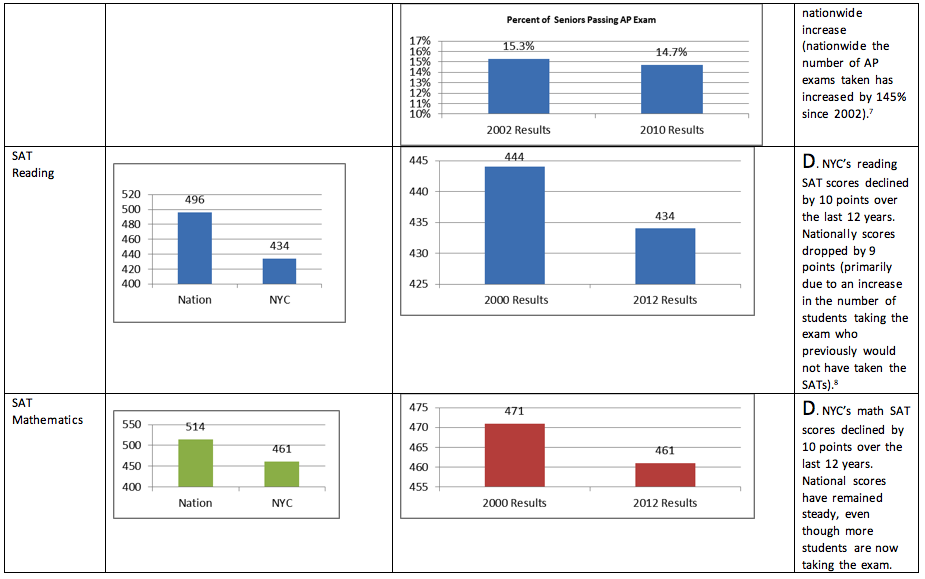
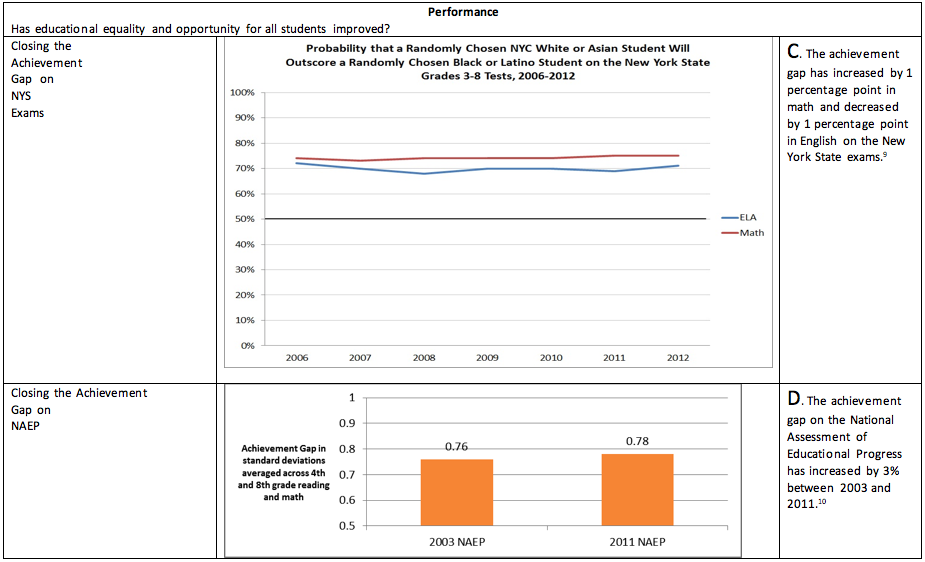
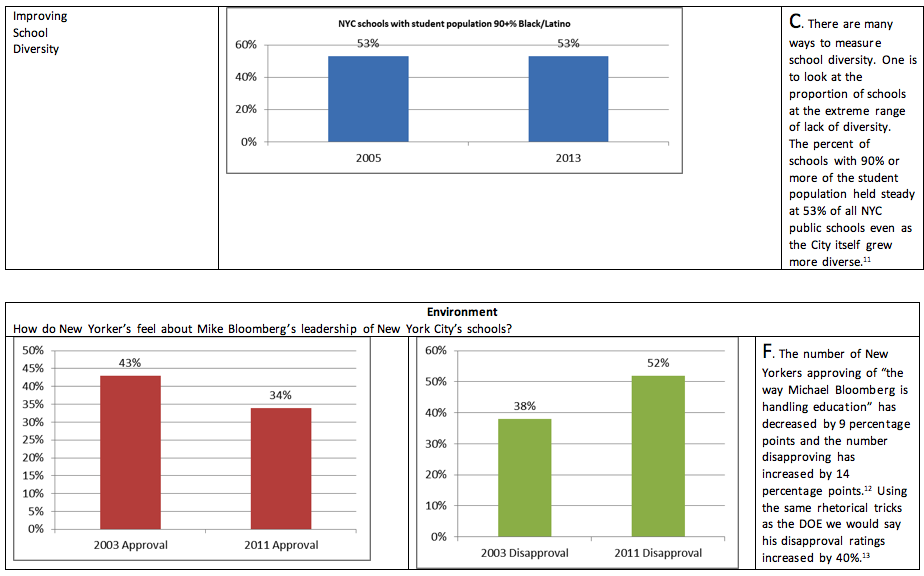
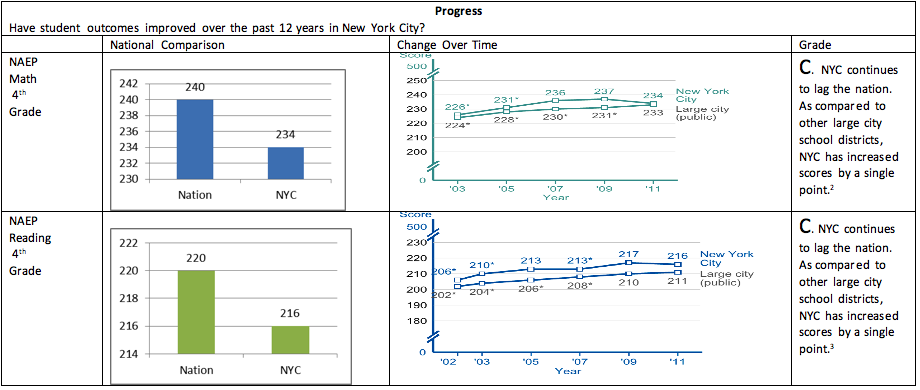
Grading A Dozen Years of Education Policy in the Big Apple: A Report Card

As we come to the end of a dozen years of Michael Bloomberg’s control of New York City’s schools, it is an appropriate time to take stock of the results. Using actual data from New York City schools, what do we learn about results of the specific policies implemented over the past 12 years? [1] Is the education of our students better after many changes and new policies? Has the focus on testing students, using test scores and formulas to grade (and punish) teachers and schools, closing schools, opening schools (and closing those schools too), co-locating and championing charter schools and new schools, and the multiple re-organizations of the bureaucracy helped students?

Screen shot 2013-10-23 at 10.43.38 PM Screen shot 2013-10-23 at 10.43.54 PM Screen shot 2013-10-23 at 10.44.11 PM Screen shot 2013-10-23 at 10.44.26 PM Screen shot 2013-10-23 at 10.44.40 PM
FINAL GRADE= D[14].Some readers may have questions or doubts about the data presented above. We do our best to answer them in the section below.

Have you cherry-picked data? These are the real numbers and we have sourced all the data. In fact, some data that were not included show even greater under-performance in New York City schools over the past 12 years. For example, the NAEP results in science show New York City lags behind the national average by 14 points in 4th grade and by 20 points in 8th grade. [15] However, since the most recent data are from 2009 and over 4 years old we did not include them.

Why do some of the metrics have different years of data cited? Because the New York City Department of Education refuses to publicly release complete data sets (and often denies data requests of researchers), we had to use the data we could identify by scouring the web and academic publications. The DOE’s secretive approach to sharing data with researchers, even with all identifying student information removed, is ironic given that they share private student information with corporations. [16]

Is it fair to compare New York City to the national average? The New York City Department of Education uses a similar measure by evaluating individual school in comparison to the performance of all city schools. This means that a school with primarily high needs students is evaluated against screened specialized schools. However, we are fairer than the NYC DOE and do not use the national comparison in the actual scoring. In this context it is worth noting that the formula New York State created and that New York City has implemented to evaluate teachers based on students test scores penalizes teachers who teach significant numbers of disadvantaged students. [17]

Why do you use test scores as your evaluative criteria? Because these are the very criteria that the education policies in New York were based on. As it turns out, even on their own terms, the policies have shown very poor outcomes. Even with the deck stacked in favor of Bloomberg’s policies the data still show that the policies have not been successful. If we were to add other criteria such as quality arts programs things are even worse. Data self-reported by schools shows that since 2006 elementary school students have at least 5% fewer opportunities to take visual arts, dance, theater and music classes taught by arts teachers. This is clearly an underestimate of the loss of arts options for students as an independent audit has demonstrated. [18]

How do you explain the increase in graduation rate in New York City? An independent study based on full access to DOE records and internal emails would help answer this question. A couple of points are in order.

A) The New York State Regents exams were made significantly easier over the past dozen years especially in terms of the grading scale applied to the exams. Math is an illustrative example. The Sequential Math 1 exam required the test taker to earn 65 percent of the available points to receive a passing score. The Math A exam, which replaced Sequential 1 in June 2002, required the test taker to earn 43 percent of the available points to receive a passing score. The Integrated Algebra exam, which replaced the Math A exam in 2009, requires the test taker to earn only 34.5 percent of the available points to receive a passing score. [19] Additionally the Biology exam was replaced by the Living Environment exam in 2001 and the Global Studies exam by the Global History exam in 2000. In each case the newer version was less content driven. [20]An academic study looking at changes in scoring and in difficulty of the Regents exams over the past 15 or so years would fill a gaping hole in our ability to make sense of test trends.

B) Schools were graded on the number of students earning credit. This led to some schools having jumps of 30-55+ percentage points in the number of students passing 10 or more classes. [21]In the space of 4 years the overall level of credit accumulation by students increased by 16 percentage points. [22]This can only be explained as being due to a citywide lowering of the bar on the expectations for earning credit, leading to a higher graduation rate, presumably at the cost of the actual quality of the diploma/college readiness of the student. [23]

C) The demographics of school age children in New York City changed dramatically since 2000, with white and Asian children becoming an increasingly larger proportion of the population. [24]As is well-known those demographic groups have significantly more educational success than Black and Latino children. Closing this achievement gap is one of the core missions of public education.

D) How can the increase in graduation rate reflect true increases in student learning when the grades 3-8 test scores have been mostly flat over the past dozen years? [25]Did students miraculously begin to learn more only when they hit 12th grade? The 8th grade Math/ELA scores on the NAEP increased by less 1.5% between 2003 and 2009, significantly less than the increase of other large urban school districts. How does that translate into an increase in graduation rates 4 years later unless the quality of a high school diploma and the bar for earning one was significantly lowered during that time?

E) The New York City Department of Education likes to compare its numbers to those of the “Big 5” cities (NYC, Buffalo, Rochester, Syracuse and Yonkers) in New York State. This is a deliberately misleading comparison as only 1 of these cities, Yonkers, is demographically similar to New York City. [26] NYC has significantly underperformed when compared to Yonkers. In fact, since 2008 the graduation rate in NYC has barely budged (the percent of students graduating by August after 4 years having gone from 62.7% to 64.7%). Yonkers, on the other hand, has seen its graduation rate increase by over 9 percentage points (from 62.9% to 72.1%). [27] Yonkers has outperformed New York City while serving a similar student population.

Bottom line: The data used here is comparable across years. It is more reliable than graduation rate which is a social construct having no set criteria or meaning. New York City underperforms on graduation rate when compared to comparable districts in New York State.

What does this all mean for the future of education in New York City? It means that we have our work cut out for us, as does the next mayor. With each mistake made over the last dozen years we have learned how we can do better. What have we learned?

  • We need to ensure that every single school has as diverse a student body as possible. Whether G&T programs, screened or specialized high schools, all schools must have a student body that reflects the diversity of New York City. The Office of Enrollment must improve their systems so that diversity is a crucial element of the process.
  • We need to provide schools with expert support and guidance in curriculum. We cannot take a sink or swim approach to teaching and learning, with every school left to their own devices. The Office of Teaching and Learning must be re-opened after having been shuttered under Bloomberg. Truly expert teachers must be identified at each grade level and subject area, their lessons videoed, their materials copied, and all of such resources must be shared with teachers throughout the city.
  • We need to develop rich early intervention and support services for students. This includes vastly increasing the number of speech teachers and math and reading intervention specialists in elementary schools. We cannot pretend that merely increasing the demands we make on students with the Common Core can take the place of our responsibility to support students in the critical early years to ensure they do not fall behind. This will also require developing a citywide early warning system and specialized curriculum to identify and provide quality remedial opportunities to students who are falling behind.
  • We need to provide support to schools that are struggling. It is wrong to continue to close schools just because they serve a high-needs student population. [28]Teams of experts must be formed to work directly with such schools in the areas of programming, data, and instructional cohesion. Each team must be assigned to one school to ensure quality support. This will also require changing Fair Student Funding so that all schools are funded equitably. [29]
  • We need to reform the DOE central office so that they take ownership of, are responsible for, and are held accountable for the success of every school (and student) in New York City. They must do the hard work of helping all schools and students improve. [30]They can no longer be allowed to take the easy way out. [31] The enormous support for a small percentage of charter schools, with no clear improvement in performance, makes no sense. The significant resources and PR devoted to the charter sector must end, while ensuring that the 6% of NYC’s children in charter schools receive a quality education. [32]Instead of destroying existing schools in order to create new schools we must add new and 21st century aligned academic and CTE programs to the schools we already have to ensure their success and that students have genuine choices and opportunities. [33]
  • We need to create an independent research office to evaluate educational initiatives so that the metrics are uniform across schools and can’t be gamed. [34]This office should report to the Panel for Educational Policy whose members should be selected to time- limited terms of office. The panel will then collaborate with the mayor in ensuring that community voice is heard.
  • We need to reorganize the bureaucracy so that schools are evaluated and coached on instructional techniques and youth development approaches by geographically based personnel with knowledge of the school and community. Other functions such as budgeting, HR and the like should be run out of regional offices. Web-based platforms will allow schools to form non-geographic affinity groups so that similar schools can share ideas no matter how far apart they are in the city.
  • We need to think creatively about ways to provide students with the additional quality learning time they need to succeed. The school year should be extended with a shorter summer break in the month of July and the new school year beginning again at the start of August. Summer learning loss is a huge factor in diminished student outcomes and we must address it system-wide.
  • Finally, we need to develop better ways to communicate with parents and communities to present an accurate picture of school performance. The current system penalizes schools and teachers who work with high-needs students. These are the precise parents and families who need the most help. Transparency about these factors must be improved.

[1] There have been some earlier attempts to answer this question https://dianeravitch.net/2012/10/02/after-a-decade-bloomberg-reforms-still-failing/. Our grading policy is as follows: significant improvement (by 10+%) over the past dozen or so years=A, improvement (2-9%) over the past dozen or so years=B, flatlining (-1,0,+1) over the past dozen or so years=C, decline (-2- -9%) over the past dozen or so years=D, significant decline (-10+%) over the past dozen years=F. This is, of course, a rather charitable grading policy as it assumes that no improvement even after a dozen years earns a gentleman’s C and not a F. We will weigh the 3 sections using the same weights as the School Report Cards implemented under Mike Bloomberg for New York City schools. Progress=60% of the final grade, Performance=25% of the final grade and Environment=15% of the final grade.

[2] http://nces.ed.gov/nationsreportcard/pdf/dst2011/2012453XN4.pdf

[3] http://nces.ed.gov/nationsreportcard/pdf/dst2011/2012456XN4.pdf

[4] http://nces.ed.gov/nationsreportcard/pdf/dst2011/2012453XN8.pdf

[5] http://nces.ed.gov/nationsreportcard/pdf/dst2011/2012456XN8.pdf

[6] http://cityroom.blogs.nytimes.com/2011/02/09/15-of-high-school-seniors-passed-an-a-p-test-last-year/ and http://nypost.com/2010/02/11/ny-schoolkids-do-a-ok-on-ap-tests/

[7] http://media.collegeboard.com/digitalServices/pdf/ap/rtn/9th-annual/9th-annual-ap-report-appendix-b.pdf nationwide AP results

[8] http://www.manhattan-institute.org/html/cr_26.htm NYC’s 2000 SAT results. http://nces.ed.gov/fastfacts/display.asp?id=171 nationwide SAT results through 2011. http://professionals.collegeboard.com/testing/sat-reasoning/scores/averages 2012 SAT results.

[9] http://eyeoned.org/content/closing-the-achievement-gap-have-we-flat-lined_379/

[10] http://eyeoned.org/content/the-emperors-new-close_313/

[11] http://schools.nyc.gov/NR/rdonlyres/B54A0720-E4EE-432D-A322-940346CCE61B/0/2013DemographicSnapshotPUBLIC.xlsx and http://www.nytimes.com/interactive/2012/05/11/nyregion/segregation-in-new-york-city-public-schools.html?_r=0 showing that “Black isolation in schools has persisted even as residential segregation has declined.” https://dianeravitch.net/2013/09/08/insider-at-bloomberg-doe-spills-the-beans-about-failed-policies/ has data on the extreme inequities in school outcomes where only a small handful of NYC produce outcomes at the national average. Finally, the Independent Budget Office has shown that from 2002-2011 school integration has remained flat http://www.ibo.nyc.ny.us/iboreports/printnycbtn11.pdf

[12] http://www.nytimes.com/interactive/2011/09/07/nyregion/20110907-nyc-schools-poll.html?ref=education

[13] The DOE, when reporting numbers, often uses percent increase rather than the actual number of percentage points. This makes small gains looks much larger than they otherwise would.

[14] Following the formula outlined in the first footnote the calculation is as follows: Progress x 60% + Performance x 25% + Environment x 15%= Final Grade. Replacing the letter grades with numbers A=1, B=2, C=3, D=4, F=5. The scores of each component were averaged and plugged into the formula as follows: (4.1667 x .6) + (3.3333 x .25) + (5 x .15) = 4.08=D.

[15] http://nces.ed.gov/nationsreportcard/pdf/dst2007/2008471XN8.pdf

[16] http://www.nytimes.com/2013/10/06/business/deciding-who-sees-students-data.html.

[17] http://www.lhcss.org/positionpapers/nysgrowthmodel.pdf

[18] http://schools.nyc.gov/offices/teachlearn/arts/ArtsCount/ArtsReport/2011-12/Final2012ArtsInSchools.pdf

[19] http://nycpublicschoolparents.blogspot.com/2008/01/ny-state-math-regents-exams-soft.html and http://atfss.wordpress.com/nys-regents/. Note that these numbers vary slightly with each exam.

[20] http://www.city-journal.org/2009/eon0731me.html

[21] http://blogs.edweek.org/edweek/eduwonkette/2008/11/the_nyc_high_school_progress_r_1.html

[22] http://www.edwize.org/credit-accumulation-soars-in-nyc-but-students-remain-behind

[23] Note that this may be very good public policy. Lowering the bar for a high school diploma so that more young adults have the opportunities for college education and job training where there is more flexibility around pursuing one’s interests is intuitively smart policy. However, when the bar is lowered policy-makers can’t claim that the graduation rate is comparable to earlier rates.

[24] “The fact is, the number of children in New York decreased by almost 9 percent between 2000 and 2010. According to the Department of City Planning, the black population under 18 decreased especially dramatically during those ten years, by 22.4 percent, while the population of white children decreased by only 3.8 percent. In the city’s richest borough, Manhattan, the number of white kids actually grew—by nearly 23 percent—and in rapidly gentrifying Brooklyn, the number of white kids increased by 7 percent. (The displacement of blacks and Latinos in some neighborhoods is painfully pronounced: In Brooklyn’s District 6, which encompasses Park Slope, the South Slope, Cobble Hill, Carroll Gardens, and Red Hook, the number of white kids grew by 28.5 percent while the number of black and Hispanic kids each dropped by 36 percent.) Asians are the one ethnic group whose number of children increased overall during the decade.” http://nymag.com/news/features/childhood/modern-childhood-2013-4/index3.html

[25] http://gothamschools.org/2010/07/28/test-scores-down-sharply-biggest-decline-for-needy-students/ data showing flat scores after New York State stopped lowering the bar for proficiency on the grades 3-8 exams.

[26] http://assembly.state.ny.us/member_files/044/20090319/report.pdf

[27] http://www.p12.nysed.gov/irs/pressRelease/20130617/GradRateSlides.ppt

[28] http://annenberginstitute.org/sites/default/files/SchoolTransformationReport_0.pdf https://dianeravitch.net/2012/08/25/nycs-schools-for-poorest-faring-poorly/ and https://dianeravitch.net/2012/08/09/after-ten-years-of-reform-in-new-york-city/

[29] https://dianeravitch.net/2012/09/05/how-new-york-city-stiffs-the-neediest-students/ https://dianeravitch.net/2012/08/12/in-nyc-fair-student-funding-is-unfair/ and https://dianeravitch.net/2012/08/30/who-is-putting-children-first/

[30] https://dianeravitch.net/2012/10/17/if-teachers-ran-their-classes-like-nyc-runs-schools-then/

[31] https://dianeravitch.net/2013/10/22/a-report-from-the-sinking-ship-at-nycs-doe-headquarters/

[32] https://dianeravitch.net/2013/10/15/the-charter-school-bubble-in-new-york-city/ on spending for charter schools. https://dianeravitch.net/2013/02/26/an-inside-the-doe-view-of-the-nyc-credo-study/ on the performance of charter schools. https://dianeravitch.net/2012/12/20/inflated-claims-of-charter-success-in-nyc/ and https://dianeravitch.net/2012/12/03/reader-calls-out-ny-daily-news-for-charter-spin-2/ on the exaggerated PR on behalf of charter schools.

[33] https://dianeravitch.net/2013/03/01/why-nyc-closes-high-schools/ on the coddling of new schools at the expense of existing ones.

[34] https://dianeravitch.net/2013/09/19/nyc-whistle-blower-how-the-doe-is-like-enron/


Merryl Tisch, chancellor of the New York State Board of Regents, harshly criticized one of Mayor Bloomberg’s signature initiatives, the school support networks.

“Me, if I were going to take over the school system, I would look heavily to change the networks,” Tisch said during a panel discussion hosted by the nonprofit group, PENCIL.

“I think the networks have basically failed children who are [English-language learners],” added Tisch, who is due to defend the state’s education policies at a state senate hearing Tuesday. “They have failed children who have special needs.”

Under the $90 million network system, principals choose from about 55 Department of Education or nonprofit-run support providers, which assist schools with teacher training, budgeting and more.

This is important, as the Boston Consulting Group (a management consulting firm) advised the Philadelphia School Reform Commission to replicate the Bloomberg networks,

Why BCG was impressed by the geographically dispersed networks is anyone’s guess.

The parents of Castle Bridge Elementary School said no to state testing. They refused to allow their little children in grades K-2 to take a standardized test. The test was canceled.

The parents drafted the following statement, which was sent to me by a parent leader, Dao Tran:

Statement of Castle Bridge School Parents on New State-Mandated K–2 Testing

October 28, 2013

When we first heard in September that the New York State Education Department was requiring some schools to give high-stakes, multiple-choice (bubble-in) tests for kindergarten through second-grade students, many of us were stunned. Tellingly, the tests are only given in English and we are a dual-language (Spanish/English) school.

We discovered (although we received no communication from our school district) these tests have nothing to do with identifying areas in which our children need help and support and everything to do with measuring their teachers’ supposed “value added,” in order to evaluate them.

However, we already have a “data system” that is far superior to anything a commercial bubble-test provider can offer.

Our children’s teachers provide us with rich, insightful narratives telling us how our children are responding to their thoughtfully designed curriculum, what progress they are making, and what challenges they are working to meet. They might include a story about how a child helped a classmate, overcame a fear, or showed a passion for an activity or experience. This gives us a much better sense of the value their teachers are adding than knowing which quartile a child falls into on a standardized test.

In a school such as ours, where the sounds of happy children engaged in hands-on projects, serious problem- solving, play, and singing is often heard, the threat of a multiple-choice test—bringing with it fear, stress, and the testing protocols that penalize collaboration—could not go unchallenged. Our children are not data points!

We knew even if a few individuals opted their individual children out, if teachers were forced to administer these tests, class instruction time would nevertheless be impacted. We prefer teachers use school time to encourage children to be curious and love learning—teaching to the child, not to the tests.

Opting our children out in large numbers was the only way to protect them while sending a strong message to policymakers that excessive testing is not in our children’s—or school’s—best interests.

As of this writing, families have opted out 93 of the 97 students who would have been subject to the tests and we know of none who want their child tested. Our principal Julie Zuckerman, having a supportive approach to parental input, heard our concerns and canceled the test.

Over the last decade, there has been a shift in public school instruction to support test preparation and erodes the quality of education. Using the scores from exams to determine the effectiveness of teachers elevates the importance of these exams—which give only a snapshot of a student’s ability to perform—to a level of absurdity.

The K–2 high-stakes tests take excessive testing to its extreme: testing children as young as four serves no meaningful educative purpose and is developmentally destructive.
Imagine if all the resources spent on test development, administration, and scoring were allocated to fund enrichment programs, school infrastructure, and staffing, we would be closer to meeting the actual needs of school communities. By refusing these tests, the message we sent was threefold:

1. To the city and state Departments of Education: testing K–2 children is not acceptable and developmentally inappropriate, excessive, and destructive.

2. To our children’s teachers and principal: we know that you can evaluate our students and help them learn and grow better than any test and we want no part of punitive evaluations of your work.

3. To other families of children in the NYC public school system: Your voice matters and you have the power to prevent your children from having to prepare for and take these unsound tests.

We hope that by saying no to these standardized, high-stakes tests we will embolden others to do the same and that together, we can reverse the tide of excessive testing in our public schools. Schools should not resemble machines that seek to track and sort children or to surveil and punish teachers.

Rather they should be caring communities of joy and learning where teachers, administrators, and parents work together to ensure a high- quality education for all children—who to us mean much more than a score.

A new study hails the success of Mayor Bloomberg’s small schools initiative. The mayor closed hundreds of schools and opened hundreds of schools.

This study follows soon after the release of a study by the Annenberg Institute of School Reform showing the Bloomberg small schools excluded large numbers of the “over the counter” students, the late arrivals who often have the highest needs, such as new immigrants. These students were diverted away from the mayor’s signature schools and sent to struggling schools that were slated for closure. They were tossed aside. Collateral damage.

That’s one way of creating a success story: keep out the kids with the highest needs. Fund researchers. Declare victory. Forget about the OTC kids.

With the Bloomberg era winding down after twelve long years, top executives are fleeing or rewriting their history. No one at Tweed knows how to help schools that are struggling. They know only how to close them and open new ones. Then they close the new ones when they fail.

Here is an inside report:

“Anyone who follows the debates on the best ways to improve education in America has to wonder: do the educators who tout corporate style reforms really believe what they preach? Do the corporate-style reformers really believe that testing, sanctions, charters, and metrics of all shapes and sizes are really best? How can they refuse to acknowledge the research demonstrating that that these things have perverse consequences and don’t work? Why won’t they consider rich curricula, quality early childhood programs, and expanded support services for schools and for children?

Current events in New York City have helped shine light on these questions. Until the recent upset in the Democratic primary, it was widely expected that the next mayor would be Ms. Christine Quinn. She was expected to continue Mayor Bloomberg’s corporate-agenda-driven education policies. Now it is clear that Bill de Blasio, a progressive who has run on a platform of prioritizing opportunity and equity for all students, will be the next mayor of New York City. He has said “it is clear that the lights are out and no one is listening in the Tweed building.” This has left the bureaucrats at Tweed, the education headquarters of New York City, scrambling.
When Dennis Walcott, the Chancellor, proclaimed to an audience of principals that he doesn’t “involve myself in politics” they laughed. Perhaps we can expect no better from a political appointee. But we can definitely expect more from professional educators. How have they held up?

Just a couple of weeks ago Marc Sternberg, the deputy chancellor responsible for closing over 100 schools, fled to a position with the Walton Foundation. Then the Annenberg Institute for School Reform, an academic institute at Brown University, released a report showing that thousands of struggling students had been deliberately sent to the schools that ended up being closed. Although many of these schools did an admirable job in educating the students they were sent, they were closed anyway. It goes without saying that thousands of struggling students were not sent to the new schools opened up under Bloomberg. Those schools were granted special privileges. Mr. Sternberg escaped just in the nick of time. After refusing to release these data for years he does not have to face the truth. The new schools are Bloomberg’s Potemkin villages.

Shael Suransky, the #2 official at Tweed, has suddenly started to write columns acknowledging the limits of the pseudo-science metrics used to evaluate schools. He seems to have forgotten that he was in charge of the unit that produced those bogus metrics. Or, that less than a year and half ago, he wrote a letter defending them to the New York Times. When education researchers pointed out the flaws of these metrics 5 years ago (see, for example, the eduwonkette blog) he was silent and continued to use those flawed metrics to punish schools and the communities they were a part of. Six months ago New Visions, an organization that supports high schools in New York City, published a comprehensive report noting many flaws with these metrics. Mr. Suransky was silent. He continued to use those flawed metrics to evaluate principals and to decide whether or not to grant teachers tenure. Now that the political landscape has changed he has miraculously found his voice and changed his tune.

As for the other top bureaucrats, although they insist that every educator in every school be evaluated and held accountable we now know, thanks to the intrepid reporting of Leonie Haimson, that not a single one of them receives a performance evaluation. For those not already inured to such things the hypocrisy is astounding

That the educators at Tweed do not care about the truth is not surprising. People want power and will overlook facts and the genuine interests of children to obtain and remain in power. If we truly care about children and want to develop policies that provide educational equity for all students we need to clean out Tweed and develop systems that won’t allow such things to happen again.
It seems clear that mayoral control is a better system than the balkanized structure that existed before. But in order to make it work the Panel on Education Policy needs to be an honest broker of education policy in New York City. The panel should be granted access to all the data and the authority to call on outside evaluators to assess the merit of proposed policies. They will need to serve a conduit for community and parent voice. Only then will the public know and be able to trust that education in New York City in moving in the right direction.”

I can’t begin to summarize the emotional impact of this 4 minute speech by Letitia James, who will soon be the Public Advocate of New York City. She recently won a run-off election to be the #2 ranked official in the city. Her election in November is a foregone conclusion.

As you will see in the video, she is a fierce advocate for public schools and for children with special needs. She is a powerful critic of charter co-locations. If you thought that Karen Lewis of the CTU was a firebrand, wait until you meet Letitia James.

In this 4-minute clip, she roasts Mayor Bloomberg’s compliant “Panel on Education Policy” for having police in the hearing room; for permitting separate-but-equal schools; for co-locating privileged charter schools into buildings with under-resourced public schools. She says, in a fiery tone, get ready for the lawsuits! Save your emails! 77 days to go and it will be a new day in New York City,

As of today, 76 days to go.

Leonie Haimson of Class Size Matters explains here in shocking detail how charter co-locations harm New York City’s neediest children.

Here is a sample:

“These proposals will uniformly disadvantage the children in the existing schools, cause even more overcrowding and larger classes, and push disabled students out of the spaces they need for special services.

Some of the examples have been described in newspaper accounts. Here is how the severely disabled children in the Mickey Mantle School in PS 149 have already been affected by the co-location of Harlem Success Academy in their building, according to Juan Gonzalez of the Daily News:

Originally, these children had a “cafeteria, playground, library, and cluster rooms (for specialized activities).” In 2006, when the charter school moved in, they lost their library and a bunch of classrooms. The following year, according to a teacher,
“We lost our technology room, our music room, our art room and we had to start sharing the cafeteria, the gym and playground,” Manuell says.

Now she is “teaching theater at Mickey Mantle in a former office with no windows. A fellow teacher conducts four periods a week of gym in a regular classroom because so little time has been allotted in the main gym to the Mickey Mantle pupils”

Now DOE wants to give space to up to “375 middle-school pupils to Manuell’s school over the next several years. They will come from another Moskowitz school, Harlem Success 4.

As for the Mickey Mantle School, 20% of its enrollment will be cut and displaced elsewhere. “Even with that reduction, officials concede the building may reach 130% of capacity.”

Of the 23 proposals to be voted on today, there are 21 co-location proposals and two expansions. Ten of the 23 co-location proposals will cause a building utilization rate of over 100% in the next few years, according to the DOE.

As the DOE severely underestimates the amount of overcrowding in these buildings, one can assume that even more schools will lose their art rooms, libraries, science labs, and intervention spaces, and will suffer class size increases as a result.

Simple justice says this is wrong. Why should we have two publicly-funded school systems, one free to select students and kick them out; the other require to accept all?