Archives for category: NCLB (No Child Left Behind)

Beverley Holden Johns is a nationally recognized expert on special education. She is alarmed that the new “Every Student Succeeds Act” permits states to engage in “pay for success” plans, where investors earn money by not referring students for the services they need. Get on the phone to your Senators and Congressmen at once to stop this money-making scheme.


Johns writes:


As we just passed its 40th birthday, special education faces perhaps its greatest threat since the Education of the Handicapped Act (EHA), now the Individuals with Disabilities Education Act (IDEA), was signed into law.


The new No Child Left Behind bill, S. 1177, as reported by the Conference Committee between the U.S. Senate and the U.S. House includes the permissive use of Federal funds by States and by local school districts of Pay for Success.


Title I, Part D
‘‘(A) may include—
‘‘(i) the acquisition of equipment;
‘‘(ii) pay-for-success initiatives;”


Funded by Goldman Sachs, Pay for Success in Utah
denied special education to over 99 percent of the
students that were in the early childhood Pay for Success program.


Goldman Sachs has received a first payment of over
$250,000 based on over 99 percent of students NOT being identified for special education.


Based on these results, Goldman Sachs may receive
an over 100 percent return on its investment as it
will receive yearly payments based on students
continuing to NOT be identified for special education (multiple yearly payments for one student).


“If special education is reduced to less than 1 percent of students, for all practical purposes it will cease to exist,” says Bev Johns, Chair of the Illinois Special Education Coalition.


Goldman Sachs has also funded a Pay for Success
program for the Chicago Public Schools based on
paying Goldman on the number of students NOT
identified for special education, but results for Chicago from that program are not yet available.


“Success is not the elimination of special education.
Success is not failing to identify students as needing
the specialized and individualized instruction required by IDEA,” states Johns.


“We simply cannot expect the general education teacher to do it all, to know it all, and to achieve academic excellence for each and every student,” says Johns.


“Pretending we can eliminate disability, pretending
that almost every student with a disability and their
parents will benefit WITHOUT the legal rights of IDEA which are only granted when a student is identified for special education, is to turn us back over 40 years to the time before we had State laws and then the Federal law requiring special education for each and every student with a disability,” states Johns.


It is possible that Pay for Success is also in other
parts of the 1,059 page S. 1177.


The section quoted above is in SEC. 1020 of S. 1177,
PREVENTION AND INTERVENTION PROGRAMS
FOR CHILDREN AND YOUTH WHO ARE
NEGLECTED, DELINQUENT, AT-RISK
which amends Part D of Title I of the Elementary and Secondary Education Act (ESEA), Section 1415.


For more information: 217-473-1790

Mercedes Schneider is one of the few people who have read all (or almost all) of the 1,000 page plus behemoth that is the Every Student Succeeds Act of 2015. Her latest post provides valuable new information. This legislation was passed out of the Senate-House conference committee and is likely to move swiftly for full approval by both houses in the next few days or weeks. ESSA would replace No Child Left Behind, which should have been reauthorized eight years ago. It also kills off Race to the Top by stripping the Secretary of any power to impose his ideas about how to reform schools on districts and states.


The big change is the reduction in the role of the federal Department of Education (ED). This is the first big downsizing of the federal role since the original Elementary and Secondary Education Act of 1965 was passed. There are strict limitations on the power of the Secretary to meddle in state or local education matters. The shrinking of the federal role is Arne Duncan’s legacy.


Mercedes points out that the law is still mired in the testing-and-accountability mindset but oversight and responsibility shifts is from the federal ED to local and state governments. She says the bill is “test-centric.”


But there are some very good things in the bill. It puts an end to the hated No Child Left Behind and the failed Race to the Top. The bill eliminates AYP and Duncan’s waivers. States can drop out of Common Core without any penalty. No more teacher evaluation by test scores unless the states want to do it. Bill Gates will no longer have the Department of Education mandating his latest ideas. No more federal mandates about how to reform schools.


I know that many readers would like the law to go farther. I would like to see an end to annual testing, a practice unknown in the high-performing nations of the world. I would like to see stipulations about charter accountability and transparency. But that’s not there.


Nonetheless, I support the bill because it gets rid of a terrible, failed law and a terrible, failed program. The Bush-Obama era is over. Now the fight for a humane education system shifts to the states. In some states, that may seem like a herculean task. But the fact is that parents and educators have a greater chance of being heard by their state legislators than by the White House and Congress.


So what next? Organize, mobilize, agitate, wake the town and tell the people. Stop the privatization of public schools. Stop the testing madness. Join with organizations in your state and community that are fighting to transform the schools to places where learning, character, ethics, imagination, creativity, citizenship, and kindness are valued. Join the Network for Public Education. Find out how to make alliances with people who share  your values. We have a long way to go. The time to start is now.


Mercedes Schneider here offers the latest version of the new federal law that will replace No Child Left Behind. Prepare yourself. It is over 1,000 pages. Look for the titles that interest you. Any law that is so long has all sorts of political compromises tucked into it, and all sorts of favors to lobbyists and special interests. It is a Christmas tree, just in time for Christmas.


In this post, Mercedes analyzes the latest draft, the one that came out of the House-Senate conference committee and will likely be made law.

As we wait impatiently to learn what the reauthorization of the Elementary and Secondary Act will mean for classrooms across the nation, as we hold our breath while elected officials decide how public schools should function (as if they knew how), the New York Times has a wonderful parody of legislation to guarantee that our elected officials are smart enough to do their jobs.


It is called The Smartness Act of 2015, and it consists of tests for elected officials. If we were serious, we would require all state and federal officials to take the eighth grade mathematics test (PARCC or SBAC) and publish their scores.


The parody starts like this:


PUBLIC LAW 114–69 114th CONGRESS


An Act

To ensure that elected and appointed officials of State and Municipal governments are sufficiently prepared (i.e., “get it”) to enforce the Basic Skills provision of the No Child Left Behind Act of 2001, the United States Federal government has enacted the Common Core Standards Reform Act for Government Officials.

Be it enacted by the Senate and House of Representatives of the United States of America in Congress assembled,

SECTION 1. SHORT TITLE.

This Act may be cited as “The Smartness Act of 2015.”

SEC. 2. PURPOSE.

The purpose of this Act is to improve the implementation (i.e., “doing it”) of Basic Skills by establishing minimum academic standards for State and Municipal government officials that must be achieved within sixty (60) days of their taking office. It is believed that core knowledge provides a foundation for being “smart” and that smartness is in the best interests of the United States of America, now more than ever what with computers and all.

SEC. 3. RESPONSIBILITIES OF GOVERNMENT OFFICIALS.

(a) Common Core Standard 1 English Language Arts (ELA)

(1) Read one (1) book in its entirety.

(A) Pop-up books, picture books, other nice books with cardboard pages, joke books, motor vehicle manuals, foldout maps and really thick magazines will not be considered in compliance with CCS1 except in the following States that have been granted waivers: Illinois, Ohio, Michigan, Texas, Georgia, South Carolina, Wyoming and any other State with legalized casino gambling.


(B) Cliff’s Notes, Spark Notes or other study guides will not be permitted as substitutes for reading a book except for “Beowulf,” “Middlemarch,” “Ulysses,” “The Godfather” and anything by Gabriel García Márquez. In the case of “The Godfather,” viewing the filmed versions (“The Godfather” Part 1 and Part II, but not Part III, so disappointing) will satisfy the requirement in the following States that have been granted waivers: New York, New Jersey, Florida, California and Nevada. Alternatively, line recitations as spoken by the films’ main characters (e.g., “Don’t ask me about my business, Kay”) will also satisfy the requirement in those States.

(C) The approved book must be written in English except for any book written in Latin. If you can understand Latin, go for it, Sophocles. Books whose original language is French and were translated into English will be prohibited except for “The Charterhouse of Parma,” which many government officials liked for some bizarre reason a while back, but no other French book like “Madame Bovary,” “In Search of Lost Time,” “The Stranger” or those paperbacks that look rained on and never move from the outdoor tables in Montmartre. It’s all so pretentious. Speaking of pretentious, any book by Gertrude Stein will not be in compliance with CCS1 even though, technically, she was an American and wrote in a language that sounds like it could be English. Can anyone explain “Tender Buttons”? “Stick stick call then, stick stick sticking, sticking with a chicken. Sticking in a extra succession, sticking in.” Really?


A time to laugh and celebrate that the dumb policies of No Child Left Behind and Race to the Top are widely recognized as failures and will soon go into the dustbin of history, where they belong. To make a better world for children and educators, the fight goes on, to replace poor leaders and failed policies, to save public education from privatization, and to make real the elusive promise of equality of educational opportunity: for all, not some.


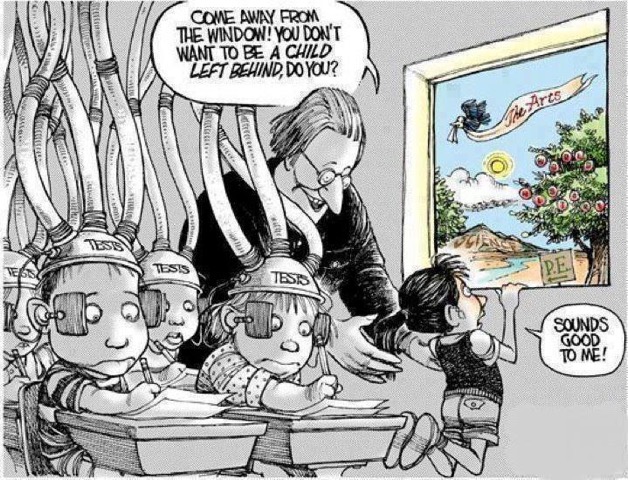
nclb_cartoon

This morning, Politico.com has a roundup of reactions to the new legislation–the Every Student Succeeds Act–that will replace the disastrous No Child Left Behind, under which almost every public school in the nation was a “failing” school. Please note that former Secretary of Education Margaret Spellings is very unhappy that NCLB has been rewritten to remove the punishments. So now we have ESSA, and now we wait for that happy day to arrive when “every student succeeds” because of federal legislation.


GETTING TO KNOW ESSA: The education world is eagerly awaiting a bill expected early next week that could replace No Child Left Behind – and waivers, too – by the end of the year. So what’s going to be in the Every Student Succeeds Act? A lot has been written (some of it by us) but Morning Education will be laying out even more on the forthcoming bill, based on information currently available, in the days to come. Spot something interesting and wonky in an outline or draft bill? Send it our way.


– The new SIG: The framework for updating NCLB includes a 7 percent set-aside in Title I for school support and improvement. Schools will receive the funds for plans that are “evidence-based,” and the framework has language laying out the bar those plans will have to meet in order to qualify as “evidence-based.” Districts and schools will also have to consult with teachers, parents, principals and others when they’re putting together plans for school improvement.


– The new tests: The framework allows for computer-adaptive tests that were hard to use under NCLB, which required all students to take the same tests. That made it difficult to measure progress made by students who were either above or below their grade level. Fordham Institute President Michael Petrilli said he’s “especially glad” to see this provision because it “should open the door to true adaptive tests, which will lead to lots more accuracy for kids way above or below grade level (and thus more accuracy in their growth scores – important for schools and teachers).”


– Joel Packer has the roundup of which programs are funded, and by how much, based on details currently available: http://bit.ly/1leOqj8.


– Mailbag: Maggie Severns’ story about how many on the left fear that the bill could hurt poor and minority kids [http://politico.pro/1LuNeNT ] elicited this response from an education advocate who’s been involved with the reauthorization process: “There seems to be collective amnesia about waivers among the chattering class,” the advocate said. “Under waivers, individual groups of students don’t have to matter at all in school ratings. And when it comes to improvement action, states and districts are invited to ignore all but a small fraction of schools with under-performing groups.” Ultimately, the new agreement “gets us back closer to the intent of Title I: Expectations and support for vulnerable students.”


– Bush-era Education Secretary Margaret Spellings slammed the rewrite while in Austin earlier this week, Houston Chronicle reports: http://bit.ly/1R2wF2Z. But Sen. Patty Murray sang its praises at a Seattle elementary school last week. The Columbian: http://bit.ly/1P4ZVXF.


And then there is a wail of anguish from the once-liberal, now conservative Brookings Institution about the AERA blast at VAM. For VAM-lovers, who want to use test scores as both the measure and goal of education, the AERA statement (as well as a statement by the American Statistical Association) is a punch in the gut:


TEACHER EVALUATION NIRVANA: Brookings is critiquing a recent policy statement from the American Educational Research Association that was skeptical of using value-added scores when making decisions about teachers. AERA said the conditions needed to make VAM scores accurate can’t be met in many cases: [http://politico.pro/1Tbil7y ]. But Michael Hansen, deputy director of the Brown Center on Education Policy, said VAM should be measured in the context of other performance measures, “not relative to a nirvana that does not exist.” Alternatives to VAM like teacher observation have their own problems, he wrote. He agreed with AERA that more research would be valuable, but argued, “If we are looking for a performance measure that has zero errors, we ought to abandon performance evaluation altogether.” More: http://brook.gs/1QER2Ej


Brookings turned rightwing when it hired Grover Whitehurst, the George W. Bush education research director, as leader of its education program. Instead of being a neutral referee of education policy, Brookings became an advocate for choice and high-stakes testing.


The House-Senate conference committee overwhelmingly (39-1) endorsed an overhaul of the No Child Left Behind, which was the latest (and worst) revision of the 1965 Elementary and Secondary Education Act (ESEA). The new ESEA, which still must be approved by both houses of Congress, is called the Every Student Succeeds Act.


The ESSA limits the federal role, a direct rebuke to Arne Duncan’s belief that he was the national superintendent of schools. The law retains a large chunk of George W. Bush’s legacy, including annual testing, a practice not found in any high-performing nation. The law no longer requires teacher evaluation by test scores.


The Republicans wanted to restore state and local control, while the Democrats ironically defended Bush’s accountability emphasis. The outcome is a compromise.


Most everyone seems to have forgotten that the original purpose of ESEA was equity for the neediest students, meaning federal dollars to high-poverty schools. Don’t you long for the day when laws were given descriptive titles, rather than aspirational ones? “Every Student Succeeds” is the flip side of “No Child Left Behind.” What was wrong with “the Elementary and Secondary Education Act”?


I don’t want to sound cynical, but I’m prepared to wager any sum that 7 years, 10 years, or 15 years from now, no one will say that every student is now succeeding. So long as nearly a quarter of our nation’s children live in poverty, “success” will remain elusive. So long as experienced teachers are underpaid and disrespected, so long as the anti-teacher lobby files lawsuits to strip teachers of their rights, “success”will escape our grasp. So long as jobs continue to be outsourced and eliminated by technology, we must continue to worry about whether and how young people will be motivated to “succeed.”


But for the moment, let’s celebrate the demise of a terrible law that saw punishment as the federal strategy for school reform. Let’s celebrate that no future Secretary of Education will have the power to impose his or her flawed ideas on every public school and teacher in the nation. Let’s thank Senator Lamar Alexander and Senator Patty Murray for finally ending a failed and punitive law.


Education Week reports that the Senate and House are near agreement on a deal to reauthorize NCLB, aka the Elementary Secondary and Elementary Act.


While it is too soon to know what will emerge from the conference committee, it is disappointing to see that the accountability Hawks kept the burden of annual testing, which is not found in any high-performing nation. The administration of George W. Bush and the testing companies won on this one.


“The compromise uses the Senate bill as a jumping-off point here. Quick refresher: That means states would still have to test students in grades 3-8 and once in high school in reading and math. But states would get to decide how much those tests count for accountability purposes. And states would be in the driver’s seat when it comes to goals for schools, school ratings, and more.


“States would be required to identify and take action in the bottom 5 percent of schools, and schools where less than two-thirds of kids graduate


“States would also have to identify and take action in schools that aren’t closing the achievement gap between poor and minority students and their peers. But importantly, the bill doesn’t say how many of those schools states would have to pinpoint, or what they would have to do to ensure that they are closing the gaps—the bill allows state leaders to figure all that out.


“On opt-outs: The bill largely maintains the Senate language, which would allow states to create their own opt-out laws (as Oregon has). But it maintains the federal requirement for 95 percent participation in tests. And unlike under No Child Left Behind, in which schools with lower-than-95 percent participation rates were automatically seen as failures, local districts and states get to decide what should happen in schools that miss targets. States would have to take low testing participation into consideration in their accountability systems. Just how to do that would be up to them, though.”


After 15 years or more of not “closing the gap,” federal law will require states to punish schools that don’t do it. Does anyone in D.C. understand that the gap is a product of standardized tests? That standardized tests are burned on a bell curve? That bell curves never close? That mandating it doesn’t make it so? A mandate to reduce class sizes to no more than 12 for the neediest children would be far more effective than a demand to “do something.”


Carol Burris carefully reviewed the NAEP scores. Listen to her interview on public radio. Unlike many commentators, she has the advantage of being an experienced educator and is also executive director of the Network for Public Education.

Marc Tucker is glad to see the U.S. Department of Education acknowledging that American students spend too much time being tested and preparing for tests. But, he writes, it didn’t go far enough to take responsibility for the multiplication of redundant tests.

He writes:

A new report from the Council of the Great City Schools has done what seemingly nothing or no one has yet been able to do: Convince the current administration that the rampant over-testing in U.S. schools is proving harmful for the quality of education that our students receive.

The report found that students take, on average, more than 112 standardized tests between pre-K and grade 12, with the average student taking about eight standardized tests per year. Some are intended to “fulfill federal requirements under No Child Left Behind, NCLB waivers, or Race to the Top (RTT), while many others originate at the state and local levels. Others were optional.”

Now the administration is signaling that they see the error of their and their predecessors’ ways. Calling for a two percent cap on the amount of classroom time that is spent on testing, and a host of other proposals, the administration’s mea culpa is an unexpected demonstration of what can occur when the facts are laid bare for all to see. How much is actually done to reverse the over-testing trend will be decided by the actions of incoming acting Secretary of Education John King.

The tone of flexibility in the Department’s announcement is new and welcome, as is its recognition that the Department may share some culpability in the national revolt against testing. Its call for fewer and higher quality assessments is on target, as is its willingness to help the states come up with more sensible approaches.

What I don’t see in the administration’s proposals is understanding that the vast proliferation of indiscriminate testing with cheap, low quality tests is the direct result of federal education policies beginning with No Child Left Behind and continuing with Race to the Top and the current waiver regime. I offer you one phrase in the Department’s announcement in evidence of this proposition: “The Department will work with states that wish to amend their ESEA flexibility waiver plans to reduce testing…while still maintaining teacher and leader evaluation and support systems that include growth in student learning.”

But it is precisely the federal government’s insistence on requiring testing regimes that facilitate teacher and leader evaluations that include student growth metrics that caused all this over-testing in the first place.

Outstanding principals I’ve talked with tell me that when tough-minded, test-based accountability came into vogue, they created or found good interventions that came with their own assessments, each keyed to the intervention they were using. They had always done that. But their district superintendents, also fearful for their jobs under the new regime, mandated other interventions, with their own tests. Then the state piled on with their own mandated programs and tests, all driven by the fear of leaders, at each level, that if student performance did not improve at the required rate, their own jobs were on the line. Few of these interventions were aligned with the new standards or with each other. But time was of the essence. Better a non-aligned instructional program than none at all. Better a cheap test of basic skills they could afford than a much more expensive one they could not afford.

What sent the numbers right over the cliff was pacing. School administrators, focused on having their students score well on the basic skills tests used by the state accountability systems, pushed schools enrolling large numbers of disadvantaged students to figure out where the students needed to be at set intervals during the year. This determined the pace of instruction. It also made it much easier for administrators to get control over the instruction. All that remained was to administer a test at each of those intervals—say every month or couple of months—to see whether the teachers were keeping pace with the scripted curriculum and the students were making enough progress to do well at the end of the semester or year….

The key for great school leaders isn’t formal evaluation and it isn’t firing people. Only Donald Trump, evidently, fired his way to the top. The key is running a great school that great people want to work in, and then spending a lot of time identifying, recruiting and supporting those great people. Principals who work this way often let their staff know that they expect them to work hard. Those who do not want to work so hard go elsewhere. But these principals do not depend on test-based accountability systems to identify the slackers nor do they depend on test-based accountability systems to identify the teachers they want to hire or to develop them once they are hired.. Why should they? They are in classrooms all the time, talking and observing, coaching and supporting.

The data reported by the Council of the Great City Schools reveal a calamity. The cause is our national accountability system. The flexibility offered by the Department of Education is welcome and refreshing, but it is not the answer. The answer will have to wait for the day when the federal government no longer insists that the states and schools use test-based accountability and value-added strategies to assess individual teachers with consequences for individual teachers. John King did not create this system. Perhaps he can help this country change it. We’ll see.