Archives for category: Media

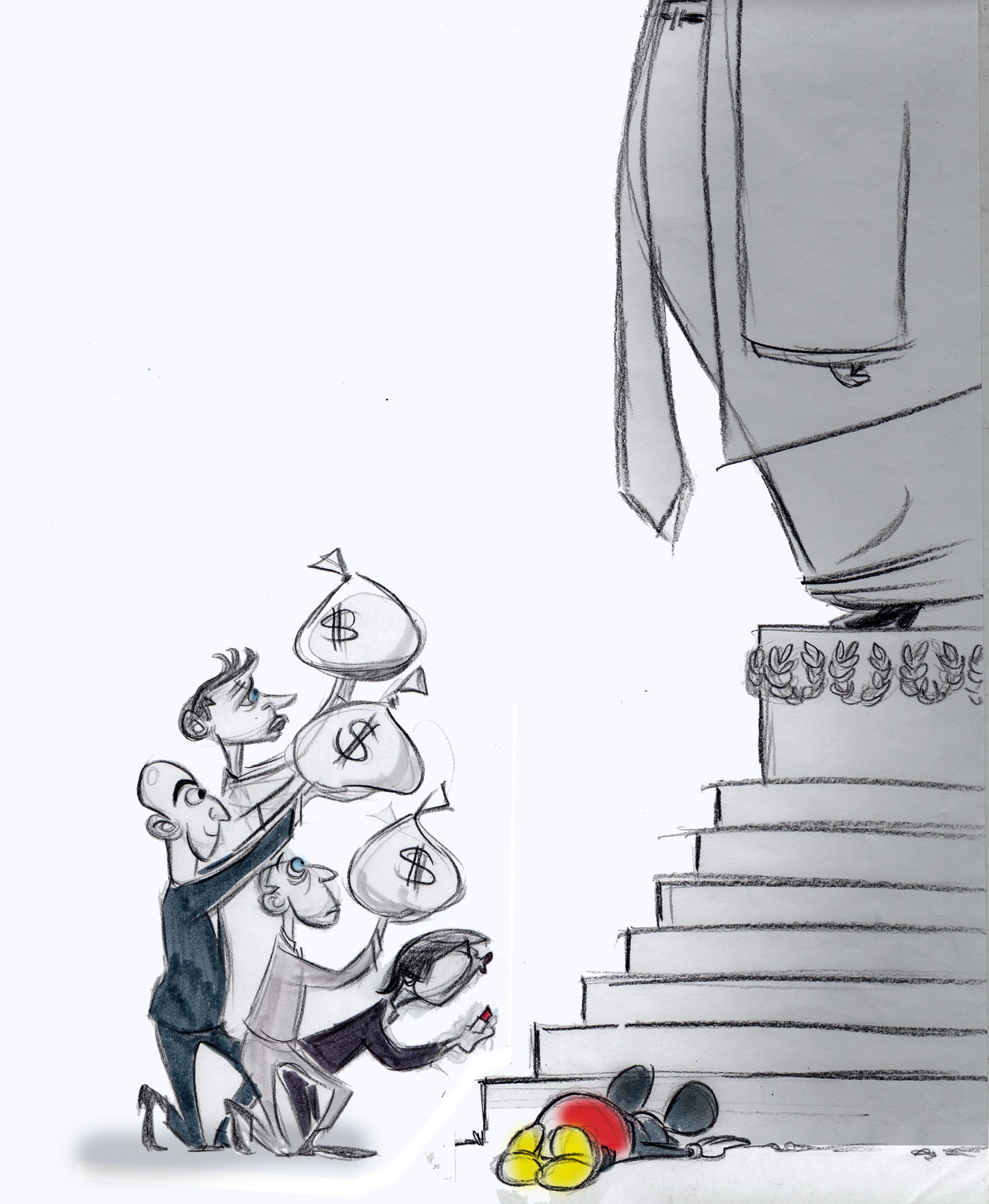
Ann Telnaes, editorial cartoonist for the Washington Post since 2008, quit her job after one of her cartoons was censored by higher-ups. The cartoon at issue depicted tech and media billionaires paying obeisance and money to Donald Trump. The cartoon included portrayals of Mark Zuckerberg (META), Sam Altman (AI), Patrick Soon-Shiong (Los Angeles Times), and Jeff Bezos, owner of the Washington Post. And, of course, Disney, which settled with Trump for $15 million rather than defend George Stephanopoulos in court. Each has given Trump $1 million or more to underwrite his inauguration. If Telnaes had waited a day, she would have added Tim Cook, CEO of Apple, to her list of suck-ups and sycophants.

The motto of the Washington Post is: “Democracy dies in darkness.” Conservative (but anti-Trump) lawyer George Conway wrote on BlueSky:

I guess the new slogan for the Washington Post ought to be:

“Newspapers die in cowardice.”

Ann Telnaes’ resignation is an act of courage that should inspire all of us to stand by our principles.

Telnaes wrote about her decision to resign on her Substack blog:

I’ve worked for the Washington Post since 2008 as an editorial cartoonist. I have had editorial feedback and productive conversations—and some differences—about cartoons I have submitted for publication, but in all that time I’ve never had a cartoon killed because of who or what I chose to aim my pen at. Until now.

The cartoon that was killed criticizes the billionaire tech and media chief executives who have been doing their best to curry favor with incoming President-elect Trump. There have been multiple articles recently about these men with lucrative government contracts and an interest in eliminating regulations making their way to Mar-a-lago. The group in the cartoon included Mark Zuckerberg/Facebook & Meta founder and CEO, Sam Altman/AI CEO, Patrick Soon-Shiong/LA Times publisher, the Walt Disney Company/ABC News, and Jeff Bezos/Washington Post owner. 

While it isn’t uncommon for editorial page editors to object to visual metaphors within a cartoon if it strikes that editor as unclear or isn’t correctly conveying the message intended by the cartoonist, such editorial criticism was not the case regarding this cartoon. To be clear, there have been instances where sketches have been rejected or revisions requested, but never because of the point of view inherent in the cartoon’s commentary. That’s a game changer…and dangerous for a free press.

(rough of cartoon killed)

Over the years I have watched my overseas colleagues risk their livelihoods and sometimes even their lives to expose injustices and hold their countries’ leaders accountable. As a member of the Advisory board for the Geneva based Freedom Cartoonists Foundation and a former board member of Cartoonists Rights, I believe that editorial cartoonists are vital for civic debate and have an essential role in journalism. 

There will be people who say, “Hey, you work for a company and that company has the right to expect employees to adhere to what’s good for the company”. That’s true except we’re talking about news organizations that have public obligations and who are obliged to nurture a free press in a democracy. Owners of such press organizations are responsible for safeguarding that free press— and trying to get in the good graces of an autocrat-in-waiting will only result in undermining that free press.

As an editorial cartoonist, my job is to hold powerful people and institutions accountable. For the first time, my editor prevented me from doing that critical job. So I have decided to leave the Post. I doubt my decision will cause much of a stir and that it will be dismissed because I’m just a cartoonist. But I will not stop holding truth to power through my cartooning, because as they say, “Democracy dies in darkness”.

Thank you for reading this.

Brian Stelter writes about the media for CNN. When CNN went through a reorganization a year or so ago, attempting to be “centrist” or appeal to the right, Brian was fired. He is actually very even-handed in his comments. After CNN’s shakeup failed, Brian was rehired and CNN again posts his “Reliable Sources” commentary in the media. Subscribe; it’s free.

He wrote this morning:

Within 24 hours of the Bourbon Street terror attack, reporters pieced together a relatively complete picture of the suspect. But a key early bit of misreporting confused the public – and possibly the president-elect. It’s a cautionary tale for everyone in the news industry as the new year begins.

Just after 10 a.m. Wednesday, Fox News reported that the suspect’s truck crossed the U.S. border in Eagle Pass, Texas “two days ago.” Some of Fox’s coverage explicitly said “the suspect” drove across the border, leading Fox viewers to believe that a foreigner might be responsible for the deadly carnage.

Evidently, Fox was misinformed by anonymous sources. The network walked it back within two hours and said the truck was in Eagle Pass nearly two months ago, not two days ago. And more importantly, the truck was being driven by someone else at the time, so the detail about the border was completely irrelevant and misleading. 

But the damage was already done. President-elect Donald Trump, seemingly misinformed by Fox, issued a statement about “criminals coming in” from other countries. “Biden’s parting gift to America — migrant terrorists,” Donald Trump Jr.wrote, sharing the Fox claim. “Shut the border down!!!” Rep. Marjorie Taylor Greene exclaimed.

The president-elect ironically used the New Orleans attack to say that he was right and the “Fake News Media” was wrong about the threat posed by illegal immigration. If he had waited a couple hours to react, he would have learned that the suspect was a U.S. citizen and Army veteran.

“Some Republicans continued to beat the border drum well after Fox News retracted its initial report,” The Daily Beast’s Josh Fiallo wrote last night. This morning I’m still seeing people on social media share the misinfo. 

A couple of takeaways: One, it’s incredibly difficult to claw back a bogus claim that people want to believe. And two, in a repeat of 2017-2020, it’s going to be crucial for reporters to scrutinize Trump’s sources of information, since his favorite sources have so often misled him in the past.

Stelter added, later in his post, a caution to the media:

I love what Kaitlan Collins told Semafor about 2024’s political surprises being “the ultimate reminder to never assume what the news is going to be.” As a reporter, “you should always operate with an open mind,” she said. “It’s easy, but risky, to think you know where a story is going.”

Ashton Pittman is the news editor of the Mississippi Free Press and a fine writer. I get my news about Mississippi by reading MFT, reported by people who live there. Pittman describes in this article why he debated whether to leave Twitter. When Musk bought Twitter, he knew it was going to be bad. He had spent years building up a following there and didn’t want to give it up. He investigated other social media platforms, but they weren’t right.

Then came the 2024 election, and Twitter turned into a political platform that favored Trump, where nasty trolls and bots created a toxic atmosphere.

Ashton joined BlueSky and very quickly gained a large number of followers close to what he (and the Mississippi Free Press) had had on Twitter.

He writes:

For a long time, it seemed like nothing was going to replace Twitter, even as it further devolved into a hellscape that seemed as if it were overrun by the trolls of 4chan, the neo-Nazis of Stormfront and the dullest AI bots Chat GPT ever powered. Twitter transformed into X, a place where racism, misogyny, homophobia and especially transphobia run rampant under the guise of “free speech,” but where using the word “cisgender” can get your account restrictedbecause Musk (who has described his very-much-alive transgender daughter as “dead”) considers it a slur.

I had really wanted one of the Twitter alternatives to take off, but one of the biggest impediments was the lack of buy-in from major journalists, publications, celebrities and other figures who could draw audiences away. A familiar pattern developed: People would leave X in hopes of joining another platform, then come back. 

Then came the election. Twitter turned into a Trump propaganda site. And Ashton was done.

But you know what I really enjoy about BlueSky? It doesn’t pigeonhole me. On other platforms, particularly X, you choose one facet of yourself and that’s the following you get, and the algorithm recommends you based on that. On BlueSky, I get to be a Mississippi journalist whose news stories draw engagement from people who care about news, but I also get to be a film photographer whose posts about my black-and-white film adventures spark conversations, too. None of us is just one thing, no matter what some lousy algorithm thinks, and it’s affirming to be able to build communities around shared interests beyond just news and politics. Social media should be social, not anti-social….

My experience as a journalist on BlueSky has reminded me that my job is to provide good information to those who want it, not to argue with trolls and validate attention-seeking behavior from the worst people on the internet. My desire to reach a diverse audience does not have to entail subjecting myself to constant abuse. I am not obligated to stay on a platform where Nazi trolls with 1488 in their usernames and cartoon frogs as their profile images regularly hurl the word “fagg-t” at me and issue veiled threats. I do not have to entertain the endless stream of incels who think “soy boy” is some sort of profound insult. I do not have to accept being under the thumb of an algorithm that prioritizes crypto scams, AI bots and conspiracy theorists over my voice.

And you know what? You don’t either.

Some of the smarter people among us have said that BlueSky is an echo chamber. Well, right now, it’s a place where I hear the echoes of artists, writers, cinephiles, scientists and neighbors caring about their neighbors. And that’s a hell of a lot better than being trapped in a chamber that’s increasingly filled with the echoes of Adolf Hitler.

So farewell, Twitter. I’m off to bluer skies.

Maurice Cunningham, a retired professor of political science, reviewed the Boston Globe’s bad habit of treating billionaire-funded groups as authoritative on education issues.

He wrote recently, as posted on the blog of the Network for Public Education:

Maurice Cunningham finds that looking at the Boston Globe tells us too much about the folks who think education is just to prepare children to become useful tools for business. Reposted with permission. 

When I was a kid in the Sixties we’d occasionally hear stories about some poor Japanese soldier, abandoned on a Pacific island after WWII, finally being rescued while believing he was still fighting the war. That’s sort of where the Boston Globe’s post-MCAS coverage is. But as a lesson in the biased media approach to interest group coverage, it is a real education.

The latest is by reporter Mandy McLaren, With no more MCAS requirement, graduation standards vary widely among state’s largest districts. What interests me is the sources used in the story, which include a heavy presence of billionaire funded and tax deductible “non-profits” aka interest groups. That’s because non-profit, while it sounds eleemosynary ( I just wanted to use that word in a sentence) actually represents the policy preferences of the moneyed few; or as the media like to say the Massachusetts business community; or as I like to say: capital.

Let’s meet the Globe’s eleemosynary sources starting with “The risk moving forward, said Andrea Wolfe, president and CEO of MassInsight, a Boston-based education nonprofit.” Mass Insight’s donors include the Bill and Melinda Gates Foundation and the Boston Foundation (you will remember them from The Globe Puffs Up Another Dubious “Science of Reading” Program) and Fidelity Investments Charitable Gift Fund (also from Puffs Up).

Then there is “Erin Cooley, Massachusetts managing director for Democrats for Education Reform, a group that advocated against Question 2.” Don’t make me go through the Oligarch Party funding of Democrats for Education Reform again, but you can catch the gist at Democrats for Education Reform: Let’s Meet the Funders and How to Understand Democrats for Education Reform Using Two Quotes from Democrats for Education Reform.

Finally,

Erika Giampietro, executive director for the Massachusetts Alliance for Early College, said she hopes whatever path the state takes next focuses on the ‘competencies’ students graduate with, especially those that truly matter in the real world.”

“[Employers] are not saying, ‘I wish kids had taken two years of foreign language, four years of English and four years of math.’ They’re saying, ‘Yeah, kids aren’t coming with strong enough executive functioning and clear enough communication skills and showing up to work every day and realizing how important that is to be on time,‘” Giampietro said.

Funders include Gates, Boston Foundation, Fidelity Charitable Gift (also in Puffs Up).

Employers=business=capital. Ms. Giampietro offers the interest group frame: employers would like taxpayer paid employee training (while not increasing taxes). The focus is employers and not children. If you read enough of these stories, that comes through. Not that kids should be introduced to foreign cultures, discover a love of literature or art, or heaven forbid, question the prevailing structures of society. Such concerns are not the “the real world” issues of business.

The article did quote Max Page, president of Massachusetts Teachers Association. But when you also quote two superintendents who miss MCAS and three eleemosynary business group interests, well . . . does three from capital equal one from labor?

Money never sleeps. Follow the money.

“Imagine movie critics who either did not know, or did not care to know, that movies have producers, script writers, directors, financiers, or casting directors, and so based their reviews on the premise that it was the actors alone who created the storyline, dialogue and mise en scene, and that the most successful actors were those who best understood the audience. That is essentially how all politics is covered in 21st century America.”—Michael Podhorzer.

Network for Public Education

P.O. Box 227
New York, New York 10156
(646) 678-4477

Margaret Sullivan, the last public ombudsman for The New York Times, wrote on her blog that ABC News was wrong to settle with Trump for $15 million for “defaming” him. On television, ABC’s George Stefanopolous said that Trump had been found liable for raping E. Jean Carroll. Trump said that was wrong and malicious because he had been found guilty of “sexual assault,” not rape.

She points out that when she was chief editor of The Buffalo News, the paper had a longstanding policy of fighting every claim of defamation or libel. They did so to discourage future lawsuits and send a message: we will vigorously oppose lawsuits. If you sue, prepare for a long battle.

Trump’s lawyers claimed that Stephanopoulos was wrong to say that Trump was found guilty of rape and that he had defamed Trump. ABC settled before trial and agreed to pay $15 million for the future Trump Presidential Library and $1 million for Trump’s legal fees.

Media experts were stunned. Not only did ABC abandon its First Amendment defense, but it abandoned a viable claim that Stephanopooulos was right to use the language he did.

Judge Lewis Kaplan, who presided over the Carroll defamation case, said:

“The finding Ms. Carroll failed to prove she was ‘raped’ within the meaning of the N.Y. Penal Law does not mean she failed to prove Mr. Trump ‘raped’ her as many people commonly understand the word ‘rape’. Indeed, as the evidence at trial… makes clear, the jury found Mr. Trump in fact did exactly that.”

By settling–and at such a hefty price–ABC has encouraged Trump and other politicians to continue to sue journalists and their employers.

Sullivan believes ABC might well have won if they continued to fight:

ABC News should never have caved. They might well have prevailed if they had hung in there. The legal bar is very high for libeling a public figure, and Trump is the ultimate public figure. Instead, this outcome encourages Trump in his attacks on the press — and he needs no encouragement. 

As one law professor told the Times, what ABC News did was very unusual. News organizations generally don’t settle “because they fear the dangerous pattern of doing so and because they have the full weight of the First Amendment on their side.”

Why did ABC News throw in the towel? It‘s hard to know for sure, but gets easier if you are aware that the news organizations is owned by Disney, a huge corporation with a lot of turf to protect. As the Times reported, the Disney executive who oversees ABC News had dinner with Trump’s top aide, Susan Wiles, just days before the settlement, as “part of a visit by several ABC News executives to Florida to meet with Mr. Trump’s transition team.”

Was this settlement, which includes ABC’s public expressions of regret, a simple case of kissing the ring? It sure looks that way. Trump has sworn to get revenge on his enemies and he values, above all, loyalty and kowtowing. 

But loyalty and kowtowing isn’t the job of the press, which is supposed to represent the public in holding powerful people and institutions accountable.

After his victory, Trump threatened to sue the Des Moines Register for posting a poll before the election that showed Biden beating him in Iowa. He also threatened to sue Bob Woodward, “60 minutes,” and the Pulitzer Prizes. This is the mischief that ABC News unleashed.

Last night Trump’s lawyers sued the Des Moines Register for publishing Ann Seltzer’s poll. The implications are frightening. The media publishes polls frequently during campaigns. They may be right, they may be wrong. If they are wrong, will candidates sue them for “election interference”? How did Trump suffer any damages by publication of that poll? He won Iowa by 13 points.

Win or lose, Trump has a strategy: to strike fear in the hearts of every journalist who dares to write critically about him.

Be sure to read Jeff Tiedrich’s condemnation of ABC’s capitulation. He attributes the deal to Disney’s overriding principle: “Protect the mouse.”

Dr. Patrick Soon-Shiong, the billionaire publisher of the Los Angeles Times, recently revealed that the newspaper would employ a technology that will tell “both sides” of every story. Journalists are outraged by the implication that their stories are biased. After the publisher’s decision to prohibit an endorsement in the Presidential race, the chief editor of the editorial board resigned, followed by others.

At that time, the published defended

The New York Times reported:

Dr. Patrick Soon-Shiong, the billionaire owner of The Los Angeles Times, said on Thursday that he planned to introduce a “bias meter” next to the paper’s news and opinion coverage as part of his campaign to overhaul the publication.

Dr. Soon-Shiong, who in October quashed a planned presidential endorsement for Vice President Kamala Harris from The Los Angeles Times’s editorial board, said in an interview that aired on Scott Jennings’s podcast “Flyover Country” that he had begun to see his newspaper as “an echo chamber and not a trusted source.”

He previously said he planned to remake the paper’s editorial board and add more conservative voices. He has asked Mr. Jennings, a CNN political commentator and a Republican strategist, to join it.

Dr. Soon-Shiong, who bought The Times in 2018, said on the podcast that he had been working with a team to create the so-called bias meter using technology he had been building in his health care businesses.

On news and opinion articles, “you have a bias meter so somebody could understand, as a reader, that the source of the article has some level of bias,” he explained in the interview. “And what we need to do is not have what we call confirmation bias, and then that story automatically — the reader can press a button and get both sides of that exact same story based on that story, and then give comments.”

He said he planned to introduce the tool in January.

Dr. Soon-Shiong’s latest comments set off immediate pushback from the L.A. Times Guild, which represents journalists at the paper.

“Recently, the newspaper’s owner has publicly suggested his staff harbors bias, without offering evidence or examples,” the union’s leadership said in a statement on Thursday. The union said all Times staff members abided by ethics guidelines that call for “fairness, precision, transparency, vigilance against bias and an earnest search to understand all sides of an issue.”

In the comments that followed the article, many ridiculed the idea of the “bias meter.” One imagined an article that reported on an earthquake rated 9.5, which said that people feared that the earthquake would cause massive destruction of lives and property; those seeking a different perspective would press the bias meter to read an article saying that most people were not afraid of a 9.5 earthquake and say it’s no big deal.

The day after the election, I opened an account at social media site BlueSky. I intend to abandon my Twitter account in a few weeks. I had over 140,000 followers on Twitter, but I don’t know how many are bots. On BlueSky, I have picked up 2,000 followers and expect to see the number rise. I know that every one of them is a real person.

I’m not the only one. According to the New York Times, one million people joined BlueSky since the election. Twitter claims 50 million in the U.S., over 500 million worldwide. BlueSky, founded by Jack Dorsey, the Twitter pioneer, has 14.7 million.

BlueSky is growing now at the rate of 1 million new accounts daily.

The numbers go up every hour, as people seek a site that moderates content.

Elon Musk has changed Twitter for the worse. It’s overloaded with ads for Trump merch. His own tweets are ads for Trump. He has restored the accounts of Nazis, anti-vaxxers, and haters. Misinformation is rampant, especially since he fired all the content moderation group. “Let hatred and lies prevail” seems to be the Twitter motto.

I am now posting at BlueSky.

BlueSky is a welcoming community. The tone is friendly. Commenters are not angry. No nazis, racists, or misogynists. There are lots of historians, journalists, academics, familiar names.

People offer advice about how to navigate the site.

It has good vibes.

I don’t want to be part of Elon Musk’s world. I had to leave.

Michael Tomasky of The New Republic offers his view about why Trump won. I think it was because Putin intervened with hacking. Most think it was high prices, the cost of eggs and gasoline. Some say it was because Kamala had no agenda (I disagree). Some say it was her unwillingness to detach from unpopular Biden. Some say it was Biden’s fault for not dropping out a year earlier. Tomasky disagrees.

He wrote:

Item one: It wasn’t the economy. It wasn’t inflation, or anything else. It was how people perceive those things, which points to one overpowering answer.

I’ve had a lot of conversations since Tuesday revolving around the question of why Donald Trump won. The economy and inflation. Kamala Harris didn’t do this or that. Sexism and racism. The border. That trans-inmate ad that ran a jillion times. And so on.

These conversations have usually proceeded along lines where people ask incredulously how a majority of voters could have believed this or that. Weren’t they bothered that Trump is a convicted felon? An adjudicated rapist? Didn’t his invocation of violence against Liz Cheney, or 50 other examples of his disgusting imprecations, obviously disqualify him? And couldn’t they see that Harris, whatever her shortcomings, was a fundamentally smart, honest, well-meaning person who would show basic respect for the Constitution and wouldn’t do anything weird as president?

The answer is obviously no—not enough people were able to see any of those things. At which point people throw up their hands and say, “I give up.”

But this line of analysis requires that we ask one more question. And it’s the crucial one: Why didn’t a majority of voters see these things? And understanding the answer to that question is how we start to dig out of this tragic mess.

The answer is the right-wing media. Today, the right-wing media—Fox News (and the entire News Corp), Newsmax, One America News Network, the Sinclair network of radio and TV stations and newspapers, iHeartMedia (formerly Clear Channel), the Bott Radio Network (Christian radio), Elon Musk’s X, the huge podcasts like Joe Rogan’s, and much more—sets the news agenda in this country. And they fed their audiences a diet of slanted and distorted information that made it possible for Trump to win.

Let me say that again, in case it got lost: Today, the right-wing media sets the news agenda in this country. Not The New York Times. Not The Washington Post (which bent over backward to exert no influence when Jeff Bezos pulled the paper’s Harris endorsement). Not CBS, NBC, and ABC. The agenda is set by all the outlets I listed in the above paragraph. Even the mighty New York Times follows in its wake, aping the tone they set disturbingly often.

If you read me regularly, you know that I’ve written this before, but I’m going to keep writing it until people—specifically, rich liberals, who are the only people in the world who have the power to do something about this state of affairs—take some action.

I’ve been in the media for three decades, and I’ve watched this happen from the front row. Fox News came on the air in 1996. Then, it was an annoyance, a little bug the mainstream media could brush off its shoulder. There was also Rush Limbaugh; still, no comparison between the two medias. Rush was talented, after a fashion anyway, but couldn’t survive in a mainstream lane (recall how quickly the experiment of having him be an ESPN color commentator went off the rails). But in the late 1990s, and after the internet exploded and George W. Bush took office, the right-wing media grew and grew. At first, the liberal media grew as well, along with the internet, in the form of a robust blogosphere that eventually spawned influential, agenda-setting websites like HuffPost. But billionaires on the right have invested far more heavily in media in the last two decades than their counterparts on the left—whose ad-supported, V.C.-funded operations started to fizzle out once social media and Google starting eating up the revenue pie.

And the result is what we see today. The readily visual analogy I use is: Once upon a time, the mainstream media was a beach ball and the right-wing media was a golf ball. Today, the mainstream media (what with layoffs and closures and the near death of serious local news reporting) is the size of a volleyball and the right-wing media is the size of a basketball, which, in case you’re wondering, is bigger.

This is the year in which it became obvious that the right-wing media has more power than the mainstream media. It’s not just that it’s bigger. It’s that it speaks with one voice, and that voice says Democrats and liberals are treasonous elitists who hate you, and Republicans and conservatives love God and country and are your last line of defense against your son coming home from school your daughter.

And that is why Donald Trump won. Indeed, the right-wing media is why he exists in our political lives in the first place. Don’t believe me? Try this thought experiment. Imagine Trump coming down that escalator in 2015 with no right-wing media; no Fox News; an agenda still set, and mores still established, by staid old CBS News, the House of Murrow, and The New York Times.

That atmosphere would have denied an outrageous figure like Trump the oxygen he needed to survive and flourish. He just would not have been taken seriously at all. In that world, ruled by a traditional mainstream media, Trump would have been seen by Republicans as a liability, and they would have done what they failed to do in real life—banded together to marginalize him.

But the existence of Fox changed everything. Fox hosted the early debates, which Trump won not with intelligence but outrageousness. He tapped into the grievance culture Fox had nursed among conservatives for years. He had (most of the time) Rupert Murdoch’s personal blessing. In 2015–16, Fox made Trump possible.

And this year, Fox and the rest of the right-wing media elected him. I discussed all this Thursday with Matthew Gertz of Media Matters for America, who watches lots of Fox News so the rest of us don’t have to. He made the crucial point—and you must understand this—that nearly all the crazy memes that percolated into the news stream during this election came not from Trump or JD Vance originally, but from somewhere in the right-wing media ecosystem.

The fake story about Haitian residents of Springfield, Ohio, eating cats and dogs, for example, started with a Facebook post citing second- and third-hand sources, Gertz told me; it then “circulated on X and was picked up by all the major right-wing influencers.” Only then did Vance, a very online dude, notice it and decide to run with it. And then Trump said it himself at the debate. But it started in the right-wing media.

Likewise with the postdebate ABC “whistleblower” claims, which Gertz wrote aboutat the time. This was the story that ABC, which hosted the only presidential debate this election, fed Team Harris the questions in advance. This started, Gertz wrote, as a “wildly flimsy internet rumor launched by a random pro-Trump X poster.” Soon enough, the right-wing media was all over it.

Maybe that one didn’t make a huge difference (although who knows?), but this one, I believe, absolutely did: the idea that Harris and Joe Biden swiped emergency aid away from the victims of Hurricane Helene (in mostly Southern, red states) and gave it all to undocumented migrants. It did not start with Trump or his campaign or Vance or the Republican National Committee or Lindsey Graham. It started on Fox. Only then did the others pick it up. And it was key, since this was a moment when Harris’s momentum in the polling averages began to flag.

I think a lot of people who don’t watch Fox or listen to Sinclair radio don’t understand this crucial chicken-and-egg point. They assume that Trump says something and the right-wing media amplify it. That happens sometimes. But more often, it’s the other way around. These memes start in the media sphere, then they become part of the Trump agenda.

I haven’t even gotten to the economy, about which there is so much to say. Yes—inflation is real. But the Biden economy has been great in many ways. The U.S. economy, wrote The Economist in mid-October, is “the envy of the world.” But in the right-wing media, the horror stories were relentless. And mainstream economic reporting too often followed that lead. Allow me to make the world’s easiest prediction: After 12 noon next January 20, it won’t take Fox News and Fox Business even a full hour to start locating every positive economic indicator they can find and start touting those. Within weeks, the “roaring Trump economy” will be conventional wisdom. (Eventually, as some of the fruits from the long tail of Bidenomics start growing on the vine, Trump may become the beneficiary of some real-world facts as well, taking credit for that which he opposed and regularly denounced.)

Back to the campaign. I asked Gertz what I call my “Ulan Bator question.” If someone moved to America from Ulan Bator, Mongolia, in the summer and watched only Fox News, what would that person learn about Kamala Harris? “You would know that she is a very stupid person,” Gertz said. “You’d know that she orchestrated a coup against Joe Biden. That she’s a crazed extremist. And that she very much does not care about you.”

Same Ulan Bator question about Trump? That he’s been “the target of a vicious witch-hunt for years and years,” that he is under constant assault; and most importantly, that he is “doing it all for you.”

To much of America, by the way, this is not understood as one side’s view of things. It’s simply “the news.” This is what people—white people, chiefly—watch in about two-thirds of the country. I trust that you’ve seen in your travels, as I have in mine, that in red or even some purple parts of the country, when you walk into a hotel lobby or a hospital waiting room or even a bar, where the TVs ought to be offering us some peace and just showing ESPN, at least one television is tuned to Fox. That’s reach, and that’s power. And then people get in their cars to drive home and listen to an iHeart, right-wing talk radio station. And then they get home and watch their local news and it’s owned by Sinclair, and it too has a clear right-wing slant. And then they pick up their local paper, if it still exists, and the op-ed page features Cal Thomas and Ben Shapiro.

Liberals, rich and otherwise, live in a bubble where they never see this stuff. I would beg them to see it. Watch some Fox. Listen to some Christian radio. Experience the news that millions of Americans are getting on a daily basis. You’ll pretty quickly come to understand what I’m saying here.

And then contemplate this fact: If you think they’re done, you’re in fantasyland. They’re not happy with the rough parity, the slight advantage they have now. They want media domination. Sinclair bought the once glorious Baltimore Sun.Don’t think they’ll stop there. I predict Sinclair or News Corp will own The Washington Post one day. Maybe sooner than we think.

I implore you. Contemplate this. If you’re of a certain age, you have a living memory of revolutions in what we used to call the Third World. Question: What’s the first thing every guerilla army, whether of the left or the right, did once they seized the palace? They took over the radio or television station. First. There’s a reason for that.

It’s the same reason Viktor Orbán told CPAC in 2022: “Have your own media.”

This is a crisis. The Democratic brand is garbage in wide swaths of the country, and this is the reason. Consider this point. In Missouri on Tuesday, voters passed a pro–abortion rights initiative and another that raised the minimum wage and mandated paid leave. These are all Democratic positions. But as far as electing someone to high office, the Man-Boy Love Party could probably come closer than the Democrats. Trump beat Harris there by 18 points, and Senator Josh Hawley beat Lucas Kunce, who ran a good race and pasted Hawley in their debate, by 14 points.

The reason? The right-wing media. And it’s only growing and growing. And I haven’t even gotten to social media and TikTok and the other platforms from which far more people are getting their news these days. The right is way ahead on those fronts too. Liberals must wake up and understand this and do something about it before it’s too late, which it almost is

Pundits today have spent time dissecting the election results, many trying to find the one tweak that would have changed the outcome, and suggesting sweeping solutions to the Democrats’ obvious inability to attract voters. There is no doubt that a key factor in voters’ swing to Trump is that they associated the inflation of the post-pandemic months with Biden and turned the incumbents out, a phenomenon seen all over the world.

There is also no doubt that both racism and sexism played an important role in Harris’s defeat. 

But my own conclusion is that both of those things were amplified by the flood of disinformation that has plagued the U.S. for years now. Russian political theorists called the construction of a virtual political reality through modern media “political technology.” They developed several techniques in this approach to politics, but the key was creating a false narrative in order to control public debate. These techniques perverted democracy, turning it from the concept of voters choosing their leaders into the concept of voters rubber-stamping the leaders they had been manipulated into backing. 

In the U.S., pervasive right-wing media, from the Fox News Channel through right-wing podcasts and YouTube channels run by influencers, have permitted Trump and right-wing influencers to portray the booming economy as “failing” and to run away from the hugely unpopular Project 2025. They allowed MAGA Republicans to portray a dramatically falling crime rate as a crime wave and immigration as an invasion. They also shielded its audience from the many statements of Trump’s former staff that he is unfit for office, and even that his chief of staff General John Kelly considers him a fascist and noted that he admires German Nazi dictator Adolf Hitler.

As actor Walter Masterson posted: “I tried to educate people about tariffs, I tried to explain that undocumented immigrants pay billions in taxes and are the foundation of this country. I explained Project 2025, I interviewed to show that they supported it. I can not compete against the propaganda machines of Twitter, Fox News, [Joe Rogan Experience], and NY Post. These spaces will continue to create reality unless we create a more effective way of reaching people.” 

X users noted a dramatic drop in their followers today, likely as bots, no longer necessary, disengaged. 

Many voters who were using their vote to make an economic statement are likely going to be surprised to discover what they have actually voted for. In his victory speech, Trump said the American people had given him an “unprecedented and powerful mandate.” 

White nationalist Nick Fuentes posted, “Your body, my choice. Forever,” and gloated that men will now legally control women’s bodies. His post got at least 22,000 “likes.” Right-wing influencer Benny Johnson, previously funded by Russia, posted: “It is my honor to inform you that Project 2025 was real the whole time.” 

Today, Trump campaign press secretary Karoline Leavitt said Trump would launch the “largest mass deportation operation” of undocumented immigrants, and the stock in private prison companies GEO Group and CoreCivic  jumped 41% and 29%, respectively. Those jumps were part of a bigger overall jump: the Dow Jones Industrial Average moved up 1,508 points in what Washington Post economic columnist HeatherLong said was the largest post-election jump in more than 100 years. 

As for the lower prices Trump voters wanted, Kate Gibson of CBS today noted that on Monday, the National Retail Federation said that Trump’s proposed tariffs will cost American consumers between $46 billion and $78 billion a year as clothing, toys, furniture, appliances, and footwear all become more expensive. A $50 pair of running shoes, Gibson said, would retail for $59 to $64 under the new tariffs.

U.S. retailers are already preparing to raise prices of items from foreign suppliers, passing to consumers the cost of any future tariffs. 

Trump’s election will also mean he will no longer have to answer to the law for his federal indictments: special counsel Jack Smith is winding them down ahead of Trump’s inauguration. So he will not be tried for retaining classified documents or attempting to overthrow the U.S. government when he lost in 2020. 

This evening, Hungarian prime minister Viktor Orbán posted on social media that he had just spoken with Trump, and said: “We have big plans for the future!” 

The Houston Chronicle is the newspaper with the second largest circulation in Texas, behind the Dallas Morning News. The Chronicle endorsed Kamala Harris. This is how you endorse a Democratic candidate in a Deep Red state.

Clawing out of the mud-caked aftermath of a deadly hurricane should be a solemn moment, even in this divided America. Scenes from Helene’s wrath in North Carolina — sedans flung like toy cars, living room couches marinated in floodwaters, towns reduced to war zone rubble — touch a nerve with Houstonians who lived through Harvey and other devastating storms.

These disasters take so much from us, but the aftermath brings hope. On a trip to North Carolina and Georgia, Vice President Kamala Harris worked a hot meal line and remarked at another point: “I think that in these moments of hardship, one of the beauties about who we are as a country is — is people really rally together and show the best of who they are in moments of crisis.”

In Houston, too, neighbors we’ve never met pull up with chainsaws and muck-and-gut gear, Cajun Navy volunteers deploy boats for rooftop rescues. Government makes itself useful, too, and leaders prioritize concern, clear communication and aid to those in need, above everything — including political stumping and tribalism.

Nearly all political leaders — regardless of party, geography or faith tradition — honor this ritual.

Not Donald Trump.

His visit to Helene-devastated areas was a vehicle to spread lies, inflame and divide. His claims that the Biden administration isn’t helping victims because they’re Republican or that FEMA has run out of money — “It’s all gone. They’ve spent it on illegal migrants.” — are baseless. They’ve been refuted by Republican officials and yet, they’re still stirring fear, anger and distrust that have led to threats against FEMA workers and confusion among vulnerable people about whether help is available and whether it can be trusted.

This is how Trump leads. He doesn’t. Even in a desperate hour of need, he exploits. Even from people who have lost everything, he takes.

It’s just one in a sea of examples showing why we believe Trump is unfit for a second term in the White House, and why this editorial board endorses Kamala Harris for president of the United States.

Many who are firmly in Trump’s camp won’t be swayed, we know. Some are fatigued by dire warnings about his threat to democracy. They’re less concerned in this election with abstract notions of patriotism than with how to pay the rent in a vulturous housing market or how to feed the kids when inflation has eaten the grocery budget. We understand Trump’s star power, the kernel of truth in some of his outrageous diatribes and the sense of community he’s built among Americans who feel their grievances have never been adequately addressed.

But we ask those with a shred of doubt to open your minds to inconvenient truths. We ask you to resist the temptation to dismiss the former president as some kind of redeemable shock jock — erratic, entertaining but not really dangerous.

And understand this: A man who will exploit a deadly hurricane will exploit you. A man with six bankruptcies and millions owed that he may not have the cash to pay is trying to win the White House in part to stay out of the poor house. He will not do any better with our economy. The inflation you’re feeling wasn’t invented by Joe Biden. It’s an aftershock of the global pandemic, it hurt wallets all over the world, and it’s finally easing off. As for Trump’s economy as president, rose-colored glasses are doing a number on us. Trump’s 2017 tax cuts didn’t grow the economy like he promised. He added twice as many trillions to the deficit as Biden, not even counting pandemic spending, and added half as many jobs.

Of course, other folks don’t need another reason to vote against Trump.

For them, Jan. 6 is enough, from the lying beforehand to attempting to overthrow a free and fair election to inciting a riotous insurrection at the Capitol. Protest “peacefully,” he said with one breath, and with the other: “if you don’t fight like hell, you’re not going to have a country anymore.”

For others, it was the two House impeachments. Or cozying up with dictators. Or nominating Supreme Court justices who overturned Roe v. Wade. Or the 34 felony convictions stemming from hush-money payments to a porn star. Or the $540 million in legal judgments largely for fraud and defamation, including a finding that he’s liable for committing sexual assault.

For still others, it’s the threats about what he’ll do with a second term, especially after he lost the trust of many decent people who were willing to serve in his Cabinet the first time. Trump’s own vice president, Mike Pence, refuses to endorse his former boss after Trump branded him a traitor and turned loose an angry mob that hunted him during the Capitol riot so they could hang him. The distinguished military men Trump called “my generals” — including John Kelly, homeland security secretary before becoming Trump’s chief of staff; James Mattis, defense secretary; and Mark Milley, chairman of the Joint Chiefs of Staff — are warning voters against his dictatorial tendencies. Milley, whom Trump named the highest-ranking military officer in the nation, told Bob Woodward that Trump is “fascist to the core” and “the most dangerous person to this country.”

But don’t take his word for it. Trump himself said the mythical fraud he alleged in the 2020 election “allows for the termination of all rules, regulations, and articles, even those found in the Constitution.”

Those wondering whether he’ll really act on threats to retaliate against political rivals don’t have to wonder: he already did in his first term, as The New York Times has reported. From Hillary Clinton to former FBI director James Comey, to Trump’s own former national security adviser John Bolton, those who crossed Trump found themselves facing costly, grueling IRS audits, Justice Department investigations and in Bolton’s case, a criminal probe and lawsuit when he tried to publish a book critical of Trump.   

So yes, Harris’ best asset is that she’s not Trump. Beyond her basic qualifications of human decency, self-control and mature leadership skills, her career path from law enforcement to the U.S. Senate to the vice president’s office illustrates independence, drive and a steely spine. And perhaps as important, a propensity to give more than take. Prosecuting child molesters and rapists required patience and compassion to earn the trust of frightened children. Later, prosecuting transnational cartel members required guts.

From prosecutor to district attorney to the state attorney general of California, it wasn’t an obvious trajectory for the daughter of freedom-fighter academics, her Indian-born mother a scientist, her Jamaican-born father an economist. Harris says her mother modeled civic leadership, exposed her to history and the American principles of freedom and equity and took her protests where she had a “stroller’s-eye view” of the civil right’s movement.

In her book, “The Truths We Hold,” Harris said she wanted to fight for justice from the inside, where she hoped to dispel the false choice between being tough on crime and smart on crime: “You can want the police to stop crime in your neighborhood and also want them to stop using excessive force,” she wrote. “…You can believe in the need for consequence and accountability, especially for serious criminals, and also oppose unjust incarceration.” She cites a reentry program for low-level offenders as a success and yet, she’s expressed regretfor the unintended consequences of a truancy crackdown that landed some parents in jail.

As a U.S. senator, she prioritized health care and criminal justice, even working with Kentucky Republican U.S. Sen. Rand Paul on bail reform that would prioritize the risk someone poses to society over their ability to pay. Assertive and clever enough in her prosecutorial style, she turned heads in Senate hearings when she stumped then-Attorney General Jeff Sessions and Supreme Court nominee Brett Kavanaugh with probing questions.

She’s no flame-thrower. She’s no Marxist. Nor is she a superstar able to ace press conference improv or deliver spell-binding speeches that break free of stale scripts. She’s changed her stances on a few things, such as whether to ban fracking; now she says no. But that’s OK.

Magnetism, private jets, four-hour rallies and a lack of self reflection have never been strong predictors of a successful American presidency. She’s fearless and quick on her feet and apparently a quick study, having transformed from a bench warmer VP to a respectable presidential contender in three months. She’s a champion of federal protections for abortion rights, desperately needed in Texas where an extreme ban doesn’t include exceptions for rape or incest or enough protections for women with severe pregnancy complications.

With little time, she’s come up with some workable policy ideas that would help Americans afford their first homes and provide expanded child tax credits to the parents of newborn babies. On immigration, she’s backed a tough bipartisan border bill that Trump undermined for political gain.

And there must be something genuine, and maybe a little magical, about a person who has obtained elite status in one of modern society’s toughest survivor challenges: She seems to be a truly beloved step-parent.

We don’t expect this endorsement to change many minds. We can’t inspire voter participation like Taylor Swift or Beyonce. We won’t buy it like Elon Musk

We just ask you to consider one question before you cast perhaps the most consequential vote of your lifetime:

If the brown floodwaters were rising around your house and the Cajun Navy could only send a small boat, who would you trust to pick you up: Kamala Harris or Donald Trump? 

We know who we’d trust.