Archives for category: Funding

Carol Burris led the delegation from the Network for Public Education at the Public Education Forum in Pittsburgh. Here are her reflections on the candidates;


There were roughly 1000 attendees at yesterday’s Public Education Forum 2020.  The group was diverse in both race and age. Students accompanied by parents sat side by side with senior citizens. It was a captivated audience, the vast majority of whom stayed until the end at around 4:00 pm. 


Outside the forum there was a small protest. When I entered the building in the morning, I counted 35 people. One news report said that the protest grew to 100. Michael Bennet was the only candidate who engaged with the protestors—that encounter can be viewed here.


Support was voiced by the candidates for community schools, increased school funding for Title I schools, increased pay for teachers, support for unions, fully-funded pre-schools, increasing the number of teachers of color, student loan forgiveness, and other equity issues which have commonly appeared in candidates’ platforms. In short, it was a positive agenda that acknowledged that resources do matter and recognized the complex difficulties that our schools and our teachers face.


It is not my intent to influence anyone’s vote with this account. What follows is my review of the candidates’ performance by giving each the award I believe they most deserve based on what I heard during the forum as well as with speaking with others afterwards. 


My award for Best Performance is shared by Elizabeth Warren and Amy Klobuchar. I thought their answers were the sharpest, but I am willing to acknowledge I may see the world through my gender lens. 


Upon entering the stage, Elizabeth Warren received cheers. Many stood and applauded. Warren stood her ground when the interviewer claimed she wanted to defund charter schools (she does not). She logically argued her platform on charter schools and ended by saying, “Public school money needs to stay in public schools,” which earned loud applause. She argued throughout for increased funding for public education, funded by her proposed wealth tax.


Klobuchar won hearts with the story of her mom who taught elementary school until she was 70 years old. Her mom would dress up as a Monarch butterfly every year when teaching a unit on butterflies. Klobuchar recounted how a former student with a disability came to her mother’s funeral due to the kindness mom had extended to him long after he left her class. She was warm and encouraging when a nervous student came to the microphone to ask a question. Many in the audience who were not familiar with the candidate were impressed. 


The You Still Don’t Get it Award goes to Michael Bennet. 


The first audience question came from a New Orleans student, Maria Harmon, who expressed concerns about charter schools, which she said are “targeting black and brown children without delivering on their promise of equity.” Maria referred to the Washington Post’s story on our Network for Public Education report, Still Asleep at the Wheel. Her question on charter school accountability received loud applause. 


Bennet claimed that in Denver only the Denver School Board can authorize a charter school. What he did not mention is that the Denver Board’s decision to not authorize a charter school can be overturned by the state board. From the Colorado State Board of Education website—


“The State Board may also, upon its own motion, decide to review any charter decision of a local board of education. Under the act, the State Board has the authority to direct the local board to grant, deny, or revoke the charter.”

So much for local control. Like other pro-charter Democrats, Bennet tried to create a false distinction between “private” and “public” charter schools, saying there are only public charter schools in Denver. “We don’t have private charters,” he said. Denver’s charters are managed by private boards. In addition, Denver allows charter schools to be managed by for-profit CMOs. For example, Life Skills Denver Charter School, was operated by the notorious for-profit White Hat Management Corporation. It was open throughout Bennet’s term as superintendent and was finally shut down by his successor, Tom Boasberg. I have no idea how Bennet’s defines a “private” charter school.


During the interview he defended his merit pay program, which has been largely abandoned, as well as the evaluation of schools by growth scores. 


Bennet’s suggestion that the school year be longer and that students attend school six days a week was not well received by students and teachers in the audience. 


Bennet told us he was “against privatization” and then left to meet with the charter school parents who were protesting the event. 


The Most Loved Award goes to Bernie Sanders


When Bernie came on the stage, nearly everyone was on their feet applauding. He made a vigorous case against high-stakes testing (it was noted by the moderators that he had voted against NCLB) as well for increased funding for public schools. Bernie was Bernie, and the crowd loved it.  His refusal to sit down resulted in the moderators getting up from their chairs to ask their questions. 


The award for Best DFER in Disguise goes to Pete Buttigieg 


Mayor Pete’s melodious even-toned voice was soothing, but no one I spoke with seemed impressed. He received polite applause. When he told the audience that a guy on his policy team (I assume Raj Chetty with whom he attended college) had done a study that showed the positive impact of “great teachers” on students’ economic futures, eyebrows went up. That study was often used by Arne Duncan to justify the evaluation of teachers by test scores.  His teacher training plan sounded an awful lot like Teach for America to me. Rachel Cohen recently reported that prominent charter schools supporters have been doing fundraisers for Mayor Pete.  With Booker and Bennet tanking, it is likely DFERs are looking to Buttigieg as their candidate. 


The James Joyce Award goes to Joe Biden 


Biden was animated and immersed in his usual stream of consciousness style. Listening to Biden is rather like reading Joyce’s Ulysses. You are just not quite sure where his inner Molly Bloom is going next. 


While he did not distance himself from Race to the Top, which I believe was not mentioned at all throughout the forum, I think he said he was against high-stakes testing (sometimes it is hard to tell with Joe). He got a smile from me with his line, “If I’m president, Betsy DeVos’ whole thing from charter schools to ignoring sexual harassment is done.” He was warmly received and frequently applauded. Afterwards many I spoke with said that although he is not their first choice, they would support him if he were the candidate or seemed to have the best chance of beating Trump. 


The Nice Guys Finish Last Award goes to Tom Steyer


Those I spoke with characterized the billionaire activist as a well-meaning guy whose funds would be better spent supporting a candidate with progressive ideas. My assessment is that he cares and wants to make a difference. He demonstrates none of the know-it-all arrogance of Bill Gates or Michael Bloomberg. I hope he will remain on the side of public schools when the campaign is over. 


All in all, the forum was a day well spent. 


Betsy DeVos gave New Hampshire $46 million from the federal Charter Schools Program to double the number of charter schools in the state. She uses the federal funding of $440 million as her slush fund to rapidly expand charters.

[CORRECTION: I ORIGINALLY WROTE THAT NH REJECTED $25 MILLION; THAT WAS AN ERROR. NH REJECTED $46 MILLION.]

In 2018, Democrats won control of the state legislature.

This morning, the Joint Legislative Fiscal Committee voted 7-3 to table the federal grant. The members of the committee were concerned about the impact of more charters on existing public schools.

New Hampshire is experiencing declining enrollments as the population ages and birth rates decline. It is an odd time to increase the number of schools competing for a shrinking pool of students.

BREAKING: The Joint Legislative Fiscal Committee just voted 7-3 against accepting the first payment of the $46 million federal charter school grant:
NH lawmakers table federal charter grant, request more information – ReachingHigherNH
On Friday, November 8, 2019, the Joint Legislative Fiscal Committee voted 7-3 to table the first portion of the $46 million federal grant to double the number of charter schools in New Hampshire. The…
reachinghigher


The New York Times recently wrote an article claiming that many black and Hispanic families were disappointed that Democratic presidential candidates were abandoning the charter school crusade beloved by the leaders of No Child Left Behind and Race to the Top, and currently by Betsy DeVos.

Steven Singer disagrees. He responds bluntly that charter schools exploit children of color. 

He writes:

Go to most impoverished black neighborhoods and you’re bound to find three things in abundance.

Liquor stores, payday lenders and charter schools.

It is no accident.

In the inner city, the underemployed compete for a shortage of minimum wage jobs, healthcare is minimal, public transportation inadequate and the schools are underfunded and short staffed.

But that doesn’t mean money isn’t being made.

In capitalist America, we make sure to turn a profit off of everything – including our peculiar institutions of racial inequality.

Businesses are on every corner, but they aren’t set up for the convenience of those living there.

Ethnic isolation – whether caused by poverty, legal coercion, safety in numbers or white flight – often puts the segregated at a disadvantage. It creates a quarantined economy set up for profiteers and carpetbaggers to get rich off the misery of the poor.

The system is set up to wring as much blood as it can from people forced to live as stones.

Families struggle to survive in a community where they are exploited by grasping landlords and greedy grocers. And the system is kept in check by law enforcement officers who are either disposed to turn the other way or so overzealous as to shoot first and ask questions later.

As W.E.B. DuBois described it nearly a century ago, “Murder sat on our doorstep, police were our government, and philanthropy dropped in with periodic advice.”

The economy is glutted with enterprises offering cheap promises of relief but which actually reinforce the status quo.

Predominantly black, low-income neighborhoods are eight times more likely to have carry-out liquor stores than white or racially integrated neighborhoods, according to researchers at the Johns Hopkins School of Public Health.

Yet in higher income black neighborhoods in the same cities, you don’t find these same liquor stores.

They are established in the poorest neighborhoods to offer cheap, temporary respite from the trauma of living in poverty. Yet they increase the likelihood of alcoholism, addiction and violence.

The same goes for payday lenders.

These are basically legal loan sharks who offer ready cash at exorbitant interest rates.  Typically these payday loans are meant to last the length between paychecks – approximately two weeks. However, they come with extremely high interest rates. For instance, the average $375 loan ends up costing $520 (139%) in interest.

These businesses aren’t located in the suburbs or wealthy parts of town. You find them typically in the inner cities and poor black neighborhoods. They promise temporary help with one-time purchases and unexpected expenses, but in truth most are used to pay for necessities like rent or food.

They end up trapping users in a debt spiral where they have to take out payday loans to pay off previous payday loans. This is mostly because these loans are made based on the lender’s ability to collect, not the borrower’s ability to repay while meeting other financial obligations.

And these are just two of the most common features of this predatory economy – capitalist enterprises designed to enrich businesses for exploiting consumers beyond their ability to cope.

Others include high priced but limited stock grocery markets, fast food restaurants, gun stores, inner city rental properties and charter schools.

That last one may seem out of place.

Most descriptions of urban neighborhoods neglect to mention charter schools, but in the last few decades they have become an increasingly common part of the landscape. And this is no wonder. They fit the same pattern of exploitation as the other establishments mentioned above.

Think about it: (1) charter schools disproportionately locate in poor black communities, (2) offer the promise of relief from inequality but end up recreating or worsening the same unjust circumstances and (3) they are often owned by rich white folks from outside the neighborhood who profit off the venture.


Steven Singer will be in Pittsburgh on Saturday as part of the Network for Public Education delegation to the MSNBC forum on public education.

Here are his questions for the candidates. 

He won’t get to ask them all, but they are all great questions!


Curtis Cardine, former superintendent of both public and charter schools, is the preeminent expert on charter schools in Arizona. He created the Grand Canyon Institute to study education issues, and it keeps a close eye on charter malfeasance.

Cardine has written two books that are well worth reading to learn about the failures of the charter industry in Arizona. He is an expert in school finance, and he demonstrates in detail how charter operators are ripping off the public.

The first was Carpetbagging America’s Public Schools.

I quote that book extensively in my own new book SLAYING GOLIATH.

Cardine’s second book, recently published, is Schooling Alone, in which he compares the atomization of society caused by school privatization, and likens its effects to sociologist Robert Putnam’s classic study of social disintegration, Bowling Alone.

Cardine recently prepared a review of Arizona charter school closures and their relation to the bond debt incurred by charters.

Read his letter to two Arizona state senators here.

A report on a 25-year-old court case in North Carolina was released yesterday. The long-anticipated report rebukes the past decade of education policy in the state, led and directed by the Republican majority in the state’s General Assembly. The powers that be don’t like to spend money on education.

The report lays out

…an important new roadmap for ensuring that our public schools provide every child with the education they deserve.

The report – a collaborative effort from some of the nation’s leading education experts – is a comprehensive examination of North Carolina’s public school system. The report’s recommendations have the potential to fundamentally change the direction of our state by unleashing the potential of all children to become flourishing adults, ready to contribute to a healthier, happier, and more prosperous North Carolina.

What is Leandro?

Leandro is a 25-year long court case. Throughout the case, the courts have consistently found that North Carolina has been failing to meet its most fundamental obligation under our State Constitution: providing every child a meaningful opportunity to receive a sound basic education, backed by adequate funding and resources in every public school. Additional background on the case can be found here.

Where did this report come from?

In 2017, parties to the case (the state defendants and the Leandro plaintiffs) agreed that North Carolina had been failing its children for far too long, and that the state needed a clear, comprehensive roadmap to providing a sound basic education that benefits all children. The court-appointed consultants (WestEd, in collaboration with the Learning Policy Institute and NC State’s Friday Institute) initially submitted the report to the court in June of 2019. The report was confidential until its release today.

What does the report say?

The report confirms what North Carolinians have been saying for years: The state has consistently failed to give every child in this state access to the education they deserve. Specifically:

  • A new approach is needed: While North Carolina was once making progress towards meeting its constitutional responsibilities, the past decade’s actions have left our state “further away from meeting its constitutional obligation to provide every child with the opportunity for a sound basic education than it was when the Supreme Court of North Carolina issued the Leandro decision more than 20 years ago.”
  • Providing children with what they are owed requires significant new investment: Current levels of school funding (North Carolina ranks 48th in terms of school funding effort) are inadequate to ensure all students are achieving at grade level.
  • We must direct resources where they’re needed most: Our funding formulas need to do a better job of prioritizing higher-need students and under-resourced communities.
  • More needs to be done to put qualified, well-prepared and diverse teachers and principals in every school: Educators need competitive pay, early-career support programs, professional development, and opportunities to collaborate and lead.
  • Scarcity of early-learning opportunities is leaving too many students unprepared to start school: Both Smart Start and NC Pre-K are effective programs, but funding must be restored and expanded to ensure all students enter kindergarten ready to learn.
  • High-poverty schools lack the resources to help students overcome out-of-school conditions that create barriers to learning: High-poverty schools should be provided the resources necessary to expand learning opportunities and implement community school models providing health and social services, youth and community development, and community engagement. Struggling schools need state-level support similar to the District and School Support teams eliminated by the General Assembly in recent years.
  • Our testing and accountability system needlessly stigmatizes high-poverty schools, rather than providing useful information about educational effectiveness: Our accountability system should instead measure schools’ progress in providing each child a sound basic education by rewarding growth in student performance and highlighting school climate and equality of resources and learning opportunities.

The report contains significantly more detail. While the report’s recommendations may appear ambitious, it’s important to remember that these steps represent the bare minimum of what it takes to for the state to provide students with the education they deserve.

What happens next?

The judge overseeing the case might order the legislature to act.

The legislature might fail to act.


The York Dispatch, a newspaper in a district that has been targeted for state intervention, blasted the state with a scathing editorial. 

I hope the editorial board will forgive me for reprinting it in full. “Financial recovery” has not helped any district; it is a disaster for the students, teachers, and schools. It accomplishes nothing but disruption.

The vultures are circling, and York City School District officials would be wise to take notice.

York City is among four Pennsylvania districts placed in state-mandated financial recovery in 2012 under a new law proponents said would finally hold to account school districts that have failed taxpayers and students alike.

York City schools clearly earned the dubious designation, one it will keep after state officials in August denied the district’s request to be removed from recovery.

Its graduation rates are among the lowest in the state — among, unsurprisingly, its peers also listed on the state’s initial list of underperformers: Harrisburg, Chester Upland and Duquesne. Its financial condition has been a dumpster fire for years.

And, all the while, York City property owners never get a whiff of tax relief. 

More: Graduation rates plunged in districts under financial recovery

But one can’t help but wonder if the past few months were a harbinger of things to come for York City. And, if that’s true, the district should gird itself against an onslaught of special interests and right-wing politicians conspiring to undermine the very idea of public education itself.

The war in Harrisburg School District has been ugly for months. This past summer, the school board revolted against the state, denying state officials access to documents and information. Soon after, much of its leadership was sacked when the state took control of its operations and the state-appointed receiver hired an outside agency for most non-educational operations.

But it got worse. 

This past month, state House Speaker Mike Turzai, R-Allegheny County, rolled out legislation that would create a voucher program specifically in Harrisburg School District. The move would immediately bleed $5 million from the district’s budget just to pay for students already enrolled in private schools. And that number would only increase as more parents are paid to send their children elsewhere.

Turzia’s bill would, seemingly by design, cripple Harrisburg’s school district and potentially render it unsalvageable.

On Wednesday, officials from Chester Upland’s school district went to court fighting for their district’s survival. They are faced off against Chester Community Charter School, which is looking to seize control of all elementary education, a move that would no doubt hammer the struggling public district’s finances even more.

More: State places York City schools in financial recovery

It’s no secret that Republicans and private interests are working throughout the country to privatize education. 

But education remains a public responsibility, one that benefits society at its very core.

Sure, elderly taxpayers grumble about ever-increasing taxes. Schools in poor, minority communities struggle financially and academically. And lawmakers lack the seriousness to address the systematic failings of a property tax-based system that creates haves and have nots.

But the “school choice” red herring only serves to line investors’ pockets and rob taxpayers of accountability. And, judging by recent history, the enemies of public education are targeting Pennsylvania’s weakest districts first. 

York City School District be warned. 


Last spring, the Network for Public Education published a report on waste, fraud, and abuse in the federal Charter Schools Program. The report, called Asleep At the Wheel, documented the Department of Education’s failure to monitor the veracity or feasibility of applications for the program or to follow up on what happened to the money spent to launch new charter schools. It found that nearly $1 billion of federal dollars had been wasted on charters that either never opened or closed soon after opening.

Today, NPE released a new report that delves into what happened with federal money from the Charter Schools Program in the states. The findings were even more concerning than last spring’s report.
The new report is called Still Asleep At the Wheel.

An excerpt:

This report, Still Asleep at the Wheel: How the Federal Charter Schools Program Results in a Pileup of Fraud and Waste, takes up where our first report left off. In it, we provide detailed information, state by state, on how federal dollars were doled out to schools that no longer exist or never existed at all.

In 2015, the U.S. Department of Education (the Department) published a list of charter schools that received grants between the years of 2006 and 2014. Using that database of 4,829 schools, we meticulously determined which charters that received grants were still open, which had closed and which had never opened, resulting in state by state records of enormous waste. We examine the detailed spending records of some of Michigan’s ghost charter schools that received grants exceeding $100,000. We explain how money moves into the hands of for-profit management organizations and tell the stories of subgrantees that engaged in fraud—sometimes amounting to hundreds of millions of dollars—all beginning with funding from the federal Charter Schools Program.

Major findings of our research include the following:

Documented charter school closures and the waste of federal funds exceeds our first report’s estimations.
We believed that about 1,000 recipient charters were defunct. However, using the 2015 database (active grantees from 2006-2014), we identified 1,779 grantee schools that either never opened or had shut down. The number of non-operational recipients, across 25 years of the program is inevitably in the thousands.
In the first report, we estimated the fail- ure rate for recipient schools to be 30 percent. For schools listed in the database, however, our latest review found a failure rate of 37 percent.

It is impossible to document total waste for the entire 25 year program because the Department never required the states to report the names of funded schools until 2006. However, we have now documented $504,517,391 (28 percent of the total database amount) that was awarded to schools between 2006-2014 that never opened or that have closed. Applying that percentage to the total expenditures ($4.1 billion) of the CSP programs designed to create new schools, approximately $1.17 billion in federal funding has likely been spent on charters that either never opened, or that opened and have since shut down.

The disbursement of over one billion dollars during the program’s first decade was never monitored for its impact or results. There is no record of which schools received the funds.

From 1995 to 2005, enormous funds were pushed out to the states to distribute to schools via subgrants. Yet the Department has no complete record of which schools re- ceived funding during the program’s early years, because it never required the states to report the names of subgrantee schools or their status. The Department’s over- sight ended when the funds left Washington.

During the first decade of the program when states did not have to report where the money went, Florida, a state where nearly half of all charter schools are run by for-profit organizations, received four grants totaling $158,353,525. Michigan, where about 80 percent of all charters are run by for-profit management companies, received four grants totaling $64,608,912. California also received four grants, totaling $190,857,243.
Although the overall rate of failed charter projects was 37 percent, in some states the rate of failure was much higher.

Iowa and Kansas have the largest propor- tions of failed subgrantee charter schools. Eleven charter schools in Iowa received grants. Ten failed, wasting over $3.66 million. As of 2014, the database indicates that Kansas doled out $8.51 million to 29 schools. Twenty-two (76 percent) of those schools either never opened or are closed today–$6,389,964 of the $8.9 million was wasted.

States with a subgrantee failure rate exceeding 50 percent include: Delaware, Georgia, Hawaii, Iowa, Kansas, Maryland, Mississippi, Virginia and Washington (state). Mississippi had only one grantee and that school failed. Georgia had 75 failures, resulting in over 23 million federal dollars wasted.

The percentage of defunct charter school grantees in Florida was 37 percent ($34.2 million); the Michigan failure rate was over 44 percent ($21 million) and Lou- Asian’s failure rate was 46 percent ($25.5 million).
The most astounding loss, however, was California’s: nearly $103 million was awarded to charters that never opened or have shut down—37% failed.

Five hundred thirty-seven (537) schools list- ed in the database never opened at all. Many received over $100,000 in federal funds.

Since 2001, charter school entrepreneurs have been eligible to receive CSP grants before they have even identified an authorizer or submitted a detailed application to open a school. In total, we identified 28 states that had at least one charter school (537 schools in total) that never enrolled even one student for one day and yet had received federal funds. According to the CSP database, those schools received, or were due to receive when the database collection ended, a total of $45,546,552 million.

Topping the list was the state of Michigan where 72 never-opened schools received grants, most exceeding $100,000. Over $7.7 million was wasted. In California, we identified 61—with waste of $8.36 million.
Other states with large numbers of never- opened schools receiving CSP funds in- clude Arkansas (18), Florida (46) Illinois (20), Maryland (38), Massachusetts (17), New Jersey (23), Ohio (20), Oregon (40), Pennsylvania (41), South Carolina (34), Tennessee (43) and Wisconsin (15).

This report provides details on how several of these never-opened charters in Mi- chigan spent those federal funds.

Although Congress forbids for-profit opera- tors from directly receiving CSP grants, they still benefit by having their schools apply.

Although we could not identify every charter in the CSP database that was run by a for-profit management company, we were able to identify those run by the large for-profit chains including Academica, K12, National Heritage Academies, White Hat and Charter Schools USA. In total, we found 357 schools in the database run by major for-profit chains. These schools had received a total of $124,929,017 in federal CSP start-up funds. Unsurprisingly, most of this money flowed to for-profit run schools in Florida ($46,936,979) and Michigan ($26,452,927). Eighty-three (83) schools run by the Flor- ida-based, for-profit chain Academica received CSP grants, totaling $23,426,383.


Still Asleep at the Wheel also describes why so many charter schools fail, along with the stories of grantee schools that abruptly closed, sometimes with little or no notice to their students and families. Far too often those schools shut down due to corruption and fraud. Our report provides disturbing accounts of grifters and profiteers who took CSP and other taxpayer funds only to enrich themselves at the expense of the students they had promised to serve.

The staggering amount spent on schools that have closed or never opened, as well as those that have engaged in fraud, is nothing short of a national scandal. As public dollars are diverted from public schools, the students who attend their neighborhood schools have fewer resources. It is time to put on the brakes and chart a new course.

We were heartened that after the publication of our first report in March of 2019, the U.S. House of Representatives reduced funding for the CSP program for 2020. However, a small reduction is not sufficient to address the program’s structural flaws.

We therefore strongly recommend that Congress end appropriations for new charter school grants in the upcoming budget and continue funding only for obligated amounts to legitimate projects. Once those grants have been closed, we recommend that the CSP be ended and that charter schools continue to receive federal support only through other federal funding streams such as Title I and IDEA. Students, not charter school en- trepreneurs, should benefit from federal funds.

We also recommend thorough audits by Congress of previous grant awards, the establishment of regulations to ensure grant awards still under term are being responsibly carried out and that misspent money is returned to the federal coffers.


Over the past decade or more, policymakers have spent zillions of hours discussing governance (charters, vouchers, state takeovers, etc.), while ignoring the basic issue facing public schools: adequate and equitable funding.

Jan Resseger writes here about the dramatic and much-needed response in Massachusetts to address the need to fund its schools appropriately: The legislature passed and the Governor signed, a bill to increase funding by $1.5 billion a year.

Resseger reviews the near collapse of funding in other states after the 2008 recession, a decade in which funding in the Bay State held steady but did not grow.

And she cites the determination of state leaders to meet the needs of today’s students.

She writes:

For NPR’s Morning Edition, Max Larkin reports: “The law is projected to add about $1.5 billion in annual state aid to schools by 2026, when it is fully phased in. The increase will reach most of the state, but it will be particularly targeted at urban districts with high concentrations of low-income students and English learners, and where many district funds now flow to charter schools.”

Larkin describes the reaction of Boston’s school superintendent to the new funding bill: “Brenda Cassellius, the new superintendent of Boston Public Schools… said… that she wants ‘to spend every single dollar’ of new aid that BPS receives on the district’s ‘neediest’ students.”

Schoenberg quotes Governor Baker’s remarks at the signing ceremony: “If there’s one thing I’ve learned in 63 years, it’s that talent is evenly distributed… What’s not evenly distributed is opportunity. There’s a reason why this is the Student Opportunity Act, because this legislation is about making sure that every kid in the commonwealth of Massachusetts, regardless of where they live, where they go to school, where they’re from, has the opportunity to get the education they need to be great.”

School funding ought not to be the kind of contentious partisan issue we see today across so many states. Kudos to Massachusetts’ legislators and Governor Charlie Baker for grappling actively with the cost of our public responsibility to provide equal opportunity in the public schools. The new Massachusetts Student Opportunity Act should be held up as a challenge to legislators in the 24 states recently identified by the Center on Budget Priorities where combined state and local school funding still lags below the 2008 level when adjusted for inflation.

Three years ago, the pro-charter, pro-voucher Thomas B. Fordham Institute published a study of Ohio’s voucher program. The study, conducted by David Figlio and Krzysztof Karbownik of Northwestern University is called “Evaluation of Ohio’s EdChoice Scholarship Program: Selection, Competition, and Performance Effects.”

The study concluded that the voucher program was failing to improve student achievement.

It said in its conclusions:

There appears to be positive selection, as measured by prior academic performance and family advantage, among voucher-eligible students into private schools as part of the EdChoice program. Although a substantial majority of the students participating in the program, as well as their peers remaining in public schools, tend to be from low-income backgrounds, those students leaving for private schools under the program tend to be more advantaged and higher performing than their peers who were eligible to participate in the program but who remained in public schools…the evidence regarding the effects of EdChoice program suggests that while higher-performing students tend to leave public schools to attend private schools under the EdChoice program, the students who remain in the public schools—at least, those public schools that were comparatively high achieving—generally perform better on statewide tests as a consequence of EdChoice vouchers being available to students in a school. On the other hand, those students who leave these comparatively high-achieving public schools to go to private schools appear to perform worse than they would have had they remained in the public schools (which we estimate to have improved as a consequence of the introduction of EdChoice). Together, it appears that EdChoice has benefitted the majority of students, but the students who actually left the public schools—at least those on the margin of eligibility—perform worse on statewide tests. Although test performance is only one measure of educational success, these findings suggest that a detailed exploration of the possible causes of the negative test-score results (for instance, which private schools participate in the program, policies on school-grade retention, test-curriculum alignment, and the like) may be warranted.

Thus, the students eligible to leave with a voucher do better if they stay in public school; the students who use the voucher, who come from more advantaged backgrounds, do worse in school.

This is the only statewide evaluation of the Ohio EdChoice Program, and not what one would call a ringing endorsement since those who use the voucher do worse in school than those who stay in public school and don’t use the voucher.

Such research did not impress the Ohio legislature. Under the  prodding of State Senator Matt Huffman (R.-Lima), the state has expanded the voucher program, so that students in two-thirds of the districts across the state are now eligible to get state funding to attend a religious school.

The Cleveland Plain-Dealer wrote that the voucher expansion will hit the budgets of school districts hard, districts that in the past were not part of the voucher program.

A year ago, no students in the Parma school district used Ohio’s main tuition voucher program to attend private schools.

This year, thanks to changes in state law, 359 students are using vouchers.

For families paying tuition to send their kids to Parma-area private Catholic schools like Padua or Holy Name, a $6,000 tax-funded voucher toward tuition is a huge help.

For the district, it’s a $2.1 million hit to the budget that impacts teachers, books and supplies for its schools.

Parma isn’t alone in facing new or increased costs to help students attend private schools. Changes to state law, have more than tripled the number of districts declared part of the voucher program, from 40 in 2018-19 to 139 this school year.

Next year, the program meant to help students escape being stuck in failing schools will grow further, to more than 400 districts, which represents more than two-thirds of the districts in the state.

Even Solon, always at the top of state test score rankings, has a school considered failing and whose students are now eligible for vouchers. Next year, add a school in each of the high-scoring Brecksville-Broadview Heights and Mayfield districts.

The change has school officials protesting and gathering to find ways to seek relief…

The use of vouchers within school districts is also increasing. The Cleveland Heights-University Heights schools saw 500 more students use vouchers this year than last year, mostly to attend Jewish schools. The district’s voucher bill increased by $3 million.

That change, said district Treasurer Scott Gainer, has the school board seeking a higher tax increase than planned this spring.

Shaker Heights Superintendent David Glasner, whose district is seeing a small bill this year, but faces a larger one next year, complained to the state school board last week about the hit that school district budgets are taking.

“There are school districts that are now expecting to lose millions of dollars in the course of one year as a result of the EdChoice [voucher] expansion,” Glasner said. “These are losses for which districts were unable to forecast or prepare.”

State Sen. Matt Huffman, one of the strongest supporters of vouchers in Ohio, said some of the rules are subtle and have changed a few times. But districts should have known, he said, and should be blaming themselves for not improving their schools…

Ohio has four “scholarship” or voucher programs that provide tax dollars to pay tuition at private schools, almost all of which are Christian schools. There is one program just for Cleveland, which was started in 1996, so Cleveland is not affected by the current changes.

The biggest is called EdChoice. Created in 2005 for students attending “underperforming” schools or who would be assigned to them, EdChoice has a student’s home district pay $4,650 toward tuition for kindergarten through eighth grade and $6,000 for private high schools.

Stephen Dyer, a former legislator in Ohio who writes a blog about education, called “BS” on Huffman’s claim that school districts should have known and should have been prepared.

Dyer says that the state rigged the grades and school report cards to produce failure and make more schools voucher-eligible.

This is where I call BS.

How can I do that? Simple: Over the last decade, the state report card grades upon which these new voucher building designations are being based have been deliberately and artificially deflated for the state’s school districts. And I’m increasingly convinced it was for this sole purpose: to ensure more districts and buildings are deemed “failing” by the state so more public money can be poured into private, mostly religious schools.

Don’t believe me?

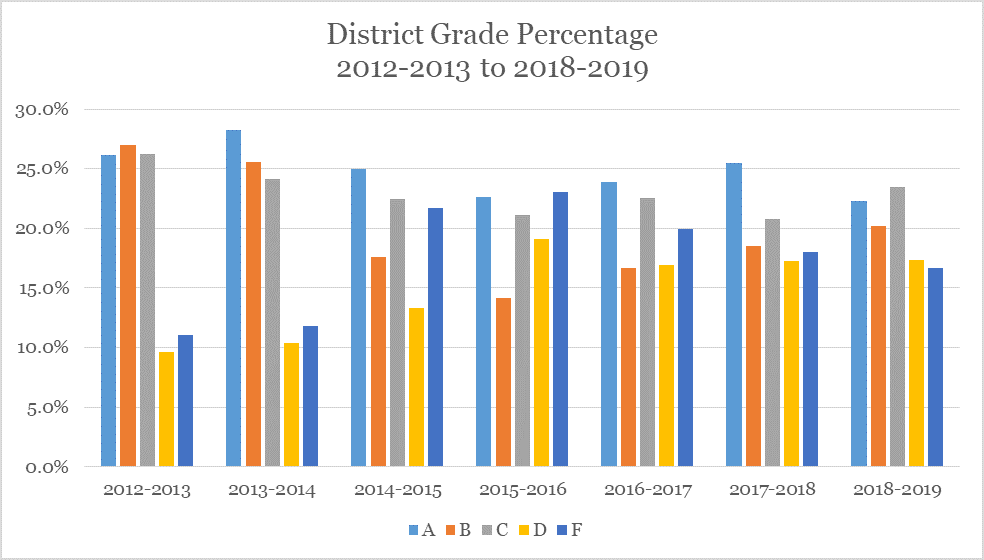
Look at school districts’ overall grade performance since the 2012-2013 school year — the first for the A-F state report card system.

Notice anything? Like a massive jump in D and F grades between 2013-2014 and 2014-2015?

Let me ask you a question: Does anyone — and I mean ANYONE — actually believe that between the 2013-2014 school year and the 2014-2015 school year school districts became more than twice as likely to “fail” kids?

Of course not.

This is a classic case of grade manipulation by state lawmakers. You’ll also notice a steady decline in the rate of Fs since the high point of 2015-2016. Why were these grades so much worse? Because the state kept changing standardized tests. So teachers and students had no idea what the testing expectations were. Since they’ve remained the same, you can see a steady and precipitous decline in the rate of F grades, though the percentages of D and F grades remain far higher than the 2012-2013 school year.

To add insult to injury, a study examing the test performance of students who take vouchers found they did worse on state tests after taking the voiucher than before … according to the pro-voucher Fordham Institute. But that doesn’t matter to Huffman, whose hero is apparently the Titanic captain who kept plowing ahead, damn the iceberg.

Anyway, here’s where Huffman struck gold for those who are taking a public subsidy to send their kids to private, mostly religious schools — only 2 out of the three years’ grades count to have your building designated “failing” from 2013-2014, 2017-2018 and 2018-2019. And once the building is eligible for vouchers, every student who gets a voucher gets to keep it forever, even if the public building becomes the highest-performing in the state…

But it’s all been a plan from the beginning:

1) Deliberately deflate district report card grades

2) Get as many buildings as possible eligible for vouchers

3) Market them like crazy to families in these districts so the rest of us taxpayers can subsidize their choices with our local tax dollars and/or fewer opportunities for our kids who remain in local school districts.

That’s not a district performance problem.

It’s Huffman’s plan.

****************************************

Last Saturday I was on Meryl Johnson’s radio show, based in Cleveland, where she was a teacher in the public schools for many years. Meryl is an elected member of the Ohio State Board of Education, and she is very concerned about the explosion of vouchers. She alerted me to this disaster. I pointed out that there is one possible silver lining. Until now, the suburban districts in Ohio could ignore vouchers and assume they affected only Ohio’s urban districts. Now the cost of vouchers will hit their school budgets and their taxes will  have to go up so that a few students can go to religious schools, where they are likely to get a worse education than the one offered in their local  public schools. Their own schools will now feel the pinch caused by vouchers. Maybe this is the wake-up call that is needed to create a statewide coalition to stop defunding the public schools that enroll the vast majority of students in the Buckeye State.

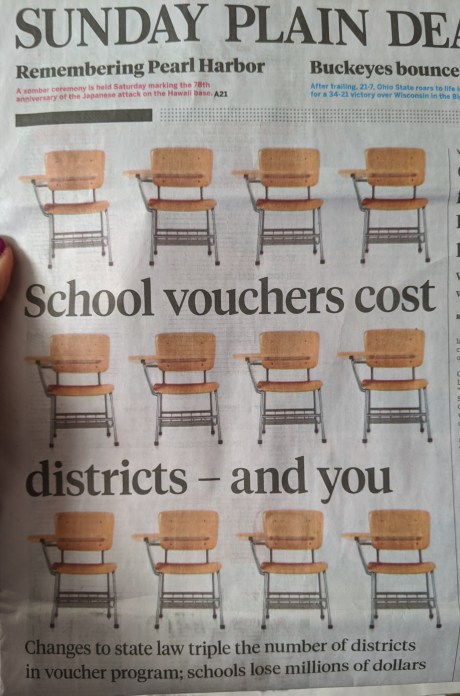
Meryl sent me a screen shot of the front page of the Cleveland Plain Dealer. Will this wake up the citizens of Ohio? Will they realize that they must raise their taxes to pay for vouchers for the small number who leave their public schools? Do they know that the students who leave for religious schools will lose ground academically?

IMG_20191208_113121