Archives for category: Funding

For those of us who are nervous about what President-Elect Biden will do in education, specifically, whether he will revive the failed ideas of Race to the Top, this interview should be comforting. It is a report on a webinar in which Stef Feldman, Biden’s national policy director, spoke to members of the Education Writers Association. It was reported by Erik Robelin in Education Week.

There are many different topics addressed.

This is what she said about charter schools:

“As President, Biden will ban for-profit charter schools from receiving federal funding because he just fundamentally believes that if they aren’t doing right by their students, no one should be getting rich by taking advantage of our kids. He will also, for nonprofit charters, Biden will make sure that we stop funding for charter schools that don’t provide results. Biden believes we shouldn’t be wasting the scarce resources that our public schools need so badly. And we’ll require every charter school, including online schools, to be authorized and held accountable by democratically-elected bodies like school boards and also hold to the same standards of transparency and accountability as all public schools. That means things like regular public board meetings and meeting all the same civil rights, employment, health, labor, safety and educator requirements that public schools must. That’s the fundamental premise of the vice president’s belief that every child, regardless of zip code or parent’s income, race or disability, should have equal access to a high-quality public neighborhood education in their school.”

[Asked to define what “results” charters would need to demonstrate, Feldman said “that would be an important priority for a Biden/Harris Department of Education at the beginning of an administration to figure out some rules to set standards that would measure that.”]

“Vice President Biden doesn’t think that we need to do away with all charter schools. He absolutely wants to support our traditional public schools. But … he feels that the way in which he has designed his policy will allow for charter schools that are delivering results to continue, while also making sure that our funding is focused on our traditional neighborhood public schools.”

On the subject of turning around low-performing schools:

“The first step is to make sure that we are providing these schools with the resources they need to provide a high-quality education to our students. Many times, Title I schools are disproportionately serving students who come from low-income communities. And the schools themselves are under-resourced. Oftentimes, they do not have the basic funding needed to make sure that you have enough teachers, to make sure you have school supplies. … These are schools where they probably have no mental health provider. … They might not even have a school nurse.” 

You can watch the video and see the whole interview.
Mitchell Robinson, a professor at Michigan State University, has advice for state Democratic parties about their message to voters. He suggests what they need to do to attract new voters and turn red legislatures blue. Two big ideas: expand internet access and promote public education, K-16.

He begins:

1. Better, more affordable access to broadband internet service

In a digital age, access to fast, secure internet service is not only a basic human need–akin to utilities like electricity, water, and gas/oil–but it’s a requirement for candidates building a digital campaign infrastructure. Not being able to reliably connect to persons in remote areas of your state, or to those who live in urban areas plagued by internet deserts, severely hampers the ability to convey a candidate’s or party’s message, policy beliefs, or positions on issues. It also leaves persons without reliable internet access to the mercies of our information sources like Fox News or the Detroit News–meaning that they are less informed than someone with no media access at all.

2. Improve support for public education, including community colleges and state universities

One of the single largest predictors of voting patterns is the level of education among a group of potential voters. In general, the more educated a person is, the more likely that person is to vote, and to vote for Democratic candidates. Areas and states with a lower percentage of college-educated voters tend to vote Republican, and more educated areas tend to vote for Democrats. It just stands to reason that increasing the number of college-educated voters would lead to a more Democratic populace.

At the same time, the concerted attacks on public institutions under Republicans have decimated public schools in both our largest cities and the most sparsely populated regions in the country. Aside from race and ethnicity, the demographics and socio-economic issues in cities and rural areas are surprisingly similar–including the damage that has been done by Republican and neoliberal ed reform policies to students, teachers, and schools in both urban and rural communities.

  • Imagine a Democratic platform that features free community college tuition and affordable access to state colleges and universities, and a return to the kind of financial support from state legislatures that was common as recently as the late 1970s.

Open the link and read his other strong ideas to change the political dynamic.

NYC Schools: A Double Crisis! A Forum on Thursday  Nov. 12 at 6:30 PM

How have pandemic and policy exacerbated the inequity in NYC public schools? What can be done? 

Thursday Nov. 12 at 6:30 PM

Join us at our next virtual event as we discuss these issues with our excellent panelists.

Speakers: (list to date; parent panelist will be announced)
Kevin Bryant — Principal at NYC DOE High Schools and current candidate for a PhD in Education at Harvard
Leonie Haimson — Executive Director of Class Size Matters
Jonathan Halabi –High School Teacher, DOE, & Chapter Leader, UFT
Tracey Willacey –Teacher for the NYC DOE for over 25 years

Co-Moderators: 
Gloria Brandman, Retired Teacher, activist with Move the Money/NYC;
Natasha Santos, Program Coordinator, Brooklyn For Peace

See it on Facebook. Please RSVP and invite your friends!

Register now

Big real estate interests managed to defeat Prop 15, intended to raise taxes on commercial real estate to produce billions for public schools.

The Los Angeles Times reports:

SACRAMENTO —  

California voters have rejected Proposition 15, a ballot measure that sought to force large businesses to pay higher property taxes but likely fell victim to concerns about its economic impact on employers and consumers amid the pandemic-sparked recession.

The defeat, projected by the Associated Press on Tuesday, came with unofficial results showing almost 52% of votes were cast against the measure — a level of opposition that remained consistent through the early counting of ballots on Nov. 3 and the week that followed. While returns won’t be certified until early next month, the AP analysis concluded that there are unlikely to be enough ballots remaining to change the outcome.

“California voters understood the very real threat Proposition 15 presented to small businesses, farmers and consumers,” Allan Zaremberg, president of the California Chamber of Commerce, said in a written statement. “Voters in California smartly recognized that enacting the largest tax hike in California history would have been devastating to jobs, our economy and California’s future competitiveness.”

Since its inception, Proposition 15 was a fight about a different ballot measure — Proposition 13, the 1978 landmark initiative that created a tight cap on property values and tax rates. The new proposal’s supporters spent years crafting their plan to strip high-value business properties from the protections provided by Proposition 13, arguing that it had allowed powerful corporations to avoid paying property taxes they could easily afford. The November ballot measure could have generated as much as $11.5 billion a year for public schools and local government services once fully implemented.

Where Proposition 13 sets the value of a property by its purchase price and caps the annual tax at 1% of the value, Proposition 15 would have generated new tax revenue by allowing more frequent valuations of commercial and industrial property holdings worth $3 million or more. Some lower-valued properties would have also been swept into the system because their owners have large portfolios of property across California.

Proposition 15 was explicit in its protection of residential property tax rules, though some of its opponents ominously warned that it was the first step toward a complete overhaul, or outright repeal, of Proposition 13...

Voters were not swayed by the promise of new, substantial tax revenue. Approximately 40% of the revenue would have been sent to K-12 schools and community colleges, while the remaining 60% would go to counties, cities and special districts for services such as law enforcement and fire suppression. The Berkeley poll found that less than a majority of middle-aged voters and those who described themselves as moderates or conservatives believed the new tax revenue was needed.

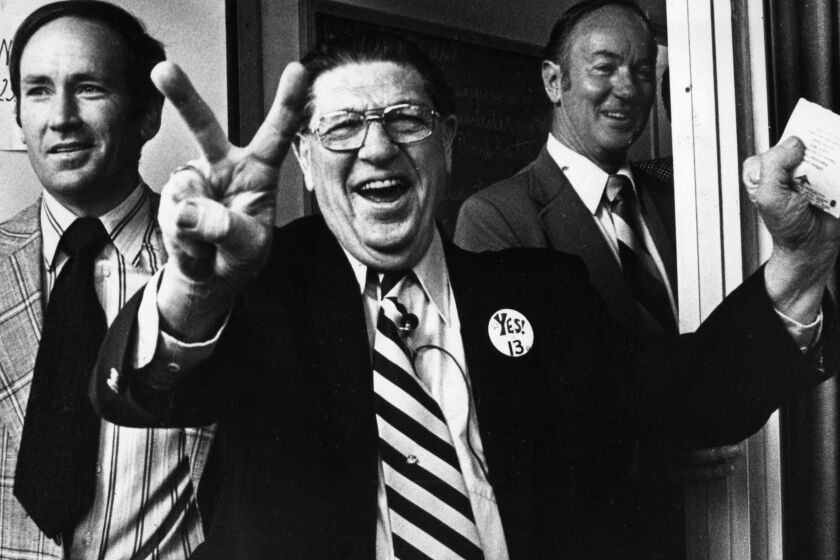
Howard Jarvis, chief sponsor of the controversial Proposition 13, signals victory as he casts his own vote at the Fairfax-Melrose precinct. June 6, 1978 photo by Ben Olender/Los Angeles Times. For From The Archives.
[Howard Jarvis, sponsor of Prop 13, which starved California’s schools]

While the homeowner tax protections of Proposition 13 have remained strongly popular over the last four decades, liberal interest groups and labor unions believed few voters realized that the low-tax rules also applied to multimillion-dollar corporations. Numerous studies revealed that many of these companies, many headquartered in Southern California and the Bay Area, operate in facilities where land values have changed very little since the 1970s — even as new businesses and homeowners alike pay taxes on property assessed more closely to market value.

Business groups that funded the opposition effort — contributing to a campaign with combined donations of more than $125 million — sought to divert attention away from large corporations and focus on Proposition 15’s potential impact on small businesses. Their advertising campaign hammered away at the fact that business owners who lease their location are often required to pay some, or all, of the building owner’s property taxes.

Jan Resseger reviews Biden’s campaign promises about education and expresses her admiration for them. They represent a sharp departure from the harsh, punitive approach of Race to the Top.

Most of those promises require a dramatic increase in funding to close the opportunity gap.

During the campaign, President Elect Biden proposed public schools policy designed to expand the opportunity to learn: “Invest in our schools to eliminate the funding gap between white and non-white districts, and rich and poor districts. There’s an estimated $23 billion annual funding gap between white and non-white school districts today, and gaps persist between high- and low-income districts as well.”

Educators and advocates will need to hold Joe Biden accountable for these promises even as we work to support his efforts to make them a reality.  A significant challenge for Biden will be passing the tax increase on corporations and the wealthiest Americans. Mitch McConnell will continue to lead a Republican majority Senate, whose members will likely not be amenable to raising these taxes.

So, one obstacle to implementing Biden’s bold promises is Mitch McConnell. Another is whether he chooses a Secretary of Education and key personnel who are still attached to the failed policies of Race to the Top. Will his new Secretary bring a bold new vision to support students, teachers, and schools instead of threatening them?

The Pastors for Texas Children, great friends of public schools, invited me to come to Texas in April 2020. I was going to speak in Houston, Dallas, and Austin to activists for public schools. The events were organized by Charles Foster Johnson, the remarkable, wise, and tireless leader of PTC. He has launched similar groups in other states, including Oklahoma and Tennessee.

Then came COVID and my trip was scratched and replaced with a Zoom meeting in late October. I had a spirited conversation with Evan Smith of the Texas Tribune, a superb interviewer who had read my book Slaying Goliath carefully and asked incisive questions. This is the recording of the Zoom. I come in about minute 15 and the conversation is about 40 minutes.

I prepared for the day by studying up on what’s happening in my native state. Texas right now is ground zero for the hungry charter industry. The state commissioner, Mike Marath, who is not an educator, is gung-ho for more charters.

The public schools, which enroll more than five million students, have been underfunded since at least 2011, when the legislature cut the schools’ budget by more than $5 billion. That funding was never fully restored even though enrollment increased. The majority of the state’s public school students and Hispanic and African American. The majority of the legislators are white men.

Meanwhile, the rightwingers have been pushing for charters and vouchers. The Pastors for Texas Children and other civic groups repeatedly stopped the voucher bill by building a coalition of urban Democrats and rural Republicans. For now, vouchers are dead.

So, the privatizers have thrown their firepower into expanding charters. Betsy DeVos gave the state more than $200 million to open new charters. Texas is overrun with corporate chains. The public schools of Texas outperform charters by test scores. Public school students are better prepared for college than charter students. Charter graduates have lower earnings after they finish their schooling. Why, I wondered, do wealthy Texans continue to fund failure?

I hope you will take the time to watch.

#Red4Ed is still producing results in Arizona!

Voters approved a measure to raise the taxes of the wealthiest by 3.5% for the benefit of public schools.

Proposition 208 passed with 52% of the vote. It will produce nearly $1 billion annually for public schools. Fifty percent will be used to raise teachers’ salaries.

The “YES” vote on Prop. 208 will impose a 3.5% income tax surcharge on taxable annual income over $250,000 for single persons or $500,000 for married persons filing jointly.

The Network for Public Education is allied with Pastors for Texas Children. PTC has been a courageous leader in the fight for our public schools and against privatization.

The leader of PTC wrote the following statement:

Statement from Reverend Charles Foster Johnson on the 2020 Elections
Pastors for Texas Children extends a hearty congratulations to all those elected and re-elected to serve our children in the 87th Texas Legislature! Both incumbents and challengers fought hard and often confrontational, contentious campaigns that produced untold stress on them and their families. This is the messy price we pay for open and free elections, and we honor all candidates for serving the public in this important and sacrificial way. We have held every candidate in our prayers, and will continue to do so. We note with profound gratification the emphasis on public education in this electoral cycle. Virtually every incumbent and challenger ran on a strong public education platform. It is clear that the people of Texas want their House of Representatives to be fully affirming of great public schools for all 5.4 million Texas children, promote policies that protect and provide for them, and oppose policies that harm them.  It is crystal clear what public education support means:

*Opposition to any voucher proposal, regardless of its name, that diverts funding away from our neighborhood public schools to underwrite private and home schools.

 Support for budget plans that adequately fund our children’s public education, for a comprehensive study that determines what that education actually costs in current dollars, and for new sources of state revenue to sustain HB3.  

Opposition to charter school expansion that drains money away from public schools.

Support for charter school transparency and accountability.

Opposition to burdensome standardized testing that teachers and parents clearly abhor.

Support for teacher authority and compensation.  

We will be working closely with all 150 House members and 31 Senate members to make sure these promises are put into action in the 87th Legislature. 

Universal education, provided and protected by the public, is an expression of God’s Common Good as well as a Texas constitutional mandate.  Our children are counting on us all to advocate for it.

What is the state of Ohio paying for charters and vouchers? From state data and evaluations, we know that neither sector performs as well as the state’s public schools. The legislature likes to fund failure.

Bill Phillis, who retired as deputy state superintendent and is expert about school finance, has the answer:

Current Cost of School Choice

The cost of school choice borne by the state and school districts is enormous. Public school leaders and advocates should be alarmed.
Ohio has been private school-friendly beginning a half century ago. In HB 166, the state provides private schools with $139,995,470 for administrative cost reimbursement and $309,878,268 for auxiliary services, for a total of $449,873,738. One half billion!

Additional direct state subsidies for charter schools and vouchers in HB 166 for FY 21 and FY 22 include:   


Charter facilities                                                $40,000,000 
 Quality charter schools                                  $60,000,000               
Public charter schools                                     $14,000,000               
EdChoice expansion                                      $178,240,758              
Choice programs                                                $9,780,309                               Total                                                $302,021,067

Hence, the direct state appropriations for private schools, charters and vouchers in FY 21 and FY 22 total $751,894,805.

If the deductions from school districts in FY 22 are equal to the deductions in FY 21 for vouchers and charters, the total will be $2,352,881,306. Therefore, the grand total of tax dollars going to private schools and charters in FY 21 and FY 22 is $3,104,776,111.

Charter school deductions from school districts started with $10,784,924 in FY 99 and escalated each year to $929,884,915 in FY 15. Since FY 15, the total charter deduction has reduced slowly to $827,136,047 in the current school year. Vouchers started in 2008 with $42,355,792 in deductions and have escalated to $349,304,605 in the current year.

HB 166 is set to expand EdChoice vouchers exponentially. The legislature gave a one-year “freeze” in the expansion but the choice community will no doubt prevail in the expansion. 

The EdChoice litigation effort is designed to outlaw the EdChoice voucher scheme.
William L. Phillis | Ohio Coalition for Equity & Adequacy of School Funding | 614.228.6540 | ohioeanda@sbcglobal.netwww.ohiocoalition.org

Parents in Texas got disgusted 15 years ago when the Legislature almost passed a voucher law. They organized the Texas Parent PAC, which is a highly effective voice on behalf of public schools and more than five million students.

The website of Texas Parent PAC has a list of the endorsed candidates, both Democrats and Republicans.

Their guiding principles are a model for parents, grandparents, and civic activists in other states.

I recently heard from Dinah Miller, co-founder and co-chair, who explained the PAC’s origins. She wrote:

Texas Parent PAC formed in 2005 after taxpayer-funded private school vouchers failed to pass the Texas House by only one vote. Five PTA moms called a press conference during PTA Summer Seminar in Austin and announced we were forming a political action committee to elect better talent to the Texas House who would oppose vouchers and support public schools. We recruited Diane Patrick from Arlington who had local and state school board experience to run against hostile Texas House Public Education Committee Chair Kent Grusendorf who had been in office 20 years. We beat Grusendorf in the primary along with others and then knocked off another hostile education committee member in the general election. Those races put us on the map.

From our website: Texas Parent PAC is a bipartisan political action committee for parents, grandparents, parents-to-be, and anyone who supports high quality public education. The PAC has a track record of success, helping to elect over 63 current members of the Texas Legislature, and defeat 23 incumbents who were hostile to public education.

Endorsed candidates reflect traditional mainstream American values that honor and support children and their families, quality public education, strong communities, unlimited opportunities, and maximum citizen participation in our democracy. All endorsed candidates support the Texas Parent PAC Guiding Principles.

Fifteen years later, our volunteers are still fundraising for our endorsed bipartisan candidates for the November 3, 2020 election. Our website is www.txparentpac.com

Sincerely, Your Fan,

Dinah Miller

Co-chair and Co-founder

Texas Parent PAC