Archives for category: Fraud

Carol Burris concludes here her fourth installment of the sad story of the charter school movement in California. What once was a movement intended to help and collaborate with public schools has been taken over by the power-hungry and the greedy, intent on displacing and destroying public education.

California is now the “wild west of charter schools” because of the state’s refusal to oversee the operations of these schools. Public money is handed out to almost anyone who wants it, and supervision is almost non-existent.

Burris writes:

The shine is off the charter school movement. Freedom from regulation, the sine qua non of the charter world, has resulted too often in troubled schools, taxpayer fleecing and outright fraud. Charters have become material for late-night comedians. That is never a good sign; just ask the proponents of the Common Core.

The greatest blow to charter momentum, however, was delivered by the NAACP. When delegates’ voted for a moratorium on new charters, it unleashed the fury of the charterphiles. A piece on the pro-reform website Education Post was titled, “The NAACP Was Founded by White People and It Still Isn’t Looking Out for Black Families,” accusing the premier civil rights organization of being “morally anemic.” And yet, despite the vitriol and critique, the NAACP board of directors stood fast, supported its delegates, and issued a strong statement calling for charter reform.

The passage of Question 2 on the November ballot in Massachusetts, which would lift the cap on charter schools, once seemed a sure thing. Now support has plummeted. The ballot measure is down by 11 points, having lost support among Democrats, especially from the progressive wing.

The problems with loosely regulated charters can no longer be brushed aside.

In the past three posts of my series on California charters (here, here and here), I highlighted some of the serious problems that exist in a state with weak governing laws, a powerful lobby propped up by billionaires, and a governor who consistently vetoes bills aimed at charter reform. California Gov. Jerry Brown, a Democrat who is usually progressive, has a blind spot when it comes to charters. The governor’s enthusiastic fundraising efforts on behalf of the two charters he started in Oakland came under scrutiny in the Los Angeles Times.

As a result, the problems with charters in the state bear an eerie resemblance to the those found in far more conservative states. As I spoke with Californians, I often felt quite depressed. The story line became clear—a state that generally holds progressive values financially abandoned its public schools with the passage of Proposition 13, thus crippling school funding. That was followed by a scramble to a charter solution to compensate for years of underfunding and neglect. That, in turn, opened the door to profit making schemes, corporate reformers hell-bent on destroying unions, and frankly, a lot of irresponsible educational models, such as storefront charters, boutique schools and “academies” linked to for-profits like K12.

There is hope, however, that California can alter its course. Despite all of the obstacles that stand in the way, there are Californians who want charter reform. They are exposing corruption, illegality, profit-making schemes and schools that are clearly not in the best interest of children. In this final piece, I will highlight some of their work.

Open the piece to see the links and to learn more about Burris’s reasons for optimism.
Pennsylvania became an ATM for the charter industry under Republican Governor Tom Corbett. He is gone now, but the legislature remains indebted to the fat, happy charter owners. Many public school districts are on the brink of bankruptcy due to the rapacious charters that snare their students with deceptive advertising. Pennsylvania has more virtual charter schools than any other state, despite the fact that study after study (including one by CREDO, funded by the Daltons) has shown that virtual charters are educational disaster zones. Students who enroll in them don’t learn anything, but the virtual charter industry is rolling in dough. Two different virtual charter leaders have been indicted for theft in Pennsylvania; one admitted stealing millions of dollars, the other saw her trial dismissed because of age and infirmity but was indicted for theft of millions.

Into this land of struggling public schools and thriving charters comes a new legislative plot to privatize and monetize public school funding. It is called HB530. Under the (usual) guise of “reform,” the bill would open the door to the vaults that hold taxpayer money meant for children and welcome the charters to help themselves.

HB530 is a blank check for a rapacious, greedy industry.

Lawrence Feinberg of the Keystone State Education Coalition wrote this post, “20 Reasons to Vote No on PA HB530.”

Here are a few of his reasons:


Pennsylvania taxpayers now spend more than $1.4 billion on charter and cyber charter schools annually, in addition to funding the state’s traditional public schools. The current “rob from public school Peter to pay charter school Paul” system drains money from traditional public schools, forcing districts to cut programs and services for the students who remain. In 2011, the charter reimbursement line was eliminated from the state budget. It provided state funding to districts for the costs and financial exposure resulting from the addition of charter schools.

Legislators are now considering House Bill 530, which would bring much-needed reform to the charter school law that was written in 1997. The bill has several helpful provisions, but the harm that it does far outweighs the good. Here are 20 reasons that the legislature should vote against this measure.

#HB530 does not provide significant accountability to taxpayers for payments made to charter school entities.

#HB530 would create a Charter School Funding Commission that would consider establishing an independent state-level board to authorize charter school entities, bypassing any local decision-making by school boards and their communities.

#HB530 further limits the ability of communities to negotiate the role of charters locally. The decisions about how, when, and where to expand them should be made by those who have the information and expertise to do so in ways that improve education.

#HB530 is an entirely unwarranted intervention in the local governance of school districts. It would remove local control of tax dollars from Pennsylvania taxpayers and their elected school directors.

#HB530 sets no limits to money that charters can drain from local school districts, eliminating districts’ capability to plan and budget.

#HB530 is a vehicle for the Pennsylvania legislature to have local taxpayers pay for unlimited charter expansion.

#HB530 would let charter operators expand and add grades without any local input or authorization, regardless of performance.

#HB530 would let charters expand by enrolling students from outside of the district in which it is located.

If you want to save public education in Pennsylvania, contact your legislators now.

I recently posted Carol Burris’s analysis of a court decision in California that blocked the sneaky expansion of charters into districts outside the one where they were authorized; the new charters called themselves “resource centers” and were infiltrating districts that did not want them.

Here is a report by the San Diego Union-Tribune on the same decision.


California’s booming satellite charter school industry that has persevered through lawsuits, scandals and turf wars suffered a blow this past week when a state appellate court ruled hundreds of the campuses are illegally operating outside their districts.

At issue now is how 150,000 California students — including 25,000 in San Diego County — will continue their education. The court decision also puts at stake millions of dollars in revenue generated by the charters for privately run organizations.

The 3rd District Court of Appeal overturned a lower court decision in a lawsuit filed by the Anderson Union High School District near Redding claiming the Shasta Secondary Home School (now Shasta Charter Academy) illegally opened satellite charter campus, which are officially called resource centers, in its jurisdiction.

Filed Monday and set to go into effect Nov. 16, the appellate decision reverses the lower court ruling, which sided with the charter that was authorized by the nearby Shasta Union High School District. The lower court said it was legal to operate a resource center, as such schools are officially called, in the neighboring Anderson district to give its independent-study students who live there a chance to use computers, receive tutoring and work on assignments in a classroom setting.

Of the state’s 1,200 charter schools, 275 are “resource centers,” many of them storefronts where students show up from time to time. That means that unless this decision is overturned by the state’s Supreme Court, more than 20% of California’s charter schools will cease to operate or seek some other option to survive.

San Diego public schools will welcome the return of the students in these “non-classroom-based” charters:

Andra Donovan, general counsel for the San Diego Unified School District, offers another option: Returning to district and its expanded catalog of independent-study programs.

San Diego Unified “is fully prepared and has sufficient capacity to absorb those students currently attending these charter schools, with fully robust, higher quality independent study and online learning programs as well as traditional and blended programs,” Donovan said. “Our graduation rate far exceeds that of many of these them and our district provides integrated support not available from these charters.”

These “resource centers” are locations intended to coordinate online instruction, which has repeatedly been shown to be a farce, educationally, an easy way to collect credits without getting an education.

Some districts opened resource centers because it was easy money.

Online instruction offers flexibility to students who want an alternative to traditional schools, and big revenue to charter organizations and authorizers. Districts that approve the charters receive up to 3 percent of their revenue for oversight and other services.

The Julian Union district opened its first charter in 1999, and now enrolls some 4,000 students in its charter resource centers across the region. Fewer then 400 local students attend Julian’s district schools.

The tiny rural two-campus district earned nearly $800,000 in revenue from its Julian and Diego Valley charters in the 2014-15 year, when its total revenue was $6.2 million.

Former Julian Superintendent Kevin Ogden helped establish the district’s first charter school, which took in $18 million in revenue last year, and operates 14 programs in eleven facilities.

Ogden helped usher in Diego Valley and Harbor Springs charters, both of which operate resource centers in other districts through independent study programs that offer as much as four days a week of classroom instruction or as little as a few teacher meetings. The Grossmont lawsuit targets Diego Valley.

Ogden retired about two years ago to take a top job at the Lancaster-based Learn4Life, an organization that includes Diego Valley, its Diego Plus Education Corporation and other charters throughout the state.

Following Julian’s lead, dozens of far-flung charters and resource centers have been authorized by other small East County districts, including some that acknowledged the arrangements were forged mostly for the money.

Does anyone seriously believe that the students who receive diplomas from these sham institutions are getting a high-quality education? Is this the way the U.S. will compete in the global economy? Hey, reformers, this is a farce.

Angie Sullivan sent the following message. The charter schools of Nevada are performing far worse than the public schools. As Angie asks, how can more charters be the answer when they are the problem? Should the failing charters be handed over to another charter? Or should they be closed so the students return to the more successful public schools? Unfortunately, as the law is written, only low-scoring public schools can be closed, not failing charter schools. Another irony: The Andre Agassi Charter school is listed by the state as a “failing school,” yet Agassi and his business partner Bobby Turner are opening Andre Agassi charter schools in many other cities. Why? To make money, not to make better schools.

Angie writes:

We have 39 charters in the state of Nevada and 14 of them are on the lowest performing list. 36% of Nevada Charters are in the lowest of the low in the state.

We have 359 schools in Clark County School District. 2 of the schools listed are alternative schools that teach credit retrieval and adult education. 17 schools in the lowest of the low in the state. That is 5% of CCSD schools.

Can someone explain to me how charters are the solution and not the problem in my state?

Frankly the public schools are doing much much better than the charters – even according to this invalid and weird data.

Also . . . keep in mind these rural schools which are failing represent a huge percentage. If Elko has 22 schools and 5 are failing – that is 23% of all their schools.

Comparatively, Clark County School District is doing better than the rest of the state and especially better than the charters.

CCSD is serving the most disenfranchised and likely to fail communities – we are doing better than the rest WITH the least amount of per pupil money. Everyone else in the state – including charters gets more.

Just think what we could do if we funded near the middle?

Yet the Nevada Department of Education keeps threatening public school staff with turnaround and now the Achievement School District. Schools without textbooks or supplies have to have entire staffs interviewed right before holiday break?

I think we need to start having a REAL discussion about education our state.

We need to demand REAL and timely data if that is what is driving this vehicle – not this sketchy fly-by-night multiple list craziness.

Tomorrow the Charter Authority will be meeting with the Las Vegas City Council at noon.

Those in power need to have a REAL discussion about closing these failing charters and a REAL discussion about the other costs charters have in our communities.

Like receivership – with receivers from Washington DC getting paid $25,000 a month to come out and reorganize charters: Quest and Silver State Schools. Who makes $25,000 a month?

_________________

I recieved the following message from a concerned parent today:

The details how this charter school set itself up is a scam.

It is part of an eviction case.

Then the receiver gets paid $25,000 a month to rehabilitate it. Plus $35,000 for a report.

And the state is soliciting for MORE receivers!!!! (On the charter school authority page.)

Look up Josh Kern and Ten Square he has 2 schools he is doing this for in Nevada the other is Silver State in Carson City.

$25,000 a month plus expenses dont want to miss that part.

Click to access Summary-Eviction-Tenant-Answer.pdf

You should see how insulted he is by the John Oliver attacks on charter schools in the Aug 26 video

http://charterschools.nv.gov/News/Public_Notices/

If they are failing shut them down and pay all of those $$$$ to public schools.

No one is going to jail over any of this.

_________________________

Someone is spending big money to try to protect these charters! BIG MONEY Who makes $25,000 in a month? Is the tax payer paying for these receivers? What a waste!

Charters are making Nevada’s education problems worse.

Angie


Carson City, Nevada

Pioneer HS

Charter

100 Academy

http://ccsd.net/divisions/stud ent-support-services-division/ 100-academy-of-excellence

Charter

Agassi SEC

http://www.agassiprep.net/apps /pages/index.jsp?uREC_ID=24017 2&type=d&pREC_ID=854780

Clark County School District

Bailey MS

Clark County School District

Brinley MS

Clark County School District

Burk Horizon SW HS

http://ccsd.net/divisions/educ ation-services-division/adult- education-horizon-sunset-high- schools

Clark County School District

Cambeiro ES

Clark County School District

Clyde Cox ES

Clark County School District

Craig ES

Charter

Delta Charter

Clark County School District

Desert Pines HS

Clark County School District

Alternative

Desert Rose ALT

http://desertrosehs.org/apps/p ages/index.jsp?uREC_ID=216521& type=d&pREC_ID=423036

Clark County School District

Ftizgerald ES

Charter

Global Community

Charter

Innovations ES

Charter

Innovations SEC

Clark County School District

Jerome Mack MS

Clark County School District

Kelly MS

Clark County School District

Lowman ES

Clark County School District

Monaco MS

Charter

Odyssey HS

http://odysseyk12.org/high-sch ool-curriculum/

Charter

One Hundred Acad ES

http://ccsd.net/divisions/stud ent-support-services-division/ 100-academy-of-excellence

Clark County School District

Orr MS

Clark County School District

Peterson ES

Clark County School District

Priest ES

Clark County School District

Von Tobel MS

Clark County School District

West Prep Sec (MS)

Clark County School District

Tom William ES

Clark County School District

William Wendell ES

Elko

Carlin HS

Elko

Owyhee ES

Elko

West Wendover ES

Elko

West Wendover JHS

Elko

West Wendover HS

Mineral

Hawthrone HS

Mineral

Schurz ES

Nye

Pathways HS ALT

Nye

Round Mountain ES

Charter

Beacon Academy

Charter

Discovery Charter

Charter

NV Connections Academy

Charter

Silver State Charter School

Washoe

Desert Height ES

Washoe

Charter

I Can Do Anything HS

http://www.icdachs.com/

Washoe

Natchez ES

Washoe

Charter

Rainshadow HS

http://rainshadowcharterhs.wee bly.com/


Blogger Jersey Jazzman is an experienced teacher and graduate student at Rutgers, where he has learned how reformers play games with data. He is better than they are and can be counted on to expose their tricks.

In this post, he blows away the myth of the “success” of Boston charter schools.

The public schools and the charter schools in Boston do not enroll the same kinds of students, due to high attrition rates in the charters (called Commonwealth charter schools).

He writes:

“As I pointed out before, the Commonwealth charter schools are a tiny fraction of the total Boston high school population. What happens if the cap is lifted and they instead enroll 25 percent of Boston’s students? What about 50 percent?

“Let’s suppose we ignore the evidence above and concede a large part of the cohort shrinkage in charters is due to retention. Will the city be able to afford to have retention rates that high for so many students? In other words: what happens to the schools budget if even more students take five or six or more years to get through high school?

“In a way, it doesn’t really matter if the high schools get their modest performance increases through attrition or retention: neither is an especially innovative way to boost student achievement, and neither requires charter school expansion. If Boston wants to invest in drawing out the high school careers of its students, why not do that within the framework of the existing schools? Especially since we know redundant school systems can have adverse effects on public school finances?”

Conclusion: Jersey Jazzman opposes Amendment 2, which would lead to an unsustainable growth in charter schools, free to push out the students they don’t want.

Maureen Downey of the Atlanta Journal-Constitution writes that there are signs that Governor Nathan Deal’s attempt to change the state constitution to allow state takeovers of low-scoring schools and turn them over to charter corporations is running into a groundswell of unexpected opposition.

The public is waking up.

The ALEC privatization crowd thought they could dupe the people of Georgia into giving up local control of their schools. The amendment is deceptively worded as a way to “improve” schools when it is a bald-faced power grab by the charter industry. It is one of the ironies of our peculiar time that conservatives and rightwingers now fight to eliminate democracy and life cal control. This makes it easier to turn public money over to corporate charter chains.

This is the deceptive language of the amendment:

Shall the Constitution of Georgia be amended to allow the state to intervene in chronically failing public schools in order to improve student performance?

( ) Yes

( ) No”

Deal calls it the “Opportunity School District,” when he really means the State Takeover District. It is modeled on Tennessee’s failed Achievement School District. There is zero evidence that a state takeover district improves test scores (“student performance”).

As Downey explains, the popular resistance is increasingly visible.

Here are one of the four signs that Downey identifies:

“This morning former Atlanta Mayor Andy Young and baseball legend Hank Aaron held a press event urging Georgians to reject the OSD. “We have to defeat this, we have to vote ‘no’ on Amendment 1,” said Aaron. Young took issue with Deal’s description of schools and students as failing. “Self-esteem is the basis of good education,” said Young. “To take that self-esteem away from families, teachers, principals and boards of education locally and turn it over to a corporate-oriented state structure is a sin and a shame and we cannot allow it.”

A great statement by an icon of the civil rights movement.

In this post, Jeff Bryant reviews the current backlash that is blocking the path of the charter industry.

For most of the past 20 years, we have been fed a steady diet of propaganda about charter schools and their magical power to “save poor kids from failing public schools.” The original founders of the charter movement wanted charter schools to collaborate with public schools, to help solve problems that public schools couldn’t solve, and to be partners. They are no longer collaborators or partners; instead they see themselves as competitors, trying to seize “market share” and drive public schools out of business. The founders did not dream that their idea would give birth to an avaricious industry that would generate for-profit schools, schools with draconian discipline, and schools that fought against any accountability.

One thing is now clear: charter schools do not have a secret formula to “save poor kids from failing public schools.” When they accept the same students, they do no better and often do much worse (on standardized tests) as compared to their “failing schools.” Many circumvent this problem by choosing the students they want and excluding those they don’t want. In some states and cities, the charters are failing far worse than the public schools they replaced. Hardly a day goes by without another story of a scandal, financial or academic, in the charter industry. This is not surprising when there is so little oversight, accountability or transparency associated with the charter schools. You need not look far to find examples of nepotism, conflicts of interest, graft, fraud, misappropriation of funds, and self-dealing.

For years, the public has been unaware of what the charter industry was up to. But as the industry became more ambitious, more aggressive, and more avaricious, the public is catching on. That is why Question 2 in Massachusetts, funded by out-of-state billionaires, is in trouble; that is why Amendment 1 in Georgia, which would allow the state to take control of struggling public schools, is in trouble. The billionaires are pumping in more money to deceive the public, but school boards, PTAs, school committees, teachers’ groups, and parents are spreading the word, door to door, without the billionaires’ help.

The loss of taxpayer money on schools of unknown quality is bad enough. What is far worse is allowing the profiteers and free-market ideologues to privatize an essential democratic institution.

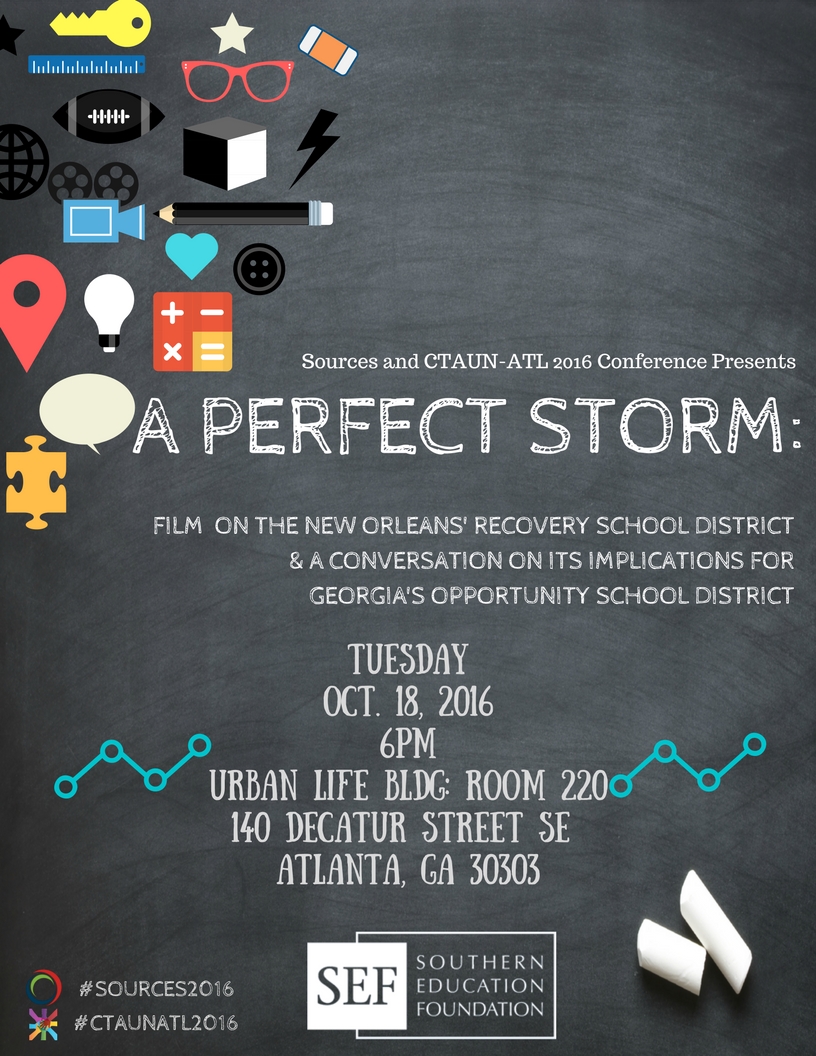
Parents, students, educators and other citizens are invited nvited to learn about the hoax of Amendment 1on the ballot. It is an effort by the far-right to change the Georgia state constitution to allow the state to take over schools with low test scores and give them to charter corporations. Tea Party Governor Nathan Deal says it is for the poor minority kids, whom he wants to “save.”

Please join civil rights activists to learn more about Amendment 1 and the myth of the New Orleans miracle.

perfect-storm-9-28

Carol Burris is writing a four-part series about charter schools in California. She recently traveled to California to visit charter schools. She found it difficult to get information on certain charter schools, because some are not located in the district that authorized them. Transparency and accountability appear to be non-existent. A recent newspaper series about the online charter K12, Inc., demonstrated that it makes a handsome profit while delivering poor education. But the state has taken no action.

Public money meant for public schools is freely handed out to charters with no supervision or oversight.

She learned about a charter school called WISE, and it sounded good on paper:

The Wise Academy is tucked away on a Girl Scout camp on the Bothin Youth Center in Fairfax, Calif. Its students attend classes in yurts and barns. Wise, which stands for Waldorf-Inspired School of Excellence, follows the curriculum taught in Waldorf private schools — its students garden, enjoy a games class, and celebrate All Souls Day and Michaelmas.

Students must apply to attend, and its preliminary application makes it clear that parents are supposed to pony up cash. The full application demands that families provide all sources of income. The school’s donate button has a default donation of $2,000. A cash-strapped parent would quickly infer that their family “need not apply.”

How many students attend Wise Academy and how well do they achieve? For the taxpaying public, that is a mystery.

You cannot find this K-6 charter school, which has been in operation for three years, on the state’s Education Department website. Rick Bagley, the superintendent of the Ross Valley School District in which Wise is located, was never informed of its presence as required by law.

The state has thus far refused to monitor charter schools or hold them accountable.

A bill that would have banned for-profit charters in California was vetoed by Gov. Jerry Brown in 2015. An additional bill, which would have prevented financially troubled districts from authorizing charters in other districts, was vetoed by Brown last month. The president of the California State Board of Education, Michael Kirst, worked as a K12 consultant, before his appointment by Brown.

I am on the train returning from Wellesley to New York City, after Pasi Sahlberg’s brilliant performance last night. I say “performance” because he didn’t give a conventional lecture. He used a multi-media platform to entertain, interact, and inform the audience. He began his talk by posing a mathematical question, which appeared on the screen behind him. He urged the audience to add the numbers, out loud, simple whole numbers, as they appeared on the screen. Many of us showed how easily we were fooled by what we thought we saw. How easily we draw false conclusions. That was his introduction to a performance that included film clips, music, data, and exposition. If you have a chance to invite him to your state or organization, I urge you to do so. He is amazing. As soon as I have the video link, I will post it.

In talking to parents and teachers during my visit, I learned that all those millions from hedge fund managers, billionaires, and union-busters are now showing up as television commercials blanketing the state with lies. Earnest “parents” explain in the commercials that they are voting for Question 2–the approval of more privately run charter schools–because they “support” public schools, they want to “help” public schools. They do not explain that passage of Question 2 means that neighborhood public schools will be closed and replaced by corporate-controlled charter schools. They do not explain that more money for charter schools means less money for public schools. They do not explain that those who vote for Question 2 are voting to cut the budgets of their own public schools.

It is a low, misleading, dishonest campaign. Why are the “reformers” dishonest? Simple. If they told the truth, the public would overwhelmingly reject their goal of privatizing public schools and turning over control to out-of-state corporations. This is the billionaire-funded propaganda campaign that dare not speak its name.

Corporate reform refuses to be truthful. It wraps itself in self-righteous lies about promoting civil rights and closing the achievement gap. Destroying a democratic institution is not promoting civil rights. Creating colonialist “no excuses” charter schools that exclude or kick out low-scoring students does not promote civil rights or reduce the achievement gap. Making a fetish of standardized testing guarantees that the “achievement gap” will never close because the standardized tests are designed to produce achievement gaps that never close.

Where do the “reformers” find the white teachers willing to enforce the harsh discipline of no-excuses schools and impose unquestioning compliance on nonwhite children? Very likely, these teachers attended progressive private or public schools. Did they learn the value of conformity and obedience in TFA training or at the Relay “Graduate School of Education”?

As Alan Singer wrote on Huffington Post, Massachusetts is now ground zero in the battle for public education. It may be the most liberal state in the nation. It is far and away the most successful state school system, as measured by the National Assessment of Educational Progress. If the billionaires can persuade the people of Massachusetts to turn over a dozen schools a year from here to eternity, they can do it anywhere. After all, what’s a couple of million dollars to the Waltons, whose family wealth exceeds $130 billion? If the billionaires can hoax the people of Massachusetts for only $15 million, what state will be outside their reach? You can be sure that the charter industry won’t stop in Boston and the small cities of the state. They have their eyes on the suburbs, too.

What happens on November 8 will matter to the future of public education in America.

Will the corporate reformers pull the wool over the eyes of the public? Will their deceptions and lies cover up their goal of undermining one of our most important democratic institutions?

Or will the grassroots actions of parents and teachers strip away their evasions, lies, and propaganda and demonstrate that the public schools of the Bay State are not for sale? Not at any price.