Archives for category: Failure


Steven Singer reviews a new report from the Center for Reinventing Public Education at the University of Washington. This is a Gates-funded think tank whose belief is that the best way to “reinvent” public schools is to privatize them.

The charter sector had been booming but this past year, the boom fizzled. What once seemed to be an unstoppable steam roller, intent on crushing public schools, has slowed to a crawl.

The problems, says the report, are real estate cost, teacher shortages, and political backlash.

Singer writes:

“How did the hippest new thing to hit education since the chalk board suddenly hit such a wall? After all, it wasn’t so long ago that every celebrity from Magic Johnson to Andre Agassi to Deion Sanders to Sean “Puffy” Combs to Pitt Bull had their own charter school. Even Oprah Winfrey, the queen of multimedia, donated millions to charter networks in Louisiana, California, Pennsylvania, Colorado, Texas and her home state of Illinois.

“How could something with so much high profile support be running out of gas?

“The Center on Reinventing Public Education (CRPE) has a theory.

“The charter school funded think tank (read: propaganda network) released a report boiling the issue down to three factors: real estate costs, a teacher shortage and political backlash.

“Real estate costs? Yes, few public schools want to offer you public property to put your privately run school that will inevitably gobble up a good portion of its funding and turn a portion of that into profit for private investors.

“Teacher shortage? Yes, when you pay your educators the least, don’t allow your employees to unionize, and demand high hours without remuneration, you tend to find it harder than most educational institutions to find people willing to work for you.

“Political backlash? DING! DING! DING!

“Of course, most people who aren’t paid by the charter school industry – as those working for CRPE are – would simply call this a charter school backlash – not political, at all.

“This isn’t one political party seeking advantage over another. It’s concerned citizens from both sides of the aisle worried about the practices of the charter school industry.”

Singer’s post includes some nifty charts. Be sure to open it.

The bottom line is that the bloom is off the rose.

The public is beginning to understand that charter schools are meant to destabilize their community public schools. They take away money meant for the public schools. They take the students they want and exclude those they don’t want. They open and close like day lilies. The for-profits are interested in profit, not education.

And it destroys their reputation when the public knows that Trump, DeVos, Wall Street, and the Koch brothers are leading the charge to destroy what belongs to the entire community.

Resist!


Just two days ago, the Bradley Success Academy in Goodyear, Arizona, shuttered, stranding its students.

The school sent a letter to parents expressing its regret.

One parent said she was finished with charter schools.

“”I will never put my child in another charter school again … because they are financially unstable,” Stephanie McMullen said.

“And then there are the practical concerns.

“I’m afraid he’s going to be behind and other kids like him are going to be behind,” McMullen said. “It’s not right. Teachers are out of work, too.”

“Preschool teacher Michelle Miller is one of them.

“For all the hard work that we’ve done all year long, it’s heartbreaking that they would do something like this to us,” she said as she held back tears.”

The school enrolled 450 students. It was started in 2003.it was managed by for-profit Imagine, which has a record of making money in real estate.

A reader of the Blog alerted me with this comment:

“And, another charter school closed its doors abruptly. The Bradley Success Academy shuttered his doors & locked the gate in Goodyear, Az,. a small suburb to the west of Phoenix. (One of those cookie cutter developments built on the edges of an old western town) It signed charter papers in 2003. The letter cited overwhelming financial problems. In looking through their Facebook pages, it seems many parents were unhappy. The Facebook page also touted their expertise in Special Ed. But, looking at the credentials and expenses, no monies were spent on Spec. Ed. Could be wrong, I’m not an expert at finacial reporting.

“I am currently investigating how much money they’re going to abscond with. One of the things that stood out in the financial report turned into Arizona Department of Education is they have over $8 million worth of capitol assets. Didn’t see any real problems with finances, other than revenue & expenses don’t quite line up.

“One of the charter holders is Paula Poultridge, Regional finance Director for Imagine Schools. Hmmmm…………………something to look at?”

I reviewed Harvard Professor Daniel Koretz’s “The Testing Charade” in “The New Republic.” It was behind a paywall until a few days ago. The paywall has been lifted.

Here are the main points.

Koretz demolishes the test-and-punish regime of No Child Left Behind and Race to the Top. He says in no uncertain terms that they failed. He says they ignored Campbell’s Law, which declares that attaching high stakes to tests distorts both the measure and distorts the process they were meant to measure. The emphasis on testing led to inflation of scores, so any rise in scores as a result of pressure is of little or no significance and surely does not mean that students are better educated. I enjoyed reading the book, and my reservation is that Koretz is not at all sure what to do about accountability. I am not either. I wish that the leaders of Congress understood what a complicated subject of accountability is. I would like to see greater accountability at the top, where decisions are made about funding and autonomy. We have a wacky system where teachers, principals and students are held accountable without the power to change the conditions under which they Labor.

This Report was written by Kris Nordstrom, who works for the North Carolina Justice Center. He previously was a research analyst for the North Carolina General Assembly. The report tells the story of a state that was once the envy of the South for its education policies, but is now in rapid decline, copying failed policies from other states,

Home

PRESS RELEASE and SUMMARY

By Kris Nordstrom
Contracting Analyst, Education & Law Project

North Carolina was once viewed as the shining light for progressive education policy in the South. State leaders—often with the support of the business community—were able to develop bipartisan support for public schools, and implement popular, effective programs. North Carolina was among the first states to explicitly monitor the performance of student subgroups in an effort to address racial achievement gaps. The state made great strides to professionalizing the teaching force, bringing the state’s average teacher salary nearly up to the national average even as the state was forced to hire many novice teachers to keep pace with enrollment increases. In addition, North Carolina focused on developing and retaining its teaching force by investing in teacher scholarship programs and mentoring programs for beginning teachers.

North Carolina innovated at all ends of the education spectrum. The state was one of the first in the nation to create a statewide pre-kindergarten program with rigorous quality standards. At the secondary level, North Carolina was at the forefront of dual credit programs for high school students, and the Learn & Earn model (now known as Cooperative Innovative High Schools) became a national model, allowing students to graduate with both a high school diploma and an associate’s degree in five years. Students graduating from North Carolina public schools could enroll in the state’s admired, low-cost community college system or its strong university system, most notably UNC Chapel Hill. For much of the 1990s through early 2000s, policymakers in other states often looked to North Carolina’s public schools as an example of sound, thoughtful policy aiming to broadly uplift student performance.

Unfortunately, over the past seven years, North Carolina has lost its reputation for educational excellence. Since the Republican takeover of the General Assembly following the 2010 election, the state has become more infamous for bitter partisanship and divisiveness, as reflected in education policies. Lawmakers have passed a number of controversial, partisan measures, rapidly expanding school choice, cutting school resources, and eliminating job protections for teachers.

Less discussed, however, has been degradation in the quality of North Carolina’s education policies. General Assembly leadership has focused on replicating a number of education initiatives from other states, most lacking any research-based evidence of delivering successful results to students. The General Assembly has compounded the problems though by consistently delivering exceptionally poorly-crafted versions of these initiatives.

Sadly, these controversial, poorly-executed efforts have failed to deliver positive results for North Carolina’s students. Performance in our schools has suffered, particularly for the state’s low-income and minority children.

So how did we get here? How is it affecting our students?

Lack of transparency leads to poor legislation

The past seven years of education policy have been dominated by a series of not just bad policies, but bad policies that are incredibly poorly crafted. This report provides a review of the major education initiatives of this seven-year period. In every case, the major initiatives are both:

Based on very questionable evidence; and
Crafted haphazardly, ignoring best practices or lessons learned from other states.
These problems almost certainly stem from the General Assembly’s approach to policymaking. Over the past seven years, almost all major education initiatives were moved through the legislature in a way to avoid debate and outside input. At the same time, the General Assembly has abandoned its oversight responsibilities and avoided public input from education stakeholders. The net result has been stagnant student performance, and increased achievement gaps for minority and low-income students.

One commonality of nearly all of the initiatives highlighted in this report is that they were folded into omnibus budget bills, rather than moved through a deliberative committee process. Including major initiatives in the budget, rather than as stand-alone bills, is problematic for three reasons:

Stand-alone bills are required to be debated in at least one committee prior to being heard on the floor. Committee hearings allow public debate and bill modifications from General Assembly members with subject-area knowledge, and can permit public input from stakeholders and other outside experts.
Stand-alone bills require majority of support to become law. While the budget bill also requires majority support to become law, there is great pressure on members to vote for a budget bill, particularly one crafted by their own party. Budget bills are filled with hundreds of policy provisions. As a result, members might vote for controversial programs that are incorporated into the budget that they would not support if presented as a standalone vote.

Budget bills are very large, and members are often provided limited time to review the lengthy documents. For example, the 2017 budget bill was made public just before midnight on June 19 and presented on the Senate floor for debate and vote by 4 PM on June 20. As a result, members are unable to adequately review programs and craft amendments that could improve program delivery.
Compounding matters, the General Assembly has effectively dismantled the Joint Legislative Education Oversight Committee (Ed Oversight), while joint meetings of the House and Senate Education Appropriation subcommittees (Ed Appropriations) are becoming increasingly rare. In the past, these two committees were integral to the creation and oversight of new initiatives.

From its formation in 1990 through 2015, Ed Oversight regularly met during the legislative interim to recommend ways to improve education in the state. However, the committee met just once in the 2015-16 interim, and not at all during the 2016-17 interim.

Similarly, Ed Appropriations—which is responsible for crafting the state budget for public schools, the community college system, and state universities—is meeting less often. Historically, Ed Appropriations meetings during long sessions have been the venue through which General Assembly members undertake detailed, line-item reviews of each state agency’s budget.

2017 marked the first time in known history that Ed Appropriations meetings featured zero in-depth presentations of K-12 funding issues. The General Assembly’s education leaders stood out for their lack of effort. Every other budget subcommittee received detailed presentations covering all, or nearly all, agency budgets.

North Carolina’s teachers, Department of Public Instruction employees, and the academic community are an incredibly valuable resource that should be drawn upon to strengthen our state educational policy. Instead, these voices have increasingly been ignored. As shown below, the net result has been a series of poorly-crafted policies that are harming North Carolina’s children.​

A study in Ohio reveals that the state’s charter schools have far lower graduation rates, even when compared to urban districts and excluding dropout recovery schools. This story appeared in the Columbus Dispatch.

“Even when excluding dropout-recovery schools, the four-year graduation rates of charter schools in Ohio are half that of traditional schools, and 28 points lower than the largest urban districts.

“Charter schools not classified as dropout recovery have a four-year graduation rate of just under 45 percent, compared with 73 percent in Ohio’s six biggest urban districts — Columbus, Cleveland, Cincinnati, Dayton, Akron and Toledo.

“Having it be that low is surprising. Very surprising,” said Howard Fleeter, chief analyst for the Ohio Education Policy Institute, who produced the data.

“Given that Ohio charter schools draw most of their students from urban districts, and those urban districts have a higher concentration of poverty than the non-dropout charter schools, the graduation numbers should be closer, Fleeter said.

““The (charter) school numbers look really bad. The question then is to figure out why,” Fleeter said, stressing that some charters are showing high graduation rates, so it’s not an indictment of the whole system. “The next step is, let’s look behind the averages and see what’s going on. There are places where they’re not doing nearly as good a job as others. Why is that?””

Tom Ultican lays out in gruesome detail the billionaires’ plan to destroy public education.

The documentation is solid. The billionaires are jointly funding every anti-public school organization they can find, and they create them when they don’t exist.

Gruesome, yes. But it is a fact that their spending has not accomplished much, other than to ruin the lives of children, teachers, families, and communities. Nowhere has it produced better education. They sow chaos and disruption, then move on to the next big idea.

He begins like this:

“Three researchers from Indiana coined the terminology Destroy Public Education (DPE). They refuse to call it reform which is a positive sounding term that obfuscates the damage being done. America’s public education system is an unmitigated success story, yet, DPE forces say we need to change its governance and monetize it.

“We are discussing the education system that put a man on the moon, developed the greatest economy the world has ever seen and wiped out small pox. It is the system that embraces all comers and resists all forms of discrimination. In the 1980’s, it was laying the foundation for the digital revolution when it came under spurious attack.

“Not only are great resources being squandered on DPE efforts but the teaching profession is being diminished. Organizations like Relay Graduate School and the New Teachers Project are put forward as having more expertise in teacher education than our great public universities. That would be amusing if wealthy elites were not paying to have these posers taken seriously.”

The Detroit News invited me to write a plan to revive education in Detroit.

Detroit has been a Petri dish for reformers for 25 years. Everything they tried has failed.

Here is my proposal.

http://www.detroitnews.com/story/opinion/2017/12/13/charter-schools/108585724/

Mercedes Schneider heard about the book promotion tour of one David Osborne. Osborne is late to the party. He has written a book claiming that New Orleans is the shiny new model for school reform. Way back during the Clinton administration, Osborne achieved a modicum of fame for his book Reinventing Government, which proposed that government agencies should compete with private businesses. The competition, he argued, would produce public benefits and make government more efficient. Vice President Al Gore invited Osborne to work with him to introduce his ideas into the federal government. I’m not sure where that project went, but charter schools certainly fit the paradigm. The Clinton administration got behind the idea and set the pattern of federal support for the experiment.

Well, we have had charter schools for 25 years. They are no longer an experiment. They are not a bright, shiny innovation. Indeed, it is difficult to think of any innovation produced by charter schools, other than getting rid of unionized teachers. It is odd to see an author pop up with an idea that has been tried for 25 years and claim that he is on to something fresh.

Even stranger is that Osborne points to New Orleans as the epitome of reform, the cutting edge that offers hope to schools everywhere. Where has he been hiding these past few years?

Schneider notes that the all-charter Recovery School District that Osborne admires has yet to crack an ACT score of 17, which is very low indeed. Osborne doesn’t mention this. He seems to have stopped learning anything about New Orleans about five years ago.

As Schneider shows in another post, The Myth of the New Orleans Miracle has collapsed.

“For a full decade following Hurricane Katrina (2005-2015), those pushing state takeover and the resulting conversion of all state-run New Orleans schools into charters have been quick to promote the marvels of their miracle.

“Twelve years later, in 2017, not so much, unless cornered for a sound byte.

“Market-based school choicers have increasingly less to work with regarding the NOLA Charter Miracle sales pitch. Consider the 2016-17 district performance scores. Those New Orleans state-takeover (now) charter schools are no longer separated from the Orleans Parish School Board (OPSB), so now those “failing schools” that the state supposedly miracle-whipped are now part of a single district (let’s call it NOLA), with one single district performance score resulting in one single district letter grade– and that single performance score and resulting letter grade really took a dive in 2016-17, from 85 B (sort of) to 70.9 C.”

If you look at her tables, based on stated sources, the Recovery School District in Baton Rouge is graded F.

Does David Osborne know this?

He seems remarkably uninformed.

Kind of like a journalist claiming that using leeches to bleed patients is an important discovery.

Professor Helen F. Ladd is professor of public policy and economics at Duke University.

In this paper, she analyzes the merits and demerits f No Child Left Behind and concludes that it failed in reaching the ambitious (and unrealistic) goal that all children would be proficient by 2014.

She calls NCLB “a deeply flawed federal policy.”

She writes:

“NCLB relied instead almost exclusively on tough test-based incentives. This approach would only have made sense if the problem of low-performing schools could be attributed primarily to teacher shirking, as some people believed, or to the problem of the “soft bigotry of low expectations” as suggested by President George W. Bush. But in fact low achievement in such schools is far more likely to reflect the limited capacity of such schools to meet the challenges that children from disadvantaged backgrounds bring to the classroom. Because of these challenges, schools serving concentrations of low-income students face greater tasks than those serving middle class students. The NCLB approach of holding schools alone responsible for student test score levels while paying little if any attention to the conditions in which learning takes place is simply not fair either to the schools or the children and was bound to be unsuccessful.”

I hope that Professor Ladd applies her sharp analytical skills to reviewing Race to the Top.

At some point, we can begin to calculate the billions spent for 13 years of punitive test-based accountability.

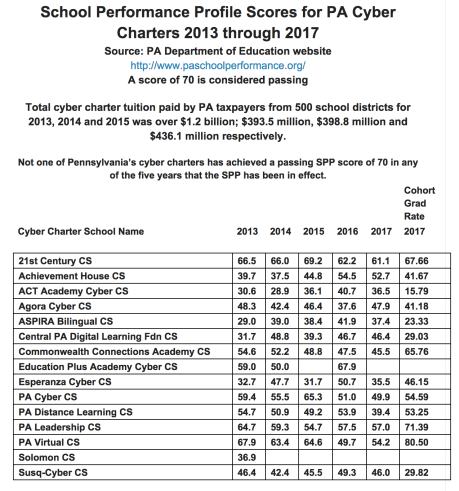
For the fifth year in a row, not one cybercharter in Pennsylvania achieved a passing school performance score of 70. When will these scams be held accountable for their poor performance? When will the State close down these failing schools? These “schools” drain hundreds of millions of dollars away from real schools and get poor results, year after year. Two different cybercharter operators were indicted for stealing millions from state taxpayers. One was convicted, the other was tried but the trial ended in a hung jury.

Screen Shot 2017-11-02 at 9.44.37 PM