Archives for category: Failure

John Thompson has been researching the tenures of Broadie Superintendents, who sem to have been trained to be tough top down administrators.

Here is his latest report:

Researching failed Broad Academy superintendents has been “déjà vu, all over again.” When No Child Left Behind promised 100% proficiency by 2014, education researchers accurately predicted that efforts would be diverted from teaching and learning to statistical gamesmanship. Being fairly new to education policy, I kept asking myself what reformers were thinking: Had they never heard of Campbell’s Law? If they hadn’t read Catch 22, had they not seen the movie, and its portrayal of the real world effects of imposing absurd, unreachable, quantitative growth targets?

Rightly or wrongly, my summary of Mike Miles’ “reign of error” in Dallas emphasized the dismal results he produced, as well as the human costs of his Broad mandates. I should have given more emphasis to Miles’ surrealistic display of hubris, and his weird dance performance, when he announced the new day he was bringing to Dallas schools. Miles seemed like a caricature of Bob Newhart’s performance of “Major Major” in Mike Nichols’ Catch 22 movie. Miles obviously failed to learn from Major Major being told, “You’re the new squadron commander. … But don’t think it means anything, because it doesn’t. All it means is that you’re the new squadron commander.”

https://www.npr.org/sections/ed/2014/10/11/354931351/it-s-2014-all-children-are-supposed-to-be-proficient-under-federal-law

Among the meaningless things that Miles told Dallas was that, by 2020, 90% students would graduate on time, 40% would attain a 21 or higher composite score on the ACT exam or a SAT of 990 on Reading/Math, 75% would be proficient on the “Year 2020 workplace readiness assessments,” and 80% would enter college, the military, or a “career-ready job” straight from high school.

Perhaps the sub-goals were even more illustrative of Miles’ autocratic disconnection from reality. Buy-in would be so great that students in targeted low-performing schools would receive at least 90 minutes of homework every night. By August 2015, he said that 75% of the staff and 70% of the community would “agree or strongly agree with the direction of the district.” At least 60% of teachers on his pay-for-performance evaluation system and 75% of principals would agree that the system is “fair, accurate and rigorous.”

In the real world of 2015, Miles resigned. The Dallas Morning News explained that “in Texas, superintendents are graded by state STAAR results, and DISD scores have stayed flat or dropped under him.” So, what sort of victories could Miles proclaim?

https://www.dallasnews.com/news/education/2015/06/23/dallas-isd-chief-mike-miles-announces-resignation-after-contract-changes-rejected

As he left office, Miles claimed victory in putting the critical pieces needed to transform Dallas into place. Instead of quantifiable gains, he bragged about continued implementation of a rigorous principal evaluation system that uses both performance and student results to measure principal effectiveness; the implementation of the Teacher Excellence Initiative, and fundamentally changing how highly effective teachers are identified and assessed; kicking off an initiative to create 35 choice schools; and increasing the focus on early childhood programs.

In other words, Miles claimed to have produced gains in implementation, innovation, identification, assessment, focus, and kicking things off, but not even he could pretend to have produced concrete, much less measurable, improvements in student learning.

Mike Miles announces resignation as Dallas ISD superintendent

And that leads to the question of whether corporate reformers, especially Broad superintendents, will ever learn the folly of demanding impossible, quantifiable accountability targets. Shouldn’t Philadelphia and its Broad trained leader, William Hite, recall the city’s cheating scandal from 2009 to 2011, when at least 140 educators engaged in improprieties?

I’d say that Philly is another case of déjà vu all over again but – at least for now – Hite seems to be getting away with it. His goals are even more incredible. The goals of his 2015 Action Plan 3.0 are:

• 100% of students will graduate, ready for college and career

• 100% of 8-year-olds will read on grade level

• 100% of schools will have great principals and teachers

• 100% of the funding we need for great schools, and zero deficit

Philadelphia may be on track to meet its 2018 goal of a 66% graduation rate, but those numbers are easily fabricated. They say nothing about the target of 100% college and career readiness. So, what do the reliable NAEP scores say about the district’s student performance?

In 2011, Philadelphia 4th graders scored 8 points lower than other urban districts in math, but in 2017, they scored 17 points lower. During the same period, Philadelphia 4th graders dropped another four points in reading in comparison to other urban schools. In 2011, Philly’s 8th graders scored 9 points lower in math. By 2017, the gap grew to 14 points. The reading score gap increased by 2 points for 8th graders.

https://www.nationsreportcard.gov/profiles/districtprofile/overview/XP?cti=PgTab_OT&chort=1&sub=MAT&sj=XP&fs=Grade&st=MN&year=2017R3&sg=Gender%3A+Male+vs.+Female&sgv=Difference&ts=Single+Year&tss=2015R3-2017R3&sfj=NL

And while we’re at it, where is Philadelphia in terms of 100% school funding and zero deficit?

Just last month, Superintendent William R. Hite Jr. said:

The Philadelphia School District needs to spend $150 million on repairs to its 300 buildings, including money for an expansion of a lead paint abatement program. To do so, the district is banking on almost $700 million in additional funding from the city proposed in Kenney’s budget.

Council, however, has publicly expressed qualms about fulfilling the mayor’s full request for schools, which would almost certainly be tied to a property-tax hike.

Of course, that leads to the next logical conclusion. Perhaps Mayor Jim Kenney should take a page from the Broad playbook. He should tell voters that passing the tax increase will solve 100% of the city’s as well as the schools’ problems.
http://www.philly.com/philly/education/mayor-kenney-william-hite-philly-crumbling-schools-lead-paint-repair-20180522.html

Julian Vasquez Heilig reports on the latest study of vouchers in D.C., which showed that students who used vouchers lost ground in math compared to their peers who did not.

This time with song and dance and disappointed voucher cheerleaders.

Rachel E. Gabriel and Sarah L. Woulfin of the University of Connecticut ask a simple but very important question: Isn’t it time to redesign teacher evaluation? Most states are stuck with laws they wrote to apply for Race to the Top funding. Nearly a decade has passed. We now know that test-based evaluation has failed. Why are so many states and districts holding on to a failed strategy for evaluating teachers? Is it inertia? Apathy?

The model in use is obsolete. It failed. It is time to move on.

“Under RTT, teacher-evaluation policies were designed using economic theories of motivation and compensation and statistical growth tools such as value-added measurement. Evaluation policies based on principles of economics and corporate management have failed to take into account the complex and personalized work of educating students.
While evaluation aims to address teacher performance and quality, what we don’t see is acknowledgement of teacher voice and choice in how policies affect their work. We need to create learning-focused evaluation policies for teachers that enable both students’ and teachers’ growth and align with the needs of schools, students, and communities.

“It’s clear to most educators that the current crop of teacher-evaluation systems is flawed, overwrought, and sometimes just plain broken. Detailed case studies demonstrate that some states now spend millions of dollars on contracts with data-management companies and statistical consulting firms. Many states and districts make similar investments despite the fact that researchers and policymakers question the wisdom of value-added measurement within high-stakes teacher evaluations.

“There is now an entire industry devoted to the evaluation of teaching and the management of student data. There are online professional-development video databases and classroom-walkthrough apps for school leaders—which have not demonstrated a positive effect on instruction. But all of them have inflated the edu-business marketplace…

“A learning-focused teacher-evaluation policy would create the organizational and social conditions teachers need to thrive. During goal-setting with administrators, teachers would work together to write challenging, yet attainable, goals for themselves and their students. They would also have professional-development opportunities to learn about different types of student-progress measurement tools to refine what works best. And in feedback meetings with school leaders, teachers would have space to reflect upon areas of their success and weakness. In turn, principals would devote time and energy to framing evaluation as an opportunity to learn about—rather than judge—teaching.

“To begin the transition toward this kind of evaluation, state and district administrators must shift the balance of resources away from measuring and sorting teachers into categories. School leaders must focus on subject-specific questions about teaching and learning, rather than applying a generic set of indicators. And instead of boiling teachers’ work down to a rating, leaders must share observations that help teachers extend what they do well and identify where they can grow.

“Only when we involve teachers in the process of evaluation policymaking will we come up with a system that supports and develops the teaching expertise students deserve.”

Pennsylvania loves cybercharters even though study after study shows that they get terrible results.

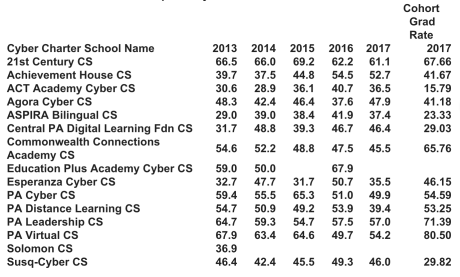
The Keystone State Coalition points out in its latest newsletter that state records demonstrate that none of the state’s 18 cybercharters meets state academic standards.

Do taxpayers care?

Not one of Pennsylvania’s cyber charters has achieved a passing SPP score of 70 in any of the five years that the SPP has been in effect. All 500 school districts are required to send taxpayer dollars to these cyber charters, even though none of them voted to authorize cyber charter schools and most districts have their own inhouse cyber or blended learning programs.
School Performance Profile Scores for PA Cyber Charters 2013-2017
Source: PA Department of Education website

http://www.paschoolperformance.org/

A score of 70 is considered passing.

Total cyber charter tuition paid by PA taxpayers from 500 school districts for 2013, 2014 and 2015 was over $1.2 billion; $393.5 million, $398.8 million and $436.1 million respectively.

Screen Shot 2018-05-23 at 9.09.06 PM


G.F. Brandenburg has been analyzing the results of the National Assessment of Educational Progress for the District of Columbia to understand the alleged “D.C. Miracle” attributed to Michelle Rhee, who was appointed in 2007 and left in 2010. Rhee was succeeded by her deputy Kaya Henderson, who pledged to protect her predecessor’s punitive policies. Rhee and Henderson (and their successors) were appointed as a result of mayoral control, mimicking New York City’s alleged “miracle” (which seems to have disappeared when Mayor Bloomberg left office).

Brandenburg concludes, based on a 10-year track record, that mayoral control benefited the children of college graduates, not the children of high school dropouts.

The reason to replace the elected board with mayoral control, he writes, was to help the least advantaged students. Instead, it was the most advantaged students who saw the greatest gains.

This is proof, he says, that “education reform” is “a complete failure.”

Let me point out the obvious: white parents in DC are overwhelmingly college-educated. Those in DC who did not graduate from high school, or who graduated from 12th grade and went no further, are overwhelmingly African-American or Hispanic. So our ‘reforms’ have had a disproportionately negative impact on black and hispanic students, and a positive one on white kids.

Bill Phillis of the Ohio Coalition for Equity and Adequacy is a steadfast critic of charter schools, which, he says, have absorbed $10 billion in funds that should have gone to Ohio public schools. Now that ECOT is in bankruptcy, the state is trying to claw a few million of the $1 billion that ECOT collected since 2000, when it was founded.

Phillis writes:

Auctions of charter school stuff-another manifestation of tax dollars squandered

The ECOT auction is just another going-out-of-business sale in the charter industry. About 250 charters have closed in Ohio and many have had auctions. These kinds of sales recover only pennies on the dollar.

The ECOT exposure has helped shed light on the waste, fraud and corruption in the industry. Previous charter closures and auctions usually had gone unnoticed by the general public.

Ohioans should assume that the ECOT auction ends the charter fiasco.

Of course, the charter fiasco will go on in Ohio even after ECOT is dead and buried and its stuff auctioned off.

The auction is today. You are not to late to pick something up if you bid online. Maybe a pencil engraved ECOT as a memento of a Teapot Dome type scandal in Ohio, a tribute to privatization and corporate reform. DeVos wants more of the same. Hold on to your wallet.

Goodbye ECOT: School auction begins today; key computers not included
Updated May 11, 2018

By Jeremy P. Kelley, Staff Writer Dayton Daily News

The Electronic Classroom of Tomorrow (ECOT) is auctioning its corporate headquarters building and most furnishings and business equipment beginning at 4 p.m. today, according to a news release from the auction firm Gryphon USA.

The auction includes everything from flat-screen TVs, tools and furniture to first-aid kits and pencils, according to Richard Kruse, president of Gryphon Auction Group and court-appointed deputy interim master for ECOT.

Kruse said the computer servers used by the school are not included in the auction. Auditors and prosecutors have suggested there could be evidence of criminal activity by ECOT on those servers.

“The media and government attention has been focused on the servers used by the school, but those are not included in the auction,” Kruse said in the news release. “Due to this, the auction is proceeding on schedule.”

ECOT was Ohio’s largest online school, at one point claiming more than 15,000 students, but the Ohio Department of Education said an enrollment review showed the school was not counting student participation correctly. The state began clawing back millions in funding that ODE said the school should not have received, eventually leading ECOT to close in January.

More than 2,000 students from southwest Ohio were listed as enrolled at ECOT in 2016-17, including 627 who lived in the Dayton school district, 168 in Hamilton, 94 in Springfield and dozens from suburbs ranging from Kettering to Troy.

ECOT’s headquarters building, a 138,000-square-foot facility originally built as Southland Mall, sits on 26.5 acres in south Columbus, near the intersection of U.S. 23 and Interstate 270.

The auction is viewable to the public online at http://www.ecotcre.com for the real estate, and http://www.ecotauction.com for the rest of the items. The online auction is open for bidding until June 12.

The largest virtual charter school in Ohio was the Electronic Classroom of Tomorrow (ECOT). Its for-profit owner William Lager collected over $1 billion in taxpayer dollars since it opened in 2000. He gave campaign contributions to state officials, and they looked the other way. They even spoke at his commencement ceremonies. When the state actually audited ECOT, it found inflated enrollments and went to court to collect money from Lager. ECOT lost its authorizer, and Lager declared bankruptcy.

Most of ECOT’s students have transferred to another online charter, the Ohio Virtual Academy, owned by Michael Milken’s for-profit K12 Inc.

K12 Inc. has asked the state to hold it harmless for the expected low academic performance of the transfer students from ECOT.

Will voters hold state officials accountable for allowing these frauds to continue collecting money from them?


When I saw that the Thomas B. Fordham Institute was grading the education legacy of John Kasich, I knew we would not agree. Its report begins by crediting Kasich for copying Jeb Bush’s simple-minded letter grading for schools, which makes less sense than giving a single letter grade to a child. Kasich tried to wipe out collective bargaining but was rebuked by the public in a referendum. He has given free reign with little or no accountability to charter entrepreneurs and presided over scandal after scandal in the charter sector, currently, the $1 billion wasted by ECOT. He has been indifferent at best, but certainly hostile, to the very concept of public schools, whereas his state was once a leader in advocacy for excellent public schools. Like all rightwing Republicans, he pushed for vouchers, and Ohio has a voucher program for “poor kids trapped in failing schools.” Ironically, the Fordham Institute commissioned a study of Ohio’s voucher program, led by David Figlio of Northwestern University, which determined that students who enrolled in voucher schools fared worse than their peers who remained in public schools.

During the Republican primaries of 2016, Kasich posed as the “moderate” in the race, and compared to the others, maybe he was. My friends in New York couldn’t understand why I thought he was a rightwing ideologue, no different from Jeb Bush, but pretending to be the “adult in the room.”

Bill Phillis, the retired Deputy Commissioner of Education in Ohio, and founder of the Ohio Coalition for Equity and Adequacy, comments on the Fordham review of Kasich.

He writes (the comments in brackets are mine, not Bill Phillis’):

An April 17 Fordham review of the Governor’s education legacy shows Fordham and the Governor seem to be on the same page regarding education issues.
 
Fordham:
 
  1. The Governor established the A-F Report Card. Fordham laments that it is now in jeopardy. [My comment: good riddance to a dumb idea.]
  2. The Governor provided passionate support for the Third Grade Guarantee. Fordham says the jury is still out on the effects of it. [My comment: Holding back third-graders is a proven way of lifting your fourth-grade scores.]
  3. The Governor’s early efforts focused on lifting limitations on the creation of new charters and providing facility assistance, but then supported charter sponsor evaluations and additional charter school accountability. Fordham says charter accountability could be a lasting legacy for the Governor. [My comment: Charter accountability? That would be innovative.]
  4. The Governor attempted to eliminate public employee collective bargaining but failed. Then he championed Teach for America (TFA) and statewide teacher evaluations. Fordham wonders if these changes will last. [My comment: Swell idea to smash unions and introduce inexperienced, unprepared teachers who will leave in two years.]
  5. The Governor, early on, focused on expanding private school choice. Fordham laments that many of Ohio’s lowest income students have little opportunity to access private school choice. [My comment: Fordham funded research demonstrating that kids who use a voucher fare worse than kids in public schools.]
  6. The Governor eliminated the “evidence-based” school funding model. Fordham says the current school funding formula is a vast improvement over the evidence-based model. [Bill Phillis: Wow…how so? Me: Evidence and Kasich’s education policies have never actually met.]
 
Fordham relishes the fact that the money-follows-the-child idea is now an integral part of budget discussions.
 
Fordham, like Betsy DeVos, subscribes to the myth that school funds belong to the students-not the system-you know, the Ohio constitutionally-required system of common schools.
 
So what would be a great education legacy for a governor? A governor that would accomplish the constitutional requirement that the state secure a thorough and efficient system of common schools would go down in history as the “education” governor.
If you live in Ohio, you should subscribe to Bill Phillis’ newsletter.
William L. Phillis | Ohio Coalition for Equity & Adequacy of School Funding | 614.228.6540 | ohioeanda@sbcglobal.net| www.ohiocoalition.org


Fred Smith is a testing expert who worked as an analyst for the New York City Board of Education for many years. In this study, he flips the question: Not, how did the students perform, but how did the tests perform?

He grades the tests and finds a remarkable increase in the number and percent of students who scored a zero, perhaps because they didn’t understand the question or provided a confused or incoherent response.

The increase in zeroes was particularly high for students with disabilities and English language learners. They were higher still for black and Hispanic students.

Smith writes:

”The data show that there has been an increase in the percentage of zero scores since the administration of exams aligned with the Common Core. We anticipate that officials will claim this outcome to be the consequence of tougher standards reflected by more rigorous exams.

“We argue that those assertions are insufficient explanations for what we found. Recall that a zero score indicates an unintelligible or incoherent answer. Certainly, some zeroes are to be expected. But the percentage of zero scores, particularly for students in grades 3 and 4, is unreasonable in our view. With so many answers deemed “incomprehensible, incoherent, or irrelevant,” we must ask whether such a program yielded any valuable information at all about our youngest students, as the testing was purported to do. The failure here is much more likely in the questions themselves and in the belief that it was acceptable to ask eight- and nine-year-olds to sit and take long exams over several days. That the data also indicate a widening achievement gaps cannot be ignored…

“Further evidence of flawed testing can be noted in the decline of zeros in 2016 — when the SED removed time limits — from the surge in 2013, for most grades. After three years of CC-aligned testing, the SED acknowledged that the time constraints imposed by the tests were an issue. This, in itself, is an after-the-fact admission that the tests were poorly developed, as test administration procedures, including timing, should be resolved as part of the test-development process before tests become operational.

“In taking stock of the testing program we must return to the fears and doubts that were expressed by a small number of people early on. Were New York State’s CC-aligned tests appropriate measures? Would they have a negative impact on students, especially the most vulnerable?

“The analyses and findings in this report vindicate these early concerns and give empirical grounding to the opt-out movement that grew to an astounding 20 percent of the test population between 2013 and 2015. Specifically, our findings raise questions about the efficacy of this kind of testing, particularly for our youngest students. They also open a needed discussion about the quality of Pearson’s work, the worth of its product, and SED’s judgment in managing the program.”

The unasked question is why we insist on testing every student in grades 3-8 every year. No other nation does it.

My guess: Congress is still inhaling the toxic fumes of NCLB, which was based on the nonexistent “Texas miracle.”


Although I often disagree with Rick Hess, I think he is the most insightful of the reformers and the nicest as well. He has a code of civility, and he never descends into mud-slinging or name-calling, unlike others in the reform camp.

In his latest article, I was surprised and delighted to see his acknowledgement that the pendulum is swinging away from the Bush-Obama reforms. He tacitly admits, as few other reformers do, that the era of No Child Left Behind and Race to the Top has failed, and (as John Merrow said in his latest post) “the air is humming,” and something great is coming. The current federal law (Every Student Succeeds Act) is a stripped-down version of NCLB, still insanely test-focused, in my view. Under ESSA, despite its grandiose name, there is no hope, none, that “every student will succeed.”

Rick looks at the wave of teachers’ strikes in West Virginia, Oklahoma, and Kentucky (with more likely to happen) and draws five lessons.

First, “Teachers are immensely sympathetic actors. For all the gibes, harsh rhetoric of the accountability era, and tsk-tsk’ing occasioned by polls in which people say they don’t want their kids to be teachers, the reality is that people really like teachers. In surveys, no matter how much talk there is about “failing” schools and problems with tenure, teachers are trusted and popular.” Although he doesn’t say it, I will: People trust teachers more than hedge fund managers or billionaires.

Second, “The Trump era has made it tougher for GOP officials to plead “fiscal restraint.” For years, GOP governors and legislators have said there is no more money, but the national GOP has just added billions to the defense budget, over a trillion dollars to the national deficit, and cut taxes for corporations by more billions.

Third, the reform movement must shoulder a significant part of the blame for demonizing teachers, demoralizing them, and building a reservoir of rage. “Along the way, teachers came to look and feel like targets, rather than beneficiaries, of “school reform,” which may be why bread-and-butter demands from teachers are ascending as the guts of Bush-Obama school reform are sinking to the bottom of the “discarded school reform” sea.”

Fourth, teachers’ strikes and walkouts are succeeding because they have broad appeal.

Fifth, he sees the current moment as a good time to rethink compensation, pensions, and staffing. In the minds of reformers, this could be converted into their usual mindset: merit pay, performance pay, replacing pensions with savings plans, etc. As the Kentucky walkout showed, teachers will not sit still while their retirement benefits are whittled away. Part of the appeal of teaching is the expectation that one will not retire to a life of penury after a career of low-paid service.

This is one of the most hopeful articles I have recently read about the pendulum swing that almost everyone knows is coming.