Archives for category: Failure

Peter Greene writes about the sad sad story of Sandy Kress, the lawyer who is widely acknowledged as the architect of No Child Left Behind.

Kress went from power and fame in D.C. to lobbying for Pearson in Texas.

Then when Texas abandoned Pearson, Kress was really sad.

While almost everyone in the nation agrees that NCLB was a disaster, at least three people disagree: Presdent George W. Bush, Margaret Spellings, and Sandy Kress. Every once in a while, Kress publishes an op-ed piece about the greatness of a federal law that imposed standardized testing on every student in public school from grades 3-8. He did it again, and Peter takes his claims apart, one by one.

“The Bottom Line

“Sandy Kress got it wrong in Texas, and he got it wrong with No Child Left Behind, a program that virtually nobody holds up as an example of a great government program that achieved great things. And unlike some reformsters who have shown a willingness to say, “Okay, some of this just isn’t working,” Kress keeps on insisting that we are on the brink of educational disaster and people have to use his great ideas right now!

“We’ve been field testing test-centered accountability for almost twenty years– long enough that entire generation of children have been educated while soaking in the stuff– and we have nothing to show for it but corporate profits, people abandoning the teaching profession, and educational results that show the gaps created when schools dropped actual education in order to prep for the Big Standardized Test. We have tried Kress’s ideas. They have failed.

“I’m not going to argue that the Texas legislature has the answers. But they are not going to find the answers by listening to Sandy Kress.“

Pennsylvania has many cyber charters. They are all failing schools. The legislature doesn’t care. Two cyber charter operators were arrested and convicted for stealing millions of dollars. One of them–Nicholas Trombetta– is awaiting sentencing for tax evasion on the $8 million he stole from the cyber charter he founded (Pennsylvania Cyber Charter School), the other–June Brown, founder of two cyber charters–was convicted but not sent to jail because the judge accepted her plea that she was too old and frail to be incarcerated (she is younger than me). Trombetta committed a crime by evading taxes, but stealing $8 million from his cyber charter was not a crime under lax Pennsylvania law, according to the article cited here.

Greg Windle writes here about the failure of the Legislature to reign in cyber charter corruption, fraud, waste, and abuse of taxpayers’ dollars.

Even choice advocates are embarrassed by cyber charters, but they keep on going, collecting tax dollars for rotten services.

No cyber charter school in Pennsylvania have ever received a passing academic score from the state, and very few have come close, according to information recently highlighted in a report from the office of Democratic State Rep. James Roebuck of Philadelphia.

Roebuck and other House Democrats have assembled a package of bills that would further regulate charters by reforming how they use reserve funds, rules for leasing buildings, special education payments, contracting, the teacher evaluation system, disclosure in advertising, school building closures, and the transfer of school records. The package would not single out cybers, but other legislation has been introduced that would reduce their per-student reimbursement.

Pennsylvania has 13 cyber charters enrolling more than 34,000 students, or 10 percent of all the cyber students in the country.

These schools are authorized not by local districts, but by the Pennsylvania Department of Education. But districts must send per-pupil payments to cyber charters for each local student they enroll, and the payments are the same as for brick-and-mortar charters, even though cybers have fewer expenses.

This has proven frustrating not only to the districts and other proponents of traditional public schools, but to several groups that favor school choice and charters…

No cyber charter school in Pennsylvania have ever received a passing academic score from the state, and very few have come close, according to information recently highlighted in a report from the office of Democratic State Rep. James Roebuck of Philadelphia.

Roebuck and other House Democrats have assembled a package of bills that would further regulate charters by reforming how they use reserve funds, rules for leasing buildings, special education payments, contracting, the teacher evaluation system, disclosure in advertising, school building closures, and the transfer of school records. The package would not single out cybers, but other legislation has been introduced that would reduce their per-student reimbursement.

Pennsylvania has 13 cyber charters enrolling more than 34,000 students, or 10 percent of all the cyber students in the country.

These schools are authorized not by local districts, but by the Pennsylvania Department of Education. But districts must send per-pupil payments to cyber charters for each local student they enroll, and the payments are the same as for brick-and-mortar charters, even though cybers have fewer expenses.

This has proven frustrating not only to the districts and other proponents of traditional public schools, but to several groups that favor school choice and charters…

It’s been a difficult school year for many U.S. cybers. Ohio’s largest chain was forced to close mid-year, and others closed down in Georgia, Indiana, Nevada, and New Mexico. In the past, it has been rare for states to close cyber charters despite low achievement across the sector and several financial scandals…

Of the 43 states that allow charter schools, only 35 allow cyber charters. The eight that do not are Delaware, Maryland, Massachusetts, New Jersey, New York, Rhode Island, Tennessee, and Virginia. Only 23 of the states that allow cybers have actually authorized any, according to the report from the National Association of Charter School Authorizers. Those states plus Washington D.C. have a total of 135 full-time cyber charter schools.

Cybers make up just 2 percent of all charters in the country.

At its peak, Pennsylvania had 14 cyber charters, more than 10 percent of the nation’s total. However, Education Plus Cyber closed in December 2015 during the state budget crisis after its bank pulled the school’s line of credit. Some staff also alleged financial mismanagement…

Out of the 13 full-time cyber charters in Pennsylvania, educating over 34,000 students, only four have come close to receiving a passing grade of 70. The rest have received the lowest rating on the state’s academic rubric every year….

Larry Feinberg has his own frustrations with cyber charters and gw attributes them to a poorly written charter school law. Feinberg has been a school board member in Haverford Township for over 20 years, is on the board of the Pennsylvania School Board Association, and co-founded the Keystone State Education Coalition — a group that advocates for traditional public education, including stronger regulations on charters.

“Every month in school board meetings, I have to approve payments to cyber charters,” Feinberg said. “Our test scores are 30, 40, 50 points higher than theirs. We never authorized any of them. … They are all authorized by the Pennsylvania Department of Education. That allows them to reach in and take our tax dollars.

“There’s just no way it can cost as much money to educate them without a building and full-time staff. So there’s huge profits to be made.”
During the tenure of former Governor Eric Greitens, Missouri had no state school board because the legislature refused to confirm his appointees. The new governor appointed new members and at last there is a quorum. Yesterday they had a meeting to renew charter schools, which are allowed only in St. Louis and Kansas City. Five charters were renewed despite their middling performance.

Typically, the board has judged charter performance against the performance of the district, but the charters said this was unfair.

Charlie Shields, president of the state board, said that it was time to review charter school laws.

“Shields was critical of the performance of the St. Louis charter schools renewed Thursday, arguing that they do not convincingly outperform St. Louis Public Schools. He said the state Legislature allowed charter schools to operate in Missouri on the premise that charter schools would be easy to open, but poor-performing charter schools should be easy to close.”

St. Louis was taken over by the state because of low performance and is hoping to have local control restored. Yet charter schools do not outperform the district, and charter leaders say that it’s unfair to expect them to do so. Once again, we see reformers moving the goal posts and lowering expectations.

Whiners. Remember when we were told that charter schools would “save poor kids from failing public schools” and would “close the achievement gap.” They don’t and they haven’t. They fight to survive because they want to.

Under Republican control, don’t expect Missouri to set meaningful accountability standards for charters.

The question now is:

“Who will save poor kids from failing charters?”

This is a refreshing development. Republican legislators in Indiana are asking whether it is time to pull the plug on failing virtual charter schools.

“As a group of state officials convene for the first time Tuesday to examine virtual charter schools, two prominent Indiana Republican lawmakers are calling for the state to intervene in the dismal performance of the schools.

““Whatever we’re doing is not working, because I don’t see where they’re improving,” said Ryan Mishler, chair of the Senate Appropriations Committee, adding, “With a virtual, if you’re failing so many years in a row, maybe we need to look at how long do we let them fail before we say you can’t operate.”

“Mishler and House education chair Bob Behning told Chalkbeat that the oversight of virtual charter schools needs to be addressed, whether through changes to state law or action by the Indiana State Board of Education.

“Indiana will have seven virtual charter schools at the start of the next school year, with three opening in the past year alone and one shutting down amid chronic bad grades. But their academic performance raises questions — four of the five schools graded by the state last year received F ratings.

“Even for students who need a more flexible alternative to traditional brick-and-mortar schools, Mishler said, “If they’re not doing well, if they’re not graduating, how good is it for them?””

Will wonders never cease?

Tom Ultican, recently retired teacher of physics, has embarked on a mission to cover the Destroy Public Education movement. His posts have taken him to several cities, where the school choice movement has destroyed public education without putting anything better in its place. In fact, the “new” schools are usually worse than the public schools.

In his latest foray, he studies the destruction wrought by the Destroy Public Education movement on the public schools of Philadelphia.

The trouble started when Republican Governor Tom Ridge hired the Edison Project to conduct a study of the Philadelphia public schools and come up with solutions (such as, taking charge of the entire district themselves, nothing like conflict of interest to stir the commercial juices.)

Ultican relies heavily on Samuel Abrams’ excellent book Education and the Commercial Mindset, which began life as a study of Chris Whittle’s Edison Project.

Things went downhill from there. The whole point of “reform” was not to make the schools better, but to save money.

“Edison’s report was not impartial. Both the Philadelphia Inquirer and the Philadelphia Daily News called it a charade. (Abrams 116) The report was overly critical of the school district and recommended that the Edison Project be put in charge of running it. Edison also called for reforming “failing” schools by turning them into charter schools.

“Helen Gym (now on the Philadelphia city council) speaking for Asian Americans United, asked, “If this [privatization] is so innovative why aren’t they doing it in Lower Merion.” (Abrams 114) This turns out to have been a perceptive question. Lower Merion is 85% white and rich. Still today, there appear to be no charter schools in Lower Merion Township. Charter schools mostly exist in poor communities without the political capital to protect their schools.”

Broadies, Broadies everywhere! Closing public schools. Starving them. Opening charters. Destroying the district. The great Charade of “Reform.”

In December 2015, a state district judge in New Mexico put a halt to the use of New Mexico’s teacher evaluation system, which then State Commissioner Hanna Skandera had imported from Florida. Her replacement since Skandera’s departure, Chris Ruzskowski (former TFA) praised the state’s harshly punitive system as the toughest in the nation. In Skandera’s seven years leading the New Mexico schools, the state NAEP scores were stagnant. They are in the NAEP cellar with the poorest Southern states. None of her “Florida reforms” made any difference.

Audrey Amrein-Beardsley here reviews what is now known about this teacher evaluation program. As is typical, 70% of teachers do not teach the tested subjects. Teachers in affluent districts get higher scores. Teachers who teach the neediest kids get the lowest scores. Caucasian teachers get higher scores than non-Caucasians.

It may soon be a moot issue, as all three Democratic candidates and the one Republican running for Governor have said they would overhaul or discard the flawed evaluation system.

Congratulations to the AFT of New Mexico, which fought this idiotic system in court and halted its consequences.

John Thompson has been researching the tenures of Broadie Superintendents, who sem to have been trained to be tough top down administrators.

Here is his latest report:

Researching failed Broad Academy superintendents has been “déjà vu, all over again.” When No Child Left Behind promised 100% proficiency by 2014, education researchers accurately predicted that efforts would be diverted from teaching and learning to statistical gamesmanship. Being fairly new to education policy, I kept asking myself what reformers were thinking: Had they never heard of Campbell’s Law? If they hadn’t read Catch 22, had they not seen the movie, and its portrayal of the real world effects of imposing absurd, unreachable, quantitative growth targets?

Rightly or wrongly, my summary of Mike Miles’ “reign of error” in Dallas emphasized the dismal results he produced, as well as the human costs of his Broad mandates. I should have given more emphasis to Miles’ surrealistic display of hubris, and his weird dance performance, when he announced the new day he was bringing to Dallas schools. Miles seemed like a caricature of Bob Newhart’s performance of “Major Major” in Mike Nichols’ Catch 22 movie. Miles obviously failed to learn from Major Major being told, “You’re the new squadron commander. … But don’t think it means anything, because it doesn’t. All it means is that you’re the new squadron commander.”

https://www.npr.org/sections/ed/2014/10/11/354931351/it-s-2014-all-children-are-supposed-to-be-proficient-under-federal-law

Among the meaningless things that Miles told Dallas was that, by 2020, 90% students would graduate on time, 40% would attain a 21 or higher composite score on the ACT exam or a SAT of 990 on Reading/Math, 75% would be proficient on the “Year 2020 workplace readiness assessments,” and 80% would enter college, the military, or a “career-ready job” straight from high school.

Perhaps the sub-goals were even more illustrative of Miles’ autocratic disconnection from reality. Buy-in would be so great that students in targeted low-performing schools would receive at least 90 minutes of homework every night. By August 2015, he said that 75% of the staff and 70% of the community would “agree or strongly agree with the direction of the district.” At least 60% of teachers on his pay-for-performance evaluation system and 75% of principals would agree that the system is “fair, accurate and rigorous.”

In the real world of 2015, Miles resigned. The Dallas Morning News explained that “in Texas, superintendents are graded by state STAAR results, and DISD scores have stayed flat or dropped under him.” So, what sort of victories could Miles proclaim?

https://www.dallasnews.com/news/education/2015/06/23/dallas-isd-chief-mike-miles-announces-resignation-after-contract-changes-rejected

As he left office, Miles claimed victory in putting the critical pieces needed to transform Dallas into place. Instead of quantifiable gains, he bragged about continued implementation of a rigorous principal evaluation system that uses both performance and student results to measure principal effectiveness; the implementation of the Teacher Excellence Initiative, and fundamentally changing how highly effective teachers are identified and assessed; kicking off an initiative to create 35 choice schools; and increasing the focus on early childhood programs.

In other words, Miles claimed to have produced gains in implementation, innovation, identification, assessment, focus, and kicking things off, but not even he could pretend to have produced concrete, much less measurable, improvements in student learning.

Mike Miles announces resignation as Dallas ISD superintendent

And that leads to the question of whether corporate reformers, especially Broad superintendents, will ever learn the folly of demanding impossible, quantifiable accountability targets. Shouldn’t Philadelphia and its Broad trained leader, William Hite, recall the city’s cheating scandal from 2009 to 2011, when at least 140 educators engaged in improprieties?

I’d say that Philly is another case of déjà vu all over again but – at least for now – Hite seems to be getting away with it. His goals are even more incredible. The goals of his 2015 Action Plan 3.0 are:

• 100% of students will graduate, ready for college and career

• 100% of 8-year-olds will read on grade level

• 100% of schools will have great principals and teachers

• 100% of the funding we need for great schools, and zero deficit

Philadelphia may be on track to meet its 2018 goal of a 66% graduation rate, but those numbers are easily fabricated. They say nothing about the target of 100% college and career readiness. So, what do the reliable NAEP scores say about the district’s student performance?

In 2011, Philadelphia 4th graders scored 8 points lower than other urban districts in math, but in 2017, they scored 17 points lower. During the same period, Philadelphia 4th graders dropped another four points in reading in comparison to other urban schools. In 2011, Philly’s 8th graders scored 9 points lower in math. By 2017, the gap grew to 14 points. The reading score gap increased by 2 points for 8th graders.

https://www.nationsreportcard.gov/profiles/districtprofile/overview/XP?cti=PgTab_OT&chort=1&sub=MAT&sj=XP&fs=Grade&st=MN&year=2017R3&sg=Gender%3A+Male+vs.+Female&sgv=Difference&ts=Single+Year&tss=2015R3-2017R3&sfj=NL

And while we’re at it, where is Philadelphia in terms of 100% school funding and zero deficit?

Just last month, Superintendent William R. Hite Jr. said:

The Philadelphia School District needs to spend $150 million on repairs to its 300 buildings, including money for an expansion of a lead paint abatement program. To do so, the district is banking on almost $700 million in additional funding from the city proposed in Kenney’s budget.

Council, however, has publicly expressed qualms about fulfilling the mayor’s full request for schools, which would almost certainly be tied to a property-tax hike.

Of course, that leads to the next logical conclusion. Perhaps Mayor Jim Kenney should take a page from the Broad playbook. He should tell voters that passing the tax increase will solve 100% of the city’s as well as the schools’ problems.

http://www.philly.com/philly/education/mayor-kenney-william-hite-philly-crumbling-schools-lead-paint-repair-20180522.html

Julian Vasquez Heilig reports on the latest study of vouchers in D.C., which showed that students who used vouchers lost ground in math compared to their peers who did not.

This time with song and dance and disappointed voucher cheerleaders.

Rachel E. Gabriel and Sarah L. Woulfin of the University of Connecticut ask a simple but very important question: Isn’t it time to redesign teacher evaluation? Most states are stuck with laws they wrote to apply for Race to the Top funding. Nearly a decade has passed. We now know that test-based evaluation has failed. Why are so many states and districts holding on to a failed strategy for evaluating teachers? Is it inertia? Apathy?

The model in use is obsolete. It failed. It is time to move on.

“Under RTT, teacher-evaluation policies were designed using economic theories of motivation and compensation and statistical growth tools such as value-added measurement. Evaluation policies based on principles of economics and corporate management have failed to take into account the complex and personalized work of educating students.
While evaluation aims to address teacher performance and quality, what we don’t see is acknowledgement of teacher voice and choice in how policies affect their work. We need to create learning-focused evaluation policies for teachers that enable both students’ and teachers’ growth and align with the needs of schools, students, and communities.

“It’s clear to most educators that the current crop of teacher-evaluation systems is flawed, overwrought, and sometimes just plain broken. Detailed case studies demonstrate that some states now spend millions of dollars on contracts with data-management companies and statistical consulting firms. Many states and districts make similar investments despite the fact that researchers and policymakers question the wisdom of value-added measurement within high-stakes teacher evaluations.

“There is now an entire industry devoted to the evaluation of teaching and the management of student data. There are online professional-development video databases and classroom-walkthrough apps for school leaders—which have not demonstrated a positive effect on instruction. But all of them have inflated the edu-business marketplace…

“A learning-focused teacher-evaluation policy would create the organizational and social conditions teachers need to thrive. During goal-setting with administrators, teachers would work together to write challenging, yet attainable, goals for themselves and their students. They would also have professional-development opportunities to learn about different types of student-progress measurement tools to refine what works best. And in feedback meetings with school leaders, teachers would have space to reflect upon areas of their success and weakness. In turn, principals would devote time and energy to framing evaluation as an opportunity to learn about—rather than judge—teaching.

“To begin the transition toward this kind of evaluation, state and district administrators must shift the balance of resources away from measuring and sorting teachers into categories. School leaders must focus on subject-specific questions about teaching and learning, rather than applying a generic set of indicators. And instead of boiling teachers’ work down to a rating, leaders must share observations that help teachers extend what they do well and identify where they can grow.

“Only when we involve teachers in the process of evaluation policymaking will we come up with a system that supports and develops the teaching expertise students deserve.”

Pennsylvania loves cybercharters even though study after study shows that they get terrible results.

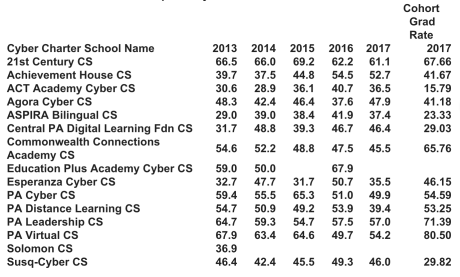
The Keystone State Coalition points out in its latest newsletter that state records demonstrate that none of the state’s 18 cybercharters meets state academic standards.

Do taxpayers care?

Not one of Pennsylvania’s cyber charters has achieved a passing SPP score of 70 in any of the five years that the SPP has been in effect. All 500 school districts are required to send taxpayer dollars to these cyber charters, even though none of them voted to authorize cyber charter schools and most districts have their own inhouse cyber or blended learning programs.
School Performance Profile Scores for PA Cyber Charters 2013-2017
Source: PA Department of Education website

http://www.paschoolperformance.org/

A score of 70 is considered passing.

Total cyber charter tuition paid by PA taxpayers from 500 school districts for 2013, 2014 and 2015 was over $1.2 billion; $393.5 million, $398.8 million and $436.1 million respectively.

Screen Shot 2018-05-23 at 9.09.06 PM