Archives for category: Education Reform

Amy Frogge is a public school parent in Nashville and an elected member of the Metro Nashville School Board. She has won twice, despite being vastly outspent by charter proponents. When she first ran for the board, she was unaware of the political battles over charters. When she saw the outpouring of money by out-of-state interests in Nashville, she realized that Nashville had been targeted for a charter invasion.

The good news is that the charter invasion has slowed and is struggling to survive. Voters have turned away the well-funded charter proponents. There are few or no waiting lists for charters. There are few true believers in charters. The bloom is off the rose.

Frogge writes:

“Project Renaissance is folding. Let me take a moment to explain what this group is really all about.

“Last summer, Project Renaissance injected itself into local school board races with a vengeance, trying to take down several board members and replace them with pro-charter school candidates. I believe Project Renaissance was founded in large part to focus on our local school board elections, but the organization failed in this mission, as those of us who were targeted last summer handily won back our seats.

“However, there is a greater purpose for groups like this, which are funded by very wealthy individuals who advocate for charter schools and other such market-based, money-making “reforms” (standardized testing, vouchers, etc.) while sending their own children to private schools.

“Charter schools need two things to survive: (1) Teachers willing to work for extremely low salaries and benefits who will churn and burn long hours; these are typically young teachers with no traditional teacher training or experience. Many come from TFA, which provides them only weeks of training before throwing them into classrooms. (In charter schools, the money goes to the top, not the classrooms.) (2) They also need parents who are trained to spread the message of “failing [traditional] schools” and “choice” in order to create greater parent demand for charter schools. (Charters die without enough parents choosing their schools, and for this reason, charters spend a lot of money on marketing.) Because parents are not clamoring for more charter schools (they usually have little to no wait lists), wealthy charter backers must resort to recruiting families by trying to build groups like “Nashville Rise.” The whole thing is astroturf, but the lovely people involved in organizations like “Nashville Rise” don’t understand this. I’ve heard many well-intentioned and thoughtful parents sent from “Nashville Rise” to speak at our board. They believe they are fighting for civil rights and the rights of poor children to receive a better education, but they don’t realize that the agenda set forth by Project Renaissance and “Nashville Rise” actually increases inequity and segregation in our school system.

“Because public opinion has changed on charter schools and polling now shows that Nashvillians are predominantly against the idea at this point, Karl Dean has decided to take a different tack during his campaign for governorship. While mayor, Dean successfully fought to remove local control of schools in Nashville. He also wanted the board to open a segregated charter school for wealthier students, and he pushed the board to open as many charter schools as possible (even extremely low performing schools like Rocketship), despite evidence that the influx of charters was having a negative fiscal impact on other schools in the district. Now that he’s running for governor, though, he maintains he’s really not about privatization or charter school expansion.”

If the wealthy elites had not spent the past five years pushing charters, she says, the district could have focused on important issues, like supporting, paying, and retained well-qualified teachers.
Ed zgilledpie is the Republican candidate for governor in Virginia.

Thomas Edsall traces the sad trajectory of Gillespie’s career in politics. There was a time when he was a moderate, with reasonable positions on hot-button issues like immigration. But as a candidate for governor, he fought and barely won a primary against a rabid right winger. Post-primary, he has turned into the guy he beat.

For most of his career, he was known as the consummate Republican lobbyist in Washington. In fact, writes Edsall, “It would be hard to find a better example of the “corrupt Washington establishment” that President Trump calls “the swamp” than Ed Gillespie.” Now he has been Trumpified, turned into a Tea Party extremist.

“Gillespie also adopted Trump’s tactics. In September, he began to run a series of attack ads against his Democratic opponent, Lieutenant Governor Ralph Northam, that accused Northam of protecting illegal immigrant gang members.

“Northam is a physician, a soft-spoken native of Virginia’s Eastern Shore, a graduate of Virginia Military Institute. He served eight years as a doctor in the Army, including during Operation Desert Storm, rising to the rank of major. He now has a practice in pediatric neurology in Norfolk and volunteers as a medical director for the Edmarc Hospice for Children in Portsmouth, where he cares for terminally ill children.”

The big issue in the election is race. Current Governor Terry McAuliffe restored voting rights to convicted felons who had paid their debt to society. Gillespie and his allies are vocally opposed. About half of those who regained their right to vote are African Americans, and they are a threat to Republicans.

Not surprisingly, Gillespie has run racially charged, divisive, scare-mongering ads against Northam.

If Gillespie wins, it will demonstrate that Trumpism defines the Republican Party.

If Northam wins, it will be a huge setback for Trump and his overtly racist, nationalist, crude, xenophobic brand of politics.

The nation is watching Virginia, where the first statewide election takes place on Tuesday.

At the top of the ticket is Lt. Gov. Ralph Northam, Democrat, running against Ed Gillespie, Republican.

Dr. Northam is a great friend of public schools; he opposes charters and vouchers.

Gillespie, former head of the Republican National Committee, is running as a Trump-DeVos clone.

In addition, there are many teachers and parents running for seats in the Virginia House of Delegates.

I have posted their names before, and will do so again on Monday.

For now, here is another able candidate: She is Shelley Simonds, former teacher and school board member.

If you live in her district, please vote for her.

Make Virginia the state that loves its public schools.

http://www.dailypress.com/news/politics/dp-nws-hod-94th-democratic-nominee–20170808-story.html

The Gates Foundation agreed to pay Hillsborough County, Florida, $100 million to pilot its teacher evaluation program. However, the program cost $271 million, and the district exhausted its reserves. It ended its relationship with Gates in 2015, Gates stopped paying after investing $80 million, the Hillsborough superintendent MaryEllen Elia was fired by the board, and was soon hired by Commissioner of Education for the state of New York. The Gates program was not working, and the district pulled out. The state legislature adopted features of the failed Gates approach in its revision of state laws.

Elia, who was fired in 2015 as the district had a financial meltdown, discussed the “success” of the soon-to-collapse teacher evaluation program with Vicky Phillips, then the president of the Gates Foundation for education, in 2014.

This week, the Hillsborough superintendent is wrestling with the problem of seven D and F-rated schools and has promised not to close them.

Districts have four options for such schools, assuming they do not improve to a C.

The first, shutting them down, is not on the table. “We’re not closing any schools, so you can put that in bright lights,” superintendent Jeff Eakins said Wednesday.

Nor is the second option, turning the schools over to private charter operators.

That leaves two more — entering a partnership with an outside consultant who would help run the school, or creating a district-run charter school.

Under that fourth scenario, the school would have a governing board, as privately run charter schools do. The district would manage the school. But union contracts would not apply, giving the district greater latitude in deciding who would work there.

Eakins and his chief of schools, Harrison Peters, said they are optimistic that all seven schools will earn at least a C. Four of the D schools were within two points of a C when the last year’s grades came out.

“Nothing has changed about our expectations, but there has to be a back-up plan,” Peters said.

School leaders, so far, seem to understand, he said. “They’re not interested in being a charter school and they’re not interested in being closed, but they get it.”

School grades, invented during Jeb Bush’s tenure, are completely bogus, but Florida and many other states continue to use them. They are a tool in the privatization toolkit.

The New Yorker has a long and incisive article about the Sackler family and how they became one of the richest families in America. Their net worth is somewhere in the neighborhood of $13 billion and growing. They are notable philanthropists who have endowed major institutions.

It is called “The Family That Built anEmire of Pain.”

https://www.newyorker.com/magazine/2017/10/30/the-family-that-built-an-empire-of-pain

The Sackler fortune derives from their pharmaceuticals company, which created and marketed OxyContin and minimized its risks. Now the country is ravaged by the opioid crisis. And the Sacklers have never been held accountable.

What you will not learn from the article is that the Sacklers are major supporters of charter schools. Jonathan Sackler funded ConnCAN, then 50CAN. His daughter Madelyn Sackler made a hagiographic documentary about Eva Moskowitz called “The Lottery.”

The Sackler opioid money is used to killpublic schools.

To read it all, you can buy a short-term subscription to the New Yorker for $6. It is worth every penny.

The article begins like this:

“The north wing of the Metropolitan Museum of Art is a vast, airy enclosure featuring a banked wall of glass and the Temple of Dendur, a sandstone monument that was constructed beside the Nile two millennia ago and transported to the Met, brick by brick, as a gift from the Egyptian government. The space, which opened in 1978 and is known as the Sackler Wing, is also itself a monument, to one of America’s great philanthropic dynasties. The Brooklyn-born brothers Arthur, Mortimer, and Raymond Sackler, all physicians, donated lavishly during their lifetimes to an astounding range of institutions, many of which today bear the family name: the Sackler Gallery, in Washington; the Sackler Museum, at Harvard; the Sackler Center for Arts Education, at the Guggenheim; the Sackler Wing at the Louvre; and Sackler institutes and facilities at Columbia, Oxford, and a dozen other universities. The Sacklers have endowed professorships and underwritten medical research. The art scholar Thomas Lawton once likened the eldest brother, Arthur, to “a modern Medici.” Before Arthur’s death, in 1987, he advised his children, “Leave the world a better place than when you entered it.”

“Mortimer died in 2010, and Raymond died earlier this year. The brothers bequeathed to their heirs a laudable tradition of benevolence, and an immense fortune with which to indulge it. Arthur’s daughter Elizabeth is on the board of the Brooklyn Museum, where she endowed the Elizabeth A. Sackler Center for Feminist Art. Raymond’s sons, Richard and Jonathan, established a professorship at Yale Cancer Center. “My father raised Jon and me to believe that philanthropy is an important part of how we should fill our lives,” Richard has said. Marissa Sackler, the thirty-six-year-old daughter of Mortimer and his third wife, Theresa Rowling, founded Beespace, a nonprofit “incubator” that supports organizations like the Malala Fund. Sackler recently told W that she finds the word “philanthropy” old-fashioned. She considers herself a “social entrepreneur.”

“When the Met was originally built, in 1880, one of its trustees, the lawyer Joseph Choate, gave a speech to Gilded Age industrialists who had gathered to celebrate its dedication, and, in a bid for their support, offered the sly observation that what philanthropy really buys is immortality: “Think of it, ye millionaires of many markets, what glory may yet be yours, if you only listen to our advice, to convert pork into porcelain, grain and produce into priceless pottery, the rude ores of commerce into sculptured marble.” Through such transubstantiation, many fortunes have passed into enduring civic institutions. Over time, the origins of a clan’s largesse are largely forgotten, and we recall only the philanthropic legacy, prompted by the name on the building. According to Forbes, the Sacklers are now one of America’s richest families, with a collective net worth of thirteen billion dollars—more than the Rockefellers or the Mellons. The bulk of the Sacklers’ fortune has been accumulated only in recent decades, yet the source of their wealth is to most people as obscure as that of the robber barons. While the Sacklers are interviewed regularly on the subject of their generosity, they almost never speak publicly about the family business, Purdue Pharma—a privately held company, based in Stamford, Connecticut, that developed the prescription painkiller OxyContin. Upon its release, in 1995, OxyContin was hailed as a medical breakthrough, a long-lasting narcotic that could help patients suffering from moderate to severe pain. The drug became a blockbuster, and has reportedly generated some thirty-five billion dollars in revenue for Purdue.

“But OxyContin is a controversial drug. Its sole active ingredient is oxycodone, a chemical cousin of heroin which is up to twice as powerful as morphine. In the past, doctors had been reluctant to prescribe strong opioids—as synthetic drugs derived from opium are known—except for acute cancer pain and end-of-life palliative care, because of a long-standing, and well-founded, fear about the addictive properties of these drugs. “Few drugs are as dangerous as the opioids,” David Kessler, the former commissioner of the Food and Drug Administration, told me.

“Purdue launched OxyContin with a marketing campaign that attempted to counter this attitude and change the prescribing habits of doctors. The company funded research and paid doctors to make the case that concerns about opioid addiction were overblown, and that OxyContin could safely treat an ever-wider range of maladies. Sales representatives marketed OxyContin as a product “to start with and to stay with.” Millions of patients found the drug to be a vital salve for excruciating pain. But many others grew so hooked on it that, between doses, they experienced debilitating withdrawal.

“Since 1999, two hundred thousand Americans have died from overdoses related to OxyContin and other prescription opioids. Many addicts, finding prescription painkillers too expensive or too difficult to obtain, have turned to heroin. According to the American Society of Addiction Medicine, four out of five people who try heroin today started with prescription painkillers. The most recent figures from the Centers for Disease Control and Prevention suggest that a hundred and forty-five Americans now die every day from opioid overdoses.”

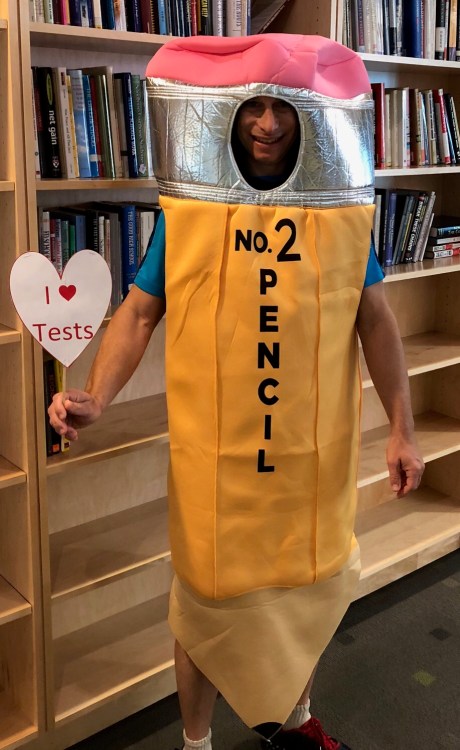
Michael Petrilli is president of the conservative Thomas B. Fordham Institute. I argue with him about almost everything related to education. I have known Mike for many years, since the days when I was on the Dark Side with him. We have email exchanges where we argue. We seldom reach agreement, but we never turn mean. I used to say that I thought one day Mike would realize he was wrong, as I did nearly ten years ago. I was probably wrong to predict that he would have an epiphany, a change of heart, actually find his heart, and it may undermine his funding from the far-right if I say it again (should I say it again?) He is set in his ways, as I once was. I changed. Can he? He probably won’t. TBF joined the vile and anti-democratic ALEC. Shame on them (and Mike).

His saving grace: he has a sense of humor. He can laugh at himself.

This is Mike’s Halloween costume.

img_4655

Here is the current schedule for screenings of Backpack Full of Cash.

It is showing in Los Angeles next week.

This is your chance to see the controversial film about the rightwing corporate attack on our public schools.

Don’t miss it!

Screen Shot 2017-10-18 at 2.54.40 PM

Please save the date to join LAANE on Wednesday 11/8 at Occidental College for a free documentary film screening of Backpack Full of Cash, a film that explores the growing privatization of public schools and the resulting impact on America’s most vulnerable children.

As you may know, LAANE has been working with the Reclaim Our Schools LA coalition over the past two years to advocate for funding, accountability, and resources for every public school student in Los Angeles. We are excited to partner with Active Voice Lab to bring this film to Los Angeles and continue this crucial conversation. Following the film, we will host a Q&A session to answer questions and discuss opportunities to further raise awareness about issues facing our public schools in Los Angeles.

Narrated by Matt Damon, this feature-length documentary showcases Philadelphia, New Orleans, Nashville and other cities, taking viewers through the tumultuous 2013-14 school year and exposing the world of corporate-driven education “reform” where public education — starved of resources — hangs in the balance.

I hope you will join us for this event. Seating is limited so RSVP today.

Click here for more information about the film and to watch the trailer.

RSVP Here
In Solidarity,

Roxana Tynan
LAANE Executive Director

LAANE is a leading advocacy organization dedicated to building a new economy for all. Combining dynamic research, innovative public policy and the organizing of broad alliances, LAANE promotes a new economic approach based on good jobs, thriving communities, and a healthy environment.
Donate to support LAANE’s work!

The charter industry in Michigan might be the worst in the nation, although it has stiff competition from the charter industry in Nevada, Ohio, and California. About 80% of charters in Michigan operate for-profit, and their academic results are unimpressive. The few high-performing charters use the usual tricks of excluding the kids they don’t want. A few years ago, the Detroit Free Press conducted a year-long investigation into the state’s charter sector and described it as a $1 Billion (Billion with a B) a year industry that is unaccountable and produces results no better than, and often worse than, public schools.

In early December, the failing but profitable charter industry is holding its annual conference. Will it discuss its problems? Will it honestly assess its failings?

Of course not! It will celebrate its role as “Innovators.” If anyone knows of any innovation that the Michigan charter industry has produced, please write in here and let us know. Its biggest innovation seems to be stuffing its pockets with taxpayers’ money that was supposed to support public schools, not enriching greedy entrepreneurs.

Cheryl Turpin is another great candidate for Virginia’s House of Delegates. She ran before and lost a close election; she is now running again.

She’s a public school parent and high school science teacher from Virginia Beach. She teaches every day while campaigning.

I endorse her candidacy.

https://cherylturpinforvb.com/

https://pilotonline.com/news/government/politics/local/this-costly-virginia-beach-house-of-delegates-race-has-drawn/article_f7c0cc68-40d5-5c55-bdf7-ebbfcd46ed52.html

Flip-A-District Friday: Volume VI

Florida Governor Rick Scott’s appointee to the State Board of Education has proposed a constitutional amendment to allow private schools to be funded as part of the state’s obligation to public schools.

http://www.tampabay.com/blogs/gradebook/2017/10/31/florida-board-of-education-chairwoman-seeks-to-add-private-schools-to-public-education-portion-of-constitution/

If a parent doesn’t like public schools, she proposes, public money should go to private schools. The state hard also proposed eliminating the Blaine amendment, which bars public spending on religious schools.

The issue of public funding for religious schools was on the ballot in 2012, and voters rejected it 55-45.