Archives for category: Education Reform


The book that everyone is talking about—Michael Wolff’s “Fire and Fury”—was excerpted in “New York” magazine. 

It is fascinating and frightening, in that it confirms our worst fears about the man who is president. According to the book, he is ignorant, semi-literate, vain, narcissistic, and had no expectation of winning. He just wanted fame and fortune, not the presidency.


The next time an advocate of school choice claims it is “ the civil rights issue of our time,” tell him or her about Michigan. After many years of school choice, it is now one of the most segregated states in the nation, tied with Mississippi and just behind the District of Columbia. 

Is racial segregation the new definition of civil rights?

”Jennifer Chambers and Christine MacDonald with the Detroit News report that the Associated Press analyzed data from the National Center for Education Statistics enrollment data from the 2014-2015 school year.

“The AP found that a large number of African-American students are enrolled in schools which are largely segregated, especially in Michigan, where 40% of black students are in public schools that are in “extreme racial isolation.”

“That puts Michigan in second-place nationwide, tied with Mississippi and behind only Washington, D.C., which came in at 66%.”

Racial segregation is highly correlated with low test scores.

“One major factor was charter schools, which are much more segregated than traditional public schools on average. In Michigan, 64% of black charter students are in schools in which the student bodies are more than 90% black.“

The head of Michigan’s charter association said the charter school hypersegrgatuin merely reflected residential patterns.

Truth is, charter advocates don’t really care about segregation or integration.


This is a story written by teacher Jane K. Marsh. It teaches a lesson about the redemptive power of the arts.

The Artful Anastasia

In the eyes of most people, Anastasia was a compliant, dutiful twelve-year-old — a respectful daughter and a model student. Yet, she had another, subversive side that found its way into her art. When she entered the world of creation, she dreamed of worlds as yet undiscovered – beautiful places where all of the earth’s inhabitants were listened to – even children. Of course, many who viewed her work failed to recognize the underlying message. Her paintings were seen as whimsical – those pictures of kittens and birds sharing a drink of water in a dish formed by a peculiar confluence of fallen leaves. Her renderings of foxes and chicks dancing in the moonlight, too, simply were regarded as a pleasant diversion. But Anastasia knew better. Her paintings represented the opening salvos of a battle for the hearts and minds of her community.

Early on, Anastasia had witnessed the all-too-usual, negative behavior of people who did not listen. Unfortunately, her family members were often troubled, and they expressed sorrow and frustration in the usual way – by yelling, accusing and so forth. Sometimes the adults found solace in alcohol which of course led to more yelling, accusing, etc. Her brothers also reflected a combative gene that seemed to rule their waking hours. Even their games involved competition and the outsmarting of one another. Anastasia vowed to live in another way.

At first, she retreated to her own place of peace and creation. When she was upset with the atmosphere of her home life, she created an alternative world in her art – losing herself in her imagination. This activity formed the groundwork from whence her later subversion would take hold. Her paintings also provided others with images of peace that, at least for a moment, appeared to affect them subliminally. That is, the shouting momentarily ceased when others viewed her work.

During one particular painful, parental argument, Anastasia thought to herself, as she had so many times before, “Why can’t they listen to one another? Tell each other calmly and honestly exactly how they feel and why?” Then she decided to create heart-shaped, post-it notes that read: “Ask her how she feels” and “Ask him how he feels.” These she placed in strategic places for her parents to find. Once again, her imagination provided momentary relief for her family. You see, her mum and dad were then aware of the feelings and thoughts of their then ten-year-old daughter, and there was talk of “out of the mouths of babes” and so forth. Anastasia suspected that she had not so easily solved the dilemma of her parents’ relationship, but the “cease-fire” was a start. When tempers flared once more, she would post signs that read “Listen” throughout the house.

Unfortunately, the listen-sign campaign backfired. “I don’t appreciate being scolded by a ten-year-old. You don’t understand everything.” Anastasia knew this to be true. Yet, she had tried, anyway – and would keep on trying – though maybe not at home for a while. Anastasia saved the heart-shaped, post-it notes for another situation that she found troubling.

You see, her school had lately seemed more like a prison. Gone were the days of laughter, conversation and discovery. Rigor and testing had become the norm. There was only one class where Anastasia felt really free to express her inner-most thoughts – and that was art class. The rest seemed like endless preparations for tests that would determine her future. Students were advised to practice self-discipline, to listen intently to their teachers so as to reach potential – that is the next step as determined by tests. Competition became the order of the day. Everyone was trying to outdo the other, and all were vying for the same prize. Then it occurred to Anastasia that the adults who expected to be carefully listened to, had very little time for the thoughts of students. As a result, students ceased to come up with their own ideas. What was the point? No one would hear. Anastasia decided that the focus on testing was the real problem. These big state tests, especially, made everyone nervous and unhappy – and unwilling to listen.

Anastasia would once again use her heart-shaped, post-it notes to send a message – this time to the teachers and students at her school. When no one was looking she placed these notes with the message “The Real Test!” in various places in the school. This anonymous, and somewhat unclear to many, signage, created a discussion in her school, for young and old wanted to know who was behind the message as well as what it meant exactly. Anastasia was pleased to overhear at least one person claim that the signs had to do with love being more important than tests. After a week or so had passed and the furor over the post-it notes had died down, Anastasia followed up with additional post-it notes that were decorated with flowers and simply stated: “Listen.”

As it turned out, this latest admonition largely went over the heads of the population of the school. She had been trying to say that when people take the time to listen to one another, something beautiful grows, but somehow that message was not received in a meaningful way. “Perhaps, it was too vague,” Anastasia thought. She also felt that the message was really aimed at those teachers who had forgotten how to listen to their students. Anastasia decided to paint a picture that would clearly state her concern. So, she drew a comic-strip-type illustration of a teacher and a student poring over a test-preparation booklet in the first frame. In the next frame the student asks the teacher: “Will you listen to me?” The final frame shows student and teacher looking at one another rather than at the test booklet, and the teacher responding: “Yes, I will.”

Maybe it was Anastasia’s imagination, but for a while it seemed to her that teachers were listening better. However, the testing continued all the same. Anastasia was disappointed that her messages and picture had not changed the feeling of the school in a big way.

However, when she admitted to her art teacher that she had been the one behind the mysterious post-it notes and larger illustration, her teacher listened very carefully to Anastasia’s explanation. She also said that it had made a difference because, for a moment in time, Anastasia had encouraged her community to question the road they were taking. The teacher said, “Big change doesn’t happen overnight. However, the artist can at least point the way and start a conversation. And remember, Anastasia, art endures – perhaps because it goes beyond simply stating (or yelling) a concern. Art enables people to stop for a moment – and to think their own thoughts in response. Good work!”

Anastasia felt much better after this conversation. Maybe she couldn’t change the world – nor even a small part of it such as a family or a school – but she could voice her opinions in interesting ways that caused people to listen, though perhaps only momentarily. And she remembered, too, the other purpose in creating art. It made her feel better when she was frustrated, angry or sad – even when she tried and failed to convince others with her views. Art meant healing herself through the illustration of a better world and remaining open to the most exciting part of herself, her imagination.

 

THE Trump administration selected a pro-choice researcher for a job that is supposed to be non-political: Head of the National Center on Education Statistics.  During my time working for George HW Bush, the position was held by Emerson Elliott, a career civil servant of unquestionable integrity.

And now, reports Politico:


TRUMP TAPS CREDO RESEARCHER TO LEAD ED DATA ARM: Late Thursday, Trump tapped James Lynn Woodworth to serve as the the next commissioner of education statistics for the remainder of a six-year term expiring in June 2021. Woodworth comes from Stanford University’s Center for Research on Educational Outcomes, or CREDO, where he worked as a quantitative research analyst.

– While at CREDO, Woodworth authored several studies on charter school management and outcomes. One recent study, released in June, found that non-profit charter schools show significantly higher student academic gains than for-profit charters. The study also found that for-profit operators have results that are comparable to traditional public schools in reading, and worse in math.

– Woodworth previously worked as a distinguished doctoral fellow in the Department of Education Reform at the University of Arkansas.

See the links here:

http://go.politicoemail.com/?qs=c5f8cfd81bbe351b5cca0a7d5255e063f1368ee0fdddafd2157968cc4ef8c84b1c9f195880e548cd4cdfb170741d65ea

*Title changed by popular request.

Trump administration is pro-school Choice.

Anti-woman’s right to choose.


I was invited to write about education and technology by EdSurge, which specializes in ed tech. I decided to do it in hopes that my words of caution would reach entrepreneurs and enthusiasts who had not given much thought to the downsides of the tech mania.

This is what I wrote.

I pointed to five major risks. The first was the invasion of student privacy.

I began like this:

At any given moment in the day, I am attached to my cellphone, my iPad or my computer. As a writer, I was an early convert to the computer. I began writing on a TRS-80 from Radio Shack in 1983 on wonderful writing software called WordPerfect, which has mysteriously disappeared. I had two TRS-80s, because one of them was always in repair. I love the computer for many reasons. I no longer had to white out my errors; I no longer had to retype an entire article because of errors. My handwriting is almost completely illegible. The computer is a godsend for a writer and editor.

I have seen teachers who use technology to inspire inquiry, research, creativity and excitement. I understand what a powerful tool it is.

But it is also fraught with risk, and the tech industry has not done enough to mitigate the risks.


In 2010, after the publication of my “turnaround” book, “The Death and Life of the Great American School System: How Testing and Choice Are Undermining Education,” I was invited to speak at Dillard University, a historically black university in New Orleans. Two events about that occasion were memorable. After I spoke, a woman in the audience got up to speak, and she said, “First they stole our democracy, then they stole our schools.” Later, during the post-lecture reception, I met a white woman whose last name was Ferguson and a black man whose last name was Plessy. They were descendants of the two principals in the historic Supreme Court case of 1896 that approved state laws requiring separate-but-equal public facilities.

The Plessy and Ferguson I met had joined to create an organization to fight for social justice.

“When Keith Plessy and Phoebe Ferguson decided to start a new civil rights education organization that would bear their famous names, they sealed the deal in a fitting local spot: Cafe Reconcile.

“They represent the opposing principals in one of the Supreme Court’s landmark decisions, Plessy v. Ferguson , which upheld the constitutionality of Jim Crow laws mandating segregation under the “separate but equal” doctrine. It stood from 1896 until the court’s historic Brown v. Board of Education ruling in 1954.

“The descendent of the man who tested Louisiana’s law requiring separate railroad cars for whites and blacks and the great-great-granddaughter of the judge who upheld it met in 2004.

“The truth is, no reconciliation was required.

“The first thing I said to her,” recalled Plessy, “was, ‘Hey, it’s no longer Plessy versus Ferguson. It’s Plessy and Ferguson.’ ”

“Her first reaction was to apologize.

“I don’t know why,” she said in an interview. “It’s just that I felt the burden of it, this great injustice.”

“Plessy’s response?

“I said, ‘You weren’t alive during that time. I wasn’t either. It’s time for us to change that whole image.’ ”

What an amazing turn of the historic wheel! Plessy v. Ferguson had become Plessy and Ferguson, teamed up for good causes.

Phoebe Ferguson, great-great-granddaughter of the judge who upheld the Plessy v Ferguson decision, is now an outspoken advocate for public education and the right to a free and appropriate education for all children. She was executive producer of  “The Perfect Storm: The Takeover of New Orleans Public Schools,” a series of short videos that reveal the true story behind the creation of the nation’s first all-charter school district. The Plessy and Ferguson Foundation sponsored the series.

Each video is short. Together, they are an effective counter to the multi-million dollar marketing campaign that has sold the public and the media the myth of the “miracle” of New Orleans.

I am not posting any more today so that you will have the time to see all the videos in this series.


Investigative writer David Dayen, writing in “The New Republic” describes the variety of ways that Secretary of Education Betsy DeVos is protecting predatory for-profit “colleges” while allowing them to stiff the students they cheated.

“Imagine a car dealer sold you a lemon. You sue to get your money back. But the judge discovers that you managed to get yourself around most of the time, despite the bum vehicle. You only missed 10 percent of your appointments, so the judge orders that you are entitled to 10 percent of the price of the car.

“That’s essentially what Education Secretary Betsy DeVos announced last week for students defrauded by for-profit chain Corinthian Colleges. Victims of the corrupt diploma mill will not have their student loans discharged; instead, they will get a portion of relief based on their current income. The more professional ingenuity they showed despite being defrauded by Corinthian, the less money they will get in restitution.

“It’s yet another way in which DeVos has acted in favor of the for-profit college industry, which was left for dead after several major companies’ deceptive schemes finally caught up with them. Not only is DeVos shielding the industry from the consequences of those misdeeds, she’s rewriting the rules to legalize those practices.

“Corinthian targeted single mothers and returning veterans with high-pressure recruitment, lying about job placement statistics to make enrollment seem like a good bet. Once signed up, Corinthian would pile on tens of thousands of dollars of unanticipated debt and deliver a substandard educational experience. One student alleged that some final exams involved board games and that he got course credit from an “internship” working at a fast-food restaurant. In the end, the useless degrees did not help, and sometimes even hurt, graduates’ job prospects.

“Corinthian shut down in April 2015, after the Education Department fined it $30 million for misrepresenting job placement rates. State and federal regulators eventually won billions in fraud judgments against the bankrupt firm.

“A coalition of students refused to pay their debts to Corinthian, citing a clause in their loan contracts allowing “defense to repayment” if they were defrauded. Even under Obama, the Education Department made loan relief unnecessarily burdensome, forcing students to prove the fraud instead of instituting blanket relief. Thousands of cases were left to DeVos to adjudicate, delaying forgiveness of billions of dollars.

“And DeVos did almost nothing about them. In the final year of the Obama administration, 27,986 of 46,274 debt cancellation claims were dealt with; in the first several months under DeVos, only two claims were addressed—and both were denied. By early December, the backlog had grown to 95,000 unprocessed claims, mostly from Corinthian students. Interest accrued on the loans while students waited in limbo for a ruling. The Education Department even used debt collectors to garnish wages and seize tax refunds on some borrowers. Several state attorneys general sued the department to deal with the backlog.

“DeVos finally announced a resolution last week, approving 12,900 “defense to repayment” applications and denying 8,600 others. But the new relief plan was noteworthy. The Education Department will now compare the earnings of an applicant for debt relief to the average earnings of students who took similar vocational courses. So if you trained at Corinthian as a medical technician, the agency will look at your salary compared to other medical technicians, and deliver relief on a sliding scale. Students making 50 percent of the average rate of their program will get 50 percent of their debt cancelled; those making 60 percent will get 40 percent cancelled; and so on.”

In case you wonder which side DeVos is on, consider the fact that she hired a former dean from DeVry University to place fraud cases in higher education. He should know. DeVry was ordered to pay a $100 Million fine for misleading students. But that was before DeVos took charge.

This is not a minor problem. Nearly 5 Million students have been cheated by phony “colleges” and “universities,” whose degrees are worthless.

The Trump administration can’t be expected to make demands on this corrupt industry, since Trump himself operated one of them and was forced to repay $25 million to angry students.


This article explains succinctly why Senator Hatch decided to retire. 

His donors have been fully paid off, he’s 83, and public opinion in Utah is against another term for him.

“After 41 years in the U.S. Senate — a blink really — Orrin Hatch, R-Utah, is retiring at the age of 83. He ran on term limits in 1976, zinging his opponent with, “What do you call a Senator who’s served in office for 18 years? You call him home.” Now a government career older than the Seattle Mariners comes to a close. Sometimes they’re gone before you know it.

“Goodness knows what Hatch will do now. But what is even less certain is what the Republican Party will do without him and over two dozen peers; he’s not taking the sunset trip alone.

“Although “shepherding the GOP tax reform bill through the Senate” already represents an ignoble enough swan song to close a career, Hatch’s reason for leaving might be even less dignified than that. Polls show 75 percent of Utahns don’t want him to run again, perhaps because of his 2012 pledge not to seek another term.“

Time for Senator Hatch to stay home after serving as Trump’s faithful lapdog.

Amazing how many Republicans have decided it’s time to spend more time with their family. Hatch is likely to be replaced by Mitt Romney, who is well liked in Utah, having successfully run a Winter Olympics there and being a Mormon.

Many others, perhaps, may be hearing the sound of a big blue wave, the one that started in Virginia.

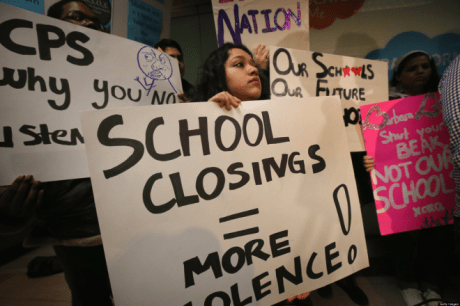
Mayor Rahm Emanuel likes to close schools in African American communities. He claims underenrillment but then opens new charter schools to replace the public schools he closed. Is there a master plan? Is this strategy about real estate and gentrification? Large numbers of black families have left Chicago. The Chicago Teachers Union has valiantly resisted School closings, but Mayor Emanuel will not be deterred. Some community activists charge that the school-closing strategy has contributed to the city’s high levels of youth violence. Stable communities support stable schools. School closings disrupt communities and studebts’ lives.

Screen Shot 2018-01-02 at 6.01.21 PM

Stop Destructive School Actions

Closingsviolence_660x440

PLEDGE TO ATTEND

CPS’ dishonest “choice model” — which sets up a limited number of well-resourced magnet schools, a large number of charter schools and defunds other schools using “Student Based Budgeting” — has destabilized Black & Latino neighborhoods, driven families from Chicago, and left many neighborhood schools struggling to offer students a quality curriculum, starved of even the most basic resources.

CPS proposes to close all four neighborhood high schools in Englewood: Hope High School, Robeson High School, Harper High School, and TEAM Englewood Community Academy High School. To the Mayor, their students just don’t matter enough to have the same rights, access or education as his children or neighbors.

CPS proposes to phase out National Teachers Elementary Academy because they want to give their building to another community.

The unelected School Board voted to co-locate a clout-heavy charter school whose charter operator is linked to scandal-ridden SUPES into Hirsch Metropolitan High School, a move that would destroy Hirsch to start a new privatized school.

As CTU members, there are ways to fight back. We urge all CTU members to support the educators and families at these schools as they defend their schools and communities. Here are some of the ways you can help:

  • Attend closings hearings starting on January 9th. Plan to testify to talk about how student based budgeting and privatization are affecting your school and community.

  • Attend actions being planned by the students, parents and educators at these schools. They need our support at these protests to keep the public informed and keep the pressure on Rahm.

  • Plan to attend the next Board of Education meeting on Wednesday, January 24.

Click here for more information.


Tennessee is a red state. Betsy DeVos visited the state to make a personal pitch for vouchers. The state already has charters and a very low performing cyber-charter. Despite all that, vouchers are dead for 2018. The rural districts don’t want them. Communities don’t want them. The legislators have heard from the people who elected them. Vouchers are dead this year. Period.

A bill to start a voucher pilot in Memphis just officially was declared dead for this year. It won’t even be introduced.

A bill that would pilot a private school voucher program in Memphis is officially dead this year.

Rep. Harry Brooks, the Knoxville Republican who sponsored the bill with Sen. Brian Kelsey of Germantown, said Friday he won’t advance it in the House. Kelsey announced earlier this week that he was giving up on the bill in the Senate.

“The interest in the House is not there,” Brooks told Chalkbeat. “If the Senate is not going to proceed with it, there’s no need to move it in the House. It’s just an exercise in futility.”

Brooks’ decision ends a years-long effort to allow some Tennessee parents to use public money to pay for private school tuition — just as U.S. Secretary of Education Betsy DeVos has focused national attention on voucher programs. Previous versions calling for a statewide program for students from low-income families met fierce opposition from state lawmakers from rural and urban areas, forcing sponsors to narrow the scope of the program. The latest proposal only applied to Memphis.

But unlike previous years when vouchers were stalled during the legislative session, this proposal — carried over from last year — lost steam before the 2018 session began.

Many members of the House in Tennessee said that vouchers would ruin the financial stability of their districts. The bill died because it had no support.