Archives for category: Education Industry

Lawrence Feinberg of the Keystone State Education Coalition writes about HB 97, which is being considered today:

HB97 is on the House calendar for today.

Instead of insisting on an omnibus charter reform bill, the legislature should consider a stand-alone, separate bill creating a charter school funding commission modelled after the successful Basic Education Funding Commission and Special Education Funding Commission, with a task of work limited to charter school funding issues and comprised solely of legislators and executive branch members.

This would be a significant first step in untying the Gordian knot that PA charter reform has become.

HB97 would stack the state’s Charter Appeals Board in favor of charter proponents.

HB97 would increase the terms of charter authorizations and renewals; shouldn’t taxpayer’s elected officials be able to review and approve the expenditure of tax dollars annually?

HB97 does virtually nothing to address the total lack of transparency for public tax dollars spent by charter management companies.

Pennsylvania’s 500 school districts never authorized the 13 chronically underperforming cyber charters and many districts offer cyber programs at significant savings to taxpayers yet all 500 districts are required to send tax dollars to cyber charters.

The legislature should consider a separate piece of legislation dealing solely with cyber charter issues.

#HB97 None of Senate Appropriations Committee Chairman .@SenatorBrowne’s school districts ever authorized a cyber charter.

In 2015-16 they had to pay over $19.5 million in cyber charter tuition.

Not one of Pennsylvania’s 13 cyber charter schools has ever achieved a passing score of 70 on the School Performance Profile.

Many school districts have in-house cyber programs that are able to serve students at considerable savings over cyber charter costs.

#HB97 None of House Appropriations Committee Chairman .@RepStanSaylor’s school districts ever authorized a cyber charter. In 2015-16 they had to pay over $3.8 million in cyber charter tuition.

#HB97 None of gubernatorial candidate .@SenScottWagner’s school districts ever authorized a cyber charter. In 2015-16 they had to pay over $11.9 million in cyber charter tuition.

#HB97 None of Senate Education Committee Minority Chairman @SenatorDinniman’s school districts ever authorized a cyber charter. In 2015-16 they had to pay over $13.4 million in cyber charter tuition.

#HB97 None of House Education Committee Chairman Eichelberger’s school districts ever authorized a cyber charter. In 2015-16 they had to pay over $11.6 million in cyber charter tuition.

#HB97 Neither of House Speaker .@RepTurzai’s school districts ever authorized a cyber charter. In 2015-16 they had to pay over $1.8 million in cyber charter tuition.

#HB97 None of Senate President .@senatorscarnati’s school districts ever authorized a cyber charter. In 2015-16 they had to pay over $9.4 million in cyber charter tuition.

#HB97 None of Senate Majority Leader .@JakeCorman’s school districts ever authorized a cyber charter. In 2015-16 they had to pay over $5.1 million in cyber charter tuition.
Pennsylvania’s state auditor said not long ago that the state has the worst charter legislation in the nation.

It is about to get worse if HB97 passes. Public school advocates at the Keystone State Education Coalition say the bill is in trouble and can be defeated. If you live in Pennsylvania, get on the phone at once and contact your legislator.

EdVotersPA: PA House Poised to Ram Through Horrible Charter Bill

Education Voters PA

We need your help to stop HB 97…

We had hoped that the PA House would work toward charter reform that would protect taxpayers and students and improve PA’s system of public education.

Our hopes were misplaced.

On Tuesday this week, members of the House Education Committee passed HB 97 out of committee on a vote of 17 to 10. Before they voted, lawmakers were assured that HB 97 was a work in progress and would be amended to address many significant problems and deficiencies in the bill.

That didn’t happen.

During the House session on Wednesday, Republican leadership and most Republican lawmakers opposed nearly every substantial amendment that was introduced to fix HB 97.

Tell your state representative to oppose HB 97. The House will be in session next week and is poised to ram through HB 97 without any further improvements.

· HB 97 does not address the $100 million profit (and growing) that charters reap off students with disabilities each year from the broken special education funding system.

· HB 97 does nothing to address the continued abysmal academic performance of the state’s cyber charter schools — none of which have met the minimum proficiency standard on the state’s school performance profile.

· HB 97 creates separate performance standards by which to evaluate charter/cyber charter schools and district schools, making a comparison of education quality between the two sectors impossible. Cyber charter performance won’t look as bad if cyber charters are compared only to other charter schools, many of which are also very low-performing.

· HB 97 strips local control from school boards. If HB 97 becomes law, local school boards would be prohibited from requesting any information from charter applicants beyond the information in a state-created application form; local school boards would be subjected to the whim of charter operators to amend their charter; and local school board decisions regarding charter applications and renewals would be at the mercy of the state’s Charter Appeal Board, which would be stacked with charter school supporters.

HB 97 improves ethics and transparency standards for charters and temporarily makes very small reductions in school district payments to cyber charters. In exchange for these modest modifications to the current law, legislators are handing charter lobbyists their wish list with a bow on top.

Making charters play by similar rules as other publicly funded entities should not earn the PA legislature high praise. These are necessary and important changes to the PA legislature’s broken law that should have been made years ago.

Kathleen Oporeza, executive director of Fund Education Now in Florida, urges all Florida citizens to contact their legislators–by email, by telephone, in person–and urge them to vote against any legislation that refers to “Schools of Hope,” which is a blatant effort to hand public schools over to charter entrepreneurs.

Urge the House & Senate to oppose any bill containing “Schools of Hope/HIgh Impact Charters” language

This dangerous concept has worked its way into at least a dozen bills, making it intentionally harder to track. All of this activity feeds the goal of making it easier to slip this bad public policy into one of several massive “train” bills far removed from public view.

Take action now. Tell our Senators and Representatives to oppose all bills, including HB 5105, SB 796, and SB 1552, that contain “Schools of Hope/High Impact Charter Networks” language.

“Schools of Hope”/“High Impact Charter Networks” create two separate, unequal publicly funded school systems – one under the control of duly elected school boards and the other controlled by outside private corporations under the direction of the appointed State Board of Education.

The deck is stacked. The BOE picks and chooses which district turnaround plans are accepted or rejected while at the same time exercising oversight authority over competing High Impact Charter Networks.

Because the BOE determines cut scores on state assessments and the calculation of school grades which can be manipulated to increase the number of D and F district schools this language will clearly drive the expansion of “Schools of Hope/High Impact Charter Networks.”

Use your voice now! One click easy. Please do not let “Schools of Hope/High Impact Charter Networks” trigger the immediate transfer of 115 “D & F” public schools and their 77K students into private, for-profit hands.

This isn’t about helping our most vulnerable students; it’s about promoting unmitigated charter school growth in an effort to erode district schools.

The Charter “Schools of Hope/High Impact Charter Networks” exponentially expand the effort to allow for-profit charters to keep grabbing tax dollars and tapping new markets to beef up the annual reports of corporate charter chains. None of this has been proven to help students or improve education.

Please tell the Florida Legislature to vote no on the “Schools of Hope/High Impact Charter Networks” language, SB 796, SB 1552 and HB 5105 with its $200M slush fund and block its inclusion in the Senate Budget and prevent it from being slipped by either chamber into a “train” bill.

Your voice has power. Our children are depending on us

After Checker Finn called for an end to teacher tenure, Mercedes Schneider became interested in the Thomas B. Fordham Institute. First she reviewed its financial reports to the IRS.

Now she scrutinizes the performance of the charter schools that TBF sponsors in Ohio. Since TBF lectures the nation about the virtues of school choice, it is useful to know how it’s own schools are doing. It is not a pretty picture.

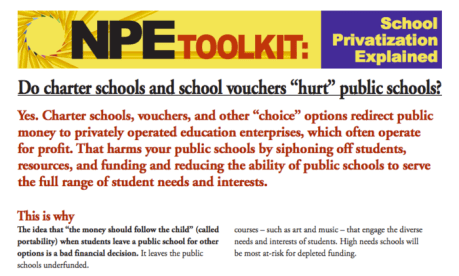
The Network for Public Education has created a toolkit to equip you to fight privatization of our public schools. In it, you will find concise summaries of important issues, with links to research, and ways that you can join with your colleagues , friends, and neighbors to block the Trump-DeVos agenda.

For the full report click here.

npe

The Auditor General of the state of Pennsylvania once declared that Pennsylvania has”the worst charter school law in the nation.”

Mark Miller shows how hard it is to fix that law. Operators of charter schools and cyber charters are reaping huge profits. One cyber charter founder was found guilty of tax evasion on his huge profits. A charter owner built a massive mansion in Palm Beach.

Yet the legislature can’t rein them in. Every dollar they collect means a dollar less for public schools.

http://www.markbmiller.com/2017/04/20/charter-deform-made-its-way-to-pa-house-floor-today/

Broad Coalition of Lawmakers, Parents, Educators to Speak Out Monday in Capitol
About 3 Bills Needed to Halt Waste, Fraud and Secrecy in Charter Schools

Media Teleconference on SB 808, AB 1478, AB 1360
Set for Same Time as News Conference: 10 a.m. Monday

SACRAMENTO – In a news conference Monday at the Capitol to demand more public control of taxpayer-funded California charter schools, a broad coalition of state lawmakers, parents, educators and community supporters will speak out about three pending bills that seek to ensure charter school accountability, transparency, and accessibility to all.

Media representatives who can’t attend the 10:00 a.m. news conference in the Capitol can listen to it in a media teleconference, then ask questions on the phone afterwards.

News conference speakers will include state Senator Tony Mendoza, author of SB 808, ensuring that charters could only be authorized by the school district in which they would be located; Assembly Member Reggie Jones-Sawyer, author of AB 1478, requiring charters to comply with the same transparency and accountability laws as traditional public schools; and Assembly Member Rob Bonta, whose AB 1360 would prohibit discriminatory admissions practices and ensure due process in pupil discipline at charter schools.

The three bills are co-sponsored by the California Teachers Association, the California Federation of Teachers and other groups, including, for AB 1360, Alliance for Boys and Men of Color, American Civil Liberties Union (ACLU), California School Employees Association (CSEA), Public Advocates and Public Counsel, while CSEA is also backing AB 1478.

Other speakers include CTA Board member Terri Jackson, a teacher in the East Bay; Gemma Abels, a CFT Vice President; Oakland parent Kim Davis, who helped found Parents United for Public Schools; Liz Guillen with Public Advocates group; and Alex Caputo-Pearl, president of United Teachers Los Angeles, who will address how the lack of charter regulations is hurting students in the Los Angeles Unified School District, where the school board has endorsed the three bills.

WHAT: News conference and media teleconference with a broad coalition supporting three pending bills to ensure California charter school accountability, transparency, and accessibility for all students.

WHEN and WHERE: News conference is 10:00 a.m. Monday, April 24, in Room 1190 at the Capitol.

***MEDIA TELECONFERENCE LOGISTICS***

TIME: 10:00 a.m. Monday, April 24

CALL-IN NUMBER: 1-888-299-7212

PASSWORD: 4228984

This article was written by Dan Currie, a member of Pastors for Texas Children. He explains that the real goal of the school choice movement is to eliminate public schools.

He writes:

Many years ago, Jerry Falwell articulated the goal of the school choice movement well when he said, “I hope I live to see the day when, as in the early days of our country, we won’t have any public schools. The churches will have taken them over again and Christians will be running them. What a happy day that will be!”

Since the beginning of the religious right movement with Falwell, Phyllis Schlafly, Pat Robertson and others, the aim has been to destroy public education in America. Today they are closer than ever to achieving their goal because it is now being promoted by the president, his education secretary Betsy DeVos and Republican leaders in Texas government including the governor, lieutenant governor, attorney general, agriculture commissioner and land commissioner.

This is what you have elected in Texas, my friends, by choosing party over sanity.

Vouchers, school choice, education savings accounts — they are all code words intended to mask the real aim of this movement: destroy public education in America and turn all schools into institutions of religious indoctrination.

Trump’s intentions are clear. His first choice for Secretary of Education was Jerry Falwell, Jr., according to Falwell himself. Trump sent his own children to private schools where the tuition is $50,000 a year or more. No voucher would allow a student to attend those schools.

Currie writes about the destructive effect that vouchers would have on public schools in his own home county:

I live in the Wall ISD. If 20 students get $5,000 apiece to leave the public school to attend a private school, Wall ISD will lose close to $130,000 that can’t be replaced. That money is just lost. No teacher can be fired, no bus route stopped, no money on utilities saved — they just lose the money.

So let me speak bluntly to my friends in the Wall ISD (and you can apply this to any ISD in our area) — when you keep electing right-wing, religious right Republicans at the state and national level, you are voting to close our schools. Please figure that out before it’s too late.

The Texas Senate passed voucher legislation, by a vote of 18-13. It was defeated overwhelmingly by a bipartisan vote in the House of Representatives. Given that vouchers are the personal obsession of Lt. Gov. Dan Patrick, expect this zombie to rise again.

Reader Michael Fiorello commented on an article about charter schools. It is no accident that the Walton family (the richest family in America, thanks to Walmart) is spending $200 million annually on charter schools. It is not about children; they could do a lot with $200 million to help children in their home state of Arkansas. They could build health clinics or provide nurses for every school in a poor community. They could pay their parents $15 an hour. But, no, they want charter schools, and they will give $200 million a year for five years (that is $1 billion) to create new charter schools. Why? They hate unions. As Michael notes below, more than 90% of charters are non-union.

He writes:

There are issues of control woven throughout the charter issue, separate from the looting they are prone to.

There is the desire to have iron control of the labor force, explaining why charters are over ninety percent non-union: the desire, as seen virtually everywhere else in the labor markets, to replace full-time employment with temporary/ contingent labor, the desire to pay teachers less, and the desire to have them under the thumb of management, which is much more difficult to maintain in a union, career-oriented environment where institutional memory has value. Thus, it’s no accident that charters have such extreme staff turnover, and often have teachers working from scripted lessons. As has occurred in so many other industries, the de-skilling of the workforce is a management axiom.

There is also a social engineering aspect of charter schools, especially prevalent among the “no excuses” chains (KIPP, Success Academies, Uncommon Schools, et. al.), which are obsessed with herding and controlling children in punitive, Skinner Box- type environments. It’s about training children, not educating them, to be docile and obedient, no matter the oppressiveness of the environment, prepping them for the lack of autonomy they’ll face in the adult workforce, and preventing them from having even an inkling that another world is possible.

If you were irked by Checker Finn’s article calling for an end to teacher tenure, you will enjoy Mercedes Schneider’s biting commentary on “tenure” at the Thomas B. Fordham Institute. She opens up the tax returns of TBF and reveals executive salaries. Working for a think tank in D.C. pays far more than teaching.

I was a founding board member of TBF, back when it started. Checker’s father was chairman of the board, and Checker was chosen to be executive director. Mr. Thomas B. Fordham was an executive in Dayton, Ohio, and Mr. Finn, Sr., was his lawyer. When Fordham’s widow died, Mr. Finn Sr. created the foundation in accordance with the will. Mr. Fordham had invested in blue chip stocks many years ago and never sold them, so he left a considerable estate.

As TBF became increasingly ideological and rightwing, and as I turned against the rightwing agenda of privatization and high-stakes testing, I left the board. That was 2009. I opposed TBF becoming an authorizer of charter schools in Ohio. I lost. I opposed seeking funding from Gates, on the grounds that it would compromise our freedom to criticize Gates. I lost. There comes a time when you realize it is time to part ways.