Archives for category: Education Industry


Peter Greene puts his finger on the reason that Secretary DeVos is unmoved by charter failures. In her ideal free-market model, failure is a feature, not a bug.

in the free market, businesses open and close all the time. Where is Eastern Airlines, Braniff, TWA? Gone.

Stability, in her view, is not desirable. Disruption and churn show that the market is working well.

Thats why she is not at all disturbed to learn that one-third of the charters funded by the U.S. Department of Education either never opened or closed soon after opening. That’s music to her ears. The market is working!

He writes:

“This is one of the area where choicers have a fundamental disagreement with public education advocates. For public schools, stability is a basic foundational value. The school is a community institution, and like all institutions, part of its values comes from its continuity, its connections to tradition, the past. It means something to people to see their children and neighbors all passing through the same halls, having the same teachers, being part of a community collective that stretches across the years. For free market Reformsters, anything that gets in the way of their idea of free market mechanics is bad; there should be winners and losers and the market should judge their worth, ruthlessly culling the weak and undeserving.

“Reformsters know they have a hard sell. That’s why they don’t try to use this as a selling point (“Don’t forget– the school your child chooses could close at any time due to market consitions! Isn’t that awesome!”) That’s why they are adamant about calling charters “public” schools– because it lulls the customers into believing that charters share some of the fundamental characteristics of public schools, like stability and longevity. They (e.g. Governor DeSantis of Florida) also want to hold onto “public” because the change to privately owned and operated market based schools is the end of public education as we know it; it truly is privatization, and almost nobody pushing these policies has the guts to publicly say, “I propose that we end public education and replace it with privately owned and operated businesses, some of which will reserve the right to refuse service to some of you, and all of which may not last long enough to see your child from K through 12.”

“The person who almost has the guts to almost say this is, ironically, Betsy DeVos– the person charged with taking care of the public system that she would like to kill. What a wacky world we live in. So don’t expect her to be moved by all the waste of tax dollars paying for failed or fraudulent charter schools; every time a charter school closes, a free market reformster gets their wings, and Betsy is a-fixin’ to fly.”


In this post, Alan Singer reviews a study conducted by SMU (Southern Methodist University) about the effectiveness of TFA teachers. He cites an earlier review of the same study by Gary Rubinstein and concludes with Gary that this study is not good news for TFA, even though TFA thinks it is.

Singer reviews the study and concludes:

“The other finding (?) is that “TFA alumni are generally more effective than non-TFA-affiliated peer teachers across all regions (as indicated by mostly blue indicators for that group).” There is a big problem with this finding. More than half of TFA corps members leave their initial placements in low-income schools after two years and only 60% even stay in the program for a third year to complete their contract. Five years after entering the program, 85% of former TFA corps members, the highly rated TFA alumni cohort, have either left teaching or after securing teacher certification have transferred to higher performing schools. Basically the TFA survivors, on the average, rate as more effective, because non-career corps members have already quit teaching and most of those who remain are working with students who already score higher on standardized tests.

“Although the Southern Methodist report did not call for disbanding Teach for America, it should have, based on the evidence. Maybe instead of corps members, TFA should just become a corpse.”


This is the second part of John Thompson’s review of Andrea Gabor’s book, After the Education Wars. 

Gabor analyzes why “Reform” failed and where we go from here.

John Thompson writes:

A first review of Andrea Gabor’s excellent After the Education Wars concentrated on the progressive reforms that should have informed the improvement of New York City schools. Billionaires like Bill Gates and Mike Bloomberg essentially imposed a set of policies that virtually guaranteed “Taylorism,” and turned so many schools into sped-up 21st century versions of Henry Ford’s assembly lines. Gabor then draws on that history to offer advice on how educators can “recover the road not taken.”

https://www.kirkusreviews.com/book-reviews/andrea-gabor/after-the-education-wars/

Each of Gabor’s chapters teaches invaluable lessons, but I learned the most from her account of New York City’s lost opportunities. I still would like to learn more about Eric Nadelstern’s efforts to work within the reformers’ system. It’s often speculated that some billionaires now sense that their experiments failed and they now place their faith in “personalized,” online instruction. But they still seem to misunderstand Nadelstern’s experiences and ignore his warning, “‘Virtual communities don’t raise children, people do.’”

Although the nuances of education reform in Massachusetts are often lost on true believers in high stakes testing, Gabor shows how the policies that actually worked in Boston and Brockton were actually much closer to New York’s progressive reforms than the test and punish mentality which challenges them. First, Massachusetts improved its schools through a well-funded, well-planned, openly deliberated, and patient process. Its accountability test, the MCAS, was transparent and iterative. Its graduation targets were only set at a sophomore level, and schools were allowed time for preparation. Individual teachers weren’t held accountable for test results and charters were not used to scale up a battle between traditional public schools and choice schools, with test scores as the ammunition.

In both Brockton High School and the very different schools in Leander, Tx, critical thinking and literacy were stressed. Both progressive approaches to school improvement were consistent with Edwards Deming’s continuous improvement.

They both believed in group efforts to improve school, and embraced vigorous debate over policy. It wasn’t much of a shock to read about Massachusetts’ efforts to build intrinsic, as opposed to extrinsic, motivation, but it was an especially nice surprise for this Oklahoman to learn about similar efforts in Texas. In my state, we heard plenty about the supposed “Texas Miracle,” where test and punish drove the creation of bogus test score gains. It was a joy, however, to read about Leander’s campaign based on “driving out fear” in order to protect teachers’ autonomy and empower collaborative school improvement.

It was doubly fun to read about a Texas administration which used an I Love Lucy video during its “Culture Day.” Gabor provides this summary of the assembly line where Lucy and her friend Ethel need to pick chocolates, wrap and send them down to the packing room:

A stern supervisor hovers over them. “If one piece of candy gets past you … you’re                                                 fired.

… the assembly line gradually speeds up and the two friends start shoving chocolates they can’t wrap fast enough into their mouths, down the front of their uniforms, and under their caps.

The Lucy and Ethel video clip … has become a Leander metaphor for fear and the systemic havoc it unleashes.

Although the chapters on Massachusetts and Leander mostly stress the ways that the progressive school improvement path was taken, both end on cautionary notes. Massachusetts recently defeated Question 2, but corporate reformers who funded the lifting of the charter school cap still threaten the state’s gains, and the new Texas teacher evaluation law could be a mortal threat to collaboration and trust in Texas.

Then Gabor turned to the alleged New Orleans (NOLA) mass charterization success. NOLA has often been proclaimed as the rare victory which is proof that the concept of accountability-driven, competition-driven reform can improve the education outcomes of poor children of color. Gabor shows, however, the New Orleans’ portfolio model provides another example of how reform has most hurt the poorest children of color. Yes, studies by the Education Research Alliance documented impressive gains for a brief time. But, she notes that it didn’t study high school results or control for no-excuses schools’ pedagogies. The gains occurred when NOLA funding was at its peak, and its Darwinian tactic of counseling out traumatized and disabled children inflated test scores. Moreover, by 2012, New Orleans had between 12,195 to 15,781 disconnected youth, who were out of school and not in a job.

It is now clear that NOLA is another example of reformers’ “self-congratulatory” public relations spin, and another illustration of, “Noisy transformations [that] are often more mirage than miracle.” As in other schools where venture philanthropists claimed transformative gains, its charter schools competed “by skimming off the most engaged parents, [which] it turns nearby public schools into dumping grounds for the most troubled kids.” Once again, reformers produced gains for some by “essentially writing off the bottom 20 to 30 percent of poor children.”

We in Oklahoma City witnessed the same dynamics that Gabor documented. As Gates and other edu-philanthropists were deciding that they needed to “teacher proof” the classroom, a bipartisan Oklahoma City coalition led a collaborative, openly-debated effort to build trusting relationships, and our district began to improve. Then came No Child Left Behind, and as in the systems described by Gabor, our humane, holistic efforts were eventually abandoned. After a superintendent from the Broad Academy doubled down on micromanaging a sped-up assembly line, my once-improving school dropped to the lowest-performing mid-high on Oklahoma. I studied the paper records of my high school students and discovered the reality reformers ignored, but that should inform the next era of school improvement.

Almost without exception, my struggling students had been doing well in school until tragedies hit their families. Cancer and heart disease dwarfed all other causes of failures, and many teachers saw what was happening. When family illnesses caused kids to fall off the instruction assembly line, school didn’t have the resources to help them get on track. Rather than tackle those problems in a collaborative manner, doomed market-driven solutions were forced on us, increasing segregation.

As school choices proliferated, the students who survived multiple traumas (ACEs) were left behind in schools serving neighborhoods with extreme concentrations of generational poverty. Those schools suffered the most from high stakes testing conducted in an aligned and paced, worksheet-driven curriculum. My students were acutely aware that powerful adults had fought an intense battle over their schools, and that they were lab rats in an experiment that turned them into drill-and-kill factories.

So, what should guide the next reform era? First, we can build on points where most people agree, such as the hard-won conclusion that “standardized tests have no place in kindergarten.” And we may be getting to the point where nearly all sides agree that schools need better funding.

Gabor ends with praise of David Kirp and the early education reforms, and the team effort to improve New Jersey’s Union City. Rather than seek better, quantitative clubs and socio-engineer the building of “a better teacher,” we should return to the promising path of peer review teacher evaluations. And as Gabor repeatedly explains, the next era’s school should be founded on trusting, collaborative, and respectful relationships.

 

Alexandra Neason of the Columbia Journalism Review asks an important question: Why did the Washington Post write an editorial opposing charter school transparency? The Post has adopted as its slogan, “Democracy Dies in Darkness.” A great slogan in these troubling times, but why should charter schools be exempt from scrutiny?

She writes:

“LAST MONTH, CHARLES ALLEN, a member of the Washington, DC Council, introduced the Public School Transparency Amendment Act of 2019, which would extend the same sunshine laws applied to traditional public schools to publicly funded charter schools. The proposal came on the heels of suggested reforms put forth by the DC Public Charter School Board. In addition to promoting access to records and meetings, it would also force charter schools to include a list of donations greater than $500 in their annual reports and to include at least two teachers on their boards. (At high schools or adult learning centers, a student representative would also have to be included.) This week, the editorial board of The Washington Post argued against the measure.

“We are firm believers in sunshine in public matters, but this legislation—which seems to be taken from the national teachers’ union playbook on how to kneecap charter schools—is not designed to benefit the public or help students,” the editorial board wrote. The piece goes on to tout the charter school board’s reputation for scrupulous oversight, arguing that it already upholds a requirement that charters “disclose financial information, including how they use resources from the government and what they accomplish with those resources.” Enacting the amendment, the editorial argues, would threaten the schools’ independence with unnecessary bureaucracy.

“In endorsing the obscurity of charter school finances, theeditorial board struggles to see how the release of information—such as the names of charter school employees, salaries, and vendor contracts under $100,000, data that DC public schools must make available—is “critical to student learning.” The editorial board adds that it’s “easy to see how it might help unions in their bid to organize at charter schools.”

“The city’s 123 charter schools, attended by nearly 45,000 students, benefit from $800 million in taxpayer funds every year. The quasi-public board that oversees them is subject to open meetings laws and the Freedom of Information Act, but journalists and the public are only granted access to charter school documents in the board’s possession. The board acts as a curator, allowing public access only to information that it deems necessary. This poses obvious problems for parents, who seek information about how their kids’ schools are run, and for journalists, tasked with covering schools that make up a massive chunk of the public education landscape in the nation’s capital. By contrast, California passed a law last monththat would subject its 1,300 charter schools to public records and open meetings laws.”

She points out that charter school advocacy groups, including the National Association of Charter School Authorizers and the National Alliance for Public Charter Schools support transparency laws—like the one proposed in D.C.

Why is the Washington Post shielding the charter sector?

The Post says that requiring charter schools to be as transparent as public schools would be an unnecessary burden. That’s not a convincing argument. Why should public schools be required to bear the same “unnecessary burden.”

Neason concludes:

“For a journalistic entity—opinion section or otherwise—to advocate against a measure that seeks to increase transparency is backwards. The editorial board’s stance echoes the arguments of charter school operators, instead of supporting a measure that would improve access to information about taxpayer-funded entities. While journalists across the country work overtime to uphold the values of disclosure, this editorial—from one of the country’s preeminent newspapers, whose tagline is “Democracy Dies in Darkness”—isn’t just embarrassing, it’s undermining.”

The editorial board’s persistent defense of charter schools and its insistence that they be allowed to operate however they wish, without scrutiny, is strange.


In this post on Valerie Strauss’s Answer Sheet blog at the Washington Post, Carol Burris and I respond to Betsy DeVos’s putdown of the Network for Public Education’s meticulous documentation of the failure of the federal Charter Schools Program. Our report, “Asleep at the Wheel,” showed that the U.S. Department of Education had handed out hundreds of millions of dollars–close to a billion dollars–between 2006 and 2014, to nearly 1,000 charter schools that never opened or that closed soon after opening. DeVos, as you will see, dismissed the report out of hand, and we assume that she never read it. The report was carefully documented, with references drawn mainly from government sources, including the website of the U.S. Department of Education. And for an added bonus, we show that 42% of all charter schools in DeVos’s home state of Michigan that received federal funding either never opened or closed soon after opening. What will she do to correct the lack of oversight in her own department?

We write:

Here is a link to 109 Michigan charter schools, called “academies,” that were awarded Charter School Program (CSP) grants from 2006-2014 but either never opened or closed. That number represents 42 percent of all recipients. Those highlighted in maroon shut down. Those highlighted in tan are schools that received funds but never opened. You will find ample documentation for your staff to review our work.

As anxious as you are to open new charter schools, if nearly half of them do not make it, we suggest that something is wrong with the selection process.

In total, $20,272,078 was awarded to defunct Michigan charter schools. And yet, in 2018 you awarded the State of Michigan an additional $47,222,222.

Your home state is not alone. Posted here is a similar list from the state of Ohio showing the names of 117 charter schools (40 percent) that received CSP funds between 2006-2014 that also never opened or are now closed. The total of CSP awards to those schools is $35,926,693. Please note that in all of these states, far more charter schools have failed than just those that received federal SEA funds. In the case of Ohio, the list of closed charters (293) is nearly equal to the number of schools that are presently open (310).

Dare I say that the U.S. Department was scammed because of its own negligence?

Read on.

There is more about Louisiana, California, and other states.

We are talking here about our taxpayer dollars. There are needy schools in the U.S. Yet the Department of Education squanders money on failed and failing charter schools. This must stop!


The battle has begun about whether to lift the cap on charter schools in New York City.

New York City has 235 charter schools serving 123,000 students (about 10% of those enrolled in public schools) and there are no empty slots for additional charters unless the legislature raises the cap.  Governor Cuomo, flush with hedge fund cash from his last campaign, wants to raise the charter cap.

Now billionaire Merryl Tisch, who previously was Chancellor of the New York Board of Regents and is now on the board of the State University  of New York, proposed that the city be allowed to use some of the 99 open charter slots from the rest of the state. 

Under Tisch’s leadership at the Regents, New York won a Race to the Top grant of $700 million, hired John King as State Commissioner, committed to evaluate teachers by the test scores of their students, and adopted the Common Core and PARCC Testing. Tisch set off the Opt Out Movement, and she also hired MaryEllen Elia from Hillsborough County in Florida, which was part of the Gates Foundation’s failed experiment with VAM (value-added measurement) of teachers.

We are told that the waiting list for admission to charters in NYC is very, very long.

So think about this:

If there is a long waiting list, as Merryl Tisch says, why do charters hire a marketing firm to send recruiting letters to children in public schools? Why are they moaning about not having access to the public school names and addresses? Why don’t they just accept kids from the waiting list? Is there a waiting list? Maybe there are actually vacancies, as in Los Angeles, where 80% of the charters have empty seats. Even Eva Moskowitz needs access to public school names for recruitment purposes.

Would someone please audit that alleged waiting list?


No matter how many scandals and frauds are exposed in the charter industry, the federal money keeps rolling in.

Open this link to see which of your favorite charter chains (the Walmarts of education) won millions from their friend Betsy DeVos.

Eva got $9.8 million from her friend Betsy.

KIPP will secure a total of $86 million over five years for its San Francisco operations.

IDEA in Texas scores $116 million over five years!

Despite the report from the Network for Public Education showing that 1/3 of the grants by the federal Charter Schools Program are awarded to schools that never open or that close soon after opening, the money keeps flowing.

No matter how many reports of charter fraud, waste, and malfeasance, the federal dollars keep flowing.

Lynn Davenport is a parent activist in Texas. She wrote the following post to alert her fellow Texans about the invasion of Kitamba Consultants, who bring with them the so-called “portfolio model” of privatization.


She writes:

The LA teacher strike thwarted a concealed plot to use Kitamba consultants to reinvent LAUSD with a portfolio model of privatization. Kitamba has a contract with TEA right now for these districts, including RISD:

tea1

I just got a 228 page public information request from the Texas Education Agency and Region 13 service center in Austin for their MOU with Kitamba.

Texas is spending big bucks on the same Kitamba consultants exposed in the LAUSD strikes against philanthropist/private equity reformer and Supt Austin Beutner:

https://www.chalkbeat.org/posts/us/2019/04/09/los-angeles-consultants-recommendations-reimagine-kitamba-consultants/
“Created by the consulting firm Kitamba, the documents lay out an aggressive timeline for assigning schools to 32 support networks, giving principals more power, and cutting the central office by fall 2019.

The January strike appears to have derailed the plans. A spokesperson for Los Angeles Unified declined to comment.

During the January strike, United Teachers of Los Angeles criticized what it described as the district’s portfolio plan and its partnership with Kitamba. (A spokesperson at the time said Los Angeles Unified is not pursuing a portfolio approach.) Kitamba won a $765,000 contract for its work, paid by a slate of outside donors, including the Eli and Edythe Broad Foundation.

Details of Kitamba’s contract and scope of work were reported in February by the Los Angeles Times after school board member Scott Schmerelson criticized Beutner for not disclosing contracts with consultants, including Kitamba, or the work they had done for the district.”

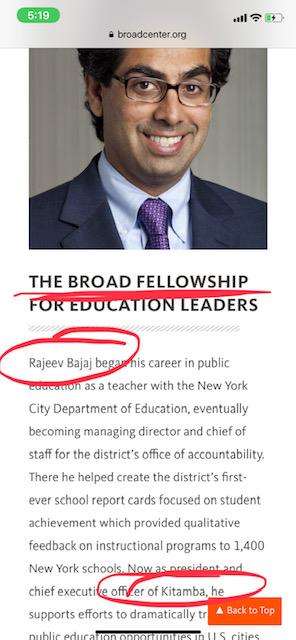
Rajeev Bajaj is a Broadie:

tea2

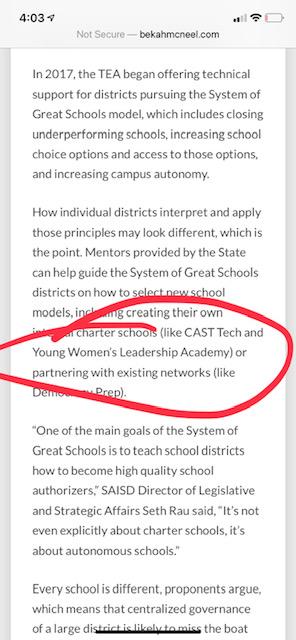
I researched all of this during my System of Great Schools LinkedIn article in December, I just didn’t see the magnitude of the Kitamba contract at the time:

tea3

Please read my SGS Takeover article again:
https://www.linkedin.com/pulse/privatization-system-great-schools-takeover-lynn-davenport

tea4

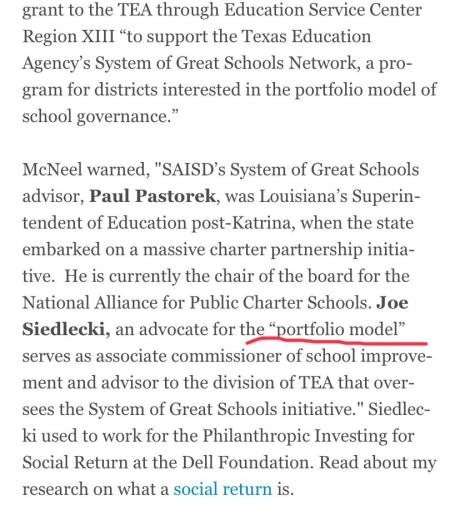
Blogger Bekah McNeel found that, “In 2017 the Laura and John Arnold Foundation gave a two-year $85,000 grant to the TEA through Education Service Center Region XIII “to support the Texas Education Agency’s System of Great Schools Network, a program for districts interested in the portfolio model of school governance.”
http://bekahmcneel.com/in-becoming-a-system-of-great-schools-saisd-is-fighting-for-its-life/

Interesting that Dallas mayoral candidate Lynn McBee’s org was mentioned:

tea5


We need to stop this with the help of Texas AFT, parents, and trustees who see the harm of the portfolio model. We also need to loop in the California union to get their advice. I would like to hire Brett Shipp Media to help expose this. If we don’t stop it, our neighborhood schools, teachers, and elected boards will be eliminated in favor of a charter-like model of “autonomy”.


John Thompson, who recently retired as a teacher in Oklahoma, here reviews Andrea Gabor’s fine book, After the Education Wars. His review appears in two parts. He is interested in Gabor’s critique of why “reform” failed and where we go next.
He writes:
We are near the end of the 21st century’s second decade, and some fervent corporate school reformers finally seem to be understanding that their experiment turned an unconscionable percentage of schools into sped-up versions of a Model T assembly line. We need a new era of humane, holistic school improvement. A first step is reading and discussing Andrea Gabor’s After the Education Wars.  Now that corporate reform failed, Gabor explains, we must learn the lessons of history and “recover the road not taken.”

https://www.kirkusreviews.com/book-reviews/andrea-gabor/after-the-education-wars/

The progressive reformers who preceded the corporate reformers of the last generation operated in a manner that was consistent with the “continuous improvement” philosophy of Edwards Deming. As Gabor and Deming explain about schools and other sectors, “Variation is as ubiquitous as air and water.” Deming said, “Only the employees closest to a given process can identify the variation that invariably diminishes quality.” That is why it was necessary to shake up the systemic hierarchy and “drive fear out of the workplace and foster intrinsic motivation.”

Gabor acknowledges the inherent flaws of the pre-reform education administrative sector. Her deepest dive into that “status quo” was her account of how progressive New York City educators, like Deborah Meier, carved out the holistic and inclusive road which reformers refused to take. Meier et.al battled the district’s “compliance managers.” Their methods embodied “creative noncompliance.” Then, Meier and her era’s reformers personified a value system consistent with Deming’s call for “a participative, collaborative, deeply democratic approach to continuous improvement.”

Meier and other progressive education reformers in New York, Massachusetts, and Leander, Tx, respected the essential role of trusting relationships. They needed educators to unite for a team effort, but they also understood the folly of trying to mandate unanimity. It would have been easier to order all teachers to obey the normative dictum which was embraced by the corporate reformers, and be “on the same page.” But they knew that the alternative to open collaboration would be “resistance, secrecy and sabotage.” If Meier and other school leaders emulated the management model of New York City and other large districts, and mandated teacher compliance, “‘the braver and more conscientious [would] cheat the most, but even the most timid can’t practice well what they don’t believe in.’”

Venture philanthropists like Bill Gates and Mike Bloomberg initially shared some of the values which motivated progressive reformers. Both groups initiated small schools in order to offer more personalized services, and the corporate reformers first seemed to not be bewildered by the key component of continuous improvement – building trust. In a sharp contrast to the reckless pace of change that would soon be imposed on public education, the Gates Foundation visited Meier’s Julia Richmond High School for a year before starting its small school campaign. I was shocked to learn that Gates’ Tom Vander Ark invested so much time in visiting schools. But, as Gabor discovered, “The Gates man was smitten with Julia Richmond, but he didn’t see what was actually happening there.”

A progressive principal told Vander Ark about 25 times that “small is a necessary, but not sufficient.” But, he was apparently so obsessed with “scaling up” reforms that the need for collaboration was subordinated to a focus on “design attributes” that could drive nationwide transformation. Vander Ark was more impressed with the “design coherence” of Success Academy than the Julia Richmond culture of trust. Because of their commitment to rapid transformations, Gates, Bloomberg, and other corporate reformers rejected the essence of Meier’s approach and pushed its “antithesis,” which resulted in the “no-excuses charter movement’s focus on behavioral conformity and control.”

Another factor was the Billionaires Boys Club’s hubris. The reformers “distrust of education culture” was combined with “suspicion – even their hatred – of organized labor and their contempt for ordinary public school teachers.” They displayed “the arrogance that elevated polished, but often mediocre (or worse), technocrats over scruffy but knowledgeable educators.” Eventually, Gabor wrote, “to be an educator in Bloomberg’s New York was a little like being a Trotskyite in Bolshevik Russia – never fully trusted and ultimately sidelined, if not doomed.”

It wasn’t just in New York City where the opportunity to learn from veteran, progressive reformers was lost. Across the nation, the accountability-driven, competition-driven reformers’ well-funded public relations campaigns “turned teacher-bashing into a blood sport.” They then sought to “teacher proof” the classroom. Consequently, canned curriculum and mind-numbing lessons drove much of the joy of teaching and learning out of the nation’s schools.

New York City’s lost opportunity morphed into a national tragedy as technocrats continued to worship data but not recognize that the most important educational factors are immeasurable. Their “Taylorism” was combined with a failure to recognize the dangers of “Schumpeterian” disruption on children. And the more that educators resisted reward and punish policies, the more reformers sought better hammers to force compliance. After tougher principal evaluations did not produce enough obedience, value added teacher evaluations sought to hold every single educator accountable for meeting their quantitative goals. Then, reformers overreached by simultaneously imposing Common Core high stakes tests and accountability metrics that were theoretically but not actually aligned with each other.

I entered the classroom as a 39-year-old rookie, but one who had a decade of experience in the inner city. Nearly 1/5th of my first years’ students would listen, learn, and yet refuse to do a single assignment. They didn’t disrupt our lessons as they often did the classes dominated by worksheet-driven instruction. Clearly, part of their noncompliance was a political statement, and they were glad to say why they resisted and why they would soon drop out of school. The common narrative was that they had been robbed of an education when growing up in our district’s teach-to-the-test era in the wake of “A Nation at Risk.” And they bitterly protested that the worst of the drill and kill was imposed on inner city schools.

This was the early 1990s and a new era of test-driven reform was being organized. During our discussions, I said that if reformers would read Catch 22, they would know that compliance couldn’t be forced, and that the system would respond with destructive games to make the accountability metrics come out right. One of my brightest students, who learned every day but who was so fed up with drill and kill that he would have nothing but zeros in every class when he dropped out, offered a better metaphor. During the famous scene in the comedy, I Love Lucy, Lucy fell behind when boxing chocolates on an assembly line. Teachers and students responded to test-driven reform in the same way, tossing out and even eating the product.

Back then, there was a common phrase which Oklahoma progressives repeated, “Feed the Teachers or They Will Eat the Kids,” which anticipates a second post on Gabor’s account of progressive reformers trying to change that reality in NYC, Massachusetts, and Leandor, Tx, as corporate reformers recreated Lucy’s sped-up assembly lines in NYC, New Orleans, and many or most urban schools. It will also review her proposals for a new era that needs to come After the Education Wars.”

Tune in tomorrow, same time, same place, to read the concluding section of Thompson’s review.

A judge in Berks County, Pennsylvania, ruled that a charter school’s property was not tax-exempt, prompted by some unusual financial arrangements. 

Judge Madelyn S. Fudeman upheld a ruling by the Berks County Board of Assessment Appeals denying I-LEAD Inc. an exemption from property taxes.

The building at 401 Penn St., which houses the I-LEAD Charter School, is assessed at $9.7 million, according to Berks County property records.

The property was placed on Berks County’s September upset tax sale for four years of unpaid property taxes totaling $2.8 million; the unpaid years spanned 2014-17.

The property’s owner, I-LEAD Inc., Philadelphia, was ordered to pay a bond of $500,000 to be removed from the tax sale list, which it did in December…

In her ruling, Fudeman takes I-LEAD Inc. to task, saying it appears to be more of a for-profit operation.

She said the testimony of [CEO David ] Castro and Angel Figueroa, the charter school’s CEO and chief operating officer, “fell far short of establishing” the charter school operates at a loss.

In her ruling, Fudeman noted a revenue-sharing agreement between I-LEAD Charter School and Harcum College.

Harcum is a two-year college offering associate degree that operates from the same building as the charter school.

For every student that I-LEAD referred to Harcum College, I-LEAD would receive 40 percent of tuition and fees received by Harcum, the ruling states.

I-LEAD received more that $8.6 million from Harcum from July 2014 to June 2017…

Castro was paid over $195,000 for the most recent year and Figueroa was paid over $240,000 for the most recent year, court documents showed.

“The salaries paid to Mr. Castro and Mr. Figueroa appears more in line with a profit making institution than a truly charitable organization,” Fudeman said in the ruling.