Archives for category: Education Industry

We have a problem in this society. We have many problems. One of them is the role of private equity in destroying products and services that were once household names.

Here is an example: One of the stores that many New Yorkers love is Fairway Markets. It started as one store on the Upper West Side. It was the place to go for an amazing selection of cheeses and fresh produce and dozens of varieties of olive oil and more.

But it started to grow, and it turned to equity investors for new capital to expand. The investors had big plans. They paid themselves big salaries. They loaded up the company with debt. They went public and took on more debt. And before long this once-successful chain was doomed.

This article appeared at Bloomberg News by Joe Nocera.

There is more. This article in Slate describes how private equity investors have pillaged well-known retail operations. Jordan Weisman wrote:

The list of retailers that have been bought and wrecked by private equity firms keeps on growing. This week, the beloved New York grocery chain Fairway filed for its second bankruptcy in less than four years and announced plans to sell off its stores, thanks to a disastrous run of mismanagement by a series of buyout shops. It’s on a list of casualties that now includes Toys R Us, Payless ShoeSource, and Sports Authority, among many others. That’s on top of financially troubled names like Neiman Marcus that have managed to avoid Chapter 11 or liquidation (so far).

Last year, a group of progressive nonprofits reported that of the 14 largest retail bankruptcies since 2012, 10 had involved companies owned by private equity. The thud of corporate failures has become so constant that it’s essentially become a meme in the financial press.

This is the marketplace that choice advocates favor as the future of schooling.

Scott Maxwell, a columnist at the Orlando Sentinel, tweeted a few days ago:

”Berate public schools all you want. There will never be a day when you take your child to aPublic school only to find it’s gone out of business.”


New Hampshire’s Governor is a Trump-style extremist, Chris Sununu, whose father John advised the first President Bush. Sununu appointed Frank Edelblut as state commissioner of education. The state commissioner home-schooled his children and follows the ideology of Betsy DeVos. He thinks government money should go wherever children go, regardless of who gets the money. That’s called “Learning Everywhere.”

Edelblut is an extremist libertarian.

Now he wants to pilot online leaning for pre-schoolers. This is his response to the growing recognition of the value of early childhood education.

Not surprisingly, advocates for ECE are alarmed that sitting in front of a computer is being substituted for play, where children learn to cooperate with others and make things and use their imagination. One group said:

Kids aren’t meant to sit still in front of a screen. They use their whole bodies to learn, and they want and need to move. Let’s not forget that some of the essential milestones for preschoolers are gross and fine motor skills. They need to practice galloping, throwing a ball, zipping up their jackets to go outside, and holding a pencil. Having good motor control is essential for children’s growth and independence. They cannot develop it by sitting at a computer.

You may recall that DeVos offered New Hampshire $46 million to double the number of charter schools in the state. The Democrats in the legislature have twice turned down her offer. New Hampshire has declining student enrollment, and the Fiscal Oversight Committee said it would be irresponsible to add new charter schools, which would drain students and resources from existing public schools.

Edelblut came back with his own analysis, claiming that adding more charter schools in a time of declining enrollment would save money.

According to the report from Education Commissioner Frank Edelblut, doubling the number of charter schools over the next 10 years could translate into at least $60 million in savings for local taxpayers as 4,000 students leave traditional public schools.

Edelblut’s report points to studies that warn declines in enrollments not related to charter schools will be at least 24,000 by 2030 — and could approach double that figure.

“If the visceral reaction is how are we going to manage a declining student enrollment due to public charter schools, the answer is you are going to have to deal with this issue regardless of this grant,” Edelblut said…

This report clearly responds to analysis from Reaching Higher New Hampshire, which supports traditional public schools.

The group has warned the charter school grant could cost the state an additional $57 million to $104 million in its first 10 years.

The same organization found in its analysis of 20 of the state’s charter schools that at least 1,083 of the 4,025 seats available went unfilled in the 2018-2019 school year.

Reaching Higher New Hampshire also maintains state funding alone often doesn’t cover operating costs for these charter schools, which make them unsustainable.

Senate Majority Leader Dan Feltes, D-Concord, said the new report doesn’t change his view that the panel should keep rejecting this grant.

“We need to support our public schools and the successful existing charter schools, work on the over 1,000 open spots in existing charter schools, and protect New Hampshire taxpayers. This fiscally irresponsible grant will cause our already record high property taxes to continue to increase, which is unacceptable,” Feltes said in a statement.

With 25% of the state’s charter school seats empty, it should be hard to make the case that NH needs more charters.

Reaching Higher NH’s research on the charter grant is cited here.

Edelblut welcomes the Trump administration’s plan to turn all education funding into a block grant as he feels it will give him more control over federal money. His own philosophy is that public schools are unnecessary, which is rooted in the practices of the 18th century.


Jan Resseger, tireless champion for social and economic justice, reflects on the fading reputation of the charter industry. The decision by the Trump administration to axe the federal Charter Schools Program (DeVos’s slush fund for corporate charter chains) is the latest affront to an industry that once was regarded as the great hope for innovation and effectiveness but got overwhelmed by scandals and profiteering.

Resseger credits the dramatic turn in the public reputation of the charter industry to the work of the Network for Public Education and its executive director Carol Burris.

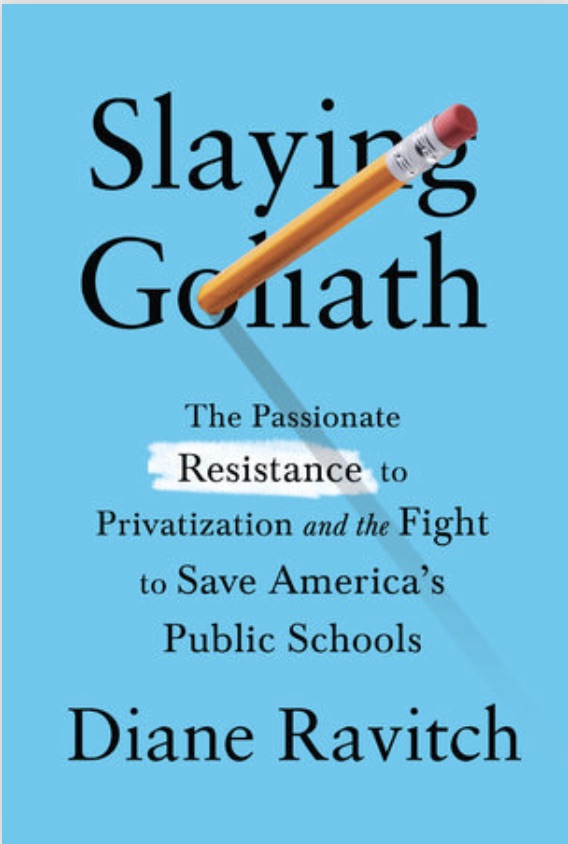
Burris brings to her work the experience of a veteran educator, a teacher and principal who spots scams quickly. Burris also has a rock solid sense of integrity that makes her unwilling to tolerate organizations that are designed to benefit the adults, not the students. She is the quintessential embodiment of the “David” I wrote about in my book SLAYING GOLIATH. She works with passion and dedication because of a sense of mission, not for love of money. She is a mortal threat to the Goliaths who wear the fake mantel of education reform. She can’t be bought and she can’t be stopped. Unlike the hirelings of Goliath, she really does work for the children, for whom she has worked all her life.

The munificently-funded Thomas B. Fordham Institute, based in D.C., controls Educatuon Policy, graduation requirements, curriculum, and testing in Ohio. Mr. Fordham, for whom the institute is named, had no known interest in education, but his namesake is part of the rightwing ALEC nexus, where contempt for public schools, hatred for unions, contempt for gun control and environmental regulation are reflexive.

Laura Chapman, who lives in Ohio, writes:


This numbers game is routinely pushed by the Ohio arm of Thomas B. Fordham Institute/Foundation. Oped’s written by employees at criticize the Fordham routinely criticize teacher unions for pointing out the debilitating affects of poverty on students. In a typical rhetorical move, the Fordham “expert” will find one exceptional school with an “A” rating of the state report card rigged to ensure few schools are rated A. Then when you read in detail, you will see that the most exceptional thing about this school is really rare. The same principal has been there for 18 years, lives in the community, and has an uncommon level of trust from her community, the teachers, and students. Test scores were a byproduct of that not the aim of her work as an educator.

In Ohio, the writer most responsible for this misleading journalism and “research” is Aaron Churchill, the Institute’s Ohio Research Director. The Institute says this: Since 2012, Aaron has worked on “strengthening” Ohio policy on standardized testing and accountability, school evaluation, school funding, educational markets, human-resource policies and charter school sponsorship. He writes for the Fordham’s blog, the Ohio Gadfly Daily and contributes op-eds to the Columbus Dispatch, Cleveland Plain-Dealer, Dayton Daily News, and Cincinnati Enquirer. Aaron previously worked for Junior Achievement.”

He has not an ounce of documented experience in teaching or studies of education as an undergraduate or graduate student. He gets a free pass on almost everything he submits to the Columbus Dispatch, Cleveland Plain-Dealer, Dayton Daily News, and Cincinnati Enquirer. These local newspapers are shrinking and have few if any staff available for questioning this “throughput” of misleading but ready to post news.

This is an extraordinary story, which I hope you will read to the end. It was published by Chalkbeat.

A group of concerned leaders in Detroit, including some retired educators, decided to open a charter school.  They won the endorsement of the city’s leading philanthropies. They won a federal grant from the Charter Schools Program.

The school struggled from the beginning. It struggled initially to attract students, because it was competing with so many other charters for the same students. It took in students from a closing charter, who were far behind. It searched for an educational management company, which drew off a large share of its income.

It housed its students in a closed elementary school, where there was far more space than the charter could use.

There was no shortage of potential authorizers. The sponsors were turned down by one, then found another.

Efforts to regulate charter schools in Michigan have run into fierce political headwinds, in large part because of DeVos and her family, who have used their considerable fortune to support a free market education system that allows charter schools to open wherever they believe they’ll succeed.

DeVos and her allies have been so successful in blocking efforts to regulate charter schools in Michigan that when the founders of Delta Prep began looking for permission to open back in 2012, they had no shortage of options. They could pick from roughly eight colleges and school districts that were empowered to authorize charter schools, some of which would provide more oversight than others. When it finally opened in 2014, Delta Prep was one of more than a dozen schools that opened in Detroit and began competing for the same students.

The problems multiplied. Low enrollment. Discipline problems. A rotating cast of principals, year after year.

Delta officials had promised that “90 percent of students will attend every class, on time, every day.” But in the school’s third year, just 20 percent of students came to class with any regularity.

Officials said they would boost student achievement by borrowing from the playbook of a New York-based education nonprofit. Their goal: “85% of students will demonstrate competency in all core subjects via exit tests.”

But within three years, not a single Delta Prep 11th-grader was deemed proficient in math, compared with 13.2 percent in Detroit’s troubled main district. Just 10 percent of 11th-graders posted passing scores in SAT English, compared with 37 percent in the district.

Delta Prep had promised that “100% of graduates will be accepted to college.” But in 2016, the only year the state recorded graduate data for Delta Prep, just over half of the school’s graduates enrolled in college. Just six students — 10 percent of that first graduating class — went on to complete a year’s worth of college credits within a year of graduating.

If the data was concerning, the situation inside the school was even more dire. When Brandi North was hired as principal in 2017, the first thing she did was hire security. The sprawling school was built during an era when Detroit couldn’t find enough classroom space for all of its students, but now it sat mostly unused, and students tended to disappear into vacant classrooms. Teacher-student relations were antagonistic. North said her assistant principal’s hand was broken during an encounter with a student, and that she regularly contacted the police about student behavior.

The year before she arrived — and the year after the influx of students from recently closed schools — Delta Prep had slapped more than half of its students with out-of-school suspensions, resulting in nearly 1,000 missed days of school.

“In 15 years of education, it was the most stressful position I’ve ever had,” North said. “I worked in south central Los Angeles, and Delta was still my most stressful situation.”

North started at the school in March 2017, after the previous principal resigned and an interim principal decided not to take the job. She says she found tutors for students, brought consistency to a patchwork curriculum, even drove to students’ houses on test day to make sure they took Michigan’s standardized exam. But she left that June following disagreement with the management company that she declined to discuss.

She was not the only administrator unable to cut it at the school. Within a few years of its hopeful start, Delta Prep had become another Detroit school desperate to find the rare principal capable of quarterbacking a long-shot school turnaround. It had five principals in less than five years of operation…

In Detroit’s crowded education landscape, Delta Prep kept falling short of its 400-student target, creating a financial situation so bleak that students lacked textbooks and other basic supplies.

When officials from Ferris State came to check in on the school, they noted that only one-third of its budget was spent on instruction, while far too much went to the management company and other operating costs. Delta Prep’s reserve fund, set aside to protect the school against unforeseen problems, dipped to $217 in 2017-18.

Twenty-two days after the start of school in the fall of 2018, Delta Prep closed its doors, to the shock of students and parents, who suddenly had to find a new school.

In the business world, closings are not uncommon. In the charter world, school closings are not uncommon. Anyone who thinks it is easy to run and manage a school should read this story and think again.

Customers can find another place to shop when a store goes out of business. When a school closes, children, parents, teachers, and families are disrupted.
 

Charter advocates have reacted with astonishment and outrage at the Trump-DeVos decision to fold the federal Charter Schools Program into a block grant to the states, along with 29 other programs. The Trump administration’s goal is to shift federal funding to states and let them decide how to spend the money.

Matt Barnum of Chalkbeat writes the story here, detailing the administration’s rationale and charter advocates’ reaction. 

Jim Blew, formerly of the Walton Family Foundation, which claims to have launched one of every four charters in the nation, brushed off the charter lobbyists: 

“The federal lobbyists for charter schools sound a lot like the lobbyists for all of the other competitive grant programs,” Assistant Secretary Jim Blew told Chalkbeat in a statement. “In their desperate communications, they have exaggerated the importance of CSP — just like other lobbyists,” he added, referring to the Charter Schools Program.

It’s not clear that the program is in real jeopardy, since Congress has previously disregarded the Trump administration’s proposed budgets. But the budget proposal and combative rhetoric suggest that charter advocates do not have as staunch an ally in the administration as they previously believed.

“We are saddened and puzzled by the Department of Education’s comments,” said Nina Rees, president of the National Alliance for Public Charter Schools, which has receivedfederal charter dollars. “We advocate for the federal Charter Schools Program because we believe it is a lifeline for students.”

Rees formerly was education advisor to Vice President Dick Cheney and to entrepreneur MIchael Milken, who engaged in education philanthropy after serving a term in prison for financial crimes.

Strangely, Barnum refers to Democrats for Education Reform (DFER) as “left of center,” which is laughable since they were founded by and funded by hedge fund managers, some of whom are billionaires and may not even be Democrats. DFER’s funding has gone to supporters of school choice, and their beneficiaries show no interest in funding, class size, teachers’ salaries, integration or other issues that matter to progressive Democrats.

It is ironic that the Republican-dominated charter industry will now have to count on Democrats in the House to save the federal Charter Schools Program, which DeVos has used to fatten avaricious corporate charter chains.

The federal CSP has funded a large proportion of the nation’s charter schools, acting like “the Small Business Administration” for charters entrepreneurs, as NPE executive director Carol Burris said recently on Twitter.

Barnum wrote:

A recent presentation from the Department showed the figure was slightly higher: as of 2016, more than 3,100 existing charter had received such a grant, with the program helping to fund close to 45% of all operating charters. (Morabito, the spokesperson, acknowledged the error when asked about it by Chalkbeat.)

For charters that opened between 2006 and 2016, the share was even higher — 60% had received a federal grant.

Studies of the federal Charter Schools Program by the Network for Public Education found that it was riddled with waste, fraud, and abuse. More than 1/3 of the federally funded charters either never opened or closed soon after opening. This is a program that should be eliminated.

What will the Democrats do?


John Thompson, historian and retired teacher in Oklahoma, reviews SLAYING GOLIATH. This is the second part of his review.

This is an excerpt of a long and thoughtful review.

This second post will focus on Ravitch’s analysis of the research which predicted the defeat of accountability-driven, charter-driven policies. Perhaps the most striking pattern documented in Slaying Goliath is how they failed in the way that scholars and practitioners anticipated.

Decades of Disruption-driven reform began with the false claim “that American education was failing and the only way to fix it was with standards, tests, competition, and accountability.” As Arne Duncan’s public relations officer and Walton-funded reformer Peter Cunningham said, “We measure what we treasure.”

Ravitch’s response was, “I was taken aback because I could not imagine how to measure what I treasure: my family, my friends, my pets, my colleagues, my work, the art and books I have collected.” And that foreshadows the victory of the Resistance over Goliath. Most educators, patrons, and students agree that children are more than a test score.

No Child Left Behind and the Race to the Top set impossible test score targets. They were based in large part on the weird idea that “no-excuses” behaviorist pedagogies could be quickly “scaled up,” providing poor children of color a ladder to economic equality. Drawing on the tradition of Edward Thorndike and B.F. Skinner, reformers “rigidly prescribed conditioning via punishments and rewards.” Previewing their fatal flaw, Ravitch observes, “Behaviorists, and the Disrupters who mimic them today, lack appreciation for the value of divergent thinking, and the creative potential of variety. And they emphatically discount mere ‘feelings.’”

When educators resisted, corporate reformers became livid and doubled down on the punitive. Perhaps their worst debacle was using value-added teacher evaluations to hold each individual educator accountable for test score growth. It combined inappropriate test outputs with an unreliable and invalid algorithm, the VAM, as a club to enforce compliance. In the short run, it forced educators, who had previously tried to keep their heads down and “monkey wrench” testing mandates to join patrons and students in the Resistance. By 2018, however, pent up anger exploded as teacher strikes spread across the nation.

Today, many or most of Goliath’s coalition have become disenchanted with standardized testing, but their Disruption model can’t function without it. Few have gone as far as Paymon Rouhanifard, the former Camden superintendent who abolished report cards after listening to complaints, and denounced standardized testing as he left the job.

The more common path is to spin their punitive tests as “personalized” learning, and their incentives and disincentives as the “portfolio model.” As Ravitch explains, “A portfolio district is one where the local board (or some entity operating in its stead) acts like a stockbrokerage, holding onto winners (schools with high test scores) and getting rid of losers (schools with low test scores).”

As was also predicted by Campbell’s Law, test-driven accountability (made more intimidating by the dual threat of test-driven competition with charters) led to corruption. The cheating was far greater than just the scandals where adults erased and changed bubble-in answers. Graduation rates were easy to manipulate. For instance, NPR reported a “heartwarming story” in 2017 about a school with 100% graduation rate. A subsequent FBI investigation and a district audit found 1/3rd of the school’s graduates lacked credits and only 42% were on track to graduation.

And that leads to the corruption associated with school choice. Today’s Disrupters seem to be doubling down on charters to drive transformative change. As explained in a previous post, in 1988 Al Shanker saw charters as a path towards innovation. Within two years, however, the promise of win-win experimentation started to be undermined when conservative reformers Terry Moe and John Chubb claimed “choice is a panacea.”

In this case, it was choice-advocate Paul Peterson who predicted the political future. Charters didn’t take off because of the balanced approach of Shanker, but because reformers “radicalized” the concept. And, of course, there was plenty of big bucks available for pushing their radical but false narrative.

Within a decade, a shocking number of non-educators had been convinced by Goliath’s spinsters that the KIPP’s behaviorist model could be scaled up. As Slaying Goliath explains, “The biggest innovation in the charter sector was the invention of ‘no-excuses’ schools.” It took nearly another decade for policy makers to accept the fact that charters get average results except for those with high attrition.” And it took nearly as long to reveal the much greater down sides of charters…

Regardless of whether we’re discussing high-stakes testing, charter expansion, or the other pet theories, we should all heed Ravitch’s most important lesson of the past few decades is that “Reform doesn’t mean reform. It means mass demoralization, chaos, and turmoil. Disruption does not produce better education.”

Slaying Goliath celebrates a great victory for public education and democracy. However, Ravitch reminds us that the Disrupters are still threatening. She compares today’s danger to that which faced a man who decapitated a rattlesnake but who nearly died after being bitten by the detached head.

So, we can’t lower our guard until the principles that inspired the Resistance are safe in our schools.


Jeff Bryant has written a powerful story that reveals the growing dominance of corporations in schools.

In the expanding effort to privatize the nation’s public education system, an ominous, less-understood strain of the movement is the corporate influence in Career and Technical Education (CTE) that is shaping the K-12 curriculum in local communities.

An apt case study of the growing corporate influence behind CTE is in Virginia, where many parents, teachers and local officials are worried that major corporations including AmazonFord and Cisco—rather than educators and local, democratic governance—are deciding what students learn in local schools.

CTE is a rebranding of what has been traditionally called vocational education or voc-ed, the practice of teaching career and workplace skills in an academic setting. While years ago, that may have included courses in woodworking, auto mechanics, or cosmetology, the new, improved version of CTE has greatly expanded course offerings to many more “high-demand” careers, especially in fields that require knowledge of science, technology, engineering, and math (STEM).

Education policy advocates across the political spectrum, from Education Secretary Betsy DeVos to former First Lady Michelle Obama, have praised expansions of CTE programs in schools. Fast-tracking federal funds for CTE programs in schools has become the new bipartisan darling of education policy. CTE lobbyists and advocates have successfully pressed for expanded funding of their programs at federal and state levels. And a 2019 study by the American Enterprise Institute, a right-wing advocacy group based in Washington, D.C., found that since 2004, mentions of CTE in U.S. media outlets “have grown over tenfold, and they have doubled since 2012.”

According to a September 2019 analysis from Brookings, “more than 7 million secondary school students and nearly 4 million postsecondary students were enrolled in CTE programming.” And a 2018 review of CTE programs by the federal government’s National Center for Education Statistics found 73 percent of school districts offered CTE courses that give students both high school and postsecondary credit, a potential benefit for students and parents who want to reduce the cost of college.

What has folks in Chesterfield County, Virginia, concerned is the particular brand of CTE that has come to their district. At a September 2019 community event, middle school teacher Emma Clark and others mentioned the district’s collaboration with Ford Next Generation Learning (NGL), an offshoot of the Ford Motor Company that claims, according to its website, that it “mobilizes educators, employers, and community leaders to create a new generation of young people who will graduate from high school both college- and career-ready.”

Chesterfield parents I spoke with also pointed to the district’s collaboration with the Cisco Networking Academy, an offshoot of the computer networking giant that has its own branded course offering in the Chesterfield CTE curriculum.

In a phone conversation, Clark described the district’s collaborations with these companies as “new layers” of school privatization. First, corporations like these can use the rush to CTE to flood schools with new course offerings that require technology the schools have to buy. And another layer is the CTE programs businesses help to create provide them with free job training.

The concern Chesterfield teachers and parents have about corporate influence in K-12 public school curricula is magnified enormously due to the entrance of Amazon into the equation.

The “centerpiece” of Virginia’s successful effort to lure Amazon to build a new headquarters in the state, according to state-based news outlets and state-issued reports, was a commitment to more than double Virginia’s tech-talent pipeline, beginning in K-12 schools.

“Virginia’s ultimate proposal was centered around an effort to provide Amazon—or any other tech firm that wanted to come—with all the educated workers it needed,” according to a report in the Washingtonian, and the state sealed the deal with a pledge “to plow $1.1 billion into tech schooling.” The state’s commitment to developing a tech-talent pipeline providing workers for Amazon and other companies was key to inking the deal, says an Amazon spokesperson in the Cincinnati Business Courier.

“We’re being hijacked in Virginia,” Kathryn Flinn explained to me. Flinn is a 20-year resident of Chesterfield and mother of two children, one a special-needs child, who both have attended Chesterfield County Public Schools.

Fred Smith was the testing expert at the New York City Board of Education for many years. After he retired, he became a relentless truth-teller about the flaws of standardized testing and the clever means of distorting the stats to produce the desired results. He currently acts as an unpaid advisor to opt-out parents.

Smith sent this article from 2007 that shows how Mayor Bloomberg and Chancellor Klein played games with the data, in this case blaming “immigrant kids” for a drop in test scores.

Mayor Bloomberg and his schools chancellor, Joel Klein, have reaffirmed that old Mark Twain saying about the three kinds of lies: lies, damn lies and statistics.

Using a PowerPoint presentation filled with glitzy graphs and color charts, Klein reached a new low yesterday by attempting to blame a sharp drop in this year’s third-, fourth- and fifth-grade reading scores on thousands of immigrant pupils.

According to the chancellor, the drop in the lower grade scores was solely because of the federal government’s new requirement that all children classified as English-language learners, or ELLs, must take the regular state tests after being in the country just one year.

Because of that requirement, some 30,000 more ELLs took the state test this year than in 2006, Klein said, and their lower scores dragged down overall city results.

Fred Smith was outraged when he heard Klein’s explanation. Smith, you see, spent three decades analyzing tests for our city’s school system, so he knows a thing or two about how chancellors paint the prettiest picture for the public.

“They never told you that back in 2005, during the mayoral race, the school district quietly increased the number of exemptions for ELL kids and then claimed a record boost in scores,” Smith said.

In 2009, with Bloomberg’s fellow billionaire Meryl Tisch, in charge of the New York Board of Regents, test scores in the city went through the roof. After the mayoral primary election was safely past, the Regents commissioned a report by professors Daniel Koretz and Jennifer Jennings showing that the test questions had become familiar, leading to score inflation, and that the dramatic rise was not real.

Also, in an amusing turn of events, New York City won the Broad award in 2007 as the most improved urban district, right before the NAEP gains were released, showing that the city had made no gains on NAEP.

In 2010, Jennifer Medina of the New York Times wrote about the perils of over reliance on standardized tests and how it affected New York City in particular. 

She wrote:

When New York State made its standardized English and math tests tougher to pass this year, causing proficiency rates to plummet, it said it was relying on a new analysis showing that the tests had become too easy and that score inflation was rampant.

But evidence had been mounting for some time that the state’s tests, which have formed the basis of almost every school reform effort of the past decade, had serious flaws.

The fast rise and even faster fall of New York’s passing rates resulted from the effect of policies, decisions and missed red flags that stretched back more than 10 years and were laid out in correspondence and in interviews with city and state education officials, administrators and testing experts.

The process involved direct warnings from experts that went unheeded by the state, and a city administration that trumpeted gains in student performance despite its own reservations about how reliably the test gauged future student success.

It involved the state’s decision to create short, predictable exams and to release them publicly soon after they were given, making coaching easy and depriving test creators of a key tool: the ability to insert in each test questions for future exams. Next year, for the first time, the tests will not be released publicly.

It involved a national push for numbers-based accountability, begun under President George W. Bush and reinforced by President Obama. And it involved a mayor’s full embrace of testing as he sought to make his mark on the city, and then to get re-elected.

“They just kept upping the stakes with the scores, putting more pressure on the schools but not really looking at what it all means,” said Pedro Noguera, an education professor at New York University who has worked with the city’s Department of Education to help improve struggling schools.

New York has been a national model for how to carry out education reform, so its sudden decline in passing rates may be seen as a cautionary tale. The turnaround has also been a blow to Mayor Michael R. Bloomberg and his chancellor, Joel I. Klein, who despite warnings that a laserlike focus on raising scores could make them less and less reliable, lashed almost every aspect of its school system to them. Schools were graded on how much their scores rose and threatened with being closed if they did not. The scores dictated which students were promoted or left back, and which teachers and principals would receive bonuses.

Even now, the city believes that the way it uses the tests is valid. The mayor and the chancellor have forcefully defended their students’ performance, noting that even after the changes this year, student scores are still better than they were in 2002. They have argued that their students’ progress is more important than the change in the passing rate, and that years of gains cannot be washed away because of a decision in Albany to require more correct answers from every student this year.

The test scores were even used for a new purpose this year: to help determine which teachers should receive tenure.

“This mayor uses data and metrics to determine whether policies are failing or succeeding,” said Howard Wolfson, the deputy mayor for government affairs and communications. He also helped run Mr. Bloomberg’s re-election campaign in 2009, using the city’s historic rise in test scores to make the case for a third term. “We believe that testing is a key factor for determining the success of schools and teachers.”

“Under any standard you look at,” he added, “we have improved the schools.”

But given all the flaws of the test, said Prof. Howard T. Everson of the City University of New York’s Center for Advanced Study in Education, it is hard to tell what those rising scores really meant.

“Teachers began to know what was going to be on the tests,” said Professor Everson, who was a member of a state testing advisory panel and who warned the state in 2008 that it might have a problem with score inflation. “Then you have to wonder, and folks like me wonder, is that real learning or not?”

New Generation of Tests

The problems that plagued New York’s standardized tests can be traced to the origin of the exams.

In 1996, New York set about creating tests for fourth and eighth graders as a way to measure whether schools were doing their jobs. A precursor to the widespread testing brought about by Mr. Bush’s No Child Left Behind law, the tests replaced more basic exams that had been given in the same grades, which simply determined whether students needed remedial instruction. (The city had also given its own tests for many years.)

Teachers pushed back, saying they could gauge their students’ performance better than any mass-produced tests could. “There was a lot of resistance from throughout the education community to having the tests,” said Alan Ray, who was the chief spokesman for the State Education Department in the 1990s and in 2000, and retired this year after overseeing data for the office.

But education officials in New York, and many other states, were coming to the conclusion that some measurement system, no matter how limited, was necessary.

The officials sought advice from dozens of educators across New York to figure out what the tests should encompass, Mr. Ray said. Teachers and principals asked that the standards be specific, to make it clear what they were expected to teach at each grade level, and superintendents pleaded to keep the tests relatively short so that students would not spend days filling in bubbles. The state obliged both requests.

The decision to keep the tests narrow and short — the fifth-grade math test, for example, had 34 questions this year — would have a lasting impact, said Daniel Koretz, a professor at Harvard’s Graduate School of Education who specializes in assessment systems. The same types of questions would be trotted out every year, he said.

“In many cases you could not write an unpredictable question no matter how hard you tried,” Professor Koretz said. He oversaw the study of New York’s tests that led to the state’s conclusion that they had become too easy to pass.

The state also continued making tests public after they were administered. Coupled with the questions’ predictability, the public release of the tests, which started long before the nationwide accountability movement, provided teachers with ready-made practice exams….

A Mayor Chases Results

The state tests’ flaws would not become evident for years. But by 2001, the tests had a champion.

During his first campaign, Mr. Bloomberg said that education was his top priority. He pledged to take control of the city’s public schools, then under the supervision of the Board of Education, which had been ridiculed for budget troubles and stagnant academic performance.

Projecting the image of a bottom-line-oriented, pragmatic businessman, Mr. Bloomberg latched on to test scores as a clear way of seeing just how well students were doing.

“If four years from now reading scores and math scores aren’t significantly better,” Mr. Bloomberg said in a radio interview in 2001, “then I will look in the mirror and say that I have been a failure. I’ve never failed at anything yet, and I don’t plan to fail at that.”

After Mr. Bloomberg persuaded the Legislature to give him control of the schools, he appointed Mr. Klein, a former Justice Department lawyer and media executive, as his chancellor. Mr. Klein was seen as a technocrat who was eager and able to produce tangible results, the kind that could be measured.

Scores in the city and state were on their way up. In 2004, for example, the proportion of fourth graders in the city meeting math standards increased to 68 percent, up 16 percentage points since 2001. Only 42 percent of eighth graders met that mark, but that was still a significant improvement from just a few years earlier. By 2009, that rate would jump nearly 30 points.

“What is encouraging is that for two or three years in a row now, the tests have gone in the same direction — up,” the mayor said on a radio show in October 2004. “So there’s reason to believe we’re headed to the correct place.”

In 2003, Mr. Bloomberg ended the practice of “social promotion” in certain grades, requiring students performing at the lowest levels on the tests be held back unless they attended summer school and showed progress on a retest. That year, Mr. Klein released a list of 200 successful schools, the only places where teachers would not have to follow the citywide math and English curriculums. The list was primarily based on test scores.

More and more of the mayor’s educational initiatives were linked to the scores. They were used to help decide which schools should be closed and replaced with new, smaller schools. The new A-through-F grading system for schools was based primarily on how their students improved on the tests. Teachers and principals earned bonuses of up to $25,000 if their schools’ scores rose. Teachers’ annual evaluations and tenure decisions are partially dependent on test results.

Each new policy was met with denunciations from the teachers’ union or from education experts like Diane Ravitch. Ms. Ravitch, a supporter of standardized testing when she was an adviser to the Clinton and Bush administrations, became one of the biggest critics, arguing that schools were devoting too much time to the pursuit of high scores.

“If they are not learning social studies but their reading scores are going up, they are not getting an education,” Ms. Ravitch said in 2005, as the mayor coasted to re-election.

The mayor and chancellor dismissed these criticisms as the hidebound defenses of an old, failed system devoid of meaningful standards. But some questions were also being raised by people close to the administration.

In the Education Department headquarters on Chambers Street, some officials argued that the A-through-F system of grading schools should incorporate not only the English and math tests, but also the science and social studies exams given by the state. “We wanted to draw this as broadly as possible,” said a former school official who spoke on the condition of anonymity to avoid publicly disagreeing with Mr. Klein.

But after months of running models and tweaking formulas, Mr. Klein decided to stick with the two core subjects. After all, he often argued, if students could not master essential math and English skills, it would be impossible for them to grasp other concepts.

Dr. Noguera, the N.Y.U. education professor and adviser to the city, applauded Mr. Klein for creating a grading system that rewarded improvement from year to year so that schools in poor neighborhoods had the same chance of achieving a good grade as those in wealthier areas.

But it also was risky, Dr. Noguera said. “That got schools fixated on how to raise scores, not looking for more authentic learning,” he said.

Dr. Noguera expressed his views publicly and to some of Mr. Klein’s deputies, but never directly told the chancellor, he said.

Mr. Klein said in recent interviews that while the tests were imperfect, they were still the best measurements available for a school system that previously had no yardsticks. They also were not the only signs proving the city had been making progress, he said: On more difficult federal tests given to a sample of fourth and eighth graders, the city had steadily improved.

And the city’s main goal, he said, was not simply giving out laurels for students’ scoring 3s (“proficient”) and 4s (“advanced”) on the state tests.

Instead, its system of school grades and teacher incentives gave considerable weight to scores that showed improvement from year to year at all levels.

“Nobody else was doing this,” Mr. Klein said. “We never said it was good enough to get to passing and just stay there.”

In 2006, the state added tests for the third, fifth, sixth and seventh grades, in order to align with the requirements of No Child Left Behind. Scores jumped in 2007.

There were improvements at every grade level across the state and in New York City, where 65 percent of all students met state standards in math, an improvement of eight percentage points in one year.

“I’m happy, thrilled — ecstatic, I think, is a better word,” Mr. Bloomberg said at the time. “The hard work going on in our schools is really paying off.”

After Mr. Bloomberg’s first full term as mayor, the new scores seemed to ratify his claims of success. They also raised more alarms.

As a superintendent in the Brownsville section of Brooklyn, Kathleen Cashin had seen several schools improve throughout the early part of the decade. But when she saw the sudden jump, she said, she was shocked.

“I said to my intimate circle of staff, this cannot be possible,” Ms. Cashin recalled. “I knew how much effort and how much planning any little improvement would take, and not all of these schools had done any of it.”

But Ms. Cashin, who retired in February, held her tongue at the time. Asked why she did not take up her concerns with Mr. Klein or his deputies, she said, “I didn’t have their ear.”

A Proposal for a Fix

The following winter, Professor Koretz, of Harvard, and Professor Everson, of CUNY, who was a member of a state testing advisory group, sent a memo to state education officials.

“Research has shown that when educators are pressured to raise scores on conventional achievement tests, some improve instruction, while others turn to inappropriate methods of test preparation that inflate scores,” they wrote in the Feb. 5, 2008, memo. “In some cases, the inflation of scores has been extreme.”

The researchers proposed to devise a kind of audit. While tests tended to be similar from year to year, they would add to each exam some questions that did not resemble those from previous years. If a class performed well on the main section of the test but poorly on the added questions, that would be evidence that scores were inflated by test preparation. If a class performed well on both, the researchers wrote, that teacher might have methods worth emulating.

In addition, they wrote, such a system would give teachers “less incentive to engage in inappropriate test preparation and more incentive to undertake the much harder task of improving instruction.”

State education officials, the professors said, did not give them a hearing.

The 2008 results showed even more large gains — 74 percent of city students were deemed proficient in math, an increase of nine points in one year; and the city’s passing rate in reading was now 58 percent, up from 51 percent two years earlier. Statewide, the passing rates jumped to 81 percent in math and 69 percent in reading.

Professor Koretz and Professor Everson wrote another memo in September 2008, again proposing to create a way to make test results more reliable. But the idea went nowhere….

The city’s Department of Education constantly mines test score data for patterns to show where improvement is happening and where it is needed. In 2008, it noticed an incongruity: Eighth graders who scored at least a 3 on the state math exam had only a 50 percent chance of graduating from high school four years later with a Regents diploma, which requires a student to pass a certain number of tests in various subjects and is considered the minimum qualification for college readiness.

The city realized that the test results were not as reliable as the state was leading people to believe.

Mr. Klein and several of his deputies spoke by phone with Merryl H. Tisch, the vice chancellor of the Board of Regents, and Mr. Mills, trying to persuade them to create a statewide accountability system similar to the city’s, one that gave improvement at least as much weight as the score itself.

The state said it would consider moving to such a system, but would need more time.

Neither the city nor state publicly disclosed the concerns about the scores. By then, students across the state were preparing for the 2009 tests, filling in bubbles on mock answer sheets, using at least three years of previous state tests as guides.

The scores arrived in May, and with them, the bluntest warning yet.

Just before the results were released, a member of the Regents named Betty Rosa called Ms. Tisch, who had recently become chancellor.

Ms. Rosa, who had been a teacher, principal and superintendent in the Bronx for nearly three decades, said the unprecedented high scores simply seemed too good to be true. She suggested the unthinkable: the scores were so unbelievable, she said, that the state should not publicly release them.

“The question was really are we telling the public the truth,” Ms. Rosa said in a recent interview. Ms. Tisch, she said, relayed that she, too, found the scores suspicious, but that it would be impossible to withhold them. “It was like a train that was already in motion and no way to stop it,” Ms. Rosa said.

The English test scores showed 69 percent of city students passing. Mr. Bloomberg called the results “nothing short of amazing and exactly what this country needs.”

“We have improved the test scores in English,” he continued, “and we expect the same results in math in a couple of weeks, every single year for seven years.” Four weeks later, it was announced that 82 percent of city students had passed the math tests.

Because of the widespread improvement in the scores, 84 percent of all public schools received an A in the city’s grading system, something Mr. Klein said he later regretted. This year, the city limited the number of A’s to 25 percent of schools.

The 2009 numbers came out as the mayor was trying to accomplish two goals: to persuade the Legislature to give the mayor control of the schools for another seven years; and to convince city voters that he deserved a third term.

Mr. Bloomberg’s opponent, Comptroller William C. Thompson, had once been president of the Education Board.

“Mike Bloomberg changed that system,” said one of the mayor’s campaign advertisements. “Now, record graduation rates. Test scores up, violence down. So when you compare apples to apples, Thompson offers politics as usual. Mike Bloomberg offers progress.”

In his debates, Mr. Bloomberg hammered home the theme. “If anybody thinks that the schools were better when Bill ran them, they should vote for him,” he said in one face-off. “And if anybody thinks they’re better now, I’d be honored to have their vote.”

Indeed, according to exit polls, 57 percent of those who said education was their primary concern voted for Mr. Bloomberg, who won the election by a five-point margin.

Mr. Wolfson, the deputy mayor and 2009 campaign strategist, said the mayor had no regrets about focusing on the exams as a matter of policy, and during the election.

“What’s the converse?” he said. “The converse is that we don’t test and we have no way of judging success or failure. Either you believe in standards or tests, or you don’t — and life is not like that. There are tests all the time.”

Ms. Tisch, in releasing the 2009 test results, had not heeded Ms. Rosa’s radical request. But the very day she put out the English test results, she began openly acknowledging doubts about the scores, irking the mayor and chancellor, who privately seethed that she was seeking to undermine their success. “As a board, we will ask whether the test is getting harder or easier,” she said.

Although the Regents did not immediately opt to create an entirely new test, Ms. Tisch and David Steiner, the new education commissioner, asked Professor Koretz, who had been rebuffed in previous requests, to analyze the ones that were in use. His conclusion — and that of another researcher, Jennifer L. Jennings — was that the tests had become too easy, and hence the scores were inflated. That led the State Education Department to raise the number of correct answers required to pass each test.

The state intends to rewrite future tests to encompass a broader range of material, and will stop publicly releasing them.

“We came in here saying we have to stop lying to our kids,” Ms. Tisch said in a recent interview. “We have to be able to know what they do and do not know.”

Bloomberg was first elected to the mayoralty in 2001. There was a two-term limit. He ran again in 2005, for what should have been his second and last term, and won easily. In 2009, he used his vast resources to persuade the City Council to vote to give him and themselves a third term. And that he is how he qualified to run for a third term and used his education record as a reason to be re-elected.
Now, after all this investment in testing, test prep, interim assessments, etc. what were the results?
New York City has shown no gains in reading on NAEP from 2003-2019, in either fourth or eighth grades.
Make of it what you will.
If Bloomberg is the Democratic candidate against Trump, I will vote for him.
But please don’t believe the boasting about the New York City education miracle.
It never happened.
An update on some of the individuals mentioned in the New York Times’ 2010 article. Betty Rosa is now Chancellor of the State Board of Regents. Kathleen Cashin is a member of the Board of Regents. Meryl Tisch is now on the board of the State University of New York (which has the power to authorize new charter schools, including those of Eva Moskowitz’s Success Academy chain). David Steiner–now a professor at Johns Hopkins University– served for two years as State Commissioner, during which time he approved Mayor Bloomberg’s choice to succeed Joel Klein as NYC Chancellor, a retired magazine publisher named Cathie Black, who lasted three months. Steiner was also in charge of the State Education Department when it won a Race to the Top grant and committed the state to using student test scores to evaluate teachers, increasing the number of charter schools, and adopting the Common Core standards. These changes, in turn, created the parent-led Opt Out movement, in which parents refused to let their children take the state tests and grew to represent 20% of the eligible students. John King succeeded David Steiner and eventually replaced Arne Duncan in the last year of President Obama’s second term. When Joel Klein stepped down, he hired a Department of Education vendor named Wireless Generation and created a technology company called Amplify. Rupert Murdoch bought Amplify and invested a reputed $1 billion; newspaper stories predicted that Amplify would usher in a new age of hardware and software. However, the biggest sale of Amplify tablets and software was made to Guilford, North Carolina, purchased with Race to the Top funding; it turned into  a disaster when chargers melted and other problems emerged. Guilford canceled the contract. Murdoch, having lost about $500 million, put the company up for sale. Laurene Powell Jobs bought it, and Amplify is now part of her Emerson Collective, selling “personalized learning.” Klein works for an online healthcare company called OSCAR, co-founded by Joshua Kushner, brother of Jared Kushner.

The controversy over the Common Core standards has died down since so many states have renamed and rebranded them as if they no longer exist. But below the eye of public attention, Common Core does what it was intended to do: It has created a marketplace for vendors. 

Alex Harwin, in her update of the marketplace, writes that more than two-thirds of district leaders say they are still buying CCSS products.

This is a good time to recall that Arne Duncan’s chief of staff Joanne Weiss wrote in the Harvard Business Review blog that building a national marketplace for vendors was one of the central goals of CCSS:

Technological innovation in education need not stay forever young. And one important change in the market for education technology is likely to accelerate its maturation markedly within the next several years. For the first time, 42 states and the District of Columbia have adopted rigorous common standards, and 44 states are working together in two consortia to create a new generation of assessments that will genuinely assess college and career-readiness.

The development of common standards and shared assessments radically alters the market for innovation in curriculum development, professional development, and formative assessments. Previously, these markets operated on a state-by-state basis, and often on a district-by-district basis. But the adoption of common standards and shared assessments means that education entrepreneurs will enjoy national markets where the best products can be taken to scale.

In this new market, it will make sense for teachers in different regions to share curriculum materials and formative assessments. It will make sense for researchers to mine data to learn which materials and teaching strategies are effective for which students – and then feed that information back to students, teachers, and parents.

If we can match highly-effective educators with great entrepreneurs and if we can direct smart capital toward these projects, the market for technological innovation might just spurt from infancy into adolescence. That maturation would finally bring millions of America’s students the much-touted yet much-delayed benefits of the technology revolution in education.

Weiss previously ran Duncan’s Race to the Top program, and before that, was CEO of NewSchools Venture Fund, which raises money for charter schools.