Archives for category: Discipline

Three law professors studied the discipline codes at Philadelphia charter schools and concluded that these punitive codes are used to push out students who are “non-compliant or challenging.”


The article, which will be published in “The Urban Lawyer,” was written by Susan DeJarnatt,  Temple University – James E. Beasley School of Law; Kerrin C. Wolf, Stockton University; and Mary Kate Kalinich, Temple University – James E. Beasley School of Law.


The authors found that: 38% of the Philadelphia charter school codes use the phrase “zero tolerance,” 74% specify offenses for which suspension is mandatory, and 38% of the charter codes mandate expulsion for certain offenses. Approximately three-quarters of charter schools have no-excuses policies in their codes. They learned that a student may be expelled “for repeated failures to recite the school pledge on demand in English by November of the 9th grade year and in Latin by the end of the 10th grade year, for having missing homework, and for failure to upgrade a failed test.” (p. 41) They found that students may be expelled for “failure to disclose on the application that a student is a currently enrolled special education student” (p. 41). One code permits expulsion for “inappropriate facial gestures” (p. 42)


You can read the article in full. Here is the abstract.
Exclusionary school discipline can steer students away from educational opportunities and towards the juvenile and criminal justice systems. As many public school systems have turned to exclusionary school discipline practices over the past two decades, they have also increasingly adopted charter schools as alternatives to traditional public schools. This research is examines the student codes of conduct for the charter schools in the School District of Philadelphia to consider the role of their disciplinary practices and the potential effects on charter students.


We analyzed every disciplinary code provided to the Philadelphia School District by charter schools within Philadelphia during the 2014-2015 school year. Our goal was to examine the provisions relating to detention, suspension, and expulsion, along with other disciplinary responses, to determine what conduct can result in disciplinary consequences, what responses are available for various types of misbehavior, and whether the code language is clear or ambiguous or even accessible to students or potential students and their parents or caregivers. We conclude that too many of the codes are not well drafted, and too many follow models of punitive discipline that can be used to push out non-compliant or challenging students. Some codes grant almost complete discretion to school administrators to impose punitive discipline for any behavior the administrator deems problematic.


We hope that this work will spur future research on implementation of charter school discipline policies to illustrate how charter schools are using their codes. Further, we hope to see the charter sector develop model disciplinary codes that move away from a zero tolerance punitive model towards disciplinary systems based on restorative principles.


The question it implicitly poses for the reader is why it makes sense to run two public-funded school systems: one that accepts all students, the other with the power to exclude or expel those it doesn’t want. This question has strong pertinence in Philadelphia where the public school system has been stripped of funding and resources over the past decade, so that the two systems are separate and unequal.


Kenya Downs interviews Professor Christopher Emdin of Teachers College, Columbia University, about his new book, called “For White Folks Who Teach in the Hood … and the Rest of Y’all Too.” 


Downs writes:


“There’s a teacher right now in urban America who’s going to teach for exactly two years and he’s going to leave believing that these young people can’t be saved,” says Dr. Chris Emdin, associate professor at Columbia University’s Teachers College. “So he’s going to find another career as a lawyer, get a job in the Department of Education or start a charter school network, all based on a notion about these urban youth that is flawed. And we’re going to end up in the same cycle of dysfunction that we have right now. Something’s got to give.”


Emdin, who is also the university’s associate director of the Institute for Urban and Minority Education, has had enough of what he calls a pervasive narrative in urban education: a savior complex that gives mostly white teachers in minority and urban communities a false sense of saving kids.


“The narrative itself, it exotic-izes youth and positions them as automatically broken,” he says. “It falsely positions the teacher, oftentimes a white teacher, as hero.”


He criticizes the “white hero teacher” concept as an archaic approach that sets up teachers to fail and further marginalizes poor and minority children in urban centers. In “For White Folks Who Teach in the Hood … and the Rest of Y’all Too,” his new book released this month, Emdin draws parallels between current urban educational models and Native American schools of the past that measured success by how well students adapted to forced assimilation. Instead, he calls for a new approach to urban education that trains teachers to value the unique realities of minority children, incorporating their culture into classroom instruction. I talked with him about the book and why he says the stakes are too high to continue with the status quo.


Emdin says:


I think framing this hero teacher narrative, particularly for folks who are not from these communities, is problematic. The model of a hero going to save this savage other is a piece of a narrative that we can trace back to colonialism; it isn’t just relegated to teaching and learning. It’s a historical narrative and that’s why it still exists because, in many ways, it is part of the bones of America. It is part of the structure of this country. And unless we come to grips with the fact that even in our collective American history that’s problematic, we’re going to keep reinforcing it. Not only are we setting the kids up to fail and the educators up to fail, but most importantly, we are creating a societal model that positions young people as unable to be saved.


I always ask my teachers why do they want to teach and I can tell by their responses how closely the white savior narrative is imbued in who they are or who they want to be. I always say, if you’re coming into a place to save somebody then you’ve already lost because young people don’t need saving. They have brilliance, it’s just on their own terms. Once we get the narrative shifted then every teacher can be effective, including white folks who teach in the hood.


Downs asks “What are the risks of continuing urban education as is?”


Emdin replies:


The repercussions are around us every day from criminal justice to engagement with the political process, to higher incarceration rates and low graduation rates. The outcomes are right in our faces today. I’m not absolving communities from blame or parents from blame. But we know that schools that have more zero tolerance policies, youth are more likely to get involved with the criminal justice system. We know that schools that have these hyper rigorous approaches to pedagogy, youth are less likely to take advanced placement classes. So the place where the magic should happen is inside the classroom.


It’s not a tale of doom and gloom. I’m simply saying this is why it’s bad but there’s a way forward. And the way forward doesn’t cost a million dollars! It doesn’t require you to give an iPad to every kid in the school district or a $3 million grant. It’s free! Teaching differently is free. Going into the communities and finding out how to do things better is free, man! It’s not an issue of finance or an issue of wealth. It’s an issue of identifying that what we’ve been doing before just ain’t working.


This should be an April Fools’ Day joke, but it is not.


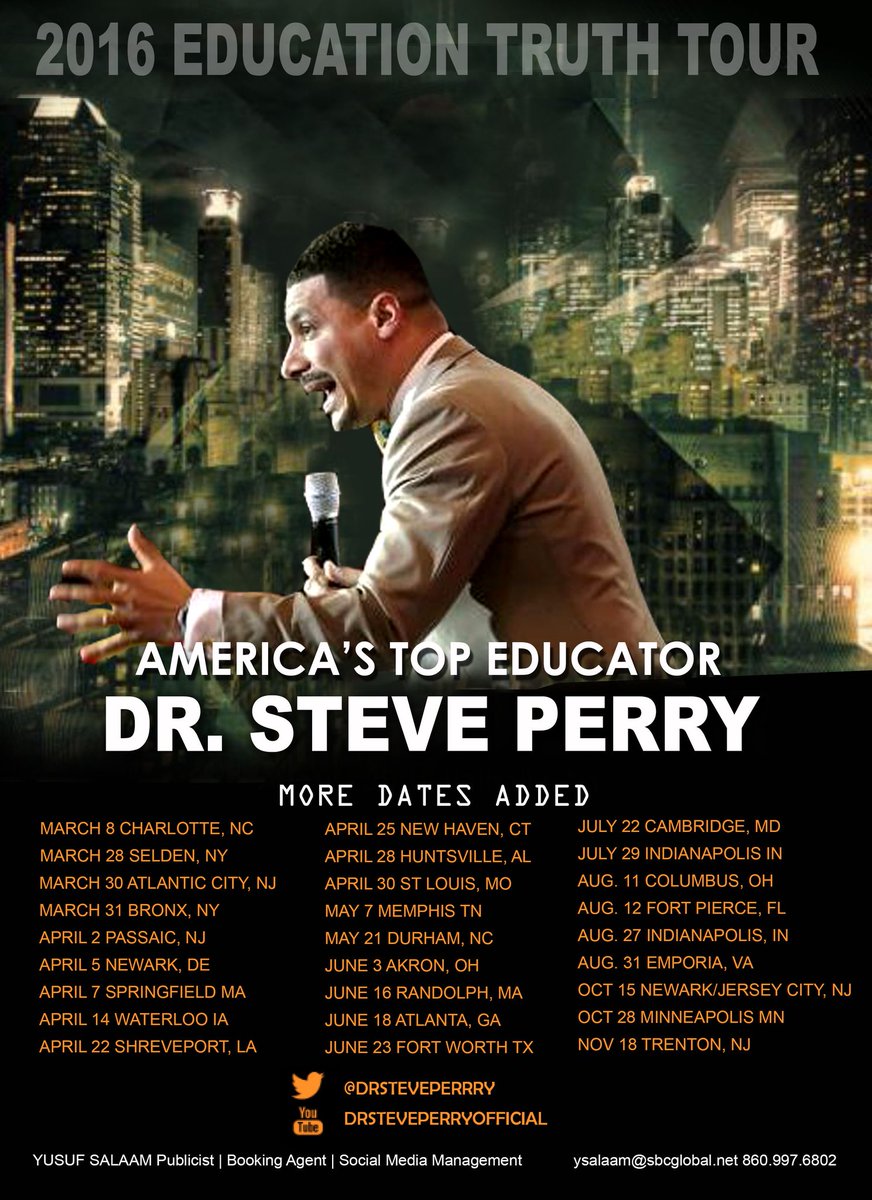
Rapper Sean (Puff Daddy) Combs is sponsoring a charter school in Harlem that will be run by the notorious Dr. Steve Perry of Hartford, Connecticut.


Perry bills himself as “America’s Most Trusted Educator.” His magnet school in Hartford was known for its harsh discipline. Perry became known for his contempt for teachers and unions. He once publicly referred to union teachers as “roaches.”


Perry has an intense lecturing schedule, including a few dates next fall after his charter school opens.


As Jonathan Pelto writes, Perry had quite a reputation in Hartford and beyond:


“Perry gained national notoriety for his school’s harsh disciplinary policies that included the use of the “Table of Shame” to punish children who received demerits and for his ugly public comments about unions, teachers and anyone who opposed his empire building efforts.


“As a 2013 Wait, What? post entitled, Hey Steve Perry – Tell us about Capital Prep’s “Table of Shame,” explained:


“Located in the cafeteria of the Capital Preparatory Magnet School at 1304 Main Street in Hartford, Connecticut is the “Table of Shame.”


“As part of Capital Prep Principal Steve Perry’s “zero-tolerance” policies even the slightest “violations,” such as wearing the wrong colored belt, will result in punishments designed to humiliate and demean students.


“For example, it is not uncommon for Capital Prep students to be forced to stand in the cafeteria to eat as punishment for violating the school uniform policy or some equally unimportant “violation.”


“And now, more than a half a dozen former and present parents, students and teachers report that Perry and his fellow Capital Prep administrators regularly require children, even the youngest students in the building, to sit at the cafeteria’s “Table of Shame.”


And yes… it is actually referred to as the “Table of Shame.”


Along with the charges of abusive disciplinary practices and questionable financial activities – According to federal and state documents, Steve Perry registered his private charter school management company at the address of the Hartford public school at which he worked – Perry’s unwillingness to provide federally required educational services to children with special needs led to a sweeping investigation and follow-up action.


As a Hartford school administrator, Perry was also unwilling or unable to recruit and retain students who were English Language Learners despite more than 50 percent of Hartford’s students being Latino.


Where Perry goes, controversy follows.


Elizabeth Green of Chalkbeat discusses the arguments for and against “no excuses” charter schools like Success Academy, KIPP, and Achievement First.


She begins with the example of the video in which a first grade teacher at a Success Academy charter chastises a child, sends her to the “calm down”corner, and rips her paper in half.


Green acknowledges that there are charters where harsh discipline is common practice.


She reviews the critics’  view that such punitive discipline is unnecessarily humiliating and that it is fundamentally racist. The children are likely to explode or have psychological melt downs in response to strict control.


Those who defend “no excuses” discipline say that it teaches children appropriate behavior and self-control. Far from being racist, they believe they are rescuing poor children from a life of poverty, gangs, and drugs.


Is the “no excuses” regime an exercise in colonialism or is it the path to liberation? Can the demand for strict conformity produce people who are capable of initiative and self-reliance?


What do you think?


PS: Schools Matter dismissed Green as a shill for the corporate reform movement. I didn’t see this critique until after I posted.

In an article in The Nation, George Joseph notes a curious phenomenon: the reports of violent and disruptive behavior are increasing at double the rate in charter schools in New York City, as compared to public schools.


The irony is that this is happening at the same time that the billionaire-backed Families for Excellent Schools has unleashed a social media campaign aimed at discrediting Mayor Bill de Blasio’s efforts to reduce harsh discipline in the public schools. Joseph’s article includes several tweets from FES, calling attention to disorder in the public schools. He surmises that FES–a major backer of Eva Moskowitz’s Success Academy charter chain–is trying to divert attention from the embarrassing video of a SA teacher humiliating a child.


Joseph interviews a retired professional who observed both types of schools in a building co-located with a charter:


Brenda Shufelt, a recently retired librarian who served public school and Success Academy Charter School students at a colocated school library in Harlem, said that as charter schools rapidly expand, they may be taking in more high-needs kids, many of whom cannot conform to one-size-fits-all disciplinary approaches.


“In my experience, what would often happen is that charter school students would be so rigidly controlled that the kids would periodically blow up,” says Shufelt. “At PS 30, some of our kids would have meltdowns, usually because of problems at home, but I never saw kids melt down in the way they did in charter schools. They were just so despairing, feeling like they could not do this. I was told by two custodians, they had never had so much vomit to clean up from kindergarten and elementary classes.”

Today is the birthday of Paul Thomas’ daughter. In his home, there were a few ironclad rules. No physical intimidation of children, no racism, no tolerance for violence against others.


Our society seems evens to be rushing backwards in its regard for other human beings. Yesterday I saw a member of the audience at a Trump rally punch a young black protestor in the face. Maybe if the guy had grown up in a home like Paul’s, he would have stopped himself.  What did his parents teach him, by word and deed?

Dave Powell is a former high school teacher, now a professor at Gettysburg College in Pennsylvania. He blogs at Education Week, where he pondered whether Eva Moskowitz is the Richard Nixon of education. The reason he asked this question is because John Merrow raised that very same question and speculated that Eva Moskowitz would be the first reformer to recognize the damage done by standardized testing. This would be the “Nixon-to-China” moment where a prominent figure persuades the public to abandon their long-held but erroneous views.


He writes:


Merrow’s analogy depends on the idea that someone who really, truly believes in the power of standardized testing will suddenly see the error of his or her ways and understand that the arts and humanities matter too, and that everything can’t be tested. This person will then lead us to a new promised land where tests are used appropriately to measure real student learning. Merrow even says he once thought he knew who this person would be: it was Eva Moskowitz, the founder and “CEO” of Success Academies, a network of 34 charter schools serving some 11,000 students in New York City. But then he, himself, saw the light.


Very much to his credit (this is an example of the kind of thing that makes Merrow so estimable), Merrow realized that Moskowitz would not be the “Nixon of Public Education” after he conducted his own investigation of the way Moskowitz’s schools are run. He found, as many of us now know, that Success Academy Charter Schools have been the site of a couple of wince-inducing “scandals” recently. In one, a principal was found to have created a “Got to Go” list of students he wanted to get off his school’s rolls and exile to the island of misfit toys. The other one came to light recently when the New York Times shared a video showing a teacher reacting with disappointment when a student failed to give the answer she wanted to hear. Go ahead; watch the video yourself if you haven’t already….


Merrow could not have been more wrong about Moskowitz when he was pining for her to be the “Nixon of Public Education.” He should have understood that her “no excuses” philosophy depends entirely on standardized tests for validation. The tests provide the only frame of reference for “no excuses” reformers who would rather oversimplify the act of teaching in pursuit of a single-minded goal than actually address the enormously complex political, social, and cultural challenges of teaching. If they acknowledged this complexity they’d have to admit that the system they oppose isn’t as corrupt as they want to believe it is—they’d have to concede that just maybe there are good people working in our schools who want what’s best for kids too but realize that it’s not as easy to accomplish that as they’d like it to be. And so they struggle. That’s not an excuse, it’s an explanation.


Expect more of this, America. As long as we keep trying to make heroes out of people who repackage intimidation and arrogance as innovation we’ll continue to read stories like these. Reformers like Eva Moskowitz fancy themselves as truth-telling crusaders for kids, in much the same way Michelle Rhee used to. They see themselves standing up to entrenched bureaucracies and ineffectual parents and teachers who want to coddle kids instead of helping them (forcing them?) to meet their potential. They may have a point, but having a point doesn’t justify creating a culture that, as one former Success Academy teacher put it, sends the message that “If you’ve made them cry you’ve succeeded in getting your point across.”


Actually, now that I think of it, maybe Merrow was right. Threats, intimidation, arrogance—maybe Moskowitz is the new Nixon after all.

The mother of the girl in the infamous Success Academy video told the New York Times that she withdrew her daughter as soon as she saw the video. 


“In two lengthy interviews, she said that she did not know what was happening in her daughter’s classroom before she saw the video. She said that she was so upset by what she saw — and by the network’s rush to rally around Ms. Dial, while showing little concern for her daughter or other students — that she took the girl out of the school in late January.”

Jan Resseger, a social justice activist in Cleveland, reminds us that “no excuses” schools are not a new idea. There is nothing innovative about harsh discipline. If you want to read about them in the 19th century, read Charles Dickens.


She writes:


“I am a great fan of the later novels of Charles Dickens—Bleak House, Great Expectations and Our Mutual Friend, but 40 years ago, when I read Hard Times, the fable seemed so overdone as to be far-fetched. When I picked up this 1854 novel again last week, however, I discovered that these days, its critique seems hardly over the top at all. Hard Times is Dickens’ critique of inequality in a mid-19th century English mill town, of authoritarian schools that drill utilitarian economic theory, and of the social Darwinist ethic that celebrates the individual and the success of the self-made man. Bounderby, Dickens’ bullying One Percenter, like Donald Trump, creates a fictitious story of a humble origin as a means of promoting the myth of his rise on his own merits. And Thomas Gradgrind, the proprietor of the novel’s school, prefigures his modern counterpart, Eva Moskowitz….


“Dickens’ second chapter, titled “Murdering the Innocents,” begins with a definition of utilitarian education, the children described as “little pitchers… who were to be filled so full of facts.” Never mind their hearts. “Thomas Gradgrind, sir. A man of realities. A man of facts and calculations. A man who proceeds upon the principle that two and two are four, and nothing over, and who is not to be talked into allowing for anything over… With a rule and a pair of scales, and the multiplication table always in his pocket, sir, ready to weigh and measure any parcel of human nature, and tell you exactly what it comes to. It is a mere question of figures, a case of simple arithmetic… Indeed… he seemed a kind of cannon loaded to the muzzle with facts, and prepared to blow them clean out of the regions of childhood at one discharge. He seemed a galvanizing apparatus, too, charged with a grim mechanical substitute for the tender young imaginations that were to be stormed.”


When you read this, you may be reminded of the developer of the Success Academy methodology, who said his goal was to turn the children into “little test-taking machines.” He succeeded.


The video of a teacher at Success Academy humiliating a first-grade student for failing to write the correct answer went viral. Scores of blogs around the world posted the video.


How did reformers react to the dilemma of their superstar?


Derrell Bradford defended Eva and agreed with her that the event was an insignificant anomaly. He is a member of her board and leader of NYCan. Before that, he led NJ4Kids on behalf of two billionaires. He agreed with Eva that her critics are “haters” who are jealous of her success.


Bradford wrote on Campbell Brown’s blog (Brown is also a member of the Success Academy board)


“So for all the Success haters out there I have some advice. If you want Success, or other “no excuses” schools to go away because you think your own brand of education is superior, because you don’t respect that other parents like it and seek it out, you don’t value the structure, or you want your kid to be a grass-fed open-range child, then you just have to, counterintuitively, do one thing: open more charter schools.”


But another reformer broke ranks. RiShawn Biddle wrote in his blog that it was no longer possible to defend Eva.


He reviews the numerous examples of the harsh disciplinary methods of SA, then concludes:


“The most-damning evidence that Dial’s misbehavior is no anomaly became clear last October when Moskowitz released the school discipline record of one of the operators former students, the son of Fatima Geidi, a parent interviewed by Merrow for his report on Success, as part of the operator’s crisis management campaign against the piece. By doing this, Moskowitz likely violate the Family Educational Rights and Privacy Act, the federal law that governs the privacy of student records, which bars Success from releasing discipline records without the permission of families. Even worse, by citing the discipline record of Geidi’s son, Moskowitz betrayed the school reform movement’s mission of nurturing and protecting the lives and futures of children. She used the life of a child who may be in need of real help as ammunition against a negative media report.

 
“But again, this is nothing new. Over the past five months, Moskowitz has shown that she will always choose to preserve the institution she founded over being a champion for children and their families. In that time, she has shown that she is more-willing to protect the teachers and school leaders that work for Success than be defenders of the young lives who sit in its classrooms. And over and over again, like a traditionalist superintendent in a failing district, Moskowitz has demonstrated that she will explain away any incident as an “anomaly” instead of acknowledging that there may be some deep-seated issues within the institution and its model of educational practice.

 
“At a certain point, either Moskowitz or Success Academy’s star-studded board, must acknowledge that when the institution has several incidents of educational malpractice, they are no longer anomalies. They represent the norm for the institution itself. Success Academy no longer merits a defense, especially from school reformers who, like Born-Again Christians, know better and should no longer tolerate its malpractice.”
Biddle is a reformer with principles.