Archives for category: Corporate Reformers

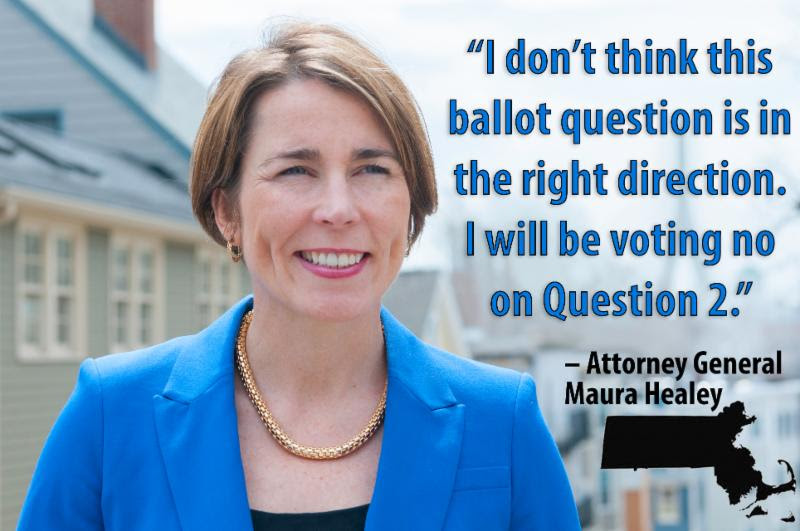
Maura Healey, the Attorney General of Massachusetts, has come out in opposition to Question 2, which would lift the cap on charter schools. Another dozen charter schools would be authorized every year indefinitely. Out-of-State billionaires, including the Waltons of Arkansas, have contributed millions of dollars to privatize public schools in Massachusetts.

I received this email the other day:

cps1

We Have the People, They Have (more and more dark) $$! 

cps2

Dear Diane,
And what excellent people we have! People like youand Attorney General Maura Healey, who has joined Senator Elizabeth Warren and the ever growing movement to protect public education for ALL students.
“If you say the money follows the student and then you don’t actually reimburse the district – then that’s a problem.” – Attorney General Maura Healey
cps3
And in other encouraging news, the Boston and Newton School Committees passed No on 2 resolutions this week, and our total has reached more than164 school committees statewide, including urban and suburban districts.
It’s time to stand up to the out-of-state billionaires and show them what a real grassroots campaign looks like, because when we fight, we win!
There have been countless great commentaries and letters to the editor from our No on 2 grassroots, but I wanted to highlight this commentary by Boston University Professor of Social Studies Education Christopher Martell. Clickhere to read his five thoughtful and clearly presented reasons to vote no.
And don’t miss EduShyster on this week’s big court ruling for keeping the cap and against the folks who argued that lifting the cap is a civil rights issue.
We have victory in our sights thanks to the hard work of people like you, people out knocking on doors, making calls and talking to everyone you know!
Sign up for a canvass shift this Saturday, Oct. 8 near you:
Boston – 10:00 AM
Almont Park
40 Almont St.
Mattapan
Brighton – 3:00 PM
Ronan’s Deli
243 Faneuil St.
Brookline – 1:00 PM
Also Sunday, 11:30 AM
Dunkin’ Donuts
1955 Beacon St., Cleveland Circle
Fall River – 10:30 AM
Fall River Educators Association
178 4th St.
Haverhill – 3:00 PM
Haverhill High School
Parking Lot A
Lowell – 4:00 PM
Riley School
115 Douglas Rd.
Northampton – 10:30 AM
Potpourri Plaza
243 King St.
Norwood – 2:00 PM
Norwood High School
Pittsfield – 2:00 PM
188 East St.
Quincy – 9:30 AM
MTA Office
Worcester – 3:00 PM
16 Alden St.
Click here to see a full list of all neighborhood canvasses. Question 2 is bad for our schools, and it’s time we stand up united to vote NO.
To get in touch with the Save Our Public Schools campaign and learn how to plug in to this important movement, click here.
Best,
Lisa Guisbond and Ann O’Halloran
CPS Executive Director and President
P.S. Click HERE to help CPS continue to inform the public on education issues, including charter schools, high-stakes testing and full funding of our public schools. 

UPDATE: Marc Kenen, the executive director of the Massachusetts Charter School Association and also the author of ballot Question 2, which would expand the number of charter schools in the state, has written to say that this post is untrue. I have no way of knowing who “Nat Morton” is since he or she will not reveal his/her identity. “Nat Morton” is a passionate advocate for charter schools who posted comments here frequently. If Marc Kenen is not “Nat Morton,” I apologize. Someone writes a blog and calls him/herself “Nat Morton,” and I implore that person to give their true name so readers can judge their credentials and their authenticity. I will also ask Marc Kenen to stop writing insulting comments to this blog, as such comments are not permitted.

Knowing this background: I leave the original post intact but warn readers that the identity of “Nat Morton” is unknown, and I can’t be certain who he/she is, other than that it is not me. Beyond that, I can’t know until “Nat Morton” removes his/her mask.

The original post began here:

Reader Christine Langhoff in Massachusetts sent the following comment about a blogger who has frequently written on this blog to defend charter schools, support Question 2 to permit more of them, and to flout his superior research abilities.

“A Boston parent, exchanging emails with (G)Nat Morton, received a digital file from Gnat in support of his arguments. But he forgot to use his nom de plume, and revealed himself as Marc Kenen, executive Director of the MA Charter School Association and also the author of ballot Question 2.

http://www.masscharterschools.org/about-us/staff

“Kenen has not denied that Nat Morton is his avatar. Further, Stephen B. Ronan is the only person I have ever seen refer to Nat Morton’s blog, and in any forum where the one appears,the other is apt to chime in. This leads me to conclude that Kenen is Gnat is Ronan.

“I find it difficult to enage seriously with someone who would defund our excellent public schools when he is not even willing to own his perspective publicly by using his own name as he advances the cause of the privatizers. And if there’s any question whether the ballot question is designed to defund our schools, it’s worth noting that Boston City Councilor Tito Jackson made this point in the Askwith Forum at Harvard on Sept. 27 regarding Question 2. He asked Kenen directly why he had not written a funding mechanism into the proposal. Start at 1:12:00 (It’s apparent in the video that Kenen bears more than a passing resemblance to his Nat Morton avatar.)

https://youtu.be/XCsZZ-J7mcU

https://gseweb.harvard.edu/news/16/09/more-charter-schools-massachusetts-vote-and-national-debate”

So there you have it: the leading advocate of Question 2 (more charters) pretends to be an independent researcher but is in fact a paid employee of the state charter association. Why not give your name and affiliation and let people make their own judgment? This is redolent of the charter movement itself, which pretends to be about helping poor kids but attracts funding from Wall Street, right wing politicians, and others whose real goal is privatization, not helping improve schools for all children.

Our national goal is equal educational opportunity, not a free-market of winners and losers. Privatization does not advance equal educational opportunity. It exacerbates inequality, just like any free market.

Larry Lee is one of the staunchest supporters of public schools in Alabama. A few years ago, he criss-crossed the state and identified 10 rural schools that were doing everyday miracles for their children and their communities because of the hard work and dedication of teachers, principals, and families, all doing their best for their children.

He sent me the following urgent message:

These are dark days for public education in Alabama. Since the legislature changed hands in 2010, things have gone steadily downhill.

Take a look:

* A bill to have A-F school grades, a practice intended solely to be punitive and a practice that research does not support.

* The Alabama Accountability Act that has now diverted $72 million from the Education Trust Fund for vouchers for private schools. A law that failed utterly in its stated mission to “help; poor students stuck in failing schools by their zip code.

* A bill to establish charter schools which cuts into already under-funded public schools funding.

* A bill known as the RAISE Act that would have forced teachers to be evaluated with the highly controversial Value Added Model.

* A bill intended to set up Education Savings Accounts that would have diverted more funding from the Education Trust Fund.

Instead of seeking input from professional educators, legislators are listening to the American Legislative Exchange Council (ALEC), the Jeb Bush foundations and Alabama special interests. In fact, the Senate majority leader boasted after passing the Accountability Act in 2013 that this bill was purposely hidden from educators because “they would have opposed it.”

Now, to add insult to injury the state board of education, the body that should be the first line of defense for public education, has turned its back on our children by hiring an attorney from Massachusetts to be state school superintendent. They ignored Alabama code and even their advertised required qualifications and put their own ideology and political ambitions ahead of the 740,000 children in Alabama public schools

Because of this, a group of 40 plaintiffs, including former local superintendents, principals, teachers, school board members, parents, local elected officials, a former college president and a former U.S. Congressman have joined together to seek legal action against the state school board.

They have said ENOUGH IS ENOUGH and formed the Alabama Public School Defense Fund to wage this battle.

Please join in standing up for our children by going to this site and contributing today.

https://www.gofundme.com/2t2r6mpy


Larry Lee
334-787-0410

http://www.larryeducation.com (blog)

Education Is Everyone’s Business

Governor Nathan Deal of Georgia is pushing a constitutional amendment to allow the state to take over low-scoring public schools. He calls it an “opportunity school district” and points to New Orleans and the Tennessee Achievement School Districts as models. He brought called together a group of African-American ministers and asked for their support.

Here is the response from one of the attendees, who knew that neither New Orleans or the Tennessee ASD had helped the neediest students. Governor Deal couldn’t answer his questions, because the ALEC model legislation doesn’t explain why cessation of democracy helps schools or what to do after privatizing the schools and giving them to corporations.

Here is the report by Rev. Chester Ellis:

Governor’s Ministers Summoning Meeting was a School Takeover Sales Pitch
By Rev. Chester Ellis 912-257-2394
Pastor of St. Paul Missionary Baptist Church in Savannah, Georgia

Governor Nathan Deal is working hard to sell the voters on what he calls an Opportunity School District. But this is an opportunity that Georgia should not take.

Recently, The Governor made a pitch to twenty-nine African American ministers in the basement of the mansion. No media was present. But I was one of those ministers.

If Amendment One was about education and opportunity for our communities and children, we could at least hold a logical discussion about evidence-based solutions. As a retired educator and community activist, it is very clear to me that his Opportunity School District is not about education or the community. He has no plan or roadmap to improve schools.

Gov. Deal was looking for our support. He stated, “I need your help.” But we left with more questions than we had answers. It truly is a takeover, and one whose extent is clear to very few voters.

I was disappointed. I thought the Governor would be able to lay out his plan in detail to us. But, what I got from the Governor is he’s making it up as he goes. There’s really no plan. At best, it was guesswork.

Bishop Marvin L. Winans, who has a charter school in Detroit, was the first to speak to us. Brother Winans is a minister and an award winning Gospel singer. He does not live in Georgia. Marvin talked about why he had established his school in Detroit and why he thought it was a good idea that the Governor was willing to do something to help failing schools. But we didn’t have a chance to dialog with him, ask questions or shed light on anything here in Georgia for him. He left for a concert, almost as quickly as he appeared!

Afterwards, the Governor followed with a spiel about why he thought he needed to take over the schools and why the Black clergymen needed to be in support of Amendment 1, The Opportunity School District. He then opened the session up for questions.

I asked him, what is the student to teacher ratio per class of all the schools on your list for takeover? He said he did not have the answer to that question.

My rationale for asking that question was that research tells us ideal pupil to teacher ratio should be 18 to 1, and the further schools and classrooms go past that recommended ratio, the more they are setting students up for failure. Districts need resources to address that problem. The A plus Act of 2000 provided such resources. In fact, this Governor has taken more resources from our public schools. The governor added that he needed to do more research on that issue, so I invited him to do that and gave him some websites he could Google.

I also asked the Governor if all of the schools that are having trouble, as defined by him, are predominately African American schools. He replied, not so much, but that when they looked at schools that were failing they looked at schools that were in a cluster. And that the ministers summoned to the meeting were invited more for being in those identified clusters of schools.

One of my colleagues asked the Governor for the specifics of his Opportunity School District plan. Deal replied that he was using different models, and two of the models he mentioned were the Louisiana Recovery School District and the Tennessee Achievement School District models. Then the question was raised about both of those state’s backing away from the models because they failed to accomplish their achievement goals. In fact indicators prove that New Orleans is worse off now The Governor replied, “We are going to look at what they did wrong, and correct their mistakes so that ours will be right. You know, we have to do something, we are willing to try this and then if it doesn’t work, we are willing to work on what doesn’t work and straighten it out.” The problem with the Governor’s logic is that he is asking the voters to change the state’s constitution. We can’t back up if the voters do that!

The Governor says OSD is a “plan in the works”. . So I urged the Governor to use Massachusetts as a model rather than one from Tennessee or Louisiana, which have both failed.

According to a recent article in Education Week, scholars at the Atlanta-based Southern Education Foundation and Philadelphia-based Research in Action organization found that some states are proposing to mimic “opportunity school district” takeover models despite evidence that prototypes of these models have gone awry. The esteemed Education Week reports that imitating these models are not an appropriate prescription for providing support for schools that needs it.

Massachusetts put their plan in place with on the ground, in the classrooms education practitioners. . Legislators met with them and applied the educator’s advice and professional know how. They set out on a course working together and didn’t change the course until they got the results they were striving for. They are now one of the celebrated and better school systems in the country. I asked the Governor, why didn’t his planners and plans look at that type of successful model?

He replied, “It’s because of demographics.” I responded that clearly Massachusetts doesn’t look like Georgia but education isn’t rocket science …..It requires an understanding of what you are working with. I also referenced just one of many of our state’s successful public school model, Woodville Thompkins High School in Savannah. I’m a graduate of that school and I have worked since 2006 with that school and the community. As a result it is an award winning school in many disciplines.

For the last two years, Woodville-Tompkins Technical and Career High School has had a 100 percent Graduation rate. They have also been cited as being one of the top 30 programs worldwide in Robotics. There is a way to turn schools around and it doesn’t require a Constitutional Amendment. I don’t see the need. It takes a little elbow grease and total involvement from parents, community and legislators to sustain evidence based solutions and models that are already working.

I don’t buy the Governor’s program or plans. He’s selling the public on a quick fix. I think the Governor has some friends who see education as a carte blanche card; something they can make money off of. It’s about the money, not about the children. The legislation doesn’t even define what a failing school is. The Governor has spent little or no time educating the public on the thirteen pages that compose all of the little devils in his plan per Senate Bill 133. He is spending lots of time though, selling his plan.

The Governor is a lame duck, yet he’s asking citizens to trust him blindly and give him all the power over their schools, public property, pocketbooks and children by changing the constitution.

I thanked the Governor for inviting me, but I told him before I left that there are too many uncertainties and too many unanswered questions to go before my congregation and say we should support this. I’m not comfortable with the Governor’s answers or his solutions. His Opportunity School District has no facts and no plans to improve schools. This is an opportunity that citizens can’t afford to take. It is all about the money. It’s just that simple.

This is a letter to a reader who frequently sends comments defending the privatization of public schools in Massachusetts. On some days, he sends 3-5 comments, filled with references to studies that support charters, insisting that charters will not take money away from public schools, even though as a practical matter, charter schools everywhere have led to budget cuts for public schools that enroll the vast majority of children. His comments are repetitive and he has taken up a lot of space on a blog that opposes privatization and opposes school choice because of the damage it does to a universal, democratically controlled system of public education. Unless you believe that scores on standardized tests are the purpose of public education and the best measure of educational quality, these “studies” are meaningless and lacking in any understanding of democracy, civic responsibility, and the common good.

For these reasons, this letter is directed to this reader.

I will not post any more of your comments about Question 2 in Massachusetts and the glories of charter schools until you answer my questions.

Why do you have so much time on your hands to defend privatization?

What is your day job?

Is anyone paying you for your constant rebuttals?

What are your credentials and your expertise?

I told you mine: 50 years a scholar of education; a Ph.D. in history of American education from Columbia University; numerous books and honorary degrees; Assistant Secretary of Education for Research in the George H.W. Bush administration; a founding member of two conservative think tanks–the Thomas B. Fordham Foundation and the Koret Task Force at the Hoover Institution, as well as a Senior Fellow at the conservative Manhattan Institute and a Senior Fellow at the centrist Brookings Institution. I was an avid proponent of charter schools for almost 15 years. Several years ago, I realized that the charter industry is now led by people who want to privatize and profit from money intended for our public schools. I saw the light. I know the arguments for charters better than you do. I used to believe them.

I have determined to devote my strength and energy, so long as I have it, to the preservation and transformation of public schools so that they offer equal opportunity for all children. Charter schools are a diversion that weaken public education. I will not allow my blog to be used as a forum for those who fight to destroy public education by diverting public funds to private schools and to those who mask their goal of privatization by stealing the language of the civil rights movement. I don’t believe that anyone should put words in the mouths of those who are not living, yet I feel certain that Dr. Martin Luther King, Jr., would never have locked arms with the Waltons, the Koch brothers, Scott Walker, Donald Trump, ALEC, hedge fund managers, Wall Street titans, and demanded privatization and defunding of public schools. Dr. King was a great supporter of the labor movement. He was murdered in Memphis fighting for the rights of sanitation workers to organize a union. He would certainly oppose the charter industry, which prides itself on being anti-union. 93% of charters are non-union and aggressively oppose efforts by teachers to form a union.

Did you notice that the World Economic Forum just named Finland the best educational school system in the world? It has no charters, no vouchers. It has a strong union that all educators belong to. It has no standardized tests until the end of high school. It focuses on creativity, the arts, physiical activity, play, and critical thinking. It has a rich curriculum taught by well-prepared teachers. No charters, no Teach for Finland. No disruption. No teacher churn. The joy of learning is paramount. Children don’t begin academic studies until the age of 7. There is a recess after every class. There is free medical care, and low poverty.

We, by contrast, ignore poverty as a given and assume that school must be harder, tests must be harder, recess must be sacrificed to rigor and grit. Joy of learning? Play? The arts? No time for that. Gets in the way of testing.

The public is waking up. No matter how many millions your friends pour into the charter industry, an aware public will not sell or give away their community public schools. The public built them with their taxes. The public wants experienced career teachers, not temps who come and go with regularity.

You can cite all the studies you want about test scores. Readers of this blog know how those scores were obtained. They know that charter schools choose the students they want and kick out the ones they don’t want. They know charters with high scores engage in intensive test prep for months. Test scores will not convince an informed public to hand over their schools to corporations and non-educators. The Waltons have wiped out large swaths of small-town America, killing mom-and-pop stores, then hiring mom and pop as low-wage greeters. The motto of the charter industry is disrupt, destroy, privatize. Disruption harms children and communities. Tell your billionaire funders: Disrupt your family and community, but don’t impose your rootlessness on others.

No thanks. We don’t want to see the Walmartization of American public schools. They are a basic democratic institution. They belong to the public, not corporations and Wall Street. Not “Families for Excellent Schools” whose own children go to such excellent schools as Exeter, Phillips Andover, Deerfield Academy, and other elite schools where tuition runs about $50,000 a year. Too bad they don’t want similar excellent schools for other people’s children. Instead, they favor “no excuses” boot camps that impose harsh discipline and focus relentlessly on test scores in math and reading, the tested subjects. I acknowledge that there are outliers, that there are charter schools that seek to improve the education of poor kids. But unfortunately, the charter industry is now led and driven by indiduals and groups that want to destroy public education. They dress their children in identical T-shirts and bus them to legislative hearings and political rallies to demand more charters, more money. Their greedy, self-serving charter leaders use the children (their “scholars”) as pawns in their quest for political power.

When charters become a potent political force, democracy suffers. Communities are divided. Legislators become consumed by charter issues, even though the charters enroll less than 10% of students. Big campaign contributions guarantee political allies, even Democrats, despite the fact that school choice has always been a beloved Republican policy, despite the fact that it promotes segregation, despite the fact that it was the rallying cry of southern segregationists after the Brown decision.

And so, dear reader, we reject your repetitive defense of school choice. We will oppose your efforts to cripple a cornerstone of our democracy. We will oppose a dual system of publicly funded schools, one open to all, the other open to a few and privately controlled.

We will fight for great public schools, democratically controlled, accountable and transparent.

We mean to keep them and make them better than ever.

The superintendent of schools in Madison, Connecticut, is Tom Scarice. He is already on the honor roll of this blog because he speaks out for good education, not corporate reform.

In this interview, he is clear about what schools should do.

This is the opening of a wonderful interview:

CTViewpoints: Assuming for a moment that these scores are meaningful, (not everyone thinks so) shouldn’t we be outraged and alarmed that only about half our children are making the grade?

Scarice: Perhaps the biggest problem is that we’re having the wrong conversation, from our current presidential candidates right down through education advocates, bureaucrats, etc.

I believe that chasing test scores is not only fool’s gold, but it will clearly not prepare our kids for the world they will enter when they leave our K-12 schools. In fact, chasing test scores, especially invalid ones like the SBAC, prepares kids for a completely different era, one that vanished decades ago. Automation, artificial intelligence, robotics, and big data will continue to transform the job market, leaving millions without utility, unless they are prepared to take on the jobs that machines cannot perform.

This reality, and the future problems our children will face, necessitates combining rich academic content with the development of deep analytical and critical thinking, and perhaps more importantly, boundless divergent and creative thinking. Students also need authentic experience in developing collective intelligence, learning from and working with others.

No one works alone. Perhaps most importantly, students need to apply their learning to novel situations. There is not one stitch of usefulness in the SBAC with regards to giving us this information — the most important information — on student performance in these essential capacities. In fact, the part of the SBAC intended to measure application of learning was removed. Yet the scores erroneously take center stage in assessing school quality.

There isn’t one piece of reputable research indicating that SBAC measures anything other than maybe family wealth. In fact, CT State Department of Education literature, referred to as the SBAC “Interpretive Guide,” states that, “characterizing a student’s achievement solely in terms of falling in one of four categories is an oversimplification.” Essentially, the “box score” of test scores that gets published every August lacks meaning and usefulness, but, most importantly, it lacks validity.

Yet, million dollar decisions are made based on those scores, and educators around the state sadly get wrapped around the “test score axle,” compelled to chase higher scores, trapped in a flawed system.

However, there is one thing that the SBAC “box scores” do provide, something that the public has an insatiable appetite for, and that is misleading rankings, sorting, charts, winners/losers, top ten lists, etc.

What we should be outraged and alarmed about is the fact that states are participating in this testing consortium, voluntarily and willingly, spending millions of dollars for meaningless tests, the results of which are purported to gauge student learning and – stunningly – misused to assess teacher competence and school quality, which this test, or any test, simply cannot do.

The misuse of test scores has stained a generation of public education by conflating our goals with our measures and distorting the teaching and learning of millions of children.

Save the date!

The world-renowned Finnish scholar Pasi Sahlberg will speak at Wellesley College on Thursday October 13 at 7 pm at Alumnae Hall.

The new President Barbara Johnston will be there, so will I.

Pasi will be introduced by Howard Gardner. Pasi’s topic: “The Inconvenient Truth About American Education.”

All are invited to hear this distinguished scholar.

This will be the second in the Lecture series that I endowed at my alma mater, to explore education and the common good.

The Network for Public Education Action Fund enthusiastically endorses Governor Steve Bullock for re-election.

Governor Bullock is a parent of children in public schools, and he understands the importance of public education in a democracy.

“Paul Horton, a history teacher and public school activist [in Chicago], had this to say about Governor Bullock. “I was visiting a friend in Bozeman, Montana this summer and was invited to a talk given by Steve Bullock, the current governor of Montana who is running against a Koch funded candidate who supports education privatization. What I heard was heartening for someone from a city where privatization is dictated by an unelected school board. Gov. Bullock pledged that he would fight for public education at all levels and continue to work to increase investment in public schools and programs. Steve Bullock is a candidate teachers, parents, and students can trust. He believes in public education and continued 100% investment in public schools.

“Steve explained to us why his support for public education is so strong. “As the father of three children who attend public school, I know firsthand that what goes on in our schools is very important to families around the state. As Governor, I also know that having a great system of public education is the foundation for building and nurturing a thriving economy. Throughout my career, both as a private attorney and in public service, I have fought to ensure that we have great public schools in Montana. As Governor, I have made record investments in public education, vetoed measures that would have otherwise diverted funds away from or weakened our public schools, and used my position to elevate and support the innovative work happening in classrooms all across Montana.”

“Steve describes his resistance to privatization as follows, “Montana does not authorize public money to go to any private charter schools. I have and will continue to oppose any efforts to do so. Montana rule does allow public school districts, under the authority of the local school board, to apply for “public charter” status. This provision gives public schools additional flexibility to innovate and implement new strategies to improve student outcomes, but maintains accountability and transparency with the locally-elected school board and the Board of Public Education. Public resources should be used to support our outstanding public schools, which are open to all students, with any kind of need. I respect and will protect the rights of parents to choose to educate their children in non-public schools. I will not, however, support legislation that subsidizes that choice with public resources.”

“Steve will face his opponent, businessman, Greg Gianforte, who supports choice and vouchers on November 8.”

Keep Montana public schools strong. Don’t let billionaire bucks undermine democracy!

Vote to re-elect Steve Bullock!

This link will take you to the opening pages of the revised “Death and Life of the Great American Dchool System: How Testing and Choice Are Undermining Education.” The book was originally published in 2010. It became a surprise national bestseller.

The publisher at Basic Books, Lara Heimert, invited me to lunch a year ago and made an unusual offer. She said that I could revise the book any way I wanted. This was an extraordinary offer. Publishers usually warn you not to add or subtract unless you keep the line count exactly the same. They want to avoid the expense of resetting the entire book. But I was offered the opportunity to change, add, delete as I wished. It was an offer I could not refuse.

The two big changes I made were these:

I removed my long-standing support for national standards and tests in light of the Common Core debacle.

Second, I revised my estimation of the 1983 report, “A Nation at Risk,” which gave rise to the myth that American education was broken.

I hope you will take the time to read this new edition. It reflects much of what I have learned from YOU on this blog over the past four years.

Diane

When most of his peers were silent about the governor’s dreadful plan for state takeovers, one school superintendent Steve Green of DeKalb County spoke out. He is a hero of public education. He joins the honor roll of this blog.

Governor Nathan Deal of Georgia is working hard to promote his constitutional amendment to allow the state to take over public schools with low test scores and turn them into charter schools. He calls this an “Opportunity School District,” modeled on the Achievement School District in Tennesssee, which failed to meet its goals. The OSD is an ALEC-inspired ploy to privatize public schools and gut local control.

Do you believe that right wing politicians like Nathan Deal can be trusted with the lives of Georgia’s most vulnerable children? If you do, I have a bridge in Brooklyn I would like to sell you.

One superintendent has spoken out loud and clear about the Governor’s misguided plan: Steve Green of DeKalb County. Green lived through a similar battle in Kansas City. He knows that the state doesn’t have a plan or an idea about how to help low-scoring schools.

He writes:


I have said it before, and I’ll say it again now: I am opposed to any state takeover of local schools no matter what it is called.

For me, the state of Georgia’s effort to take control of 26 DeKalb County schools … and schools elsewhere … is déjà vu all over again.

When I became superintendent of the Kansas City (Missouri) Public Schools in 2011, my team and I found ourselves in a desperate fight for survival and for control of public education. An appointed Missouri state employee was attempting to take over the school system under a conspiratorial smokescreen – by creating a special statewide district for low-performing schools.

Sound familiar?

In Georgia, the state wants control of schools it has stigmatized as “failing,” based on standardized testing. This takeover effort comes despite strong evidence that standardized tests can’t fairly take into account … or accurately measure … the extreme complexity of teaching and learning in a district like DeKalb County, with 135 schools and 102,000 students from 180 nations and with 144 languages.

We fought … and won … the battle to keep schools in Kansas City under control of parents and professional educators and out of the hands of politicians. I am probably the only school superintendent in the state of Georgia to lead a system through this unique experience. Key members of today’s DeKalb schools leadership team also worked beside me in Kansas City. These academic professionals are battle-tested in holding onto local control of schools.

Striking parallels can be seen between the struggle in Missouri and ours in Georgia.

The real issue in Kansas City involved powerful, ambitious officials exploiting a political situation rather than working with local school systems to address root causes of underachievement and provide what schools needed to succeed.

It was ruthless aggression – like predator and prey. A rapacious state political system wanted to take over the weakest, most vulnerable schools.

Georgia feels painfully similar. We see racial, socio-economic, and political parallels. The names are different, and the titles of the people who want to take over are different, but the goal is still the same – seize local control of public education….

As Green and fellow citizens fought the state takeover, they knew the stakes were high:

“We’d seen the failed results of state takeovers of local schools in New Orleans and Memphis. (After being unable to take over schools in Kansas City, the Missouri commissioner did manage to take over the school system in nearby Normandy. That state-controlled education experiment failed miserably – students performed more poorly under the state regimen than under local control.) It was also abundantly clear to us that too much power and secrecy concentrated in the hands of a detached, uninformed, faceless state bureaucracy would ultimately fail students, schools, and society.”

Green and his team created an effective plan to improve the Kansas City schools:

Progress came by design – our team made strategic, systematic, intentional, student-by-student improvements. The key? We built a foundation of trust and a sense of purpose among parents, school leaders, teachers, and the community.

Here in DeKalb, our own progress in just two years using this same model has already earned national and international attention. Of the specific 26 DeKalb schools targeted for takeover, 15 are within five points of the 60-point threshold. Ten others need more intensive support, and we’ve launched strong remedial measures. In all schools, we’re laser-focused on the classroom experience, where any lasting improvement in education must start.

There are no quick fixes, no short cuts. Turning around schools takes deep, hard, intimate work. It means fighting poverty and all that it brings. It means helping new arrivals to our country anchor lives and hopes to our communities and country. It means giving special needs and pre-school students and others among our most vulnerable the schooling, security, and stability that allows them to be their best.

That’s the kind of work going on right now with our most challenged schools and at others all through our system.

We stand for something in DeKalb County – education with rigor, relevance, and relationships. Our goal is nothing less than to be recognized nationally for academic excellence and for world-class service to kids, caregivers, and communities.

In my opinion, you’ll look far and wide before you find a politician in Georgia who goes to bed at night and gets out of bed in the morning with this same ambitious goal.

In DeKalb, we have 15,000 teachers and staff who work 365 days a year to reach our goal of excellence. We are professional educators … not predatory politicians.

Who do you want teaching and looking out for our children?