Archives for category: Corporate Reform

This article by Ed Montini in the Arizona Republic explains the childish behavior of Republican leaders, who engage in taunts instead of reasoned discourse about their agenda. They don’t want to expand Medicare. They don’t want universal pre-K. They don’t support efforts to combat climate change. They oppose paid family leave for families in need after surgery or childhood. They are against a federal guarantee of two years tuition-free community college. They oppose higher taxes on billionaires. They don’t care about voting rights. They don’t want to expand opportunity. They don’t want to reduce inequality. They don’t invest in the future.

What are they for? Tax breaks for the rich.

Since they have no agenda, their goal is to make sure Biden can’t succeed. After blocking everything he proposes (with the help of Senator Manchin of West Virginia and Senator Krysten Sinema), they have nothing to offer other than the schoolyard chant.

Ed Mancini was walking his dog early one morning, and he saw two other dog owners engage in conversation, a man and a woman. As they part ways, the man says to the woman, “Let’s go, Brandon!” then turning away.

The woman is puzzled and asks Montini if he knows what that phrase means.

So, first thing in the morning I am called upon to explain this recent cultural phenomenon to one of the few American grown-ups who has managed to remain a fully functioning adult, while most of the rest of us have been transformed by social media into crude, smart-alecky 8-year-olds.

There’s that Southwest Airlines pilot

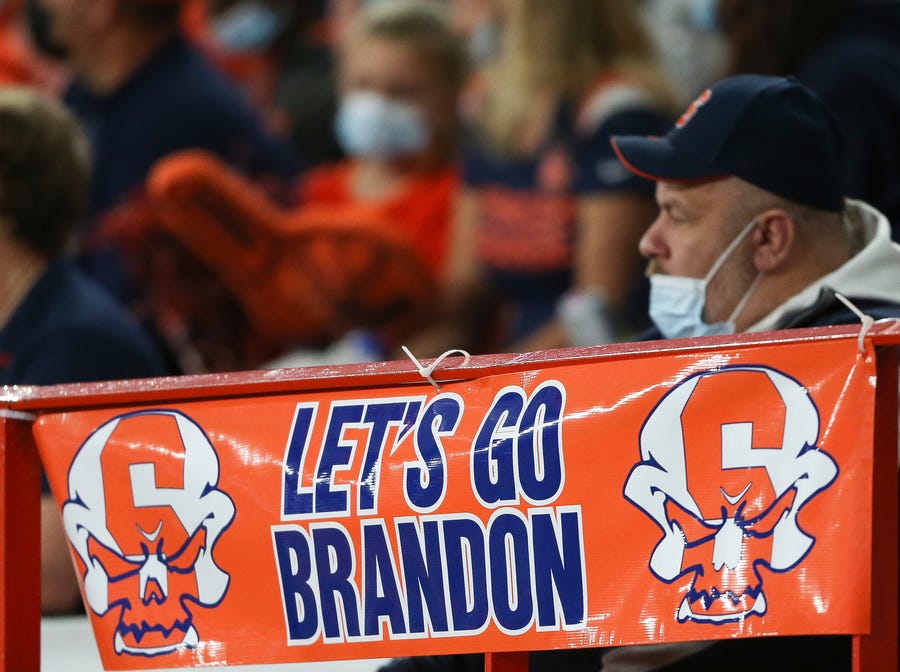
This particular sign was a the Boston College-Syracuse football game Oct. 30. A fan’s juvenile jab at President Joe Biden.Joshua Bessex

For instance, the woman had not heard about the Southwest Airlines pilot who recently signed off on a flight, telling passengers, “Let’s go, Brandon.”

Or about how the whole thing began when a race car driver named Brandon Brown won a NASCAR race and, while being interviewed on TV, the crowd started chanting, “F–k Joe Biden.” The flummoxed interviewer suggested they might be saying, “Let’s go, Brandon.”

After that, the phrase became a way for grown-up 8-year-olds to say the f-word about Biden without actually using it.

Really.

Elected Republican politicians in Washington, D.C., started using the phrase.

Donald Trump began selling “Let’s go Brandon” T-shirts through his Save America PAC for $45, and grown-up 8-year-olds in America actually purchased them.

$45.

There are adults who channel their 8-year-old selves by bringing signs saying, “Let’s go, Brandon” to public events, as well as some who scribble the message in paint on the rear window of their automobiles….

How to answer someone who says such a thing

Of course, we all learned as children that infantile behavior tends to draw some type of backlash….

After I explain the whole “Let’s go, Brandon” thing to the woman who’d been walking her dog she says, “That seems incredibly childish. How are you supposed to answer someone who says such a thing?”

I tell her that, as a grown-up, she would be best served simply ignoring it.

As for the rest of us, suffering as we do from social-media-induced age regression, I’d respond, “I’m rubber and you’re glue …”

Reach Montini at ed.montini@arizonarepublic.com.

Problem viewing email? View in browser

Veteran journalist Jennifer Berkshire speculated on Twitter about why Democrats failed to defend public schools against extremists. The answer is that they swerved into the politics of neoliberalism 25 years ago and promoted privately-run charter schools. They allied with reactionary forces like the Waltons in their fruitless quest for “innovative” schools. Her handle is @@BisforBerkshire.

She wrote with crystal clarity:

Lots of takes on the Dem’s public education problem. But party’s utter inability to articulate why public education matters may be the biggest.

The Democrats’ favorite policy shop in D.C. is the Center for American Progress, which has been the party’s leading advocate of charter schools. The question that CAP can’t answer is: Why does public education matter?

Nancy Bailey addressed the same problem on her blog. She said bluntly that Democrats are not the education party, as they want the public to believe. They abandoned public schools and teachers by their promotion of school choice and evaluating teachers by their students’ test scores.

The eight years of Obama’s Race to the Too was a nightmare for teachers, who were constantly scapegoated. Arne Duncan fell in love with Common Core and Teach for America and used every opportunities to bash teachers and real public schools.

Democrats cannot be the education party when they support charter schools, Common Core, and fast-track teachers like Teach for America. They haven’t stood up for public education despite all the teacher union hoopla.

Where have they been on the discussion of special education? They’ve worked along with Republicans to deny children individualization, smaller class sizes.

Democrats can become the “education party” again when they walk away from the billionaires like Bill Gates, who likes to play with other people’s lives.

On September 22, the National Alliance for Public Charter Schools put out a press release boasting of unprecedented enrollment growth during the pandemic. The report asserted that charter school enrollment increased during the pandemic in at least 39 states, with a 7 percent overall increase. The charter lobby said that this growth “is likely” to be “the largest rate of increase in student enrollment increase in half a decade,” as charter schools added nearly a quarter million students.

Carol Burris, executive director of the Network for Public Education, conducted a state-by-state analysis of their claim and discovered that it was a half-truth at best. Maybe a quarter truth. Maybe less.

What she discovered was that most of the enrollment gains occurred at the worst-performing segment of the charter industry: virtual charter schools. Many brick-and-mortar charter schools actually lost enrollment.

Writing on Valerie Strauss’s “Answer Sheet” blog at the Washington Post, Burris documented the hollowness of the charter lobby claim.

She began:

The National Alliance for Public Charter Schools (NAPCS) has been broadcasting a 7 percent surge in charter school enrollment during the 2020-2021 pandemic school year. Parents are “voting with their feet,” according to its new report, preferring charters to their local public schools. What the authors of the report avoid telling readers is that much of the increase — and likely most of it — was in virtual charter schools, the worst-performing in the charter sector. This occurred even at the expense of brick-and-mortar charters.

The report says this:

“Although a school-level analysis was not conducted as a part of this paper, in some states (e.g., Oklahoma, Pennsylvania, and Utah), charter school enrollment increases were primarily driven by enrollment in virtual charter schools. This explains some but not all of the enrollment increases experienced by the charter school sector nationwide last year.

What exactly does “primarily” mean? How bad is the problem? To find out, the Network for Public Education did a school-by-school analysis of virtual charter growth in the states with the largest proportional enrollment increases.

We began with the three mentioned states. In Oklahoma, the virtual charter-school sector more than doubled enrollment. Ninety-seven percent of the more than 35,000 new students in charters enrolled in virtual schools — most in the for-profit EPIC, which has been repeatedly under investigation for misreporting costs to state officials, improper financial transfers and more.

In Pennsylvania, 99.7 percent of the charter enrollment growth occurred in virtual charter schools. Enrollment in the Commonwealth’s traditional brick-and-mortar charter schools increased by a mere 78 students.

Cyber charters accounted for over 131 percent of the growth in Utah, with enrollment in traditional charters declining.

We expanded our analysis to see if this trend occurred in other states. We began with Michigan, a state whose auditor general had recently released an audit finding that cyber charters could not document participation in at least a single course in more than half of the inspected student records.
The enrollment surge in that state’s cyber charters accounted for 237 percent of the increase. Cyber charters enrollment increased by 5,071 students, while traditional charter enrollment dropped by nearly 3,000.

We then looked at Arizona, a state where families have been bombarded with cyber charter ads and billboards. Over 94 percent of the charter enrollment growth in that state was in the cyber charter sector.

Burris then includes a graph of every state that experienced at least a 10% increase in charter enrollments; there were 13. The graph shows how many students switched to online charters and how many to brick-and-mortar charters. In sum, 95.5% of the enrollment growth was virtual charters. Some brick-and-mortar charters lost enrollments.

Why does this matter? The virtual charter schools have a record of low academic achievement, high attrition, and low graduation rates. In addition, the sector has experienced massive scandals, like the A3 chain in California, whose founders pleaded guilty to phantom enrollments and are repaying the state hundreds of millions of dollars. Like ECOT (Electronic Classroom of Tomorrow) in Ohio, which collected $1 billion over 20 years, gave generously to politicians, then declared bankruptcy rather than comply with a court order to repay $67 million to the state for padded enrollments.

Seeing this increase in schools with abysmal performance is cause for alarm. A study of virtual schools by CREDO in 2015 concluded that students who attend these schools lose ground. While findings vary for each student, the results in CREDO’s report show that the majority of online charter students had far weaker academic growth in both math and reading compared to their traditional public school peers. To conceptualize this shortfall, it would equate to a student losing 72 days of learning in reading and 180 days of learning in math, based on a 180-day school year. This pattern of weaker growth remained consistent across racial-ethnic subpopulations and students in poverty.

Students may have”voted with their feet” to enroll in virtual schools during the pandemic, but we have to wait for the evidence to find out if they stayed or returned to public schools. If they decide to stay in virtual schools, we should be alarmed.

Jeannie Kaplan, a former member of Denver’s elected school board, has warned for years about the subversion of Denver’s school election by well-funded, out-of-state “reformers.” Their money makes it difficult for ordinary citizens to run for the school board.

In this post, Jeannie reports that Dark Money is back and is prepared to fund candidates who support charter schools and other elements of the failed “reform” agenda. She has identified the groups that act as pass-throughs for Dark Money, she has tallied the total (to date) of $360,000, but it’s usually impossible to identify the original source of the money.

Jan Resseger is puzzled that Chicago Mayor Lori Lightfoot selected San Antonio Superintendent Pedro Martinez to lead Chicago’s public schools. His experience and views overlap with those of Arne Duncan, for whom he served as Chief Financial Officer. Parents and teachers wanted the next superintendent to be an instructional leader. Martinez has no experience as a teacher or a principal. He represents the failed ideas of corporate reform. Twenty years of test score driven decisions—closing schools and replacing them with charter schools— should be enough.

She writes:

For WBEZ, Chicago’s best education reporter, Sarah Karp introduces Pedro Martinez: “Turning to a non-educator with deep Chicago ties, Chicago Mayor Lori Lightfoot named former Chicago schools official and a current San Antonio schools superintendent Pedro Martinez as the next CEO of Chicago Public Schools. Martinez, who was born in Mexico and raised in Chicago, will be the first permanent Latino leader in the school district’s history… Martinez worked as CPS’ chief financial officer under former CEO Arne Duncan… Martinez is an accountant who has been called ‘analytics heavy.’ And in San Antonio, he has expanded charter schools as well as partnered with private organizations to take over failing schools. These ideas have been popular in Chicago, but they have fallen out of favor in recent years… Martinez has never taught or run a school as principal. And, thus, in choosing him, Lightfoot is rejecting the input of parents and others who said they wanted someone with a strong instructional background with ‘boots on the ground’ experience… Martinez is a graduate of the Broad Superintendent Academy training program. Critics say the Broad Academy promotes school leaders who use corporate-management techniques and that they work to limit teachers’ job protections and the involvement of parents in decision-making.”

John Tanner is a blogger in San Antonio. In this post, he asks a question that I have asked myself many times: Why do ”reformers” and politicians keep funding failure? Why do they demand more charters and vouchers when neither has matched their claims, neither has closed achievement gaps or dramatically higher scores (except when they cherrypick their students)?

Tanner asks the question about test-based accountability, which Texas has embraced for decades.

He begins:

It is inexplicable to me how the failed policies of test-based accountability continue to be championed as if they have worked in the past and will continue to work into the future. The position of those espousing the effectiveness of test-based accountability can only be valid if at some point in the past all schools were essentially equal, and then good or bad educators created the disparities between what are now labeled “good” and “bad” schools. Then, the current accountability systems might reflect the efforts of those educators and the judgments would be warranted.

Of course, that is a joke. Schools never started at a level playing field. The first time anyone administered a standardized test to the universe of students in America what it showed were the effects of an inequitable society as well as the size and scope of a problem. But it was much easier for Americans to ignore the problem and instead declare that poor children were just dumber than rich children and that the cause of that was the educators in their lives. Pretending that at some point everything had been equal and then it just so happened that all the bad educators migrated towards the bad schools now serving poor children was easier than admitting the truth—that we were a society rooted in inequity and that our approach to schooling reflected that fact.

Reality is a good bit different than the test-based accountability crew would have you believe. The Coleman report pointed out way back in the 1960s that an effective, research-based approach to creating a great educational system for all students required two major policy efforts: address the ravages of generational poverty and make teaching into a position as revered as medicine and the law. So far, more than half a decade later, we are 0/2.

Now, instead, we look askance at the schools that serve students who are the victims of generational poverty and who are as a result behind their wealthier peers. We pretend that what we are seeing in these schools is not the consequences of ignoring Coleman, but of laziness and incompetence on the part of the educators in them.

And because test scores of the types used by states are designed to order students from the furthest below to the furthest above average within a content area as of a certain date (that’s a mouthful—sorry), they make for a beautiful tool for confirming the bias that schools serving poorer children became bad because of bad teachers that just need to try harder. That denies the reality that student exposure to academic content occurs in two places: inside and outside school, and that exposure differs a great deal as a direct result of generational poverty. Make no mistake—schools and teachers matter, as they will account for about 1/3 of the difference in test scores between students (and could account for more with the right supports that do not now exist). But what happens outside of a school will account for almost 2/3 of the difference. Any judgment based on a test score that fails to acknowledge that very real fact is unethical and needs to be dismissed as specious.

Read on. He nails the failure of test-based accountability.

NPE ACTION’S NEW PROJECT TO BRING TALES FROM THE FRONTLINES OF PUBLIC SCHOOL ADVOCACY

Public schools remain incredibly popular among Americans across the political spectrum, even under the strains of a global pandemic and a divisive political culture being inflamed by opportunists seeking to push radical, unpopular agendas. Parents, students, volunteers, and communities who rely on and cherish their public schools deserve to be heard now more than ever. Public Voices for Public Schools, a community project of the Network for Public Education Action, launches today with tales from the frontlines of public school advocacy.

Unfortunately, public education in America has been under systematic attack for decades by an axis of right-wing political radicals, self-appointed reformers, opportunists, segregationists, and wealthy special interests, all working together to dismantle and privatize our treasured public schools. Their efforts have done lasting harm to students and their communities, and it is time those communities have a platform where their stories can be shared.

“After my two sons enrolled in a private school thanks to vouchers, I began to understand that school is about more than academics,” said Dountonia Batts, a former voucher parent. “As charter schools and vouchers expanded, the school system in Indianapolis was falling apart. All of the high schools in our neighborhood had been shut down, even as charter high schools were popping up. I realized I could no longer accept school vouchers for my children because it was unethical.”

People like Batts rarely get a chance to be heard, especially by policymakers who are often targeted for pressure by pro-privatization groups with access to campaign donations and full-time public relations machinery. That’s why Public Voices for Public Schools is so important, as it is a place to elevate the regular people in our community and help them have access to the tools to engage their elected representatives directly.

“Once I understood that our funders wanted us to help them burn down the entire public school system, I realized I had very different intentions than the school reform movement,” said Gloria Evans Nolan, a former Missouri education reformer. “I could see for myself the toll that education “reform” was having on my city. The result was that our sense of community was dropping away. We were also losing our history. Every school I attended is now closed.”

Public Voices for Public Schools will regularly bring you stories from parents like Batts and Nolan, students, academics researching the effects of privatization, along with many others. Visit us at pv4ps.org where you can join our shared community and always be kept up to date. You will learn what you can do to preserve a pillar of our democracy, our neighborhood public schools.
*************

Jeff Bryant is a journalist who specializes in education. In a recent issue of The Progressive, he details the many failures of what is falsely called “education reform.” The term for many has been a ruse for privatization via charter schools and vouchers. Instead of “reform,” it should be called disruption and destruction. Bryant leads the Progressive’s Public School Advocate project. This is a good-news story. Ed Reform has no successful strategies or ideas, but it’s billionaire funders and the U.S. Department of Education continue to fund its failed ideas.

He begins:

It was telling that few people noticed when Chicago’s Board of Education announced in late May that it was closing down its school turnaround program and folding the thirty-one campuses operated by a private management company back into the district.

The turnaround program had been a cornerstone of “Renaissance 2010,” the education reform policy led by former Chicago Public Schools Chief Executive Officer Arne Duncan, who became U.S. Secretary of Education during the Obama Administration. As the news outlet Catalyst Chicago reported, Duncan used the core principles of Renaissance 2010 as the basis for “Race to the Top,” his signature policy that he rolled out to the nation.

Race to the Top, a successor to former President George W. Bush’s “No Child Left Behind” program, included holding schools accountable for higher scores on standardized tests, inserting private management companies into district administration, and ramping up charter schools to compete with public schools.

Another news event affecting Chicago public schools that got very little national attention was the decision by the Illinois state legislature to rescind mayoral control of Chicago schools and bring back a democratically elected school board. The plan is backed by the state’s Democratic governor, J.B. Pritzker (and, predictably, opposed by Chicago mayor Lori Lightfoot). For years, prominent Democratic leaders—including New York Governor Andrew Cuomo and former Chicago mayor and previously Obama White House Chief of Staff Rahm Emanuel—touted mayoral control and a rejection of school board governance.

A third story from the Chicago education scene was that, in December, Noble Charter Network, the city’s largest charter school chain, disavowed its “no excuses” approach to educating Black and brown students because of the racist implications. Noble’s decision added to other reports of no-excuses charter chains dropping their harsh behavioral control and discipline policies during the past year.

These stories highlight the waning of three “school improvement” approaches: strict accountability with private management, mayoral control, and no-excuses charter schools. Each approach was among the pillars of “education reform” favored by previous presidential administrations and heartily endorsed by Washington, D.C., policy shops, such as the Center for American Progress.

Taken in unison, the three stories also contribute to the much larger narrative of how the once all-pervasive and generously funded policy movement known as education reform has ended—not with a bang, but a whimper.

Other policy directives of the reform movement that are also being relegated to the dustbin of history include state takeovers of low-performing schools, evaluating teachers based on student test scores, and flunking third-graders who score below a certain threshold on reading exams.

Please open the link and read on.

Nancy Bailey writes here about the growing influence and persistence of the billionaire-funded groups that want to privatize our nation’s public schools.

Despite the substantial research that shows the ineffectiveness of free market school choice, the school choice in undeterred. As Bailey shows, “reformers” (disrupters) have become influential voices in the Biden administration and have created new groups to press their agenda of privatizing public schools. The new dean of the Harvard Graduate School of Education is a free market “reformer.”

Despite the persistent failure of the “reformers’” strategies, they press on, attacking public schools, supporting state takeovers, fighting to expand charters and vouchers. The billionaires continue to pour millions into their hobby, which is chicken feed to them.

This is an important article. Please read it.

This is a fascinating paper published in the peer-reviewed Education Policy Analysis and Archives in 2018. It explores the question of how Forbes magazine selects the “edu-preneurs” who are recognized as education leaders. It is quite a plum to receive this recognition, as it supposedly confers recognition on those young people who are “the best hope for revolutionizing and reforming education.” This recognition sets them apart as “experts,” despite their youth and meager experience.

The authors are T. Jameson Brewer, Nicholas D. Hartlep, and Ian M. Scott.

They see this selection process as a means of advancing privatization and the market-orientation of education, given the composition of the judges and the winners.

The marketization of public education in the era of neoliberalism elevates buzzwords like “innovation,” “investments,” “return on investments,” and “technology integration.” Moreover,  within the context of education and schooling, the professional status of educators is challenged in an effort to exalt the logic and norms of the business class. President Trump, a businessman, appointed Betsy DeVos to be the Secretary of Education despite the fact she and her children have never attended public schools. The message the White House sent to Americans is that experience in education is not a necessary component of administrating education. Education reform, both Forbes 30 Under 30 in Education 5 domestically and internationally, has been led by a consortium of organizations and individuals who have expanded market-oriented reforms throughout schools. Those market-oriented reforms have included charter schools, school vouchers, and alternative certification training for teachers. The logic, as it were, is that government based training, organization, and control of schooling is woefully inefficient and would benefit from market competition. Finding roots in Milton Friedman, market-oriented education reformers seek to inject competition (note the business terminology) into the public sphere of public education. And, despite a growing body of research that suggests that charter schools underperform traditional public schools (Miron, Mathis, & Welner, 2015) and exacerbate segregation (Author & Lubienski, 2017; Frankenberg, 2011; Frankenberg & Lewis, 2012), and other research raising concerns over alternative certification programs like Teach For America (Brewer, 2014; Anderson, 2013a, 2013b; Redding & Smith, 2016; Scott, Trujillo, & Rivera, 2016), these reforms continue to expand. And these reforms are not conducted within a vacuum. The disproportionate number of TFA alumni who have received the Under30 and the shared language of neoliberal education reform highlight the common understandings and aims of market-oriented reformers (Lahann & Reagan, 2011)…

Given Forbes’ s ideological commitment to promoting business-oriented reforms in education, the Under30 award itself—using the language of industry—highlights the role that neoliberalism continues to play across education reforms. Grounded in the assumption that government is both too ineffective and inefficient to oversee schools (Chubb & Moe, 1990; Friedman, 1955, 1997, 2002; Greene, Forster, & Winters, 2005; Walberg & Bast, 2003), neoliberalism asserts a solution of free-market competition and individualization (Ball, 1994, 2003, 2007, 2012; Giroux, 2004; Harvey, 2005). As explicated in our findings, the individuals who receive the Under30 not only lack degrees in education, but the judges of the award and the majority of the awardees have direct connections to organizations that operate along an ideological commitment to competition, deregulation, and privatization (often, for-profit). In their discussion of alliances and divisions within the policy landscape, DeBray-Pelot, Lubienski, and Scott (2007) outlined how  various types of ideological groups influence policy outcomes. Our analysis here adds to that work by contributing further empirical evidence that the market-oriented landscape has become more complex in that support for such reforms have shared connections across the ideological (and often competing) stances of “Centrist/New Democratic,” (e.g., National Alliance for Public Charter Schools) “Center/Left,” (e.g., Center for American Progress) “Neoliberal,” (e.g., Center for Education Reform, Walton Foundation, Broad Foundation, New Schools Venture Fund, etc.) and “States’ rights” (e.g., American Legislative Exchange Council) groups presented in their findings

If we were to apply social closure theory to Under30, we might ask ourselves: “Who are the judges, and who are the recipients?” The four judges for the 2017 competition were: (1) Stacey Childress, the CEO of NewSchools Venture Fund, (2) Arne Duncan, the Managing Partner of Emerson Collective, (3) Wendy Kopp, the Co-founder of Teach for America (TFA) and Teach for  All, and (4) Marcus Noel, the Founder of Heart of Man Ventures and a TFA alum (see Howard & Conklin, n.d.). We might also ask, “Who were the recipients of the award?” If the award recipients  were found to be mostly from the organizations that were connected to the judges, then we might be able to discern whether social closure is occurring. By nominating and awarding Under30 to people like themselves, the judges effectively act as gatekeepers to the resources and benefits that come to those who receive such a designation. Those benefits are national recognition, marketing of the individual and the individual’s organization or business by Forbes , and networking connections made during the Under30 Summit (a multi-day event of speeches and networking). Given that the purpose of the Under30 is to identify and celebrate those who are leading in their industry, receiving the Under30 designation stands to help recipients expand their business ventures.

Raymond Murphy (2001) points out that social closure is really about monopolization of opportunities. What this means is social closure and closed networks lead to protecting power and maintaining the same messages and signal ideologies. Within the realm of the Under30 network, those ideologies are ones that elevate ideologies of pro-privatization and pro-marketization of schools and education. These ideologies support the de-professionalization of teacher preparation.  The manifestation of social closure increases and is an outcome of echo chambers whereby members of the closed network not only engage in self-congratulations but rely on the growing network information and resources to further its shared ideology. Social closure is not a new area of study; it has been documented to exist in higher education award systems, such as the American Educational Research Association (AERA) Fellows program (Hartlep et al., 2017). However, the present study contributes new knowledge to how social closure can lead to moving forward policies that are pro-market and pro-privatization and that lead to bolstering edu-preneurship.

The authors reviewed the resumes of five years of recipients of the 30Under30 award. Few of them had studied education.

Only four of 192 Under30 recipients over the last five years have had an undergraduate degree that focuses on education. While 23 have master’s degrees in some field connected to education, many of them completed that training through partnerships between universities and Teach For America (TFA), which has some control over the courses their corps members take...

Wendy Kopp, the founder of TFA, and Stacey Childress, the CEO of NewSchools Venture Fund, both have served as judges for the majority of the years that the Under30 award has included the education industry. Additionally, other judges alongside Kopp and Childress have direct ties to the individuals and organizations being recognized through the award. While there is no way to know the academic background and connections of all of the Under30 nominees—that is, we do not know if the majority of nominees are, for example, TFA alumni—it is clear from our analysis that the majority of the recipients of the award have very close connections to the judges and their organizations. And while we explore the specific connections below, because the judges are so closely connected to the individuals that receive the award the Under30 serves as a mechanism through which judges are able to highlight the individuals and alums of their organizations.

Forbes 30 Under 30 in Education 13 recipients can, in turn, use the platform the Under30 award affords to further market and promote their specific brand of education reform. This process feedback loop becomes reciprocal. For example, Marcus Noel, who, having connections to TFA was awarded the Under30 in 2016, became a judge in 2017. Additionally, Joe Vasquez, a judge for the newly announced 2018 cohort of Under30, has direct connections to TFA and was, himself, a recipient of the award in 2017 when Kopp was a judge (Kopp was also a judge in 2018).

The paper goes on to describe the networks within which most of the awardees are embedded, the most prominent being Teach for America. Although TFA comprises less than 1% of teachers in the nation, TFA alums comprise 22% of the 30Under30 awardees. It helps that Wendy Kopp is often one of the judges of the competition.

The paper has some very illustrative sociograms that show the connections among the organizations, the judges, and the awardees.

They conclude:

Our findings suggest that the Forbes  Under30 award, its judges, and the growing network that the award creates both benefits from and reinforces social closure. The theory of social closure examines the myriad ways in which individuals and institutions are able to restrict access while simultaneously protecting the resources, power, and influence that members on the inside have and share among each other. If we believe the Under30 award to be a prestigious award, as Forbes suggests, then we should equally expect that those recommended for the award undergo a rigorous  Forbes 30 Under 30 in Education 19 and unbiased selection process. Yet, our findings suggest that the judges of the Under30 award systematically select individuals who are either directly associated with the organizations that the judges represent and/or those who share the same ideological commitments to education reform— ideological homophily. Such a reality is suggestive of an echo chamber where individuals within, or close to, the reform network are selected for the award as a means of self-congratulating the ideology fueling their reforms and, in short, self-congratulating the judges since the recipients of the awards largely come from the judge’s organizations.

In short, the 30Under30 competition is an echo chamber where the judges select members of their own or similar organizations and complete a closed circle. The judges use their influence to enhance their power and promote their proteges. In normal terms, this would be considered a conflict of interest.