Archives for category: Childhood

A big win for all those opposed to the mandatory testing of very young children.

FOR IMMEDIATE RELEASE

April 11, 2022

Samay Gheewala, 312-380-6324, info@ilfps.org

IL LEGISLATURE PASSES ‘TOO YOUNG TO TEST’ ACT

Bill will safeguard grades PreK-2nd from state testing

Young children will be protected from any current or future plans to expand state standardized testing into prekindergarten through second grade if Governor Pritzker signs a new Too Young To Test law passed by the Illinois General Assembly this session.

The Too Young To Test bill, SB 3986, received broad and bipartisan support from legislators and a coalition of Illinois parents, educators, researchers, and advocacy orgs concerned about the possible encroachment of the state testing system into PreK-2. The Too Young To Test bill prevents the state from requiring or paying for any non-diagnostic standardized testing of children before third grade.

“Too Young To Test seeks to safeguard the early years by ensuring that the Illinois State Board of Education does not spend finite resources or require standardized assessments in K-2 that have been proven to be developmentally inappropriate during such a fluid time of child development.” said State Senator Cristina Pacione-Zayas (D-Chicago), the bill’s chief sponsor in the Senate. “Instead, the state should invest in research-based practices that support whole child development such as play-based learning, social-emotional skill building, and teacher coaching. Especially after the unprecedented disruptions of these last two years, we cannot forget that the same part of the brain that registers stress and trauma is also responsible for memory and learning.”

“Our decisions about state standardized testing should reflect evidence-based research and provide reliable data,” chief House sponsor of SB 3986 State Representative Lindsey LaPointe (D-Chicago) said. “Encouraging schools to focus on unreliable standardized tests for children too young will change the focus of classroom instruction and create further inequity. We need to direct our education resources and energy toward proven strategies that enrich the classroom experience for our youngest learners.”

Assessment experts, teachers, and early childhood researchers all agree that test scores from children below age eight are not statistically reliable or valid measures of what children know and can do and should not be used to assess academic achievement or school performance.

Despite this, the Illinois State Board of Education has been considering a proposal to add optional, state-funded K-2 testing in Illinois to the existing 3-8th grade tests. That proposal has been unpopular with parents and teachers. A petition from grassroots public ed advocacy group Illinois Families for Public Schools calling on ISBE to drop the plan garnered over 1300 signatures from parents and community members in over 150 towns and cities across Illinois.

Too Young To Test wouldn’t restrict the ability of districts, schools, and teachers to use or develop assessments paid for with local funding dollars. It also does not stop the state from creating or funding tests or evaluations used for screening or diagnostic purposes.

Since the passage of the federal No Child Left Behind Act in 2001, overtesting has become a significant problem in early elementary school because younger students are being prepped for high-stakes tests in later grades. “We are relieved and encouraged by the General Assembly’s action to set clear criteria for what types of assessment the state can develop, fund and require before third grade.” said Cassie Creswell, director of Illinois Families for Public Schools.

“Before age eight, and even after, kids should be learning via play, exploration and inquiry, and the way teachers assess what they’ve learned should reflect that. What parents want for their children is small classes with teachers who use meaningful assessment methods, not more contracts with commercial test vendors,” added Creswell. “Governor Pritzker has said he’s committed to Illinois becoming the best state in the nation for families raising young children, and we think the Too Young To Test bill is an important part of fulfilling that. We hope we can count on him to sign this bill into law as soon as it gets to his desk.”

Too Young to Test was supported by a broad coalition of organizations, including the Chicago Teachers Union, Defending the Early Years, Illinois Federation of Teachers, Illinois School Counselor Association, Learning Disabilities Association of IL, and the National Association of Social Workers – IL Chapter.

###

About Illinois Families for Public Schools

Illinois Families for Public Schools (IL-FPS) is a grassroots advocacy group that represents the interests of families who want to defend and improve Illinois public schools. Founded in 2016, IL-FPS’ efforts are key to giving public ed parents and families a real voice in Springfield on issues like standardized testing, student data privacy, school funding and more. IL-FPS reaches families and public school supporters in more than 100 IL House districts. More at ilfps.org.
Michael J. Petrilli drew a lot of criticism a few months ago when he proposed to give NAEP tests to children in kindergarten, arguing that fourth grade was too late to start assessing student skills.

Now he has an even more radical proposal: test the babies, he says.

He writes:

Earlier this year, I took to the pages of Education Next to make the case for NAEP to test starting in kindergarten, stating that, “The rationale for testing academic skills in the early elementary grades is powerful.” Therefore, “Starting NAEP in fourth grade is much too late.”

I was wrong, and I’m sorry.

Kindergarten is much too late. We must begin a program of NAEP testing for newborns. In the hospital. Before parents take them home. Maybe before parents name them.

If we wait until age five to assess students in math and literacy skills, that leaves a half-decade of missing data. How are we to know where our infants fall on a distribution scale of academic achievement? How many of them are already proficient? How can we possibly differentiate preschool playtime with success and rigor?

Some of my critics might point to the difficulty in assessing newborns. Sure, their precious, tiny hands can grip your finger in an act of sublime yet simple affection, but can they grip a pencil? How can they fill in the bubbles on a standardized test when swaddled lovingly in a blanket? How can they deal with a keyboard if they can’t sit up? Do not be swayed by such arguments, which only reinforce the mediocre expectations endemic to America’s nurseries.

Others will assert that newborns are already assessed through the Apgar test. Again, don’t be fooled! The Apgar only measures the ultra-basics, like muscle tone and respiration. Talk about low standards. We’re going to give babies passing marks just for having normal reflexes? Give me a break.

What next? Test the fetuses? Open the link and finish the article. Always good to see people making fun of their own bad ideas on April 1!

This story appears on Apple News, taken from the BBC News site. Google it on the BBC site and watch the video if you can. I couldn’t. Anyone who blames the Ukrainians for this cruel war is insane. The attack on Ukraine was completely unprovoked. The Russian forces are now engaged in reducing the city of Mariupol to rubble. 90% of its buildings have been destroyed. Hundreds of women and children are buried in the rubble of a theater where they were sheltering. Hundreds more are buried under an arts school. And the world watched in horror.

In his hospital bed, little Artem stares into space. He clutches a small yellow toy tractor but says nothing as specialist nurses monitor his condition. The Russian shell that blasted shrapnel into his belly also badly wounded his parents and grandparents as they tried to flee Mariupol. A victim of Putin’s war and he’s not yet three years old.

In the next bed to Artem lies 15-year-old Masha, also from near Mariupol. Her right leg was amputated after it was torn apart by the blast from a Russian shell last Tuesday.

The very worst of Vladimir Putin’s war in Ukraine and what the relentless Russian bombardment has done to the people trapped in the besieged city of Mariupol, can be seen at the Regional Children’s Hospital in the nearby city of Zaporizhzhia.

Hundreds of people have been evacuated here. Their physical wounds are obvious and may, to an extent, heal. The psychological trauma will live with them for ever.

Doctors here and the children’s surviving relatives, asked us to tell their stories, among them Dr Yuri Borzenko, head of the Children’s Hospital. He can’t hide his contempt for what Russia has done.

“I hate Russia,” says Dr Borzenko, without a flicker of emotion on his face. “The girl who lost her leg (Masha) was so traumatised she wouldn’t eat or drink for days. She couldn’t mentally handle what had happened. We had to feed her intravenously.”

“Another boy,” says the doctor, “a six-year-old, with shrapnel in his skull described – without any tears or emotion – watching his mother burn to death in their car after it was hit. Two days later he said ‘dad buy me a new mum, I need someone to walk me to school’.”

What is happening in Mariupol is a humanitarian disaster, even – perhaps – a war crime. An estimated 90% of the city’s buildings have been damaged or destroyed. After last week’s destruction of a theatre where more than 1,000 people were sheltering, reports today that an arts school, with 400 people inside, has also been attacked.

Those who’ve been able to escape Mariupol talk of unimaginable horrors. First-hand accounts of bodies lying in the streets, of homes destroyed. Carrying those memories they put as much physical distance as they can between themselves and what they went through….

At Zaporizhzhia’s Children’s Hospital, I came across one grief-stricken, inconsolable father whose family had been completely torn apart.

His daughter Natasha, who was 26, and his 4-year-old granddaughter Dominica, were killed when a Russian shell landed near the shelter where the whole family was seeking refugee from the bombardment of Mariupol.

“I looked at the ground and there lay my little granddaughter with her head completely torn to pieces,” says Vladimir. “She lay there without a single breath and right next to her was my daughter with her legs fractured, open fractures.”

Dominica – whose pictures her grandfather almost caresses on his phone – was killed instantly. Her mother died from her injuries the next day.

As broken as he is, Vladimir is trying to stay strong for his second daughter, Diana. She was also critically wounded in the blast and was about to undergo emergency surgery.

But he could not hide his pain. “God, why would you bring all this upon me? I was not supposed to bury my children, my lovely girls, I failed to protect you.”

Toby Price, an assistant principal of an elementary school in the Hinds County School District in Mississippi, was fired because he read a book to second graders on Zoom called I Need a New Butt! The school board did not approve. Nor did the superintendent.

The school was participating in “Read Across America” day to honor Dr. Seuss’s birthday and to encourage children to love reading. Mr. Price thought the children would find the book hilarious, and they did. But they also got a lesson in the power and danger of books when Mr. Price was fired a few days later. He’s trying to get his job back and has a GoFundMe to support his family and pay a lawyer.

When I first read this story, I sent it to Carol Burris, my friend and executive director of the Network for Public Education. She immediately responded that she must be a criminal grandma because she’s shared that same book with her grandchildren many times, and they love it.

She drafted a confession:

True confession. I am a terrible grandma to my five grandkids. I confess. I bought little Phinney I Need a New Butt! I did not even wait for second grade—I bought it for him when he was two. We would laugh all the way through and he would beg me to read it… again and again and again.

But I did not stop there. I bought a copy for my other two grandkids, Merek and Reeve, then four and two. That’s me, a serial corrupter of young children’s minds.

And if there were a grandma license in the State of Mississippi, then mine would surely be snatched away. I am referring, of course to the tragic ridiculousness of the firing of an assistant principal in Mississippi for reading I Need a New Butt! to second-graders over Zoom.

Anyone who has ever spent any time with young kids knows that silliness is a magnet that draws kids into stories. I devoured Dr. Seuss, limericks, and rhymes as a child. My daughters loved the hilarity of Where the Sidewalk Ends with its rhymes about a child poet in a lion’s belly, baby brothers that ran away, and of course that sack with its mysterious contents (perhaps an extra butt is inside?) Stories with rich rhymes and rhythms build literacy. And maybe a sense of humor—something the world sorely needs.

I worked in schools long enough to figure out the back story on this one. Some self-righteous fool, who likely never liked the man, heard the story and called their friend on the school board. And then a spineless administrator complied, rather than standing up for a man whose life work was spent among children.

It’s a chilling tale of power and fear and extremism. And worst of all, the children of Gary Road Elementary lost someone who understands them, only to be left with school leaders whose butts may be tight and intact, but most certainly have cracks in their hearts and heads.

So, here’s the irony: I Need a New Butt! is now #1 bestseller on Amazon’s list of beginning readers for children.

The word should go out to every school board and legislature in the nation: whenever you ban a book, its sales will soar! Authors will wear your ban as a badge of honor. They may even ask you to ban their books so they too will benefit. Don’t do it!

You won’t believe this. Peter Greene sums it up in a hilarious/sad post.

Dolly Parton created a foundation to give free books to children 0-5. A committee of the Kentucky State Senate was discussing whether to partner with Dolly’s Imagination Library. One of the senators —Stephen Meredith—expressed concern with the term “age appropriate.” He thought it might be code for something bad, like indoctrinating little children.

Then the uproar started, including an outraged tweet from Dolly’s sister, demanding to know Sen. Meredith’s IQ score. That shut down Sen. Meredith. You can’t beat Dolly Parton and her sister.

At the beginning of December, Jan Resseger wrote about why President Biden’s Build Back Better agenda is so important. At the moment, it’s prospects are dim,due to theintransigenceofSenator Joe Manchin of West Virginia. Senator Manchin drives a Maserati and owns a yacht, but his state is very poor and needs the help that Build Back Better offers.

Jan Resseger describes the hoary English tradition—which we inherited—of expecting the poor to pull themselves up by their own bootstraps. This is apparently what Senator Manchin believes in, as he fears that the poor will become “spoiled” by too much government help.

She writes:

Right now, the U.S. House of Representatives has passed the Build Back Better Bill which represents a radically different philosophy: President Biden’s commitment to helping children whose families live in poverty instead of punishing their parents. The U.S. Senate is negotiating its version, which many hope to see passed by the end of 2021.

The Center on Budget and Policy Priorities explains why a single reform in the Child Tax Credit—making it fully refundable for families with very low income—is for America’s children the most important element in Build Back Better: “Making the full Child Tax Credit available for families with low or no earnings in a year, often called making it ‘fully refundable,’ is expected to generate historic reductions in child poverty compared to what it would have been otherwise. Before the Rescue Plan made the full Child Tax credit fully available in 2021, 27 million children in families with low or no income in a year received less than the full credit or no credit at all.” In the American Rescue relief bill last spring, Congress made three significant changes in the Child Tax Credit: raising the maximum Child Tax Credit from $2,000 to $3,600 per child through age 5, and $3,000 for children age 6-17; allowing families to receive a Child Tax Credit for 17-year-olds; and making the Child Tax Credit fully refundable for the year 2021. The House version of the Build Back Better Bill extends the first two provisions only through 2022, but the House version permanently makes the Child Tax Credit fully refundable:

“In the absence of the full refundability provision, the first two of those changes would lift an estimated 543,000 children above the poverty line, reducing the child poverty rate by 5 percent… But the two changes plus full refundability stand to raise 4.1 million children above the poverty line and cut the child poverty rate by more than 40 percent. In other words, the full refundability feature makes the expansion nearly eight times as effective in reducing child poverty.” “Until last spring’s COVID relief bill, many children had been excluded because “their families’ incomes were too low. That included roughly half of all Black and Latino children and half of children who live in rural communities… This upside-down policy gave less help to the children who needed it most. The (COVID) Rescue Plan temporarily fixed this policy by making the tax credit fully refundable for 2021. Build Back Better, in one of its signature achievements, would make this policy advance permanent.” (emphasis in the original)

In a new report last Friday, the Center on Budget and Policy Priorities warnsabout what we can expect if the U.S. Senate fails to pass the Build Back Better Bill by the end of December, 2021 and allows to expire the reforms instituted temporarily for this year alone in last spring’s American Rescue Plan: “If Build Back Better isn’t enacted, the Child Tax Credit would revert to providing the least help to the children who need it most — and some 27 million children would once again get a partial credit or none at all because their families’ incomes are too low.”

The First Focus for Children Campaign outlines other urgently needed reforms included in the House version of the Build Back Better Bill: “The Children’s Health Insurance Program, CHIP, which covers roughly 10 million children would be made permanent, sparing it from serial expiration every few years.” The bill would also require states to make children’s eligibility continuous over all 12 months for CHIP and Medicaid; would guarantee 12 months (instead of 60-days) of postpartum coverage for mothers on Medicaid; and would provide 4-weeks of paid leave for new parents and expand family leave. Build Back Better would significantly expand access to quality child care and phase in universal pre-K for 3- and 4-year-olds. For young adults aging out of foster care, the law would lower the age of eligibility for the Earned Income Tax Credit from 25 to 18. The bill would also address hunger among children by making meals available during the summer months when school is not in session.

None of these programs directly invests in public education, but together they will improve educational opportunity. Why? We know that a family’s economic circumstances affect children’s opportunity at school. Recently this blog covered a new report that 101,000 students in the New York City Public Schools—10 percent of the district’s students—were homeless in the past year. Decades of research show that such challenges directly affect such students’ experiences at school.

Jan Resseger, one of our best informed bloggers and social justice advocates, lauds President Biden’s Build Back Better program for its benefits for children. It would end decades of policies that punish poor children. Our nation has dramatically reduced poverty among the elderly, but neglected our children.

She writes:

The U.S. House of Representatives finally passed President Biden’s infrastructure plan last Friday. The Senate passed it a while ago, and the bill is headed to Biden’s desk for signature.  At the same time, Democrats in the U. S. House of Representatives pledged that if the Congressional Budget Office confirms cost estimates for the Build Back Better Bill, Democrats in the House will pass the current version of the plan and send it on to the Senate for consideration. For months, Congress has been debating the programs that are part of this plan, and even if Congress passes it, it won’t be perfect.

Even if imperfect, however, the Build Back Better Bill in its current form would signify a truly revolutionary investment in America’s children. That is because the United States has, for decades, utterly failed to use government to begin to eradicate a morally reprehensible level of childhood economic inequality.

Cara Baldari of the First Focus Campaign for Children explains: “For the first time in generations, we are on the precipice of making serious and long-term progress to reduce our stubbornly high rate of child poverty in the United States. Historically, the United States has had a significantly higher rate of child poverty than other developed countries because we have continually failed to sufficiently invest in our children. While the establishment of Social Security has permanently reduced poverty for seniors, children have remained the poorest group in America. This situation is not due to a lack of evidence on what works to reduce child poverty, but rather the lack of political will to act.”

Since 1997, families who earn enough income to pay federal income taxes have benefited from a tax credit for each child. Last spring’s American Rescue Plan Covid-relief bill made the full Child Tax Credit available to children in families with low earnings or without income, and it increased the credit’s maximum amount—$2,000 per-child last year— to $3,000 per child and $3,600 for children under age 6—but only through the end of 2021. Without the extension of this reform, many children will fall back into deep poverty in 2022.

Balderi presents some recent history: In 2015, advocates for children “worked with Reps. Lucille Roybal-Allard (D-CA) and Barbara Lee (D-CA) to secure federal funding for the landmark National Academy of Sciences study, A Roadmap to Reducing Child Poverty, which was published in 2019. This study, written by a committee of experts… confirmed that… providing families with flexible cash assistance through a monthly child allowance was the most effective way to combat child poverty, reduce racial-economic inequality, and improve children’s long-term outcomes.”  In a tragic irony, until this year families without income or with income so low they payed little in federal income taxes could not receive the full tax credit, while middle class and even wealthy parents could receive the full credit, thereby reducing their federal income tax.

Last week the Center on Budget and Policy Priorities examined several provisions of the Build Back Better Bill which will, if the law is passed in its current draft form, reduce racial disparities.  The brief leads with the Bill’s provision to reduce child poverty by extending last spring’s expansion of the Child Tax Credit: “Build Back Better extends the American Rescue Plan’s expansion of the Child Tax Credit for 2022, which is expected to lift 4 million children above the poverty line and narrow the difference between poverty rates for Black and white children by 44 percent (compared to what the rates would be otherwise) and to narrow the difference between the poverty rates for Latino and white children by 41 percent.  Build Back Better also permanently ensures that the full Child Tax Credit is available to children in families with low or no earnings in a year.This is particularly important for Black and Latino children, about half of whom received a partial credit or no credit at all before the Rescue Plan expansion because their families’ incomes were too low, compared to about 20 percent of white children.”

In late October, a Center on Budget and Policy Priorities Senior Research Analyst, Claire Zippel reported data collected from late July through September by the U.S. Census’s Household Pulse Survey. These data documented that, “Some 91 percent of families with low incomes (less than $35,000) are using their monthly Child Tax Credit payments for the most basic household expenses—food, clothing, shelter, and utilities—or education… Many of these households are receiving the full Child Tax Credit for the first time thanks to the American Rescue Plan’s credit expansion. The Rescue Plan temporarily increased the credit amount, provided for the credit to be paid monthly rather than once a year at tax time, and halted a policy that prevented 27 million children from receiving the full credit because their parents earned too little or lacked earnings in a given year.”

How did parents use the money?  Zippel continues: “Among households with incomes below $35,000 who received the Child Tax Credit, 88 percent spent their payments on the most basic needs: food, clothing, rent, a mortgage, or utility bills.  The Child Tax Credit payments also helped many parents and other caregivers invest in their children’s education, Pulse data suggest. Some 40 percent of families with low incomes used their Child Tax Credit payments to cover education costs such as school books and supplies, tuition, after-school programs, and transportation to and from school. (In some cases, these expenses may be for adults’ own education. About 5 percent of adults in low-income households with children are enrolled in school, other Census data show.)

The NY Times’ Claire Cain Miller adds that in its current form in the U.S. House of Representatives: “The Build Back Better Bill also includes extensive investment in pre-Kindergarten for 3 and 4-year-olds and assistance for parents to afford childcare as well as dollars to ensure that “teachers in child care classrooms be paid a livable wage, equivalent to that of elementary teachers with the same credentials… Also as part of the proposal, pre-K lead teachers must have a bachelor’s degree in early childhood education or a related field, though they would be given six years to get the degree with some exemptions based on professional experience.”

Nobel Prize winning economist Paul Krugman strongly endorses these and other proposals to help families and their children: “Democrats may—may—finally be about to agree on a revenue and spending plan. It will clearly be smaller than President Biden’s original proposal, and much smaller than what progressives wanted. It will, however, be infinitely bigger than what Republicans would have done, because if the G.O.P. controlled Congress, we would be doing nothing at all to invest in America’s future. But what will the plan do?  Far too much reporting has focused mainly on the headline spending number.”

Krugman continues: “So let me propose a one-liner: Tax the rich, help America’s children.  This gets at much of what the legislation is likely to do. Reporting suggests that the final bill will include taxes on billionaires’ incomes and minimum taxes for corporations, along with a number of child-oriented programs.”

Krugman, the economist, comments on the economic arguments for Congressional passage of this bill: “(T)here is overwhelming evidence that helping children, in addition to being the right thing to do, has big economic payoffs. Children who benefited from safety-net programs like food stamps became healthier, more productive adults. Children who were enrolled in pre-K education were more likely to graduate from high school and go to college…. As I’ve argued in the past, the economic case for investing in children is even stronger than the case for investing in physical infrastructure.”

Krugman also believes that President Biden’s Build Back Better Bill, philosophically conforms to American political tradition: “Remember, we are the nation that basically invented universal education… America led the way in creating ‘common schools’ that were meant to include students from all social classes, and were justified by many of the same arguments now being made for universal pre-K and other forms of aid to children. So when Republicans denounce pro-child policies as socialist and try to promote private schools, they, not Democrats, are rejecting our nation’s traditions.”

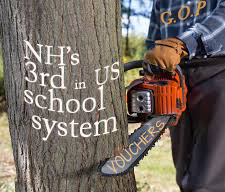
Jeanne Dietsch writes regularly about politics and social welfare in New Hampshire. She is a former legislator. The Republican legislature recently voted to cut public school funding, to launch vouchers for private schools and homeschooling, and to cut property taxes.

She wrote:

A decade ago, I read a story in The Atlantic about a boy stranded at sea, in a boat that had been carefully crafted and tended by his grandfather, but neglected by his parents. The motor died and the dinghy was beginning to leak, amid tall waves, while he was still far from shore.


I see New Hampshire’s children in that boat. One in every nine children in NH lives in poverty – less than $22k per year for a family of three – compared with one in fifteen adults. Between 2008 and 2018, the proportion of children on free and reduced lunch rose almost 40%. NH has among the highest rates of college debt, highest tuition, highest growth in teen suicide. Educational achievement has been demonstrated over 50 years to vary with poverty and parental education more than race. Mental health problems can be caused or exacerbated by the stress of poverty and depression.

Are NH leaders ferreting out the causes of child poverty, the causes of mental illness, to root them out? No, because they would have to admit that defunding government and giving the private sector free rein is not working. They would have to stop steering tax cuts to the wealthy and powerful and start investing in children and the future.

Instead, the G.O.P. is defunding 22 positions at DCYF, the people tasked with protecting children, at a time when reports of abuse have increased. Is it because the state is short on funds? No, revenues exceed plan. It is because the pay scale for those positions is so low that DCYF has been unable to fill 41 vacancies. Last time NH let case loads rise to 70 per employee, two children died. The problem is not lack of funds, it is lack of interest from the G.O.P.

The G.O.P is also cutting the education stability grants that the Senate allocated to property-poor districts last term. This burdens those towns local property taxpayers. This increases poverty in those towns. Public schools hand out take-home meal bags to children who cannot rely on being fed over the weekend. Public schools must try to educate children of parents struggling with addiction, children who have no one at home to care for them.

Rather than address poverty and its impact on educational achievement, G.O.P. leaders merely bandage the wounds of a sick society.[1] They inserted “Education Freedom Account” vouchers into the budget. The EFAs give $4600 per year to people already paying their children’s private tuition. For a family living in poverty, whose parents work extended hours to get by, a partial tuition subsidy is useless. And at least one for-profit company is already raising millions in startup money at the prospect of raking in NH taxpayer dollars for providing cut-rate instructional services. The goal of the company is to replace schools and certified teachers with aides who educate children in their homes. This, according to EFA supporters, will cut local taxes because: Professional teachers will be laid off. Schools will close. And taxpayers will no longer need to maintain the stranded assets of the school districts.These new “micro-schools” cater to people of similar economic, cultural, and educational background. Any sociologist can explain that the way to increase upward mobility is to create networks across boundaries. This approach traps children in bubbles of like-minded people, just as social media does.

Similarly, for mental health, the NH G.O.P majority is funding band aids, increasing budgets for treatment resources. For people already suffering from mental illness, treatment is crucial, of course. However, to ignore poverty’s role in depression and mental illness is like foregoing COVID vaccination and only treating patients after they are sick. It is foolish, expensive, and cruel.

New Hampshire has the second lowest birth rate in a country with less-than-replacement rate nationwide. Each child is that much more precious, as a result. Yet the G.O.P. refuses to invest in them. Is it not obvious that this is a recipe for future decline?

Are NH G.O.P. members so determined to prove that government can do no good that they refuse to use it to help children? Are they so self-indulgent that they only care about their own? Or are they just drinking the kool-aid of the cult?

Whatever reason drives each individual official, they act as a block. We must replace them. And we must not send to Washington any who place profit, power or party over our nation’s future well-being. The seas are rough and the G.O.P. seem willing to let the boat sink, as long as their kids have life vests.

The title of this post may sound absurd. Of course, children should play; it need not be a “right,” as defined in law, but it should be common sense. Play is an essential part of childhood. Most of us remember the games we made up, the pots and pans that we turned into playthings, the music we created on our own. But children today have been denied the fundamental time needed for unstructured play at school. The enactment of No Child Left Behind in 2002 prioritized academic skills and caused many schools to eliminate recess as a “frill.”

Today, happily, there is a movement to bring back recess. Whereas schools used to provide recess once, or twice, or three times a day, it is now legislatures that are mandating recess. Crazy, no? When I attended Montrose Elementary School in Houston, we had recess twice a day, without benefit of a state law.

Today there are several states that mandate recess, which seems to be the only way to guarantee that it is provided.

Parent activists in Illinois just won a victory in the Illinois legislature, with the passage of a bill that requires 30 minutes of recess daily and guarantees that children cannot be punished by withholding recess.

In Texas, where the state legislature spends most of its time figuring out how to increase the number of charters and how to pass vouchers, some districts have taken the initiative to make play available.

Others have decided to rethink recess at the school or district level. A program called LiiNK—Let’s Inspire Innovation ’N Kids—in several Texas school districts sends kids outside for four 15-minute recess periods daily.

Debbie Rhea, a professor and associate dean at Texas Christian University, launched the initiative after seeing a similar practice in Finland. It reminded her of her own elementary school years.

“We have forgotten what childhood should be,” said Rhea, who was a physical education teacher before going into academia. “And if we remember back to before testing—which would be back in the ’60s, ’70s, early ’80s—if we remember back to that, children were allowed to be children.”

LiiNK was a big change for the Eagle Mountain Saginaw Independent School District, where schools saw their recess time quadruple after implementing the program four years ago.

“We’ve seen some amazing changes in our students,” said district LiiNK coordinator Candice Williams-Martin. “Their creative writing has improved. Their fine motor skills have improved, their [body mass index] has improved. Attention in the classroom has improved.”

Some educators claim that play increases test scores, but that’s a shaky foundation for supporting one of the most important building blocks of childhood. Everyone needs time to play, even adults.

I originally posted this commentary in December 2020. It has since been opened by readers more than 600,000 times. It struck a chord with teachers and parents. It still does.

In recent months, we have heard a crescendo of recommendations for what to do with the children. “Test them!” “Quantify the learning loss!” “Let no child go untested!” Those clamoring for testing are well-funded, usually by the Bill & Melinda Gates Foundation. They have big megaphones. Here and there, other voices have spoken with quiet authority about what children need when they are back in school. They need social and emotional support. Some have lost parents, grandparents, siblings, cousins to the virus. Some have experienced intense loneliness and sadness.

Theresa Thayer Snyder offers different advice, based on her long experience as an educator. She was superintendent in the Voorheesville, New York, district. As more and more schools begin to reopen, it is time to read it again.

Teresa Thayer Snyder was superintendent of the Voorheesville district in upstate New York. She wrote this wise and insightful essay on her Facebook page. A friend sent it to me.

Dear Friends and Colleagues:

I am writing today about the children of this pandemic. After a lifetime of working among the young, I feel compelled to address the concerns that are being expressed by so many of my peers about the deficits the children will demonstrate when they finally return to school. My goodness, what a disconcerting thing to be concerned about in the face of a pandemic which is affecting millions of people around the country and the world. It speaks to one of my biggest fears for the children when they return. In our determination to “catch them up,” I fear that we will lose who they are and what they have learned during this unprecedented era. What on earth are we trying to catch them up on? The models no longer apply, the benchmarks are no longer valid, the trend analyses have been interrupted. We must not forget that those arbitrary measures were established by people, not ordained by God. We can make those invalid measures as obsolete as a crank up telephone! They simply do not apply. 

When the children return to school, they will have returned with a new history that we will need to help them identify and make sense of. When the children return to school, we will need to listen to them. Let their stories be told. They have endured a year that has no parallel in modern times. There is no assessment that applies to who they are or what they have learned. Remember, their brains did not go into hibernation during this year. Their brains may not have been focused on traditional school material, but they did not stop either. Their brains may have been focused on where their next meal is coming from, or how to care for a younger sibling, or how to deal with missing grandma, or how it feels to have to surrender a beloved pet, or how to deal with death. Our job is to welcome them back and help them write that history.

I sincerely plead with my colleagues, to surrender the artificial constructs that measure achievement and greet the children where they are, not where we think they “should be.” Greet them with art supplies and writing materials, and music and dance and so many other avenues to help them express what has happened to them in their lives during this horrific year. Greet them with stories and books that will help them make sense of an upside-down world. They missed you. They did not miss the test prep. They did not miss the worksheets. They did not miss the reading groups. They did not miss the homework. They missed you.

Resist the pressure from whatever ‘powers that be’ who are in a hurry to “fix” kids and make up for the “lost” time. The time was not lost, it was invested in surviving an historic period of time in their lives—in our lives. The children do not need to be fixed. They are not broken. They need to be heard. They need be given as many tools as we can provide to nurture resilience and help them adjust to a post pandemic world.

Being a teacher is an essential connection between what is and what can be. Please, let what can be demonstrate that our children have so much to share about the world they live in and in helping them make sense of what, for all of us has been unimaginable. This will help them– and us– achieve a lot more than can be measured by any assessment tool ever devised. Peace to all who work with the children!

As an added bonus, here is a video featuring the author of this wonderful article. Her title: “Children. Cherished and Challenged.”