Archives for category: Childhood

This letter was written by a first grade teacher in upstate Néw York:

She writes:

(Un)Intended Consequences

Today was the first day of the NYS ELA tests. I must state right from the outset that my students do not take these tests. Not yet. But in two short years, they will. And yet, these tests had an effect on my students today and will continue to do so in the days to come. You see, these tests have a ripple effect. The immediate effect is that my students who receive services such as reading and resource will not receive these services for the next TWO WEEKS since the teachers who provide these services are proctoring the state tests. They will also lose services when some of these same teachers are pulled out to score the tests in the subsequent weeks. (They will lose out again when we begin the SLO testing in May, but that is for another post). The longer term effects are more devastating. You see, their education has been hijacked by these tests. Although my “Firsties” are not taking these tests yet, they are preparing for them and will continue to do so throughout their Elementary years.

When I started teaching oh so many years ago, we focused on thematic instruction and integrating all subject areas so that our students had opportunities to make connections. We taught in ways that honored many learning styles, student’s individual differences and developmental stages, along with their individual needs. We understood (and still do) that each child has different intelligences and learning styles. My walls and windows of my classroom were covered with songs and poems, student artwork and artifacts of student learning. My little ones sang and read and played. We taught using literature with rich language and focused on building background knowledge. Children were encouraged to synthesize knowledge and draw conclusions using what they knew and what they were learning. We used a tremendous amount of glitter and paper and encouraged children to express themselves in ways that played to their strengths. We did projects and had lots of hands-on learning with manipulatives. I assessed through observation and working directly with students.

Over the years, we have had to move away from what we know is right for kids to what we are told we must do in order to prepare students for the tests.

At first, teachers knew that we could use those tests to help identify areas where students needed further instruction and where we could improve our teaching. We accepted that our 4th and 8th grade students would be tested and we knew how to prepare them. We focused on those areas and we saw growth. We didn’t like “No Child Left Behind” but we could work within it.

Fast forward to “Race To The Top” and Common Core and the use of the tests to evaluate teachers. Without going into all that is wrong with this, let me just say how it has affected my little ones:

My walls are no longer covered with songs and poems and artwork. That has been replaced with “anchor charts”, “I can statements” and “Learning targets”. We barely use construction paper and I have not purchased glitter in 3 years. There is no time for art projects or creative expression. Children can no longer choose their learning. They write to prompts and must write different genres at certain times. Math is done on paper and manipulatives are few and far between (except when I pull out the old stuff). Reading is “close reading” and answers to questions are to be solely based on the text, without synthesis of prior knowledge.

Assessment is daily and must be documented along with being scripted (because Big Brother is watching). Modules are scripted, teacher led and boring for little ones. We have to have 50% of text presented as informational text. Students have to write essays before they even have automaticity of letter formation. ALL THIS IS DONE SO THEY CAN PREP FOR THE TESTS. My students will take keyboarding in 3rd grade so they can take the tests online…BEFORE SOME OF THEM EVEN HAVE THE PHYSICAL HAND SPAN TO USE A KEYBOARD.

Our littlest learners are preparing for these tests as soon as they enter school. We know that. We know that our colleagues in grades 3-8 depend on us to lay the foundation. We know that our little ones are being used as weapons to help destroy public education. We know that they cannot possibly do well on these tests as they are written 2-3 grade levels above their current grade level and that an arbitrary “cut score” will be determined AFTER the tests are scored to manipulate the data. We know that we cannot discuss these tests and that they cannot be used to inform instruction nor to inform us of our students’ progress. These tests are solely being used to create false data about our students and our schools. They are being used to make our public schools look as though they are “failing” and that our teachers are incompetent. They are creating a pressure cooker atmosphere.

Our Bully of a governor wants to turn our public schools into For-profit Charter schools (which are little more than test prep factories that do NOT have transparency of finances). He is beholden to his hedge fund donors and his big $ donors. In addition, he has publicly stated that he wants to break the teacher’s union. Our children’s education has been hijacked. Our teachers are being abused by an agenda that puts money over what is right for kids. Our society’s future is being manipulated to create a country where the rich get richer and the poor get poorer, both in terms of dollars and education and opportunities. The simple fact that the private schools where the children of the elite attend do not have to participate in these tests or this curriculum, is very telling.

Today’s refusal numbers are encouraging. This is a lesson in civil rights and civil disobedience. We are teaching our children that they have a way of changing what is wrong in our government and our society through nonviolent means. We are teaching them that they have a voice. We are showing them that we can all create change. We are also showing them how to stand up to Bullies. And THAT is a great lesson that no amount of test prep can compare to.
I received this from a principal in New York City. It was written by one of his teachers.


From a 3rd Grade Teacher


“I love teaching!! It fills my heart when my students make connections and get that light in their eyes when they become excited by what they’ve learned. I have some of the brightest bunch of kids this year. They come to school enthusiastic about the day, prepared to learn something new. They challenge me and my thinking, my pedagogy and I reciprocate. Today I saw some of the light in many of my students completely disappear and it broke my heart.


It’s been a grueling three days of testing. Their anxieties manifested themselves in tears, trips to the bathroom because of nausea and complete shutdown. Their self-confidence was stripped from them today and I felt them questioning their intelligence. I believe my 3rd graders were asked to think in ways that many of them are not developmentally ready for. When I could not decide between ‘a’ or ‘d’ and had to critically think and rethink how I would go about answering the questions being asked, I know that what was given to them today was not fair.


So now I will spend the next few days building my kids back up. Help them to forget the trauma of these past few days and remind them that it’s ok to be a kid and to think the way they do. I cannot find the words to express my disgust for this system and for the people in power who continue to allow this to happen.


We have to STAND UP PEOPLE!! We need to remind those test makers that we teach children, little humans who learn in different ways and who can demonstrate their learning in different ways. We need to change the face of assessment in this country. I’m ready… Are you??! “

Defending the Early Years is an organization of professionals who have devoted themselves to early childhood education. DEY has just published a new report by Lillian G. Katz, Professor Emerita of Early Childhood Education at the University of Illinois, called Lively Minds: Distinctions Between Academic Versus Intellectual Goals for Young Children.


This comes from DEY’s website:


Dr. Katz argues that the common sense notion that “earlier is better” is not supported by longitudinal studies of the effects of different kinds of preschool curriculum models. Furthermore, her report maintains that a narrow academic curriculum does not recognize the innate inquisitiveness of young children and ultimately fails to address the way they learn.


“Young children enter the classroom with lively minds–with innate intellectual dispositions toward making sense of their own experience, toward reasoning, predicting, analyzing, questioning and learning,” says Dr. Katz.


“But in our attempt to quantify and verify children’s learning, we impose premature formal instruction on kids at the expense of cultivating their true intellectual capabilities – and ultimately their optimal learning.”


While the report concludes that an appropriate curriculum for young children is one that focuses on supporting children’s in-born intellectual dispositions, some basic academic instruction in early years is needed. “Academic skills become necessary for students to understand and report on their own authentic investigations,” explains Katz. “These skills can then serve as a means to the greater end of fostering and advancing children’s intellectual capabilities.”


The report begins:


The extent to which academic instruction should be a major goal of the curriculum for preschool and kindergarten children is a constant topic of debate among the many parties concerned with early childhood education. The introduction of local, state and national standards has exacerbated the complexities involved in resolving these issues. I am suggesting that perhaps one approach to resolving some of the dissention concerning curriculum focus in the early years and about the potential risks of premature formal academic instruction is to examine the distinctions between academic and intellectual goals – perhaps during all the years of education.


Some participants in these debates assume that we confront a choice between a traditional preschool curriculum that emphasizes spontaneous play plus many simple activities, (e.g. creating objects with clay, building with blocks, listening to amusing stories, and other pleasant experiences) versus introducing and emphasizing formal instruction on basic academic skills and knowledge (e.g. the alphabet, days of the week, names of the months, the calendar, counting, etc.).


The main argument presented here is that the traditional debates in the field about whether to emphasize so-called free play or formal beginning academic instruction are not the only two options for the early childhood curriculum. Certainly some proportions of time can be given to both of those kinds of curriculum components. But in the early years, another major component of education – (indeed for all age groups) must be to provide a wide range of experiences, opportunities, resources and contexts that will provoke, stimulate, and support children’s innate intellectual dispositions.


ACADEMIC GOALS. Academic goals are those concerned with the mastery of small discrete elements of disembodied information, usually related to pre-literacy skills in the early years, and practiced in drills, worksheets, and other kinds of exercises designed to prepare children for the next levels of literacy and numeracy learning. The items learned and practiced have correct answers, rely heavily on memorization, the application of formulae versus understanding, and consist largely of giving the teacher the correct answers that the children know she awaits. Although one of the traditional meanings of the term academic is “of little practical value,” these bits of information are essential components of reading, writing, and other academic competencies useful in modern developed economies, and certainly in the later school years. In other words, I suggest that the issue here is not whether academic skills matter; rather it is about both when they matter and what proportion of the curriculum they warrant, especially during the early years.


INTELLECTUAL GOALS. Intellectual goals and their related activities, on the other hand, are those that address the life of the mind in its fullest sense (e.g. reasoning, predicting, analyzing, questioning, etc.), including a range of aesthetic and moral sensibilities. The formal definition of the concept of intellectual emphasizes reasoning, hypothesizing, posing questions, predicting answers to the questions, predicting the findings produced by investigation, the development and analysis of ideas and the quest for understanding and so forth.


An appropriate curriculum for young children is one that includes the focus on supporting children’s in-born intellectual dispositions, their natural inclinations. These would include, for example, the disposition to make the best sense they can of their own experiences and environments. An appropriate curriculum in the early years then is one that includes the encouragement and motivation of the children to seek mastery of basic academic skills, e.g. beginning writing skills, in the service of their intellectual pursuits. Extensive experience of involving preschool and kindergarten children in in-depth investigation projects has clearly supported the assumption that the children come to appreciate the usefulness of a range of basic academic skills related to literacy and mathematics as they strive to share their findings from their investigations with classmates and others. It is useful to assume that all the basic intellectual skills and dispositions are in-born in all children, though, granted, stronger in some individuals than in others…like everything else.


SCHOOL READINESS AND THE INTELLECT. There are two further points to emphasize in connection with the importance of intellectual goals. One is that it is widely assumed that because some young children, especially those of low-income families, have not been exposed to the knowledge and skills associated with ‘school readiness,’ e.g. have not had experience of using books, etc., that they lack the basic intellectual dispositions such as to make sense of experience, to analyze, hypothesize, predict, as do their peers of more affluent backgrounds. Such children may not have been read to or to have observed adults habitually reading, or perhaps have never yet used a pencil at home. But I suggest that it is reasonable and perhaps also helpful to assume that they too usually have lively minds. Indeed, the intellectual challenges many children face in coping with precarious environments are likely to be substantial and often complex. It is incumbent upon the school to connect with them in terms of the unique aspects of intellect and dispositions that they bring.


Secondly, while intellectual dispositions may be weakened or even damaged by excessive and premature formal instruction, they are also not likely to be strengthened by many of the mindless, trivial if not banal activities frequently offered in child care, preschool and kindergarten programs. I visited a school district in one of our Western states not long ago in which the kindergartens had adopted as a theme for the year “Teddy Bears” – a whole year!! In the classroom visited, the children were to take turns “showing and telling” about their own teddy bears, to count the number of them in the class collection, to measure the lengths and weights of the items, define their colors, and to make up stories with them as main characters. While such activities are probably not harmful and may even – at least briefly – be fun for the children, they are unlikely to be intellectually provocative, engaging or stimulating. By contrast, when young children engage in projects in which they conduct investigations of significant objects and events around them, for which they have developed the research questions and by which they themselves find out how things work, what things are made of, what people around them do to contribute to their well-being, and so forth, as can be seen in many reports of project work in the early years (see reports of projects in each issue of Early Childhood Research and Practice http://ecrp. uiuc.edu)1, their lively minds are fully engaged. Furthermore, the usefulness and importance of being able to read, write, measure and count gradually becomes self-evident (See also Katz & Chard, 2000; Helm & Katz, 2001). We need significant meanings as the center of education. Significant meanings through action-based learning environments provide reasons for children to represent experiences through many formats and deserve to be the center of education.


If you care about children and the early years, read the entire report.

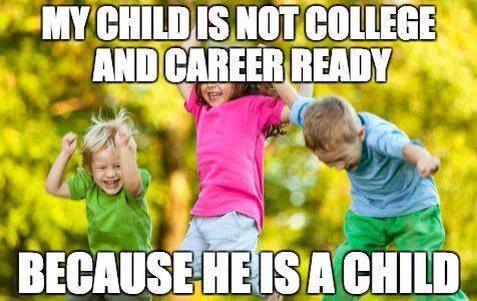
This wonderful photo is making the rounds on Twitter. The quote was taken from Monroe County ICPE (Indiana Coalition for Public Education) chairperson Cathy Fuentes-Rohwer’s speech at the Indiana State House last month. When I hear about “college and career ready standards” for elementary school and middle school children, I am reminded of the famous words of Secretary of Education Arne Duncan, who once famously said:


“We should be able to look every second grader in the eye and say, ‘You’re on track, you’re going to be able to go to a good college, or you’re not,’ ” he said. “Right now, in too many states, quite frankly, we lie to children. We lie to them and we lie to their families.”


When I look at my young grandchildren, ages 8 and not quite 2, this is the same thought that occurs to me, as I feel sure it does to most parents and grandparents:


collegeready

This statement was posted as a comment on the blog:


The Rights of the Children


An education is the right for us, the children

And even now here in the USA

More than half of us don’t have enough clothes or food

Please don’t test our educational rights away

Don’t fire those teachers who are on our side

Please don’t make them go away

Just because we couldn’t get those very high scores

Testing us doesn’t help us learn more

Testing us more doesn’t increase our scores

An education is our ticket to our future lives

So our kids won’t come home to what we do now

An empty home, an empty house

No one to help us study or do homework

Because our parents have to work hard and long

They do not care about tests, but they care what we learn

Please don’t test our educational rights away

Don’t fire those teachers who are on our side

Please don’t make them go away

Just because we couldn’t get those very high scores

Testing us doesn’t help us learn more

Testing us more doesn’t increase our scores

An education is our ticket to our future lives

Cynthia DeMone

Rae Pica wrote an excellent column about the disconnect between current education policies and well-established principles of child development. Rae has written a book that I read last weekend in galleys, called What If Everybody Understood Child Development? (Corwin Press); it will be published in June.


In this article, she makes a straightforward point: Children develop at different rates. They are not identical. There is a range of “normal” development.


She writes:


Did you know that there are 90 reading standards for kindergartners under Common Core and that allkindergartners will be expected to read under these standards?


I don’t know why I’m surprised. In an interview on BAM Radio Network several years ago, noted early childhood expert Jane Healy told me, “We have a tendency in this country to put everybody into a formula – to throw them all into the same box and have these expectations that they’re all going to do the same thing at the same time.”


For the most part, that’s always been the case with education: expecting all children in the same grade to master the same work at the same level and pace. But since the inception of No Child Left Behind – and now with Race to the Top and the implementation of the Common Core Standards (“common” being the operative word) – it’s only gotten worse. The “box” has gotten even smaller. And the younger the children, the less room there is for movement inside it. (Play on words intended.)…


Standards are written by people with little to no knowledge of child development or developmentally appropriate practice. They’re written with too little input from people who do have that knowledge – like teachers and child development experts. In fact, of the 135 people on the committees that wrote and reviewed the K-3 Common Core Standards, not one was a K-3 teacher or an early childhood professional….


As an example demonstrating the large range of what is “normal” in child development, Marcy [Guddemi, of the Gesell Institute for Child Development] explains that the average age at which children learn to walk is 12 months – 50 percent before and 50 percent after. But the range that is normal for walking is 8-3/4 months all the way to 17 months. The same applies for reading. The average age at which children learn to read is six-and-a-half – again, 50 percent before and 50 percent after.


I suggest you pre-order a copy of Rae Pica’s book. It is filled with research-based, commonsense wisdom.

Reader David Spring read about Connecticut’s plan to pass a law to teach keyboarding skills in kindergarten, and he had a good idea:

“I think if moms do a lot of keyboarding while they are pregnant, it should help infants learn keyboarding sooner. After all, we should be able to look a two year old in the eye and tell them whether they are career and college ready.”

David Gamberg, superintendent of the Southold and Greenport districts in Long Island, Néw York, here defends childhood and the value of play against the endless barrage of high-stakes testing coming from federal and state officials.


He writes:


“The curiosity and creativity of a child is at stake. They should be full of wonder. They should be given the proper time and space to venture into the world of others as they read for pleasure, dabble in watercolors that know no bounds, or expend the boundless energy of a little boy or girl on the playground without the fear of being cut short in the name of preparing for a high stakes test. The experiences that children should be engaged in are being sacrificed at an alarming rate…..


“The idea that we must designate scores to a narrow band of testable content areas (math and English Language skills) as future predictors of global competitiveness is about as sensible as mining for fool’s gold in the desert. The future of our nation more likely hinges on educating a generation of well-nourished children, who arrive at school excited by the prospect of being socially and emotionally engaged in learning that is joyous. School must promote the use of time that is filled as much with singing, dancing, drawing and running as it is with experimenting in science or practicing essential skills in reading, writing, and math.


“I call upon our elected leaders and policymakers to fashion a more balanced and sensible path forward. The current plan that looks at one side of the educational ledger is as misguided as it is destined to produce a generation of children who fail to fully experience childhood to the detriment of our civil well being in the years ahead.”

Peter Rawitsch is a first-grade teacher in New York. He is a National Board Certified Teacher. He has been trying to teach his class the Common Core standards for nearly three years. He has concluded that they are a nightmare. He wrote this opinion piece in the Albany Times Union:


“What do you want to be when you grow up?” Depending on the day, my six and seven year old children might answer: “soccer player,” “princess,” or “veterinarian.” Sadly, most of them will have to put their dreams on hold because they’re too busy working on someone else’s dream of them becoming “college and career ready.” I think it’s a nightmare.

Six and seven year old children are active learners. They use all of their senses to learn in a variety of ways. Each child learns at their own pace. Play is their work. Using materials they can manipulate helps them think about how things work, use their imagination, and solve problems. They construct knowledge through their experiences.

As a 1st grade teacher with bachelor’s and master’s degrees in education, National Board Certification in Early Childhood, and 37 years of classroom experience, I’m deeply troubled by what is being demanded of our young learners.

For the past 2½ years I have been trying to help the children in my classroom become proficient in the 1st grade Common Core State Standards (CCSS). Because the children are at different places in their development, some have been successful with the new standards, but for too many, these new expectations are inappropriate and unfair. They’re being asked to master material they simply aren’t ready to do yet. Among the flaws of the CCSS is the assumption that all students in a given grade are capable of learning all of the same grade level standards by the end of a school year. But many of the current 1st grade standards were, just a few years ago, skills that 2nd grade students worked on.


The Gesell Institute of Child Development has studied the cognitive development of children three to six years of age since 1925. In 2010 it reported that young children “are still reaching developmental milestones in the same timeframe,” meaning, that while the learning standards have changed, the way children learn has not.


He points out that those who wrote the Common Core standards included no one experienced or expert in the teaching of the youngest learners. No one on the New York Board of Regents that adopted the Common Core had experience with teaching young children. The Common Core standards are inappropriate for young children.


He concludes that it is time for parents to take action. Learn about what your children do in school. Talk to their teacher. Find out what activities have been replaced by sitting and bubbling in answers and busywork.


How much more sitting are the children doing for reading and writing activities? How have additional paper and pencil tests affected when and how things are taught? Which activities and experiences that once enriched the school day and fostered a love of learning have been pushed out? Teachers need to talk about child development and appropriate academic standards at School Board and PTA meetings. Together we need to speak up and advocate for an education that celebrates and honors our young learners. Our children’s dreams matter.


Try this link:

http://www.timesunion.com/tuplus-opinion/article/Advocate-for-young-learners-6109146.php

Mercedes Schneider reviews what is in store for children in Néw Jersey when they take the PARCC test:

“PARCC testing in New Jersey is scheduled to begin March 2, 2015. The NJ PARCC testing “window” will not end in March, but will continue into April, May, and June, depending upon the grade level and whether the test is part of the PBA (performance-based assessment), which is given 75% of the way through a school year, or EOY (end of year), which comes 90% of the way into a school year.

“For third grade, New Jersey schools must schedule 4.75 hours for the English language arts (ELA) PBA and EOY PARCC and 5 hours for the math PBA and EOY PARCC.

“Just shy of 10 hours of schedules testing time for a third grader.

“For fourth and fifth graders it is a full 10 hours.

“For sixth through eighth graders, almost 11 hours.”

Why is it necessary to spend so much time to find out whether children can read and do math?

Some parent groups are urging opting out.

The opt out talk has grown so loud that DC-based Education Trust has sent opinion pieces to Néw Jersey papers urging parents not to opt out. Schneider points out that Education Trust is heavily funded by the Gates Foundation.

New Jersey parents: do not subject your children to 10 hours of testing. Opt out.