Archives for category: Childhood

David Gamberg, superintendent of the Southold and Greenport districts in Long Island, Néw York, here defends childhood and the value of play against the endless barrage of high-stakes testing coming from federal and state officials.


He writes:


“The curiosity and creativity of a child is at stake. They should be full of wonder. They should be given the proper time and space to venture into the world of others as they read for pleasure, dabble in watercolors that know no bounds, or expend the boundless energy of a little boy or girl on the playground without the fear of being cut short in the name of preparing for a high stakes test. The experiences that children should be engaged in are being sacrificed at an alarming rate…..


“The idea that we must designate scores to a narrow band of testable content areas (math and English Language skills) as future predictors of global competitiveness is about as sensible as mining for fool’s gold in the desert. The future of our nation more likely hinges on educating a generation of well-nourished children, who arrive at school excited by the prospect of being socially and emotionally engaged in learning that is joyous. School must promote the use of time that is filled as much with singing, dancing, drawing and running as it is with experimenting in science or practicing essential skills in reading, writing, and math.


“I call upon our elected leaders and policymakers to fashion a more balanced and sensible path forward. The current plan that looks at one side of the educational ledger is as misguided as it is destined to produce a generation of children who fail to fully experience childhood to the detriment of our civil well being in the years ahead.”

Peter Rawitsch is a first-grade teacher in New York. He is a National Board Certified Teacher. He has been trying to teach his class the Common Core standards for nearly three years. He has concluded that they are a nightmare. He wrote this opinion piece in the Albany Times Union:


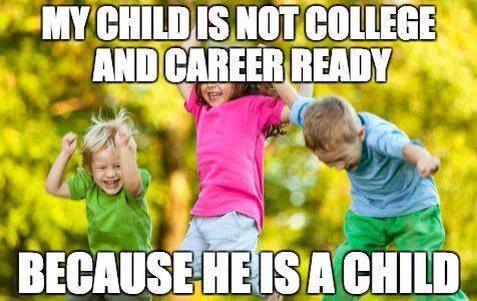
“What do you want to be when you grow up?” Depending on the day, my six and seven year old children might answer: “soccer player,” “princess,” or “veterinarian.” Sadly, most of them will have to put their dreams on hold because they’re too busy working on someone else’s dream of them becoming “college and career ready.” I think it’s a nightmare.

Six and seven year old children are active learners. They use all of their senses to learn in a variety of ways. Each child learns at their own pace. Play is their work. Using materials they can manipulate helps them think about how things work, use their imagination, and solve problems. They construct knowledge through their experiences.

As a 1st grade teacher with bachelor’s and master’s degrees in education, National Board Certification in Early Childhood, and 37 years of classroom experience, I’m deeply troubled by what is being demanded of our young learners.

For the past 2½ years I have been trying to help the children in my classroom become proficient in the 1st grade Common Core State Standards (CCSS). Because the children are at different places in their development, some have been successful with the new standards, but for too many, these new expectations are inappropriate and unfair. They’re being asked to master material they simply aren’t ready to do yet. Among the flaws of the CCSS is the assumption that all students in a given grade are capable of learning all of the same grade level standards by the end of a school year. But many of the current 1st grade standards were, just a few years ago, skills that 2nd grade students worked on.


The Gesell Institute of Child Development has studied the cognitive development of children three to six years of age since 1925. In 2010 it reported that young children “are still reaching developmental milestones in the same timeframe,” meaning, that while the learning standards have changed, the way children learn has not.


He points out that those who wrote the Common Core standards included no one experienced or expert in the teaching of the youngest learners. No one on the New York Board of Regents that adopted the Common Core had experience with teaching young children. The Common Core standards are inappropriate for young children.


He concludes that it is time for parents to take action. Learn about what your children do in school. Talk to their teacher. Find out what activities have been replaced by sitting and bubbling in answers and busywork.


How much more sitting are the children doing for reading and writing activities? How have additional paper and pencil tests affected when and how things are taught? Which activities and experiences that once enriched the school day and fostered a love of learning have been pushed out? Teachers need to talk about child development and appropriate academic standards at School Board and PTA meetings. Together we need to speak up and advocate for an education that celebrates and honors our young learners. Our children’s dreams matter.


Try this link:

http://www.timesunion.com/tuplus-opinion/article/Advocate-for-young-learners-6109146.php

Mercedes Schneider reviews what is in store for children in Néw Jersey when they take the PARCC test:

“PARCC testing in New Jersey is scheduled to begin March 2, 2015. The NJ PARCC testing “window” will not end in March, but will continue into April, May, and June, depending upon the grade level and whether the test is part of the PBA (performance-based assessment), which is given 75% of the way through a school year, or EOY (end of year), which comes 90% of the way into a school year.

“For third grade, New Jersey schools must schedule 4.75 hours for the English language arts (ELA) PBA and EOY PARCC and 5 hours for the math PBA and EOY PARCC.

“Just shy of 10 hours of schedules testing time for a third grader.

“For fourth and fifth graders it is a full 10 hours.

“For sixth through eighth graders, almost 11 hours.”

Why is it necessary to spend so much time to find out whether children can read and do math?

Some parent groups are urging opting out.

The opt out talk has grown so loud that DC-based Education Trust has sent opinion pieces to Néw Jersey papers urging parents not to opt out. Schneider points out that Education Trust is heavily funded by the Gates Foundation.

New Jersey parents: do not subject your children to 10 hours of testing. Opt out.

Robert Pondiscio hit a hornet’s nest when he wrote in defense of the Common Core standards for kindergarten. In this post, which was released by DEY (Defending the Early Years), its director Geralyn Bywater McLaughlin, responds to Pondiscio.


She writes:


Last week, Senior Fellow and Vice President for External Affairs at the conservative Fordham Institute, Robert Pondiscio published a critique of our recent report Reading Instruction in Kindergarten: Little to Gain and Much to Lose. His essay “Is Common Core too hard for kindergarten?” was published in the Common Core Watch blog at the Fordham Institute. After reading his essay, a few things are quite clear.


First, it is not surprising that the critique comes from this corner – the Fordham Institute has been a key player promoting the Common Core State Standards (CCSS). In fact, the Gates-funded Fordham Institute, which has been rating education standards for years, has been pushing the CCSS even in places where they have rated the existing state standards higher than they have rated the CCSS.


Second, it is surprising how our paper and our position have been completely misunderstood by Pondiscio. Not only does he dismiss early childhood expertise out of hand, he misrepresents our arguments. This is even after participating in an hour-long panel discussion on KQED’s Forum with one of the report authors, Nancy Carlsson-Paige, Ed.D. Pondiscio further debases the intellectual competence of early childhood educators when he describes our researched-based advocacy report as “complaints”.


Pondiscio writes that our report “complains” that “expecting kindergarteners to read is ‘developmentally inappropriate’”. In fact, we agree that many kindergarteners do learn to read. It is precisely something that we expect. Our deep concern is over the CCSS expectation that ALL children learn to read in kindergarten. As we state in the report, “Many children are not developmentally ready to read in kindergarten, yet the Common Core State Standards require them to do just that. This is leading to inappropriate classroom practices.”


Pondiscio describes our position as simply stating the “Common Core is too hard for kindergarten”. He uses this reductive phrase “too hard” repeatedly throughout his essay. In fact, our argument is much more nuanced than that. We do state, “When children have educational experiences that are not geared to their developmental level or in tune with their learning needs and cultures, it can cause them great harm, including feelings of inadequacy and confusion.”


To bolster his critique, Pondiscio offers a link to a chapter in a book published by Scholastic (no author given) that references a study by researchers Hanson and Farrell (1995). We were able to find this study, which was presented at the annual meeting of the American Association of Colleges for Teacher Education in Chicago, though it is not clear if this research was published in a peer-reviewed journal. We shared the research with a trusted education researcher who responded that it is difficult to evaluate this “poor and old piece of evidence,” as some important technical information is missing – such as the standard deviations – making it hard to estimate the size of the claimed effects.


Pondiscio writes that “If teachers are turning their kindergarten classrooms into joyless grinding mills and claiming they are forced to do so under Common Core (as the report’s authors allege), something clearly has gone wrong.” Here, Pondiscio contributes to the on-going national narrative of teacher-bashing. The onus here is on the teachers, he claims, not on the misguided CCSS or the pressure from school administrators, district superintendents and state departments of education to produce high-scoring test results.


It is insulting for Pondiscio to imply our intended message is “children should not be reading by the end of kindergarten, or that they will read when they are good and ready.” We clearly state that there is a normal range for learning to read. We know that many children learn to read at five, four or even three-years-old. Many will learn to read in kindergarten. That is not a problem. We also understand quite fully that learning to read is highly individualized and that it is part of the craft of good teaching to know your students well and to understand why, how and when specific supports are needed. The CCSS one-size-fits-all, lock-step expectations do not allow for teacher judgment. We know that the CCSS has led to a shift in reading assessments that have been around for a long time. For example, reading experts Fountas and Pinnell used to suggest that ending kindergarten in the A-C of books range was okay. Now, with the CCSS-informed shift, if a student has not progressed past level B by the beginning of first grade, he is designated as requiring “Intensive Intervention.”


There is much more to refute in Pondiscio’s essay, though we have given him enough of our attention. To read more on the issue, we suggest Susan Ochshorn’s response to Pondiscio here.


Geralyn Bywater McLaughlin, Director

Defending the Early Years (DEY)

Susan Ochshorn read Robert Pondiscio’s post “Is Common Core Too Hard for Kindergarten?” (he thinks not), and she felt impelled to respond, even though she is on vacation. Ochshorn is the founder of ECE Policy Works. She is the author of the forthcoming book, “Squandering America’s Future – Why ECE Policy Matters for Equality, Our Economy and Our Children,” about critical policy issues in early childhood education (Teachers College Press, 2015).


Susan Ochshorn writes:


Leave the country, and all hell breaks loose. A couple of days ago, in the “Common Core Watch,” the bully pulpit for the conservative Fordham Institute, Robert Pondiscio, senior fellow and vice president for external affairs, asked if the blessed academic standards were too hard for kindergarten. The short answer: no.


The occasion for his musings—and supreme irritation—was the publication of “Reading Instruction in Kindergarten: Little to Gain and Much to Lose,” a report of Defending the Early Years (DEY Project) and the Alliance for Childhood. The paper debunks the common belief that reading earlier is better for future academic success, and warns of the deleterious effects on children of what Pondiscio calls a “perceived shift” from play-based, experiential learning to more academic approaches.


Perception is relative, of course. But where has Pondiscio been? Apparently, he’s heard nothing about the research of Daphna Bassok and Anna Rorem—empirical proof on the shift, from the Frank Batten School of Leadership and Public Policy at the University of Virginia. Working with two national datasets, which straddle the introduction of No Child Left Behind, the authors sought to fill in the gaps about the changing nature of kindergarten in the United States between 1998 and 2006. They discovered that even before the adoption of the Common Core standards, pressure among principals and teachers had accelerated considerably, with high-stakes assessments leading to academic and accountability “shove down.”


For some of that time, according to LinkedIn, Pondiscio was employed in public relations and communications at Time magazine, Hill and Knowlton, and Businessweek. Just as NCLB got going, he spent four years teaching fifth-graders in the South Bronx, before moving on to the Core Knowledge Foundation, and Democracy Prep, a network of charter schools based in Harlem, where he taught seminars in civics, citizenship, and democracy.
Civics? For someone who calls himself an expert on the machinations of our precious democracy, Pondiscio couldn’t be more disdainful of those who would raise their voices in protest—those who do know something about early child development and education. “The authors make much of the fact that no one involved with writing the standards was a K-3 teacher or early-childhood professional,” he writes. Not important, he concludes.


And then there’s Valerie Strauss. The Washington Post and “Common Core-averse education blogger” has been championing the report in her space, and running pieces by parents and teachers “arguing that ‘forcing some kids to read before they are ready could be harmful.’” What unmitigated nerve!
But let’s get down to the nitty gritty here. Before Pondiscio became a PR guru and a civic society expert, he picked up a bachelor’s degree in cultural studies. Nowhere on his curriculum vitae do I see anything related to kids’ development. Nada.


Yet he has no trouble weighing in on the fine details of the subject—including developmentally appropriate (or inappropriate) practice.
It’s “not as scientifically clear-cut as many suppose,” he writes. “There’s little evidence to suggest that a child’s readiness to learn occurs in the discrete, stair-step phases that Piaget theorized about long ago.” He then goes on to cite cognitive psychologist Dan Willingham, who has apparently noted—wisely, I might add—that “children’s cognition is fairly variable day to day, even when the same child tries the same task.” Indeed. The very argument made by the authors of “Kindergarten: Little to Gain and Much to Lose!” Kids are not universally ready to read at five.


Pondiscio’s in way over his head here. Children’s development is exceedingly uneven. Anyone who knows anything about child development would tell you that—including the Finns, who don’t push their children to read when they’re five, who hold off on standardized testing until much later, and, by the way, are up there with the world’s highest scorers on the PISA tests of academic mastery. Another thing: the Finns revere children, and see early childhood as a time for play, exploration, and the foundation for equality, and citizenship in a democracy.


As Finland’s minister of education, Krista Kiuru, told an interviewer in the Atlantic last spring: “Equal means that we support everyone and we’re not going to waste anyone’s skills. “We can’t know if one first-grader will become a famous composer, or another a famous scientist,” she said. “Regardless of a person’s gender, background, or social welfare status, everyone should have an equal chance to make the most of their skills.”


But Finland’s not cramming kindergarten readiness assessments and reading down the throats of five-year-olds. And Finland doesn’t have alarming rates of preschool expulsion, as we do in the U.S., mostly among little boys of color. Children’s social-emotional development is inextricably linked to their acquisition of cognitive skills. And play is where the cognitive and social-emotional come together. Yes, kids are capable of amazing things—they are, in fact, our littlest innovators—but play, as neuroscientist and anthropologist Melvin Konner wrote in his epic work, “The Evolution of Childhood,” is the primary engine of human development.


Pondiscio says that nothing in the Common Core standards precludes the creation of “safe, warm, nurturing classrooms that are play-based, engaging, and cognitively enriching.” Wouldn’t it be pretty to think so? But such classrooms are rapidly disappearing, given over to learning blocks dedicated to discrete subjects, which sideline the kind of imaginative play on which children thrive. They’re part and parcel of the Common Core package, over which teachers have no control. He also urges early childhood advocates to push “aggressively for teacher education and professional development,” enabling them to meet the Common Core benchmarks. They are pushing, like Sisyphus—but the rock weighs a ton. And as states develop evaluation systems that rate teachers based on student test scores, their very livelihoods are at stake.


I’d suggest a semester of child development 101 for the Fordham Institute’s VP for external affairs. NYC has plenty of terrific programs, and he’s got huge gaps in his own core knowledge.

Daniel S. Katz read the New York Times’ article “Is Your First-Grader College-Ready,” and he was not sure at first whether it was a spoof or for real. Evidently, it was for real. He introduces us to the useful term “Poe’s Law.” Wikipedia describes it thus: “a literary adage which stipulates that without a clear indicator of an author’s intended sarcasm it becomes impossible to tell the difference between an expression of sincere extremism and a parody of extremism.”*


It takes close reading a la Common Core for Katz to figure out that the article was for real, not a parody. Yet it still reads like a parody.


He writes:


So what is almost satirical about some of the approaches described in the Times?


It is one thing to talk to first grade students about what they want to be when they grow up. For students who are growing up without many community models of post-secondary education, I can see potential in the middle school activities described that emphasize recognizing what would be needed to accomplish their ambitions. However, the early elementary discourse transforms from surprising to comical to frustrating in very short order. Six year-olds are not simply talking about what they want to be as grown ups; they are naming specific schools and filling out mock applications for the bulletin board. The first grade teacher is quoted discussing that it is not enough to ask children what they want to be: “We need to ask them, ‘How will you get there?’ Even if I am teaching preschool, the word ‘college’ has to be in there.” The approach is not simply being applied in districts with high concentrations of disadvantage; the article quotes a college planner from Westchester County, New York who compares college preparation to becoming an Olympic skater whose training begins in earnest at age 6.


As a mother and grandmother, I can recall many conversations with young children about what they want to be when they grow up. The answers ranged from “a cowboy.” to “a fireman,” to “a movie star,” to “a baseball player,” to “an astronaut.” Why in the world would six-year-old children fill out mock college applications? Isn’t there plenty of time in high school to think about college, which courses to take to be prepared, which colleges are a good fit for one’s interests, which colleges are affordable, etc.? There ought to be a law that little children are allowed to have a childhood before adult compulsions are forced on them. They should be playing with dolls and building sand castles and making things out of blocks and coloring in coloring books and molding things from clay or Play-Dough; they should dance and sing. Why can’t the grown-ups let them be children? They are NOT global competitors; they are children.


*According to Wikipedia, Poe’s Law is of recent vintage. The article says:


The statement called Poe’s law was formulated in 2005 by Nathan Poe on the website christianforums.com in a debate about creationism. The original sentence read:


Without a winking smiley or other blatant display of humor, it is utterly impossible to parody a creationist in such a way that someone won’t mistake for the genuine article.[4]


The sentiments expressed by Poe date back much earlier – at least to 1983, when Jerry Schwarz, in a post on Usenet, wrote:


8. Avoid sarcasm and facetious remarks.


Without the voice inflection and body language of personal communication these are easily misinterpreted. A sideways smile, :-), has become widely accepted on the net as an indication that “I’m only kidding”. If you submit a satiric item without this symbol, no matter how obvious the satire is to you, do not be surprised if people take it seriously.[5]


Another precedent posted on Usenet dates to 2001. Following the well-known schema of Arthur C. Clarke’s third law, Alan Morgan wrote:


“Any sufficiently advanced troll is indistinguishable from a genuine kook.”[6]

The Boston Globe interviewed early childhood education expert Nancy Carlsson-Paige about the changing nature of kindergarten. C-P told the writer Joanne Weiss that five-year-old children learn through play, not flash cards and drill. They are hard-wired to learn through play. The Common Core expects that children will learn to read in kindergarten, but C-P says that goal is developmentally inappropriate. An organization she helped found, “Defending the Early Years,” reviewed the research and could find no support for the Common Core claim that children in kindergarten should learn to read. There is time for that in first and second grades.


Weiss followed that interview by talking to State Commissioner Mitchell Chester in Massachusetts, who said that his concern for poor and minority students led him to believe that they should learn to read in kindergarten. It is a matter of civil rights. But reformers have become skilled at invoking “civil rights” for whatever they choose to do. If it is not right for children, it is not right for poor and minority children. Don’t you think?

We live in a time that reeks with what the late child psychiatrist Elisabeth Young-Bruehl called “Childism: Prejudice Against Young Children.” In a book with that title, she identified NCLB high stakes testing as an example of “Childism.”

Thomas Scarice, Superintendent of Schools in Madison, Connecticut, makes a plea to restore innocence to children.

Scarice writes:

“Over the past decade, schools have deteriorated into data factories, reducing children to mere numbers, with a perverted ranking and sorting of winners and losers in high stakes testing schemes. And now, a new test promising to revolutionize education will produce yet more meaningless data for adults starving to exploit children for self-gain, selfish career aspirations, blind ideological ploys, or for the purposes of establishing high property values on the backs of children, all the while sorting out which 8 year olds are on track to be “college and career ready”.

“Even at the classroom level, children suffer from the unintended consequences of well-meaning adults unaware of the ways that children naturally develop and grow. Frivolous homework policies invade private family time and rob children of necessary unstructured time to develop executive functioning.

“Play, the natural way children learn, is reduced to filler, barely acknowledged for the critical role it fulfills in child development. No one questions why the caged bird flies as soon as the cage door opens, nor should they question why children naturally play at a moment’s notice.

“Even perhaps the most fundamental function of schools, the teaching of reading, has succumbed to the ignorance of this era. New standards and tests with a myopic focus on text without regard for the reader (i.e. the child actually doing the reading), without regard for their interests, knowledge, and passions, will serve to further disengage children from the splendor of reading and give students more reasons to see school, and reading, as irrelevant.

“With unprecedented childhood poverty rates, an explosion in the identification of attention deficit disorder, recent reports of soaring teenage suicide rates, one thing is clear: the violation of childhood knows no boundaries.”

We are the adults, Scarice says. It is our responsibility to protect children, not to use them to satisfy our will or ideology.

Politicians continue to fret about scores on tests and to ignore the causes of poor academic performance. They have this strange belief that more testing will raise test scores and that they need not address the underlying causes of low scores.


Consider this report from politico.com:


“THE CONSEQUENCES OF CHILDHOOD TRAUMA: Nearly half of U.S. children have gone through a traumatic experience like exposure to violence, economic hardship, family discord or mental health and substance abuse. And for the one in five children who’ve been through at least two traumatic experiences, the consequences can be dire, a study in this month’s issue of Health Affairs says. Those kids were twice as likely as their peers to have a chronic condition and special health needs. And they were 2.5 times more likely to repeat grades in school. The study: http://bit.ly/1stwY81

Chris Rowan, a pediatric occupational therapist, wants governors, schools, and parents to ban the use of handheld electronic devices for children under the age of 12.

Rowan lists ten reasons why he believes that these devices impair children’s healthy development.

Among the negative effects, he says, are attention deficit disorder, obesity, increased impulsivity, delayed cognitive development, sleep deprivation, mental illness, aggression, decreased concentration, and exposure to radiationeission.

What do you think?