|
Craig’s Chicago Business acknowledges that the children in Chicago public schools need what the Chicago Teachers Union won in their contract negotiations. But still, they wonder, are taxpayers willing to pay the price?
Now that financial details of the pact are starting to trickle out, it’s clear that the mayor was telling the truth—that is, for the teachers. And that truth raises a very significant question of whether the unprecedented, potentially $1.5 billion mayoral bet will be worth the cost to already struggling Chicago taxpayers.
That $1.5 billion figure comes from the Chicago Public Schools’ budget office. It’s at the high range of what officials say the new CTU deal will cost over the next five years cumulatively…
“The union won the strike. They absolutely won,” says Paul Vallas, a former CPS CEO who was one of Lightfoot’s rivals in the February mayoral election. “It’s going to be impossible for them to come up with that much dough without major tax increases if (Gov. J.B.) Pritzker does not fully fund the state’s new school-aid formula.”
Overall, there is little dissent that putting increased staff resources into particularly needy schools—as the contract requires—is the right thing to do. Eventually, that should result in higher graduation rates and kids better prepared to enter the job market.
It is always good to get Vallas’ views, since he privatized schools in Philadelphia and New Orleans as his budget solution and ran unsuccessfully for mayor, governor, and lieutenant governor.
Are the voters in Illinois willing to pay higher taxes to improve conditions of learning, to assure smaller class sizes, and to get better prepared youth?
The Chicago teachers’ strike represents a change in Chicago, for sure. The harsh policies of Daley, Duncan, and Emanuel are over. A new day has dawned, with national implications.
“It’s a definitive shift in the entire landscape, not just in Chicago, but throughout the U.S., away from privatization, school closures, charter schools, and the kind of Koch Brother-funding of private schools instead of public schools, a threat we’ve been fending off for the last 30 years,” said Jackson Potter, a high school teacher and union bargaining member in Chicago.
Potter continued, “This contract really represents advances—and not just trying to preserve what we had or prevent the annihilation of the public system—but how to expand it, fortify it, and have a considerable [investment] in low income students of color and their communities that starts to look more [like] what we see in wealthy white suburbs.”
The contract dealt a blow to the charter industry, with “hard caps on charter school expansion and enrollment growth.” The rightwing Heartland Institute called the settlement “a death blow to charter schools in the Windy City.”
Alas, the sustained efforts of the Disrupters foiled by one powerful teachers’ strike, joined by Chicago’s progressive new mayor! Their policies of austerity and privatization undone. Calling the world’s smallest violin.
Thanks to the invaluable organization “In the Public Interest” for assembling these sources in one place.
Jan Resseger explains the history and context of the truly historic teachers’ strike in Chicago that recently ended. She explains it with clarity, as only Jan can do.
This was not a strike for higher salaries. The mayor offered a 16% increase before the strike began, and that is what the Chicago Teachers Union accepted.
This was a strike for students. This was a strike to reverse a quarter-century of disinvestment by Mayors Richard Daley and Rahm Emanuel.
This was a strike against 25 years of austerity in a booming city that had billions for developers but nothing for students and schools.
This was a strike against corporate reform, which starved the public schools for the benefit of charter schools.
This was a historic strike. To understand why, read this post.
Troy Laraviere, president of the Chicago Principals and Administrators Association, writes in Crains Chicago Business that the Chicago Teachers Union is not demanding enough for the public schools.
He maintains that the Chicago schools are woefully understaffed as compared to other districts in Illinois.
He writes:
Consider the following:
•The Illinois State Board of Education tracks staffing numbers for 861 school districts in our state. Chicago is ranked 861st—dead last—in the ratio of students-to-staff.
•The 20 most adequately staffed school districts in Illinois have 100 staff members for every 500 students.
•The average Illinois school district has 50 staff for every 500 students. In Chicago, however, our district has just 29 staff for the same 500 students.
On average, each Chicago school has 71 fewer staff than the top Illinois schools, and 21 fewer staff than the average Illinois school. Think about that for a moment. We would need 21 more staff in every Chicago school just to reach average staffing levels.
Well, you have to start somewhere. The facts in Chicago demonstrate that the previous mayors–Rahm Emanuel and Richard Daley (the mayors from 1989-2019)–woefully underfunded the public schools as they diverted huge sums of public funding to luxury developments. Thirty years of underfunding shortchanged the students.
The CTU has been the leading edge of the fight to restore adequate funding to the schools and the children. Troy LaRaviere demonstrates that the changes are a beginning and that much more must be done to provide funding that the children of Chicago and their public schools need and deserve.
|
||||||||||


The CTU reached a tentative agreement with Chicago Public Schools. The CTU House of Delegates voted 364-242 to suspend the strike pending resolution of final issues. The settlement, which meets most of the CTU demands, will be voted on by the full membership within 10 days.
But the strike is not yet over. The sides are very close but the union wants an assurance that there will be no loss of instructional time for the students. They want to make up the instructional time, possibly by extending the school year. Thus far, Mayor Lightfoot says no.
The union made no concessions. For the first time ever, they have won enforceable guarantees about class sizes, though the agreed-upon limits are still too large: no more than 32 students in K-3. No more than 35 in upper grades. $35 million has been pledged for class size reductions, which will be lowered as funding permits. The agreement commits the city not to authorize any new charters, nor add to the current enrollment of students in charter schools.
No school tomorrow while the bargaining continues.
The settlement contains not only caps on class sizes, but guarantees about school nurses, and other important staffing issues. It also offers significant salary increases, which was not a contentious issue. The union really did fight for better conditions for their students. .
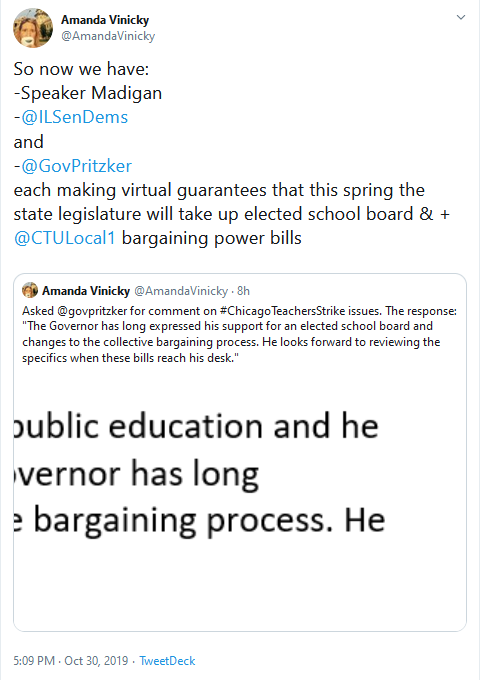
The Big Three—Governor Pritzker, the Democrats in the Legislature and House Speaker Madigan— have agreed to restore a democratically elected board to replace mayoral control and to restore full collective bargaining rights so Chicago is on the same footing as other districts in Illinois.
Now we wait to see how long it will take to assure that the students do not lose instructional time.
The Chicago Teachers Union posted the following message from its legendary leader and president emerita, Karen Lewis:
|
||||||||||


Jitu Brown is a son of Chicago. He is National director of the Journey for Justice Alliance, which has affiliates in 30 cities, where they work for social justice.
Jitu was the driving force behind the community effort to save Dyett High school in Chicago, the last open admission high school in Bronzeville. Mayor Rahm Emanuel had decided to close Dyett, and Jitu organized a campaign to save Dyett. He led a 34-day hunger strike, and eventually Rahm gave up and instead of closing Dyett, he invested $16 million into renovating it as a school for the arts.
Listen to Jitu here, where he is videotaped by videographer Bob Greenberg. Greenberg has created an archive of hundreds of interviews with educators. He is a retired teacher.
In this video, Jitu Brown describes the two teachers who had a profound impact on him and helped him discover his strengths.
In this video, Jitu Brown recites Claude Mckay’s “If We Must Die.”
Jitu belongs on the Honor Roll of this blog.
Jitu Brown is a hero of the Resistance. He is also a member of the board of the Network for Public Education.
He is featured in my new book SLAYING GOLIATH.
|
||||||
From the Chicago Teachers Union:
For ten months we had absolutely no progress on key proposals. After only two strike days, we have seen considerable movement and crucial openings on issues such as homeless students, class sizes, staffing and other key issues that the mayor told us would not be open for bargaining. Today, we got a tentative agreement for specific staff positions to support Students in Temporary Living Situations (students who qualify as homeless). For Pre-Kindergarten classes, we won contractual guarantees that CPS will follow Illinois law in maintaining a ratio of 1 adult for every 10 students in a Pre-K classroom. We also won guaranteed naps for preschoolers in all-day pre-K programs. We won language that counselors will not be pulled from counseling to do other duties such as substitute teaching in a classroom. This will lead to greater counselor access for our students.
We also brought CPS a new counter-offer on class size, today. We need guaranteed caps on class sizes and we continue to fight for them. There are still many open issues, including prep time and steps for veteran teachers, as well as a raise capable of moving our lowest-paid paraprofessionals above poverty wages.
Our gains have only been possible thanks to the strength of our picket lines, the turnout at our afternoon protests and the support we’ve gotten from students, parents and community members. Keep it up!
Pickets Monday at 6:30am
Although we made progress over the weekend on important issues, this strike will need to continue Monday. Like Thursday and Friday, all CTU members are directed to picket at their schools, starting at 6:30 a.m. Although different schools have different start times, it’s important that our union operate as one. Keep talking to parents, students and community members about what we’re fighting for. Despite the expected rain, we need to keep up our strength to win what’s best for our schools and our students. Dress for rain, bring umbrellas and boots. Take turns coming inside. But keep those picket lines strong from 6:30 to 10:30!
Regional unity marches
In a number of neighborhoods, educators at schools near one another are coming together for particular actions tomorrow.
Southwest Side
CTU strikers will line Pulaski from Archer to 111th from 8:00am to 9:00am. Contact Organizing@ctulocal1.org for more information.
Hyde Park
Hyde Park “Nurse in Every School” Solidarity March for Justice
CTU, SEIU, National Nurses United and Graduate Students United at University of Chicago are combining forces to put muscle behind our call for adequate and equitable nurse staffing. Marches will start at area schools between 8:45 and 9:00 am and converge on Kenwood Academy at 9:45am.
You can email Michael Shea of Kenwood Academy for more information and coordination.
North Side
March at 2:00pm at Union Park
Our afternoon rallies have been incredibly effective in demonstrating our unity and the sheer scale of what we are fighting for. Keep coming!
Monday, we will march from Union Park, at the corner of Washington and Ogden. The location is accessible from the Green Line Ashland stop and by bus (Ashland, Ogden, etc.).
Afternoon Allied Actions
Raise Chicago Coalition
Youth will hold an action at City Hall at 1:00 p.m. to highlight the need for $15 per hour minimum wage AND the need for a fair contract that enshrines the resources schools need to combat things like overcrowded classrooms and housing issues.
Resist, Reimagine, Rebuild Coalition
The R3 coalition will host a Teach-In for Strikers so that they may learn about community based struggles that support and intersect with teachers demands for education justice. It will be held at Experimental Station (6100 S Blackstone) from 12:00 to 3:00 pm.
Art Build
The Grassroots Collaborative will be setting up an art build at the CTU Center Monday night from 5:00 to 8:00 pm to create signs and props for colorful and impactful actions later this week.

Image adapted by Jesus Sanchez of Social Justice HS from Are You Ready to Play Outside? by Mo Willems.


