Archives for category: Charter Schools

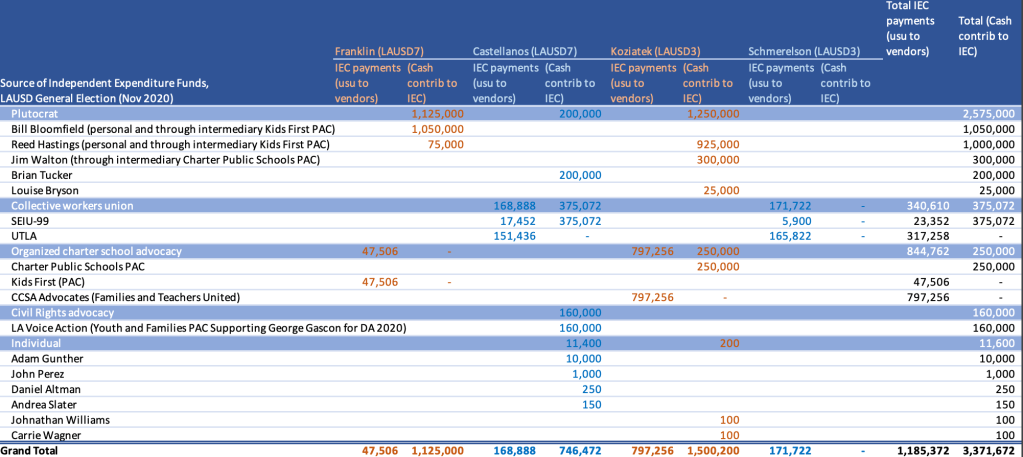
Once again, control of the Los Angeles Unified School Distict school board is up for grabs, and once again the billionaires hope to buy control so they can expand the number of charter schools. The latest financial disclosures show that Reed Hastings of Netflix has contributed $925,000 to try to defeat veteran educator Scott Schmerelson. Billionaire Jim Walton of the Walmart family added another $300,000. The charter lobby is flush with money to buy TV ads and flyers that smear Schmerelson and use vicious anti-Semitic tropes in their attack ads. The charter lobby is angry at Schmerelson for two reasons: 1. He fights fearlessly for the 80% of students in public schools. 2. He released the explosive fact that 80% of Los Angeles’ charter schools have vacancies, not waiting lists. His opponent Marilyn Koziatek has no experience in the public schools; she holds an administrative job in a charter school.

Download the .pdf here.

Note: Sara Roos of Los Angeles (blogger Red Queen in LA) prepared the graph of political expenditures based on public records.

Dr. Jennifer McCormick, state superintendent of education in Indiana, is a hero of public education. She has steadfastly sided with public schools and defied her own party’s embrace of charters and vouchers.

Blogger Steve Hinnefeld reports that Superintendent McCormick has endorsed Democratic candidates who support public schools instead of members of her own party aligned with the Mitch Daniels-Mike Pence privatization agenda.

Hinnefeld writes:

There was a time when Indiana Republicans supported public schools; at least, they supported their local public schools. The shift came in 2011, when Gov. Mitch Daniels got the GOP-controlled legislature to adopt school vouchers and expand charter schools. Today, many Hoosier Republicans have come very close to embracing the late economist Milton Friedman’s vision of a “universal” voucher program of unrestricted state support for private schools.

But McCormick, former superintendent of Indiana’s Yorktown school district, has been an outspoken advocate for public schools. Every time she spoke out for public school districts, you could see Republicans edging further away. When she announced in 2018 that she wouldn’t seek re-election, she implied that she was being elbowed aside. Legislators promptly changed the law so Indiana’s governor will appoint the state’s next chief education officer, starting in 2021.

Yes, support for public schools used to be bipartisan. Indiana has a long tradition of valuing public schools. But party leaders followed the Pied Piper, Milton Friedman, and determined to promote private school choice while defunding the public schools that enroll the vast majority of the state’s children.

Meanwhile, Hinnefeld writes, McCormick has endorsed Democrats because they, like her, believe in the importance of public schools.

I hereby add Jennifer McCormick to the Honor Roll of the blog, for her principled support of public schools and the common good and for her uncommon courage.

Betsy DeVos lost the biggest fight of her tenure as Secretary of Education. Federal judges consistently rejected her legally binding rule requiring states to give private schools a share of the $13 billion Congress allocated for public schools and for needy students in private schools. DeVos wanted private schools to get a share of the federal money without regard to the need of their students. The judges said no.

After fighting for her position, DeVos admitted defeat and decided not to appeal the court decisions.

Some states have already given federal funds to private schools, using DeVos’ formula, and it is not clear whether that money will be clawed back.

Charter schools also received a share of the $13 billion in CARES funds, which they qualified for as “public schools.” Many charter and private schools also applied for and received millions of dollars from the Paycheck Protection Program (public schools were not eligible for PPP). A study by Good Jobs Inc. determined that charter and private schools obtained SIX TIMES as much federal relief money as public schools.

In this brief video, Dr. Leslie Fenwick, former dean of the College of Education at Howard University, explains why the “schemes” of corporate reformers always fail. She doesn’t hold back about charters, vouchers, Broad superintendents, and Teach for America.

The video is part of a series of hundreds of interviews of educators, conducted by former teacher Bob Greenberg. He calls his series the Brainwaves Video Anthology. After you watch Dr. Fenwick’s wonderful interview, you should browse his collection. It’s very impressive.

Jan Resseger describes a grassroots effort to stave off the persistent assaults on public schools by the Republican-controlled legislature and state officials. Ohio has a large and low-performing charter sector, as well as a well-funded voucher sector that has produced no gains for students.

The privatization movement has harmed the public schools that most students attend without providing better schools. While the nation has struggled to survive the pandemic, Ohio’s legislators have remained focused on expanding their failed choice plans.

Resseger describes the work of the Northeast Ohio Friends of PublicEducation and their decision to create a website to educate the public.

Resseger writes:

In this leaderless situation with schools struggling everywhere, no matter their efforts to prepare, questions of policy have just sort of faded away—except that the privatizers are doggedly trying to co-opt the chaos in every way they can. In Ohio, the Legislature has taken advantage of the time while the public is distracted by COVID-19 to explode the number of EdChoice vouchers for private schools at the expense of public school district budgets, to neglect to address the injustices of our state’s punitive, autocratic state takeovers of the public schools in Youngstown, Lorain and East Cleveland, and to put off for over a year discussion of a proposed plan to fix a state school funding formula so broken that 503 of the state’s 610 school districts (80 percent) have fallen off a grossly under-funded old formula.

In recent years, most Ohio school districts have been getting exactly as much state funding as they got last year and the year before that and the year before that even if their overall enrollment has increased, the number poor children has risen, or the number of special education students has grown. And all this got even worse under the current two-year state budget, in which school funding was simply frozen for every school district at the amount allocated in fiscal year 2019. That is until this past June, when, due to the revenue shortage caused by the coronavirus pandemic, the Governor cut an additional $330 million from the money already budgeted for public schools in the fiscal year that ended June 30, thus forcing school districts to reduce their own budgets below what they had been promised. With much hoopla in the spring of 2019, the new Cupp-Patterson school funding plan was proposed. A year ago, however, research indicated (see here and here) that—partly thanks to the past decade of tax cuts in Ohio and partly due to problems in the new distribution formula itself—the new school funding proposal failed to help the state’s poorest schools districts. The analysis said that a lot of work would be required to make the plan equitable. New hearings are planned this fall, but nobody has yet reported on whether or how the Cupp-Patterson Plan has been readjusted.

In this context, discussions in the Northeast Ohio Friends of Public Education focused on our need to help ourselves and the citizens in our school districts find our way. What are the big issues? What information will help us explore and advocate effectively for policies that will ensure our schools are funded adequately and that funding is distributed equitably? In Ohio, how can we effectively push the Legislature to collect enough revenue to be able to fund the state’s 610 school districts without dumping the entire burden onto local school districts passing voted property tax levies? How can we help stop what feels like a privatization juggernaut in the Ohio Legislature? And how can federal policy be made to invest in and help the nation’s most vulnerable public schools?

The idea of a website emerged, with the idea of highlighting four core principles—with a cache of information in each section: Why Public Schools? Why More School Funding? Why Not Privatization? and Why Educational Equity? Although we have noticed that much public school advocacy these days emphasizes what public school supporters are against, we decided to frame our website instead about what we stand for as “friends of public education” even though our opposition to charter schools and private school tuition vouchers is evident in our website.

Educating the public is a crucial step in reclaiming the narrative from entrepreneurs, libertarians, and cultural vandals.

Some charter schools are like day lilies–they open, they close. Charter advocates say that their instability is a feature, not a bug. They decry the public schools that serve families for generations. Better to have market forces at work. Then you get a situation like the one in Fort Myers, Florida.

The Lee County school board yanked the authorization from the Collegiate Charter School after district staff found serious disorder: overflowing trash bins, kids walking around unsupervised, and only two teachers running the whole operation. District staff said they didn’t know who was working in the school. When staff visited the school, they found two teachers responsible for three classrooms. How do you do that? One teacher responded that she stands between the two classes. This is apparently innovative teaching, but the school board didn’t think so.

The charter was approved last April, even though it did not yet have a facility. That’s what the law says. Just approve the charter and see what happens.

Choice advocates always said that parents know best. Why would parents put their children into a school that is understaffed and chaotic?

The Harvard Program on Education Policy and Governance is led by Professor Paul Peterson, an advocate for school choice. It would not be off the mark to say that PEPG exists to promote the DeVos agenda. Soon after she was confirmed, PEPG invited her to speak, and her speech was disrupted by Harvard students not affiliated with PEPG. Peterson has been the mentor for a generation of pro-school choice academics, including Jay Greene (University of Arkansas, Department of Education Reform), Patrick Wolf (same, also served as “independent evaluator” of Milwaukee and DC voucher prigrams), and Martin West (Harvard Graduate School of Education). Peterson recently appeared at the White House to support Trump’s call to reopen schools and co-wrote an oped with Dr. Scott Atlas (both are senior fellows at the rightwing Hoover Institution). Dr. Atlas supports Trump’s views that mask-wearing should not be mandatory, that children and adolescents don’t get the virus, th ast schools should reopen without delay, and that lockdowns are unnecessary. In many articles about Dr. Atlas, Peterson is his reliable defender.

The event today asks whether teachers unions can be part of the solution. Michelle Rhee and George Parker. Parker was head of the Washington Teachers Union when Rhee was chancellor. When he stepped down, he went to work for Rhee. He now works for a charter school lobbying group. More than 90% of charters are non-union.

Fall 2020 Colloquium Series: Can Teachers Unions Be Part of the Solution?

The PEPG Colloquium series continues Thursday, Sept. 24, with “Can Teachers Unions Be Part of the Solution?,” a talk by Michelle Rhee, Founder and CEO, StudentsFirst, former Chancellor for District of Columbia Public Schools, and George Parker, Senior Advisor, National Alliance for Public Charter Schools, former President, District of Columbia Teachers Union.

Thursday, Sept. 24
12-1:15 p.m.
Register to attend the Zoom webinar

Thomas Ultican, retired teacher of physics and advanced mathematics, has been researching the tentacles of the Destroy Public Education movement in various cities.

In this post, he reviews the plutocrats’ lavish spending in California. It’s tapered of since 2018, he writes, but it’s still enough to outspend and overwhelm citizens who want to have a role in choosing their local school board.

The biggest battle in the state this year is the competition to control the board of the Los Angeles Unified School district. Ultican gives a succinct overview of the candidates, then examines the spending of the plutocrats.

The issue in L.A., again, is whether the plutocrats will win control so they can expand the charter sector or whether advocates of public education will overcome the money spent by the plutocrats and limit privatization.

You have read here that the Texas State Board of Education approved five charter chains to grow in the Lone Star State and nixed three chains. One of those approved is a Gulen charter chain that was rejected in Alabama and Nevada.

Another of those that were approved is the Learn4Life chain, a California-based chain of more than 60 charter schools.

Learn more about Learn4Life here.

Will Huntsberry wrote in the Voice of San Diego about Learn4Life last year. Its a sweet deal for its leaders, not so much for its students.

John Helgeson, a charter school executive, has a great deal for a public servant.

In 2007, he helped found Charter School Capital, a for-profit Oregon company that loans money to charter schools and buys school properties. In May 2015, he also started making $300,000 a year as an executive vice president at Learn4Life, a nonprofit network of more than 60 charter schools that serves roughly 45,000 students in California.

Charter School Capital lends money to Learn4Life schools and pockets the interest. While working at Learn4Life – which is funded almost entirely by California taxpayers – Helgeson maintained an ownership stake in Charter School Capital. In doing so, Helgeson discovered a way to collect not just one, but two paychecks from California’s cash-strapped public school system.

Learn4Life, which operates nine San Diego locations, serves a unique group of students. Many are at-risk and have dropped or failed out of traditional high schools. The schools are publicly funded and often located in strip-mall storefronts. Students usually come in to meet with a teacher once or twice a week and complete work packets.

Since 2014, Charter School Capital has loaned more than $6 million to two Learn4Life schools in San Diego alone. A charter school borrowing money from a for-profit lender is normal enough. To have a key employee who profits from both is not.

Just two months after Helgeson came on board at Learn4Life, the company increased its business with Charter School Capital. Charter School Capital purchased the 100,000 square-foot corporate headquarters of Learn4Life in July 2015 – making Charter School Capital the landlord of Learn4Life. Now Charter School Capital wasn’t just profiting on its loans to Learn4Life. It was also profiting on a lease. And so was Helgeson.

“It sounds like a classic conflict of interest, where someone is serving two masters,” said Jessica Levinson, former president of the Los Angeles Ethics Commission and a professor at Loyola Law School.

Carol Burris wrote about Learn4Life in her comprehensive report Charters and Consequences. Its schools have enormous dropout rates and very low graduation rates. By traditional indicators, they would be considered failing schools. Some have graduation rates as low as 0%, though 10-20% is more typical.

The Texas State Board of Education has very low standards for charter schools. How can it set standards for students and teachers when its standards for charters are so rockbottom?

Michael Kohlhaas, a super investigator of public records in California, discovered that 22 charter schools in Los Angeles were rated “low performing” this year. If they get the same rating for a second year in a row, they must close, under the terms of the recently passed charter accountability law, AB 1505.

Among the low-performing schools are a couple of KIPPS, some Ref Rodriguez charters, and other highly touted but low performing schools.

Thomas Sowell at the Stanford’s Hoover Institution pointed to NYC’s high-scoring, high-attrition Success Avademy as his evidence for the miracle of charter schools. Los Angeles is not far from Palo Alto. Why didn’t he look there?