Archives for category: Charter Schools

Pasi Sahlberg, the great Finnish educator, was in Birmingham, Alabama, last night, where he patiently explained how to make schools great. There is a summary of his advice here.

Thursday night (tomorrow), he will speak at Wellesley College at Alumnae Hall at 7:30 pm.

He will be introduced by Howard Gardner.

I will be there too because I endowed the lecture series to make sure there was one great campus that sought out the best minds in education and presented them each year in a public event. The series is called the Diane Silvers Ravitch 1960 Lecture on Education and the Common Good.

Come early, as parking will be limited. Chelsea Clinton is conducting a rally for her mother (class of 1969) from 3-5. I wish she would stay to hear Pasi’s lecture. She would learn a lot.

There will be a vote this weekend by the Board of the NAACP on whether it will sustain the general assembly vote for the Moratorium on Charters. The charter lobby is on fire contacting them. I am seeing calls to action on their Association sites. Please post everywhere.

Call these two numbers and express your support for a moratorium on charter schools

Hollywood Bureau
Los Angeles, CA
Phone: (323) 938-5268
Fax: (323) 938-8153

Washington Bureau
1156 15th Street, NW Suite 915
Washington, DC 20005
Phone: (202) 463-2940
Fax: (202) 463-2953
washingtonbureau@naacpnet.org

Since the Reagan era, Republicans have touted the virtues of individual choice. The idea was appealing but ignored the fact that none of us lives alone on an island. We form communities and societies to solve problems and create possibilities that none of us can do alone. We collaborate for our common well-being and safety.

Unfortunately, the Democratic Party decided to co-opt the language of Republicans in the crucial area of education. Whereas once Democrats championed equity and support for teacher professionalism, the Obama administration joined in the chorus seeking school choice instead of better public schools for all and belittled our nation’s career educators. So for the past 15 years, we have had a Bush-Obama agenda of testing, accountability, school choice and competition. This agenda has done incredible damage to children, teachers, and public schools. Arthur Camins writes that it also hurts our democracy.

In this post, Arthur Camins explains why individual choice undermines democracy. Camins is Director of the Center for Innovation in Engineering and Science Education at Stevens Institute of Technology.

Camins writes:

“In an 1857 speech, Fredrick Douglass offered this advice: Let me give you a word of the philosophy of reform. The whole history of the progress of human liberty shows that all concessions yet made to her august claims have been born of earnest struggle. […] If there is no struggle there is no progress. Those who profess to favor freedom and yet deprecate agitation are men who want crops without plowing up the ground; they want rain without thunder and lightning. They want the ocean without the awful roar of its many waters.

“Douglass called for a struggle for a democracy in which the disempowered are the active agents and shapers of their own destiny.

“Donald Trump and promoters of unelected school boards would have us acquiesce to a contrary subservient vision. How dare I equate Trump’s racist, xenophobic, misogynistic, authoritarian appeal with charter-school advocates who wrap themselves in the mantle of civil rights? Well, I am not equating, but I am asserting that they share a dangerous dismissal of the vitalness of democracy.

“Trump wears his disdain for democracy proudly on his sleeve. I am your voice… No one knows the system better than me, which is why I alone can fix it. Trump’s message is that the solution to persistent problems is not democracy or for people to join with one another in a struggle for a better life, but rather to trust him.

“Advocates for privately governed, but publicly funded, charter schools are more circumspect. To justify abandonment of democracy, they point to the dysfunction of elected school boards. Netflix’s billionaire CEO Reed Hastings, a charter school cheerleader, argued that instability due to turnover in elected school boards makes long-term planning difficult. Similarly, in one post the Fordham Foundation asserted, “When it comes to school boards, what matters most is the character of those who serve — not how they were selected.” Whatever it takes to get the job done assertions have a practical and utilitarian patina, but are profoundly anti-democratic as its apostles typically eschew the inconvenience of dissent and challenge. History is replete with examples of the slippery slope that begin with constrained restrictions of inconvenient democracy in the name of addressing real or trumped up threats but end with more generalized despotism. The solution to the necessary messiness of contentious democracy is never its avoidance in the name of expediency.

“In contrast to Douglass’s call for struggle, Trump, and advocates for privately governed charter schools share a let others solve your problems for you philosophy. Many share something else. They are- or claim to be- billionaires. The already empowered stake their claims to legitimacy on convincing “the less fortunate” that despite vast differences in wealth, power, and life circumstances, they should trust the judgment of their self-appointed defenders rather than one another. One such disingenuous pitch is that poor folks should have the same school choices as the wealthy. The cynical messages are: Give up on struggle for equity across your racial differences. Give up on democratically governed schools. Improvement depends on being out for yourself, just like us.”

There is more. Please read it.

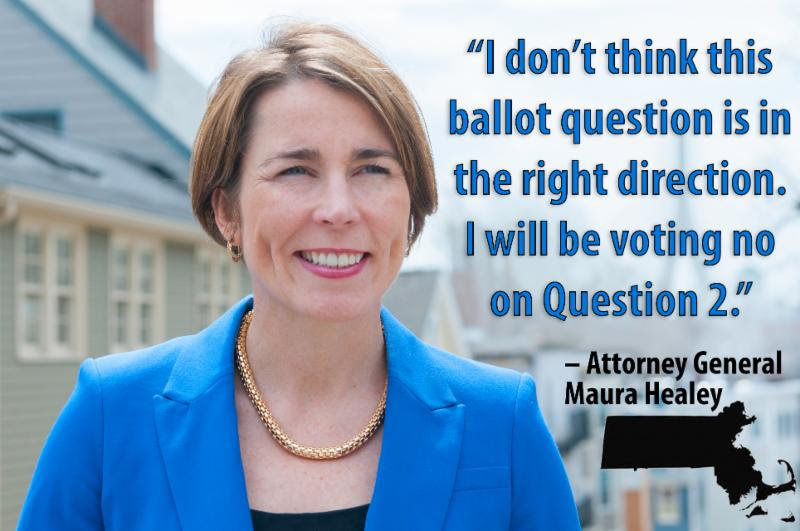
Maura Healey, the Attorney General of Massachusetts, has come out in opposition to Question 2, which would lift the cap on charter schools. Another dozen charter schools would be authorized every year indefinitely. Out-of-State billionaires, including the Waltons of Arkansas, have contributed millions of dollars to privatize public schools in Massachusetts.

I received this email the other day:

cps1

We Have the People, They Have (more and more dark) $$! 

cps2

Dear Diane,
And what excellent people we have! People like youand Attorney General Maura Healey, who has joined Senator Elizabeth Warren and the ever growing movement to protect public education for ALL students.
“If you say the money follows the student and then you don’t actually reimburse the district – then that’s a problem.” – Attorney General Maura Healey
cps3
And in other encouraging news, the Boston and Newton School Committees passed No on 2 resolutions this week, and our total has reached more than164 school committees statewide, including urban and suburban districts.
It’s time to stand up to the out-of-state billionaires and show them what a real grassroots campaign looks like, because when we fight, we win!
There have been countless great commentaries and letters to the editor from our No on 2 grassroots, but I wanted to highlight this commentary by Boston University Professor of Social Studies Education Christopher Martell. Clickhere to read his five thoughtful and clearly presented reasons to vote no.
And don’t miss EduShyster on this week’s big court ruling for keeping the cap and against the folks who argued that lifting the cap is a civil rights issue.
We have victory in our sights thanks to the hard work of people like you, people out knocking on doors, making calls and talking to everyone you know!
Sign up for a canvass shift this Saturday, Oct. 8 near you:
Boston – 10:00 AM
Almont Park
40 Almont St.
Mattapan
Brighton – 3:00 PM
Ronan’s Deli
243 Faneuil St.
Brookline – 1:00 PM
Also Sunday, 11:30 AM
Dunkin’ Donuts
1955 Beacon St., Cleveland Circle
Fall River – 10:30 AM
Fall River Educators Association
178 4th St.
Haverhill – 3:00 PM
Haverhill High School
Parking Lot A
Lowell – 4:00 PM
Riley School
115 Douglas Rd.
Northampton – 10:30 AM
Potpourri Plaza
243 King St.
Norwood – 2:00 PM
Norwood High School
Pittsfield – 2:00 PM
188 East St.
Quincy – 9:30 AM
MTA Office
Worcester – 3:00 PM
16 Alden St.
Click here to see a full list of all neighborhood canvasses. Question 2 is bad for our schools, and it’s time we stand up united to vote NO.
To get in touch with the Save Our Public Schools campaign and learn how to plug in to this important movement, click here.
Best,
Lisa Guisbond and Ann O’Halloran
CPS Executive Director and President
P.S. Click HERE to help CPS continue to inform the public on education issues, including charter schools, high-stakes testing and full funding of our public schools. 

Tracy Novick lives in Worcester, Massachusetts, a small city that was hit hard by de-industrialization.

In this article, she explains that the Wall Street backers of Question 2, which would lift the cap on charters, are pitching their propaganda at affluent white liberals. Their slick ad campaign is aimed at white guilt. They say “vote yes for the sake of poor black and brown children.” They pretend that there is plenty of money for two separate systems of schools. There isn’t.

Voting yes, she writes, will inflict “savage inequalities” (Jonathan Kozol”s book title) on public schools across the state, but not in the affluent suburbs, which are not dependent on state aid. They can assuage white guilt, but everyone else will suffer, not their children, not their schools.

She writes:

“Recently, those pushing for cap lift have been piling on the suburban guilt. It was all over the column I referenced yesterday; it was a big part of the Newton School Committee public testimony last night. Some of this is about wealth, a lot of this is about race, but it is all intended to make those who have a lot feel badly about those who don’t and vote for cap lift to make themselves feel better.

“As a parent in one of those urban communities, I am telling you: spare us.

“I am a parent in a community in which the vast majority of our school funding comes from the state. Worcester is unable to fund its schools on its own. Under McDuffy, Worcester, along with Springfield, Fall River, Lowell, and many of the other urban districts, is majority state funded.

“That isn’t true of most of the places the cap lifters are trying to send on a guilt trip. Most suburbs get a minimum 15% of their foundation budget in state aid. They are majority local funded.
And most fund well over the minimum requirement.

“As I’ve said numerous times, to some extent, this is actually required: the foundation budget hasn’t been reconsidered for twenty years, and the districts that can make up the gaps themselves are doing so.

“Many districts cannot.

“This includes mine.

“Should the ballot cap lift pass, and the state suddenly be faced with funding the reimbursements of up to 12 new schools a year, every year, something is going to have to give. There is no plan in the ballot question for dealing with the funding, and there is nothing in the plan to change reimbursement or any other funding rates.

“It will start, of course, with continuing to not fully fund reimbursements. As the number of schools, and reimbursements, and facilities fees get larger and larger, the state’s going to have to look at state education aid.

“When that happens, it isn’t going to be Newton, funded in FY16 at 165% of foundation, or Cambridge, funded in FY16 at 227% of foundation, or–pick a W: Weston? 208% Wellesley? 165%–that get hit.
Will it hurt them if they lose their state aid? Yes.
Will it devastate their budgets? No.

“Worcester and its peer communities have no such local resources, though. Thus their district public school children–which are the vast majority of schoolchildren in those districts–will be those hurt.

“If you start to feel guilty about other people’s children in “those” districts, think about this:

“Keep in mind where most of them go to school.
Remember how those schools are funded.
Remember who will really be hurt by a cap lift.
And vote no on question two.”

UPDATE: Marc Kenen, the executive director of the Massachusetts Charter School Association and also the author of ballot Question 2, which would expand the number of charter schools in the state, has written to say that this post is untrue. I have no way of knowing who “Nat Morton” is since he or she will not reveal his/her identity. “Nat Morton” is a passionate advocate for charter schools who posted comments here frequently. If Marc Kenen is not “Nat Morton,” I apologize. Someone writes a blog and calls him/herself “Nat Morton,” and I implore that person to give their true name so readers can judge their credentials and their authenticity. I will also ask Marc Kenen to stop writing insulting comments to this blog, as such comments are not permitted.

Knowing this background: I leave the original post intact but warn readers that the identity of “Nat Morton” is unknown, and I can’t be certain who he/she is, other than that it is not me. Beyond that, I can’t know until “Nat Morton” removes his/her mask.

The original post began here:

Reader Christine Langhoff in Massachusetts sent the following comment about a blogger who has frequently written on this blog to defend charter schools, support Question 2 to permit more of them, and to flout his superior research abilities.

“A Boston parent, exchanging emails with (G)Nat Morton, received a digital file from Gnat in support of his arguments. But he forgot to use his nom de plume, and revealed himself as Marc Kenen, executive Director of the MA Charter School Association and also the author of ballot Question 2.

“http://www.masscharterschools.org/about-us/staff

“Kenen has not denied that Nat Morton is his avatar. Further, Stephen B. Ronan is the only person I have ever seen refer to Nat Morton’s blog, and in any forum where the one appears,the other is apt to chime in. This leads me to conclude that Kenen is Gnat is Ronan.

“I find it difficult to enage seriously with someone who would defund our excellent public schools when he is not even willing to own his perspective publicly by using his own name as he advances the cause of the privatizers. And if there’s any question whether the ballot question is designed to defund our schools, it’s worth noting that Boston City Councilor Tito Jackson made this point in the Askwith Forum at Harvard on Sept. 27 regarding Question 2. He asked Kenen directly why he had not written a funding mechanism into the proposal. Start at 1:12:00 (It’s apparent in the video that Kenen bears more than a passing resemblance to his Nat Morton avatar.)

“https://youtu.be/XCsZZ-J7mcU

“https://gseweb.harvard.edu/news/16/09/more-charter-schools-massachusetts-vote-and-national-debate”

So there you have it: the leading advocate of Question 2 (more charters) pretends to be an independent researcher but is in fact a paid employee of the state charter association. Why not give your name and affiliation and let people make their own judgment? This is redolent of the charter movement itself, which pretends to be about helping poor kids but attracts funding from Wall Street, right wing politicians, and others whose real goal is privatization, not helping improve schools for all children.

Our national goal is equal educational opportunity, not a free-market of winners and losers. Privatization does not advance equal educational opportunity. It exacerbates inequality, just like any free market.

Larry Lee is one of the staunchest supporters of public schools in Alabama. A few years ago, he criss-crossed the state and identified 10 rural schools that were doing everyday miracles for their children and their communities because of the hard work and dedication of teachers, principals, and families, all doing their best for their children.

He sent me the following urgent message:

These are dark days for public education in Alabama. Since the legislature changed hands in 2010, things have gone steadily downhill.

Take a look:

* A bill to have A-F school grades, a practice intended solely to be punitive and a practice that research does not support.

* The Alabama Accountability Act that has now diverted $72 million from the Education Trust Fund for vouchers for private schools. A law that failed utterly in its stated mission to “help; poor students stuck in failing schools by their zip code.

* A bill to establish charter schools which cuts into already under-funded public schools funding.

* A bill known as the RAISE Act that would have forced teachers to be evaluated with the highly controversial Value Added Model.

* A bill intended to set up Education Savings Accounts that would have diverted more funding from the Education Trust Fund.

Instead of seeking input from professional educators, legislators are listening to the American Legislative Exchange Council (ALEC), the Jeb Bush foundations and Alabama special interests. In fact, the Senate majority leader boasted after passing the Accountability Act in 2013 that this bill was purposely hidden from educators because “they would have opposed it.”

Now, to add insult to injury the state board of education, the body that should be the first line of defense for public education, has turned its back on our children by hiring an attorney from Massachusetts to be state school superintendent. They ignored Alabama code and even their advertised required qualifications and put their own ideology and political ambitions ahead of the 740,000 children in Alabama public schools

Because of this, a group of 40 plaintiffs, including former local superintendents, principals, teachers, school board members, parents, local elected officials, a former college president and a former U.S. Congressman have joined together to seek legal action against the state school board.

They have said ENOUGH IS ENOUGH and formed the Alabama Public School Defense Fund to wage this battle.

Please join in standing up for our children by going to this site and contributing today.

https://www.gofundme.com/2t2r6mpy

—
Larry Lee
334-787-0410

http://www.larryeducation.com (blog)

Education Is Everyone’s Business

Governor Nathan Deal of Georgia is pushing a constitutional amendment to allow the state to take over low-scoring public schools. He calls it an “opportunity school district” and points to New Orleans and the Tennessee Achievement School Districts as models. He brought called together a group of African-American ministers and asked for their support.

Here is the response from one of the attendees, who knew that neither New Orleans or the Tennessee ASD had helped the neediest students. Governor Deal couldn’t answer his questions, because the ALEC model legislation doesn’t explain why cessation of democracy helps schools or what to do after privatizing the schools and giving them to corporations.

Here is the report by Rev. Chester Ellis:

Governor’s Ministers Summoning Meeting was a School Takeover Sales Pitch
By Rev. Chester Ellis 912-257-2394
Pastor of St. Paul Missionary Baptist Church in Savannah, Georgia

Governor Nathan Deal is working hard to sell the voters on what he calls an Opportunity School District. But this is an opportunity that Georgia should not take.

Recently, The Governor made a pitch to twenty-nine African American ministers in the basement of the mansion. No media was present. But I was one of those ministers.

If Amendment One was about education and opportunity for our communities and children, we could at least hold a logical discussion about evidence-based solutions. As a retired educator and community activist, it is very clear to me that his Opportunity School District is not about education or the community. He has no plan or roadmap to improve schools.

Gov. Deal was looking for our support. He stated, “I need your help.” But we left with more questions than we had answers. It truly is a takeover, and one whose extent is clear to very few voters.

I was disappointed. I thought the Governor would be able to lay out his plan in detail to us. But, what I got from the Governor is he’s making it up as he goes. There’s really no plan. At best, it was guesswork.

Bishop Marvin L. Winans, who has a charter school in Detroit, was the first to speak to us. Brother Winans is a minister and an award winning Gospel singer. He does not live in Georgia. Marvin talked about why he had established his school in Detroit and why he thought it was a good idea that the Governor was willing to do something to help failing schools. But we didn’t have a chance to dialog with him, ask questions or shed light on anything here in Georgia for him. He left for a concert, almost as quickly as he appeared!

Afterwards, the Governor followed with a spiel about why he thought he needed to take over the schools and why the Black clergymen needed to be in support of Amendment 1, The Opportunity School District. He then opened the session up for questions.

I asked him, what is the student to teacher ratio per class of all the schools on your list for takeover? He said he did not have the answer to that question.

My rationale for asking that question was that research tells us ideal pupil to teacher ratio should be 18 to 1, and the further schools and classrooms go past that recommended ratio, the more they are setting students up for failure. Districts need resources to address that problem. The A plus Act of 2000 provided such resources. In fact, this Governor has taken more resources from our public schools. The governor added that he needed to do more research on that issue, so I invited him to do that and gave him some websites he could Google.

I also asked the Governor if all of the schools that are having trouble, as defined by him, are predominately African American schools. He replied, not so much, but that when they looked at schools that were failing they looked at schools that were in a cluster. And that the ministers summoned to the meeting were invited more for being in those identified clusters of schools.

One of my colleagues asked the Governor for the specifics of his Opportunity School District plan. Deal replied that he was using different models, and two of the models he mentioned were the Louisiana Recovery School District and the Tennessee Achievement School District models. Then the question was raised about both of those state’s backing away from the models because they failed to accomplish their achievement goals. In fact indicators prove that New Orleans is worse off now The Governor replied, “We are going to look at what they did wrong, and correct their mistakes so that ours will be right. You know, we have to do something, we are willing to try this and then if it doesn’t work, we are willing to work on what doesn’t work and straighten it out.” The problem with the Governor’s logic is that he is asking the voters to change the state’s constitution. We can’t back up if the voters do that!

The Governor says OSD is a “plan in the works”. . So I urged the Governor to use Massachusetts as a model rather than one from Tennessee or Louisiana, which have both failed.

According to a recent article in Education Week, scholars at the Atlanta-based Southern Education Foundation and Philadelphia-based Research in Action organization found that some states are proposing to mimic “opportunity school district” takeover models despite evidence that prototypes of these models have gone awry. The esteemed Education Week reports that imitating these models are not an appropriate prescription for providing support for schools that needs it.

Massachusetts put their plan in place with on the ground, in the classrooms education practitioners. . Legislators met with them and applied the educator’s advice and professional know how. They set out on a course working together and didn’t change the course until they got the results they were striving for. They are now one of the celebrated and better school systems in the country. I asked the Governor, why didn’t his planners and plans look at that type of successful model?

He replied, “It’s because of demographics.” I responded that clearly Massachusetts doesn’t look like Georgia but education isn’t rocket science …..It requires an understanding of what you are working with. I also referenced just one of many of our state’s successful public school model, Woodville Thompkins High School in Savannah. I’m a graduate of that school and I have worked since 2006 with that school and the community. As a result it is an award winning school in many disciplines.

For the last two years, Woodville-Tompkins Technical and Career High School has had a 100 percent Graduation rate. They have also been cited as being one of the top 30 programs worldwide in Robotics. There is a way to turn schools around and it doesn’t require a Constitutional Amendment. I don’t see the need. It takes a little elbow grease and total involvement from parents, community and legislators to sustain evidence based solutions and models that are already working.

I don’t buy the Governor’s program or plans. He’s selling the public on a quick fix. I think the Governor has some friends who see education as a carte blanche card; something they can make money off of. It’s about the money, not about the children. The legislation doesn’t even define what a failing school is. The Governor has spent little or no time educating the public on the thirteen pages that compose all of the little devils in his plan per Senate Bill 133. He is spending lots of time though, selling his plan.

The Governor is a lame duck, yet he’s asking citizens to trust him blindly and give him all the power over their schools, public property, pocketbooks and children by changing the constitution.

I thanked the Governor for inviting me, but I told him before I left that there are too many uncertainties and too many unanswered questions to go before my congregation and say we should support this. I’m not comfortable with the Governor’s answers or his solutions. His Opportunity School District has no facts and no plans to improve schools. This is an opportunity that citizens can’t afford to take. It is all about the money. It’s just that simple.

This is a letter to a reader who frequently sends comments defending the privatization of public schools in Massachusetts. On some days, he sends 3-5 comments, filled with references to studies that support charters, insisting that charters will not take money away from public schools, even though as a practical matter, charter schools everywhere have led to budget cuts for public schools that enroll the vast majority of children. His comments are repetitive and he has taken up a lot of space on a blog that opposes privatization and opposes school choice because of the damage it does to a universal, democratically controlled system of public education. Unless you believe that scores on standardized tests are the purpose of public education and the best measure of educational quality, these “studies” are meaningless and lacking in any understanding of democracy, civic responsibility, and the common good.

For these reasons, this letter is directed to this reader.

I will not post any more of your comments about Question 2 in Massachusetts and the glories of charter schools until you answer my questions.

Why do you have so much time on your hands to defend privatization?

What is your day job?

Is anyone paying you for your constant rebuttals?

What are your credentials and your expertise?

I told you mine: 50 years a scholar of education; a Ph.D. in history of American education from Columbia University; numerous books and honorary degrees; Assistant Secretary of Education for Research in the George H.W. Bush administration; a founding member of two conservative think tanks–the Thomas B. Fordham Foundation and the Koret Task Force at the Hoover Institution, as well as a Senior Fellow at the conservative Manhattan Institute and a Senior Fellow at the centrist Brookings Institution. I was an avid proponent of charter schools for almost 15 years. Several years ago, I realized that the charter industry is now led by people who want to privatize and profit from money intended for our public schools. I saw the light. I know the arguments for charters better than you do. I used to believe them.

I have determined to devote my strength and energy, so long as I have it, to the preservation and transformation of public schools so that they offer equal opportunity for all children. Charter schools are a diversion that weaken public education. I will not allow my blog to be used as a forum for those who fight to destroy public education by diverting public funds to private schools and to those who mask their goal of privatization by stealing the language of the civil rights movement. I don’t believe that anyone should put words in the mouths of those who are not living, yet I feel certain that Dr. Martin Luther King, Jr., would never have locked arms with the Waltons, the Koch brothers, Scott Walker, Donald Trump, ALEC, hedge fund managers, Wall Street titans, and demanded privatization and defunding of public schools. Dr. King was a great supporter of the labor movement. He was murdered in Memphis fighting for the rights of sanitation workers to organize a union. He would certainly oppose the charter industry, which prides itself on being anti-union. 93% of charters are non-union and aggressively oppose efforts by teachers to form a union.

Did you notice that the World Economic Forum just named Finland the best educational school system in the world? It has no charters, no vouchers. It has a strong union that all educators belong to. It has no standardized tests until the end of high school. It focuses on creativity, the arts, physiical activity, play, and critical thinking. It has a rich curriculum taught by well-prepared teachers. No charters, no Teach for Finland. No disruption. No teacher churn. The joy of learning is paramount. Children don’t begin academic studies until the age of 7. There is a recess after every class. There is free medical care, and low poverty.

We, by contrast, ignore poverty as a given and assume that school must be harder, tests must be harder, recess must be sacrificed to rigor and grit. Joy of learning? Play? The arts? No time for that. Gets in the way of testing.

The public is waking up. No matter how many millions your friends pour into the charter industry, an aware public will not sell or give away their community public schools. The public built them with their taxes. The public wants experienced career teachers, not temps who come and go with regularity.

You can cite all the studies you want about test scores. Readers of this blog know how those scores were obtained. They know that charter schools choose the students they want and kick out the ones they don’t want. They know charters with high scores engage in intensive test prep for months. Test scores will not convince an informed public to hand over their schools to corporations and non-educators. The Waltons have wiped out large swaths of small-town America, killing mom-and-pop stores, then hiring mom and pop as low-wage greeters. The motto of the charter industry is disrupt, destroy, privatize. Disruption harms children and communities. Tell your billionaire funders: Disrupt your family and community, but don’t impose your rootlessness on others.

No thanks. We don’t want to see the Walmartization of American public schools. They are a basic democratic institution. They belong to the public, not corporations and Wall Street. Not “Families for Excellent Schools” whose own children go to such excellent schools as Exeter, Phillips Andover, Deerfield Academy, and other elite schools where tuition runs about $50,000 a year. Too bad they don’t want similar excellent schools for other people’s children. Instead, they favor “no excuses” boot camps that impose harsh discipline and focus relentlessly on test scores in math and reading, the tested subjects. I acknowledge that there are outliers, that there are charter schools that seek to improve the education of poor kids. But unfortunately, the charter industry is now led and driven by indiduals and groups that want to destroy public education. They dress their children in identical T-shirts and bus them to legislative hearings and political rallies to demand more charters, more money. Their greedy, self-serving charter leaders use the children (their “scholars”) as pawns in their quest for political power.

When charters become a potent political force, democracy suffers. Communities are divided. Legislators become consumed by charter issues, even though the charters enroll less than 10% of students. Big campaign contributions guarantee political allies, even Democrats, despite the fact that school choice has always been a beloved Republican policy, despite the fact that it promotes segregation, despite the fact that it was the rallying cry of southern segregationists after the Brown decision.

And so, dear reader, we reject your repetitive defense of school choice. We will oppose your efforts to cripple a cornerstone of our democracy. We will oppose a dual system of publicly funded schools, one open to all, the other open to a few and privately controlled.

We will fight for great public schools, democratically controlled, accountable and transparent.

We mean to keep them and make them better than ever.

Mercedes Schneider has written a book every summer for three years in a row, during her break from teaching high school English. Thomas Ultican reviews her latest book, School Choice: The End of Public Education?

The book traces school choice to libertarian economists Friedrich Hayek and Milton Friedman. Mercedes shows the centrality of school choice to the segregationist diehards in the South in the 1950s and 1960s.

There is a terrible irony in the fact that today’s advocates of school choice claim to be fighting for civil rights when they are promoting racial segregation. Dr. Martin Luther King, Jr., would not have allowed them to get away with this deceptive rhetoric.

Ultican notes that school choice has encouraged not only racial segregation, but class segregation as well. He tells this anecdote:

“Around 2003, a friend tried to convince my wife and I to send our daughter to High Tech High. This mother did not want her daughter to be exposed to all those bad influences at Mira Mesa High School. Mira Mesa High School is a quality school that graduates amazingly gifted students every year and sets them on to a course of academic and social success. But the new charter school that Bill Gates and Irwin Jacobs had put so much money into surely would not have all those feared “bad kids.””

Schneider’s book is the go-to book to understand the current vogue for vouchers and charters, as well as public ignorance of the ways that charter operators scam public funds. The most lucrative angle is in real estate; the charter operator buys the building, rents it to his charter school, charges double the going rate, and passes the bill to taxpayers.

Ultican urges you to buy the book, read it, and share it with friends.