Archives for category: Charter Schools

Democratic Senator Michael Bennett of Colorado will introduce Neil Gorsuch at his Senate confirmation hearings for the U.S. Supreme Court.

Gorsuch is from Colorado.

Bennett is one of the most fervent advocates for school privatization in Congress. Before entering the Senate (he was appointed to fill a vacancy, then was elected), he was superintendent of Denver, where he promoted high-stakes testing and charter schools. He is a DFER favorite.

Apparently, he forgot that not a single Republican senator was willing to support Merrick Garland, the highly respected federal judge nominated by Obama for the seat that Gorsuch is likely to take.

Ian Millhiser of Think Progress says of Gorsuch:

Gorsuch’s record suggests that he is to the right of the late conservative icon Justice Antonin Scalia, and possibly as far right as the most conservative member of the Supreme Court, Justice Clarence Thomas. As a judge, Gorsuch voted to limit women’s access to birth control in the Hobby Lobby case. He tried to cut off funding for Planned Parenthood in Utah. And he is likely to provide the key fifth vote to uphold voter suppression laws that skew the electorate to the right and help keep Democrats like Michael Bennet from winning elections.

Those who have followed the rightwing tilt of Democrats like Bennett are not surprised.

Count on Mercedes Schneider to review Trump’s budget proposal.

It is as bad as you heard.

She says, “At least he doesn’t call himself an ‘education president.'”

True, he is the anti-education president.

He is the first who wants to tear down public education, not improve it.

He does not want to invest in our children or our future.

He is an enemy of the people.

Tom Ultican teaches physics in San Diego after a career in the private sector. He likes evidence. He reviews the failure of various privatization schemes. Vouchers have failed to “save” children, and voucher schools are often far worse than public schools. Charters are scandal-ridden, supported too often by profit-seekers.

He writes: American Schools Rock!

Don’t be fooled.

“By the middle of the 20th century, cities and villages throughout the USA had developed an impressive educational infrastructure. With the intent of giving every child in America the opportunity for 12 years of free education, this country was the world’s only country not using high stakes testing to deny the academic path to more than a third of its students. The physical infrastructure of our public schools was of high quality and schools were staffed with well-trained experienced educators.

“This system that is the foundation – to the greatest economy in the world, the most Nobel Prize winners and democratic government – has passed the exam of life. It is clearly the best education system in the world. To diminish and undermine it is foolhardy. Arrogant greed-blinded people are trying to steal our legacy.”

The privatization steam roller continues to move through the Republican controlled states.

The Missouri House of Representatives narrowly approved a bill to expand the number of charter schools in the state. The bill now moves to the Senate.

After more than five hours of debate Wednesday and more than an hour of debate Thursday, the measure advanced to the Senate on an 83-76 vote.

Charter schools are tuition-free public schools that operate independently from elected school boards. They currently operate in St. Louis and Kansas City only; the plan would allow charter schools in places like Columbia and Springfield.

The sponsor, Rep. Rebecca Roeber, R-Lee’s Summit, touted the legislation as a way to provide students and families with more choices. The changes, she said, will bring competition to schools, triggering improvement and innovation in education.

Public education advocates warned that charter schools have not fulfilled their promises of success and innovation, but Republicans were determined to pass the bill anyway.

AASA Executive Director Responds to President Trump’s FY18 Budget Proposal

Alexandria, Va. – March 16, 2017 – Earlier today, President Trump released details for his FY18 budget proposal. It is a “skinny budget,” in that it only covers discretionary funding, and within that, doesn’t fully list the impact on all discretionary programs. The proposal cuts funding to the U.S. Education Department by $9 billion (13 percent). It provides a $1 billion increase for Title I, but the increase is for states and districts to use for portability and choice. This is in addition to a new $250 million school choice/voucher program and a $168 million increase for charters, bringing the total amount of NEW funding in the President’s budget for choice to $1.4 billion. The budget level funds IDEA, eliminates ESSA Title II Part A and eliminates the 21st Century Community Learning Centers.

In response to this budget proposal, AASA Executive Director Daniel A. Domenech released the following statement:

“AASA is deeply concerned that the first budget proposal from the new administration doesn’t prioritize investment in the key federal programs that support our nation’s public schools, which educate more than 90 percent of our nation’s students. While we would normally applaud a proposal that increases funding for Title I by $1 billion, we cannot support a proposal that prioritizes privatization and steers critical federal funding into policies and programs that are ineffective and flawed education policy. The research on vouchers and portability has consistently demonstrated that they do not improve educational opportunity and leave many students, including low-income students, student with disabilities and students in rural communities-underserved. AASA remains opposed to vouchers and will work with the administration and Congress to ensure that all entities receiving federal dollars for education faces the same transparency, reporting and accountability requirements.

“AASA is disappointed at the significant cuts proposed to critical education programs, including the Every Student Succeeds Act (ESSA) Title II. FY 18 dollars will be used by schools across the nation in just the second year of ESSA implementation, and the idea that this administration thinks that schools can do this work—and the administration claim they support this work—without supporting teachers and teacher leaders, and their professional development, is a deeply disconcerting position.

“As recently as yesterday, Secretary DeVos indicated an interest in supporting state and local education agencies, and ‘to returning power to the states whenever and wherever possible.’ AASA is concerned that while the Department indicates it wants to return power, the proposed funding levels—including continued level funding of the Individuals with Disabilities Education Act (IDEA) and cuts to core programs in ESSA—deeply undercut state and local efforts in these areas and expand the reality of federal requirements without commensurate support, further encroaching on state and local dollars. The return of power, however well intended, when systematically and deliberately paired with low funding, translates into unfunded federal requirements.

“AASA remains committed to parity between defense and non-defense discretionary (NDD) dollars, and we are deeply opposed to the proposed $54 billion increase in defense discretionary spending being offset by NDD spending cuts. AASA supports robust investment in our nation’s schools and the students they serve, and we support increased investment for both defense and NDD funding by lifting the budget caps, as set forth in the Budget Control Act of 2011, for both. NDD programs are the backbone of critical functions of government and this proposed cut will impact myriad policy areas—including medical and scientific research, job training, infrastructure, public safety and law enforcement, public health and education, among others—and programs that support our children and students.

“Increased investment in education—particularly in formula programs—is a critical step to improving education for all students and bolstering student learning, school performance and college and career readiness among our high school graduates. AASA remains hopeful that our President, who has consistently articulated an interest in growing our economy, growing jobs, and keeping this nation moving forward, will recognize the unparalleled role that education plays in each of these goals and work to improve his FY18 budget to increase investment in the key federal K12 programs that bolster and improve our nation’s public schools, the students they serve and the education to which they aspire.”

###

About AASA
AASA, The School Superintendents Association, founded in 1865, is the professional organization for more than 13,000 educational leaders in the United States and throughout the world. AASA’s mission is to support and develop effective school system leaders who are dedicated to the highest quality public education for all children. For more information, visit http://www.aasa.org.

Gary Rubinstein has a peculiar habit of insisting on integrity of reporting. He gets hot and bothered when people claim “miracle achievements” but hide the facts or distort them.

He noticed an article in USA Today that both appeared to criticize charter schools and at the same time to claim that some of them had achieved astonishing college graduation results.

The bottom line, said USA Today, was that many charter school students don’t make it through college. But, it also said, their college graduation rate is far higher than that of comparable low-income students.

Gary did an inquiry, and he learned that the writer of the article–as is typical–did not take the charters’ high attrition rates into account.

So, in the end, the article was another phony claim about the “success” of charter schools, when that “success” depends on shedding large numbers of students.

The star example: Democracy Prep in New York.

In 2006-07, it had a class of 131 students in 6th grade.

New York State has a pretty good public data system, so I investigated the numbers for Democracy Prep’s first cohort, the ones that 87.5% of their graduates are on track to graduate from college. What I found was that in 2006-2007, they had 131 6th graders. According to their testing data from that year where 127 students were tested, there were 63 girls and 64 boys tested. Also, of the 131 students, 80% were Black while 20% were Latino.

But look at their graduation class:

Six years later they had 50 12th graders. This represents just 38% of the original 131 students. Of those 50, 13 were boys and 37 were girls. So they went from 50% boys to 33% boys. Also of their 50 students, they went from 80% Black in 2006 to 66% Black in 2013.

Amazing: 87.5% finished college of those who survived. Not exactly an advertisement for the miracle of charter schools.

As Gary’s article is titled: Charter School With 38% High School Completion Rate Brags About 88% College Completion Rate In USA Today

Over the vociferous opposition of parents and educators, the Kentucky state senate voted to authorize charters in the state, thus opening it up to exploitation by entrepreneurs, out-of-state corporations, and hucksters.

The threat to public schools could not be clearer, as the state senate voted 23-15 to betray their constituents and go with the big money backing private management of charter schools that have no track record of improving student achievement.

The Republican governor Matt Bevin is a Republican free-markets ideologue, so he will of course sign the legislation.

Parents will have to continue the fight to preserve their communities and public schools from the privatization vultures.

The new charters will be required to have certified teachers, which the so-called reformers said was an intolerable burden that would prevent innovation, like having untrained teachers in the classroom. The reformers’ idea of innovation sounds amazingly like the schools of the 19th century–unregulated schools with no certified teachers.

But reformers got what they wanted: charters and money. They are looking out for adult interests, not for families, kids or communities.

The bill allows for school boards and only the mayors of Louisville and Lexington to approve charter schools in those districts or cities. Earlier in the day, the Senate Education Committee added language saying charter school teachers must be a qualified teacher and that students will not be able to go to a charter school across county lines unless a regional charter is created.

The changes also require mayors to provide written notice saying they want to be an authorizer of charters and clarified that only the mayor of Louisville would be able to authorize charter schools in Jefferson County, as opposed to mayors from the county’s smaller cities.

After passing the full Senate amid criticism from Democrats on how charter schools would be funded, Republican senators fought back and filed an amendment to an unrelated House budget bill — House Bill 471 — which seeks to transfer federal funds and state money to cover the costs of students who move to charter schools.

Sen. Ray Jones, D-Pikeville, was furious at the move, saying “this is one of the worst things I have seen happen to public education in my lifetime.”

HB520, the bill that will authorize privately managed charter schools in Kentucky, was approved by the Senate Education Committee and now will go to the full Senate for a vote. The Senate is in Republican hands. The Governor is a Republican.

The politicians in Kentucky seem poised to invite out-of-state corporations to come into Kentucky and take charge of public money and taxpayer dollars.

The governor says in the linked article that the people fighting charters are only out for adult interests. He has it backwards. The people fighting charters are parents and educators. The ones who want charters have dollar signs in their eyes, thinking about how they can get a piece of Kentucky’s public school budget.

Kentucky is one of only 7 states that do not yet have charters, which is the gateway drug to full privatization of public education. Republicans in Kentucky don’t want to be different. They want to be just like everyone else, even though there is no evidence that bringing in entrepreneurs and fast-buck chuck operators will mean better education for the neediest kids. If charters in Kentucky operate the way they do in most states, they will keep out the neediest kids and hang on to the ones that make them look good.

Public school parents: Wake up and vote these guys out of office when they run again. They don’t care about you or your children or your community. They are bowing down to the almighty dollar of the Waltons and the other billionaires who want to wipe out local control and democratically elected school boards.

Jeanne Allen of the Center for Education Reform posted a photograph in which leaders of charter schools met with their new champion: Secretary Betsy DeVos. She was joined by charter leaders from D.C., Philadelphia, New York, and California. The Ohio charter leader didn’t make it because of the snow. There were also leaders from the for-profit sector, including the virtual charter sector.

Betsy DeVos is one of them. Their hero now is in charge of the U.S. Department of Education, and she wants to divert billions of dollars from children in public schools to feed the charter industry. O happy day!

The charter industry and DeVos are on the same page. They hope to make enormous gains during her tenure in office. They see the public schools not as a public good or a civic institution, but as a target, a prize to be conquered, defeated, looted, and depleted. But it’s all for the kids!

Angie Sullivan teaches first- and second-grade students in a Title 1 school in Carson County, Nevada. She sends her email reports to legislators and journalists. She is the conscience of Nevada.

She writes:


Attached is a report I put together in an attempt to review what data I could find on Nevada Connections Academy.

I did include some research on the parent corporation also for background which may or may not give you insight into the Nevada Connections Academy.

Opened in 2007 – Nevada Connections has never been successful.

Ten years later the Nevada Charter Authority is attempting to shut down this charter because of poor graduation rates.

Ten years.

I have been studying this information for months and have yet to see any accountability by Nevada Charters. Claims that they can be closed are not backed by real evidence. Nevada Charters close due to bankruptcy and fraud. They do not close due to severe and consistent academic under-performance.

As you review the data – you will notice that in most years and most grade levels half or more of the students are failing.

Graduation rates have been abysmal.

If I am reading the hard to understand reports correctly, in 2016 Nevada most likely paid $6,000 X 2400 = $14,400,000 to Nevada Connections Academy for High School Seniors and 40% or 914 graduated.

Total enrollment in Nevada Connections Academy was report at 2,851. Overall the Nevada Tax Payer spend $17,106,000 for less than half its students to be proficient.

The school also has a swinging door with half its students turning over. Due to lack of regulation and oversight – plus the “missing” students every year at testing time – I have to ask if the Nevada Tax Payer is paying for students not even in the program any longer.
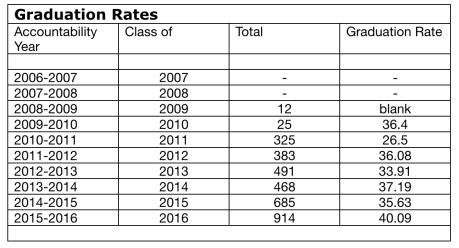
nevada graph

Understandably parents and students do not want their charter school to close.

Parent and students do not want my public school to close either. Yet, I am held accountable. My school can be turned around or taken over by the Achievement School District. This failing charter has been doing poorly for 10 years and what has happened?

Nothing.

Parent and students base their “choice” of school on things other than standardized testing and numbers. I understand this very well. And they will protest if this school is closed. However, I am using this an example which is fairly similar to half of Nevada’s Charters which are on the lowest performing list.

Half of Nevada’s charters are on the lowest performing list. The worst graduation rates in the state are in the State Public Charter School System.

This charter is one of many in Nevada not doing well.

Half of Nevada’s charters are on the lowest performing list.

Parents need access to charter information at the same level public schools are required to give information to parents. In an annual report published on-line. Charters which spend on marketing to produce enrollment numbers need to be giving their data and graduation rate information to student prior to enrollment. No one should have to dig around in the Nevada Report Card for a month to try to determine if a school is academically achieving. If these charters are actually serving students not expected to graduate – if they are alternative schools – they should tell parents up-front the likelihood of graduating from these schools.

Charters need to be audited. Public schools have the SAGE Commission. Charters should have a similiar body which looks at return on investment and other financial measures.

I just attempted to watch an audit or something like an audit on-line from the charter authority.

https://manage.lifesizecloud.com/#/publicvideo/975a6334-1f01-4734-9678-cc6042d30f29?vcpubtoken=2021a45f-3957-40df-97a4-8cc8d9196bdb

Besides cheerleading for charters – I’m not sure the audit produced much information. It certainly did not expose anything I have discovered in the last few months. Watch the video for yourself and ask yourself if the Nevada Charter Authority is able to hold any of Nevada’s Charters accountable with the information presented.

Due process is the reason charters are not closing?

Perhaps there is simply zero political appetite to close a perpetually failing charter?

While charters may protest accountability in the name of freedom and choice. . . this needs to be balanced by accountability to the tax payer who pays the bills.

It is not fair to have a strict accountability system for public systems while charters are allowed to run amuck in the state of Nevada.

The unfairness of a legislated system that turns public schools into charters but does nothing about all the failing charters spending million in tax payer money in the state – is foul.

The Nevada Charter System is a failing school system in the state. That is clear according the data.

If Nevada Connections cannot be closed after 10 years of failure, which charter will ever be held accountable?

Angie

See the whole report here.